
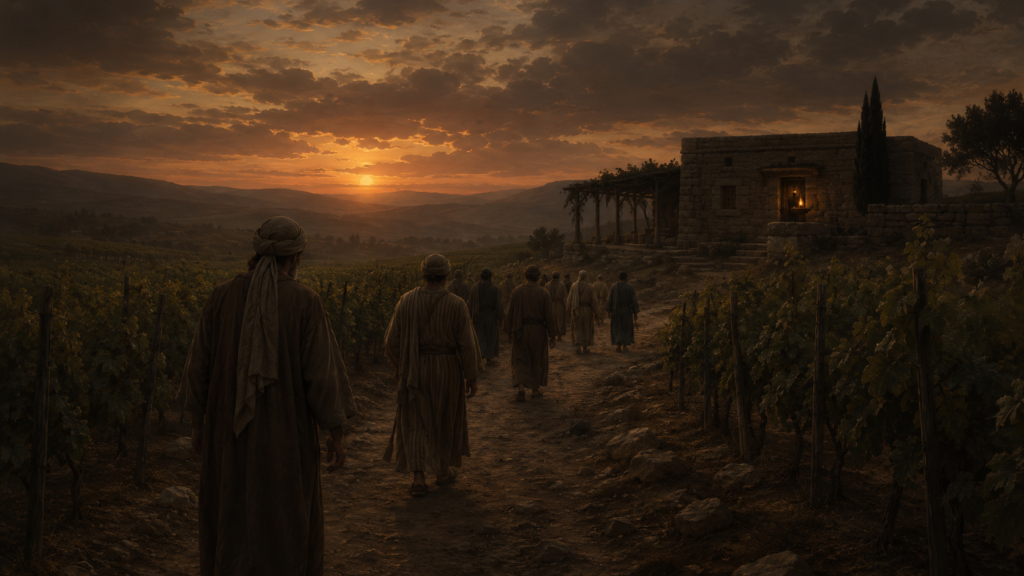
Matthew 20 sits between the rich young ruler’s grieved exit (chapter 19) and the entry into Jerusalem (chapter 21). It is the gospel’s last sustained block of teaching before the passion narrative begins. The chapter has three movements, all organized around the same first-last reversal that closed chapter 19. The parable of the vineyard’s day-laborers reframes the kingdom’s economy. The third explicit passion prediction names what is about to happen on the road. The mother of the sons of Zebedee asks for thrones, and Jesus uses the request to teach the disciples one more time what kind of authority the kingdom runs on. The chapter closes with a double healing of two blind men at Jericho who address Jesus as Son of David and follow him on the road.
The chapter has three movements. The first (verses 1 to 16) is the parable of the workers in the vineyard: the master hires laborers at five different times throughout the day and pays them all the same, provoking the early workers’ protest that the kingdom’s accounting is unfair. The second (verses 17 to 28) is the third passion prediction, the request of James and John’s mother for thrones at the king’s right and left, and Jesus’s teaching about service-as-greatness. The third (verses 29 to 34) is the healing of two blind men outside Jericho, who address Jesus as Son of David and join the procession toward Jerusalem.
Beneath the chapter’s surface flow is the gospel’s most concentrated single argument about the kingdom’s economy. The world’s-system runs on merit, hierarchy, and exchange-of-equivalents. The kingdom runs on grace-given-to-the-late-comer, service-as-the-shape-of-greatness, and the Son of Man-who-came-not-to-be-served-but-to-serve. The chapter is preparing the disciples for a Jerusalem-arrival that is going to subvert every expectation about what kingship and victory look like.
A · Matthew 20:1–16 · The workers in the vineyard
¹ “For the Kingdom of Heaven is like a man who was the master of a household, who went out early in the morning to hire laborers for his vineyard. ² When he had agreed with the laborers for a denarius a day, he sent them into his vineyard. ³ He went out about the third hour, and saw others standing idle in the marketplace. ⁴ He said to them, ‘You also go into the vineyard, and whatever is right I will give you.’ So they went their way. ⁵ Again he went out about the sixth and the ninth hour, and did likewise. ⁶ About the eleventh hour he went out, and found others standing idle. He said to them, ‘Why do you stand here all day idle?’ ⁷ They said to him, ‘Because no one has hired us.’ He said to them, ‘You also go into the vineyard, and you will receive whatever is right.’ ⁸ When evening had come, the lord of the vineyard said to his manager, ‘Call the laborers and pay them their wages, beginning from the last to the first.’ ⁹ When those who were hired at about the eleventh hour came, they each received a denarius. ¹⁰ When the first came, they supposed that they would receive more; and they likewise each received a denarius. ¹¹ When they received it, they murmured against the master of the household, ¹² saying, ‘These last have spent one hour, and you have made them equal to us, who have borne the burden of the day and the scorching heat!’ ¹³ But he answered one of them, ‘Friend, I am doing you no wrong. Didn’t you agree with me for a denarius? ¹⁴ Take that which is yours, and go your way. It is my desire to give to this last just as much as to you. ¹⁵ Isn’t it lawful for me to do what I want to with what I own? Or is your eye evil, because I am good?’ ¹⁶ So the last will be first, and the first last.” (Matthew 20:1–16, World English Bible)
- The Kingdom of Heaven is like a man who was the master of a household (verse 1). The Greek anthropo oikodespote, “a person who is master of a house,” names the parable’s central figure. The parable’s framing is a continuation of 19:30’s many will be last who are first; and first who are last, which the chapter is now going to illustrate at length. The kingdom-economy this parable describes is the inversion-economy chapter 19 just announced.
- He had agreed with the laborers for a denarius a day (verse 2). The Greek ek denariou, “from a denarius,” names the standard daily wage for a Galilean day-laborer in the first century. The amount is sufficient for a family’s basic daily food. The chapter is recording, with characteristic narrative-cultural precision, that the agreement is fair: the master is paying what was negotiated.
- He went out about the third hour, and saw others standing idle in the marketplace (verse 3). The Greek en te agora, “in the marketplace,” names the standard first-century gathering place where day-laborers assembled at dawn waiting to be hired. Workers who were not hired by mid-morning faced the prospect of going home with no wages and no food for their families. The chapter is recording, with characteristic narrative-cultural specificity, the precarity of day-labor life.
- Whatever is right I will give you (verse 4). The Greek ho ean e dikaion, “whatever is just,” names the master’s promise. There is no agreed-upon rate this time; the master simply promises to do right by them. The chapter is recording, with characteristic narrative care, that the dynamic with these later workers is different: there is no bargained contract, only the master’s character.
- About the eleventh hour he went out, and found others standing idle (verse 6). The eleventh hour names roughly the last hour of daylight, late afternoon by modern reckoning. These workers have been waiting since dawn and have not been hired. No one has hired us (verse 7) is their explanation. The chapter is recording, with characteristic narrative honesty, that the issue is not laziness; the issue is that no one offered them work.
- Beginning from the last to the first (verse 8). The Greek arxamenos apo ton eschaton heos ton proton, “beginning from the last unto the first,” names the master’s deliberate payment-order. He could have paid the first-hired first; the early workers would have left without ever knowing what the late workers received. The order of payment is deliberate. The chapter is recording, with characteristic narrative care, that the master is staging the moment for his hearers’ formation, not just settling accounts.
- They each received a denarius (verse 9). The eleventh-hour workers receive a full day’s wage for one hour’s work. The chapter is recording, in one short clause, the parable’s most provocative single move. The kingdom’s master is not paying by the hour; he is providing for the family.
- We have borne the burden of the day and the scorching heat (verse 12). The Greek bastasasi to baros tes hemeras kai ton kausona, “having borne the burden of the day and the burning heat,” is the parable’s most loaded single phrase. The vocabulary echoes the rabbinic literature’s description of Israel’s vocation under Torah: the people who bear the burden of the day, who keep the kosher laws, who observe the Sabbath, who carry the covenantal weight that the Gentile nations did not have to carry. On this reading, the early workers are the historic covenant-people of Israel, the late workers are the Gentile latecomers, and the parable is staging the Pharisaic-Israelite reaction to the kingdom’s inclusion of the Gentiles. The kingdom is, on the master’s reading, his to give. The early workers’ complaint is not that they have been cheated; they have not. The complaint is that the late-comers have been made equal to them. The kingdom’s master is not running a meritocracy; he is running a household.
Influence callout: Marty Solomon (the day-laborers and Israel’s bearing-the-burden)
Solomon’s reading of the parable names the bearing the burden of the day and the scorching heat phrase as the chapter’s interpretive key. The expression echoes the rabbinic tradition’s description of Israel’s covenant-burden: the historic people of God who carried Torah on behalf of the nations, who kept Sabbath when the world ran on Roman time, who maintained the kosher laws, who lived as God’s set-apart people for the sake of the world’s eventual blessing. The parable, on this reading, is not arbitrary. The early workers are not generically envious laborers; they are Israel-as-covenant-people. The late-comers are the Gentile latecomers whom Jesus has been bringing into the kingdom throughout the gospel (the centurion of chapter 8, the Canaanite woman of chapter 15, the implied Gentile crowd at the second feeding). The early workers’ protest is the protest of the religious establishment that has been complaining since chapter 9 about Jesus’s table fellowship with sinners and outsiders. The master’s answer (friend, I am doing you no wrong… is your eye evil because I am good?) names the issue precisely. The early workers received what they were promised. The grievance is not unjust pay; it is the master’s generosity toward those they would not have included. Solomon argues that this is the gospel’s most sustained single parable on the kingdom’s grace-economy and the human resistance to it. Grace given to others is, for those who think they have earned theirs, often experienced as injustice. The master’s evil eye (Greek poneros ophthalmos) language picks up the same Hebrew idiom Jesus used in 6:23 (ayin ra’ah, the grasping-and-stingy disposition). The early workers are not just complainers; they are operating with the ayin ra’ah the Sermon on the Mount warned about. The chapter is recording, with characteristic narrative-pedagogical precision, that the kingdom’s generosity will keep producing this kind of resistance from the people who think they should have received more.
- Or is your eye evil, because I am good? (verse 15). The Greek e ho ophthalmos sou poneros estin hoti ego agathos eimi, “or is your eye evil because I am good,” uses the same evil eye / good eye idiom as 6:22-23. The chapter is recording, with characteristic verbal continuity, that the Sermon on the Mount’s ayin ra’ah (the grasping, stingy disposition) is now being applied to the early workers’ grievance. The disciples are being trained to recognize the disposition in themselves before they meet it in the religious establishment of Jerusalem.
- So the last will be first, and the first last (verse 16). The closing line repeats 19:30’s reversal-saying, framing the parable as an extended commentary on the chapter-19 close. The chapter is recording, with characteristic narrative-structural care, the kingdom’s first-last inversion as the parable’s frame.
B · Matthew 20:17–28 · The third passion prediction and the request for thrones
¹⁷ As Jesus was going up to Jerusalem, he took the twelve disciples aside, and on the way he said to them, ¹⁸ “Behold, we are going up to Jerusalem, and the Son of Man will be delivered to the chief priests and scribes, and they will condemn him to death, ¹⁹ and will hand him over to the Gentiles to mock, to scourge, and to crucify; and the third day he will be raised up.” ²⁰ Then the mother of the sons of Zebedee came to him with her sons, kneeling and asking a certain thing of him. ²¹ He said to her, “What do you want?” She said to him, “Command that these, my two sons, may sit, one on your right hand, and one on your left hand, in your Kingdom.” ²² But Jesus answered, “You don’t know what you are asking. Are you able to drink the cup that I am about to drink, and be baptized with the baptism that I am baptized with?” They said to him, “We are able.” ²³ He said to them, “You will indeed drink my cup, and be baptized with the baptism that I am baptized with; but to sit on my right hand and on my left hand is not mine to give; but it is for whom it has been prepared by my Father.” ²⁴ When the ten heard it, they were indignant with the two brothers. ²⁵ But Jesus summoned them, and said, “You know that the rulers of the nations lord it over them, and their great ones exercise authority over them. ²⁶ It shall not be so among you, but whoever desires to become great among you shall be your servant. ²⁷ Whoever desires to be first among you shall be your bondservant, ²⁸ even as the Son of Man came not to be served, but to serve, and to give his life as a ransom for many.” (Matthew 20:17–28, World English Bible)
- As Jesus was going up to Jerusalem, he took the twelve disciples aside (verse 17). The Greek anabainon eis Hierosolyma, “going up to Jerusalem,” names the chapter’s geographic-narrative frame. The pilgrim verb anabaino (to go up) is technical: going up to Jerusalem is the standard Jewish vocabulary for pilgrimage to the temple, regardless of compass direction. The chapter is recording, with characteristic narrative-cultural precision, that Jesus’s road to the cross is a pilgrim’s road. He is going up the way pilgrims have always gone up.
- The Son of Man will be delivered to the chief priests and scribes, and they will condemn him to death, and will hand him over to the Gentiles to mock, to scourge, and to crucify; and the third day he will be raised up (verses 18 to 19). The Greek records the gospel’s third explicit passion prediction (after 16:21 and 17:22-23). This third version is the most detailed: the chief priests and scribes will hand him over; the Gentiles (Romans) will mock, scourge, and crucify; the third day will be the resurrection. The chapter is recording, with characteristic narrative-prophetic care, that the disciples have now been told three times exactly what is coming, in increasing specificity.
- Then the mother of the sons of Zebedee came to him with her sons, kneeling and asking a certain thing of him (verse 20). The Greek prosekynei, “she was bowing down,” uses the worship-gesture vocabulary. Mark’s parallel (Mark 10:35) records the request as coming from James and John themselves; Matthew has their mother make the request, possibly to soften the disciples’ overreach. The chapter is recording, with characteristic narrative honesty, the disciples’ continuing inability to absorb the cross-shape of the kingdom Jesus has just announced for the third time. He has just said crucified; they hear kingdom and ask for thrones.
- Command that these, my two sons, may sit, one on your right hand, and one on your left hand, in your Kingdom (verse 21). The Greek eis dexion sou kai eis euonymon sou, “at your right and at your left,” asks for the two highest positions of honor in a royal court. The right-and-left-hand positions are the standard ancient configuration for the king’s chief officials. The chapter is recording, with characteristic narrative irony, that the disciples are still operating in the world’s-system understanding of kingship. Jesus has just predicted his crucifixion; they want vice-presidential appointments.
- Are you able to drink the cup that I am about to drink, and be baptized with the baptism that I am baptized with? (verse 22). The Greek to poterion ho ego mello pinein, “the cup that I am about to drink,” uses the Hebrew Bible’s cup of suffering image (Psalm 75:8; Isaiah 51:17, 22; Jeremiah 25:15-29). The cup is the cup the disciple drinks at Gethsemane (26:39, let this cup pass from me). The chapter is recording, with characteristic narrative-prophetic care, that Jesus is asking the brothers whether they can share the suffering as well as the throne. The pairing is the chapter’s deepest single point: the throne and the cup come together in the kingdom Jesus is bringing.
- We are able (verse 22b). The brothers’ answer is, on its own register, the right rabbinic-disciple answer (the disciple is to do what the rabbi does). The chapter is recording, with characteristic narrative honesty, that the brothers have not yet understood what they are agreeing to. Their answer is more confident than informed.
- You will indeed drink my cup (verse 23). The Greek to men poterion mou piesthe, “indeed my cup you will drink,” is the chapter’s most somber confirmation. James will be martyred under Herod Agrippa I in roughly 44 AD (Acts 12:2); John will be exiled to Patmos and, on church tradition, suffer for the gospel for the rest of his long life. Both will, in fact, drink the cup. The chapter is recording, with characteristic narrative-prophetic precision, that the throne-request is being answered with the suffering they did not ask about.
- When the ten heard it, they were indignant with the two brothers (verse 24). The Greek eganaktesan, “they were indignant,” names the other ten disciples’ reaction. The chapter is recording, with characteristic narrative honesty, that the rest of the twelve are bothered not because the request was wrong but because the brothers asked first. The whole group has been thinking the same thoughts; the brothers just made the play.
- You know that the rulers of the nations lord it over them, and their great ones exercise authority over them. It shall not be so among you (verses 25 to 26). The Greek katakyrieuousin auton kai hoi megaloi katexousiazousin auton, “they lord it over them and the great ones exercise authority over them,” uses two prefixed verbs (kata-kyrieuo, kata-exousiazo) that name the over-and-against posture of imperial rule. The chapter is recording, with characteristic verbal precision, the two kingdoms’ opposing structures. The world’s kingdoms run on power-over; the kingdom of heaven runs on service-from-below.
Influence callout: N.T. Wright (the kingdom’s inverted authority)
Wright’s reading of 20:25-28 names this passage as the gospel’s clearest single statement of the kingdom’s inverted authority-pattern. The Roman world ran on the principle of gravitas-and-auctoritas, the weighty authority of those at the top exercised over those below. Caesar exercised authority by virtue of his position; the position itself granted the right to command. Wright argues that Jesus’s it shall not be so among you is the kingdom’s most direct rejection of the entire ancient hierarchical model. Authority in the kingdom is not the right granted by position; authority in the kingdom is the trust earned through service. The Greek diakonos (servant) names the table-server, the household-attendant, the person whose job is to provide for the needs of others. The Greek doulos (bondservant) names the slave, the person whose entire life is given to another’s service. Both terms occupy the bottom of the Roman hierarchy. Wright argues that Jesus is not just rearranging the metaphors; he is naming a structural change. The kingdom is not the world’s-system run by better people; the kingdom is structurally different. The Son of Man embodies the structure: he came not to be served but to serve, and to give his life as a ransom for many. The cross is the structure made fully visible. Every Christian leader, every disciple-community, every gospel-organization since has had to negotiate with this verse. The temptation to revert to Roman-style gravitas is constant; Jesus’s rejection of it is unambiguous. The chapter is recording, in one short paragraph, the kingdom’s organizational DNA.
- To give his life as a ransom for many (verse 28). The Greek dounai ten psychen autou lytron anti pollon, “to give his life as a ransom in place of many,” is the chapter’s most theologically-loaded single phrase. Lytron (ransom) is the redemption-payment vocabulary the Septuagint uses for the Passover redemption (Exodus 30:12), the firstborn-redemption (Numbers 18:15), and the Jubilee-redemption (Leviticus 25:51-52). Anti (in place of, on behalf of) names the substitutionary direction: the Son of Man’s life is given in the place of the many. Isaiah 53:11-12 (the suffering servant bearing the iniquities of the many and poured out unto death) is the chapter’s most likely background. The chapter is recording, in one short clause, the gospel’s first explicit cross-as-ransom statement. The cross is not just martyrdom; the cross is, on Jesus’s own framing, the lytron-payment that releases the many.
C · Matthew 20:29–34 · The two blind men outside Jericho
²⁹ As they went out from Jericho, a great multitude followed him. ³⁰ Behold, two blind men sitting by the road, when they heard that Jesus was passing by, cried out, “Lord, have mercy on us, you son of David!” ³¹ The multitude rebuked them, telling them that they should be quiet, but they cried out even more, “Lord, have mercy on us, you son of David!” ³² Jesus stood still, and called them, and asked, “What do you want me to do for you?” ³³ They told him, “Lord, that our eyes may be opened.” ³⁴ Jesus, being moved with compassion, touched their eyes; and immediately their eyes received their sight, and they followed him. (Matthew 20:29–34, World English Bible)

- As they went out from Jericho, a great multitude followed him (verse 29). The Greek ekporeuomenon auton apo Hiericho, “as they were going out of Jericho,” names the chapter’s geographic seam. Jericho is the last major town before the climb up to Jerusalem (a roughly fifteen-mile ascent of about 3,500 feet). The chapter is recording, with characteristic narrative-geographic care, that Jesus is now within a day’s walk of the city.
- Two blind men sitting by the road (verse 30). The Greek dyo typhloi, “two blind men,” is Matthew’s typical pairing (Matthew has two demoniacs at the Gadarenes where Mark has one; here Matthew has two blind men where Mark has one named Bartimaeus). The chapter is recording, with characteristic narrative-pairing precision, the witnesses’ double-witness pattern. (Hebrew Bible legal practice required two witnesses for testimony; the chapter may be using the pairing to satisfy the witness-requirement implicitly.)
- Lord, have mercy on us, you son of David! (verse 30b). The Greek huie David, “son of David,” is the messianic title. The chapter is recording, with characteristic narrative-theological irony, that two blind men are seeing what the disciples have only just begun to see. The blind men are using the right title; the disciples have been asking for thrones. The kingdom’s recognition keeps showing up in the people the world expects least.
- The multitude rebuked them, telling them that they should be quiet (verse 31). The Greek epetimesen, “rebuked,” is the same verb used elsewhere for rebuking demons. The chapter is recording, with characteristic narrative honesty, the crowd’s instinct to manage the rabbi’s procession by silencing the marginalized. The chapter has just shown the disciples doing the same with children (19:13). The pattern is consistent: those at the social margin get hushed, and Jesus stops to attend to them.
- They cried out even more, “Lord, have mercy on us, you son of David!” (verse 31b). The Greek meizon ekraxan, “they cried out greater,” names the men’s persistence. The chapter is recording, with characteristic narrative care, that the men are not deterred by the crowd’s instruction. Their cry is the chapter’s persistent prayer-form, and the gospel’s pattern: those who keep crying out tend to get heard.
- What do you want me to do for you? (verse 32). The Greek ti thelete poieso hymin, “what do you want me to do for you,” is the same question Jesus asked the sons of Zebedee’s mother in 20:21. The pairing is the chapter’s most pointed single juxtaposition. The mother asked for thrones; the blind men ask for sight. The kingdom’s question gets two different kinds of answers from two different kinds of askers. The chapter is teaching, in two scenes, what the disciple should actually be asking the rabbi for.
- Lord, that our eyes may be opened (verse 33). The Greek hina anoigosin hoi ophthalmoi hemon, “that our eyes may be opened,” is the men’s request. The chapter is recording, with characteristic narrative restraint, the simplicity of the right ask. They want to see. The disciples have been told three times what is coming and have not absorbed it; the blind men know exactly what they are asking for, and they get it.
- Jesus, being moved with compassion, touched their eyes (verse 34). The Greek splanchnistheis, “having been moved with compassion,” uses the gut-level verb the gospel has used at 9:36, 14:14, 15:32, 18:27. The chapter is recording, with characteristic verbal continuity, the kingdom’s standing disposition: compassion. The healing flows from the same disposition that has produced every miracle from the leper of chapter 8 forward.
- Immediately their eyes received their sight, and they followed him (verse 34b). The Greek ekolouthesan auto, “they followed him,” is the gospel’s discipleship verb. The chapter is closing on a discipleship-act: the men who could not see are now following the rabbi up the road to Jerusalem. The chapter is recording, with characteristic narrative-theological care, that the men are joining the procession that will arrive at the city in the next chapter. The chapter ends on a small but decisive image: the formerly-blind, now seeing, walk up the Jericho road behind the king.
Reflection prompts
- The early workers in the vineyard receive exactly what they bargained for. The complaint is not that they were cheated; the complaint is that the late-comers were made equal to them. The kingdom’s grace given to others is, for the people who think they earned theirs, often experienced as injustice. Where in your life is your reaction to someone else’s unearned grace currently functioning as the evil eye the chapter describes, and what would it mean to take the master’s question seriously: is your eye evil because I am good?
- Jesus has just predicted his crucifixion for the third time. The disciples respond by asking for thrones. The chapter’s juxtaposition is unsparing: crucified and one on your right hand, one on your left in the same conversation. Where in your life are you currently confessing the cross while reaching for the throne, and what does it mean to consider the chapter’s pattern: the cup and the throne come together in the kingdom?
- The mother of the sons of Zebedee asks Jesus for thrones; two blind men outside Jericho ask Jesus for sight. The kingdom’s question (what do you want me to do for you?) gets two different answers from two different kinds of askers. Where in your life is what you are currently asking the king for closer to thrones than to sight, and what would it mean to ask the chapter’s right question: Lord, that our eyes may be opened?