
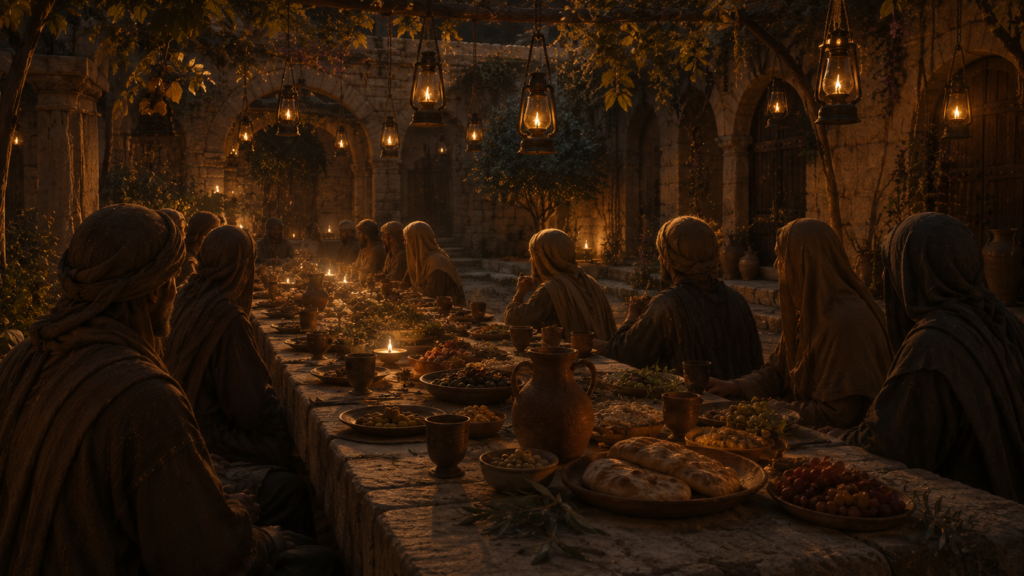
Matthew 22 is the chapter of the temple-week debates. After the entry-into-Jerusalem of chapter 21, Jesus has positioned himself in the temple precincts and is teaching the crowds. The religious establishment, from multiple factions in succession, comes to test him. The chapter records four of these tests: the parable of the wedding banquet (which extends the wicked-tenants critique from chapter 21 into a positive image of the kingdom-table), the Pharisees-and-Herodians question about taxes to Caesar, the Sadducees’ question about the resurrection, and the lawyer’s question about the greatest commandment. The chapter closes with Jesus’s own question (what do you think about the Christ? whose son is he?) that silences the establishment for the rest of the temple-week.
The chapter has four movements. The first (verses 1 to 14) is the parable of the wedding banquet: the king who invites guests to his son’s wedding, the refusal of the original invitees, the invitation extended to those gathered from the highways, and the closing scene of the man without a wedding garment. The second (verses 15 to 22) is the Pharisees-and-Herodians question about paying taxes to Caesar, and Jesus’s render to Caesar response. The third (verses 23 to 33) is the Sadducees’ hypothetical question about the resurrection, and Jesus’s appeal to Exodus 3 (God of the living, not of the dead). The fourth (verses 34 to 46) is the lawyer’s question about the greatest commandment, Jesus’s pairing of Deuteronomy 6:4-5 and Leviticus 19:18, and Jesus’s counter-question about Psalm 110.
Beneath the chapter’s surface flow is the gospel’s most concentrated single sequence of public theological-political confrontations. Each test attempts to entrap Jesus on one of the day’s most contested issues; each response demonstrates the kingdom’s reframing of the question. The chapter is recording, in four scenes, a rabbi who has more than answered every question put to him.
A · Matthew 22:1–14 · The wedding banquet
¹ Jesus answered and spoke to them again in parables, saying, ² “The Kingdom of Heaven is like a certain king, who made a wedding feast for his son, ³ and sent out his servants to call those who were invited to the wedding feast, but they would not come. ⁴ Again he sent out other servants, saying, ‘Tell those who are invited, “Behold, I have prepared my dinner. My cattle and my fatlings are killed, and all things are ready. Come to the wedding feast!”‘ ⁵ But they made light of it, and went their ways, one to his own farm, another to his merchandise, ⁶ and the rest grabbed his servants, and treated them shamefully, and killed them. ⁷ When the king heard that, he was angry, and sent his armies, destroyed those murderers, and burned their city. ⁸ Then he said to his servants, ‘The wedding is ready, but those who were invited weren’t worthy. ⁹ Go therefore to the intersections of the highways, and as many as you may find, invite to the wedding feast.’ ¹⁰ Those servants went out into the highways, and gathered together as many as they found, both bad and good. The wedding was filled with guests. ¹¹ But when the king came in to see the guests, he saw there a man who didn’t have on wedding clothing, ¹² and he said to him, ‘Friend, how did you come in here not wearing wedding clothing?’ He was speechless. ¹³ Then the king said to the servants, ‘Bind him hand and foot, take him away, and throw him into the outer darkness; there is where the weeping and grinding of teeth will be.’ ¹⁴ For many are called, but few chosen.” (Matthew 22:1–14, World English Bible)
- The Kingdom of Heaven is like a certain king, who made a wedding feast for his son (verse 2). The Greek gamous to huio autou, “a wedding feast for his son,” names the chapter’s central kingdom-image. The wedding-banquet is the standard Hebrew Bible image of the messianic age (Isaiah 25:6-9; 62:5; Hosea 2:19-20). The parable is, on its first reading, an extension of chapter 21’s wicked-tenants parable: the same king-and-people relationship, now imaged as a wedding-banquet rather than a vineyard.
- They would not come (verse 3). The Greek kai ouk ethelon elthein, “and they would not come,” names the original invitees’ refusal. The parable’s opening move is the religious establishment’s rejection of the kingdom-summons. The chapter is recording, with characteristic narrative care, the same indictment that 21:33-46 just delivered, in different imagery.
- They made light of it, and went their ways, one to his own farm, another to his merchandise (verse 5). The Greek amelesantes, “having neglected,” names the more common form of refusal. Some refuse violently (verse 6); others simply do not come because they are busy with their own affairs. The chapter is recording, with characteristic narrative honesty, that the kingdom’s most frequent rejection is not active opposition but passive distraction. The farm and the merchandise are both legitimate pursuits; they have become the reason for not coming.
- He was angry, and sent his armies, destroyed those murderers, and burned their city (verse 7). The Greek records the parable’s most violent verse. The image of the king’s army destroying the murderers’ city has been read by most early commentators (Origen, Eusebius, Jerome, Chrysostom) as a direct parabolic prediction of the Roman destruction of Jerusalem in 70 AD. The chapter is recording, with characteristic narrative-prophetic care, what the wicked-tenants parable just announced in a different image: the religious establishment of Jerusalem has run out of time, and the consequences are coming.
- Go therefore to the intersections of the highways, and as many as you may find, invite to the wedding feast (verse 9). The Greek eis tas diexodous ton hodon, “to the road-junctions,” names the wide-net-gathering. The servants are sent to the public crossroads to invite anyone they find. The chapter is recording, with characteristic narrative-theological care, the kingdom’s open-invitation principle. The original invitees’ refusal does not cancel the wedding; the wedding gets a different guest list. Both bad and good (verse 10) names the kind of crowd the highways produce: a moral mix, not a pre-screened group.
- But when the king came in to see the guests, he saw there a man who didn’t have on wedding clothing (verse 11). The Greek me endedymenon enduma gamou, “not having put on wedding clothing,” is the parable’s most exegetically-debated single image. Wedding garments in first-century practice were either provided by the host (in royal weddings) or expected as a basic courtesy from the guest. The parable does not specify, leaving the reader to interpret. The dominant patristic-and-medieval reading: the wedding garment is the fruit-of-righteousness the kingdom expects of its guests. The kingdom is open-invitation, but the kingdom is not no-invitation. The chapter is recording, with characteristic narrative-theological care, that being at the wedding does not guarantee remaining at the wedding; the kingdom’s open door is paired with the kingdom’s expected response.
- Bind him hand and foot, take him away, and throw him into the outer darkness; there is where the weeping and grinding of teeth will be (verse 13). The Greek eis to skotos to exoteron, “into the outer darkness,” echoes the chapter-8 outer darkness warning to the religiously-presumptive (8:12). The chapter is recording, with characteristic narrative-theological continuity, the same warning in a new context: the wedding’s open invitation does not preclude the wedding’s actual standards.
- For many are called, but few chosen (verse 14). The Greek polloi gar eisin kletoi, oligoi de eklektoi, “for many are called, few chosen,” is the parable’s closing aphorism. The verse has been read in many different theological registers. The chapter’s most basic reading: the kingdom’s invitation goes out to many; the actual response that constitutes being-chosen is comparatively rare. The chapter is recording, with characteristic narrative restraint, the gap between hearing the invitation and inhabiting the wedding.
B · Matthew 22:15–22 · The question about taxes to Caesar
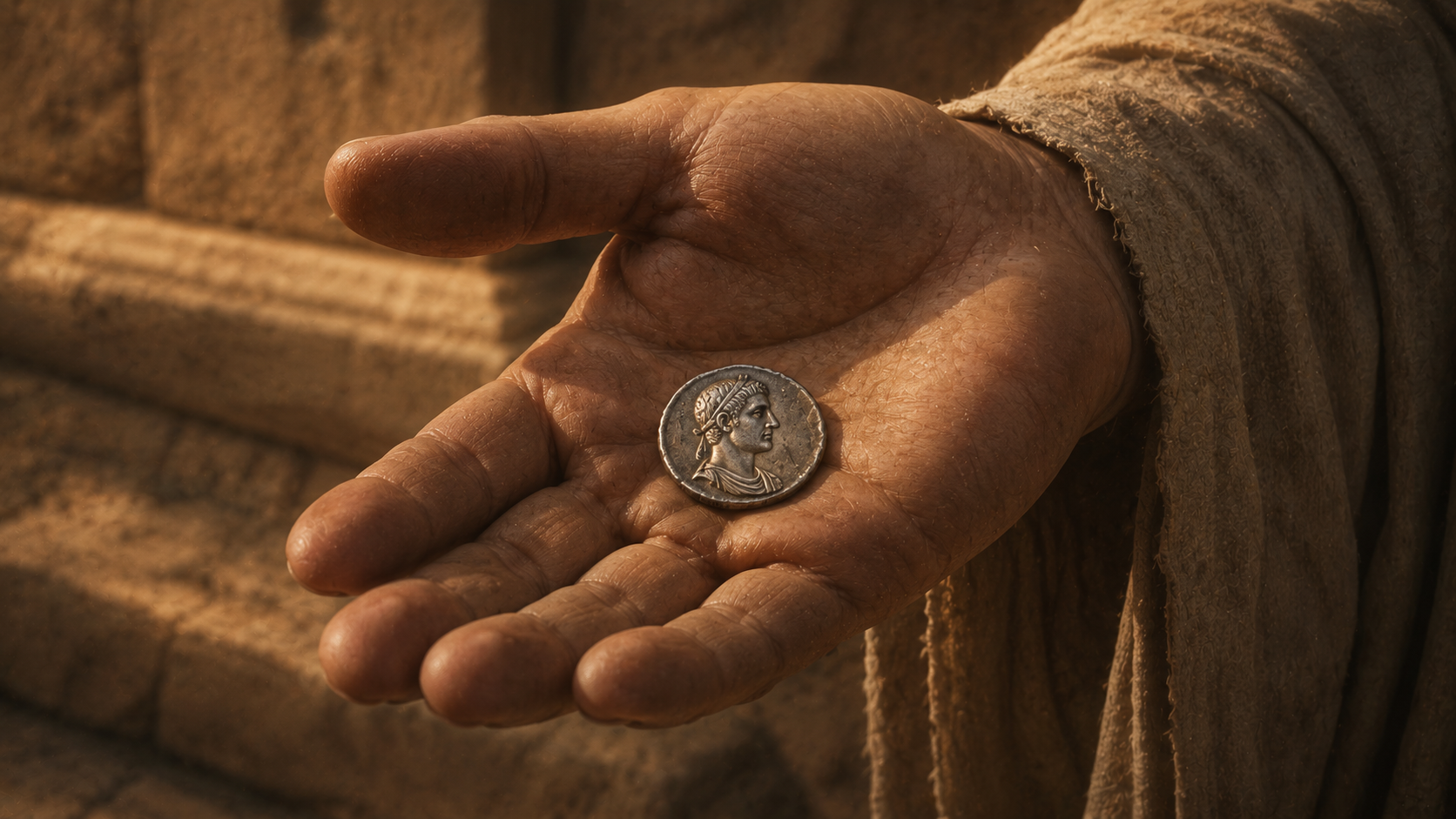
¹⁵ Then the Pharisees went and took counsel how they might entrap him in his talk. ¹⁶ They sent their disciples to him, along with the Herodians, saying, “Teacher, we know that you are honest, and teach the way of God in truth, no matter whom you teach, for you aren’t partial to anyone. ¹⁷ Tell us therefore, what do you think? Is it lawful to pay taxes to Caesar, or not?” ¹⁸ But Jesus perceived their wickedness, and said, “Why do you test me, you hypocrites? ¹⁹ Show me the tax money.” They brought to him a denarius. ²⁰ He asked them, “Whose is this image and inscription?” ²¹ They said to him, “Caesar’s.” Then he said to them, “Give therefore to Caesar the things that are Caesar’s, and to God the things that are God’s.” ²² When they heard it, they marveled, and left him, and went away. (Matthew 22:15–22, World English Bible)
- Then the Pharisees went and took counsel how they might entrap him in his talk (verse 15). The Greek symboulion elabon hopos auton pagideusosin, “they took counsel that they might trap him,” names the chapter’s open shift to deliberate entrapment. The Pharisees, after the parable they understood as directed at them (21:45), are now strategizing. The chapter is recording, with characteristic narrative honesty, that the temple-debates of this chapter are not innocent inquiries.
- Along with the Herodians (verse 16). The Greek meta ton Herodianon, “with the Herodians,” names a startling alliance. The Pharisees and the Herodians were typically opponents (the Pharisees opposed Roman rule and Herod-as-Roman-client; the Herodians supported Herod-as-Roman-client). For them to be working together signals that the religious-political establishment of multiple factions is now united against Jesus. The chapter is recording, with characteristic narrative-political care, the breadth of the opposition.
- Is it lawful to pay taxes to Caesar, or not? (verse 17). The Greek exestin dounai kenson Kaisari, “is it lawful to give kensos to Caesar,” uses kensos (Latin census), a technical term for the Roman head-tax (the tributum capitis) imposed on every Jewish person aged 14 to 65 in the province of Judea. The tax was deeply controversial: it was paid in Roman coinage bearing the emperor’s image and divine titles, it funded the occupation, and it had triggered a major revolt in 6 AD (Judas the Galilean’s revolt, mentioned in Acts 5:37). The question is genuinely a trap. Yes makes Jesus a Roman collaborator in the eyes of the crowd; no makes him a tax-revolt instigator in the eyes of Rome. The chapter is recording, with characteristic narrative-political precision, the trap’s structure.
- Show me the tax money (verse 19). The Greek epideixate moi to nomisma tou kensou, “show me the coinage of the kensos,” is Jesus’s first move. He has not produced the coin himself; the Pharisees-and-Herodians have it. The chapter is recording, with characteristic narrative care, the small but pointed observation that the questioners themselves are carrying Caesar’s coinage in the temple precincts. The trap-setters have already made their compromise visible.
- Whose is this image and inscription? (verse 20). The Greek tinos he eikon haute kai he epigraphe, “whose is this image and this inscription,” names the chapter’s pivot. The denarius of Tiberius Caesar bore the emperor’s profile and the inscription Tiberius Caesar Augustus, son of the Divine Augustus; the reverse side often included the title Pontifex Maximus (high priest). The coin was, in its inscription, an idolatrous claim. The chapter is recording, with characteristic narrative-theological care, the precise weight of what is being held up: a piece of metal that names Caesar as divine.
- Give therefore to Caesar the things that are Caesar’s, and to God the things that are God’s (verse 21). The Greek apodote oun ta Kaisaros Kaisari kai ta tou theou to theo, “render therefore the things of Caesar to Caesar and the things of God to God,” is the chapter’s most quoted single line. The verb apodidomi (give back, render) is significant: the coin already has Caesar’s image; give it back to him. The chapter is recording, with characteristic narrative-theological precision, the response’s deeper logic. If Caesar’s coin bears Caesar’s image, what bears God’s image? Genesis 1:27 has long since answered: the human person bears God’s image. The coin goes back to Caesar; the human goes to God. The two-claim relationship has not been collapsed (Jesus is not a tax-rebel) and has not been compromised (Jesus is not a Caesar-divinizer). The two are correctly distinguished. Jesus’s render to Caesar what is Caesar’s permits paying the coin; Jesus’s render to God what is God’s refuses to call Caesar what only God is. The chapter is recording the kingdom’s most precise single statement on the disciple’s relationship to imperial authority.
Influence callout: N.T. Wright (the render to Caesar reading and the image-of-God logic)
Wright’s reading of 22:15-22 names the response as one of the gospel’s most theologically careful single political answers. The Pharisees-and-Herodians have framed the question as a binary (yes pay, no don’t pay); Jesus has reframed it as a layered theological-political question about whose image is on what. The coin bears Caesar’s image and inscription; the human bears God’s image. The disciple owes the coin to Caesar (because it is, in fact, Caesar’s; he minted it, his face is on it, he calls it back to himself); the disciple owes the whole self to God (because God minted the human, God’s image is on the human, God calls the human back to himself). Wright argues that the verse is doing two things at once. It is permitting the disciple to participate in the imperial economy at the level the empire actually operates (you can pay the tax; the empire is a real political reality you live inside) without surrendering to the empire’s deeper claim (you cannot give the empire what only God should receive: your worship, your ultimate loyalty, your image-bearing self). The Roman emperor was not just a tax collector; he was a god-figure who claimed divine titles, demanded worship, and shaped the world’s loyalty around his own person. Jesus’s response gives Caesar what Caesar can rightly have (the coin, the political loyalty appropriate to a temporal ruler) and refuses Caesar what only God can have (worship, ultimate allegiance, the image-bearing person). Wright argues that this verse has been the foundation of every subsequent Christian engagement with imperial authority, from the early martyrs who paid taxes but refused the emperor-cult to the post-Constantine debates about the church and state to the twentieth-century Confessing Church’s Barmen Declaration under the Nazi regime. The verse permits political participation without permitting political idolatry. The chapter is recording, in two short clauses, the kingdom’s whole posture toward Caesar.
C · Matthew 22:23–33 · The Sadducees on the resurrection
²³ On that day Sadducees came to him, those who say that there is no resurrection. They asked him, ²⁴ saying, “Teacher, Moses said, ‘If a man dies, having no children, his brother shall marry his wife, and raise up offspring for his brother.’ ²⁵ Now there were with us seven brothers. The first married and died, and having no offspring left his wife to his brother. ²⁶ In the same way, the second also, and the third, to the seventh. ²⁷ After them all, the woman died. ²⁸ In the resurrection therefore, whose wife will she be of the seven? For they all had her.” ²⁹ But Jesus answered them, “You are mistaken, not knowing the Scriptures, nor the power of God. ³⁰ For in the resurrection they neither marry, nor are given in marriage, but are like God’s angels in heaven. ³¹ But concerning the resurrection of the dead, haven’t you read that which was spoken to you by God, saying, ³² ‘I am the God of Abraham, and the God of Isaac, and the God of Jacob?’ God is not the God of the dead, but of the living.” ³³ When the multitudes heard it, they were astonished at his teaching. (Matthew 22:23–33, World English Bible)
- Sadducees came to him, those who say that there is no resurrection (verse 23). The Greek Saddoukaioi, “Sadducees,” identifies the priestly-aristocratic faction of first-century Jewish religious leadership. The Sadducees accepted only the written Torah (the five books of Moses) as authoritative; they rejected the Pharisaic oral tradition; they did not believe in bodily resurrection (a doctrine that developed primarily through Daniel and the Maccabean-period writings, after the Pentateuch was completed). The chapter is recording, with characteristic narrative-historical precision, that the question is not arbitrary. The Sadducees are testing Jesus on the doctrine they themselves reject, with a hypothetical they think proves the doctrine absurd.
- Moses said, “If a man dies, having no children, his brother shall marry his wife” (verse 24). The Greek cites Deuteronomy 25:5, the levirate marriage law (Hebrew yibbum). The Mosaic law required a deceased man’s brother to marry the widow and raise up offspring in the deceased brother’s name, preserving the family inheritance line. The chapter is recording, with characteristic narrative-legal care, that the Sadducees are framing their question entirely from the Pentateuch (the only authoritative scripture they accept).
- In the resurrection therefore, whose wife will she be of the seven? For they all had her (verse 28). The Greek records the Sadducees’ hypothetical absurdity. Seven successive levirate-marriages of the same woman, with seven brothers all dying, and the woman dying last. The Sadducees are arguing by reductio ad absurdum: if there is a resurrection, the resurrection of this woman creates an irresolvable marital tangle, and therefore the resurrection-doctrine is incoherent.
- You are mistaken, not knowing the Scriptures, nor the power of God (verse 29). The Greek me eidotes tas graphas mede ten dynamin tou theou, “not knowing the Scriptures or the power of God,” is Jesus’s diagnosis of the Sadducees’ error. They have made two related mistakes: they have not read the scriptures carefully enough to see what God has actually said about the resurrection (Jesus will demonstrate from Exodus 3 in a moment), and they have underestimated the kind of life resurrection actually involves (it is not a continuation of present-age structures but a transformation into a new register). The chapter is recording, with characteristic narrative-theological precision, that the Sadducees’ problem is not their reasoning; their reasoning is fine. The problem is their starting categories.
- In the resurrection they neither marry, nor are given in marriage, but are like God’s angels in heaven (verse 30). The Greek hos angeloi en to ourano, “as angels in heaven,” names the resurrection-life’s structural difference. The point is not that the resurrected lose their humanity; the point is that marriage, as the present-age institution organized around procreation and the continuation of family lines, is not the resurrection-age’s organizing structure. The chapter is recording, with characteristic narrative-theological care, that the Sadducees’ question presupposes the resurrection is just a continuation of present-age life. It is not. Resurrection-life operates by different categories.
- I am the God of Abraham, and the God of Isaac, and the God of Jacob? God is not the God of the dead, but of the living (verse 32). The Greek cites Exodus 3:6, the burning-bush self-revelation to Moses. The chapter is recording, with characteristic narrative-rabbinic precision, Jesus’s choice of proof-text. The Sadducees only accept the Pentateuch; Jesus is proving the resurrection from the Pentateuch itself. The argument turns on the verb am: God says I am the God of Abraham, Isaac, and Jacob, not I was. Abraham, Isaac, and Jacob were long dead in Moses’s day. If God is, present-tense, their God, they must, in some sense, be alive to him. The Hebrew Bible’s understanding that the LORD is the God of the living (verse 32b is Jesus’s gloss on Exodus 3) requires that those whose God he is are, in some sense, living before him. The resurrection-doctrine the Sadducees thought was a late innovation is implicit in the burning-bush itself. The chapter is recording, in three short clauses, the kingdom’s most direct single demonstration that the Pentateuch already requires the resurrection-doctrine.
D · Matthew 22:34–46 · The greatest commandment and David’s son
³⁴ But the Pharisees, when they heard that he had silenced the Sadducees, gathered themselves together. ³⁵ One of them, a lawyer, asked him a question, testing him. ³⁶ “Teacher, which is the greatest commandment in the law?” ³⁷ Jesus said to him, “‘You shall love the Lord your God with all your heart, with all your soul, and with all your mind.’ ³⁸ This is the first and great commandment. ³⁹ A second likewise is this, ‘You shall love your neighbor as yourself.’ ⁴⁰ The whole law and the prophets depend on these two commandments.” ⁴¹ Now while the Pharisees were gathered together, Jesus asked them a question, ⁴² saying, “What do you think of the Christ? Whose son is he?” They said to him, “Of David.” ⁴³ He said to them, “How then does David in the Spirit call him Lord, saying, ⁴⁴ ‘The Lord said to my Lord, sit on my right hand, until I make your enemies a footstool for your feet?’ ⁴⁵ “If then David calls him Lord, how is he his son?” ⁴⁶ No one was able to answer him a word, neither dared any man from that day forth ask him any more questions. (Matthew 22:34–46, World English Bible)
- Teacher, which is the greatest commandment in the law? (verse 36). The Greek poia entole megale en to nomo, “which great commandment in the Torah,” is the lawyer’s question. First-century Jewish religious culture had a tradition of asking which commandment a particular rabbi prioritized, not because some commandments were unimportant, but because the chosen yoke (the rabbi’s primary commandment) functioned as the interpretive lens for the whole Torah. The chapter is recording, with characteristic narrative-rabbinic care, that the question is asking Jesus to declare his interpretive lens.
- You shall love the Lord your God with all your heart, with all your soul, and with all your mind (verse 37). The Greek cites Deuteronomy 6:5 (the Shema‘s second verse). Every observant first-century Jew prayed the Shema (Deuteronomy 6:4-9) twice daily; it was the foundation of Jewish covenantal identity. The chapter is recording, with characteristic narrative-cultural precision, that Jesus’s first-commandment answer is the most expected possible answer. Every rabbi would have given this answer to the first half of the question.
- A second likewise is this, “You shall love your neighbor as yourself” (verse 39). The Greek cites Leviticus 19:18, from the Holiness Code. The chapter is recording, with characteristic narrative-rabbinic care, the chapter’s most theologically-loaded move. The lawyer asked for the greatest commandment; Jesus has paired the Shema‘s love-of-God with Leviticus 19’s love-of-neighbor. The pairing is the chapter’s own statement of yoke. The chapter is recording, in two citations, the gospel’s whole interpretive lens: the Torah is interpreted by reading every commandment in light of love-of-God-and-love-of-neighbor.
Influence callout: Marty Solomon (the rabbinic schools and Jesus’s yoke)
Solomon’s reading of 22:34-40 names this as the gospel’s most direct single statement of Jesus’s yoke: his primary interpretive principle for the whole Torah. The first-century rabbinic world had several major schools (Beit Hillel, Beit Shammai, and others) that disagreed about which commandments to prioritize and how to read the more difficult passages. The lawyer’s question was, in part, asking Jesus to position himself within this debate. The most famous rabbinic parallel is Hillel’s response to a Gentile who asked for the Torah summarized standing on one foot: what is hateful to you, do not do to your neighbor; that is the whole Torah, and the rest is commentary; go and learn it (Babylonian Talmud, Shabbat 31a). Solomon argues that Jesus’s answer is essentially the Hillel-tradition’s answer in its positive form, but with one significant addition: Jesus pairs the love-of-neighbor with the love-of-God, refusing to detach them. The Shema-and-Leviticus-19 combination is, on Solomon’s reading, Jesus’s distinctive yoke: the Torah is interpreted by reading every commandment as an expression of either love-of-God or love-of-neighbor (or both), and any interpretation that contradicts either is, on Jesus’s reading, a misreading. The Sermon on the Mount has been demonstrating this principle for chapters 5-7; the antitheses’ deepening of the commandments (anger as the heart-form of murder, lust as the heart-form of adultery, enemy-love as the heart-form of love-of-neighbor) all flow from this paired-commandment yoke. The chapter is recording, in one short answer, the whole gospel’s interpretive method.
- The whole law and the prophets depend on these two commandments (verse 40). The Greek en tautais tais dysi entolais holos ho nomos kai hoi prophetai krematai, “on these two commandments the whole law and prophets hang,” uses the kremamai (to hang) verb. The chapter is recording, with characteristic narrative-theological precision, that the Torah-and-Prophets is being framed as two commandments-with-a-corpus-hanging-on-them. The rest of the scriptures are commentary on these two principles.
- What do you think of the Christ? Whose son is he? (verse 42). The Greek records Jesus’s counter-question after the silence of the Sadducees. The chapter is recording, with characteristic narrative-pedagogical care, that Jesus is now asking the question that the chapter’s debates have all been circling. Christ (Greek Christos, Hebrew Mashiach) is the messianic title; whose son? is asking for the Christ’s family-of-origin. The Pharisees’ answer (of David) is the standard Davidic-Messiah doctrine.
- How then does David in the Spirit call him Lord, saying, “The Lord said to my Lord” (verse 43-44). The Greek cites Psalm 110:1, the most-quoted Hebrew Bible passage in the New Testament (cited or alluded to roughly twenty-five times). David, in Psalm 110, addresses the messianic figure as my Lord, a strange address if the messianic figure is simply David’s son. The chapter is recording, with characteristic narrative-rabbinic precision, the puzzle: if the Christ is son of David, why does David call him Lord? The implied answer (which the Pharisees do not give) is that the Christ is not just David’s son in the Davidic-line sense; the Christ is also David’s Lord in a different sense, beyond the human-genealogy register. Jesus is, in his counter-question, opening the messianic question to the Christological depth that Peter’s confession at Caesarea Philippi already named (you are the Christ, the Son of the living God). The chapter is recording, with characteristic narrative-theological care, the kingdom’s deeper Christology emerging in plain sight.
- No one was able to answer him a word, neither dared any man from that day forth ask him any more questions (verse 46). The Greek closes the chapter with the establishment’s silence. Jesus has answered every question put to him and asked one of his own that no one will answer. The chapter is recording, with characteristic narrative-structural care, the temple-debates’ end. The next chapter (the seven woes against the scribes and Pharisees) will be Jesus’s own offensive after the establishment’s offensive has run out of questions.
Reflection prompts
- The wedding-banquet’s original invitees do not refuse the invitation by attacking the messenger; they refuse it by going to their farms and merchandise. The kingdom’s most frequent rejection is not active opposition but distracted preoccupation. Where in your life is the kingdom’s invitation currently being declined not by argument but by the legitimate competing demands of farm, merchandise, and the everyday, and what would it mean to recognize the king’s invitation as the chapter’s wedding-feast it actually is?
- Render to Caesar what is Caesar’s, and to God what is God’s. The coin bears Caesar’s image; the human bears God’s image. The chapter is recording the kingdom’s most precise single statement on the disciple’s relationship to imperial authority. Where in your life are you currently rendering to Caesar what only God can have (your worship, your ultimate loyalty, your image-bearing self), and what would it mean to make the chapter’s distinction with the precision Jesus made it?
- The lawyer asks for the greatest commandment; Jesus gives him two paired commandments and names them as the lens through which the whole Torah is read. The kingdom’s yoke is love-of-God-and-love-of-neighbor, and any interpretation of any commandment that contradicts either is, on Jesus’s reading, a misreading. Where in your life is some piece of religious teaching currently producing love-of-God-without-love-of-neighbor or love-of-neighbor-without-love-of-God, and what would it mean to test that teaching against the chapter’s paired-commandment yoke?