
Genesis 7 is the storm itself. Genesis 6 commissioned the ark. Genesis 8 will see the waters recede. This chapter is the middle: the loading, the closing of the door, and forty days of catastrophe. It’s also one of the chapters in scripture where the imagery is most closely paired with Genesis 1, but in reverse. What was separated by God’s word in Genesis 1 (waters above from waters below, dry land from sea) comes back together here. Creation itself is being undone. The chapter is, in a real sense, de-creation.
A note on what this chapter is not doing. Genesis 7 doesn’t argue for or against a global versus local flood. It tells the story theologically. Whether the flood narrative describes a regional catastrophe in the ancient Near East (Walton’s view, with a long argument in The Lost World of the Flood) or something larger, the theological claim is the same: God lets creation come apart, and only what God has set apart on the ark survives. That’s the chapter we’ll read.
A · Genesis 7:1–5 · The final commission, seven days
¹ Yahweh said to Noah, “Come with all of your household into the ship, for I have seen your righteousness before me in this generation. ² You shall take seven pairs of every clean animal with you, the male and his female. Of the animals that are not clean, take two, the male and his female. ³ Also of the birds of the sky, seven and seven, male and female, to keep seed alive on the surface of all the earth. ⁴ In seven days, I will cause it to rain on the earth for forty days and forty nights. Every living thing that I have made, I will destroy from the surface of the ground.” ⁵ Noah did everything that Yahweh commanded him.
- The clean/unclean distinction shows up here, before Sinai, before the food laws, before the priesthood. Genesis 7 assumes Noah already knows what counts as clean. This bothers some readers (“How would Noah know?”) but it fits the theological move the text is making: the categories of clean and unclean are deeper than the Mosaic law, woven into the design of creation itself. The law later codifies what’s already implicit.
- Seven pairs of clean animals, two of unclean. The text is preparing us for what happens at the end of the next chapter: Noah will offer sacrifices to God after disembarking. The extra clean animals are for that. Genesis is telegraphing that the post-flood world will involve worship and sacrifice from the start.
- “In seven days, I will cause it to rain.” A seven-day countdown. The text has been pulsing with sevens since Genesis 1. Seven days of creation, seven generations between Cain and Lamech, Enoch the seventh from Adam, Lamech’s seventy-seven, Methuselah’s 969 (a number rich with sevens). Now seven days before the flood. The cosmos is being unmade on the same rhythm by which it was made.
- “Forty days and forty nights.” Forty is another biblical number, recurring whenever a major transition is in view. Israel will wander forty years. Moses will be on Sinai forty days. Jesus will be in the wilderness forty days. The forty-day flood is the prototype of every later “forty,” the original season of testing, transition, and remaking.
- “Noah did everything that Yahweh commanded him.” This is the second time the text says this about Noah (we saw it in 6:22). The repetition matters. Noah’s obedience isn’t a one-time decision. It’s continuous. He keeps choosing to trust the word he was given.
B · Genesis 7:6–16 · Boarding the ark, God shuts the door
⁶ Noah was six hundred years old when the flood of waters came on the earth. ⁷ Noah went into the ship with his sons, his wife, and his sons’ wives, because of the floodwaters. ⁸ Clean animals, animals that are not clean, birds, and everything that creeps on the ground ⁹ went by pairs to Noah into the ship, male and female, as God commanded Noah. ¹⁰ After the seven days, the floodwaters came on the earth. ¹¹ In the six hundredth year of Noah’s life, in the second month, on the seventeenth day of the month, on that day all the fountains of the great deep burst open, and the sky’s windows opened. ¹² It rained on the earth forty days and forty nights. ¹³ In the same day Noah, and Shem, Ham, and Japheth, the sons of Noah, and Noah’s wife and the three wives of his sons with them, entered into the ship, ¹⁴ they, and every animal after its kind, all the livestock after their kind, every creeping thing that creeps on the earth after its kind, and every bird after its kind, every bird of every sort. ¹⁵ Pairs from all flesh with the breath of life in them went into the ship to Noah. ¹⁶ Those who went in, went in male and female of all flesh, as God commanded him; then Yahweh shut him in.
- “All the fountains of the great deep burst open, and the sky’s windows opened.” This is one of the most carefully constructed phrases in the chapter. Both the waters above and the waters below are released at once. In Genesis 1:6–8, God separated these waters, putting the dome of the sky between them as a structural barrier. Now both barriers fail simultaneously. The cosmos that was built by separation is unbuilt by the same separations being undone. The flood isn’t just heavy rain. It’s de-creation.
- The word for the “great deep” is tehom, the same word used in Genesis 1:2 for the formless waters over which God’s Spirit hovered before creation. Tehom is back. The pre-creation chaos has returned, swallowing the world.
- Notice the careful catalogue of who entered the ark: Noah, Shem, Ham, Japheth, Noah’s wife, the three sons’ wives, every animal after its kind, every creeping thing after its kind, every bird after its kind. The text is going out of its way to mirror Genesis 1’s “after their kind” language. The ark is preserving the categories of creation, not just specimens. The taxonomy of Genesis 1 is being carried through the destruction.
- “Then Yahweh shut him in.” Six words, possibly the most tender in the chapter. Noah doesn’t shut his own door. God does. The same God who closed Adam and Eve out of Eden now closes Noah and his family in. The grammar of mercy here is precise: God seals them in safety with his own hand. They’re not surviving by their effort; they’re surviving by his.
C · Genesis 7:17–24 · The flood prevails
¹⁷ The flood was forty days on the earth. The waters increased, and lifted up the ship, and it was lifted up above the earth. ¹⁸ The waters rose, and increased greatly on the earth; and the ship floated on the surface of the waters. ¹⁹ The waters rose very high on the earth. All the high mountains that were under the whole sky were covered. ²⁰ The waters rose fifteen cubits higher, and the mountains were covered. ²¹ All flesh died that moved on the earth, including birds, livestock, animals, every creeping thing that creeps on the earth, and every man. ²² All on the dry land, in whose nostrils was the breath of the spirit of life, died. ²³ Every living thing was destroyed that was on the surface of the ground, including man, livestock, creeping things, and birds of the sky. They were destroyed from the earth. Only Noah was left, with those who were with him in the ship. ²⁴ The waters rose on the earth one hundred fifty days.
- “The waters rose very high on the earth. All the high mountains that were under the whole sky were covered.” Whether one reads this as global or as the totality of the known world from Noah’s perspective, the narrative claim is the same: the waters cover everything. The high places are erased. The ordered cosmos that distinguished mountain from sea has collapsed back into undifferentiated tehom.
- “All flesh died… in whose nostrils was the breath of the spirit of life.” The phrase “breath of the spirit of life” is a deliberate echo of Genesis 2:7, where God breathed the breath of life into Adam. The very thing that made humans and animals living souls in chapter 2 is now departing from them. Death is the un-making of the gift of breath.
- “Only Noah was left, with those who were with him in the ship.” Five words in English, two key words in Hebrew (ach and Noach, “only” and “Noah”). The text is reduced to this one fact. The image-bearing line, the breathing line, the worshiping line, all of it is now eight people on a wooden box on water.
- “The waters rose on the earth one hundred fifty days.” Five months. Five months of rising waters. The forty days of rain ended (verse 12), but the waters kept rising for a hundred and fifty days total. The flood is not a brief storm. It’s a long, slow, sustained un-making. The earth is held under for a season.
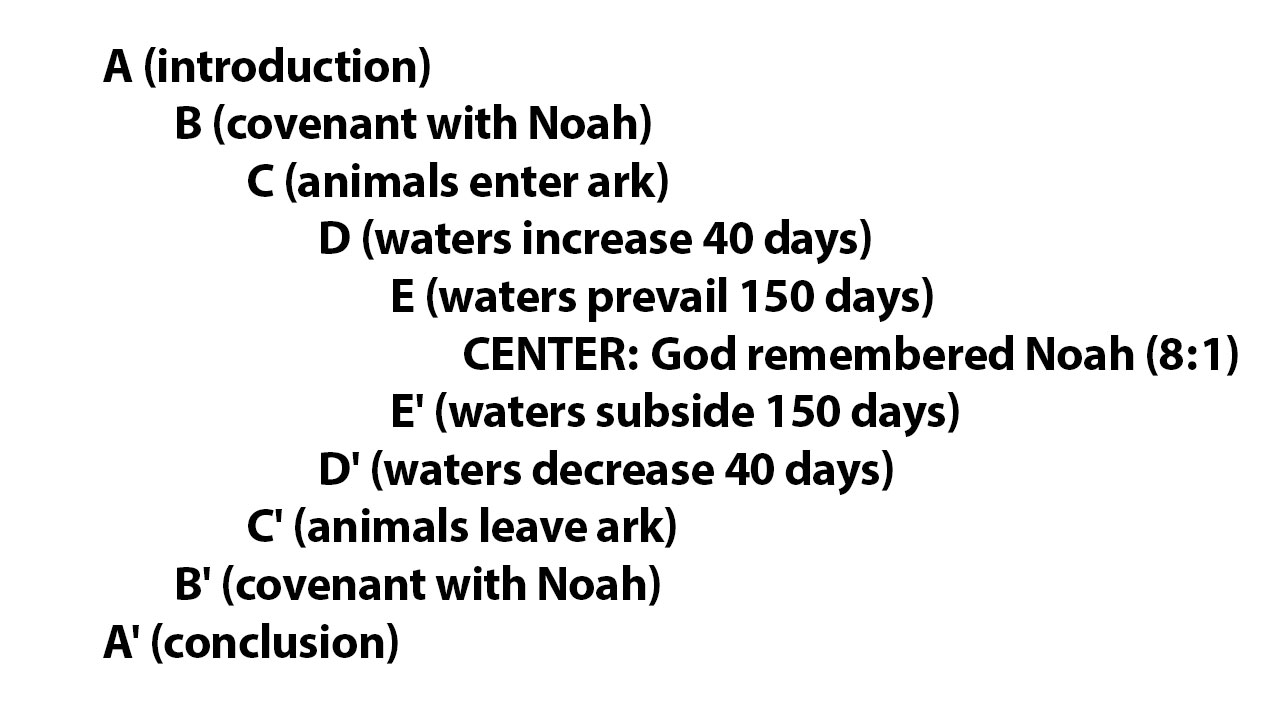
- The chapter ends with the waters at maximum and the world reduced to the ark. This is the deepest valley of the narrative. Everything that was made in Genesis 1 is gone except what’s on the ark. If the story ended here, it would end in absolute loss. But Genesis 8:1 is about to begin with three of the most beautiful words in scripture: “God remembered Noah.”
Reflection prompts
- The flood reverses the separations of Genesis 1. The waters above and below come back together, the dry land disappears, the mountains are covered. What happens when you read the flood as the cosmos coming apart at the seams of its design? How does that reframe your sense of what’s at stake when communities or relationships are described as “coming apart”?
- Yahweh shut him in. Noah doesn’t seal his own door. What in your life are you trying to seal yourself, that might actually be God’s job to seal?
- By the end of Genesis 7, the world is reduced to one wooden vessel and eight people on the water. What is preserved when everything else is taken? What’s on your ark right now?