

If Genesis 7 was de-creation, Genesis 8 is recreation. The flood narrative is structured as a long chiasm centered on the very first verse of this chapter: and God remembered Noah. Everything in chapters 6 through 9 mirrors around that pivot. From here on, the waters recede, the dry land returns, the breath of life resurfaces, and humanity steps off the ark into a world that is, in some real sense, made again.
The chapter ends with the first altar in the Bible, the first sacrifice, and a promise: God will not curse the ground again because of humans. The covenant proper will come in chapter 9, with the rainbow. But Genesis 8 already has the inflection. The cosmos has been rebuilt, and the relationship between God and the new humanity has a different tone than the one before the flood.
→ Read the chiastic structure framework for the literary architecture this chapter sits at the center of.
A · Genesis 8:1–5 · God remembered Noah
¹ God remembered Noah, all the animals, and all the livestock that were with him in the ship; and God made a wind to pass over the earth. The waters subsided. ² The deep’s fountains and the sky’s windows were also stopped, and the rain from the sky was restrained. ³ The waters receded from the earth continually. After the end of one hundred fifty days the waters decreased. ⁴ The ship rested in the seventh month, on the seventeenth day of the month, on Ararat’s mountains. ⁵ The waters receded continually until the tenth month. In the tenth month, on the first day of the month, the tops of the mountains were visible.
- God remembered Noah. The Hebrew is vayizkor Elohim et-Noach. “Remembered” doesn’t mean God had forgotten. The verb zakar in the Hebrew Bible means more than mental recall. It means to act in light of a relationship, to bring a person or covenant back into active care. When God remembers Hannah (1 Samuel 1:19), she conceives. When God remembers his covenant with Abraham (Exodus 2:24), the exodus begins. When God remembers Noah, the flood reverses. Remembering, in the Hebrew Bible, is the divine act that turns a situation around.
- “God made a wind to pass over the earth.” The word for “wind” is ruach. In Genesis 1:2, the ruach of God hovered over the formless waters. Now, with the cosmos again under water, the ruach moves again. Genesis is telling us, in the language of Genesis 1 itself, that this is a re-creation. The Spirit who hovered before is hovering again. The same wind, the same God, the same act.
- “The deep’s fountains and the sky’s windows were also stopped.” Genesis 7:11 said the fountains burst open and the windows opened. Now the same two structures are closed. The de-creation is being put back together piece by piece, in reverse.
- “The ship rested in the seventh month, on the seventeenth day of the month, on Ararat’s mountains.” The Hebrew word for “rested” is vatanach, from the root nuach, the same root as Noah’s name (Noach). The rester finally rests. Lamech named his son for hope of rest from the cursed ground (5:29); now, in the seventh month, on Ararat, the ark rests. The naming has become true.
- The dating is precise. The seventeenth day of the second month (7:11) was when the flood began. The seventeenth day of the seventh month is when the ark rests. Five months exactly. The numerology is intentional.
B · Genesis 8:6–14 · The raven, the dove, the dry land
⁶ At the end of forty days, Noah opened the window of the ship which he had made, ⁷ and he sent out a raven. It went back and forth, until the waters were dried up from the earth. ⁸ He himself sent out a dove to see if the waters were abated from the surface of the ground, ⁹ but the dove found no place to rest her foot, and she returned to him into the ship; for the waters were on the surface of the whole earth. He put out his hand, and took her, and brought her to him into the ship. ¹⁰ He waited yet another seven days; and again he sent the dove out of the ship. ¹¹ The dove came back to him at evening, and behold, in her mouth was a freshly plucked olive leaf. So Noah knew that the waters were abated from the earth. ¹² He waited yet another seven days, and sent out the dove; and she didn’t return to him any more. ¹³ In the six hundred first year, in the first month, the first day of the month, the waters were dried up from the earth. Noah removed the covering of the ship, and looked. He saw that the surface of the ground was dried. ¹⁴ In the second month, on the twenty-seventh day of the month, the earth was dry.
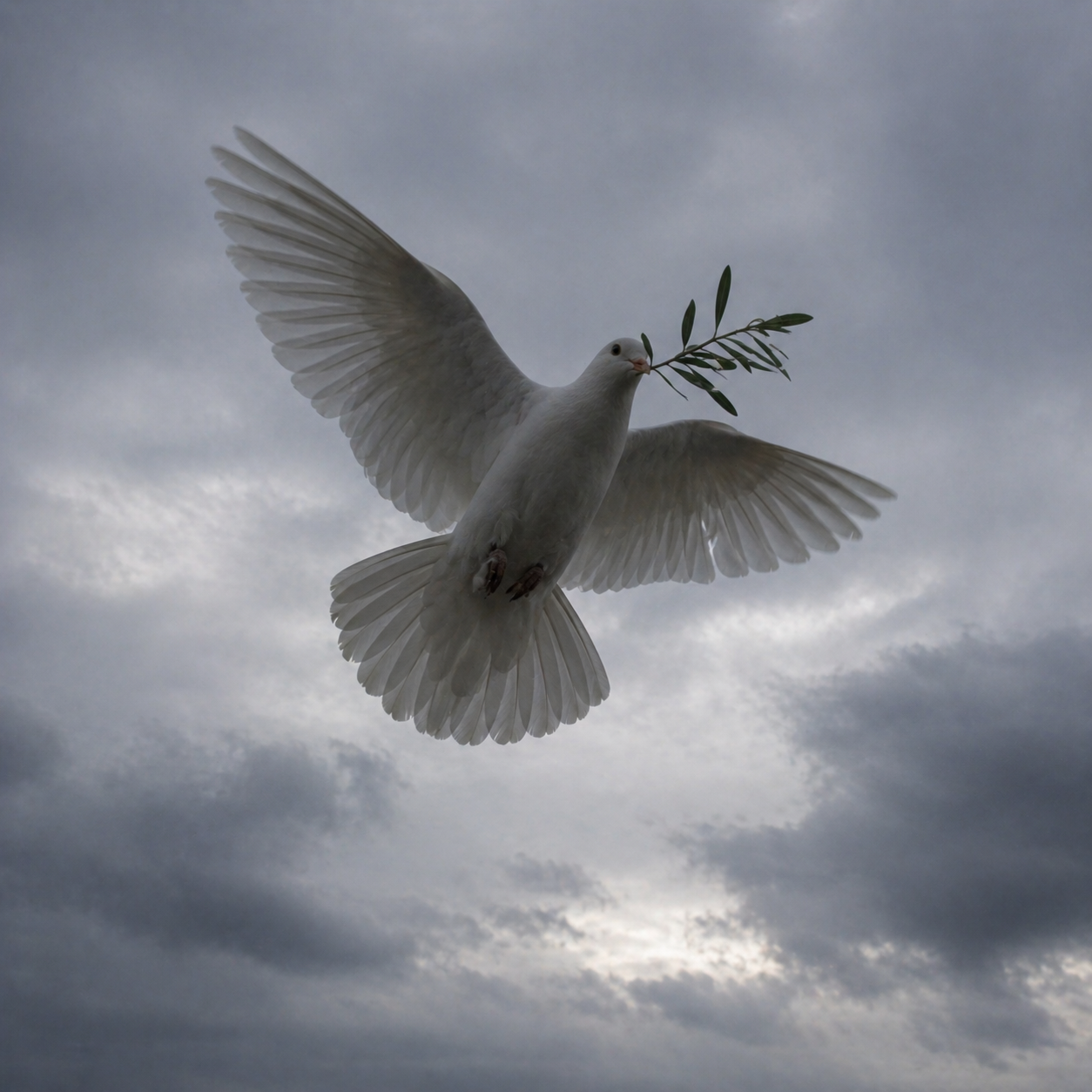
- The raven first. Ravens are scavengers; the raven would have been able to feed on any floating carrion and stay aloft. It “went back and forth,” and the Hebrew suggests a restless, unresolved circulation. The raven is honest about the world’s state: there’s enough to scavenge, but no settled place to land.
- Then the dove. The dove won’t eat carrion. She needs living vegetation. Her first flight returns her empty: no place to rest. Her second flight, after another seven days, returns her with an olive leaf. The olive tree is one of the longest-lived trees in the Mediterranean ecology, and it has the capacity to regrow from its roots even after catastrophic loss. The olive leaf is, in itself, a sign of new growth: proof that life is returning.
- The dove image will become one of the most loaded symbols in scripture. The Spirit of God descends like a dove on Jesus at his baptism (Matthew 3, parallels). The dove of Genesis 8 is the first instance of this image, the Spirit-creature returning with evidence of new life. Genesis is planting a seed the rest of scripture will harvest.
- “He waited yet another seven days.” The pattern is sevens again. Noah’s waiting is patient and structured. He doesn’t rush off the ark. He listens, releases the dove, waits, releases again, waits again. The man who walked with God walks slowly.
- “Noah removed the covering of the ship, and looked. He saw that the surface of the ground was dried.” Noah opens the roof and looks. The verb is the same one used of Adam looking on his wife (ra’ah). It’s the verb for seeing in the deeper sense: recognizing, perceiving. Noah sees the world is back. After a year on the water, the ground is visible again.
C · Genesis 8:15–19 · Disembarking, the new earth
¹⁵ God spoke to Noah, saying, ¹⁶ “Go out of the ship, you, your wife, your sons, and your sons’ wives with you. ¹⁷ Bring out with you every living thing that is with you of all flesh, including birds, livestock, and every creeping thing that creeps on the earth, that they may breed abundantly in the earth, and be fruitful, and multiply on the earth.” ¹⁸ Noah went out, with his sons, his wife, and his sons’ wives with him. ¹⁹ Every animal, every creeping thing, and every bird, whatever moves on the earth, after their families, went out of the ship.
- “Be fruitful, and multiply on the earth.” This is the same blessing God spoke over the creatures and humans in Genesis 1:22 and 1:28. The blessing is being re-issued. The post-flood world is meant to be fruitful, generative, populated, the way the original creation was. The flood didn’t end the project. It re-launched it.
- Notice that this commission goes first to the animals. They are blessed to “breed abundantly,” “be fruitful,” “multiply.” The earth itself is to teem again. Genesis 8 is honest about the cost of the flood (the catalogue of dead in chapter 7 was real), but it’s also clear that the project of creation is resuming.
- “After their families.” Hebrew lemishpechothayhem. The text is preserving the category-language of Genesis 1 (“after their kind”) but with a slight evolution. Mishpachah means “family” or “clan.” Creation comes off the ark not as a chaotic mass but as ordered families, ready to generate the populations that will refill the earth.
- “Noah went out.” A simple line, but loaded. He’s been on the ark for over a year. He steps out onto an earth that is recognizably continuous with the world before the flood and yet utterly transformed. The mountains are the same; the ground is the same; the animals are the same. But the violent civilization Noah was born into is gone. He stands at the front edge of a new humanity.
D · Genesis 8:20–22 · The altar, the smell, the promise
²⁰ Noah built an altar to Yahweh, and took of every clean animal, and of every clean bird, and offered burnt offerings on the altar. ²¹ Yahweh smelled the pleasant aroma. Yahweh said in his heart, “I will not again curse the ground any more for man’s sake because the imagination of man’s heart is evil from his youth. I will not again strike every living thing, as I have done. ²² While the earth remains, seed time and harvest, and cold and heat, and summer and winter, and day and night will not cease.”
- The first altar in the Bible. Noah builds it. The text gives no record of God commanding it. Worship comes spontaneously out of survival. The man who has just stepped off the ark, whose first act on the new earth is not to plant or to build, but to thank. Genesis is making a quiet theological claim here: gratitude is the primary post-flood response.
- “Yahweh smelled the pleasant aroma.” The Hebrew is reach nichoach, “soothing aroma.” The same phrase will recur all through Leviticus, describing the offerings God receives. We’re at the headwaters of all biblical sacrifice. The first altar, the first burnt offerings, the first time God receives worship by smell. Notice also that the verb nichoach shares its root with nuach and with Noach. There’s a cluster of resting and pleasing words around Noah’s name. The man named for rest causes God to be pleased.
- “I will not again curse the ground any more for man’s sake.” Genesis 3:17 cursed the ground because of Adam’s eating. Genesis 8:21 reverses that. God isn’t reversing the entire post-Eden condition (we still live east of Eden, mortality is still real, work is still hard), but the specific increase of cursing-the-ground that came at the flood is now lifted. The ground will not be subjected to this kind of de-creation again.
- “Because the imagination of man’s heart is evil from his youth.” This is striking. Almost the same words used in 6:5 to justify the flood are now used to justify God’s promise not to repeat the flood. In chapter 6, human wickedness was the reason for the flood. In chapter 8, the same wickedness becomes the reason God will absorb it differently going forward. The covenant-grace that’s coming in chapter 9 is built on this realization: humans are going to keep being humans. God knows. The new arrangement will work with that fact, not pretend it away.
- “While the earth remains, seed time and harvest, and cold and heat, and summer and winter, and day and night will not cease.” Six pairs in three rhythms. Seed time and harvest (agricultural). Cold and heat (climatic). Summer and winter (seasonal). Day and night (diurnal). The text is naming the structures of natural rhythm and committing them. From here on, the earth will continue. The cosmos has been re-anchored to predictable cycles. Genesis is making a theological claim: there is a covenant of seasons underlying every harvest, every cold morning, every sunset. The ordinary functioning of the world is itself an act of divine faithfulness.
Reflection prompts
- God remembered Noah is the chiastic center of the entire flood narrative. The story turns on the divine act of remembering. When in your life have you experienced what felt like God’s remembering after a long stretch of feeling forgotten? What changed?
- The dove finds an olive leaf, the sign of new growth after total loss. Where in your life are you currently looking for an olive leaf? What would constitute, for you, evidence that the waters are receding?
- Noah’s first act on the new earth is to build an altar. Worship comes before settlement, before farming, before rebuilding. What would it look like to make gratitude your first response to coming through something difficult, rather than an afterthought once you’ve recovered?