

Matthew 7 closes the Sermon on the Mount. The chapter is structured as a series of two-way contrasts that bring the discourse to its decision-point. After the kingdom’s blessings (chapter 5) and the kingdom’s daily practices (chapter 6), the disciple is now being called to a choice. The chapter’s structuring images come in pairs: the speck and the log (judgment), pearls and pigs (discernment), the asking and the giving (prayer), the narrow gate and the wide gate (way), the good tree and the bad tree (fruit), the doer and the talker (profession), the wise builder and the foolish builder (foundation). The Sermon ends with the crowd’s astonishment and the formal narrative-closure formula that Matthew uses for each of his five discourses: and it happened, when Jesus had finished saying these things.
The chapter is doing wisdom-literature work in its closing form. The two-ways teaching (Psalm 1, Deuteronomy 30, Proverbs 4 the way of the wicked vs. the path of the righteous) is the Hebrew Bible’s foundational discipleship structure. The gospel inherits the form and applies it to the kingdom’s call. The disciple is presented with a choice: enter or not, build on rock or on sand, bear fruit or not. The chapter’s closing rhetoric is not subtle. The decision matters.
Beneath the structural moves is the chapter’s deepest pastoral move: the prayer of the disciple is heard. Ask, and it shall be given to you. If you then, being evil, know how to give good gifts to your children, how much more will your Father in heaven give good things to those who ask him? The disciple is being assured, before being asked to choose, that the Father can be trusted with the asking. The decision the chapter calls for is made under the canopy of a Father whose character has just been described as more reliable than the disciple’s own.
A · Matthew 7:1–12 · Judging, asking, the golden rule
¹ “Don’t judge, so that you won’t be judged. ² For with whatever judgment you judge, you will be judged; and with whatever measure you measure, it will be measured to you. ³ Why do you see the speck that is in your brother’s eye, but don’t consider the beam that is in your own eye? ⁴ Or how will you tell your brother, ‘Let me remove the speck from your eye;’ and behold, the beam is in your own eye? ⁵ You hypocrite! First remove the beam out of your own eye, and then you can see clearly to remove the speck out of your brother’s eye. ⁶ “Don’t give that which is holy to the dogs, neither throw your pearls before the pigs, lest perhaps they trample them under their feet, and turn and tear you to pieces. ⁷ “Ask, and it will be given you. Seek, and you will find. Knock, and it will be opened for you. ⁸ For everyone who asks receives. He who seeks finds. To him who knocks it will be opened. ⁹ Or who is there among you who, if his son asks him for bread, will give him a stone? ¹⁰ Or if he asks for a fish, who will give him a serpent? ¹¹ If you then, being evil, know how to give good gifts to your children, how much more will your Father who is in heaven give good things to those who ask him! ¹² Therefore whatever you desire for men to do to you, you shall also do to them; for this is the law and the prophets.” (Matthew 7:1–12, World English Bible)
- Don’t judge, so that you won’t be judged (verse 1). The Greek me krinete, hina me krithete, “do not judge, that you not be judged,” uses the cognate active and passive forms of krino (to judge). The chapter is recording, with characteristic verbal precision, the kingdom’s reciprocal grammar: the standards the disciple applies to others will be applied back. The teaching is not a prohibition of all moral discernment (verses 6 and 15 will require discernment); it is a prohibition of the condemning, person-evaluating judgment that puts the disciple in God’s seat. The Greek krino is broad. At root it means to sort or to separate, and first-century usage stretches across at least three uses: judicial decision-making in court, ordinary discernment between wise and foolish or healthy and unhealthy, and the condemning separation of people into in-groups and out-groups. Luke’s parallel (Luke 6:37) clarifies which use Jesus is targeting by pairing do not judge with do not condemn. The chapter is forbidding the third (the condemning sort that ranks human worth) without forbidding the second (the discernment between wise and foolish ways the next twenty verses will require).
- Why do you see the speck that is in your brother’s eye, but don’t consider the beam that is in your own eye? (verse 3). The Greek karphos (speck, splinter) and dokos (beam, log) are deliberately disproportionate. The chapter is recording, with characteristic Jewish-rabbinic humor, the absurdity of the pattern: the speck-noticer has a log in his own eye. Jesus is not naming a hypothetical case; he is describing the actual pattern of religious life that the entire Sermon on the Mount has been working against. The Pharisaic religious attention has been on small failures in others while ignoring large failures in self; the kingdom’s righteousness inverts that order. Self-examination comes before other-examination. The disciple-community will be a community of self-aware speck-removers, not a community of log-bearing speck-judges.
- Don’t give that which is holy to the dogs, neither throw your pearls before the pigs (verse 6). The chapter pivots from over-judging to under-discerning. The Greek to hagion (the holy) and tous margaritas (the pearls) are paired with tois kysin (to dogs) and ton choiron (of pigs), both of which were ritually unclean animals in the Jewish context. The chapter is recording, with characteristic narrative care, that the kingdom’s anti-judgment teaching does not collapse into the absence of all discernment. The disciple is also called to know what is holy and to whom it can be entrusted. The cultural valence of dogs and pigs in first-century Jewish speech is worth a quiet note: the terms commonly functioned as shorthand for the surrounding pagan-Gentile world (much as Yanks or Rednecks function in regional American speech, neutral or insulting depending on tone). The pearls were a rabbinic image for valuable Torah-teaching and wisdom. On this reading, the saying is not anti-Gentile (the gospel will keep including Gentiles in the kingdom) but anti-imposition: the disciple-community is not to take its covenant-shaped ethical demands and force them on people who have not yet entered the covenant. Israelites cannot hand the Mosaic law to a Gentile and demand obedience to a covenant the Gentile has not entered; the Christian community cannot hand its discipleship-ethics to people who have not yet apprenticed to Jesus. The teaching is consistent with 7:1-5: the disciple’s first work is on the disciple, and the kingdom’s witness to the watching world is fruit-bearing rather than fruit-demanding.
- Ask, and it will be given you. Seek, and you will find. Knock, and it will be opened for you (verse 7). The Greek aiteite, kai dothesetai hymin; zeteite, kai heuresete; krouete, kai anoigesetai hymin, “ask and it will be given you; seek and you will find; knock and it will be opened to you,” uses three present-tense imperatives. The verbs imply continuing action: keep asking, keep seeking, keep knocking. The asking-life is the disciple’s basic posture toward the Father. The chapter is closing the Sermon with a prayer-promise that frames the discourse’s demands: the disciple is being called to extraordinary obedience (the antitheses, the secret-righteousness, the seeking-first-the-kingdom), and the resources for that obedience come through sustained asking. This is not a name-it-and-claim-it transaction; it is the patient asking-life of the disciple who knows the Father.
- If you then, being evil, know how to give good gifts to your children, how much more will your Father who is in heaven give good things to those who ask him! (verse 11). The Greek poso mallon, “how much more,” is the rabbinic kal va-chomer argument-form (the light-and-heavy: if the lesser case is true, how much more the greater). The chapter is recording, with characteristic Jewish-rabbinic-style argumentation, that the Father’s giving exceeds even the imperfect human parent’s giving. The argument is doing standard first-century Jewish reasoning, not Greek philosophical syllogism.
Word study: kal va-chomer (קַל וָחֹמֶר), “the light and the heavy” (Jewish hermeneutical principle)
The Hebrew name for the rabbinic interpretive principle Jesus uses in 7:11 (and frequently throughout the gospels). Kal va-chomer is the a fortiori argument: if a teaching is true in a lesser case, it is more certainly true in a greater case. If you, being evil, give good gifts … how much more will your Father. The principle is the first of Hillel’s seven middot (rules of interpretation), formalized in the first century. The chapter is recording, in deliberate rabbinic-form, that Jesus is teaching as a rabbi who uses the standard rabbinic interpretive moves. The argument is not just about prayer; it is also a demonstration of the kind of teacher Jesus is. The crowd at 7:29 will recognize the s’micha-authority precisely because they recognize the rabbinic technique being used.
- Therefore whatever you desire for men to do to you, you shall also do to them; for this is the law and the prophets (verse 12). The Greek panta oun hosa ean thelete hina poiosin hymin hoi anthropoi, houtos kai hymeis poieite autois, “therefore everything that you wish people would do to you, so do you to them,” is the chapter’s most famous line, the so-called Golden Rule. The chapter is recording, with characteristic narrative care, that this principle is the law and the prophets in summary form. The Torah’s whole heart-direction is condensed to a single relational principle.
Influence callout: David Stern (Jewish New Testament Commentary), the Hillel parallel
Stern’s reading of the Golden Rule names the rabbinic-tradition parallel. Hillel the Elder, the leading Pharisaic teacher of the generation just before Jesus, was once asked by a Gentile to teach him the entire Torah while standing on one foot. Hillel famously answered: what is hateful to you, do not do to your neighbor; that is the whole Torah, and the rest is commentary; go and learn it (Babylonian Talmud, Shabbat 31a). Jesus’s formulation is the positive version of Hillel’s negative version. Stern argues that Jesus is teaching, in 7:12, a principle the rabbinic tradition had already identified as the heart of Torah. The chapter is recording the deep continuity between Jesus’s teaching and the best of the Pharisaic tradition. Hillel’s negative formulation and Jesus’s positive formulation are saying the same thing in slightly different forms. The Jewish tradition had already found the heart of Torah; Jesus is restating it as the foundation of the kingdom community.
B · Matthew 7:13–23 · Two gates, two trees, two professions
¹³ “Enter in by the narrow gate; for the gate is wide, and the way is broad that leads to destruction, and there are many who enter in by it. ¹⁴ How narrow is the gate, and restricted is the way that leads to life! Few are those who find it. ¹⁵ “Beware of false prophets, who come to you in sheep’s clothing, but inwardly are ravening wolves. ¹⁶ By their fruits you will know them. Do you gather grapes from thorns or figs from thistles? ¹⁷ Even so, every good tree produces good fruit, but the corrupt tree produces evil fruit. ¹⁸ A good tree can’t produce evil fruit, neither can a corrupt tree produce good fruit. ¹⁹ Every tree that doesn’t grow good fruit is cut down, and thrown into the fire. ²⁰ Therefore by their fruits you will know them. ²¹ “Not everyone who says to me, ‘Lord, Lord,’ will enter into the Kingdom of Heaven; but he who does the will of my Father who is in heaven. ²² Many will tell me in that day, ‘Lord, Lord, didn’t we prophesy in your name, in your name cast out demons, and in your name do many mighty works?’ ²³ Then I will tell them, ‘I never knew you. Depart from me, you who work iniquity.’” (Matthew 7:13–23, World English Bible)
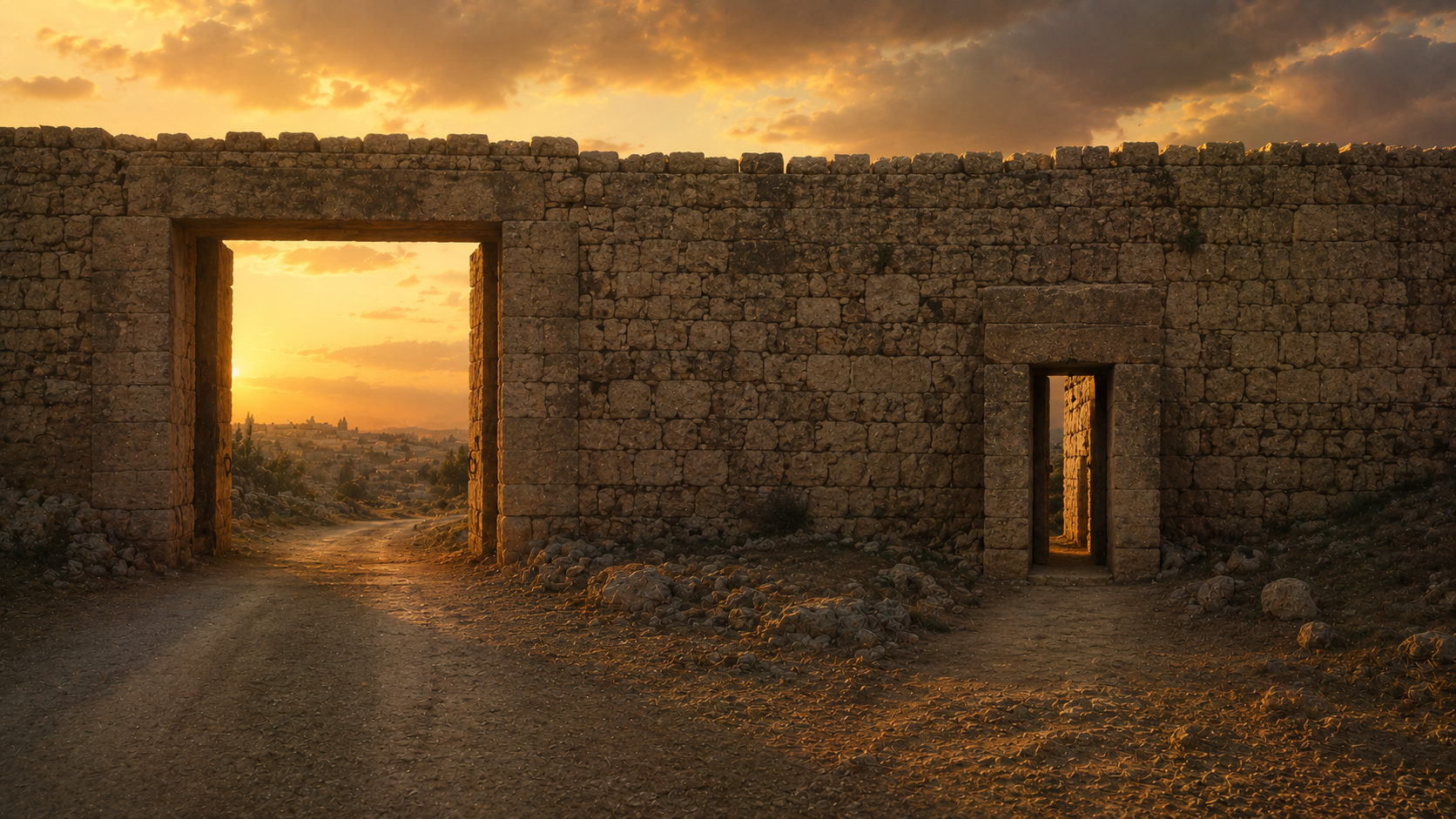
- Enter in by the narrow gate (verse 13). The chapter pivots from the asking-promise to the choice-call. The Greek eiselthate dia tes stenes pyles, “enter through the narrow gate,” uses the imperative aorist (decisive single action). The chapter is recording, with characteristic narrative directness, the kingdom’s call: choose the narrow gate, knowing that the broad gate is the path of the many. Worth a careful read of the destination-vocabulary, because later Christian tradition has often loaded the verse with afterlife-categories Jesus does not use here. The Greek apoleia (rendered destruction in most English translations) means waste, ruin, or loss. The only other place Matthew uses the word is at 26:8, where the disciples complain about the waste of the expensive perfume Mary pours on Jesus. Jesus has not been talking about heaven and hell as eternal destinations across the Sermon on the Mount; he has been talking about how to live as the kingdom’s people. The narrow way the chapter is calling for is the difficult way of love-of-neighbor, enemy-love, secret-righteousness, and Torah-deepening that the previous three chapters have just described. The wide way is the natural-default common-sense way most lives drift into. Both ways are real lives lived now; the life the narrow gate leads to is the kingdom-life Jesus has been describing, and the waste the wide gate leads to is the loss of that kind of life. The chapter may also have eschatological resonance, but its primary register is the difference between two ways of being human in the world.
Influence callout: Marty Solomon (the “two ways” reading)
Solomon’s reading of the narrow-gate teaching names it as the chapter’s deliberate echo of the two-ways tradition that runs throughout the Hebrew Bible. Deuteronomy 30:15-20 frames the entire covenant as a two-ways choice: I have set before you life and death, blessing and curse; therefore choose life. Psalm 1 opens the Psalter with the same two-ways structure: the way of the righteous versus the way of the wicked. Proverbs 4:14-19 contrasts the path of the wicked with the path of the righteous. Solomon argues that Jesus is doing wisdom-tradition teaching in its most foundational Hebrew form. The chapter is recording, with characteristic Hebrew Bible literacy, that the Sermon on the Mount’s closing rhetoric is the Hebrew Bible’s deepest discipleship-form: two ways, two outcomes, choose. The Didache (the early Christian teaching document) opens with this same two-ways structure, drawing directly on the chapter’s pattern. The kingdom’s discipleship-call is the Hebrew Bible’s discipleship-call, now being issued by the kingdom’s king.
- Beware of false prophets, who come to you in sheep’s clothing, but inwardly are ravening wolves (verse 15). The chapter introduces the false-prophet category. The Greek en endymasi probaton, “in clothing of sheep,” and lykoi harpages, “ravening wolves,” are paired vivid images. The chapter is recording, with characteristic narrative directness, that the disciple-community will encounter teachers whose appearance is one thing and whose substance is another. The discernment-call of 7:6 is now being applied to leaders.
- By their fruits you will know them (verse 16). The Greek apo ton karpon auton epignosesthe autous, “by their fruits you will know them,” is the chapter’s diagnostic principle. The Hebrew Bible’s prophetic tradition repeatedly evaluated prophets by their effects (Deuteronomy 18:21-22). The chapter is recording, with characteristic Hebrew Bible literacy, that the kingdom’s discernment is fruit-based. Words and credentials and miraculous performances do not certify; the actual outcome of the life and the teaching does.
- Not everyone who says to me, “Lord, Lord,” will enter into the Kingdom of Heaven; but he who does the will of my Father who is in heaven (verse 21). The Greek ho poion to thelema tou patros mou, “the one doing the will of my Father,” is the chapter’s core discipleship-criterion. The kingdom’s exclusion-criterion is unsparing: confession is not enough; doing the will is what matters. The people in 7:22 who are excluded are not the irreligious; they are people who prophesied in Jesus’s name, cast out demons in Jesus’s name, and did many mighty works in Jesus’s name. Even spectacular religious activity is not the kingdom’s currency. The kingdom’s currency is doing the will of the Father, the kind of life the Sermon on the Mount has been describing for three chapters: the Beatitudes, the salt-and-light vocation, the Torah-deepening of the antitheses, the secret-righteousness of chapter 6, the seeking-first-the-kingdom of 6:33, the asking-life of 7:7. The disciple who does this is in; the disciple who professes this without doing it is the one Jesus never knew. The chapter is the Sermon’s closing call to integration. The list of things that are not by themselves the kingdom’s fruit is worth pausing over, because it tracks closely with what large stretches of contemporary American religious culture treat as the markers of fruit. Spectacular spiritual gifts, mighty works, prophetic speech, religious confession, large-scale miraculous ministry: these are precisely the items the speakers in 7:22 list to plead their case, and Jesus’s answer is that none of them is sufficient. The Galatians 5 fruit-of-the-Spirit list (love, joy, peace, patience, kindness, goodness, faithfulness, gentleness, self-control) is the kind of fruit the chapter is asking the disciple to look for, in self and in teachers. Orthopraxy (right practice) functions in the chapter as the test that orthodoxy alone cannot pass.
C · Matthew 7:24–29 · The two builders and the crowd’s astonishment
²⁴ “Everyone therefore who hears these words of mine and does them, I will liken him to a wise man who built his house on a rock. ²⁵ The rain came down, the floods came, and the winds blew and beat on that house; and it didn’t fall, for it was founded on the rock. ²⁶ Everyone who hears these words of mine and doesn’t do them will be like a foolish man who built his house on the sand. ²⁷ The rain came down, the floods came, and the winds blew and beat on that house; and it fell, and great was its fall.” ²⁸ When Jesus had finished saying these things, the multitudes were astonished at his teaching, ²⁹ for he taught them with authority, and not like the scribes. (Matthew 7:24–29, World English Bible)
- Everyone therefore who hears these words of mine and does them, I will liken him to a wise man who built his house on a rock (verse 24). The chapter closes with the wise-and-foolish-builder pair. The Greek hostis akouei mou tous logous toutous kai poiei autous, “whoever hears these words of mine and does them,” restates the integration-criterion of 7:21. The chapter is recording, with characteristic narrative directness, that the Sermon on the Mount is meant to be done, not just heard.
- The wise-and-foolish-builders pair signals the Sermon’s wisdom-literature signature. The Hebrew Bible’s wisdom tradition (especially Proverbs) repeatedly uses the contrast between the chakam (wise) and the kesil (fool) as its organizing diagnostic. The Sermon is bracketed by Hebrew wisdom-tradition vocabulary: the blessed-flourishing (ashrei) of 5:3-12 at the front, the wise-builder of 7:24-25 at the close. The new son of David, the new wisdom-teacher, delivers wisdom that exceeds Solomon’s own (because Solomon-the-king built houses on the wrong foundations, while this Son of David teaches the foundation that does not fall).
- The rain came down, the floods came, and the winds blew and beat on that house; and it didn’t fall, for it was founded on the rock (verse 25). The Greek epi ten petran, “on the rock,” uses the rock-vocabulary that runs through the Psalter (Psalm 18:2; 31:2; 71:3 be a rock of refuge). The chapter is recording, with characteristic Hebrew Bible literacy, that the foundation-image is the Psalter’s foundation-image. The wise builder is on the rock the Hebrew Bible has long named.
- Everyone who hears these words of mine and doesn’t do them will be like a foolish man who built his house on the sand (verse 26). The Greek epi ten ammon, “on the sand,” is the Hebrew Bible’s image of foundationlessness (Job 4:19 whose foundation is in the dust; Ezekiel 13:11-15, the wall built without mortar). The chapter is recording the contrast: same storms, same rain and wind and floods, but the unfounded house collapses.
- And it fell, and great was its fall (verse 27). The Greek kai megale en he ptosis autes, “and great was its fall,” is the discourse’s most ominous closing image. The chapter is recording, with characteristic narrative restraint, that the discipleship-decision the Sermon has been calling for has real-world consequences. The disciple who hears without doing has built a house. The house will fall.
- When Jesus had finished saying these things, the multitudes were astonished at his teaching, for he taught them with authority, and not like the scribes (verses 28-29). The Greek kai egeneto hote etelesen ho Iesous tous logous toutous, “and it happened, when Jesus had finished saying these things,” is the formal closing-formula that Matthew uses to end each of his five teaching discourses (here at 7:28; also at 11:1; 13:53; 19:1; 26:1). The five-discourse architecture (Sermon on the Mount, the missionary discourse in chapter 10, the parables discourse in chapter 13, the community discourse in chapter 18, the Olivet discourse in chapters 24-25) marks the gospel as a new Pentateuch with five teaching-books. The chapter is recording, with characteristic narrative care, the structural seam between the Sermon (chapters 5-7) and the next narrative block (chapters 8-9, the ten miracles).
- He taught them with authority, and not like the scribes (verse 29). The Greek hos exousian echon, “as one having authority,” is the discourse’s most structurally important closing claim. The crowd’s recognition of exousia (authority) confirms what the chapter’s antitheses (5:21-48) had been claiming. Jesus has been teaching with the s’micha authority that the scribes do not have. The chapter is recording, with characteristic narrative care, that the audience has heard the rabbinic-authority claim and recognized it.
Influence callout: Marty Solomon (the s’micha-recognition reading)
Solomon’s reading of he taught with authority, not as their scribes names it as the chapter’s most theologically loaded closing. The scribes’ teaching pattern in first-century Pharisaic culture was to cite previous rabbis: Rabbi Hillel said… Rabbi Shammai said… The teaching was authoritative because it stood in the lineage of named teachers. Jesus’s pattern in the Sermon on the Mount has been radically different: but I say to you. The crowd recognizes that the teaching is not derivative. Solomon argues that Matthew is recording, in this closing line, the moment when the s’micha-authority is publicly recognized. The teacher’s source is not Hillel or Shammai or any rabbinic predecessor; the teacher is teaching directly. The chapter is closing with the question that will run through the rest of the gospel: where does this man’s authority come from, and what does it mean for the people who recognize it?
Reflection prompts
- The chapter opens with the speck-and-the-log: the most vigilant noticer of others’ small failures often has a large failure of his own to attend to first. Where in your life are you currently focused on a speck in someone else’s eye while a log sits in your own, and what does it mean to attend to the log first as the chapter requires?
- Ask, and it will be given. Seek, and you will find. Knock, and it will be opened. The three present-tense imperatives name a sustained asking-life rather than a one-time petition. Where in your life are you currently expecting a single prayer to do the work of a sustained asking, and what does it mean to be the kind of disciple whose prayer-life is the patient knocking the chapter describes?
- The Sermon ends with two builders facing the same storm. The difference between them is not the weather; it is the foundation. Where in your life are you currently hearing the Sermon on the Mount without doing it, and what storm is on its way that the unfounded house will not survive?