

Matthew 6 is the practical core of the Sermon on the Mount. Where chapter 5 named the citizens of the kingdom and re-interpreted Torah at its heart-level, chapter 6 turns to the daily disciplines of disciple-life. The chapter has three movements. The first (verses 1-18) walks through the three classical Jewish practices of righteousness: almsgiving (tzedakah), prayer (tefillah), and fasting (tzom). Each is to be done in secret, not for human reward but for the Father who sees in secret. The second (verses 19-24) names the heart’s economic reorientation: do not store up treasures on earth, watch your eye, you cannot serve two masters. The third (verses 25-34) is the chapter’s longest sustained teaching: do not worry about your life; consider the birds and the lilies; seek first the kingdom.
The chapter is not introducing new disciplines. Tzedakah, tefillah, and tzom were the three pillars of first-century Jewish religious life, and the rabbinic tradition had already developed extensive teaching about each. What Jesus is doing is inheriting the practices and deepening their interpretation, exactly as he did with the Torah commandments in chapter 5. The three antitheses of chapter 6 are not you have heard it said… but I say to you in form, but they are doing the same theological work: they have their reward… but you, when you do this, do it like this. The pattern is rabbinic-deepening rather than rabbinic-replacement.
At the chapter’s center sits the Lord’s Prayer (verses 9-13), the gospel’s most influential single teaching. The prayer is not a new prayer; it is a deeply Jewish prayer, drawing on the synagogue prayer tradition (the Kaddish, the Amidah, the Avinu Malkeinu) and gathering its key petitions into a compact disciple-formula. The prayer’s six petitions structure the chapter’s whole teaching about how the disciple is to live in relationship to God, to neighbor, and to the world.
A · Matthew 6:1–18 · Tzedakah, tefillah, and tzom done in secret
¹ “Be careful that you don’t do your charitable giving before men, to be seen by them, or else you have no reward from your Father who is in heaven. ² Therefore when you do merciful deeds, don’t sound a trumpet before yourself, as the hypocrites do in the synagogues and in the streets, that they may get glory from men. Most certainly I tell you, they have received their reward. ³ But when you do merciful deeds, don’t let your left hand know what your right hand does, ⁴ so that your merciful deeds may be in secret, then your Father who sees in secret will reward you openly. ⁵ “When you pray, you shall not be as the hypocrites, for they love to stand and pray in the synagogues and in the corners of the streets, that they may be seen by men. Most certainly, I tell you, they have received their reward. ⁶ But you, when you pray, enter into your inner room, and having shut your door, pray to your Father who is in secret; and your Father who sees in secret will reward you openly. ⁷ In praying, don’t use vain repetitions as the Gentiles do; for they think that they will be heard for their much speaking. ⁸ Therefore don’t be like them, for your Father knows what things you need before you ask him. ⁹ Pray like this: ‘Our Father in heaven, may your name be kept holy. ¹⁰ Let your Kingdom come. Let your will be done on earth as it is in heaven. ¹¹ Give us today our daily bread. ¹² Forgive us our debts, as we also forgive our debtors. ¹³ Bring us not into temptation, but deliver us from the evil one. For yours is the Kingdom, the power, and the glory forever. Amen.’ ¹⁴ For if you forgive men their trespasses, your heavenly Father will also forgive you. ¹⁵ But if you don’t forgive men their trespasses, neither will your Father forgive your trespasses. ¹⁶ “Moreover when you fast, don’t be like the hypocrites, with sad faces. For they disfigure their faces that they may be seen by men to be fasting. Most certainly I tell you, they have received their reward. ¹⁷ But you, when you fast, anoint your head, and wash your face, ¹⁸ so that you are not seen by men to be fasting, but by your Father who is in secret; and your Father, who sees in secret, will reward you.” (Matthew 6:1–18, World English Bible)
- Be careful that you don’t do your charitable giving before men, to be seen by them (verse 1). The Greek prosechete ten dikaiosynen hymon me poiein emprosthen ton anthropon, “watch your righteousness, do not perform it before people,” uses the same dikaiosyne (righteousness) word that ran through chapter 5 and through Joseph’s portrait in chapter 1. The chapter is recording, with characteristic verbal continuity, that the Sermon on the Mount is one unified teaching: the exceeding righteousness that 5:20 demanded is the not-performed-for-people righteousness that 6:1 begins to define.
Influence callout: Marty Solomon (the “Done in Secret” reading)
Solomon’s reading of the chapter’s opening eighteen verses names them as Jesus’s teaching on the three classical Jewish acts of righteousness: tzedakah (Hebrew צְדָקָה, “righteousness/charitable giving”), tefillah (prayer), and tzom (fasting). These three pillars had been the foundation of Jewish religious practice for centuries before Jesus, and they remain the foundation of Jewish religious life today (the High Holy Days liturgy explicitly names the three: teshuvah, tefillah, tzedakah, “repentance, prayer, charity”). The Hebrew Bible’s tzedakah (Genesis 15:6, Abraham believed God, and it was reckoned to him as tzedakah) was always relational: it named the right alignment of the person with God’s covenant. By the rabbinic period, the word had specialized to also mean the giving that maintains the right alignment with the community’s poor. Solomon argues that Jesus is not introducing new practices; he is teaching the right way to do the practices Israel has always practiced. Each of the three is to be done in secret, not for human reward, with the Father-who-sees-in-secret as the only audience that matters. The Pharisaic problem he is naming is not the practices themselves but the public performance of the practices.
- When you do merciful deeds, don’t sound a trumpet before yourself, as the hypocrites do in the synagogues and in the streets (verse 2). The Greek me salpises emprosthen sou, “do not trumpet before yourself,” is the chapter’s first vivid image. The trumpet-before-the-giving may refer literally to the trumpet-shaped collection horns that stood in the temple court (the shofarot), or it may be a metaphor for ostentatious announcement. Either reading captures the principle: the giving that wants to be seen has already received its reward.
- When you pray, you shall not be as the hypocrites (verse 5). The Greek hypokritai, “hypocrites,” literally means play-actors or performers. The word originally named the Greek theatrical tradition’s masked actors. The chapter is recording, with characteristic narrative precision, the Pharisaic problem Jesus is naming: religious practice has become a performance, a stage-craft, with the audience being the watching crowd rather than the watching God. The hypocrite is not the person who does not believe; the hypocrite is the person who turns the practice of belief into a performance.
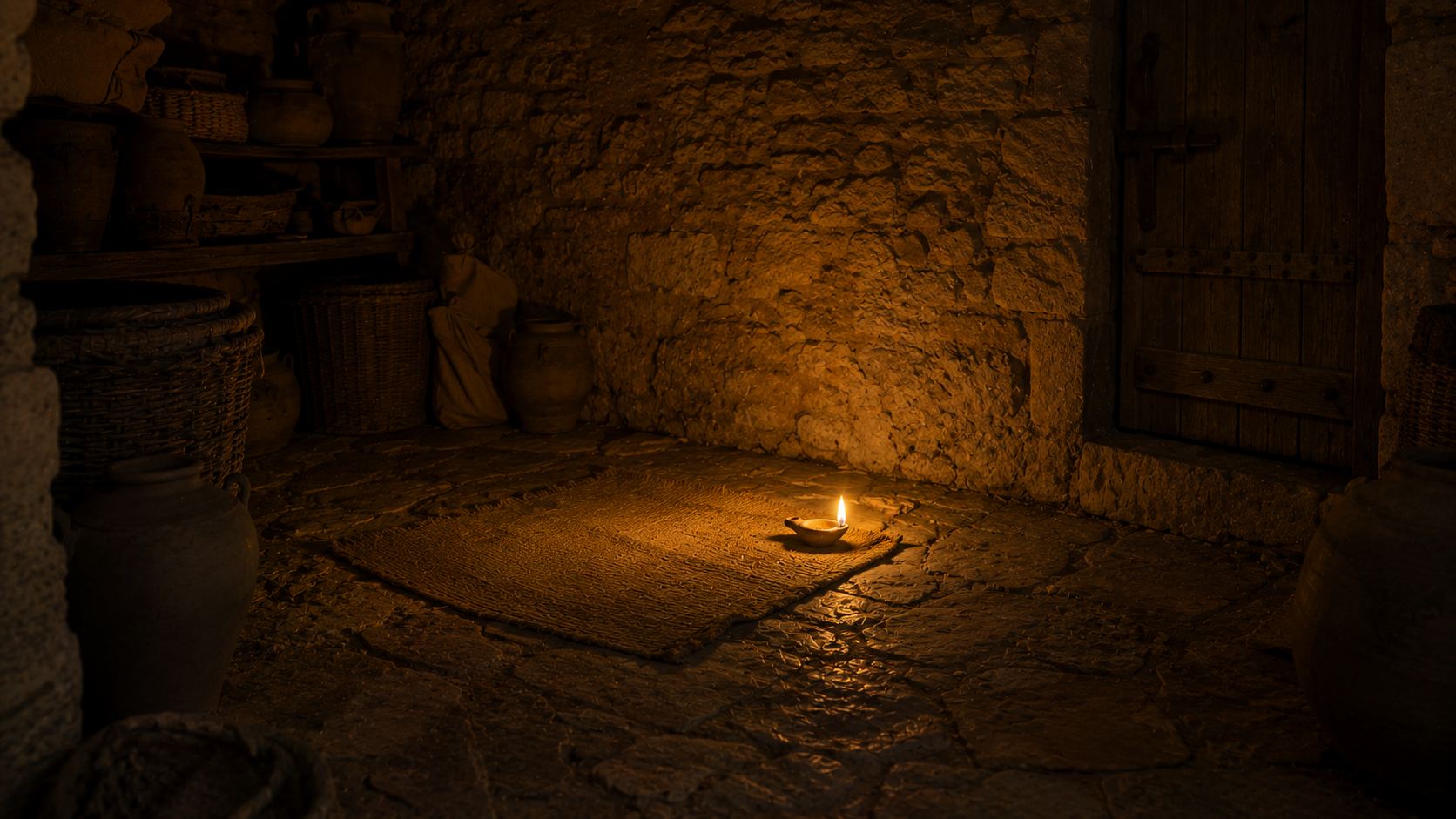
- When you pray, enter into your inner room, and having shut your door, pray to your Father who is in secret (verse 6). The Greek eis to tameion, “into the inner storeroom,” refers to the small windowless storage room in a typical first-century Galilean house. The chapter is recording, with characteristic cultural specificity, the most private space available to the disciple. Prayer is to be done in the room where no one can see. The kingdom’s prayer is not a public-relations exercise.
- In praying, don’t use vain repetitions as the Gentiles do; for they think that they will be heard for their much speaking (verse 7). The Greek me battalogesete, “do not babble,” names the Gentile practice of repeated formulas (the Greco-Roman religious tradition had elaborate prayer-formulas, sometimes hundreds of repetitions of divine names). The chapter is recording the contrast: the kingdom’s prayer is not formula-multiplication; it is honest address to a Father who already knows.
- Pray like this (verse 9). The Greek houtos oun proseuchesthe hymeis, “thus then pray you,” introduces the Lord’s Prayer. The chapter is recording, with characteristic narrative care, that what follows is not a transcript to be repeated word-for-word (though the church has rightly used it that way) but a model. Pray like this invites the disciple to pray prayers shaped by these patterns.
Influence callout: Marty Solomon (the prayer’s Jewish lineage)
Solomon’s reading of the Lord’s Prayer names it as a thoroughly Jewish prayer, gathering threads from the synagogue prayer tradition. The opening Our Father in heaven (Greek Pater hemon ho en tois ouranois) is identical in form to the rabbinic Avinu Malkeinu (“our Father, our King”) prayer-tradition. The petition may your name be kept holy echoes the Aramaic Kaddish prayer (yitgaddal v’yitqaddash sh’meh rabba, “may his great name be magnified and sanctified”). The petition let your kingdom come echoes the synagogue’s Amidah (the standing prayer recited multiple times daily). The petition forgive us our debts as we also forgive our debtors echoes the Yom Kippur liturgy. Solomon argues that Jesus is not inventing a new prayer; he is gathering the deepest Jewish prayer-tradition into one compact formula. The prayer is the disciple’s daily Jewish prayer condensed to its kingdom-essence. The chapter is recording, with characteristic Jewish-liturgical literacy, the gospel’s most enduring single prayer as a thoroughly Jewish piece of religious devotion.
- Our Father in heaven, may your name be kept holy (verse 9). The Greek hagiastheto to onoma sou, “let your name be sanctified,” is a passive-voice petition. The disciple is asking that God’s name be held holy in the world (and, by implication, that the disciple be one of the agents of that sanctification). The petition is the prayer’s first move: the disciple asks first for God’s reputation in the world, not for the disciple’s own needs.
- Let your Kingdom come. Let your will be done on earth as it is in heaven (verse 10). The Greek eltheto he basileia sou, “let your kingdom come,” is the prayer’s second petition. The kingdom is the gospel’s central announcement; the prayer makes the kingdom’s coming the disciple’s daily request. On earth as it is in heaven names the prayer’s deepest theological hope: the alignment of earth’s life with heaven’s pattern.
- Give us today our daily bread (verse 11). The Greek ton arton hemon ton epiousion dos hemin semeron, “give us today our daily bread,” uses the rare word epiousios (daily, or possibly “for the coming day”). The petition is the prayer’s pivot from God’s purposes to the disciple’s needs. The first three petitions concern God; the next three concern the disciple. Daily bread echoes the manna of Exodus 16: the disciple is asking for what is needed for the day, not for storehouses against the future.
- Forgive us our debts, as we also forgive our debtors (verse 12). The Greek opheilemata, “debts,” is the chapter’s most economically explicit word. Opheilema is a financial term: a debt owed. The chapter is recording, with characteristic verbal precision, that the prayer’s forgiveness-petition uses economic language. The disciple’s relationship to financial debts is being tied directly to the disciple’s relationship to spiritual debts. The connection is reinforced by 6:14-15 immediately after the prayer. This petition is also the Lord’s Prayer’s most genuinely original line. Compared with the Avinu Malkeinu, the Kaddish, the Amidah, and the wider synagogue prayer tradition (which already had requests for God’s name to be sanctified, for the kingdom to come, for daily provision, for forgiveness of the praying community’s sins), the petition that ties human-to-human forgiveness to God’s forgiveness is the new note. Jewish prayer-tradition routinely asked God to forgive his people; Jewish prayer-tradition did not routinely commit the praying person to forgiving others as the condition of receiving that forgiveness. Forgiveness was largely God’s vertical work, supported by reconciliation and restitution between people. By tying the two clauses together (forgive us … as we also forgive) and then commenting on this petition specifically in 6:14-15 (the only line of the prayer that gets follow-up commentary), Jesus is adding to the inherited prayer-form a horizontal forgiveness-vocation that becomes the disciple’s distinctive practice. The kingdom is not just God’s forgiveness extended to the disciple; the kingdom is the disciple participating in the same forgiveness-economy toward others.
Influence callout: N.T. Wright (the Jubilee-debt reading)
Wright’s reading of the opheilemata (debts) language names it as the prayer’s deepest economic-theological move. The first-century Jewish economic context was one of widespread peasant indebtedness; the Roman taxation-tax-collector system had pushed many small landholders into impossible debt-spirals. The Jubilee tradition (Leviticus 25) was the Hebrew Bible’s prescribed remedy: debt-cancellation every fifty years. Wright argues that Jesus, in teaching his disciples to pray forgive us our debts as we forgive our debtors, is teaching them to pray for the kingdom’s economic-Jubilee as the ordinary content of daily prayer. The disciple does not just ask for personal sin-forgiveness; the disciple asks for and practices the Jubilee-economic forgiveness that the Hebrew Bible’s covenant economy required. The chapter is recording, in the prayer’s most demanding line, that the gospel’s forgiveness vocabulary is irreducibly economic and social.
- Bring us not into temptation, but deliver us from the evil one (verse 13). The Greek me eisenenkes hemas eis peirasmon, “do not bring us into testing,” uses the same root peirazo that the chapter 4 wilderness-temptation used. The prayer is asking that the disciple not be brought into the kind of testing Jesus himself faced in chapter 4. The petition acknowledges the weakness of the disciple compared to the Master: Jesus passed the test; the disciple should pray not to be brought to it.
Influence callout: Tertullian (On Prayer, c. 200 AD) and Cyprian (On the Lord’s Prayer, c. 250 AD)
The earliest Christian commentaries on the Lord’s Prayer come from Latin-speaking North Africa. Tertullian’s De Oratione (c. 200 AD) and Cyprian’s De Dominica Oratione (c. 250 AD) treat the prayer as the disciple’s compendium of the whole Christian life. Tertullian calls the prayer breviarium totius evangelii, “an abridgement of the whole gospel.” Cyprian, writing to congregations under the Decian persecution, reads each petition as the disciple’s daily rehearsal of the kingdom: thy kingdom come is the daily request that the kingdom Christ has inaugurated reach its full coming; thy will be done on earth as in heaven is the petition that the disciple’s body and soul become an instance of heaven’s pattern; forgive us as we forgive is the daily renewal of the church’s unity. Both fathers are clear that the prayer is to be prayed (the modern reduction of the prayer to a model not actually to be repeated is not the early church’s reading) and that the prayer is the foundation of Christian liturgy. Cyprian is the source of the Latin liturgical tradition that has shaped Catholic, Orthodox, and Reformed prayer-books for eighteen centuries. The site does not dismiss the model-vs-script question (Jesus’s pray like this in 6:9 has weight), but the early church’s instinct that the Lord’s Prayer is the church’s daily prayer, prayed in actual words, is the practice that has carried the prayer from the second century to the present day.
- When you fast, anoint your head, and wash your face (verse 17). The third practice (fasting) gets the same treatment. The Greek aleipsai sou ten kephalen, “anoint your head,” names the routine grooming of normal life. The chapter is recording, with characteristic narrative restraint, the kingdom’s principle: the fasting that wants to be noticed has already received its reward. Hidden fasting is the kingdom’s pattern.
- Hidden practice (verses 16-18). The third practice, fasting, is anti-storehouse and anti-display in the same way the first two were. The Greek epiousios in the daily-bread petition (verse 11) is one of the rarest words in the New Testament, used only in the Lord’s Prayer (here and in Luke 11:3); the most likely meaning is “necessary for existence” or “for the day.” The chapter’s whole economic claim is built into this one rare word: the disciple asks for what the day requires, no more. The petition is anti-storehouse, anti-accumulation, anti-anxiety. The kingdom’s economy runs day by day on what God provides.
B · Matthew 6:19–24 · Treasures, the eye, two masters
¹⁹ “Don’t lay up treasures for yourselves on the earth, where moth and rust consume, and where thieves break through and steal; ²⁰ but lay up for yourselves treasures in heaven, where neither moth nor rust consume, and where thieves don’t break through and steal; ²¹ for where your treasure is, there your heart will be also. ²² “The lamp of the body is the eye. If therefore your eye is sound, your whole body will be full of light. ²³ But if your eye is evil, your whole body will be full of darkness. If therefore the light that is in you is darkness, how great is the darkness! ²⁴ “No one can serve two masters, for either he will hate the one and love the other; or else he will be devoted to one and despise the other. You can’t serve both God and Mammon.” (Matthew 6:19–24, World English Bible)
- Don’t lay up treasures for yourselves on the earth, where moth and rust consume, and where thieves break through and steal (verse 19). The chapter pivots from the three practices to the heart’s economic orientation. The Greek me thesaurizete hymin thesaurous, “do not store up for yourselves treasures,” uses cognate noun and verb (thesaurizo and thesaurus) for emphasis. The chapter is recording the kingdom’s economic teaching directly: the disciple is not to be in the storage business.
- For where your treasure is, there your heart will be also (verse 21). The Greek hopou gar estin ho thesauros sou, ekei estai kai he kardia sou, “for where your treasure is, there will be your heart,” is the chapter’s central diagnostic principle. The chapter is recording, with characteristic narrative restraint, that the disciple’s location of treasure reveals (and shapes) the disciple’s heart. The teaching is not asking the disciple to control the heart; it is teaching that the heart follows the treasure. Move the treasure; the heart follows.
- The lamp of the body is the eye (verse 22). The Greek ho lychnos tou somatos estin ho ophthalmos, “the lamp of the body is the eye,” uses the eye-as-window image. The chapter is recording, with characteristic Hebrew Bible idiom, the Jewish wisdom-tradition vocabulary of the good eye and the evil eye.
Influence callout: Marty Solomon (the “A Good Eye” reading)
Solomon’s reading of 6:22-23 names it as one of the Sermon on the Mount’s most culturally specific passages. In Hebrew idiom, ayin tovah (עַיִן טוֹבָה, “good eye”) means generosity, the disposition of giving freely. Ayin ra’ah (עַיִן רָעָה, “evil eye”) means stinginess, greed, the disposition of grasping. The two terms are standard rabbinic vocabulary used throughout Pirkei Avot and the Mishnah. The Greek haplous (sound, single, healthy) translates tovah; poneros (evil, bad) translates ra’ah. Solomon argues that Jesus, in 6:22-23, is not making an ophthalmological statement; he is using a standard rabbinic idiom that his Jewish audience would have understood immediately. The good eye is the generous-giving eye; the evil eye is the grasping-hoarding eye. The verse is the bridge between the don’t store up treasures of 6:19-21 and the cannot serve God and Mammon of 6:24. The chapter is teaching, in a single Hebrew idiom, that the disciple’s eye is the diagnostic for the disciple’s relationship to wealth. A generous eye fills the body with light; a grasping eye fills the body with darkness. The entire chapter 6 economic teaching hinges on whether the disciple has ayin tovah or ayin ra’ah.
- No one can serve two masters, for either he will hate the one and love the other; or else he will be devoted to one and despise the other. You can’t serve both God and Mammon (verse 24). The Greek ou dunasthe theo douleuein kai mamona, “you cannot serve God and Mammon,” uses the Aramaic word mamona (Hebrew mammon) untranslated. Mammon is wealth-as-personal-loyalty, money-as-master, treasure-as-deity. Wealth is not a neutral tool; wealth is a rival deity that competes for the disciple’s allegiance. The Roman world ran on the assumption that wealth-accumulation was the basic measure of human flourishing; the Pax Romana was the peace held by the wealthy. Jesus’s teaching is a direct refusal of the empire’s economic theology. Mammon is named as a rival deity, not as a useful tool, and the disciple is being asked to choose.
C · Matthew 6:25–34 · Do not worry; seek first the kingdom
²⁵ Therefore I tell you, don’t be anxious for your life: what you will eat, or what you will drink; nor yet for your body, what you will wear. Isn’t life more than food, and the body more than clothing? ²⁶ See the birds of the sky, that they don’t sow, neither do they reap, nor gather into barns. Your heavenly Father feeds them. Aren’t you of much more value than they? ²⁷ “Which of you, by being anxious, can add one moment to his lifespan? ²⁸ Why are you anxious about clothing? Consider the lilies of the field, how they grow. They don’t toil, neither do they spin, ²⁹ yet I tell you that even Solomon in all his glory was not dressed like one of these. ³⁰ But if God so clothes the grass of the field, which today exists, and tomorrow is thrown into the oven, won’t he much more clothe you, you of little faith? ³¹ “Therefore don’t be anxious, saying, ‘What will we eat?’, ‘What will we drink?’ or, ‘With what will we be clothed?’ ³² For the Gentiles seek after all these things; for your heavenly Father knows that you need all these things. ³³ But seek first God’s Kingdom, and his righteousness; and all these things will be given to you as well. ³⁴ Therefore don’t be anxious for tomorrow, for tomorrow will be anxious for itself. Each day’s own evil is sufficient.” (Matthew 6:25–34, World English Bible)
- Therefore I tell you, don’t be anxious for your life: what you will eat, or what you will drink; nor yet for your body, what you will wear (verse 25). The Greek me merimnate, “do not be anxious,” is the chapter’s third movement’s central command. The verb merimnao names the divided-mind condition: pulled in multiple directions by the basic survival concerns. The chapter is recording the kingdom’s third great practical teaching after the secret-righteousness teaching and the treasure-teaching: the disciple’s relationship to the future is to be anxiety-free.
- See the birds of the sky, that they don’t sow, neither do they reap, nor gather into barns. Your heavenly Father feeds them (verse 26). The Greek emblepsate eis ta peteina tou ouranou, “look at the birds of heaven,” uses the looking-at-creation pattern that is foundational to Hebrew wisdom literature (Job 38-41; Proverbs 6:6, go to the ant; Psalm 104). The Hebrew Bible’s wisdom tradition repeatedly trains the reader to look at the natural world to learn theology, and Jesus is doing that here. The birds do not store up treasures on earth; they are fed. The lilies do not labor; they are clothed. The kingdom’s economy is built into the creation’s pattern. The disciple who watches the world rightly is being trained to trust.
- Consider the lilies of the field, how they grow. They don’t toil, neither do they spin, yet I tell you that even Solomon in all his glory was not dressed like one of these (verses 28-29). The reference to Solomon’s glory connects the teaching to the Hebrew Bible’s wealth-narrative. Solomon’s wealth was the height of Israel’s worldly grandeur, and yet a wildflower in a Galilean meadow exceeds it. The chapter is doing wisdom-comparison: God’s ordinary clothing of the wildflowers exceeds the king’s most elaborate self-clothing.
- You of little faith (verse 30). The Greek oligopistoi, “of little faith,” is a word Matthew uses repeatedly (8:26; 14:31; 16:8; 17:20). The chapter is recording, with characteristic narrative honesty, the kingdom’s primary disciple-failure mode. The disciples are not condemned for their little faith; they are gently named for it. The little-faith problem is the condition the kingdom is forming them out of.
- For the Gentiles seek after all these things (verse 32). The Greek panta gar tauta ta ethne epizetousin, “for all these things the Gentiles seek after,” names the contrast. The Gentile world’s preoccupation with food, drink, and clothing is named as the alternative the kingdom is offering an exit from. The disciple’s anxiety about basic provision is, on the chapter’s reading, a Gentile-mind condition rather than a kingdom-mind condition.
- But seek first God’s Kingdom, and his righteousness; and all these things will be given to you as well (verse 33). The Greek zeteite de proton ten basileian tou theou kai ten dikaiosynen autou, “seek first the kingdom of God and its righteousness,” is the chapter’s central command. The verb zeteo (to seek) and the noun proton (first, foremost) name the disciple’s primary orientation. The kingdom and the righteousness that the chapter has been describing all the way back to 5:6 (hunger and thirst for righteousness) and 5:20 (unless your righteousness exceeds) are the one thing the disciple seeks first.
- The chapter has named the three Jewish practices (tzedakah, tefillah, tzom), the heart’s economic orientation (treasures, the eye, Mammon), and the future-orientation (do not worry, consider the birds, consider the lilies). All three sections have been driving toward this single command in 6:33: seek first God’s kingdom and his righteousness. Jesus is not promising that disciples will get whatever they want; he is teaching that the disciple who seeks the kingdom first will find that the basic provisions of life come along with the seeking. Discipleship is not a multi-track project. It is one thing: seeking first the kingdom. Everything else follows.
- Therefore don’t be anxious for tomorrow, for tomorrow will be anxious for itself. Each day’s own evil is sufficient (verse 34). The Greek arketon te hemera he kakia autes, “sufficient to the day is its own evil,” is the chapter’s closing wisdom-saying. The disciple is being given a daily-bread frame for the whole life: today is enough; tomorrow will arrive when it does; the disciple’s task is the day at hand.
Reflection prompts
- The chapter teaches that almsgiving, prayer, and fasting are to be done in secret, not for human reward. The Father who sees in secret is the only audience that matters. Where in your life are you currently turning a religious or ethical practice into a performance, and what would it mean to do the same practice in secret with the Father as the only audience?
- The Lord’s Prayer asks for daily bread, not a storehouse. It asks for forgiveness in the same breath as the disciple’s forgiving of others. Where in your life are you currently asking God for what tomorrow will require rather than what today actually needs, and what does it mean to pray daily for daily bread and to forgive daily as you ask to be forgiven?
- Where your treasure is, there your heart will be also. The chapter teaches that the heart follows the treasure, not the other way around. Where in your life is your treasure currently located, and what does that location tell you about where your heart actually is, regardless of what you would say if asked?