
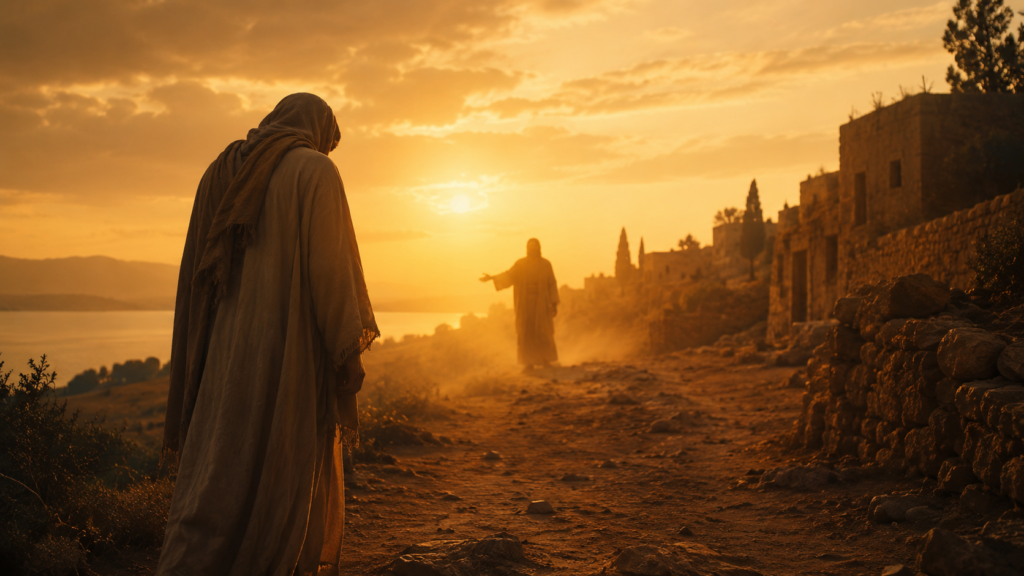
Matthew 8 opens the gospel’s first sustained miracle block. Where the Sermon on the Mount (chapters 5 to 7) showed the kingdom in teaching, chapters 8 and 9 will show the kingdom in action. Matthew structures these two chapters as a deliberate sequence of ten miracle stories, organized into three groups of three with a discipleship-saying interlude between each group. The chapter is recording, in narrative form, the kingdom’s authority on every front the first-century world recognized as out of human reach: disease, distance, weather, and the demonic.
The chapter has three movements. The first (verses 1 to 17) walks through three healings: the leper, the Roman centurion’s servant, and Peter’s mother-in-law, closing with a summary statement that quotes Isaiah 53:4 as fulfilled in Jesus’s healing ministry. The second (verses 18 to 22) is a discipleship interlude: two would-be followers approach Jesus and hear what following him will actually cost. The third (verses 23 to 34) is two demonstrations of authority over the powers: the calming of the storm and the deliverance of the Gadarene demoniacs.
Beneath the miracle-by-miracle progression is the chapter’s deeper announcement: the kingdom of heaven that Jesus has been preaching is not just a teaching to be heard. It is a power that reaches into the actual conditions of human suffering and sets them right. The centurion’s outsider-faith and the Gadarenes’ Gentile setting also continue the gospel’s mumzer note: the kingdom keeps showing up in the wrong neighborhoods, and the people who should not be inside keep finding themselves in.
A · Matthew 8:1–17 · Three healings and the Isaiah-53 fulfillment
¹ When he came down from the mountain, great multitudes followed him. ² Behold, a leper came to him and worshiped him, saying, “Lord, if you want to, you can make me clean.” ³ Jesus stretched out his hand and touched him, saying, “I want to. Be made clean.” Immediately his leprosy was cleansed. ⁴ Jesus said to him, “See that you tell nobody, but go, show yourself to the priest, and offer the gift that Moses commanded, as a testimony to them.” ⁵ When he came into Capernaum, a centurion came to him, asking him, ⁶ saying, “Lord, my servant lies in the house paralyzed, grievously tormented.” ⁷ Jesus said to him, “I will come and heal him.” ⁸ The centurion answered, “Lord, I’m not worthy for you to come under my roof. Just say the word, and my servant will be healed. ⁹ For I am also a man under authority, having under myself soldiers. I tell this one, ‘Go,’ and he goes; and tell another, ‘Come,’ and he comes; and tell my servant, ‘Do this,’ and he does it.” ¹⁰ When Jesus heard it, he marveled and said to those who followed, “Most certainly I tell you, I haven’t found so great a faith, not even in Israel. ¹¹ I tell you that many will come from the east and the west, and will sit down with Abraham, Isaac, and Jacob in the Kingdom of Heaven, ¹² but the children of the Kingdom will be thrown out into the outer darkness. There will be weeping and gnashing of teeth.” ¹³ Jesus said to the centurion, “Go your way. Let it be done for you as you have believed.” His servant was healed in that hour. ¹⁴ When Jesus came into Peter’s house, he saw his wife’s mother lying sick with a fever. ¹⁵ He touched her hand, and the fever left her. She got up and served him. ¹⁶ When evening came, they brought to him many possessed with demons. He cast out the spirits with a word, and healed all who were sick, ¹⁷ that it might be fulfilled which was spoken through Isaiah the prophet, saying, “He took our infirmities and bore our diseases.” (Matthew 8:1–17, World English Bible)
- When he came down from the mountain, great multitudes followed him (verse 1). The Greek katabantos de autou apo tou orous, “and as he came down from the mountain,” sets the chapter in deliberate continuity with the Sermon on the Mount. The new Moses who has just delivered the new Torah from the mountain now comes down to the people, exactly as Moses came down Sinai with the law. The narrative seam is structurally important: the kingdom’s teaching is now going to become the kingdom’s healing.
- A leper came to him and worshiped him (verse 2). The Greek lepros names the wider category of skin-disfiguring conditions the Mosaic law treated as ritually unclean (Leviticus 13 to 14). A leper in first-century Palestine was triply excluded: from the temple, from the synagogue, and from human community. He was required by law to live outside the camp, to cover his upper lip, and to cry unclean, unclean when anyone approached. The chapter is recording, with characteristic narrative restraint, that the first person Jesus heals after the Sermon on the Mount is a person no first-century Jew was supposed to touch.
- Jesus stretched out his hand and touched him (verse 3). The Greek hepsato autou, “he touched him,” is the chapter’s most loaded verb. The expected pattern in first-century practice was that uncleanness flowed from the unclean person to the clean person, so the toucher was the one made unclean. Jesus reverses the flow: he touches the leper, and cleanness flows the other way. The chapter is teaching, in one Greek verb, the kingdom’s reversal of contamination logic. Jesus is not made unclean by the touch; the leper is made clean. It is also worth a careful read of the underlying Torah, because the Pharisaic-traditional handling of lepers in Jesus’s day was significantly stricter than what Leviticus actually required. Leviticus 13 and 14 do not forbid contact with lepers; they assume contact will happen and prescribe the cleansing procedure for when it does. The total social isolation of the leper (excluded from family, synagogue, and community life, often required to live outside the village) was largely the product of oral-tradition tightening that doubled down on the inconvenience of any contact. Jesus’s touch is not a violation of Torah; it is a refusal of the tradition’s tightening of Torah, exactly the pattern 5:17-20 announced he would follow. The next verse confirms the point: he sends the cleansed man straight to the priest as Moses commanded (verse 4). The chapter is also setting up a quiet contrast with the very next scene, the centurion’s servant. Jesus there will heal at distance, by a word, without entering the house. Here, with the leper, he could just as easily have healed by a word and avoided the touch. That he chose the touch is the chapter’s point. The chapter is recording that Jesus’s healing is not just about restoring the body; it is about restoring the person to the human contact the leper has been deprived of for years.
- Show yourself to the priest, and offer the gift that Moses commanded, as a testimony to them (verse 4). The Greek eis martyrion autois, “as a testimony to them,” sends the cleansed leper through the proper Levitical procedure (Leviticus 14). The chapter is recording, with characteristic narrative care, that Jesus is not bypassing Torah; he is sending the cleansed person to the priests so the priests can confirm what the kingdom has done. The gospel’s Torah-honoring stance from 5:17 (I came not to abolish but to fulfill) is being enacted in narrative form.
- A centurion came to him (verse 5). The Greek hekatontarchos names a Roman officer commanding (nominally) one hundred soldiers. A first-century Roman centurion in Galilee was the visible face of imperial occupation: a Gentile, a soldier of Caesar, the commander of the troops who would later crucify the Messiah. The chapter is recording that the kingdom’s second healing-recipient is, by every cultural marker, an outsider.
Influence callout: Marty Solomon (the mumzer reading continues)
Solomon’s reading of the centurion scene names it as the gospel’s most explicit pre-cross announcement that the kingdom is for the people first-century Israel had every reason to exclude. The centurion is a Gentile, a Roman, an officer of the occupying empire, and a soldier whose profession routinely violated Torah. By every measure of religious-ethnic ranking, he is on the wrong side of the line. Yet Jesus’s response is not just to heal his servant. It is to publicly name his faith as exceeding anything Jesus has found in Israel (verse 10) and to announce that many will come from the east and the west and sit down with Abraham, Isaac, and Jacob while the children of the kingdom will be thrown out into the outer darkness (verses 11 to 12). Solomon argues that the chapter is doing the mumzer logic in its sharpest form. The cultural insiders are warned of exclusion; the cultural outsider is held up as the model of kingdom-faith. The Gentile mission that Acts will eventually formalize is being announced, in principle, here, in the second healing of the gospel’s miracle block. The whole gospel’s outsider-agenda is on display in one Roman officer’s request and Jesus’s marveled response.
- Just say the word, and my servant will be healed (verse 8). The Greek monon eipe logo, “only speak by a word,” is the centurion’s most theologically loaded line. He understands authority by analogy to his own military command structure: a word of command from the proper authority is sufficient to produce the action. He treats Jesus’s authority as no less real than the Roman chain of command, and arguably more so. The chapter is recording a Gentile soldier’s recognition of Jesus’s exousia (the same word the crowd used at 7:29) in language a Roman officer would naturally use.
- I haven’t found so great a faith, not even in Israel (verse 10). The Greek par’ oudeni tosauten pistin en to Israel heuron, “with no one in Israel have I found so great a faith,” is the chapter’s first explicit faith-vocabulary. The Greek pistis (faith, loyalty, trust) is the gospel’s word for what makes the centurion’s request register as it does. He has not asked for proof; he has not demanded a sign; he has put his weight on Jesus’s word. The centurion’s pistis is the model the gospel will keep returning to.
- Many will come from the east and the west, and will sit down with Abraham, Isaac, and Jacob in the Kingdom of Heaven (verse 11). The Greek anaklithesontai, “will recline at table,” uses the standard first-century Jewish image of the messianic banquet (Isaiah 25:6 to 9; Luke 14:15 to 24; the rabbinic seudat ha-mashiach). The kingdom is staged as a great feast at which the patriarchs are at table and unexpected guests are arriving. The geography (from east and west) names Gentile origin. The chapter is recording, in two short verses, the gospel’s most sweeping pre-passion announcement of Gentile inclusion. The contrast-image in verse 12 (the children of the kingdom will be thrown into the outer darkness; there will be weeping and gnashing of teeth) is worth reading inside its first-century cultural setting. Jesus’s listeners would have heard a concrete reference, not just an abstract spiritual category. The outer darkness (Greek to skotos to exoteron) named the area outside a walled town, beyond the gates, where the village’s refuse was dumped, scavenger animals roamed at night, and the place was used by some communities to leave suspected criminals tied up overnight as a kind of trial-by-ordeal. Weeping and gnashing of teeth describes the kind of night a person tied up out there could expect. The image is therefore a cultural-political one as much as it is an eschatological one: the people who think themselves children of the kingdom by birthright are warned that they may find themselves on the wrong side of the village wall while the centurion-types take their seat at the patriarchs’ table. Whether the saying also points forward to a final eschatological reality is a question later passages will sharpen. In its first hearing, it is a sharp warning to the religiously presumptive that their assumed places at the table are not guaranteed.
- When Jesus came into Peter’s house, he saw his wife’s mother lying sick with a fever (verse 14). The Greek pyresso, “burning with fever,” names a serious illness in a world without antibiotics. Peter’s mother-in-law’s fever could plausibly have killed her. The chapter is recording, with characteristic narrative restraint, the third healing in the sequence: a domestic, family-level miracle following the public miracles of leper and centurion’s servant.
- He touched her hand, and the fever left her. She got up and served him (verse 15). The Greek diekonei auto, “she was serving him,” uses the same verb (diakoneo) the gospel uses elsewhere for the work of disciples and angels (Matthew 4:11; 25:44; 27:55). The chapter is recording the woman’s restoration in the language of vocation: she does not just rise; she serves. Some readers have noted that Peter’s mother-in-law is, on this verb-choice, the gospel’s first explicitly named woman in service of the kingdom.
- When evening came, they brought to him many possessed with demons. He cast out the spirits with a word, and healed all who were sick (verse 16). The Greek hesperas de genomenes, “and evening having come,” names the end of the Sabbath in a Jewish-Galilean setting (the Sabbath ended at sundown; the crowds could not have brought the sick during the Sabbath itself). The chapter is recording a mass-healing event that the village would have brought to Peter’s door as soon as the religious day was over. The kingdom is now publicly visible at scale.
- That it might be fulfilled which was spoken through Isaiah the prophet, saying, “He took our infirmities and bore our diseases” (verse 17). The citation is Isaiah 53:4. The chapter’s first fulfillment-formula in the miracle block applies the suffering-servant prophecy not (yet) to the cross but to the healing ministry. The chapter is recording, with characteristic narrative care, that Jesus’s healing-work is itself a kind of bearing: he does not dispense the healings from a distance; he takes them on himself, carries them, absorbs them in some way the gospel will only fully explain at Calvary.
Influence callout: N.T. Wright (the Isaiah 53:4 reading)
Wright’s reading of the Isaiah 53:4 fulfillment in 8:17 names it as the gospel’s earliest application of the suffering-servant pattern to Jesus’s whole ministry. The verse is famous for its passion-narrative use: he was wounded for our transgressions, he was crushed for our iniquities, the chastisement that brought us peace was on him, and by his wounds we are healed (Isaiah 53:5). Matthew applies this prophecy not to the cross (where Christian readers usually expect it) but to the healing crowds at the door of Peter’s house. Wright argues that the gospel is teaching, in this fulfillment-formula, that the cross’s pattern of substitutionary bearing is already at work in the healings. Jesus does not zap the disease away from a sterile distance. He takes it on. The healing ministry is itself a foretaste of the cross. The cross will be the healing ministry brought to its theological climax. The chapter is laying down, in one Isaiah citation, the gospel’s deepest claim about how the kingdom’s authority actually works: it works by bearing.
B · Matthew 8:18–22 · The cost of following
¹⁸ Now when Jesus saw great multitudes around him, he gave the order to depart to the other side. ¹⁹ A scribe came, and said to him, “Teacher, I will follow you wherever you go.” ²⁰ Jesus said to him, “The foxes have holes, and the birds of the sky have nests, but the Son of Man has nowhere to lay his head.” ²¹ Another of his disciples said to him, “Lord, allow me first to go and bury my father.” ²² But Jesus said to him, “Follow me, and leave the dead to bury their own dead.” (Matthew 8:18–22, World English Bible)
- Now when Jesus saw great multitudes around him, he gave the order to depart to the other side (verse 18). The Greek eis to peran, “to the other side,” refers to the eastern shore of the Sea of Galilee, the predominantly Gentile region of the Decapolis. The chapter is recording, with characteristic narrative care, that Jesus is moving the ministry from the Jewish western shore to the Gentile eastern shore. The geographic move is itself a kingdom-statement: the east and west of verse 11 is becoming concrete travel.
- Teacher, I will follow you wherever you go (verse 19). The Greek didaskale, “teacher,” is a respectful but not necessarily theological address. A scribe (grammateus) is a member of the literate religious-legal class. The scribe’s offer is enthusiastic but uninstructed: he has not yet heard what following will cost.
- The foxes have holes, and the birds of the sky have nests, but the Son of Man has nowhere to lay his head (verse 20). The Greek ho de huios tou anthropou ouk echei pou ten kephalen kline, “but the Son of Man has nowhere to lay his head,” contains the chapter’s first use of Son of Man (Greek ho huios tou anthropou) as Jesus’s preferred self-designation. The title comes from Daniel 7:13 to 14, where one like a son of man receives the everlasting kingdom from the Ancient of Days. Jesus uses the title throughout the gospels for himself, and the title carries both human-solidarity and messianic-authority weight at once.
- Allow me first to go and bury my father (verse 21). The Greek request is, on its surface, a request to fulfill the deepest first-century Jewish family obligation. Burying one’s father was a sacred duty taking precedence over almost every other religious requirement. Most readers assume the man’s father was already dead and the request was for a brief delay. Some readers (notably Kenneth Bailey) have argued that the man’s father was still alive and the request was for an indefinite delay, possibly years, until the inheritance was settled.
- Follow me, and leave the dead to bury their own dead (verse 22). The Greek aphes tous nekrous thapsai tous heauton nekrous, “leave the dead to bury their own dead,” is the chapter’s most uncomfortable saying. The reading depends on hearing two senses of nekrous: the spiritually-not-yet-alive can do the work of physical burial; the disciple-call admits no delay. The chapter is recording, with characteristic narrative directness, the kingdom’s claim on the disciple’s life. The cost is real. The call has urgency.
C · Matthew 8:23–34 · The storm and the Gadarene demoniacs
²³ When he got into a boat, his disciples followed him. ²⁴ Behold, a violent storm came up on the sea, so much that the boat was covered with the waves, but he was asleep. ²⁵ The disciples came to him, and woke him up, saying, “Save us, Lord! We are dying!” ²⁶ He said to them, “Why are you fearful, O you of little faith?” Then he got up, rebuked the wind and the sea, and there was a great calm. ²⁷ The men marveled, saying, “What kind of man is this, that even the wind and the sea obey him?” ²⁸ When he came to the other side, into the country of the Gergesenes, two people possessed by demons met him there, coming out of the tombs, exceedingly fierce, so that nobody could pass that way. ²⁹ Behold, they cried out, saying, “What do we have to do with you, Jesus, Son of God? Have you come here to torment us before the time?” ³⁰ Now there was a herd of many pigs feeding far away from them. ³¹ The demons begged him, saying, “If you cast us out, permit us to go away into the herd of pigs.” ³² He said to them, “Go!” They came out, and went into the herd of pigs; and behold, the whole herd of pigs rushed down the cliff into the sea, and died in the water. ³³ Those who fed them fled, and went away into the city, and told everything, including what happened to those who were possessed with demons. ³⁴ Behold, all the city came out to meet Jesus. When they saw him, they begged that he would depart from their borders. (Matthew 8:23–34, World English Bible)
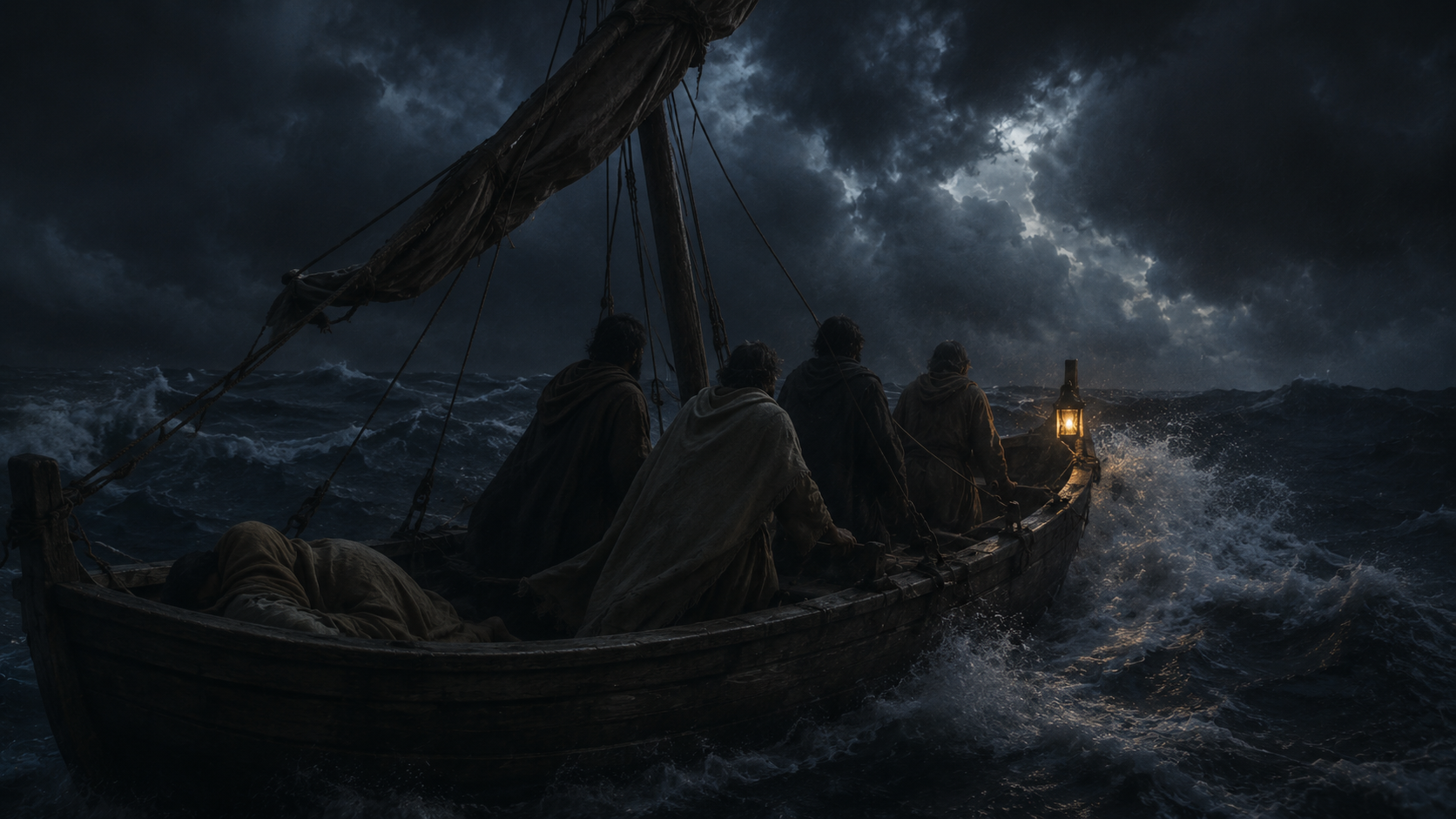
- When he got into a boat, his disciples followed him (verse 23). The Greek embanti auto eis to ploion, “as he embarked into the boat,” is the chapter’s most literal discipleship-image: the disciples are following in the most concrete sense. They have gotten into the boat after him.
- Behold, a violent storm came up on the sea, so much that the boat was covered with the waves (verse 24). The Greek seismos megas, “a great earthquake,” is unusual storm-vocabulary. Seismos is the Septuagint’s word for earthquake-shaking, the kind of cosmic disturbance that accompanies theophany (Exodus 19:18; Psalm 18:7). Mark and Luke use the more ordinary storm-word; Matthew chooses the cosmic-shaking word. The chapter is recording, with characteristic vocabulary-care, that what the disciples are experiencing is not just bad weather but something with theological weight.
- But he was asleep (verse 24b). The Greek autos de ekatheuden, “but he himself was sleeping,” is one of the chapter’s most theologically dense details. The reader is meant to hear the contrast between the cosmic-shaking storm and the sleeping Messiah. Some readers hear an echo of Jonah 1:5 (the prophet asleep in the hold while the storm threatens the ship). The Jonah parallel will return explicitly at 12:38 to 41 (the sign of Jonah).
- Why are you fearful, O you of little faith? (verse 26). The Greek oligopistoi, “of little faith,” recurs from 6:30. The chapter is recording, with characteristic narrative continuity, that the disciples’ problem is not the storm but their reading of the storm. They have not yet learned that the kingdom’s representative is in the boat with them.
- He got up, rebuked the wind and the sea, and there was a great calm (verse 26b). The Greek epetimesen tois anemois kai te thalasse, “he rebuked the winds and the sea,” uses the verb (epitimao) the gospels use for rebuking demons (Matthew 17:18; Mark 1:25). The chapter is recording, with characteristic verbal care, that Jesus addresses the storm as if it were a personal opponent. The implicit divine-council reading is present: the storm is not a neutral weather event; it is a hostile power being brought to heel.
- What kind of man is this, that even the wind and the sea obey him? (verse 27). The Greek potapos estin houtos, “what sort is this one,” is the chapter’s first record of the disciples’ Christological wondering. They have just seen a demonstration of authority that, in the Hebrew Bible, belongs only to Yahweh (Psalm 89:9, you rule the raging of the sea; when its waves rise, you still them). The question is rhetorical and theological. The reader is being trained to ask the same question of every scene that follows.
- When he came to the other side, into the country of the Gergesenes, two people possessed by demons met him there, coming out of the tombs (verse 28). The Greek ek ton mnemeion, “from the tombs,” locates the scene in ritual-impurity terrain. Tombs were the most unclean of all locations in first-century Jewish religious geography. The two demoniacs are doubly excluded: by their spiritual condition and by their physical location. (Mark and Luke record only one demoniac in their parallel accounts; Matthew often pairs figures, possibly for a literary doubling motif.)
- What do we have to do with you, Jesus, Son of God? Have you come here to torment us before the time? (verse 29). The Greek pro kairou, “before the time,” names the eschatological framework the demons themselves operate in. They know there is a coming day of judgment. They know Jesus is the agent of that judgment. They are protesting that their judgment has come early, before the end. The chapter is recording, in the demons’ own mouths, an apocalyptic Christology the disciples have not yet articulated.
Influence callout: Michael Heiser (the divine council reading)
Heiser’s reading of the Gadarene scene names it as the gospel’s clearest pre-passion staging of the cosmic-conflict framework that the divine council literature has been preparing the reader for. The demons in 8:29 know exactly who Jesus is (Son of God) and what is coming (the time of final judgment). Heiser argues that the gospel is teaching, in the demons’ protest, that the spiritual realm operates with a fuller Christological awareness than the human disciples do. The cosmic powers know what the human characters are still figuring out. The Gadarene scene is also located precisely where ancient Jewish geography had marked as foreign-spirit territory: the eastern Decapolis was Gentile-pagan turf, the kind of place a first-century Jewish reader would expect demonic presence to be concentrated. Jesus’s deliberate trip across the lake, in this reading, is a kingdom-incursion into hostile spiritual territory. The whole gospel’s binding-of-the-strong-man pattern (which will be named explicitly at 12:29) is being staged in Decapolis pagan country, not in Jewish synagogue space. The kingdom is moving into enemy territory.
- Now there was a herd of many pigs feeding far away from them (verse 30). The Greek agele choiron, “a herd of pigs,” locates the scene firmly in Gentile economy. Jewish farmers did not raise pigs (Leviticus 11:7). The chapter is recording, with characteristic geographic care, that the setting is unambiguously Gentile. There is also a sharper political resonance worth noting. The Roman legion stationed in the broader region of the Decapolis used as its standard a wild boar, the aper, the totem-image of legions associated with the eastern provinces (Mark’s parallel account names the demon Legion, sharpening the political-military reading; Matthew’s account is more restrained but the regional context is the same). The pigs the demons enter and drive into the lake are, in the first-century reader’s ear, not just unclean animals but the iconography of imperial occupation. The destruction of the herd in the sea echoes both the leviathan-of-chaos image of the Hebrew Bible (Psalm 74:13-14) and the Pharaoh-and-his-army-in-the-Red-Sea pattern of the Exodus. The chapter is staging, in pagan-occupied territory, a small-scale image of the kingdom’s confrontation with the powers that occupy the world.
- They came out, and went into the herd of pigs; and behold, the whole herd of pigs rushed down the cliff into the sea, and died in the water (verse 32). The Greek kremnos, “a steep place,” names a cliff into the lake. The chapter records the demons’ destruction in their own requested host: the pigs die in the water the demons fled into. Some readers have noted that the water-grave of the pigs echoes the water-grave of Pharaoh’s army at the Red Sea: hostile powers ending in the sea is a recurring biblical pattern.
- All the city came out to meet Jesus. When they saw him, they begged that he would depart from their borders (verse 34). The chapter closes with the village’s request that Jesus leave. The Gentile village has experienced both the deliverance of the demoniacs and the destruction of a significant economic asset (a herd of swine). Their reaction is fear, not gratitude. The chapter is recording, with characteristic narrative honesty, that the kingdom’s arrival in unwilling territory is sometimes received as threat rather than gift. The Gentile mission Jesus announced in verse 11 will not be received without cost on both sides.
Reflection prompts
- The first person Jesus heals after delivering the Sermon on the Mount is a leper, the most ritually excluded category in first-century Jewish religious life. Jesus touches him, and cleanness flows the wrong way. Where in your life are you currently treating someone or something as a contamination to be avoided, and what does it mean to consider that the kingdom moves in the opposite direction of what your reflexes are protecting?
- The centurion’s just say the word is named by Jesus as faith greater than anything he has found in Israel. The cultural outsider, the soldier of empire, the man with no synagogue credentials, gets the chapter’s faith-trophy. Where in your life are you currently expecting kingdom-faith to come from the inside (the religious establishment, the credentialed insider) rather than from the unexpected outside?
- Jesus is asleep in the boat during the cosmic-shaking storm, and the disciples’ problem is not the storm but their reading of the storm. They have forgotten who is in the boat with them. Where in your life is your fear, right now, more about your reading of your situation than about the situation itself, and what does it mean to consider that the kingdom’s representative is in the boat?