
Matthew 9 continues the gospel’s miracle block, completing six of the chapter 8 to 9 sequence’s ten miracles and reaching its narrative-emotional climax in a single closing line: when he saw the multitudes, he was moved with compassion for them, because they were harassed and scattered, like sheep without a shepherd. The chapter has three movements. The first (verses 1 to 17) brings the kingdom into direct conflict with the religious establishment over forgiveness, table fellowship, and fasting: the paralytic is forgiven and healed, Matthew the tax collector is called from his toll booth, the Pharisees object to dinner-with-sinners, and John’s disciples ask why Jesus’s disciples don’t fast. The second (verses 18 to 34) records four more miracles in rapid succession: a synagogue ruler’s daughter raised, a long-bleeding woman healed by touching his garment, two blind men given sight, and a mute demoniac delivered. The third (verses 35 to 38) closes the miracle block with a summary statement: teaching, preaching, healing, and the chapter’s most searing pastoral image of Jesus seeing the people as harassed sheep without a shepherd.
Beneath the miracle-by-miracle progression is the chapter’s deeper announcement: the kingdom’s authority is not just power; it is also mercy, and the mercy keeps showing up in the same direction the kingdom keeps showing up. The tax collector (the Jewish man whose profession had made him a mumzer-by-vocation in his own community) is called as a disciple. The bleeding woman (whose long-term ritual impurity had excluded her from synagogue and family) is healed by her own initiative. The synagogue ruler (the religious insider) gets the same kingdom-mercy as the rest. The Pharisees, who object to the table fellowship, are confronted with Hosea 6:6: I desire mercy and not sacrifice. The chapter is recording the kingdom’s pastoral shape as well as its power-shape.
A · Matthew 9:1–17 · Forgiveness, calling, and the controversies
¹ He entered into a boat, and crossed over, and came into his own city. ² Behold, they brought to him a man who was paralyzed, lying on a bed. Jesus, seeing their faith, said to the paralytic, “Son, cheer up! Your sins are forgiven you.” ³ Behold, some of the scribes said to themselves, “This man blasphemes.” ⁴ Jesus, knowing their thoughts, said, “Why do you think evil in your hearts? ⁵ For which is easier, to say, ‘Your sins are forgiven;’ or to say, ‘Get up, and walk?’ ⁶ But that you may know that the Son of Man has authority on earth to forgive sins…” (then he said to the paralytic), “Get up, and take up your mat, and go up to your house.” ⁷ He arose and departed to his house. ⁸ But when the multitudes saw it, they marveled and glorified God, who had given such authority to men. ⁹ As Jesus passed by from there, he saw a man called Matthew sitting at the tax collection office. He said to him, “Follow me.” He got up and followed him. ¹⁰ As he sat in the house, behold, many tax collectors and sinners came and sat down with Jesus and his disciples. ¹¹ When the Pharisees saw it, they said to his disciples, “Why does your teacher eat with tax collectors and sinners?” ¹² When Jesus heard it, he said to them, “Those who are healthy have no need for a physician, but those who are sick do. ¹³ But you go and learn what this means: ‘I desire mercy, and not sacrifice,’ for I came not to call the righteous, but sinners to repentance.” ¹⁴ Then John’s disciples came to him, saying, “Why do we and the Pharisees fast often, but your disciples don’t fast?” ¹⁵ Jesus said to them, “Can the friends of the bridegroom mourn, as long as the bridegroom is with them? But the days will come when the bridegroom will be taken away from them, and then they will fast. ¹⁶ No one puts a piece of unshrunk cloth on an old garment; for the patch would tear away from the garment, and a worse hole is made. ¹⁷ Neither do people put new wine into old wine skins, or else the skins would burst, and the wine be spilled, and the skins ruined. No, they put new wine into fresh wine skins, and both are preserved.” (Matthew 9:1–17, World English Bible)
- He entered into a boat, and crossed over, and came into his own city (verse 1). The Greek eis ten idian polin, “into his own city,” refers to Capernaum, the Galilean fishing town Jesus has made his ministry base since 4:13. The chapter is recording, with characteristic narrative care, that the Decapolis excursion is over and the ministry has returned to its home base. The pace from chapter 8 continues: storm, demoniacs, return.
- Jesus, seeing their faith, said to the paralytic, “Son, cheer up! Your sins are forgiven you” (verse 2). The Greek idon de ho Iesous ten pistin auton, “and seeing their faith,” names a corporate faith: not just the paralytic’s but the friends who brought him. The chapter is recording, with characteristic narrative attention, that the kingdom honors faith that comes packaged in community. Jesus’s first word to the paralytic is forgiveness, not healing. The healing is what the chapter will read as the external proof of the forgiveness that has already been spoken.
- Some of the scribes said to themselves, “This man blasphemes” (verse 3). The Greek blasphemei, “he is blaspheming,” names the religious-legal charge. The forgiveness of sins, in standard first-century Jewish theology, was a divine prerogative effected through the temple sacrificial system. For a man to declare sins forgiven outside that system was, in the scribes’ reading, an arrogation of divine authority. To feel the weight of the scandal, it helps to picture how forgiveness was actually obtained. A first-century Israelite who had wronged God or neighbor began with internal repentance, but the public ratification ran through the temple. The penitent traveled to Jerusalem (an eighty-mile pilgrimage from Galilee), bought or brought a sacrificial animal at the southern court, was led by a priest into the inner courtyard, named the offense at the altar, watched the priest kill the animal and pour its blood, and finally heard the priest pronounce the sins forgiven. That whole apparatus was the Hebrew Bible’s gracious gift to the people: an embodied liturgy of pardon. Jesus, sitting in a Capernaum house with no altar, no priest, no animal, and no temple, looks at the paralytic and pronounces in one short sentence what normally took a journey, an animal, and a priest’s word. The scribes are not wrong about the boldness of the claim. The chapter is recording, with characteristic narrative honesty, the religious establishment’s first Christological objection: the forgiveness-claim is the gospel’s first explicit divine-authority claim, and the scribes hear it correctly even if they reject it.
- That you may know that the Son of Man has authority on earth to forgive sins (verse 6). The Greek exousian echei, “has authority,” uses the same word the crowd used at 7:29 for the Sermon on the Mount’s teaching. The chapter is recording, with characteristic verbal continuity, that Jesus’s authority is not just teaching-authority but forgiveness-authority. The healing of the paralytic is staged explicitly as the visible proof of the invisible forgiveness. The choice of Son of Man (Greek huios tou anthropou; Hebrew ben adam) carries a particular weight in this scene that is easy to miss in English. Daniel 7 had spoken of one like a son of man coming on the clouds to receive an everlasting kingdom from the Ancient of Days, and by Jesus’s century, the figure was widely expected to come with judgment. The Hebrew ben adam literally means son of Adam, and one strand of Jewish reflection on Daniel 7 imagined the figure as the one who would finally render verdicts for all the unjust suffering of the children of Adam, beginning with Abel’s blood that had cried out from the ground (Genesis 4:10). The synagogue community waiting for the Son of Man was waiting, in that strand, for a Messiah who would arrive and at long last say to every Cain here is what is coming for you. Jesus, claiming the title in 9:6, inverts the expectation. The Son of Man’s first publicly recorded use of his Daniel-7 authority is to forgive, not to condemn. The Cain-and-Abel reversal is sharp: where the inherited expectation was that ben adam would arrive avenging the children of Adam, Jesus arrives announcing pardon. The same point will be made again in Hosea-vocabulary in verses 12-13 (I desire mercy, not sacrifice). The chapter is teaching, in the title’s own ironic deployment, that the kingdom’s authority is exercised through forgiveness rather than retribution.
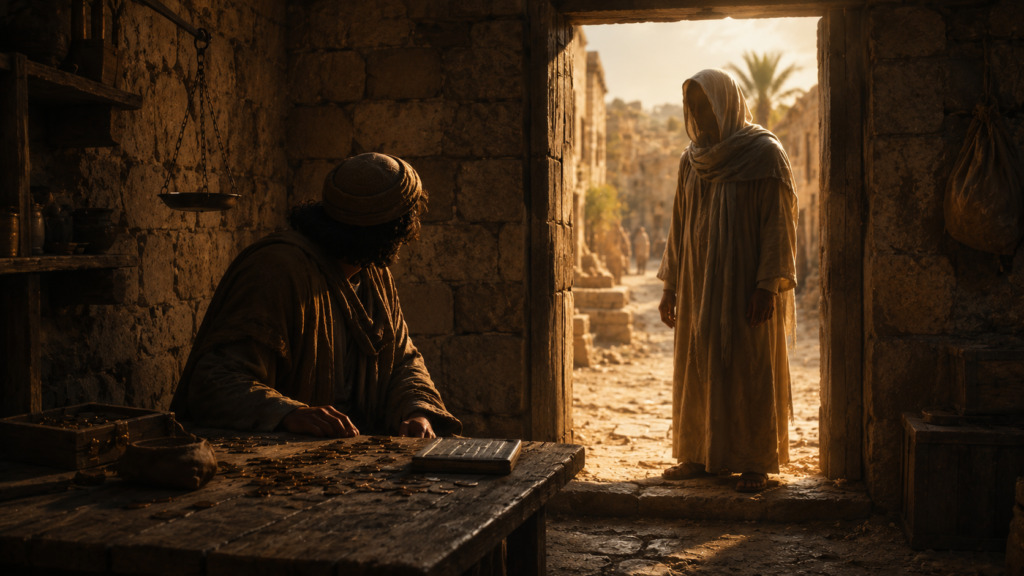
- He saw a man called Matthew sitting at the tax collection office. He said to him, “Follow me.” He got up and followed him (verse 9). The Greek epi to telonion, “at the tax collection booth,” locates Matthew at his trade. A first-century Galilean tax collector worked for the local Herodian administration collecting customs duties on goods passing through the region. The trade was hated for three overlapping reasons: it required collaboration with the occupying power, it was almost universally corrupt (collectors made their living by overcharging and pocketing the difference), and it rendered the collector ritually impure by routine contact with Gentiles. By every cultural marker, Matthew is on the wrong side of the line.
Influence callout: Marty Solomon (the mumzer reading, autobiographical for the gospel writer)
Solomon’s reading of the call of Matthew names it as the gospel’s most personally autobiographical mumzer moment. Matthew the tax collector is, by every first-century Jewish standard, a mumzer-figure: a Jewish man who has cashed in his religious credentials by working for the empire, who has profited at his own people’s expense, and who has been written off by the synagogue community he was born into. Solomon argues that the gospel writer, who has chosen to identify himself in his own gospel by his pre-call name (most other gospels call him Levi before the call and Matthew after, but this gospel calls him Matthew throughout), is the gospel’s prime exhibit for the agenda the genealogy announced in chapter 1: the Messianic family is the family of the people the religious community has wanted to exclude. Solomon reads this scene as Matthew telling on himself: I was the worst of them, and the rabbi called me anyway, at my desk, in the middle of the day I was making my dirty money, and what I did was get up and follow. The dinner that follows in verses 10 to 13 is Matthew’s housewarming party for his new community: every tax collector and sinner he knew shows up, and the new rabbi sits at the table with all of them. The chapter is recording, in autobiographical narrative form, the gospel writer’s own mumzer-becomes-disciple story. The call of Matthew is the call of every reader the religious establishment has ever written off.
- Why does your teacher eat with tax collectors and sinners? (verse 11). The Greek meta ton telonon kai hamartolon, “with tax collectors and sinners,” names the two categories the Pharisaic religious establishment most strictly avoided table fellowship with. To eat with someone in first-century Jewish culture was to grant them honor, signal acceptance, and risk ritual impurity. The Pharisees’ question is, on its own logic, reasonable: a rabbi who eats with these people is making a religious-political statement.
- I desire mercy, and not sacrifice (verse 13). The Greek eleos thelo kai ou thysian, “I desire mercy and not sacrifice,” is Jesus’s citation of Hosea 6:6 (Septuagint). The Hebrew chesed (covenantal kindness, faithful love) is what the Septuagint translates as eleos. The chapter is recording, with characteristic Hebrew Bible literacy, that Jesus is teaching the Pharisees from their own scripture: the prophet Hosea had already told them that God prefers covenant-mercy to ritual purity. The whole prophetic tradition (Isaiah 1:11 to 17; Amos 5:21 to 24; Micah 6:6 to 8) has been making this argument for centuries.
Influence callout: Marty Solomon (the “Mercy Not Sacrifice” reading)
Solomon’s reading of Hosea 6:6 in 9:13 names it as the chapter’s most explicit announcement of the kingdom’s pastoral shape. The Pharisees in this scene are not theologically wrong about ritual impurity; they are rabbinically correct about who gets defiled by table fellowship. Their problem is that they have read the Torah without reading the prophets. Solomon argues that Jesus’s go and learn what this means, the standard rabbinic invitation to deeper study, is sending the Pharisees back to school on Hosea. The Hebrew Bible itself contains the corrective to a religion that prizes purity over mercy, and the prophets had already preached the correction. The kingdom Jesus announces is not a new religion imported from outside Judaism; it is Judaism read at its prophetic depth. The whole gospel from this point forward will keep citing Hosea 6:6 (Matthew 9:13; 12:7) as the key to its understanding of what God has always wanted from his people. The kingdom is the Hebrew Bible’s chesed tradition reaching its fullness in a rabbi who eats with the people the synagogue had decided not to.
- Can the friends of the bridegroom mourn, as long as the bridegroom is with them? (verse 15). The Greek hoi huioi tou nymphonos, “the sons of the wedding hall,” names the wedding party. The image is messianic: in Hebrew Bible and Second Temple Jewish tradition, the messianic age is repeatedly imaged as a wedding banquet (Isaiah 25:6 to 9; 62:5; Hosea 2:19 to 20; later, Revelation 19:7 to 9). Jesus is, on this self-identification, the bridegroom. The fast can wait. The wedding has come.
- No one puts a piece of unshrunk cloth on an old garment… neither do people put new wine into old wine skins (verses 16 to 17). The Greek neon oinon eis askous palaious, “new wine into old wineskins,” is the chapter’s most quoted parable. The kingdom’s kainotes (newness) cannot be patched onto the religious-establishment system as it stands. Both have to be respected for what they are. The chapter is not announcing the abolition of Israel’s religious tradition (5:17 has already settled that question); it is announcing that the new thing the kingdom is doing requires its own structures.
B · Matthew 9:18–34 · Four more miracles
¹⁸ While he told these things to them, behold, a ruler came and worshiped him, saying, “My daughter has just died, but come and lay your hand on her, and she will live.” ¹⁹ Jesus got up and followed him, as did his disciples. ²⁰ Behold, a woman who had a discharge of blood for twelve years came behind him, and touched the fringe of his garment; ²¹ for she said within herself, “If I just touch his garment, I will be made well.” ²² But Jesus, turning around and seeing her, said, “Daughter, cheer up! Your faith has made you well.” And the woman was made well from that hour. ²³ When Jesus came into the ruler’s house, and saw the flute players, and the crowd in noisy disorder, ²⁴ he said to them, “Make room, because the girl isn’t dead, but sleeping.” They were ridiculing him. ²⁵ But when the crowd was put out, he entered in, took her by the hand, and the girl arose. ²⁶ The report of this went out into all that land. ²⁷ As Jesus passed by from there, two blind men followed him, calling out and saying, “Have mercy on us, son of David!” ²⁸ When he had come into the house, the blind men came to him. Jesus said to them, “Do you believe that I am able to do this?” They told him, “Yes, Lord.” ²⁹ Then he touched their eyes, saying, “According to your faith be it done to you.” ³⁰ Their eyes were opened. Jesus strictly commanded them, saying, “See that no one knows about this.” ³¹ But they went out and spread abroad his fame in all that land. ³² As they went out, behold, a mute man who was demon possessed was brought to him. ³³ When the demon was cast out, the mute man spoke. The multitudes marveled, saying, “Nothing like this has ever been seen in Israel!” ³⁴ But the Pharisees said, “By the prince of the demons, he casts out demons.” (Matthew 9:18–34, World English Bible)

- A ruler came and worshiped him, saying, “My daughter has just died” (verse 18). The Greek archon names a synagogue official. (Mark 5:22 names him Jairus and identifies him as a synagogue ruler.) The chapter is recording, with characteristic narrative restraint, that a religious-establishment figure is approaching Jesus in the same posture (worship, prostration) as the leper of 8:2 and the centurion of 8:6. Need is the great social leveler in Jesus’s ministry: insider and outsider come the same way.
- A woman who had a discharge of blood for twelve years came behind him, and touched the fringe of his garment (verse 20). The Greek aimorroousa dodeka ete, “having a flow of blood for twelve years,” names a chronic gynecological condition that, under Levitical purity law, rendered the woman ritually unclean for the entire twelve years (Leviticus 15:25 to 27). She had not been able to enter the temple, the synagogue’s women’s court, or any context requiring ceremonial purity for twelve years. The chapter is recording, with characteristic cultural specificity, the depth of her exclusion before her gesture.
- She touched the fringe of his garment (verse 20b). The Greek tou kraspedou tou himatiou autou, “the fringe of his garment,” refers to the tzitzit, the Mosaic-commanded tassels on the corners of an observant Jewish man’s outer garment (Numbers 15:38 to 41; Deuteronomy 22:12). The tzitzit were a covenantal-identity marker, the visible sign that the wearer belonged to the covenant people. The woman is reaching, in her contagious-uncleanness condition, for the most covenantally-sacred external part of Jesus’s clothing. Her gesture is theologically loaded. Her specific reasoning is also worth tracing, because it draws on a thread of messianic expectation in Malachi 4:2, the closing oracle of the Twelve Prophets and the last word of the Hebrew Bible’s prophetic canon. There Malachi promises that for those who fear God’s name, the sun of righteousness shall rise with healing in its wings (Hebrew u-marpe bi-knafeha, “and healing in his kanaph“). The Hebrew kanaph is a flexible word: it means wing but also corner, edge, hem, and is the same word that names the corners of a garment to which the tzitzit are attached (Numbers 15:38, kanphei bigdeihem, “the corners of their garments”). Some Second-Temple Jewish reflection on Malachi’s healing in his wings read the verse to mean healing in his hem, and the coming Messiah was sometimes pictured as the figure on whose tassel-corners the people would find healing. The bleeding woman, who has been excluded from the synagogue and the temple for twelve years, has somehow held onto enough of the prophets to make the connection. She does not need to ask for healing; she only needs to reach for the kanaph of the Messiah. Her gesture is not superstition; it is a remarkably literate piece of biblical exegesis enacted under desperate conditions.
- Daughter, cheer up! Your faith has made you well (verse 22). The Greek thygater, “daughter,” is the chapter’s tenderest address. Jesus does not chide her for the touch (which, by Levitical reckoning, would have rendered him impure); he names her as kin. Your faith has made you well (Greek he pistis sou sesoken se, “your faith has saved you”) uses sozo (to save, to rescue, to make whole), the same verb the gospel will use for soteriology more broadly. Healing and salvation are, in this verse, the same word.
- The girl isn’t dead, but sleeping (verse 24). The Greek katheudei, “she is sleeping,” uses death-as-sleep imagery the New Testament will consistently use (John 11:11 to 14 of Lazarus; 1 Corinthians 15:51; 1 Thessalonians 4:13 to 14). The chapter is recording, with characteristic narrative restraint, that Jesus is naming death itself as a temporary condition the kingdom can wake. The crowd ridicules him; the chapter does not respond. The dead girl rises a verse later.
- Have mercy on us, son of David! (verse 27). The Greek huios David, “son of David,” is the chapter’s first explicit messianic title from non-disciple petitioners. The two blind men recognize Jesus by the Davidic-messianic vocabulary. The chapter is recording, with characteristic Hebrew Bible literacy, that the messianic identification is now beginning to be made by the people Jesus encounters.
Word study: splanchnizomai (σπλαγχνίζομαι), “to be moved with deep gut-level compassion”
The Greek verb that closes the chapter at 9:36 (esplanchnisthe peri auton, “he was moved with compassion for them”). Splanchnizomai is built on splanchna (the inward parts, the bowels, the gut), and the verb names a visceral, body-located response to suffering. The Septuagint uses related vocabulary for divine compassion (Hebrew racham, the womb-related word for tender mercy). The gospel uses the verb at the gospel’s most pastoral moments (here in 9:36; at 14:14 before the feeding of the five thousand; at 15:32 before the feeding of the four thousand; at 20:34 before the healing of the blind men of Jericho). The chapter is recording, with characteristic Hebrew-into-Greek vocabulary, that the kingdom’s pastoral response to suffering is not detached evaluation but gut-level being-moved. Jesus does not just see the harassed crowd; the sight goes through him at the level of viscera.
- Nothing like this has ever been seen in Israel! (verse 33). The Greek oudepote ephane houtos en to Israel, “never has it appeared like this in Israel,” names the public reception. The crowds recognize that the miracle block of chapters 8 and 9 is unprecedented. The pattern is not just numerous healings; it is the kingdom’s authority becoming publicly visible at scale.
- By the prince of the demons, he casts out demons (verse 34). The Greek en to archonti ton daimonion ekballei ta daimonia, “by the ruler of the demons he casts out demons,” names the religious establishment’s first major counter-explanation for the miracle ministry. This same charge will be developed at length in chapter 12 (the Beelzebul controversy at 12:22 to 32). The chapter is recording, with characteristic narrative honesty, that the kingdom’s increasing public visibility is generating not just amazement but also a hostile alternative interpretation. The conflict that will end at the cross is being staged here.
C · Matthew 9:35–38 · The harvest and the workers
³⁵ Jesus went about all the cities and the villages, teaching in their synagogues and preaching the Good News of the Kingdom, and healing every disease and every sickness among the people. ³⁶ But when he saw the multitudes, he was moved with compassion for them, because they were harassed and scattered, like sheep without a shepherd. ³⁷ Then he said to his disciples, “The harvest indeed is plentiful, but the laborers are few. ³⁸ Pray therefore that the Lord of the harvest will send out laborers into his harvest.” (Matthew 9:35–38, World English Bible)
- Jesus went about all the cities and the villages, teaching in their synagogues and preaching the Good News of the Kingdom, and healing every disease and every sickness among the people (verse 35). The Greek triplet didaskon, kerysson, therapeuon, “teaching, preaching, healing,” is the chapter’s structural seam to chapter 4:23, where the same triplet first named the ministry. The chapter is closing the miracle block with the same summary that opened it. The framework is the same; the miracles have filled it in.
- He was moved with compassion for them, because they were harassed and scattered, like sheep without a shepherd (verse 36). The Greek eskylmenoi kai errimmenoi, “harassed and thrown down,” is one of the chapter’s most pastorally loaded phrases. Eskylmenoi (from skyllo) is the language of being worn out, troubled, tormented. Errimmenoi (from rhipto) is the language of being thrown down, cast aside, dropped. The chapter is recording, with characteristic verbal precision, the actual condition of the first-century crowds: not opponents of the kingdom, but exhausted people whose religious leadership has not been pastoring them. The shepherd-vocabulary echoes Ezekiel 34’s prophetic indictment of Israel’s failed shepherds and announcement that Yahweh himself would shepherd his sheep.
- The harvest indeed is plentiful, but the laborers are few (verse 37). The Greek therismos polys, ergatai oligoi, “the harvest is plentiful, the workers are few,” names the kingdom’s pastoral problem. The crowds are ready; the laborers to gather them are not yet ready. The chapter is closing the miracle block by setting up chapter 10, where the twelve will be commissioned and sent.
- Pray therefore that the Lord of the harvest will send out laborers into his harvest (verse 38). The Greek deethete tou kyriou tou therismou hopos ekbale ergatas eis ton therismon autou, “ask the Lord of the harvest that he send out laborers into his harvest,” names the disciple’s first task: prayer for sent workers. The chapter is recording, with characteristic narrative care, that the kingdom’s expansion begins on the disciples’ knees. Chapter 10’s missionary discourse will be the Father’s first answer to the prayer Jesus has just commanded them to pray.
Reflection prompts
- The friends of the paralytic believe enough for him; their faith is what Jesus sees. The bleeding woman believes enough to reach for the fringe of his garment in a crowd; her faith is what makes her well. The kingdom is generous about how faith arrives. Where in your life are you currently waiting for the right kind of faith before you bring something to Jesus, and what does it mean to consider that the kingdom honors faith in whatever package it shows up?
- Matthew is called from his tax-collection booth in the middle of his working day. The chapter does not record a long conversation, a study period, or a vetting process. He got up and followed him. The first dinner that follows is at Matthew’s house with his friends. Where in your life is the call you are sensing waiting on you to get up, and what would it mean to call your friends to dinner with the rabbi rather than abandoning them on your way to the religious establishment?
- The chapter closes with Jesus seeing the crowds as harassed and scattered, like sheep without a shepherd, and being moved at the gut level. The kingdom’s pastoral response to suffering is not detached evaluation; it is splanchnizomai, the visceral being-moved. Where in your life are you currently looking at a crowd, a group, or a person and treating the suffering as a problem to be analyzed, and what does it mean to consider that the kingdom’s representative looked at the same suffering and was moved?