
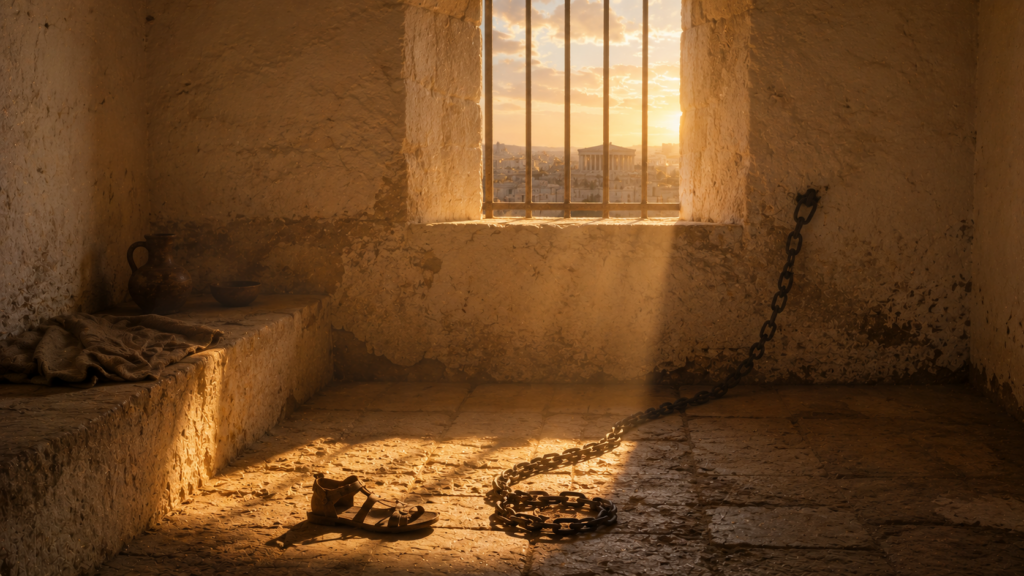
Ephesians 3 is the chapter that closes the indicative half of the letter. After the cosmic Christology of chapter 1 and the new humanity of chapter 2, chapter 3 names the secret that those two chapters are the unveiling of: a mystery that was hidden through previous generations and is now made plain. Paul names himself a prisoner of Christ on behalf of the gentiles, names his commission as the stewardship of this mystery, names the content of the mystery in a single sentence in verse 6 (the gentiles are fellow heirs, fellow members of the body, fellow partakers of the promise, three Greek syn- compounds in a row), and then names the purpose of the church’s existence in a sentence that should be read with deep breath. Through the church, verse 10 says, the manifold wisdom of God might be made known to the principalities and the powers in the heavenly places. The church is, in chapter 3, the demonstration project of God’s cosmic plan. The unseen rulers learn the gospel not by direct address but by watching the body that the gospel has produced.
The chapter has two clear movements. The first (verses 1 to 13) is the mystery and its stewardship: how the unveiling reached Paul, what it contains, why it produces a church whose existence makes the gospel visible to the powers. The second (verses 14 to 21) is Paul’s second prayer, climbing the same theological heights as the first (1:15-23) but asking for something different. The first prayer asked for eyes; the second prayer asks for fullness. It ends with the doxology that the church’s liturgy has carried ever since: to him who is able to do exceedingly abundantly above all that we ask or think.
The underlying claim is that the gospel is bigger than the believer’s interior life. What was hidden through the ages and is now revealed is not first a private salvation but a cosmic re-organization of all things in Christ, with the church as its public sign. Chapter 4 will return to walking worthy of that calling; chapter 3 sets the calling at the height from which the walking begins.
A · Ephesians 3:1-13 · The mystery, the stewardship, and the church displayed to the powers
¹ For this cause I, Paul, am the prisoner of Christ Jesus on behalf of you Gentiles, ² if it is so that you have heard of the administration of that grace of God which was given me toward you, ³ how that by revelation the mystery was made known to me, as I wrote before in few words, ⁴ by which, when you read, you can perceive my understanding in the mystery of Christ, ⁵ which in other generations was not made known to the children of men, as it has now been revealed to his holy apostles and prophets in the Spirit, ⁶ that the Gentiles are fellow heirs and fellow members of the body, and fellow partakers of his promise in Christ Jesus through the Good News, ⁷ of which I was made a servant according to the gift of that grace of God which was given me according to the working of his power. ⁸ To me, the very least of all saints, was this grace given, to preach to the Gentiles the unsearchable riches of Christ, ⁹ and to make all men see what is the administration of the mystery which for ages has been hidden in God, who created all things through Jesus Christ, ¹⁰ to the intent that now through the assembly the manifold wisdom of God might be made known to the principalities and the powers in the heavenly places, ¹¹ according to the eternal purpose which he accomplished in Christ Jesus our Lord. ¹² In him we have boldness and access in confidence through our faith in him. ¹³ Therefore I ask that you may not lose heart at my troubles for you, which are your glory. (Ephesians 3:1-13, World English Bible)
- For this cause I, Paul, am the prisoner of Christ Jesus on behalf of you Gentiles (verse 1). Paul begins a sentence that he does not finish. The opening For this cause (Greek toutou charin) starts a thought that the long parenthesis of verses 2 to 13 interrupts, and that he picks up again only at verse 14 (“For this cause, I bow my knees…”). The parenthetical structure matters. Paul has so much to say about the mystery that he literally cannot stay on the rails of his own sentence. He has to step aside, name the thing, and only then return to the prayer he set out to pray. The chapter’s structure is the structure of a writer overcome.
- if it is so that you have heard of the administration of that grace of God which was given me toward you (verse 2). The Greek noun oikonomia (translated “administration” by the WEB, “stewardship” by the NIV, NASB, and CSB, “commission” by the NRSVue, and “plan” by the NRSVue elsewhere) is one of the chapter’s key terms. It originally meant household management, the running of an oikos. In Paul’s usage it carries two related senses: the administration or plan that God has set in motion in history (3:9, 1:10) and the stewardship given to a specific apostle for executing his part of that plan (3:2, 7-8). Paul is naming himself a household-steward of grace, dispatched by the Master to serve the gentiles.
Word study: oikonomia (οἰκονομία), “administration, stewardship, plan”
The Greek word oikonomia is built on oikos (house) and nomos (law, ordering), and it originally named the running of a household. The oikonomos was the household steward, often a slave entrusted with authority over the household’s affairs, the kind of figure Jesus’s parables keep returning to (Luke 12:42; 16:1-13). In Paul’s usage the word stretches in two complementary directions. First, oikonomia names God’s cosmic plan unfolding in history (1:10, to an administration of the fullness of the times; 3:9, the administration of the mystery which for ages has been hidden in God); second, it names the delegated stewardship given to specific apostles for executing pieces of that plan (3:2, 7; 1 Cor 9:17; Col 1:25). The two senses are linked: there is a divine oikonomia over all things, and there are human oikonomoi who serve it. The WEB and KJV-tradition translation “administration” sounds bureaucratic; “stewardship” (NIV, NASB, CSB) is warmer and more accurate to the household-management background. The word is doing pastoral work, not bureaucratic. The English word economy, which descends from oikonomia, has lost the word’s relational depth. The Christian tradition that talks about the divine economy of salvation (Irenaeus, the Cappadocians, the modern theological tradition) is using this word in its Pauline sense: the unfolding plan of the Maker’s household, with the church as the place where the household is gathered.
- how that by revelation the mystery was made known to me, as I wrote before in few words, by which, when you read, you can perceive my understanding in the mystery of Christ (verses 3-4). Paul names the means of his knowledge: by revelation (kata apokalypsin), the same word and grammar he uses in Galatians 1:12 to describe how he received the gospel. Paul did not work out the inclusion of the gentiles through inference from texts; he received it, the way the Hebrew Bible prophets received their visions, by direct unveiling. He references something he wrote before (almost certainly chapters 1-2 of the same letter), implying the Asian readers should now go back and reread with this lens.
- which in other generations was not made known to the children of men, as it has now been revealed to his holy apostles and prophets in the Spirit (verse 5). The mystery is a new revelation, not in the sense that God’s plan changed, but in the sense that what was hidden is now publicly unveiled. The phrase holy apostles and prophets (singular article in Greek, tois hagiois apostolois autou kai prophētais) likely refers to the New Testament apostolic-prophetic generation (the same generation the church is being built on, 2:20), not the Hebrew Bible prophets here. In the Spirit names the means of the revelation: the Spirit who is the present down-payment of the inheritance (1:13-14) is also the agent who unveils the plan.
- that the Gentiles are fellow heirs and fellow members of the body, and fellow partakers of his promise in Christ Jesus through the Good News (verse 6). The verse that is the content of the mystery. Three Greek syn- compounds in a row, all in the present tense: synklēronoma (fellow heirs), syssōma (fellow members of one body, a word Paul coins for this verse), symmetocha (fellow partakers). The three words are saying the same thing three ways. The gentiles are not added to the people of God as a separate annex; they are fellow this and fellow that, on equal footing with the original heirs of the promise. The chapter that began with strangers and aliens (2:19) reaches its theological crescendo here. The mystery is not that new things will be given to the gentiles; the mystery is that the same things are now given to both, in one body, in Christ Jesus.
Influence callout: Mike Erre (Voxology / Journey Church) on the mystery as the box top
Erre’s reading of Ephesians, developed across his Offspring series at Journey Church and the broader Voxology theology podcast, takes 1:9-10 and 3:6 together as the box top of the whole letter. The “mystery” that God has now revealed is the summing up of all things in Christ (1:10) and the inclusion of the gentiles as fellow heirs (3:6), two faces of the same truth. Erre’s pastoral move is the one the chapter most needs: the gospel cannot be reduced to me and God. The gospel is the bringing back together of a fractured cosmos, and the visible sign of that bringing-back is a church in which the formerly excluded are equals. Erre keeps pressing the implication: every line we still draw between who is in and who is out among the people who name Jesus is a line drawn against the box top. The image-bearers we have not yet welcomed are the ones the chapter is asking us to look at, “without first having to know where they’re from or what they believe or what they stand for or how they vote.” That is the mystery in operation. See one new humanity and in Christ: participation and union.
- of which I was made a servant according to the gift of that grace of God which was given me according to the working of his power. To me, the very least of all saints, was this grace given, to preach to the Gentiles the unsearchable riches of Christ (verses 7-8). Paul’s self-description is striking. He is a servant (diakonos) of the gospel he is preaching, dispatched according to the gift of grace, and he names himself the very least of all saints. The Greek elachistoterō, “lesser-est,” is a double comparative invented by Paul to drop himself below any normal grammatical floor. The unsearchable riches of Christ (to anexichniaston ploutos, the wealth that cannot be traced out) are the content of his preaching. The chapter that names the apostle’s commission also keeps the apostle small.
Influence callout: Timothy Gombis on the church as theater of God’s wisdom (3:10)
Gombis’s Drama of Ephesians (2010) takes 3:10 as the structural pivot of his whole reading. The verse is one of the most theologically surprising claims in the New Testament. The manifold wisdom of God (hē polypoikilos sophia tou theou, “the many-colored wisdom of God”) is made known through the church to the rulers and the authorities in the heavenly places. The unseen powers do not learn the gospel by direct announcement. They learn it by looking at the body the gospel has produced. Gombis’s image is theatrical. The cosmic powers, defeated at the cross (Col 2:15) and outranked by the enthroned Christ (Eph 1:20-23), are spectators in the heavenly places. The church is the stage on which their defeat is publicly demonstrated. When Jew and gentile, slave and free, male and female sit together at one table in Christ, the powers are shown that their dividing-wall ontology has been overthrown. The argument is silent in words and overwhelming in form. The pastoral consequence is severe. When the church divides along the lines the cross dissolved, the theater goes dark; the powers are not shown the gospel because the gospel is not visible to be shown. When the church lives as one new humanity, the wisdom of God is being publicly preached to the cosmos through her existence. The cosmic apologetic of Ephesians is not what the church says about the gospel; it is what the church is. See powers and principalities and cosmic Christology.
- and to make all men see what is the administration of the mystery which for ages has been hidden in God, who created all things through Jesus Christ, to the intent that now through the assembly the manifold wisdom of God might be made known to the principalities and the powers in the heavenly places, according to the eternal purpose which he accomplished in Christ Jesus our Lord (verses 9-11). The chapter’s most stunning theological claim. The mystery has two audiences. First, all men (panta, all people; verse 9), who are to see the administration of the mystery now revealed. Second, the principalities and the powers in the heavenly places (verse 10), who are to be shown the manifold wisdom of God through the church. The two audiences are not separate; the visible church among humans is itself the demonstration to the unseen powers. The reference to the eternal purpose (kata prothesin tōn aiōnōn, “according to the plan of the ages”) underlines that this is not God’s improvisation in the present; it is what he was always doing.
Where this lands: the church is the apologetic
The most striking apologetic move in Ephesians is not an argument; it is a body. Through the church, 3:10 says, the manifold wisdom of God is made known to the powers. The powers learn the gospel by looking at the gathered people. This is a different vision of Christian witness from the one modern American Christianity has often produced. The dominant model has been the church takes a message into the world: we craft the right arguments, we evangelize, we explain. Ephesians’ model is the church’s existence is the message. When the formerly divided are at one table, when the dividing-wall ontology of the old age is undone, when the body is visibly one across the lines the powers used to defend, the gospel is being announced in the most cosmically loud register available. The pastoral implication for the ordinary congregation is sobering. The witness of your church is not first the sermons preached or the programs run; it is the kinds of people gathered at the table and the way they sit together. The witness of your marriage is not first the talks you give your kids; it is the cruciform mutuality the household practices. The witness of your workplace is not first the conversations you have about Jesus; it is the line of integrity you hold across categories of class, ethnicity, and power. Eph 3:10 is the chapter’s call to take with terrible seriousness the visible shape of the body Christ has built. The powers are watching. They are watching how we are, not what we say.
- In him we have boldness and access in confidence through our faith in him. Therefore I ask that you may not lose heart at my troubles for you, which are your glory (verses 12-13). The section ends with the believer’s posture (parrēsia, boldness, the same word for free public speech in classical Greek; prosagogē, access, the word for being granted audience with the king) and Paul’s pastoral concern that his imprisonment not discourage the readers. The apostolic suffering is for them and is, in its own way, their glory. The chapter that names the cosmic stage of the church’s existence also names a chained apostle in a Roman cell as part of the same drama.
B · Ephesians 3:14-21 · The prayer for fullness, and the doxology
¹⁴ For this cause, I bow my knees to the Father of our Lord Jesus Christ, ¹⁵ from whom every family in heaven and on earth is named, ¹⁶ that he would grant you, according to the riches of his glory, that you may be strengthened with power through his Spirit in the inner person, ¹⁷ that Christ may dwell in your hearts through faith, to the end that you, being rooted and grounded in love, ¹⁸ may be strengthened to comprehend with all the saints what is the width and length and height and depth, ¹⁹ and to know Christ’s love which surpasses knowledge, that you may be filled with all the fullness of God. ²⁰ Now to him who is able to do exceedingly abundantly above all that we ask or think, according to the power that works in us, ²¹ to him be the glory in the assembly and in Christ Jesus to all generations, forever and ever. Amen. (Ephesians 3:14-21, World English Bible)
- For this cause, I bow my knees to the Father of our Lord Jesus Christ (verse 14). Paul finally returns to the For this cause of verse 1, picks up the suspended sentence, and prays. The posture is bowed knees (kamptō ta gonata mou), unusual for first-century Jewish prayer (which was typically standing); the kneeling marks the prayer as one of deep reverence and supplication. Paul prays to the Father (pros ton patera), the same Father whose name 1:2 has set the letter’s theological key.
- from whom every family in heaven and on earth is named (verse 15). A Greek wordplay the English cannot quite carry: patera (Father) and patria (family, lineage, kindred) are related forms. Every family, every patria, takes its identity from the One Father, patēr. The chapter that has refused to let the Jew-and-gentile division divide the church will not let it divide the cosmos either. There is one Father, and every family in heaven and on earth derives its name from him. The cosmic Christology of chapter 1 reappears here as a cosmic patriology. The God who fills all things is also the Father from whom all families are named.
- that he would grant you, according to the riches of his glory, that you may be strengthened with power through his Spirit in the inner person, that Christ may dwell in your hearts through faith (verses 16-17a). The first petition. The Greek is careful. Strengthened with power (dynamei krataiōthēnai) is doubled force: not one word for strength but two, intensifying each other. In the inner person (eis ton esō anthrōpon) names the location: the deepest interior of the believer’s life. And the purpose of the strengthening is named: that Christ may dwell in your hearts through faith. The verb katoikēsai (dwell, settle, take up permanent residence) is the same root as katoikia (dwelling-place) in 2:22 (a habitation of God in the Spirit). The temple language of chapter 2 is now turned inward: not only the church corporately as the temple where God dwells, but Christ personally dwelling in the heart of each believer.
- to the end that you, being rooted and grounded in love, may be strengthened to comprehend with all the saints what is the width and length and height and depth, and to know Christ’s love which surpasses knowledge, that you may be filled with all the fullness of God (verses 17b-19). The prayer’s heart. Two metaphors run together: rooted (errizōmenoi, agricultural, like a tree’s deep roots) and grounded (tethemeliōmenoi, architectural, like a building’s foundation). In love is the medium. The dimensions of love (platos kai mēkos kai hypsos kai bathos, width and length and height and depth) are notoriously suggestive; the church has read them in many ways across the centuries (Augustine took them as the dimensions of the cross; modern readers more often take them as the immensity of Christ’s love that cannot be measured by human categories). The prayer’s climax is that you may be filled with all the fullness of God (hina plērōthēte eis pan to plērōma tou theou), the same plērōma word from 1:23, now applied to the believer. The cosmic Christ who fills all in all is what the believer is being prayed to be filled with. There is no theological reach in the New Testament higher than this prayer.
Word study: the four dimensions (3:18) and agape
The Greek text gives no object for the four dimensions: what is the width and length and height and depth. Of what? The translation tradition fills in the implied object as Christ’s love (which the next clause, 3:19, names directly), but the openness of the Greek phrasing has invited a long history of reading. Augustine (Sermons on Ephesians) read the four dimensions as the four arms of the cross: width across, length up, height of the upright above, depth of the buried root below. The cross becomes the measuring instrument by which the love of Christ is comprehended. John Chrysostom (Homilies on Ephesians, Hom. 7 on 3:18-19) read them as the dimensions of the divine plan unveiled in chapter 3: the breadth of the inclusion (the gentiles, the nations, the cosmos), the length of the ages (from before the foundation of the world to the ages to come), the height of the enthronement (Christ in the heavenly places), the depth of the descent (the cross, the grave). Modern readers (Cohick, Markus Barth) usually take the four as a rhetorical totality, the four-corner expression for the whole. Whichever specific reading one favors, the noun the dimensions are anchored to is agapē, the love of Christ, and what the believer is asked to do with that love is to know it in a way that surpasses knowledge (verse 19). The Greek is paradoxical on purpose. To know a love that surpasses knowledge is the kind of knowing that is participation, not analysis. You do not master Christ’s love; you are filled with it.
- Now to him who is able to do exceedingly abundantly above all that we ask or think, according to the power that works in us, to him be the glory in the assembly and in Christ Jesus to all generations, forever and ever. Amen (verses 20-21). The chapter ends in doxology. The Greek piles on the superlatives: hyperekperissou (“over and above and far beyond”) is a triple-intensive Greek compound coined for this verse. God is able to do above all (hyper panta), above and beyond all we ask, and above and beyond all we ask or think. The clause is constructed precisely to refuse the believer’s instinct to put a ceiling on God’s possibilities. The power that works in us (the same energeia that raised Christ from the dead, 1:19-20) is the operating force of the church’s life. And the glory is given in the church and in Christ Jesus, in both, two coordinated locations of the one glory.
Influence callout: John Chrysostom on the doxology (Hom. 7 on Eph 3:20-21)
Chrysostom’s homily on 3:20-21 marvels at the apostolic generosity of the Greek. The text does not stop at do what we ask. It does not stop at do above what we ask. It does not stop at do above what we ask or think. It piles up the prepositions, each one taking the reader further. Chrysostom: “Mark how he uses every kind of expression to show the immensity. He is able. Above all. Exceedingly above all. Exceedingly abundantly above all we ask. Exceedingly abundantly above all we think. And not in our own strength, but according to the power that worketh in us.” For Chrysostom, the doxology is the necessary response to the chapter that has just ended. After such a mystery, such a cosmic plan, such a prayer for fullness, the only honest closing word is the praise of the One whose capacities the text has just spent twenty verses indicating cannot be exhausted. The Reformation tradition would later carry this doxology into the church’s liturgy (it remains one of the most-used benedictions in modern Protestant worship); Chrysostom’s reading is the patristic anchor for why. The doxology is not decorative. It is the chapter’s logical conclusion: if God can do that (the cosmic plan, the new humanity, the indwelling Christ, the filling with all the fullness of God), the only response is glory.
Reflection prompts
- The mystery, in verse 6, is that the gentiles are fellow heirs, fellow members of the body, fellow partakers of the promise: the syn- compounds insist on equal standing, not annex membership. Where in your own life or church do you treat any group of believers as attached to the people of God rather than fellow with them? What would the fellow word change?
- Eph 3:10 says the cosmic powers learn God’s manifold wisdom through the church, not through the church’s arguments. The body’s existence is the apologetic. What is your own congregation showing the unseen rulers, by being what it is? Where do the lines of belonging in your community mirror the dividing-wall ontology the cross has overthrown?
- Paul prays for the church to be filled with all the fullness of God (verse 19). The verb is passive; the filling is not produced from inside. Where in your life have you been trying to produce a fullness that the prayer says is received? What would it look like to stop generating and start being filled?
Frameworks at play in this chapter: in Christ: participation and union, cosmic Christology, one new humanity, powers and principalities, Abrahamic covenant, Paul within Judaism, apocalyptic Paul, tabernacle as cosmic temple.