
Ephesians
One body, one Spirit.
All 6 chapters drafted.
Ephesians
How to read it
Themes: the risen Christ enthroned over every cosmic power · every spiritual blessing located in him · grace through faith creating a people for good works · the dividing wall between Jew and gentile demolished in his flesh · one new humanity, one body, one temple where God dwells by the Spirit · the mystery of God’s plan to sum up all things in Christ · the church making known God’s wisdom to the unseen powers · the calling to walk worthy of the new identity · cruciform mutuality in the household · the divine warrior’s own armor put on his people for the war already won Literary design: a two-half letter, indicatives of what God has done in Christ (chs 1-3) followed by imperatives to walk worthy of that calling (chs 4-6), hinged at 4:1 (I therefore beg you to walk worthy) · framed by two prayers (1:15-23 and 3:14-21) · opens with a single Greek sentence berakah (1:3-14, the longest sentence in the New Testament) in which every theological assertion is qualified by en Christo (in Christ) · ethical section organized around six occurrences of the verb walk (4:1, 4:17, 5:1, 5:8, 5:15) · climaxes in the household codes (5:21-6:9) and the cosmic armor passage (6:10-20) Frameworks at play: in Christ: participation and union · cosmic Christology · one new humanity · powers and principalities · the household codes · adoption and sonship · apocalyptic Paul · counter-imperial reading · the cruciform hermeneutic · justification · gospel allegiance · Paul within Judaism · the Shema · tabernacle as cosmic temple · the new covenant · the vocabulary of humanity · the image of God · two ways
Ephesians is one of the most-read and most-preached letters in the Christian canon, and for good reason. In six short chapters Paul (or, on the disputed view, a close disciple writing in his name) compresses an entire vision of the gospel: cosmic Christology, the new humanity created from former enemies, grace as God’s incongruous gift, the church as temple and as army, the household reorganized around the cross, and the unseen war the believer is now equipped to wage. It is the letter the church has reached for whenever it needed to remember what it is, and the letter modern American Christianity has most badly under-read whenever it has reduced the gospel to private individual salvation. Read well, Ephesians refuses both the church’s smallness about itself and its self-importance.
This page is a “how to read it” overview, meant to be read alongside the chapter commentaries (linked at the bottom). If you want the verse-by-verse work, follow a chapter link. If you want the lay of the land before you walk it, you’re in the right place.
Where it came from, and to whom
The letter calls itself an apostolic letter from Paul to “the saints who are in Ephesus” (1:1), but two scholarly questions sit at the surface of any honest reading. Was Paul actually the author? And was Ephesus actually the destination? The site’s posture on the first is, for the sake of argument, assume Pauline authorship. The arguments against Pauline authorship, vocabulary and style somewhat different from the undisputed letters, theology slightly later-feeling, dependence on Colossians, are real and worth taking seriously; the arguments for Pauline authorship (the letter’s own claim, the early church’s reception, the deep continuity of thought with the undisputed Paulines, the plausibility of secretarial composition, the fact that no NT writer between AD 65 and 90 could plausibly have produced this) are also real. We read the letter as Paul’s, likely composed late in his ministry, possibly through a secretary (the way Romans was; see Rom 16:22), and possibly while he was in Roman imprisonment (3:1; 4:1; 6:20). Where the disputed-authorship question shapes a specific reading, we will note it.
The second question is more easily settled. The words “in Ephesus” in 1:1 are missing from some of the earliest and most important manuscripts: P46, Codex Sinaiticus (in the original hand, before correction), and Codex Vaticanus. The second-century church knew of a version sent “to the Laodiceans” (Tertullian’s note about Marcion). The simplest explanation is that Ephesians was a circular letter, probably carried by Tychicus (6:21) around the network of house churches in Roman Asia, with the destination city filled in locally as the letter arrived. This is the lane’s reading. The letter is catholic, universal, in a way that addresses no specific congregational dispute. It is Paul’s vision of the gospel sent to a region, not his troubleshooting of a particular crisis.
The macro-shape: indicatives, then imperatives
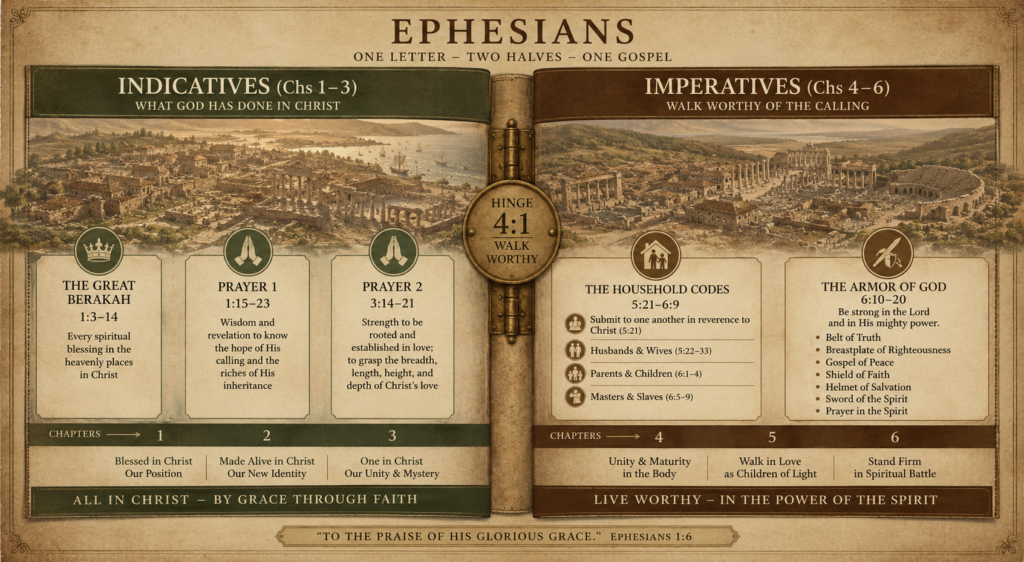
The most important structural feature of Ephesians is the hinge at 4:1. The first three chapters are indicatives, sustained declaration of what God has done in Christ. The last three are imperatives, sustained call to live the calling that the indicatives created. “I therefore, a prisoner for the Lord, urge you to walk worthy of the calling to which you have been called” (4:1). The verb walk (peripateō) then organizes the ethical material: walk worthy of the calling (4:1); no longer walk as the gentiles walk (4:17); walk in love (5:2); walk as children of light (5:8); walk wisely (5:15). The letter’s logic is identity-then-ethics, gift-then-response, indicative-grounds-imperative. To reverse this order, by reading Ephesians as a moral program that produces an identity, is to read the letter backwards.
Chapters 1-3: what God has done in Christ
The first three chapters are theological symphony. After the briefest of openings (1:1-2), Paul lifts off into the great berakah of 1:3-14, a single Greek sentence, the longest in the New Testament, in which every clause is governed by en Christo (in Christ) or one of its variants. Blessed in him, chosen in him, adopted in him, graced in the Beloved, redeemed in him, the mystery revealed in him, the inheritance obtained in him, sealed in him. The sentence is impossible to read aloud without losing breath, which is exactly the point: Paul is making the reader feel that there is no detachable benefit of the gospel. Salvation has a location, and the location is the risen Messiah. See in Christ: participation and union.
The berakah is followed by Paul’s first prayer (1:15-23), which climaxes in one of the New Testament’s most concentrated statements of cosmic Christology: God raised him, seated him at his right hand in the heavenly places, put all things under his feet, gave him as head over all things to the church, which is his body, the fullness (plērōma) of him who fills all in all. The four cosmic-power nouns (archē, exousia, dynamis, kyriotēs) and the climactic “every name that is named” (1:21) speak the language of the Ephesian magical-religious world (the Artemis cult, the Ephesia Grammata, the magical papyri); the risen Christ is enthroned above every name those texts catalogued. See cosmic Christology.
Chapter 2 is the single richest theological chapter in the letter. 2:1-10 announces the gospel for the individual: dead in trespasses → made alive together with Christ → raised → seated with him in the heavenly places → saved by grace through faith, not from yourselves, the gift of God, not from works, lest anyone boast → created in Christ Jesus for good works which God prepared beforehand that we should walk in them (the hinge of grace-and-vocation). 2:11-22 announces the gospel for the community: the dividing wall, almost certainly the soreg of the Jerusalem temple, the low stone barrier separating the court of the gentiles from the inner courts, broken down in his flesh, the law-of-commandments-as-boundary-marker abolished, one new anthropos created in place of the two, both reconciled to God in one body through the cross, and the formerly excluded built together into a holy temple in the Lord. The chapter’s two halves are not separable themes. The gift creates the body. See one new humanity and (on grace) justification.
Chapter 3 returns to the mystery, God’s plan, hidden for ages, now unveiled: the gentiles are fellow heirs, fellow members of the body, fellow partakers of the promise (3:6). The chapter’s most surprising claim is 3:10: “so that through the church the manifold wisdom of God might now be made known to the rulers and authorities in the heavenly places.” The new humanity’s existence is the visible argument that the cosmic powers have been disarmed; the church is the demonstration project. Paul’s second prayer (3:14-21) then folds the cosmic Christology of chapter 1 and the new humanity of chapter 2 into a single petition: that Christ may dwell in our hearts through faith, that we may have strength to comprehend the breadth and length and height and depth of his love, that we may be filled with all the fullness (plērōma) of God. The prayer ends with the doxology that has carried more weight in Christian prayer than almost any other line of Paul: “to him who is able to do far more abundantly than all that we ask or think… to him be glory in the church and in Christ Jesus throughout all generations, forever and ever. Amen.”
Chapters 4-6: walking worthy of the calling
Chapter 4 turns the corner. 4:1-16 is the unity-of-the-body passage, with its Christian Shema (one body, one Spirit, one hope, one Lord, one faith, one baptism, one God and Father of all, 4:4-6, Paul’s reframing of Deuteronomy 6:4 around the risen Christ; see the Shema), the descent-and-ascent Christological hymn-fragment from Psalm 68 (4:8-10), and the gifted ministries that build up the body until we all attain to the unity of the faith and of the knowledge of the Son of God, to the mature anthropos, to the measure of the stature of the fullness of Christ (4:13). 4:17-32 is the put off / put on call (4:22-24), the old self of pre-incorporation life renounced and the new self of in-Christ identity adopted, image-of-God language refigured around the new humanity. See the vocabulary of humanity and the image of God.
Chapter 5 weaves cruciform ethics into household practice. 5:1-2: be imitators of God, walk in love as Christ loved us and gave himself for us, the heart of the cruciform hermeneutic compressed into two verses. 5:3-21 runs the two ways, children of darkness vs. children of light, through specific behaviors (sexual purity, speech, sober wisdom, Spirit-filled singing, gratitude). And 5:21-33 opens the household codes with the governing verb of the whole passage: submitting to one another out of reverence for Christ (5:21). The marriage section that follows reframes the Greco-Roman husband-as-authority around the husband-as-cruciform-lover, as Christ loved the church and gave himself for her, and reaches its climax in the mystery, the marriage union as the public sign of Christ and the church. See the household codes.
Chapter 6 closes the codes (children and parents, slaves and masters, 6:1-9) and then lifts off into the cosmic-warfare passage that is the letter’s climax (6:10-20). Our struggle is not against flesh and blood but against the rulers, against the authorities, against the cosmic powers over this present darkness, against the spiritual forces of evil in the heavenly places. The armor that follows, belt of truth, breastplate of righteousness, shoes of the gospel of peace, shield of faith, helmet of salvation, sword of the Spirit, is YHWH’s own armor, drawn from Isaiah 11:5, 52:7, and 59:17, where the divine warrior arms himself for battle. The pieces of God’s gear are now put on God’s people. The believer’s defense in the unseen war is not a counter-magic of competing names but participation in the One whose Name is above every name. The whole passage ends not with an incantation but with prayer in the Spirit (6:18). See powers and principalities.
Voices we read with
Our chapter commentaries lean on a careful slate of modern and pre-modern voices. Lynn Cohick (NICNT) is the lane’s careful exegetical baseline. N.T. Wright (NT for Everyone; Paul and the Faithfulness of God) supplies the new-creation and Israel-fulfilled reading. Tim Gombis (The Drama of Ephesians) is our primary voice for the apocalyptic theater of God’s cosmic victory and the church’s participation in it. Clinton Arnold (Ephesians: Power and Magic) is indispensable for reading Ephesians in its actual Ephesian magical-cult context, especially chapter 6. Markus Barth (Anchor, two volumes) is the gold standard on Eph 2:11-22 and the Jew-and-gentile reading. John Barclay (Paul and the Gift) reframes Eph 2:8-10 grace through his six “perfections,” especially incongruity. Scot McKnight, Marty Solomon (Bema), Tim Mackie (BibleProject), and Brian Zahnd carry the kingdom, Hebraic, biblical-theology, and cruciform threads. From the pre-modern church, John Chrysostom‘s twenty-four Homilies on Ephesians (c. 392) are the foundational patristic reading, especially on chapters 2, 5, and 6; John Calvin‘s commentary (1548) anchors the Reformation tradition’s reading, especially on Eph 1 and 2:8-10. Willie James Jennings is our contemporary conscience on Eph 2: the chapter the modern American church has most badly failed to live is the dividing-wall chapter.
What Ephesians is for
The letter exists to give the church its identity and its posture. Who are we?, the body of the cosmic Christ, the new humanity of formerly-divided peoples, the dwelling place of God by the Spirit. How then do we live?, walking worthy of that calling, in cruciform love, in honest household relationships, in unceasing prayer, in the armor of God for the war that is already won. To read Ephesians is to be told what you are before you are told what to do, and to find that the what you are is far larger than your private interior life. The Christian life Ephesians is forming is corporate, cosmic, cruciform, and confidently engaged with a world still under contested powers. Six chapters. Read them slowly.
Chapters
- Ephesians 1 · Every blessing in him: the great berakah, the mystery of God's will, and the cosmic enthronement of Christ
- Ephesians 2 · But God: from death to life by grace, the dividing wall demolished, and one new humanity built into a holy temple
- Ephesians 3 · The mystery revealed: gentiles as fellow heirs, the church as the wisdom of God displayed to the powers, and the prayer for fullness
- Ephesians 4 · Walk worthy: one body and a Christian Shema, the gifts that build the mature anthropos, and putting on the new self
- Ephesians 5 · Walk in love as Christ loved us, children of light, Spirit-filled, and the household codes opened by mutual submission
- Ephesians 6 · Children, parents, slaves, masters, the armor of God, and the closing greetings: the letter ends in cosmic war and prayer