
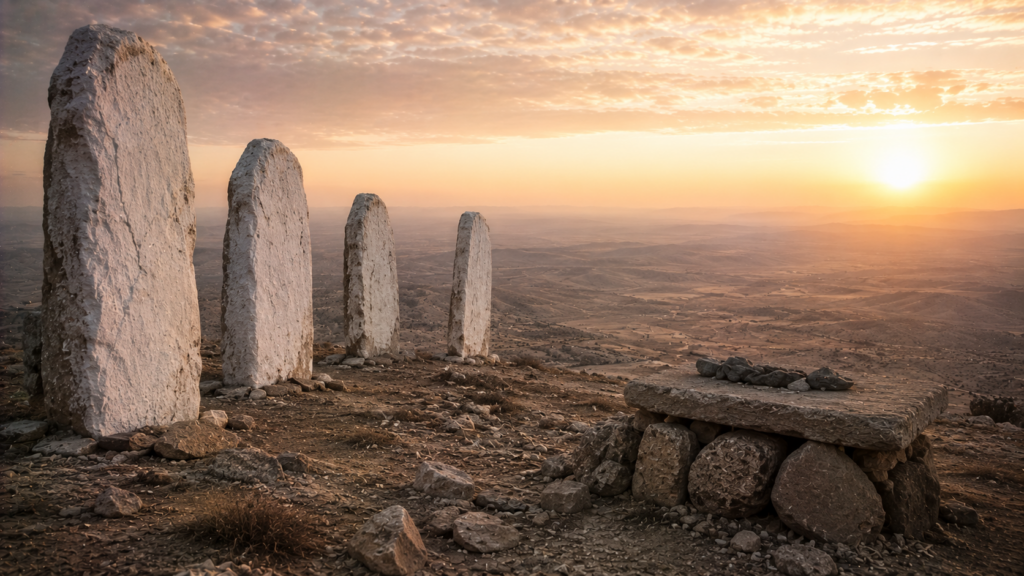
Chapter 27 turns from the law’s content to its ratification. Moses commands a ceremony for the day Israel crosses the Jordan: write the whole law on great plaster-coated stones, build an altar on Mount Ebal and rejoice there, and then array the twelve tribes across a natural amphitheater, six on Mount Gerizim for the blessing, six on Mount Ebal for the curse, with the Levites in the valley between, reciting twelve curses to which all the people answer “Amen.” (The ceremony is carried out in Joshua 8:30-35.) It is the covenant being publicly sealed, the people audibly binding themselves to the words they have heard (see the Sinai covenant).
Two things stand out. The altar of sacrifice and joy is built not on Gerizim, the mountain of blessing, but on Ebal, the mountain of the curse, grace planted in the very place of curse, a small foreshadowing of where this whole covenant is heading. And the twelve curses target mostly secret sins: the idol “set up in secret,” the landmark quietly moved, the bribe taken in the dark, the things no human court can reach. Before the God who sees the hidden, the people seal their accountability with their own “Amen.”
A · Deuteronomy 27:1-10 · The law on stones, and an altar on Ebal
¹ Moses and the elders of Israel commanded the people, saying, “Keep all the commandment which I command you today. ² It shall be on the day when you shall pass over the Jordan to the land which Yahweh your God gives you, that you shall set yourself up great stones, and coat them with plaster. ³ You shall write on them all the words of this law, when you have passed over, that you may go in to the land which Yahweh your God gives you, a land flowing with milk and honey, as Yahweh, the God of your fathers, has promised you. ⁴ It shall be, when you have crossed over the Jordan, that you shall set up these stones, which I command you today, on Mount Ebal, and you shall coat them with plaster. ⁵ There you shall build an altar to Yahweh your God, an altar of stones. You shall not use any iron tool on them. ⁶ You shall build Yahweh your God’s altar of uncut stones. You shall offer burnt offerings on it to Yahweh your God. ⁷ You shall sacrifice peace offerings, and shall eat there. You shall rejoice before Yahweh your God. ⁸ You shall write on the stones all the words of this law very plainly.” ⁹ Moses and the Levitical priests spoke to all Israel, saying, “Be silent and listen, Israel! Today you have become the people of Yahweh your God. ¹⁰ You shall therefore obey Yahweh your God’s voice, and do his commandments and his statutes, which I command you today.” (Deuteronomy 27:1–10, World English Bible)
- Write on them all the words of this law… build an altar… rejoice (verses 1-8). The first act in the land is to publish the law, written “very plainly” (the same word, be’er, as 1:5) on whitewashed stones for all to read, and to build an altar of uncut stones (no iron tool, no human “improvement” on what God provides) for sacrifice and a joyful covenant meal. Word and worship together: the law inscribed, the altar smoking, the people feasting. And it all happens on Mount Ebal, the mountain assigned to the curse (verse 13), which is striking. The place of blessing-through-sacrifice is set down in the place of curse, the first hint of a pattern the gospel will complete, where the curse and the altar meet at one place, the cross.
- Today you have become the people of Yahweh your God (verses 9-10). After all the statutes, the priests declare the people’s new identity: today you have become his people. It is performative covenant language, the same “today” that runs through the book (5:3; 26:17-18). Belonging precedes the obedience that follows from it; the command to “obey” (verse 10) rests on the status already granted, “you have become his people.”
Influence callout: Daniel Block on the Shechem covenant ceremony
Block’s reading of the covenant ceremony at Gerizim and Ebal (27:1-13; cf. Josh 8:30-35) keeps insisting that the staging is theology in space. The two mountains stand opposite each other across the valley of Shechem, with the city of Shechem (later Sychar; see John 4) in the saddle between them. Mount Gerizim, to the south, is by tradition the better-watered, more fruitful slope; Mount Ebal, to the north, is bare and stony. Six tribes are arrayed on Gerizim for the blessing, six on Ebal for the curse, the Levites in the valley between with the ark, reciting the curses toward the assembled tribes. The ceremony is not just a liturgy; it is the covenant in three dimensions, with geography doing what would later be done with words. The blessing slope and the curse slope are both visible to everyone at once. The people are not allowed to forget either one. Block: the Deuteronomic insistence that the law be inscribed on plastered stones at Ebal, the curse mountain, is itself a theological statement. The covenant is laid down in the place of judgment, not just in the place of promise. The whole arrangement embeds, in topography, what chapter 30 will later say in words: life and death, blessing and curse, are set before you; therefore choose life.
B · Deuteronomy 27:11-26 · The tribes, and the people who answer Amen
¹¹ Moses commanded the people the same day, saying, ¹² “These shall stand on Mount Gerizim to bless the people, when you have crossed over the Jordan: Simeon, Levi, Judah, Issachar, Joseph, and Benjamin. ¹³ These shall stand on Mount Ebal for the curse: Reuben, Gad, Asher, Zebulun, Dan, and Naphtali. ¹⁴ With a loud voice, the Levites shall say to all the men of Israel, ¹⁵ ‘Cursed is the man who makes an engraved or molten image, an abomination to Yahweh, the work of the hands of the craftsman, and sets it up in secret.’ All the people shall answer and say, ‘Amen.’ ¹⁶ ‘Cursed is he who dishonors his father or his mother.’ All the people shall say, ‘Amen.’ ¹⁷ ‘Cursed is he who removes his neighbor’s landmark.’ All the people shall say, ‘Amen.’ ¹⁸ ‘Cursed is he who leads the blind astray on the road.’ All the people shall say, ‘Amen.’ ¹⁹ ‘Cursed is he who withholds justice from the foreigner, fatherless, and widow.’ All the people shall say, ‘Amen.’ ²⁰ ‘Cursed is he who lies with his father’s wife, because he dishonors his father’s bed.’ All the people shall say, ‘Amen.’ ²¹ ‘Cursed is he who lies with any kind of animal.’ All the people shall say, ‘Amen.’ ²² ‘Cursed is he who lies with his sister, his father’s daughter or his mother’s daughter.’ All the people shall say, ‘Amen.’ ²³ ‘Cursed is he who lies with his mother-in-law.’ All the people shall say, ‘Amen.’ ²⁴ ‘Cursed is he who secretly kills his neighbor.’ All the people shall say, ‘Amen.’ ²⁵ ‘Cursed is he who takes a bribe to kill an innocent person.’ All the people shall say, ‘Amen.’ ²⁶ ‘Cursed is he who doesn’t uphold the words of this law by doing them.’ All the people shall say, ‘Amen.’” (Deuteronomy 27:11–26, World English Bible)
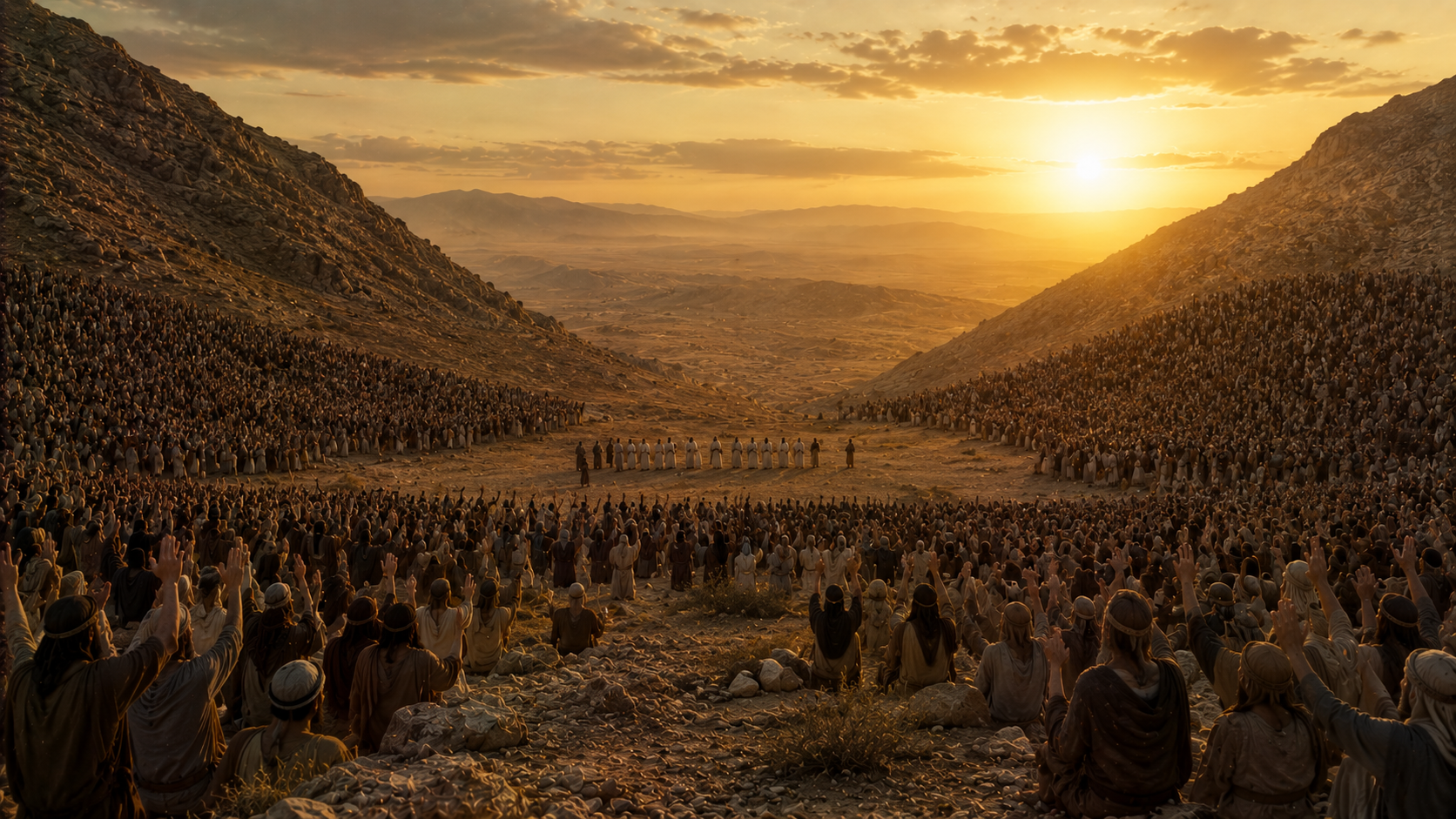
- Six tribes for blessing, six for the curse (verses 11-13). The people are split across the two facing peaks of Shechem, Gerizim and Ebal, in a vast natural amphitheater (the acoustics there really do carry). The covenant is being ratified not by a king’s signature but by the whole nation’s voice, every tribe present and audible.
Influence callout: twelve curses on secret sins, and the people’s “Amen” (and Galatians 3:10)
The twelve curses (verses 15-26) are worth reading slowly for what they target. Strikingly, most of them name sins done in the dark, where no court could ever convict: the idol “set up in secret” (verse 15), the neighbor’s landmark quietly moved (17), misleading a blind man on the road (18), the various hidden sexual sins (20-23), the one who “secretly kills his neighbor” (24), the bribe taken to condemn the innocent (25). These are the offenses that escape human justice precisely because no one sees, and that is the point: the people bind themselves before the God who does see the hidden, sealing each curse with their own “Amen” (“so be it”, they pronounce the sentence on themselves). It is covenant accountability reaching into the conscience, into the places only God can reach (the same concern as Jesus’ Sermon on the Mount, where anger and lust, the hidden sins, fall under judgment). And the list climaxes in a sweeping twelfth curse: “Cursed is everyone who doesn’t uphold the words of this law by doing them” (verse 26). Paul quotes this exact verse in Galatians 3:10 to make his case that the law, taken as a system of performance, leaves everyone under a curse, “for all who rely on works of the law are under a curse.” The “Amen” the people say here is, in Paul’s reading, an “Amen” to a standard none could keep, which is why he immediately turns to the One who “became a curse for us” (Gal 3:13; the very curse-on-a-tree of Deut 21:23). The mountain of curse, where the altar already stood (27:5-7), is where the gospel was always heading.
Reflection prompts
- The altar of sacrifice and joy was built on Ebal, the mountain of the curse, grace planted in the place of judgment. Where in your life has God met you with mercy precisely at the site of your failure, the very place you expected only curse?
- Most of the twelve curses target secret sins, the things no one sees, no court can reach. Which of your “set up in secret” areas would you least want recited aloud, and what does it mean that you live before a God who sees them already, and still invites you?
- The whole nation sealed the covenant with their own “Amen,” pronouncing the sentence on themselves. Paul says that “Amen” exposed a standard no one could keep, sending us to the One who took the curse. Where are you still trying to earn an “Amen” you could only ever receive as a gift?
Frameworks at play in this chapter: the Sinai covenant, two ways, the cruciform hermeneutic.