
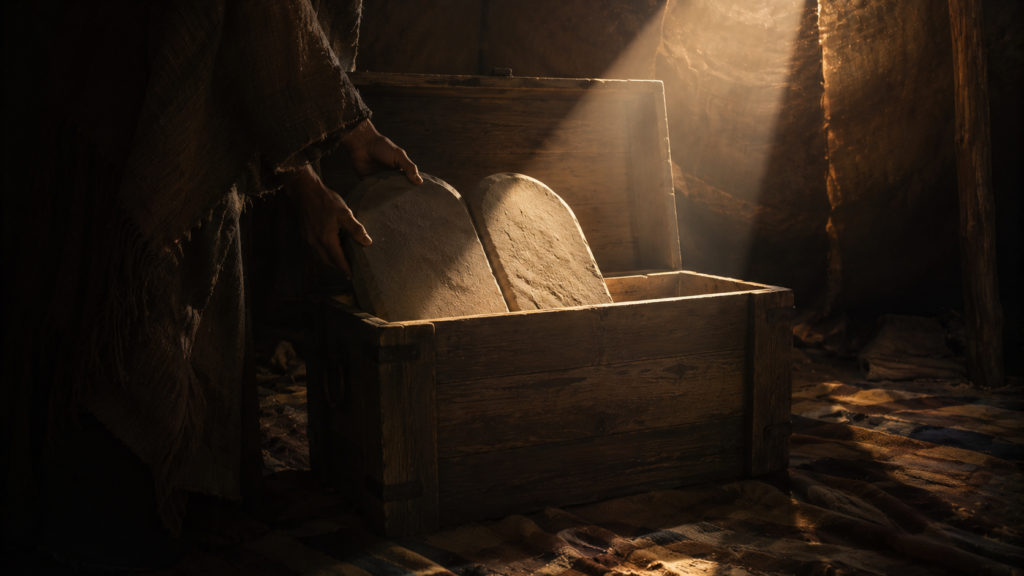
After the long recital of failure in chapter 9, chapter 10 opens with grace: God tells Moses to cut new tablets, the covenant is remade, the broken stone is replaced. The prayer in the breach was heard, Yahweh would not destroy you (10:10), and the journey resumes. Then Moses gathers the whole sermon so far into a single, famous question, what does Yahweh your God require of you? (10:12), and answers it with the Shema in miniature: fear, walk, love, serve, with all your heart and soul.
But the chapter does not stop at requirement. It names the cure for the stiff neck of chapter 9, circumcise the foreskin of your heart (10:16), the command that chapter 30 will turn into a promise. And it closes with one of the most breathtaking portraits of God in the Hebrew Bible: the God of gods and Lord of lords, the supreme power of the universe, whose greatness is displayed not in remoteness but in stooping to defend the orphan, the widow, and the foreigner, and who commands Israel to love the stranger because Israel was once a stranger. Cosmic majesty and tender justice, in the same breath.
A · Deuteronomy 10:1-11 · New tablets, and a prayer that was heard
¹ At that time Yahweh said to me, “Cut two stone tablets like the first, and come up to me onto the mountain, and make an ark of wood. ² I will write on the tablets the words that were on the first tablets which you broke, and you shall put them in the ark.” ³ So I made an ark of acacia wood, and cut two stone tablets like the first, and went up onto the mountain, having the two tablets in my hand. ⁴ He wrote on the tablets, according to the first writing, the ten commandments, which Yahweh spoke to you on the mountain out of the middle of the fire in the day of the assembly; and Yahweh gave them to me. ⁵ I turned and came down from the mountain, and put the tablets in the ark which I had made; and there they are as Yahweh commanded me. ⁶ (The children of Israel traveled from Beeroth Bene Jaakan to Moserah. There Aaron died, and there he was buried; and Eleazar his son ministered in the priest’s office in his place. ⁷ From there they traveled to Gudgodah; and from Gudgodah to Jotbathah, a land of brooks of water. ⁸ At that time Yahweh set apart the tribe of Levi to bear the ark of Yahweh’s covenant, to stand before Yahweh to minister to him, and to bless in his name, to this day. ⁹ Therefore Levi has no portion nor inheritance with his brothers; Yahweh is his inheritance, according as Yahweh your God spoke to him.) ¹⁰ I stayed on the mountain, as at the first time, forty days and forty nights; and Yahweh listened to me that time also. Yahweh would not destroy you. ¹¹ Yahweh said to me, “Arise, take your journey before the people; and they shall go in and possess the land which I swore to their fathers to give to them.” (Deuteronomy 10:1–11, World English Bible)
- Cut two stone tablets like the first… I will write on the tablets the words (verses 1-5). Grace takes a concrete form: God replaces what the calf destroyed. The same ten words, re-inscribed, placed in the ark. The covenant Israel shattered (9:17) is remade by the God against whom it was broken. The relationship survives the worst thing Israel could do to it, not because the breach was small but because God restores.
- Levi has no portion… Yahweh is his inheritance (verses 6-9). A parenthesis notes Aaron’s death and the setting apart of Levi to carry the ark and minister. The line about Levi is quietly beautiful: the tribe that gets no land gets God himself as its inheritance (verse 9). Sometimes the deepest blessing is to be given the Giver instead of the gift.
- Yahweh listened to me that time also. Yahweh would not destroy you (verses 10-11). The intercession of chapter 9 is confirmed answered. The people live, and the command comes: arise, take your journey before the people. Mercy does not just spare; it sends them forward.
B · Deuteronomy 10:12-16 · What does YHWH require? Circumcise your heart
¹² Now, Israel, what does Yahweh your God require of you, but to fear Yahweh your God, to walk in all his ways, to love him, and to serve Yahweh your God with all your heart and with all your soul, ¹³ to keep Yahweh’s commandments and statutes, which I command you today for your good? ¹⁴ Behold, to Yahweh your God belongs heaven, the heaven of heavens, and the earth, with all that is therein. ¹⁵ Only Yahweh had a delight in your fathers to love them, and he chose their offspring after them, even you above all peoples, as it is today. ¹⁶ Circumcise therefore the foreskin of your heart, and be no more stiff-necked. (Deuteronomy 10:12–16, World English Bible)
- What does Yahweh your God require of you? (verses 12-13). Moses compresses the entire law into one question and a five-fold answer: fear, walk, love, serve, and keep the commandments… for your good.
Influence callout: the Shema in summary, “for your good” (10:12-13)
This is one of the great summaries of covenant life, and it is the Shema restated: love him and serve him with all your heart and with all your soul (verse 12) echoes 6:5 almost word for word. Micah will later distill the same instinct (“what does the LORD require of you but to do justice, love mercy, and walk humbly,” Micah 6:8), and Jesus will name love of God as the greatest commandment. Two things keep this from being a crushing list. First, the verbs are relational, not transactional, fear (reverence), walk (a way of life), love, serve, cling (verse 20), the language of a bond, not a contract. Second, the stated purpose: it is all for your good (verse 13; see Torah as gift). God requires nothing that is not also a gift. The summary of the law is not “perform, or else” but “love the One who loves you, and live.”
- To Yahweh belongs the heaven of heavens… only Yahweh had a delight in your fathers to love them (verses 14-15). The motive for obedience is set in cosmic scale. Everything belongs to God, the heaven, the heaven of heavens, the earth and all in it, and yet this all-owning God set his delight on this one small people in love. The vastness makes the choosing more astonishing, not less: the One who needs nothing chose to love them.
- Circumcise therefore the foreskin of your heart, and be no more stiff-necked (verse 16). Here is the cure for the diagnosis of chapter 9.
Influence callout: circumcise your heart (10:16 → 30:6)
Chapter 9 named the disease, a stiff neck (9:6, 13), a will that won’t bend. Chapter 10 names the cure, and it is not “try harder” but a deeper operation: circumcise the foreskin of your heart. The image takes the covenant sign given to Abraham (Gen 17) and drives it inward, the layer of stubborn resistance around the heart must be cut away so the heart can love (see circumcision of the heart). Most translations keep the surgical metaphor (“circumcise your hearts,” CSB, NIV, NASB, NRSVue); the NLT paraphrases it “change your hearts.” Notice that here it is a command, something Israel is told to do. But Deuteronomy knows the stiff neck too well to leave it there: by 30:6 the same image becomes a promise, Yahweh your God will circumcise your heart… to love him. What is commanded here, God will pledge to do himself there. The prophets pick it up (Jer 4:4; Ezek 36:26), and Paul lands it: real circumcision “is of the heart, by the Spirit” (Rom 2:29). The seed of the new covenant is planted in this single verse.
C · Deuteronomy 10:17-22 · The God of gods who loves the foreigner
¹⁷ For Yahweh your God, he is God of gods and Lord of lords, the great God, the mighty, and the awesome, who doesn’t respect persons or take bribes. ¹⁸ He executes justice for the fatherless and widow and loves the foreigner in giving him food and clothing. ¹⁹ Therefore love the foreigner, for you were foreigners in the land of Egypt. ²⁰ You shall fear Yahweh your God. You shall serve him. You shall cling to him, and you shall swear by his name. ²¹ He is your praise, and he is your God, who has done for you these great and awesome things which your eyes have seen. ²² Your fathers went down into Egypt with seventy persons; and now Yahweh your God has made you as the stars of the sky for multitude. (Deuteronomy 10:17–22, World English Bible)
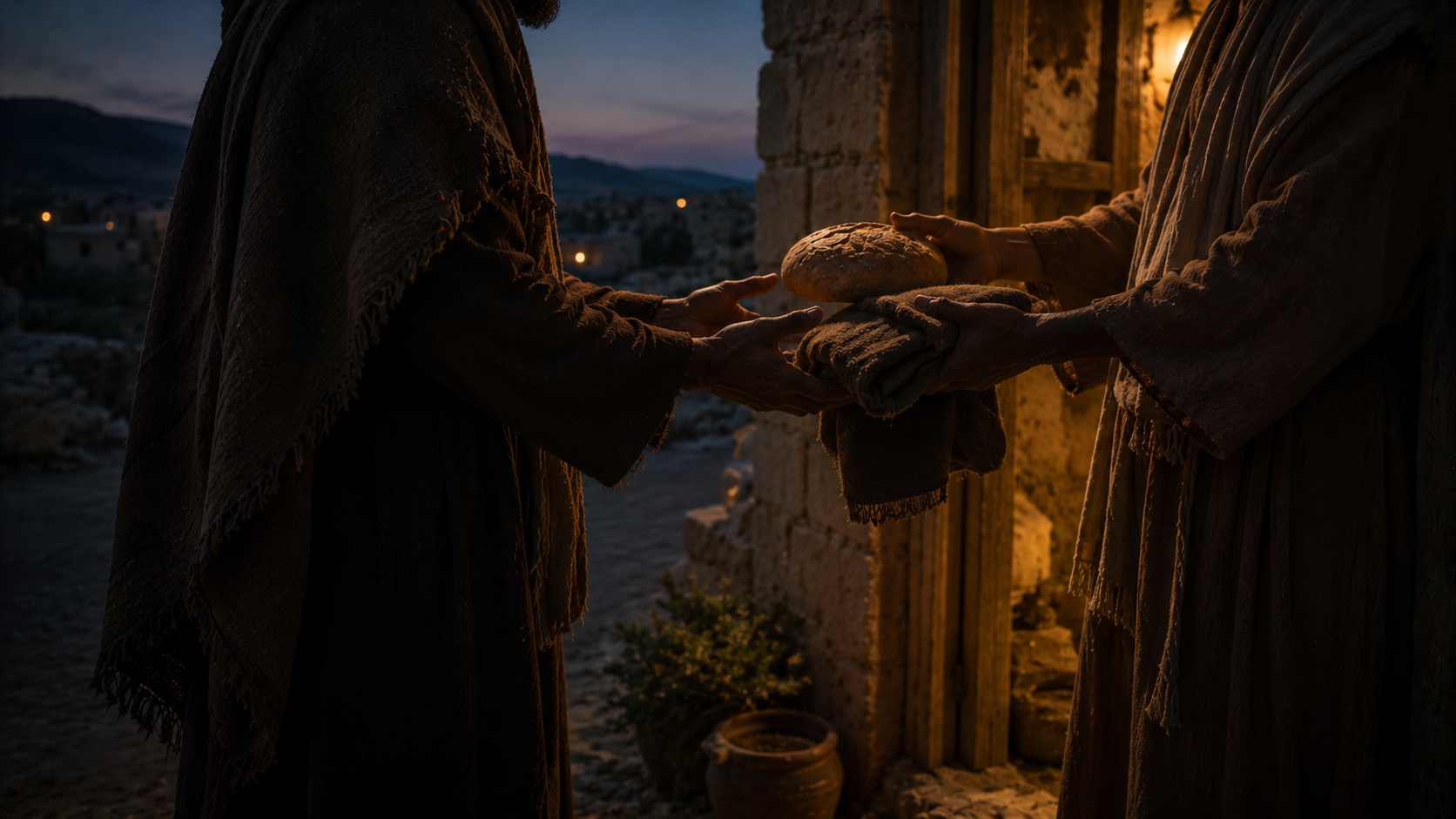
- Yahweh your God is God of gods and Lord of lords… who doesn’t respect persons or take bribes (verse 17). The chapter reaches its theological summit, and the translations all keep the towering titles: God of gods and Lord of lords, the great God, the mighty, and the awesome. This is the supreme-power language of the cosmos.
Influence callout: the God of gods who loves the foreigner (10:17-19)
Watch what Deuteronomy does with God’s supremacy, because it is the opposite of what every other ancient culture did with it. God of gods and Lord of lords places YHWH at the absolute top of every power in heaven and earth (see the divine council), incomparably great, impossible to bribe or sway. And then verse 18 completes the sentence in the most unexpected way: this supreme God executes justice for the fatherless and widow, and loves the foreigner, giving him food and clothing. The mightiest being in existence is defined by his care for the three most powerless figures in the ancient world, the orphan, the widow, and the immigrant. Greatness, in Deuteronomy, bends down. And then the ethical hinge: therefore love the foreigner, for you were foreigners in the land of Egypt (verse 19). Israel is to image this God by extending the same welcome it once needed, its own memory of vulnerability becoming the engine of its compassion (see the cry of the oppressed). To be like the God of gods is not to dominate but to defend the defenseless and love the stranger.
- You shall fear him, serve him, cling to him… he is your praise (verses 20-22). The chapter closes by returning to the verbs of devotion, adding cling (the word for a husband and wife becoming “one flesh,” Gen 2:24), and by marveling at the multiplication: your fathers went down into Egypt with seventy persons, and now Yahweh your God has made you as the stars of the sky. The promise to Abraham (Gen 15:5) has been kept. The God who loves the powerless has turned a refugee family of seventy into a nation, and he is, Moses says, your praise, the one your whole life sings.
Pushback note: immigration, the ger, and modern American Christianity
Deuteronomy 10:18-19 may be one of the most-bypassed texts in modern American Christianity: “He executes justice for the fatherless and widow, and loves the foreigner in giving him food and clothing. Therefore love the foreigner, for you were foreigners in the land of Egypt.” It is not a sentimental sidebar; it is a confession of who Yahweh is and a command grounded in Israel’s own story. The God of the universe self-defines, in the climactic clause of chapter 10’s summary creed, by his love for the foreigner. Israel is then commanded to imitate him because they remember being foreigners. The grammar of the command is memory. A Christianity that practiced this triad — justice for the orphan and widow, love of the foreigner because we were foreigners — would not produce the same border politics, the same rhetoric about migrants, the same indifference, that modern American evangelicalism has too often produced. This is not a partisan note. The text is older than any of our parties, and it answers to none of them. But Deuteronomy is unembarrassed: the God you say you worship is the God who loves the foreigner. What you do with the ger is one of the most honest signs of whether you have actually met the God Deuteronomy 10 confesses. The chapter’s circumcised heart (10:16) and its love of the foreigner (10:19) are not two separate themes; they are the same theme, stated from inside and outside the body. The inward surgery is shown by the outward welcome.
Influence callout: Christopher J. H. Wright on the ger as paradigm
Wright’s reading of Deuteronomy’s social ethics keeps insisting that the ger (the resident foreigner, the immigrant living in Israel without ancestral land or kinship structure) is not a marginal ANE legal category. It is the paradigmatic outsider through whom God teaches Israel how to be God’s people in any time and place. Mention of the ger shows up across Deuteronomy, almost always as part of a triad with the yathom (fatherless) and ‘almanah (widow), the three classic vulnerabilities of an agrarian society, those without male protectors, without land, without legal voice. The triad gets dozens of mentions in the Torah, twelve of them in Deuteronomy alone (e.g., 10:18; 14:29; 16:11, 14; 24:17, 19-21; 26:12-13; 27:19). Wright’s point is that this is not optional weight in the Torah; it is the core. The treatment of the foreigner is one of the load-bearing tests of whether a people actually belong to the God of Deuteronomy. The New Testament will pick up the same logic, “you were once strangers and aliens, now you are fellow citizens” (Eph 2:19), and ground hospitality in the same memory. Israel’s social ethic is “love the foreigner because you were a foreigner”; the church’s is “welcome the stranger because you were strangers brought in.” Same God, same grammar.
Reflection prompts
- What does YHWH require of you? The answer is relational, fear, walk, love, serve, cling, and it is for your good. Does your sense of what God “requires” feel like a contract to perform or a bond to live in? What would shift if you heard it as gift?
- The cure for a stiff neck is a circumcised heart, something Deuteronomy first commands and later promises God will give. Where are you trying to force by willpower a softening of heart that you may need to ask God to perform in you?
- The God of gods proves his greatness by loving the orphan, the widow, and the foreigner, and tells Israel to do the same because they were foreigners. Where could your own memory of having once been an outsider, helpless, or in need, become the engine of your welcome to someone in that place now?
Frameworks at play in this chapter: circumcision of the heart, the Shema, the divine council, the cry of the oppressed.