
After the catastrophe of chapter 14, chapter 15 does something unexpected: it gives laws about offerings for when Israel comes into the land. The generation standing there has just been told it will die in the wilderness, and the very next words out of God’s mouth assume that the people will, in fact, arrive. The promise is not canceled; it is postponed to the next generation. The placement is pastoral. Just after the worst day in the book, God speaks as though the land is still certain, because it is.
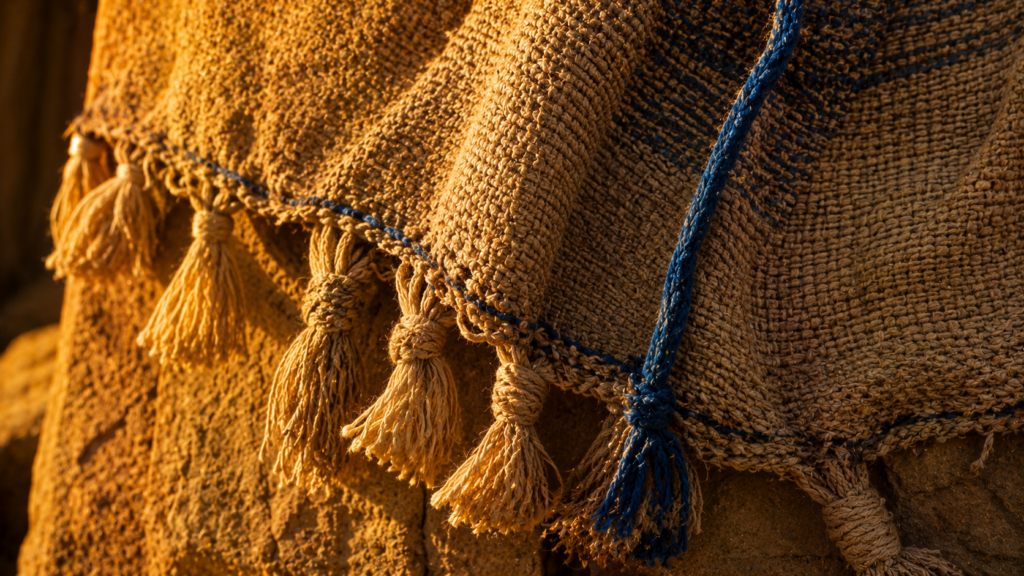
The chapter then gathers several pieces: the difference between sins of weakness and sins of defiance, the hard case of a man who gathers wood on the Sabbath, and the command to wear tassels with a blue cord on the corners of every garment. That last command is placed here on purpose. Israel has just failed because of what its eyes saw (the giants) and what its heart wanted (Egypt). Now God gives them something to see every day that will pull the eyes and the heart back toward his commandments. The chapter answers the failure of chapters 13 and 14 with a thread of blue.
A · Numbers 15:1-21 · Laws for the land
² “Speak to the children of Israel, and tell them, ‘When you have come into the land of your habitations, which I give to you…’”
- When you have come into the land (v. 2). The first words after the forty-year verdict assume entry. The laws that follow (grain and drink offerings to accompany the sacrifices, the firstfruits of the dough) only make sense for a settled, farming people in the land. God is legislating for a future the present generation will not see, which means the future is secure. The promise outlives the people who forfeited it (see the two generations).
- The native and the foreigner alike (vv. 14-16). The chapter repeats that one statute governs both the native-born and the resident foreigner: as you are, so shall the foreigner be before YHWH. The instinct that ran through chapter 9’s Passover provision continues here. The community God is forming has a single law for insider and outsider, and a place at its worship for the one who joins from outside.
- The hope is quiet but real. There is no fanfare, just the steady assumption that the land will be reached and farmed and that its harvests will be offered back to God. After a chapter of weeping and judgment, the steadiness is itself a mercy. God has not given up on the project; he has only handed it to the children of those who refused.
B · Numbers 15:30-36 · Defiance, and the man who gathered wood
³⁰ “But the soul who does anything with a high hand, whether he is native-born or a foreigner, blasphemes Yahweh. That soul shall be cut off from among his people.”
- Unintentional sin… and the high hand (vv. 22-31). The chapter distinguishes two kinds of wrong. Sins committed unintentionally, out of weakness or ignorance, are covered by sacrifice (vv. 22-29). But a sin done b’yad ramah, “with a high hand,” in open, willful defiance of God, is different in kind. It is not weakness but rebellion, and it blasphemes YHWH. The distinction matters: the system has wide grace for failure and a hard line for defiance. The issue is not the size of the act but the posture of the heart toward God.
- A man gathering sticks on the Sabbath day (vv. 32-36). Immediately a case appears. A man is found gathering wood on the Sabbath; he is held in custody until God’s verdict is sought, and then stoned outside the camp. This is one of the chapter’s hard texts (flagged in the book overview), and it should not be softened. A death sentence for gathering sticks strikes the modern reader as wildly disproportionate.
- Read in context, the placement is telling. Coming right after the description of the high-handed sin, the episode reads as a case of open, deliberate defiance of the Sabbath that anchors Israel’s whole covenant identity, not an accident or a desperate act of survival. The Sabbath was the sign of the covenant (Exodus 31:13-17), and to flout it publicly in the wilderness, where the manna had taught Sabbath rhythm daily, was to reject the covenant itself. The commentary names the difficulty plainly: the severity is real, the stakes of the wilderness covenant were uniquely high, and this is not a template for how the people of God treat Sabbath observance now (Jesus will insist the Sabbath was made for humanity, not humanity for the Sabbath, Mark 2:27). The text is honest about a hard moment; so is this reading.
C · Numbers 15:37-41 · A thread of blue
³⁸ “Speak to the children of Israel, and tell them that they should make themselves fringes on the borders of their garments throughout their generations, and that they put on the fringe of each border a cord of blue. ³⁹ It shall be to you for a fringe, that you may see it, and remember all Yahweh’s commandments, and do them; and that you don’t follow after your own heart and your own eyes.”

- Fringes on the borders of their garments (v. 38). God commands the tzitzit, tassels on the four corners of the garment, each with a single cord of blue (tekhelet). They are a wearable memory device. Every time an Israelite looks down, the tassels are there, tying sight to obedience.
- That you don’t follow after your own heart and your own eyes (v. 39). The purpose statement is the chapter’s hinge, and it answers the disaster of chapters 13 and 14 directly. Israel had just followed its eyes (the spies saw giants and grasshoppers) and its heart (the craving to return to Egypt) straight out of the promise. Now God gives a daily, visible cure for the wandering eye and the wandering heart: a thread of blue at the edge of every garment that pulls the gaze back to his commandments. The placement of the tassels right after the spy narrative is not random; it is the remedy prescribed for the exact failure just diagnosed.
- That you may see it, and remember (v. 39). The whole logic is sight and memory. The eyes that failed are retrained by something the eyes can see. The tassels function like the doorpost mezuzah and the bound tefillin of the Shema (Deuteronomy 6:8-9): physical objects that keep the covenant in view. Jesus wore tzitzit; the woman with the hemorrhage reaches for the fringe of his garment (Matthew 9:20), and the sick beg to touch the fringe of his cloak and are healed (Matthew 14:36). The thread of blue that Israel wore to remember became, on the Messiah, a thing people grasped for life.
Word study: tzitzit (צִיצִת) and tekhelet (תְּכֵלֶת), “tassel” and “blue”
The tzitzit are the corner-tassels; the tekhelet is the single cord of blue woven into each. The blue dye was costly, extracted from a marine creature, and it was the color of royalty and of the tabernacle’s own fabrics (Exodus 26:1) and the high priest’s robe (Exodus 28:31). To wear a thread of tekhelet on the corner of an ordinary garment is to carry a strand of the sanctuary and the royal court on your clothes, a small daily sign that this is a kingdom of priests (Exodus 19:6), a Name-bearing people (see bearing God’s name). The rabbinic tradition connected the blue of the tassel to the blue of the sea, the sea to the sky, and the sky to the sapphire pavement under God’s throne (Exodus 24:10): the eye travels up the chain of blue from the hem of your robe to the throne of God. The tassel is a thread that ties the worshipper’s gaze, all day, to heaven.
Reflection prompts
- Right after the verdict, God legislates “for when you come into the land.” The promise outlived the failure. Where do you need to hear that God has not abandoned a future just because you (or your generation) stumbled badly?
- The chapter distinguishes sins of weakness, widely covered by grace, from defiance done “with a high hand.” Honestly, are the things that trouble you mostly failures of weakness, or is there somewhere you are defying God with open eyes?
- The tassels were a daily, visible cure for eyes and hearts that wandered. What physical, repeated reminder keeps your own gaze tied to God rather than to what you crave or fear? If you have none, what could you make?
Frameworks at play in this chapter: the two generations, bearing God’s name, outside the camp.