
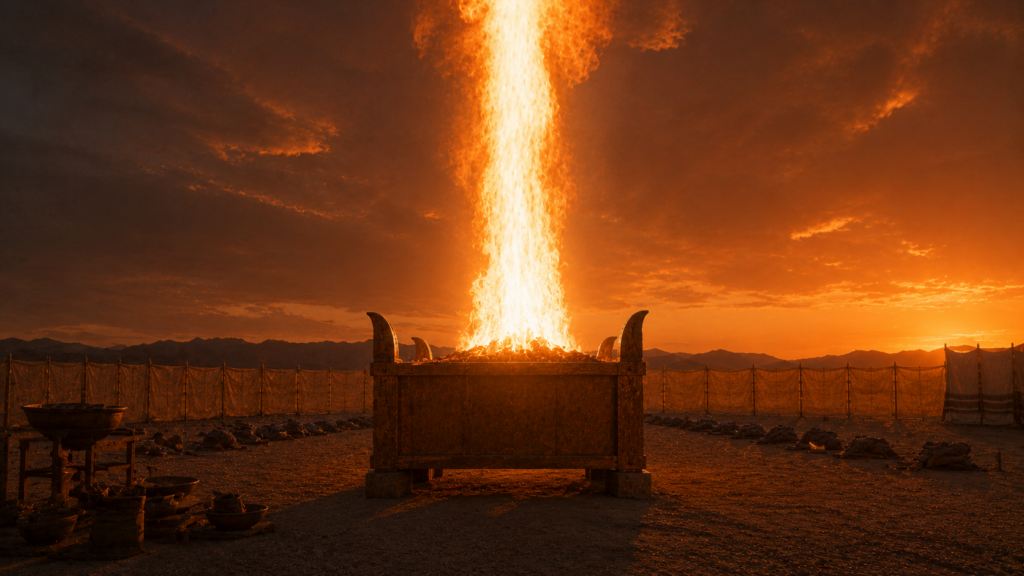
Chapter 9 is the eighth day. Aaron and his sons have spent seven days at the doorway of the Tent of Meeting (ch. 8). Now, on the morning of the eighth day, the priesthood begins to function. Moses calls Aaron forward; Aaron offers his own chatta’t and olah; then Aaron offers the people’s chatta’t, olah, shelamim, and minchah. After the day’s sacrifices conclude, Aaron blesses the people, Moses and Aaron enter the Tent together, and the glory of YHWH appears to all the people. Fire comes out from before YHWH and consumes the offering on the altar. The people fall on their faces and shout.
The chapter is the inauguration of the entire sacrificial system that chapters 1-8 have been building toward. Everything Leviticus has taught up to this point has been preparation for this day: the day YHWH’s fire descends and accepts the offering. The whole later book of Hebrews’ claim that we have a great priest over the house of God (Heb 10:21) and the New Testament’s pattern of fire from heaven (1 Kings 18, Elijah; Acts 2, Pentecost) read forward from this chapter.
The chapter also opens a small theological tension that chapter 10 will detonate. The fire on the altar, the chapter says, came from before YHWH (9:24). The chapter is teaching that YHWH himself ignited the altar. The priests did not strike the spark. In chapter 10, Aaron’s two oldest sons will try to bring their own fire, and the consequences will be catastrophic.
A · Leviticus 9:1-7 · The eighth day instructions
¹ On the eighth day, Moses called Aaron and his sons, and the elders of Israel; ² and he said to Aaron, “Take a calf from the herd for a sin offering, and a ram for a burnt offering, without defect, and offer them before Yahweh. ³ You shall speak to the children of Israel, saying, ‘Take a male goat for a sin offering; and a calf and a lamb, both a year old, without defect, for a burnt offering; ⁴ and a bull and a ram for peace offerings, to sacrifice before Yahweh; and a meal offering mixed with oil: for today Yahweh appears to you.’” ⁵ They brought what Moses commanded before the Tent of Meeting. All the congregation came near and stood before Yahweh. ⁶ Moses said, “This is the thing which Yahweh commanded that you should do; and Yahweh’s glory shall appear to you.” ⁷ Moses said to Aaron, “Draw near to the altar, and offer your sin offering, and your burnt offering, and make atonement for yourself, and for the people; and offer the offering of the people, and make atonement for them; as Yahweh commanded.”
- On the eighth day (v. 1). The chapter’s structural key. The first seven days were ordination (ch. 8); the eighth day is operation. The Hebrew Bible’s eighth-day theology will recur throughout the book: a newborn male is circumcised on the eighth day (Lev 12:3); the Feast of Booths concludes on the eighth day (Lev 23:36); the Shemini Atzeret (the eighth-day assembly) becomes a major rabbinic festival. The whole later Christian tradition’s octave (the eighth day as the day of resurrection, the new creation, the Lord’s Day) draws on this Levitical pattern. The chapter is the foundation of the eighth-day-as-inauguration grammar.
- Take a calf from the herd for a sin offering, and a ram for a burnt offering (v. 2). Aaron’s own offerings come first. The Hebrew is unusual: Aaron, who has just been ordained as the anointed priest, is required on his very first day to offer a chatta’t (sin offering) for himself. The chapter is teaching that even the consecrated priest enters the sanctuary as a sinner. The whole later book of Hebrews’ careful note that every high priest is obligated to offer for sins on behalf of his own first, and then for the sins of the people (Heb 5:3; 7:27; 9:7) reads forward from this verse. The chapter is laying the foundation for Hebrews’ eventual claim that Christ is the one priest who needed no sin offering for himself.
- A calf for a sin offering (v. 2). Aaron brings a calf (a young bull). In chapter 4, the high priest’s chatta’t required a bull (a full-grown male). The chapter’s reduced offering is a feature, not a slip: this is Aaron’s first day, and the smaller offering may signal the ordination’s purifying effect (the chapter 8 milluim has reduced Aaron’s standing chatta’t-debt). Or, more simply, the chapter may be specifying the minimum for ceremonial inauguration. Different scholars read this differently.
- Take a male goat for a sin offering; and a calf and a lamb, both a year old, without defect, for a burnt offering (v. 3). The people’s offerings. The goat (the standard nasi / community-leader chatta’t-animal of 4:22-26) addresses the people’s collective state. The calf and lamb together form the burnt offering. The chapter is teaching that the priest must address his own state before he can mediate the people’s.
- For today Yahweh appears to you (v. 4). The Hebrew is ki hayyom YHWH nir’ah aleikhem. The verb nir’ah (he appears, he is seen) is the same verb used at the great theophany moments: Abram at the oaks of Mamre (Gen 18:1), Moses at the burning bush (Ex 3:2), the elders at Sinai (Ex 24:9-11), and the kavod (glory) descending on the tabernacle (Ex 40:34). The chapter is putting the eighth-day theophany into the lineage of all the previous great visible-appearances. The whole later New Testament theology of Christ appearing (Greek epiphaneia, the same semantic field; 2 Tim 1:10; Titus 2:13) reads forward from this Hebrew verb.
- Make atonement for yourself, and for the people (v. 7). The Hebrew is vekapper ba’adkha uvad ha’am. Two prepositions: ba’adkha (on your behalf) and uvad ha’am (and on behalf of the people). The chapter is using the kipper vocabulary developed in chapters 4-5 (see the kipper / atonement framework) for the priest’s first official act. The whole later New Testament theology of the high priest interceding (Rom 8:34; Heb 7:25) takes its structural shape from this moment.
B · Leviticus 9:8-14 · Aaron’s first sacrifices
⁸ So Aaron drew near to the altar, and killed the calf of the sin offering, which was for himself. ⁹ The sons of Aaron presented the blood to him; and he dipped his finger in the blood, and put it on the horns of the altar, and poured out the blood at the base of the altar; ¹⁰ but the fat, and the kidneys, and the cover from the liver of the sin offering, he burned upon the altar; as Yahweh commanded Moses. ¹¹ The flesh and the skin he burned with fire outside the camp. ¹² He killed the burnt offering; and Aaron’s sons delivered the blood to him, and he sprinkled it around on the altar. ¹³ They delivered the burnt offering to him, piece by piece, and the head: and he burned them upon the altar. ¹⁴ He washed the innards and the legs, and burned them on the burnt offering on the altar.
- Aaron drew near to the altar (v. 8). The Hebrew is vayyiqrav Aharon el-ha-mizbeach. The verb qarav (to draw near) is the same verb that gives the name to the qorban (offering, the thing-that-draws-near; see the word study at Lev 1:2). Aaron himself is now the one drawing near. The book’s opening vocabulary has come full circle: the offering has been taught, and now the priest is performing the very qorban-action the chapter 1 vocabulary established.
- Aaron’s sons presented the blood to him (v. 9). The chapter shows the priestly team in operation. The Hebrew specifies the sons of Aaron (Eleazar, Ithamar, and the about-to-be-disgraced Nadab and Abihu) as the priestly assistants. They bring the blood; Aaron applies it. The mechanism preserves Aaron’s primary role while distributing the labor.
- He dipped his finger in the blood, and put it on the horns of the altar (v. 9). Aaron’s first official priestly act. Note: he applies the blood to the outer altar’s horns, not bringing it into the Tent. The chapter is treating Aaron’s first chatta’t on the analog of the chapter 4 ruler’s or common person’s sin offering (4:25, 30, 34), not on the analog of the priest’s-own-sin offering (4:6-7) that would have required blood inside the Tent. The chapter is making a quiet theological move: on Aaron’s first day, the milluim and inauguration have reduced his sin-state to the ordinary tier; his offering operates at the outer altar. The interpretive payoff is hopeful: ordination has done something, even before regular service begins.
- The flesh and the skin he burned with fire outside the camp (v. 11). The remaining bull-flesh is taken outside the camp, following the protocol of 4:11-12 for the priest’s chatta’t. (The Hebrews 13:11-13 echo applies here too, as in the analogous treatment of the bull in chapter 8.)
- He killed the burnt offering; and Aaron’s sons delivered the blood to him (v. 12). Aaron continues with the olah, his own burnt offering. The chapter is preserving the chapter 1 mechanics: Aaron does the killing, the priestly assistants bring the blood, Aaron applies it. The book’s instruction has become operation.
C · Leviticus 9:15-21 · The people’s sacrifices
¹⁵ He presented the people’s offering, and took the goat of the sin offering which was for the people, and killed it, and offered it for sin, like the first. ¹⁶ He presented the burnt offering, and offered it according to the ordinance. ¹⁷ He presented the meal offering, and filled his hand from there, and burned it upon the altar, in addition to the burnt offering of the morning. ¹⁸ He also killed the bull and the ram, the sacrifice of peace offerings, which was for the people. Aaron’s sons delivered to him the blood, which he sprinkled around on the altar; ¹⁹ and the fat of the bull and of the ram, the fat tail, and that which covers the innards, and the kidneys, and the cover of the liver: ²⁰ and they put the fat upon the breasts, and he burned the fat on the altar. ²¹ Aaron waved the breasts and the right thigh for a wave offering before Yahweh, as Moses commanded.
- Like the first (v. 15). The Hebrew is kari’shon. The people’s chatta’t follows Aaron’s. The chapter is using shorthand: as the first one was done, so this one. The book is teaching its reader the sacrificial system by repetition and analogy, not by re-stating every detail.
- In addition to the burnt offering of the morning (v. 17). The chapter mentions the tamid (perpetual) morning burnt offering of Ex 29:38-42. The eighth-day offerings are layered on top of the daily continual offerings, not in place of them. The chapter is teaching that the special celebrations augment the ordinary daily worship, not replace it. The whole Christian liturgical tradition’s habit of adding to the daily office on feast days (rather than displacing it) reads forward from this verse.
- The bull and the ram, the sacrifice of peace offerings (v. 18). The eighth-day’s shelamim is large: a bull and a ram for the people. This is the chapter’s communal banquet, the largest peace offering in the book so far. The chapter is teaching that inaugurations are feasts. The ordination concludes not with a sacrifice that ascends entirely (an olah) but with one that the people eat together (a shelamim; cf. ch. 3 and 7:11-21).
- Aaron waved the breasts and the right thigh for a wave offering before Yahweh (v. 21). The same tenufah gesture established in 7:30-34. Aaron is now performing the priestly portion-presentation he was instructed in.
D · Leviticus 9:22-24 · The blessing and the fire
²² Aaron lifted up his hands toward the people, and blessed them; and he came down from offering the sin offering, and the burnt offering, and the peace offerings. ²³ Moses and Aaron went into the Tent of Meeting, and came out, and blessed the people; and Yahweh’s glory appeared to all the people. ²⁴ Fire came out from before Yahweh, and consumed the burnt offering and the fat upon the altar: and when all the people saw it, they shouted, and fell on their faces.
- Aaron lifted up his hands toward the people, and blessed them (v. 22). The chapter records the first priestly blessing. The exact words are not given here; Numbers 6:22-27 will record them: YHWH bless you and keep you; YHWH make his face shine on you and be gracious to you; YHWH lift up his countenance upon you and give you peace. The chapter is the inaugural moment of what will become Judaism’s central daily blessing (recited every morning at synagogues; recited by parents over children every Sabbath eve) and one of Christianity’s most-used liturgical formulas (recited at the close of nearly every Christian worship service for two millennia). The Hebrew Bible’s most enduring liturgical word, the Aaronic blessing, has its first performance in this verse.
- Moses and Aaron went into the Tent of Meeting, and came out (v. 23). The chapter is silent about what happened inside the Tent. Moses and Aaron enter, and they come out. Some commentators read this as Moses escorting Aaron in for the priest’s first inside-the-Tent visit (to light the lamps, to set the bread, to burn incense, the daily priestly tasks). Others read it as a quiet sealing of the priesthood’s transition: Moses, the prophet who initiated the system, hands off the office to Aaron, the priest who will now operate it.
- Yahweh’s glory appeared to all the people (v. 23). The Hebrew is vayyera kavod-YHWH el-kol-ha’am. The same kavod (glory) that descended on the tabernacle at Ex 40:34-38 now appears to all the people. The whole congregation sees what only Moses saw at Sinai (Ex 24). The chapter is teaching that the sacrificial system democratizes the theophany: what was once limited to the prophet and the seventy elders is now available to all the people through the proper functioning of the tabernacle.
Word study: kavod (כָּבוֹד)
The Hebrew kavod names YHWH’s visible presence and weight. The root kavad means to be heavy, to be weighty, to have substance. Kavod is YHWH’s manifest weight, the substance of his presence made physically perceptible (Ex 16:10, the kavod in the cloud; Ex 24:16-17, the kavod as devouring fire on the mountaintop; Ex 33:18-23, Moses asks to see the kavod and is allowed to see only the back). The chapter’s kavod-event is the public manifestation of the substance the tabernacle was built to host. The whole later prophetic vision of the kavod‘s departure from the temple (Ezek 8-11; the kavod leaves the city eastward and goes up the Mount of Olives) and its eschatological return (Ezek 43; the kavod returns through the eastern gate) is the structural ground of Israel’s exile theology. The New Testament reads forward: John’s gospel says of the Word made flesh, we beheld his kavod, the kavod of the only begotten of the Father (Jn 1:14, where the Greek doxa translates the Hebrew kavod). The whole Christian theology of glory takes its weight from the Hebrew kavod the chapter is now publicly manifesting at the eighth-day inauguration.
- Fire came out from before Yahweh, and consumed the burnt offering (v. 24). The chapter’s climactic moment. The fire is from before YHWH, not struck by the priests. The same divine-fire-on-the-altar pattern will recur at Mt Carmel (1 Kings 18:38, Elijah and the prophets of Baal) and at Pentecost (Acts 2:3, divided tongues as of fire rested on each of them). The chapter is establishing the pattern: when YHWH accepts an offering with public confirmation, his own fire ignites it. The whole later prophetic theology of the day of fire (Mal 4:1; 2 Pet 3:7, 10-13) reads forward from this verse. The people’s response is appropriate: they shouted, and fell on their faces.
Influence callout: Tim Mackie (BibleProject; the eighth day as the inauguration of new creation)
Mackie’s reading of Leviticus 9 places the chapter inside the book’s largest theological arc and inside the canon’s deepest creation grammar. The seven days of the tabernacle’s construction (Ex 40:17-33) and the seven days of the priesthood’s ordination (ch. 8) together complete two seven-day creation cycles. The eighth day is the day after the seventh, the day that begins a new week of creation. The chapter is teaching, by its eighth-day setting, that the sacrificial system’s inauguration is the opening of new creation. The whole later book of Hebrews’ theology of a new and living way (Heb 10:20) and Paul’s theology of new creation (2 Cor 5:17; Gal 6:15) read forward from this eighth-day pattern. Mackie’s pastoral payoff: the church’s Sunday (the eighth day, the day after the seventh-day Sabbath) is the church’s continuation of the Levitical eighth-day inauguration. Resurrection happened on the eighth day. The new creation begins on the eighth day. The eucharist is celebrated on the eighth day. The Christian week is Levitically structured: the week ends in Sabbath, the new week begins on the eighth day, and the eighth day is the day YHWH’s fire descends to consume the new gift. Whatever else the chapter is doing, it is teaching the church the rhythm of the eighth day.
Reflection prompts
- The chapter teaches that even the consecrated priest enters the sanctuary as a sinner. Aaron’s first official act is to offer a chatta’t for himself. Where in your own work or ministry do you operate as if the office itself has cleansed you? What would it look like to begin each day with Aaron’s self-first humility?
- The fire on the altar comes from before YHWH, not from the priest’s flint. The chapter is teaching that the priest does not produce the ignition. Where in your own spiritual practice are you striving to generate what only YHWH can ignite? What would patient waiting look like?
- The chapter’s blessing (which Numbers 6 will record in full) becomes the most-used liturgical formula in the history of God’s people. Where in your own family, work, or worshipping life is the spoken blessing missing? What relationship would benefit from your hands lifted, voice spoken, version of the blessing?
Frameworks at play in this chapter: the five offerings, the kipper / atonement framework, the festival calendar, the tabernacle as cosmic temple.