
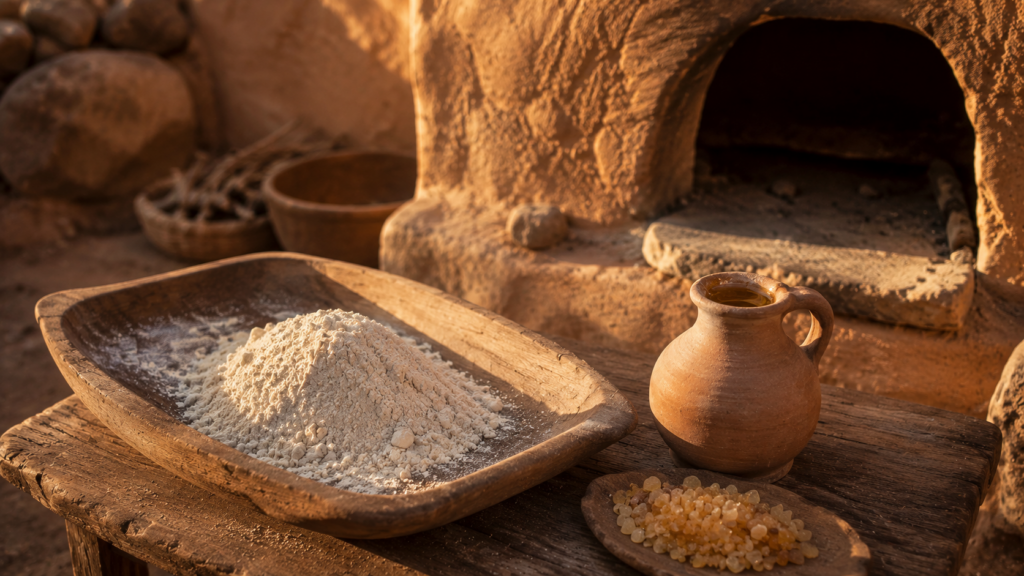
After the olah (ch. 1), the book turns to the minchah: the grain offering. The chapter moves from the animal sacrifice to the vegetable one, from the bloody to the bloodless, from the rare event to the everyday food. The chapter is showing that the sacrificial system of the five offerings is not built around blood alone. Flour, oil, frankincense, and salt are also media through which an Israelite can come near to YHWH. The minchah extends the chapter 1 grammar in a new direction.
The Hebrew word minchah originally means gift or tribute, the kind of present a vassal brings to a king or a younger brother brings to an older one (Gen 32:13, Jacob’s minchah to Esau; Gen 43:11, Joseph’s brothers’ minchah of the land’s best produce). The word’s primary register is political-relational. To bring a minchah is to acknowledge the recipient’s standing and to seek a place inside their goodwill. The chapter is teaching that this everyday register of gift-giving-to-a-superior applies, in its sacrificial form, to YHWH. The Israelite who has eaten today brings some of today’s flour back to the one who gave the harvest.
The chapter is also the budget chapter. The minchah requires no livestock; even a poor Israelite who could not afford a turtledove (the cheapest olah, 1:14-17) can still bring flour. The book is continuing chapter 1’s economic-egalitarian commitment: every Israelite, regardless of wealth, has a way to bring an acceptable gift.
A · Leviticus 2:1-3 · The raw flour offering
¹ “‘When anyone offers an offering of a meal offering to Yahweh, his offering shall be of fine flour. He shall pour oil on it, and put frankincense on it. ² He shall bring it to Aaron’s sons, the priests. He shall take his handful of its fine flour, and of its oil, with all its frankincense; and the priest shall burn its memorial on the altar, an offering made by fire, of a pleasant aroma to Yahweh. ³ That which is left of the meal offering shall be Aaron’s and his sons’. It is a most holy part of the offerings of Yahweh made by fire.
- Fine flour (v. 1). The Hebrew is solet, the finest grade of milled wheat, the same flour used for the showbread inside the tabernacle (Lev 24:5) and for festal meals at the priest’s table. Not raw grain. Not coarse meal. The flour an Israelite would mill especially for guests. The chapter is teaching that what is offered to YHWH is not the worshipper’s leftover; it is the good product, the one prepared with extra care. The same pastoral note that ran through chapter 1’s tamim (a male without defect) runs here too. Generosity is not the disposal of what no longer serves the giver.
- Oil and frankincense (v. 1). Olive oil and frankincense (levonah, the resin of the Boswellia tree from the Arabian peninsula, the same substance the magi bring to the infant Jesus at Mt 2:11) are added to the flour. Oil makes the flour edible-baked; frankincense makes it fragrant when burned. The combination is a tiny feast, miniaturized into a handful. The Israelite is bringing not just raw material but prepared food.
- Aaron’s sons, the priests (v. 2). The grain offering is the first sacrifice in which the priest is named as the system’s salaried beneficiary. Most of the minchah will be eaten by the priests (v. 3). The book is naming a structural reality of the sacrificial system: the priests eat from the offerings. Their livelihood is built into the worshippers’ gifts. The whole later New Testament principle at 1 Cor 9:13-14 (those who serve at the altar share in what is offered on the altar; in the same way, the Lord has ordained that those who proclaim the gospel should make their living from the gospel) is built on this Levitical foundation.
- His handful (v. 2). The Hebrew is qomtso, “his fistful.” A small portion of the flour, the oil, and all the frankincense is taken from the offering and burned. The rest is given to the priests. The chapter is teaching the memorial portion logic: a small token goes up to YHWH; the bulk supports the priesthood. The same logic will run through several of the offerings in chapters 3-7. The Hebrew Bible’s sacrificial economy is not primarily about burning food in front of God; it is primarily about redistributing food in the worshipping community, with a memorial portion sent up.
Word study: azkarah (אַזְכָּרָה) — “the memorial portion”
The Hebrew azkarah names the small portion of the grain offering that is burned on the altar. The root is zakhar, “to remember,” the same root as zikkaron (the Passover memorial, Ex 12:14) and the verb at the center of the Lord’s Supper (do this in remembrance of me, Lk 22:19; Gk anamnesis, the LXX translation of zikkaron). The chapter is teaching that the burned portion functions as a memorial: it reminds YHWH of the worshipper, and reminds the worshipper that they have approached YHWH. The whole offering is not consumed by the altar; only the azkarah is. The rest enters the community’s food chain through the priests. The portion sent up has a naming function, not a destructive one. The Hebrew Bible’s later prophets will distinguish between sacrifices that truly memorialize (Mal 3:16, a book of remembrance was written before him) and sacrifices that fail to do so (Isa 1:11-15, where YHWH refuses sacrifices brought without justice). The chapter is laying the groundwork: a sacrifice without memorial-meaning is a sacrifice that has missed its function.
- A pleasant aroma to Yahweh (v. 2). The phrase from chapter 1 (reach nichoach) repeats. The flour offering is received by YHWH the same way the bull offering is. The chapter is making, by deliberate textual repetition, the same egalitarian theological claim that ran through chapter 1’s three economic tiers: the cheap gift and the expensive gift receive the same divine reception.
- A most holy part (v. 3). The Hebrew is qodesh qodashim, “holy of holies.” The same superlative phrase is used for the most holy place of the tabernacle (Ex 26:33-34) and for the most holy sacrifices that transfer holiness by contact (Ex 29:37; cf. the clean and unclean framework). The leftover minchah eaten by the priests is most holy. It must be eaten in the holy precinct, by the priests alone, in a clean state. The flour the Israelite milled at home is now, by the azkarah being sent up, holy of holies.
B · Leviticus 2:4-10 · The baked variants
⁴ “‘When you offer an offering of a meal offering baked in the oven, it shall be unleavened cakes of fine flour mixed with oil, or unleavened wafers anointed with oil. ⁵ If your offering is a meal offering of the griddle, it shall be of unleavened fine flour, mixed with oil. ⁶ You shall cut it in pieces, and pour oil on it. It is a meal offering. ⁷ If your offering is a meal offering of the pan, it shall be made of fine flour with oil. ⁸ You shall bring the meal offering that is made of these things to Yahweh. It shall be presented to the priest, and he shall bring it to the altar. ⁹ The priest shall take from the meal offering its memorial, and shall burn it on the altar, an offering made by fire, of a pleasant aroma to Yahweh. ¹⁰ That which is left of the meal offering shall be Aaron’s and his sons’. It is a most holy part of the offerings of Yahweh made by fire.
- Baked in the oven (v. 4). The chapter offers three forms in which the minchah can come prepared: oven-baked cakes (v. 4), griddle-cooked flatbread (vv. 5-6), or pan-fried bread (v. 7). Each represents a different cooking apparatus an Israelite would have access to. The book is teaching that the offering’s theological function does not depend on the physical form. Whatever cooking tool the household has, the gift can be prepared on it.
- Unleavened (vv. 4, 5). The Hebrew is matzot, the same word as the Passover bread (Ex 12:8, 15-20; 13:6-7). All three baked forms must be without leaven. The next section (v. 11) will name the rule directly. The chapter is treating the unleavened state as the default for the grain offering.
- Anointed with oil (v. 4). The wafers are not just mixed with oil but anointed. The Hebrew is meshukhim, the same root as mashiach (anointed one, messiah). The vocabulary is deliberately ritual: olive oil is the substance that consecrates priests (Lev 8:12), kings (1 Sam 16:13), and the tabernacle and its furniture (Ex 30:22-33). The grain offering’s wafers are anointed in the same vocabulary that anoints sacred persons and places. The food is being treated as a consecrated object.
- Cut it in pieces, and pour oil on it (v. 6). The griddle bread is broken before the oil is added. The chapter is preserving the physical texture of the rite. The bread is broken; the oil pours into the broken pieces; the azkarah portion is taken up to the altar. The chapter is treating the worshipper’s home cooking as the raw material of a sacrament. The whole later Christian image of broken bread (1 Cor 11:24, this is my body, broken for you) draws part of its semantic field from this verse.
- The same memorial-portion logic from section A repeats (v. 9-10). Whatever the form of the minchah, the azkarah goes up and the rest is for the priests. The chapter is teaching the minchah‘s structural rhythm: prepare → bring → memorial up → priest’s share. This four-beat rhythm is the bloodless analogue to the chapter 1 rhythm (animal → hand-on-head → kill → blood and burning).
C · Leviticus 2:11-16 · No leaven, no honey, always salt
¹¹ “‘No meal offering, which you shall offer to Yahweh, shall be made with yeast; for you shall burn no yeast, nor any honey, as an offering made by fire to Yahweh. ¹² As an offering of firstfruits you shall offer them to Yahweh, but they shall not rise up for a pleasant aroma on the altar. ¹³ Every offering of your meal offering you shall season with salt; nor shall you allow the salt of the covenant of your God to be lacking from your meal offering. With all your offerings you shall offer salt. ¹⁴ “‘If you offer a meal offering of first fruits to Yahweh, you shall offer for the meal offering of your first fruits fresh heads of grain parched with fire and crushed. ¹⁵ You shall put oil on it, and lay frankincense on it. It is a meal offering. ¹⁶ The priest shall burn as its memorial part of its crushed grain and part of its oil, along with all its frankincense. It is an offering made by fire to Yahweh.
- No yeast, nor any honey (v. 11). The two prohibitions function together. Leaven (se’or) and honey (devash) are both fermenting substances: leaven works by yeast biology; honey, when warmed, ferments. The chapter is teaching that what goes up on the altar must not be in a state of transformation. The altar receives the offering in its arrested-state, not in mid-process. The Hebrew Bible’s deeper logic, which Milgrom develops carefully, is that fermentation and decay both involve the same biological process (microbial action), and the altar refuses anything that suggests decay. The same logic that excludes blemished animals (1:3, 10) excludes fermenting bread.
- As an offering of firstfruits (v. 12). The exception. Leavened bread and honeyed offerings can be brought as firstfruits offerings (the bikkurim of Lev 23:17 brings two leavened loaves at Pentecost), but they cannot be burned on the altar. They are given to the priests; they enter the food chain; they do not rise as smoke. The chapter is keeping the altar’s standard (no fermentation) and the people’s diet (leavened bread, sweetened with honey) in distinct categories. Bread that rises on the table cannot rise on the altar.
Word study: melach b’rit elohecha (מֶלַח בְּרִית אֱלֹהֶיךָ) — “the salt of the covenant”
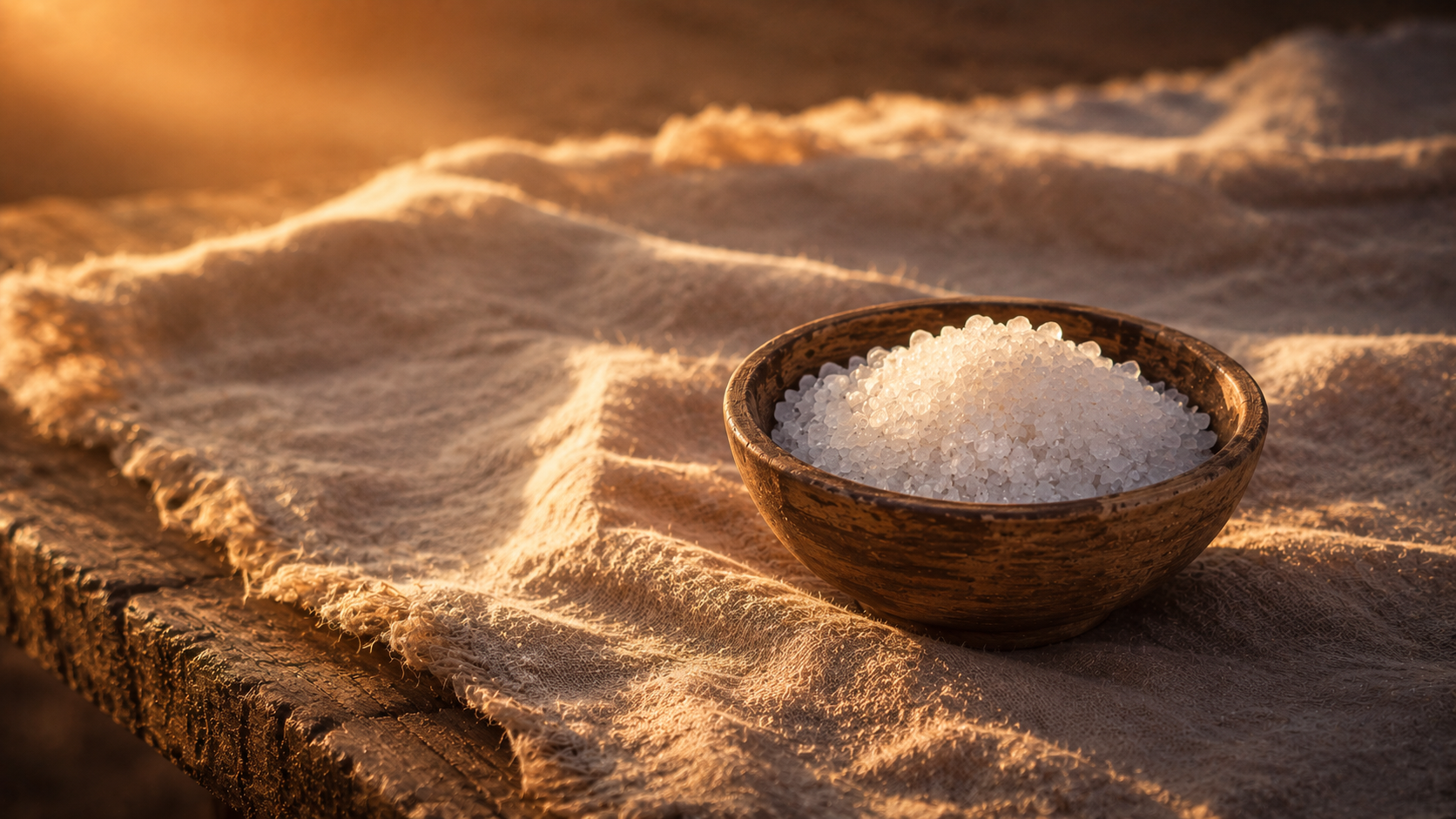
The Hebrew phrase at v. 13, melach b’rit elohecha, “the salt of the covenant of your God,” is one of the chapter’s deepest theological signals. Salt has three properties relevant here. It preserves (preventing decay, the opposite of the leaven and honey just prohibited). It seals covenants (the Hebrew Bible records covenants of salt at Num 18:19 and 2 Chron 13:5; ancient Near Eastern treaty practice often included the shared eating of salt as a covenant-binding gesture). It cannot be destroyed by fire; the altar’s burning will not consume the salt the way it consumes the flour. The chapter is teaching that every grain offering carries the same covenant signal the firstborn priests and the royal house carry. The grain on the altar is salted with the covenant the way a treaty document is sealed with its sovereign’s signet. The whole later New Testament image of salt of the earth (Mt 5:13; cf. Mk 9:50, have salt in yourselves, and be at peace with one another; Col 4:6) draws on this Levitical association. The disciples are being identified, by Jesus’s metaphor, with the chapter 2 minchah‘s covenantal property.
- Fresh heads of grain parched with fire and crushed (v. 14). The chapter closes with the firstfruits form of the grain offering: the very first ripening grain of the harvest, parched (roasted) and crushed, offered before the rest of the year’s harvest has been taken in. The Hebrew is aviv qaluy, the same word aviv that names the first month of the year (Ex 13:4) and the season of Passover. The offering is eschatologically forward-pointing: the worshipper is bringing the first of the harvest as an earnest deposit on the harvest still to come. The whole later apostolic theology of the firstfruits (Rom 8:23; 1 Cor 15:20-23; Jas 1:18) uses this chapter’s vocabulary. Christ is the aparche, the firstfruits, of those who sleep, in the same grammar Leviticus 2:14 establishes.
Influence callout: Michael Heiser (Naked Bible Podcast on Leviticus 2; the altar’s no-fermentation rule)
Heiser’s reading of Leviticus 2’s no-leaven, no-honey, always-salt rule centers on what the altar’s symbolic grammar is communicating. The altar’s space, Heiser argues, is the place where YHWH’s life meets Israel’s gift. What can occupy that space must signal life and stability, not decay and process. Leaven and honey, biologically, are decay-adjacent: they involve microbial activity, fermentation, the same processes that turn meat rancid. Salt, by contrast, is the substance most associated in the ancient world with the suspension of decay (salt-curing food extends its life by orders of magnitude). The chapter’s rules are not arbitrary fastidiousness; they are the altar’s consistent symbolic vocabulary. The same God who has just moved into the camp (Ex 40) requires that the altar at the camp’s center signal the suspension of death. Heiser’s pastoral note: the New Testament’s many warnings against the leaven of the Pharisees and the Sadducees (Mt 16:6-12), the leaven of malice and wickedness (1 Cor 5:6-8), and a little leaven leavens the whole lump (Gal 5:9) take their texture from Leviticus 2:11. The Hebrew Bible has trained the New Testament’s ear to hear leaven as the signature of that which is going to decay. To say that Christ is our Passover lamb (1 Cor 5:7) and that the church should celebrate the feast with the unleavened bread of sincerity and truth (1 Cor 5:8) is to assume the Levitical grain offering’s rules of the altar.
Reflection prompts
- The minchah is the grain offering: the offering of daily food. What in your own household’s ordinary economy could you bring as a minchah? What everyday provision could become a deliberate gift back to its giver?
- The azkarah (memorial portion) is small, but it makes the rest of the offering holy. What practical token, in your own life, could function as the azkarah for a larger gift?
- The chapter says every grain offering must be salted with the covenant. Where in your own discipleship is the covenant-signal missing? What would it look like to season every gift with the seal of the relationship it belongs to?
Frameworks at play in this chapter: the five offerings, the clean and unclean, the tabernacle as cosmic temple.