
Exodus 30 is the chapter of the small things that turn out to matter. The altar of burnt offering (chapter 27) is large, public, bronze, and bloody; the altar of incense (chapter 30) is small, hidden, gold, and fragrant. The Day of Atonement money (30:11-16) is half a shekel per person, rich or poor; the bronze basin (30:17-21) is the simple place where priests wash their hands. The anointing oil (30:22-33) and the sacred incense (30:34-38) are two precise aromatic recipes, both of them forbidden for personal use.
The chapter feels miscellaneous at first reading. Five short pericopes with no obvious unifying theme. But the chapter is in fact tightly organized around a single theological claim: the holy is composed, and the composition is exclusive. Specific ingredients in specific proportions are blended for specific purposes, and the people who serve in the holy place must come to it washed, with their lives equally ransomed, and with the fragrance of YHWH’s own composition rising before the veil.
The Hebrew Bible’s later prayer theology, the New Testament’s image of prayers as incense (Rev 5:8; 8:3-4), and the Christian tradition’s habit of careful liturgical composition all have roots in this chapter.
A · Exodus 30:1-10 · The altar of incense
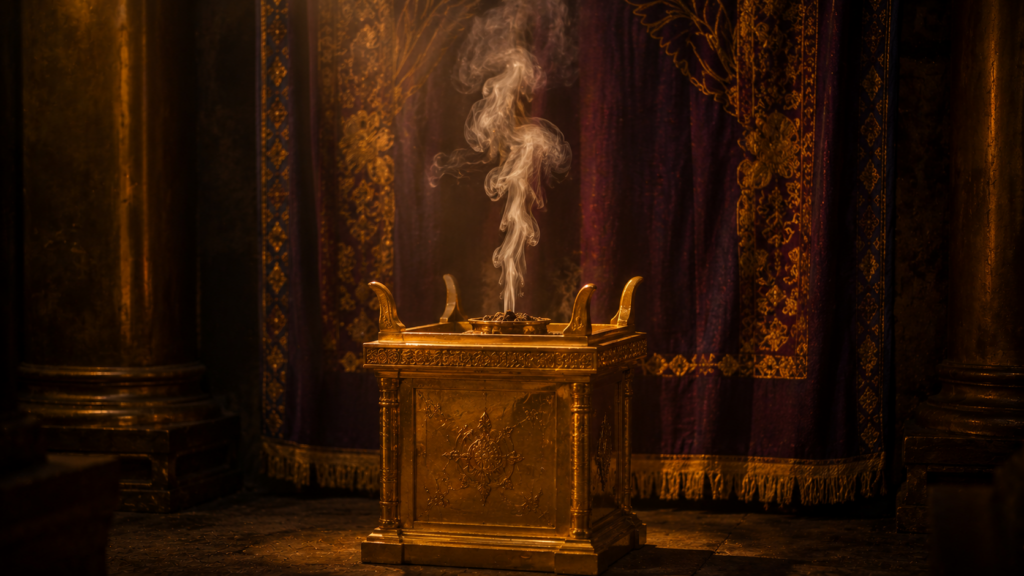
¹ “You shall make an altar to burn incense on. You shall make it of acacia wood. ² Its length shall be a cubit, and its width a cubit. It shall be square, and its height shall be two cubits. Its horns shall be of one piece with it. ³ You shall overlay it with pure gold, its top, its sides around it, and its horns; and you shall make a gold molding around it. ⁴ You shall make two golden rings for it under its molding; on its two ribs, on its two sides you shall make them; and they shall be for places for poles with which to bear it. ⁵ You shall make the poles of acacia wood, and overlay them with gold. ⁶ You shall put it before the veil that is by the ark of the covenant, before the mercy seat that is over the covenant, where I will meet with you. ⁷ Aaron shall burn incense of sweet spices on it every morning. When he tends the lamps, he shall burn it. ⁸ When Aaron lights the lamps at evening, he shall burn it, a perpetual incense before the LORD throughout your generations. ⁹ You shall offer no strange incense on it, nor burnt offering, nor meal offering; and you shall pour no drink offering on it. ¹⁰ Aaron shall make atonement on its horns once in the year; with the blood of the sin offering of atonement once in the year he shall make atonement for it throughout your generations. It is most holy to the LORD.”
- An altar to burn incense on, small, gold, square (vv. 1-3). The chapter’s first piece is a second altar, distinct from the bronze altar of chapter 27. This one is gold (the metal of the inner sanctuary), much smaller (one cubit square, two cubits tall, roughly 18 by 18 by 36 inches), and located inside the holy place, before the veil. The book is teaching graded sacrifice: the bloody altar stands in the outer courtyard, the fragrant altar stands inside the tent. The same word mizbeach (altar) names both, but their functions diverge: the bronze altar consumes flesh; the gold altar releases scent.
- Before the veil that is by the ark of the covenant, before the mercy seat (v. 6). The geography is theologically loaded. The altar of incense stands as close to the ark as anything else outside the holy of holies. The veil is the only thing between the priest tending the incense and the kapporet (mercy seat) over the ark. When the priest burns incense, the smoke rises and the scent passes over the veil into the most holy place. The chapter is teaching that the fragrant smoke does what the priest’s body cannot: it crosses the boundary. The book is staging incense as the one element that always reaches all the way in.
- Aaron shall burn incense every morning, and every evening, a perpetual incense before the LORD (vv. 7-8). The tamid (perpetual) language reappears for the third time in the tabernacle chapters: the lampstand burns tamid (27:20), the lambs are sacrificed tamid (29:38), the incense rises tamid. The three perpetual practices interlock: every morning and evening, the priest tends the lamp, offers the lamb on the outer altar, and burns incense on the inner altar. The whole worship system runs on twin daily heartbeats. The book is teaching that the holy is not occasional; it is rhythmic.
- You shall offer no strange incense on it, nor burnt offering, nor meal offering; and you shall pour no drink offering on it (v. 9). The chapter draws sharp lines. The incense altar is for only this incense (the recipe is in vv. 34-38), only at the prescribed times, only by the consecrated priest. The Hebrew word zarah (strange, foreign) reappears here from 30:9, and will reappear at the death of Nadab and Abihu in Lev 10:1, who offered strange fire before YHWH and were consumed. The chapter is warning, before the catastrophe arrives, that improvisation at the gold altar has lethal consequences. The book is teaching that there are zones where creativity is welcome (the courtyard, the daily life of Israel) and zones where exact composition is required (the inner sanctum, the altar of incense). The two are not the same.
- Once in the year, atonement on the horns (v. 10). The chapter ends section A by linking the gold altar to the Day of Atonement (Lev 16). Once a year, the high priest applies the blood of the sin offering to the horns of the incense altar (Lev 16:18-19 will spell this out). The incense altar is, structurally, the most easily defiled piece in the sanctuary, because it receives the priest’s smoke every day for a year, and the priests are themselves sinful. Annual blood-application restores it. The book is teaching that even the place of prayer needs cleansing.
Word study: qetoret (קְטֹרֶת)
The Hebrew word qetoret names incense, fragrant smoke. The root qatar means to make smoke, to send up in smoke. The same root, in different forms, names sacrifices burned on the altar (the verb form often translated offer up in the Hebrew Bible). Qetoret is what qatar produces. The chapter chooses this word deliberately: the incense is sacrificial in its theological logic, even though no animal dies in this sacrifice. The smoke rising from the gold altar is doing the same work, on a small fragrant scale, as the smoke rising from the bronze altar. The Hebrew Bible’s later equivalence between prayer and qetoret (Ps 141:2: let my prayer be set before you as incense, the lifting up of my hands as the evening sacrifice) is built on this chapter’s vocabulary. To pray, in the Hebrew Bible’s image, is to qatar: to release a small portion of one’s life into smoke that ascends to YHWH. The verb is the same.
B · Exodus 30:11-21 · The half shekel and the bronze basin
¹¹ The LORD spoke to Moses, saying, ¹² “When you take a census of the children of Israel, according to those who are numbered among them, then each man shall give a ransom for his soul to the LORD, when you number them; that there be no plague among them when you number them. ¹³ They shall give this, everyone who passes over to those who are numbered, half a shekel after the shekel of the sanctuary; (the shekel is twenty gerahs); half a shekel for an offering to the LORD. ¹⁴ Everyone who passes over to those who are numbered, from twenty years old and upward, shall give the offering to the LORD. ¹⁵ The rich shall not give more, and the poor shall not give less, than the half shekel, when they give the offering of the LORD, to make atonement for your souls. ¹⁶ You shall take the atonement money from the children of Israel, and shall appoint it for the service of the Tent of Meeting; that it may be a memorial for the children of Israel before the LORD, to make atonement for your souls.” ¹⁷ The LORD spoke to Moses, saying, ¹⁸ “You shall also make a basin of bronze, and its base of bronze, in which to wash. You shall put it between the Tent of Meeting and the altar, and you shall put water in it. ¹⁹ Aaron and his sons shall wash their hands and their feet in it. ²⁰ When they go into the Tent of Meeting, they shall wash with water, that they not die; or when they come near to the altar to minister, to burn an offering made by fire to the LORD. ²¹ So they shall wash their hands and their feet, that they not die: and it shall be a statute forever to them, even to him and to his descendants throughout their generations.”
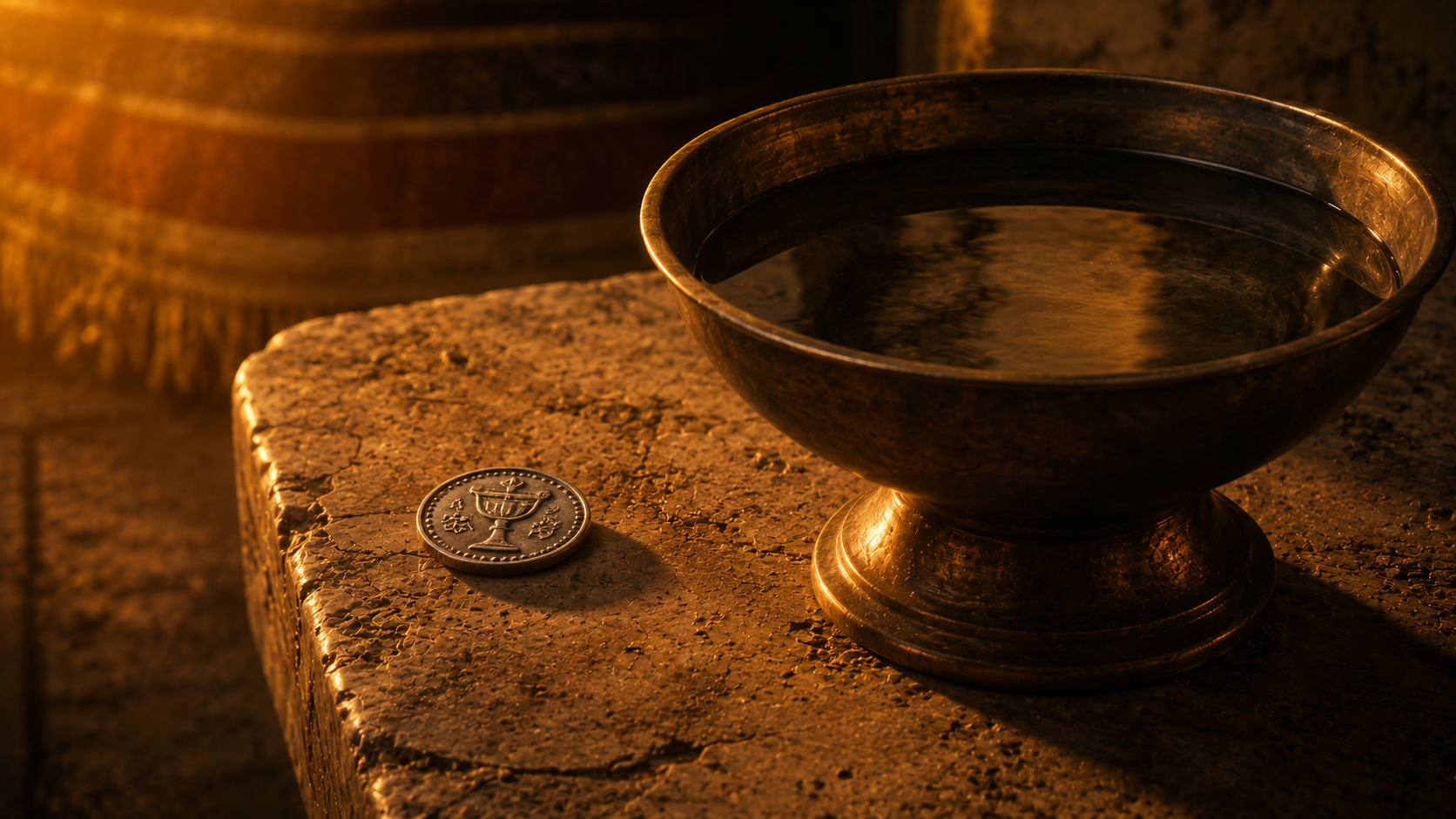
- A ransom for his soul (v. 12). The Hebrew is kofer nafsho. Kofer is the noun cognate of kipper (the atonement verb of chapter 29). Nafsho is his soul, his life, his living self. Together: a covering for his life. The chapter is teaching that to be counted in the census is itself a kind of theological exposure; the person counted is now a known individual before YHWH, and a known individual needs kofer, a ransom-covering. The same logic will reappear in 2 Sam 24, where David’s census without atonement money brings a plague (the chapter’s anticipatory that there be no plague among them when you number them in v. 12). The book is teaching that being known by God is not yet safe; it requires kofer.
- Half a shekel, the rich shall not give more, and the poor shall not give less (vv. 13-15). The chapter’s most explicitly economic line. The atonement money is fixed: half a shekel for everyone, regardless of wealth. Half a shekel is roughly the cost of a few days’ wages for an average laborer in the ancient Near East. The rich cannot buy more atonement; the poor cannot be excluded for lack of funds. The chapter is making, in one verse, a theological statement about the economy of salvation: it is one price for all. The book of Exodus, which began with Hebrews and Egyptians sharply distinguished by economic status (slaves, taskmasters, royal household), now teaches that before YHWH the economic distinction does not apply. The Hebrew Bible’s later prophetic critique of economic injustice (Amos 8:4-6; Mic 2:1-2) has its theological anchor here.
- Appoint it for the service of the Tent of Meeting (v. 16). The atonement money is practical: it pays for the upkeep of the tabernacle, the silver sockets the boards stand on, the silver hooks of the courtyard. The whole physical structure of YHWH’s house is, in part, funded by the equally-distributed half-shekel of every Israelite. The book is teaching: Israel’s house of God is built on the common contribution of the people. The same shekel-of-the-sanctuary will reappear in later chapters as the standard unit of the tabernacle economy. The atonement and the architecture are not separate.
- A memorial for the children of Israel before the LORD (v. 16). The Hebrew zikkaron (memorial) reappears from 28:12 and 29:7. The shekel is a zikkaron: it reminds YHWH that this person exists. The shoulder stones name the twelve tribes; the breastpiece stones name them again; the daily incense rises before YHWH; the half-shekel keeps each adult Israelite named-and-paid-for in the sanctuary economy. The book is teaching that mediation works through layered presence: the priest carries you, the smoke carries you, the half-shekel carries you. You are remembered in multiple ways at once.
- A basin of bronze, between the Tent of Meeting and the altar (v. 18). The chapter’s fourth piece: a simple bronze basin of water. The location is geographically deliberate: between the altar (outside) and the tent (inside), the threshold zone the priest crosses in both directions, multiple times a day. The basin is the transit-washing point. The priests wash their hands and feet before entering the tent and before approaching the altar. The book is teaching that the space between the two altars is the place of cleansing. You cannot bring outer-court dust into the inner sanctum, and you cannot bring inner-sanctum residue out to the bronze altar.
- That they not die (vv. 20, 21). The chapter repeats this warning twice. Washing is not optional courtesy; it is lifesaving. The same warning attended the priestly garments (28:35: bells that he not die; 28:43: linen breeches that he not die). The chapter is honest about the danger of priestly service. The holy is not safe. Approaching YHWH unwashed is, in the Hebrew Bible’s logic, the same kind of risk as approaching a high-voltage line ungrounded. The basin is the grounding station.
C · Exodus 30:22-38 · The anointing oil and the sacred incense
²² Moreover the LORD spoke to Moses, saying, ²³ “Also take fine spices: of liquid myrrh, five hundred shekels; and of fragrant cinnamon half as much, even two hundred and fifty; and of fragrant cane, two hundred and fifty; ²⁴ and of cassia five hundred, after the shekel of the sanctuary; and a hin of olive oil. ²⁵ You shall make it a holy anointing oil, a perfume compounded after the art of the perfumer: it shall be a holy anointing oil. ²⁶ You shall use it to anoint the Tent of Meeting, the ark of the covenant, ²⁷ the table and all its articles, the lamp stand and its accessories, the altar of incense, ²⁸ the altar of burnt offering with all its utensils, and the basin with its base. ²⁹ You shall sanctify them, that they may be most holy. Whatever touches them shall be holy. ³⁰ You shall anoint Aaron and his sons, and sanctify them, that they may minister to me in the priest’s office. ³¹ You shall speak to the children of Israel, saying, ‘This shall be a holy anointing oil to me throughout your generations. ³² It shall not be poured on man’s flesh, neither shall you make any like it, according to its composition: it is holy. It shall be holy to you. ³³ Whoever compounds any like it, or whoever puts any of it on a stranger, he shall be cut off from his people.’” ³⁴ The LORD said to Moses, “Take to yourself sweet spices, gum resin, and onycha, and galbanum; sweet spices with pure frankincense: of each shall there be an equal weight; ³⁵ and you shall make incense of it, a perfume after the art of the perfumer, salted, pure, and holy: ³⁶ and you shall beat some of it very small, and put some of it before the covenant in the Tent of Meeting, where I will meet with you. It shall be to you most holy. ³⁷ The incense which you shall make, according to its composition, you shall not make for yourselves: it shall be to you holy for the LORD. ³⁸ Whoever shall make any like it, to smell of it, he shall be cut off from his people.”
- Five hundred shekels of liquid myrrh, two hundred fifty of fragrant cinnamon, two hundred fifty of fragrant cane, five hundred of cassia, a hin of olive oil (vv. 23-24). The anointing oil’s recipe is precise. Four aromatic spices (myrrh, cinnamon, cane, cassia) in measured proportions, blended into roughly a gallon of olive oil. The total dry weight is fifteen hundred shekels (about 37.5 lbs), an enormous quantity by ancient ANE perfume standards. The chapter is teaching that the consecrating oil is itself a costly composition. Holiness is not free; the anointing that makes things holy requires significant investment of expensive imports (myrrh and cinnamon and cassia were all imported from distant lands, and frankincense in the incense recipe was traded along the Arabian incense routes).
- Anoint the tent, the ark, the table, the lampstand, the altar of incense, the altar of burnt offering, the basin, and Aaron and his sons (vv. 26-30). The oil is applied to the whole sanctuary structure: every piece of furniture, every implement, and every priest. The chapter is teaching that consecration is comprehensive. There is no piece of the tabernacle that is not anointed; there is no priest who is not anointed. The same oil makes the same kind of holy, across the entire ecosystem.
- Whatever touches them shall be holy (v. 29). The chapter repeats the holiness-by-contact principle from 29:37. The anointed items become sources of contagious holiness. The Hebrew Bible’s ritual logic, complex and counterintuitive to modern readers, names the holy as transferable through touch. Anyone who touches the anointed altar is now in the same category of holy. The book is teaching that contact with the consecrated changes you. The later sacramental theology of the Christian tradition, the practice of touching relics, the laying-on of hands at ordination, the kiss of peace, all have roots in this ritual grammar.
- It shall not be poured on man’s flesh, neither shall you make any like it (v. 32). The chapter draws another sharp line. The anointing oil is exclusively for the sanctuary and the priests. To compound the same recipe for personal use is a capital-level offense: whoever compounds any like it, or whoever puts any of it on a stranger, he shall be cut off from his people (v. 33). The Hebrew karat (cut off) is the technical idiom for excommunication or, in extreme cases, divine death sentence. The book is teaching that some objects belong to YHWH alone. Domesticating the sacred recipe for private benefit collapses the distinction the whole tabernacle is trying to teach.
Word study: mishchah (מִשְׁחָה) and mashiach (מָשִׁיחַ)
The Hebrew word for anointing is mishchah, from the verb mashach, “to smear, anoint, paint.” The same verb gives the Hebrew Bible its word for anointed one: mashiach, the messiah. The chapter’s recipe is the Hebrew Bible’s first detailed description of how messianic anointing oil is made. Aaron is the first mashiach in the Hebrew Bible (29:7, “you shall pour the anointing oil on his head and anoint him”). Saul and David will be anointed kings with this same idiom (1 Sam 10:1, 16:13). Isaiah will speak of a coming anointed one (Isa 61:1). The whole later messianic vocabulary of Judaism and Christianity is built on this oil. The New Testament’s Christos (Greek for anointed) translates mashiach. To call Jesus Christ is to name him, etymologically, the one on whom this oil has been poured. The chapter’s small recipe is the etymological seed of a two-thousand-year theological vocabulary.
- Sweet spices, gum resin, onycha, galbanum, frankincense, equal weight (vv. 34-35). The sacred incense recipe is four ingredients in equal proportions, salted, pure, holy. The salt (v. 35) is the same covenant salt of 2:13 and Lev 2:13 (you shall season every grain offering with salt; you shall not let the salt of the covenant of your God be missing from your grain offering). The chapter is teaching that the incense is covenantally seasoned: the smoke rising before the veil is the smoke of the salt-covenant people. The recipe, like the anointing oil, is forbidden for private use: whoever shall make any like it, to smell of it, he shall be cut off from his people (v. 38).
- To smell of it, he shall be cut off (v. 38). The chapter’s final verse is unusually specific. To make the sacred incense recipe to smell of it (for one’s own pleasure) is the violation. The chapter is naming the temptation directly: the incense smells wonderful, and the priests have access to the recipe, and there will be a temptation to reproduce the fragrance at home for personal enjoyment. The book is teaching that the sensory delight of the sacred is itself sacred, and not for personal consumption. The same incense rising before the veil cannot be the same incense rising in your private rooms. There is a holiness that requires non-reproduction.
Influence callout: Tim Mackie (the prayer-as-incense reading)
Mackie’s reading of Exodus 30’s incense altar names it as the canonical seed of an entire prayer theology. The chapter establishes that the small fragrant smoke rising twice a day from a hidden altar is, in the Hebrew Bible’s symbolic logic, equivalent to a sacrifice. The Hebrew Bible itself names the equivalence in Ps 141:2, let my prayer be set before you as incense. The prophet Malachi promises an eschatological vision (Mal 1:11) where in every place incense and a pure offering shall be offered to my name, naming the universal expansion of the chapter’s tiny gold altar. The New Testament inherits the metaphor: at Luke 1:10, the whole multitude of the people was praying outside at the hour of incense, while Zechariah burns the qetoret inside the temple; in Rev 5:8, golden bowls full of incense, which are the prayers of the saints; in Rev 8:3-4, an angel offers much incense, that he should add it to the prayers of all the saints. Mackie’s pastoral note: the chapter is teaching that prayer is not first the verbal expression of an interior state; prayer is the small fragrant rising of a life given over to YHWH. The smoke is what reaches across the veil. The chapter’s deepest claim, in Mackie’s reading, is that the small daily fragrance of an ordinary life, faithfully prayed, goes into the holy of holies in a way that the body of the worshipper cannot. The whole later Christian image of intercessory prayer is built on this chapter’s altar.
Reflection prompts
- The chapter teaches that prayer is the qetoret, the small fragrant smoke that rises twice a day. What would it mean to think of your own daily prayers (morning and evening) as the smoke from a small gold altar inside you, rising past the veil?
- Half a shekel, the rich shall not give more, and the poor shall not give less. The atonement is one price for all. Where in your own theology, or in the practice of your church, has the half-shekel principle been quietly abandoned?
- The chapter forbids reproducing the anointing oil and the sacred incense for private use. Where in your spiritual life have you tried to domesticate the sacred, taking the fragrance of holy things into private possession in a way that flattens what made them holy in the first place?
Frameworks at play in this chapter: the tabernacle as cosmic temple, kipper / atonement.