
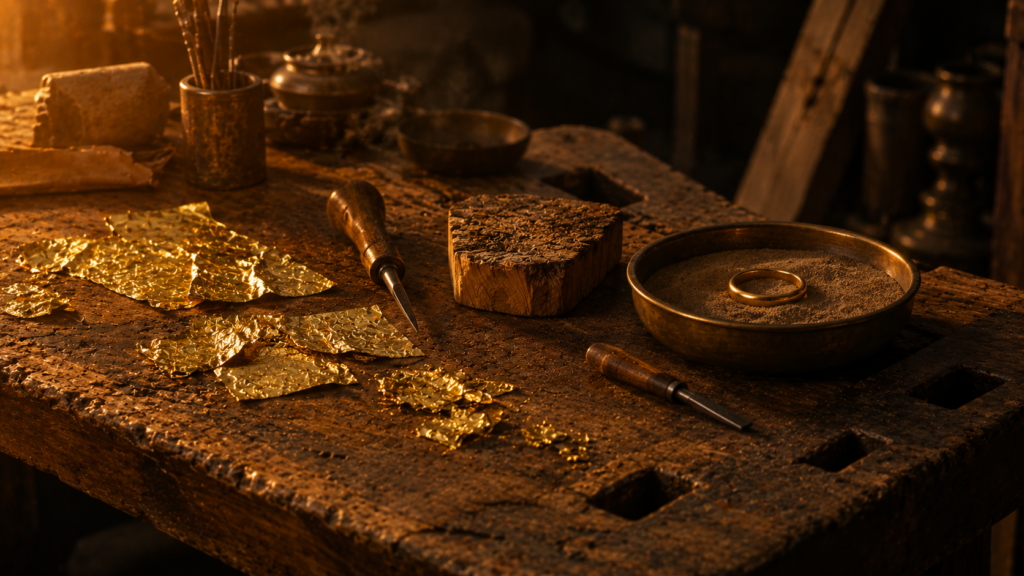
Exodus 31 closes the first long block of tabernacle instruction. Chapters 25-30 told Moses what to build; chapter 31 names who will build it and reframes the whole project with one essential preamble and one essential punctuation. The preamble is the call of Bezalel and Oholiab: artisans filled with the ruach Elohim, the Spirit of God, for craft. The punctuation is the Sabbath: a one-day-in-seven pause that protects the whole tabernacle project from collapsing into work-without-rest.
The chapter ends, in a single verse, with YHWH handing Moses the two tablets of the testimony, tablets of stone, written with the finger of God. The next chapter will smash them. The chapter before us is recording the moment they were given, in full, with no anticipation of what is coming.
The Hebrew Bible is doing two structural things here. First, it is teaching that creation and consecration both require Spirit-filled craft and Sabbath rest. Tabernacle-building is staged as a microcosm of Genesis 1: form-and-fill followed by Sabbath. Second, it is setting up the dramatic reversal of chapter 32. The instructions are complete; the artisans are called; the Sabbath is named; the tablets are delivered. And while Moses is still on the mountain receiving them, Aaron and the people are already making something else.
A · Exodus 31:1-11 · Bezalel and Oholiab, filled with the Spirit for craft
¹ Yahweh spoke to Moses, saying, ² “Behold, I have called by name Bezalel the son of Uri, the son of Hur, of the tribe of Judah. ³ I have filled him with the Spirit of God, in wisdom, and in understanding, and in knowledge, and in all kinds of workmanship, ⁴ to devise skillful works, to work in gold, and in silver, and in brass, ⁵ and in cutting of stones for setting, and in carving of wood, to work in all kinds of workmanship. ⁶ I, behold, I have appointed with him Oholiab, the son of Ahisamach, of the tribe of Dan; and in the heart of all who are wise hearted I have put wisdom, that they may make all that I have commanded you: ⁷ the Tent of Meeting, the ark of the covenant, the mercy seat that is on it, all the furniture of the Tent, ⁸ the table and its vessels, the pure lamp stand with all its vessels, the altar of incense, ⁹ the altar of burnt offering with all its vessels, the basin and its base, ¹⁰ the finely worked garments, the holy garments for Aaron the priest, the garments of his sons, to minister in the priest’s office, ¹¹ the anointing oil, and the incense of sweet spices for the holy place: according to all that I have commanded you they shall do.”
- Behold, I have called by name Bezalel (v. 2). The chapter opens with naming. Bezalel (Hebrew Betzal’el) means in the shadow of God. The chief artisan’s name is itself a theological location: he works under the shadow of God. He is of the tribe of Judah, the kingly tribe (Gen 49:10), grandson of Hur (Aaron’s deputy at the battle with Amalek, Ex 17:10-12). The book is being careful: the first Spirit-filled craft worker named in the Hebrew Bible has a royal lineage. Tabernacle-building is staged as a Judah-tribe vocation. The genealogy will not fully matter until 1 Kings 7, when another Judahite (Hiram of Tyre, paired with Hiram-Abi of Naphtali) will build Solomon’s temple. The book is laying foundations.
- I have filled him with the Spirit of God, in wisdom, and in understanding, and in knowledge, and in all kinds of workmanship (v. 3). The Hebrew is va-amale oto ruach elohim, be-chochmah u-vitvunah u-veda’at u-vechol-melakhah. Four nouns name what ruach Elohim-filling produces in Bezalel: chochmah (wisdom), tevunah (understanding), da’at (knowledge), melakhah (workmanship, craft, skilled labor). The same triad (wisdom, understanding, knowledge) appears in Prov 24:3-4 as the foundation of building a house. The chapter is teaching that wisdom-tradition vocabulary, normally associated with sages and elders, applies equally and primarily to craft workers. The first explicit Spirit-filling in the Hebrew Bible is not for prophecy, not for kingship, not for priesthood. It is for craft.
- Gold, silver, brass, stones, wood, all kinds of workmanship (vv. 4-5). The Spirit’s gifts to Bezalel are listed in concrete materials. The chapter is teaching that Spirit-filling for craft is materially competent. The artisan can work in metal, stone, and wood. The book refuses the assumption that the spiritual is opposed to the material. The Spirit comes into the hands that shape gold and cut stone, and the work of those hands is, in the Hebrew Bible’s reading, the work of the Spirit of God.
- Oholiab, the son of Ahisamach, of the tribe of Dan (v. 6). The second named artisan is Oholiab, “tent of my father,” from the tribe of Dan. Dan is, in the tribal politics of the Hebrew Bible, the least prestigious of the twelve sons (Dan’s mother was Rachel’s servant Bilhah, not Rachel herself). The book is teaching, by deliberate pairing, that the Spirit’s call to craft crosses tribal hierarchy. Bezalel (Judah, the kingly tribe) and Oholiab (Dan, the lower-status tribe) work together. The same Spirit fills both. The same craft is honored in both. The chapter is making a quiet but firm theological-political statement: in the tabernacle project, the social ranking of the tribes is suspended. The artisans are partners, not subordinates.
Word study: chochmah (חָכְמָה) and melakhah (מְלָאכָה)
The Hebrew word chochmah is usually translated wisdom. Its semantic range is wider than the English word suggests. Chochmah names skilled competence, the ability to do something well. The same word names the sage’s wisdom in Proverbs, Solomon’s administrative wisdom in 1 Kings, and the artisan’s manual skill in Exodus. The chapter is not making a metaphorical move; the Hebrew Bible’s chochmah genuinely covers both intellectual insight and manual dexterity. The word that the Hebrew Bible uses for Bezalel’s melakhah (workmanship) is the same word that Genesis 2:2 uses for the work God finished on the seventh day: vayechal Elohim… melakhto, “God finished his work.” The chapter is teaching, by lexical choice, that Bezalel’s work is YHWH’s work. The same word names both. To craft the tabernacle is, in the Hebrew Bible’s vocabulary, to do what God did in Genesis 1.
- All that I have commanded you they shall do (v. 11). The chapter ends section A by tying the artisans’ work to the prior six chapters of instructions. Bezalel and Oholiab are not free-form sculptors; they are executors of a received pattern. The whole tabernacle has been described in detail (25-30); the chapter now names the hands that will carry it out. The book is teaching that Spirit-filling for craft does not mean autonomous creativity; it means competent fidelity to the divine pattern. The artist’s freedom is real, but it is exercised inside the framework of what YHWH has commanded.
B · Exodus 31:12-18 · The Sabbath sign, and the two tablets
¹² Yahweh spoke to Moses, saying, ¹³ “Speak also to the children of Israel, saying, ‘Most certainly you shall keep my Sabbaths: for it is a sign between me and you throughout your generations; that you may know that I am Yahweh who sanctifies you. ¹⁴ You shall keep the Sabbath therefore; for it is holy to you. Everyone who profanes it shall surely be put to death; for whoever does any work therein, that soul shall be cut off from among his people. ¹⁵ Six days shall work be done, but on the seventh day is a Sabbath of solemn rest, holy to Yahweh. Whoever does any work on the Sabbath day shall surely be put to death. ¹⁶ Therefore the children of Israel shall keep the Sabbath, to observe the Sabbath throughout their generations, for a perpetual covenant. ¹⁷ It is a sign between me and the children of Israel forever; for in six days Yahweh made heaven and earth, and on the seventh day he rested, and was refreshed.’” ¹⁸ He gave to Moses, when he finished speaking with him on Mount Sinai, the two tablets of the testimony, tablets of stone, written with God’s finger.
- Most certainly you shall keep my Sabbaths (v. 13). The chapter pivots, with no transition, from the artisans to the Sabbath. The juxtaposition is the chapter’s deepest teaching. Right after commissioning the Spirit-filled artisans to build the most important construction project in Israel’s history, YHWH names the Sabbath. The book is teaching: even sacred work pauses on the seventh day. There is no project so holy that it overrides the Sabbath. Tabernacle-construction, of all things, must respect the rhythm of work-and-rest. The Rabbinic tradition reads this verse as the source of the thirty-nine categories of forbidden Sabbath work (the melakhot), since they are derived from the categories of work involved in building the tabernacle. The chapter is hardwiring Sabbath into the very project that would most tempt Israel to ignore it.
- It is a sign between me and you (v. 13). The Hebrew ot (sign) is the same word the Hebrew Bible uses for the rainbow (Gen 9:13) and for circumcision (Gen 17:11). The Sabbath joins those two as the third great covenant sign in the Genesis-Exodus narrative. Each of the three signs is temporal-public in a different way: the rainbow appears in the sky after rain (visible from anywhere); circumcision is borne in the body (private but permanent); the Sabbath occurs in time (public, weekly, communal). The book is teaching that Israel’s covenant identity has a weekly visible marker. To keep Sabbath is to publicly remember that you belong to YHWH.
- That you may know that I am Yahweh who sanctifies you (v. 13). The Hebrew is ki ani YHWH meqaddishkhem. The verb qadash in its piel form means to make holy, to consecrate. The chapter is teaching that Sabbath observance is itself an act of being sanctified. The Sabbath is not Israel’s gift to YHWH; it is YHWH’s gift to Israel. To rest is to receive sanctification. To work without ceasing is to forfeit it.
- Whoever does any work therein, that soul shall be cut off (v. 14). The chapter’s Sabbath instruction is stricter than most modern readers expect. Karet (cut off) is the technical term for either divine excision or community-imposed excommunication; yumat (shall be put to death) appears immediately after. The book is taking Sabbath with full seriousness. To break Sabbath is to deny the covenant sign, and the chapter is willing to call that what it is. The pastoral reception of this verse has, of course, varied through the tradition. The Hebrew Bible itself records community judgment on Sabbath-breakers (Num 15:32-36); the prophets denounce empty Sabbath observance (Isa 1:13); Jesus rules that the Sabbath was made for humans, not humans for the Sabbath (Mk 2:27). The chapter’s force, in any reading, is that Sabbath is not optional.
- In six days Yahweh made heaven and earth, and on the seventh day he rested, and was refreshed (v. 17). The chapter’s grounding theology comes from Genesis. The Sabbath is rooted in creation, not just covenant. To keep Sabbath is to participate in the creator’s rhythm. The Hebrew word for was refreshed is vayinafash, “and he took breath” (from the noun nefesh, “soul/breath/life”). The book is making a startling claim: God himself takes breath on the seventh day. The creator’s Sabbath is not a passive cessation but an active in-breathing. Israel’s Sabbath is meant to be the same. The chapter is teaching that to rest is to take in life.
Influence callout: Walter Brueggemann (Sabbath as resistance)
Brueggemann’s reading of Exodus 31 names the Sabbath as the chapter’s deepest anti-imperial gesture. Pharaoh’s Egypt, in chapters 1-15, was a nonstop production economy: more bricks, less straw, no rest. The Hebrews in slavery were never given a day off. The first thing YHWH does after the Exodus, on Brueggemann’s reading, is teach Israel that the new economy is not the old one. The Sabbath is the visible weekly statement that Israel is no longer Pharaoh’s slave. The chapter is recording this teaching in its sharpest form: in the very project that would most resemble Egyptian construction (a sanctuary, requiring metalwork and stonework and woodwork and weaving), Israel is commanded to stop one day in seven. Brueggemann’s pastoral note: the modern reader, especially in late-capitalist economies that demand more without rest, hears Exodus 31:12-17 as radical liberation. To keep Sabbath is to refuse Pharaoh’s logic. To keep Sabbath is to remember that one’s identity does not come from one’s productivity. The chapter is recording, in the middle of YHWH’s most ambitious construction project, that the Spirit-filled artisans pause every seven days. The work matters; the rest matters more.
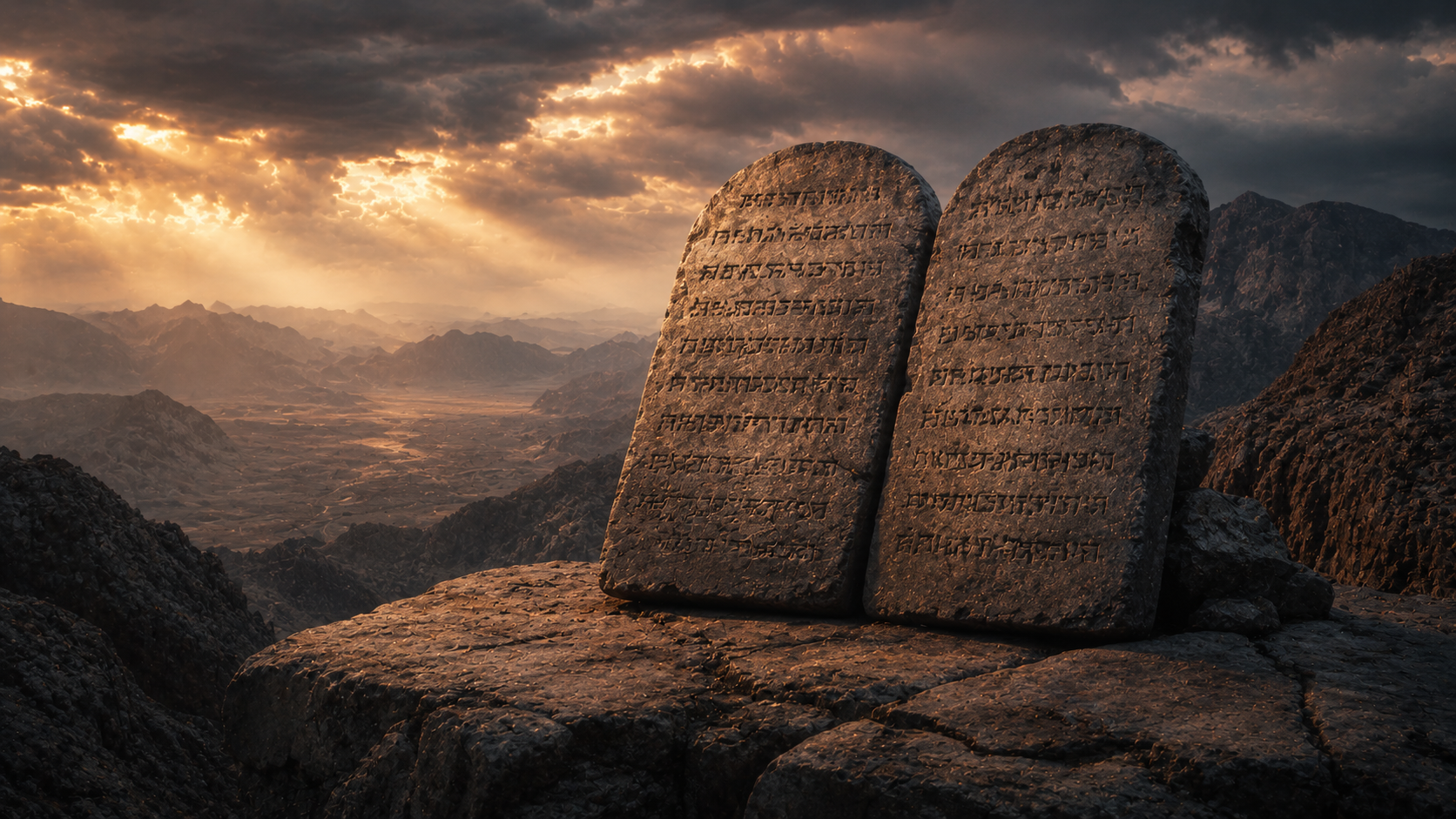
- He gave to Moses… the two tablets of the testimony, tablets of stone, written with God’s finger (v. 18). The chapter ends with the literal handing-over of the two stone tablets. Etsbah Elohim, “the finger of God,” is the same phrase the Egyptian magicians used in 8:19 to confess YHWH’s superior power. The tablets are autograph documents: not mediated through Moses’s hand, but written directly by God. The Hebrew Bible has reserved this language carefully; nothing else in the canon is described as written with the finger of God. The chapter is closing the great Sinai instruction block with the most concentrated single moment of divine self-disclosure: here is what I have written; here are the words; here is the covenant. The tragic irony of chapter 32 will be unbearable.
Reflection prompts
- The chapter teaches that the first explicit Spirit-filling in the Hebrew Bible is for craft, not prophecy. Where in your own community has the Spirit’s work in the arts and trades been undervalued? What changes if you treat the hands of carpenters, painters, designers, and engineers as Spirit-filled?
- The Sabbath is wired into the most ambitious construction project YHWH ever commissions. There is no sacred work that overrides Sabbath. Where, in your own season, have you justified skipping rest because the work matters too much? What if the chapter’s logic is right: that the more important the work, the more necessary the rest?
- In six days Yahweh made heaven and earth, and on the seventh day he was refreshed. The creator takes breath. What would it look like for you to take breath this week in a deliberate, Sabbath-shaped way?
Frameworks at play in this chapter: the tabernacle as cosmic temple, sabbath rest.