
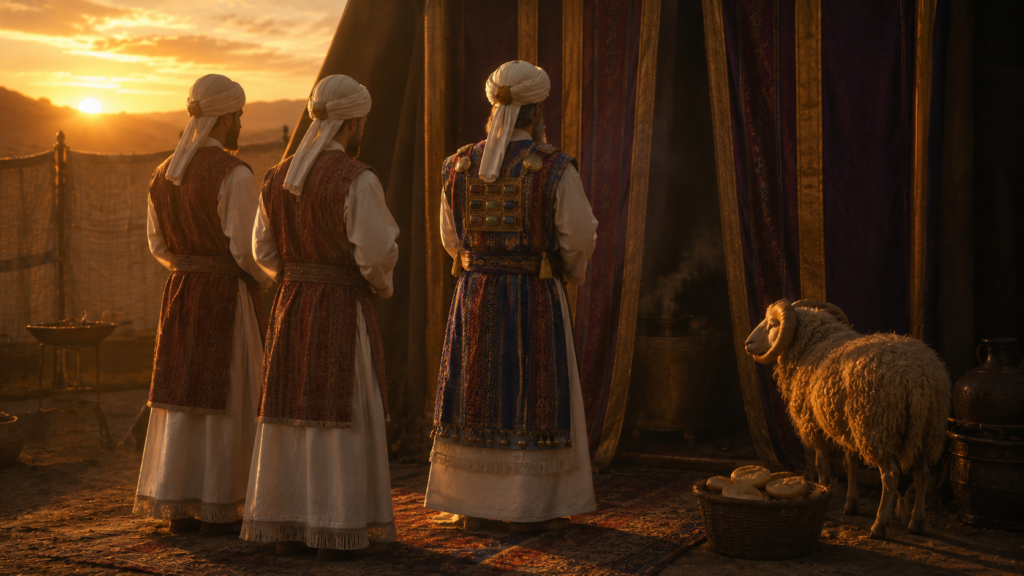
Exodus 29 ordains the priests. The previous chapter dressed them; this chapter sets them apart in a seven-day ritual of washing, robing, anointing, and animal sacrifice. The Hebrew verb qadash, “to make holy, to set apart for sacred use,” appears repeatedly. The chapter is performing what the previous chapter only described: it is making the priests priests.
The chapter has three movements. First, the preparation and the bull as sin offering (vv. 1-14). Second, the two rams, the burnt offering and the ram of ordination, with blood applied to Aaron’s right ear, thumb, and toe (vv. 15-37). Third, the continual offering of two lambs each day, morning and evening, framed by the chapter’s climactic theological statement: I will meet with the children of Israel; and the place shall be sanctified by my glory. I will dwell among the children of Israel, and will be their God (vv. 43-45).
That last sentence is the chapter’s whole point. Everything else, the bulls and the blood, the seven-day repetition, the daily lambs, the unleavened bread, is the architecture by which YHWH can dwell among Israel without consuming them. The book that began with Israel crying out from Egypt ends here, in chapter 29, with YHWH announcing the deep purpose of the rescue: that I might dwell among them. The book of Exodus is, on the chapter’s own theological logic, primarily the book of divine indwelling. The crossing of the Sea was the beginning. This is what it was for.
A · Exodus 29:1-14 · Preparation, robing, and the bull as sin offering
¹ “This is the thing that you shall do to them to make them holy, to minister to me in the priest’s office: take one young bull and two rams without defect, ² unleavened bread, unleavened cakes mixed with oil, and unleavened wafers anointed with oil: you shall make them of fine wheat flour. ³ You shall put them into one basket, and bring them in the basket, with the bull and the two rams. ⁴ You shall bring Aaron and his sons to the door of the Tent of Meeting, and shall wash them with water. ⁵ You shall take the garments, and put on Aaron the coat, the robe of the ephod, the ephod, and the breastplate, and bind on him the skillfully woven band of the ephod; ⁶ and you shall set the turban on his head, and put the holy crown on the turban. ⁷ Then you shall take the anointing oil, and pour it on his head, and anoint him. ⁸ You shall bring his sons, and put coats on them. ⁹ You shall clothe them with sashes, Aaron and his sons, and bind headbands on them: and they shall have the priesthood by a perpetual statute. You shall consecrate Aaron and his sons. ¹⁰ “You shall bring the bull before the Tent of Meeting: and Aaron and his sons shall lay their hands on the head of the bull. ¹¹ You shall kill the bull before the LORD, at the door of the Tent of Meeting. ¹² You shall take of the blood of the bull, and put it on the horns of the altar with your finger; and you shall pour out all the blood at the base of the altar. ¹³ You shall take all the fat that covers the innards, the cover of the liver, the two kidneys, and the fat that is on them, and burn them on the altar. ¹⁴ But the flesh of the bull, and its skin, and its dung, you shall burn with fire outside of the camp: it is a sin offering.
- This is the thing that you shall do to them to make them holy (v. 1). The Hebrew is zeh ha-davar asher ta’aseh la-hem le-qadesh otam. Note the verb construction: holiness is something that is done to the priests, not something they generate. Aaron does not become a priest by claiming priestly identity or by personal piety. He becomes a priest by being washed, robed, anointed, and brought through a seven-day sacrificial sequence by his brother. The chapter is staging the priesthood as a received office, not an assumed one. Vocation is given.
- Washing, robing, anointing (vv. 4-7). The three actions are the chapter’s first three movements in sequence. Aaron is washed at the door of the tent (the same location where the bronze laver will later sit, 30:18-21). Then he is robed in the vestments of chapter 28, layered on him by Moses: coat, robe, ephod, breastplate, sash, turban, holy crown. Then anointing oil is poured on his head (v. 7). The oil is the shemen ha-mishchah (anointing oil) that 30:22-33 will describe in detail. The high priest is anointed on the head; the same gesture and oil will later mark Israel’s kings (1 Sam 10:1, 16:13). The chapter is recording that kingship and priesthood share the anointing-language. The Hebrew word mashiach (anointed one, messiah) comes from this verb. Aaron is the Hebrew Bible’s first named mashiach.
- Aaron and his sons shall lay their hands on the head of the bull (v. 10). The Hebrew is samakh yad, to lean the hand upon. The gesture is not a touch but a pressing down. The Hebrew Bible’s sacrificial system reads it as the means by which the offerer’s identification with the animal is transferred: the bull is standing in for the priest. The chapter is teaching from the start that ordination involves substitutionary death. The priesthood does not begin with a self-offering by the priests; it begins with an animal dying for them, because they need it too. Aaron will offer sacrifices for Israel, but only after a sacrifice has been offered for Aaron. The priest is not above the system.
- The blood on the horns of the altar, the blood poured at the base, the fat burned on the altar, the flesh burned outside the camp (vv. 12-14). The sin-offering ritual disperses the bull in four directions: horns (the altar’s highest points), base (the altar’s foundation), altar-top (the burning fat and inner organs), outside-the-camp (the flesh and dung). Each element has a function in the Levitical sacrificial system. The chapter foreshadows Lev 4 in detail. The phrase outside the camp will become theologically loaded: Heb 13:11-13 reads Christ’s crucifixion outside the camp as the climactic enactment of this very ritual. The chapter is one of Hebrews’s structural foundations.
Word study: qadash (קדש) and kipper (כפר)
Two verbs do the chapter’s deepest theological work. Qadash (in its piel and hiphil stems) means to make holy, to consecrate, to set apart for sacred use. The same verb names what is done to the priests, the altar, the garments, the tent, the entire week’s ritual. The chapter uses it seven times. Kipper names to atone, to cover, to wipe clean. The verb’s basic image (debated among scholars) is either to cover (cf. kapporet, the cover of the ark) or to wipe. Either way, the verb names the liturgical action that allows the holy and the unholy to coexist without one consuming the other. The chapter is teaching that priesthood is not generated by purity; it is generated by atonement. The priest is the one who is *kuppar*ed (atoned for) before he is sent to atone for others.
- A sin offering (v. 14). The Hebrew is chatta’t, the technical term for the offering that addresses unintentional or covered sin (cf. Lev 4-5). The first animal in the ordination is a sin offering, not for Israel but for Aaron and his sons. The chapter is teaching that the priesthood begins with the priests’ own need for atonement. There is no entry into the priestly office that bypasses the priest’s recognition that he is, himself, a sinner. The book is naming this from the first sacrifice. Hebrews 5:3 will pick it up: the high priest is obligated to offer for sins on behalf of himself, as well as the people. The chapter is structurally honest.
B · Exodus 29:15-37 · The two rams, the blood on ear-thumb-toe, and the seven-day rhythm
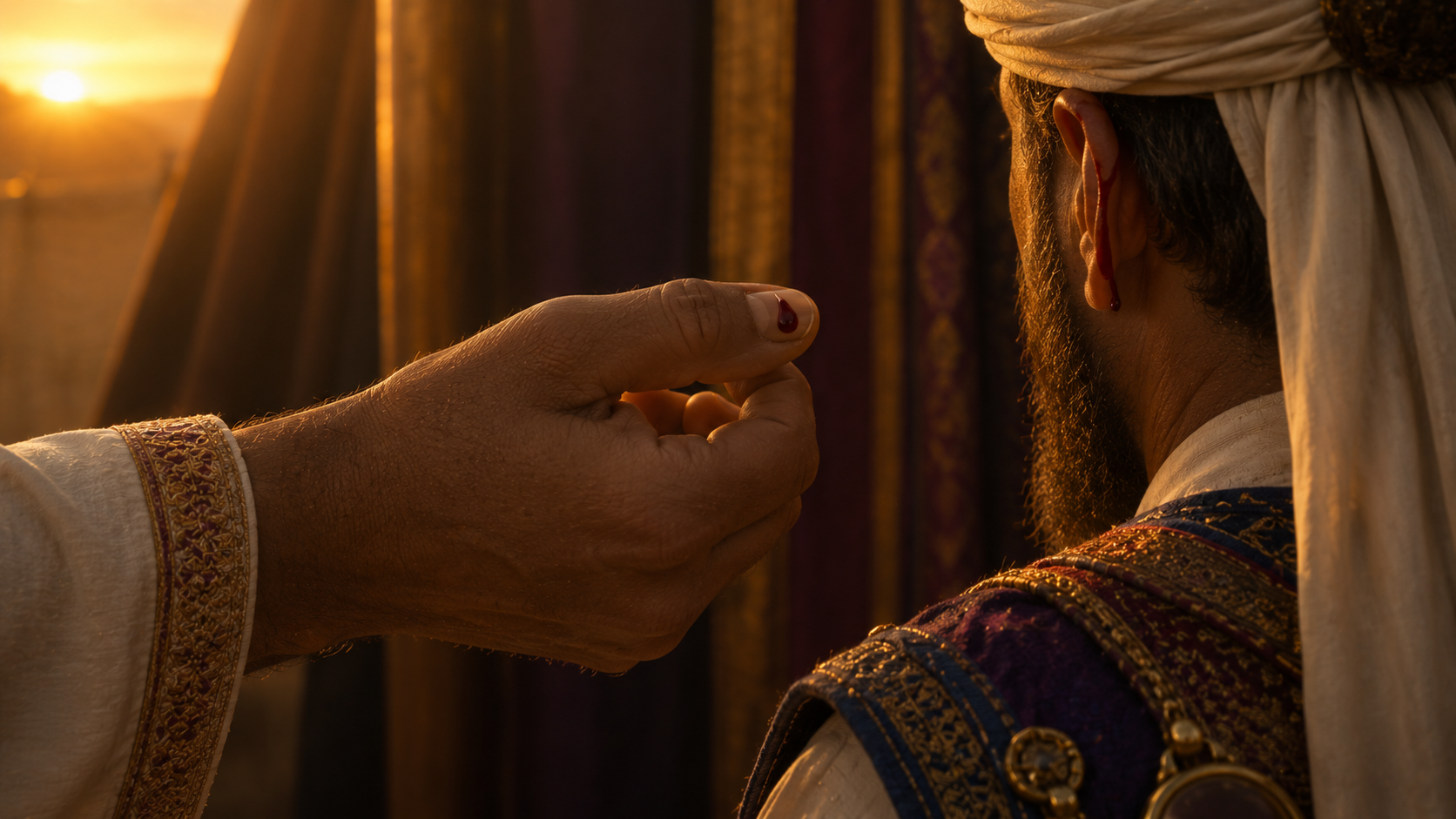
¹⁵ “You shall also take the one ram; and Aaron and his sons shall lay their hands on the head of the ram. ¹⁶ You shall kill the ram, and you shall take its blood, and sprinkle it around on the altar. ¹⁷ You shall cut the ram into its pieces, and wash its innards, and its legs, and put them with its pieces, and with its head. ¹⁸ You shall burn the whole ram on the altar: it is a burnt offering to the LORD; it is a pleasant aroma, an offering made by fire to the LORD. ¹⁹ “You shall take the other ram; and Aaron and his sons shall lay their hands on the head of the ram. ²⁰ Then you shall kill the ram, and take some of its blood, and put it on the tip of the right ear of Aaron, and on the tip of the right ear of his sons, and on the thumb of their right hand, and on the great toe of their right foot, and sprinkle the blood around on the altar. ²¹ You shall take of the blood that is on the altar, and of the anointing oil, and sprinkle it on Aaron, and on his garments, and on his sons, and on the garments of his sons with him: and he shall be made holy, and his garments, and his sons, and his sons’ garments with him. ²² Also you shall take the ram’s fat, the fat tail, the fat that covers the innards, the cover of the liver, the two kidneys, the fat that is on them, and the right thigh (for it is a ram of consecration), ²³ and one loaf of bread, one cake of oiled bread, and one wafer out of the basket of unleavened bread that is before the LORD. ²⁴ You shall put all of this in Aaron’s hands, and in his sons’ hands, and shall wave them for a wave offering before the LORD. ²⁵ You shall take them from their hands, and burn them on the altar on the burnt offering, for a pleasant aroma before the LORD: it is an offering made by fire to the LORD. ²⁶ “You shall take the breast of Aaron’s ram of consecration, and wave it for a wave offering before the LORD: and it shall be your portion. ²⁷ You shall sanctify the breast of the wave offering, and the thigh of the wave offering, which is waved, and which is heaved up, of the ram of consecration, even of that which is for Aaron, and of that which is for his sons: ²⁸ and it shall be for Aaron and his sons as their portion forever from the children of Israel; for it is a wave offering; and it shall be a wave offering from the children of Israel of the sacrifices of their peace offerings, even their wave offering to the LORD. ²⁹ “The holy garments of Aaron shall be for his sons after him, to be anointed in them, and to be consecrated in them. ³⁰ Seven days shall the son who is priest in his place put them on, when he comes into the Tent of Meeting to minister in the holy place. ³¹ “You shall take the ram of consecration, and boil its flesh in a holy place. ³² Aaron and his sons shall eat the flesh of the ram, and the bread that is in the basket, at the door of the Tent of Meeting. ³³ They shall eat those things with which atonement was made, to consecrate and sanctify them: but a stranger shall not eat of it, because they are holy. ³⁴ If anything of the flesh of the consecration, or of the bread, remains to the morning, then you shall burn the remainder with fire: it shall not be eaten, because it is holy. ³⁵ “You shall do to Aaron and to his sons according to all that I have commanded you. You shall consecrate them seven days. ³⁶ Every day you shall offer the bull of sin offering for atonement: and you shall cleanse the altar, when you make atonement for it; and you shall anoint it, to sanctify it. ³⁷ Seven days you shall make atonement for the altar, and sanctify it: and the altar shall be most holy; whatever touches the altar shall be holy.
- Two rams (vv. 15 and 19). The first ram is a burnt offering (Hebrew olah, “ascending”), entirely consumed on the altar; nothing is reserved for the offerer. The second ram is a ram of consecration or ordination, Hebrew eil milu’im, “ram of filling,” from the verb mille’ yad, “to fill the hand,” the technical idiom for ordaining. Part of this ram’s flesh will be eaten by the priests; part will be burned; part will be waved before YHWH. The two rams together teach the priestly vocation as both total surrender (the burnt offering, all to YHWH) and shared feast (the ordination ram, partly for YHWH, partly for the priests). The priest’s life will be both.
- Blood on the right ear, right thumb, and right big toe (v. 20). The chapter’s most distinctive ritual moment. Blood from the consecration ram is applied to the tip of the right ear (the organ of hearing the divine word), the thumb of the right hand (the organ of priestly action), and the great toe of the right foot (the organ of walking into the holy place). The three points name the priest’s whole vocation in three body parts: he must hear, do, and go. The blood marks him in each. The ritual will be applied again in Lev 14:14, when a healed leper is restored, with the same blood-on-ear-thumb-toe pattern. The chapter is creating a Hebrew sacramental grammar: consecration is total. There is no zone of the priest’s body that is not marked.
- Sprinkle the blood and the anointing oil on Aaron and his garments and his sons (v. 21). The chapter mixes blood and oil and sprinkles both on the priests and their vestments. The result is, visibly, the chapter’s most dramatic moment: the high priest stands at the door of the tent with blood and oil dripping down his face and onto the white linen tunic, the blue robe, the gold-and-color ephod, the breastpiece set with twelve named stones. The vestments themselves are being consecrated. The book is teaching that the priest’s clothing shares in the holiness, not just his body. The garments that 28:2 called holy garments for glory and for beauty are now made holy in fact.
- Wave offering (v. 24). The Hebrew verb is henif, “to wave back and forth in the air.” Aaron and his sons hold the ram’s fat, kidneys, thigh, and three pieces of unleavened bread in their hands (the chapter’s specific verb in v. 24 is namate, to place in, with the noun yad, “hand”; the idiom mille’ yad, “to fill the hand,” reappears here as the filling of ordination). They wave them before YHWH. The wave offering is a public gesture of presentation: the priests show the gift to YHWH and YHWH receives it. The book is teaching ordination as gift-giving as well as consecration. The priest does not just receive his office; he gives himself in return.
- Seven days (vv. 30, 35, 37). The ordination is repeated each day for seven days. The same bull, the same two rams, the same anointing, the same blood. The Hebrew Bible’s seven-day rhythm is Genesis 1’s rhythm: form on days 1-3, fill on days 4-6, rest on day 7. The priesthood is being created on a creation-pattern. The book is teaching that the priesthood is a small new creation, with its own seven-day inauguration, mirroring the cosmic seven-day inauguration of all things. Walton’s reading: the tabernacle is a microcosm of creation, and the priesthood’s ordination is the microcosm of creation week itself.
- Whatever touches the altar shall be holy (v. 37). The chapter ends section B with a startling theological claim. After seven days of atonement-for-the-altar, the altar itself becomes most holy; and the contagion-of-holiness is now outward: anything that touches the altar becomes holy. The same logic will reappear at Hag 2:11-13: holiness, in the Hebrew Bible’s ritual logic, can transfer by contact. The chapter is teaching that the sanctified altar is not a passive object; it is an active source of holiness that the priests are mediating outward. The whole later sacramental theology of the Christian tradition (objects, places, persons made holy by contact with the sacred) has roots in this verse.
Word study: milu’im (מִלֻּאִים) and mille’ yad (מִלֵּא יָד)
The Hebrew word the chapter uses for ordination is milu’im, from the root male, “to fill, to be full.” The verb idiom mille’ yad, “to fill the hand,” is the chapter’s technical term for ordaining. To ordain a priest is, literally, to fill his hands. The image is concrete: at the climactic moment of the ordination ritual, Aaron’s hands are physically filled with the wave offering (v. 24, put all of this in Aaron’s hands and in his sons’ hands). The Hebrew Bible’s vocabulary for entering vocation is, deeply, being given something to carry. You are not ordained as an abstract status; you are ordained by having your hands filled with what you will offer. The chapter is teaching that priestly vocation is not received passively; it is received as a load placed in the open hand. To be sent is to be given something to bring.
C · Exodus 29:38-46 · The continual offering, and the divine indwelling
³⁸ “Now this is that which you shall offer on the altar: two lambs a year old day by day continually. ³⁹ The one lamb you shall offer in the morning; and the other lamb you shall offer at evening: ⁴⁰ and with the one lamb a tenth part of an ephah of fine flour mixed with the fourth part of a hin of beaten oil, and the fourth part of a hin of wine for a drink offering. ⁴¹ The other lamb you shall offer at evening, and shall do to it according to the meal offering of the morning, and according to its drink offering, for a pleasant aroma, an offering made by fire to the LORD. ⁴² It shall be a continual burnt offering throughout your generations at the door of the Tent of Meeting before the LORD, where I will meet with you, to speak there to you. ⁴³ There I will meet with the children of Israel; and the place shall be sanctified by my glory. ⁴⁴ I will sanctify the Tent of Meeting and the altar: Aaron also and his sons I will sanctify, to minister to me in the priest’s office. ⁴⁵ I will dwell among the children of Israel, and will be their God. ⁴⁶ They shall know that I am the LORD their God, who brought them out of the land of Egypt, that I might dwell among them: I am the LORD their God.
- Two lambs a year old, day by day continually (v. 38). The Hebrew is kevasim benei-shanah shenayim la-yom tamid. One lamb in the morning, one at evening. With each lamb, a meal offering (flour and oil) and a drink offering (wine). The chapter is establishing the tamid offering, the continual daily sacrifice that will define the priestly calendar for the next thousand years. Morning and evening, every day, two lambs, forever. The chapter’s earlier tamid (the perpetual lamp, 27:20-21) now expands into a full daily sacrificial rhythm.
- I will meet with you, to speak there to you (v. 42). The chapter’s first explicit theological purpose-statement. The altar at the door of the tent is the meeting place. The verb ya’ad (to appoint, meet) is the same verb that gives the tabernacle its name: Tent of Meeting is ohel mo’ed. The book is naming the location where YHWH’s word will arrive in the future: not at Sinai (which the people have already left), but at the altar of the tabernacle. The meeting is not a one-time event; it is a continuous appointment. The morning and evening lambs will mark each day’s meeting time.
- I will dwell among the children of Israel, and will be their God (v. 45). The chapter’s deepest theological line, and the deepest theological line of the whole book of Exodus. The Hebrew is ve-shakhanti betoch benei yisra’el, “I will dwell in the midst of the children of Israel.” The verb shakhan gives the tabernacle its name: mishkan, “dwelling place.” The book is naming why everything that has happened since Egypt was happening: that I might dwell among them. The plagues, the Sea, the Sinai covenant, the tabernacle blueprint, the priestly vestments, the seven-day ordination, all serve the single purpose: divine indwelling. The chapter is one of the book’s deepest theological climaxes.
- That I might dwell among them (v. 46). The chapter repeats the indwelling word in v. 46 to make sure it lands. The verb is the same: le-shokhni betokham, “for my dwelling in their midst.” The Hebrew Bible’s later doctrine of the shekhinah (the divine presence) takes its name from this root. The intertestamental Jewish tradition will speak of the shekhinah dwelling in the Holy of Holies, departing at the exile (Ezek 10), and returning at the eschaton. The New Testament’s gospel of John picks up the same root in eskenosen en hemin, “tabernacled among us” (Jn 1:14): Christ is the shekhinah in person. The chapter is the canonical seed of an entire theology of divine presence.
- They shall know that I am the LORD their God, who brought them out of the land of Egypt (v. 46). The chapter ends by naming the Exodus from the perspective of its goal. Egypt is named one final time: I am YHWH your God, who brought you out of Egypt. The book that began with bondage in Egypt now identifies the rescue from Egypt as the precondition of the indwelling. The two are theologically inseparable. The chapter is teaching: YHWH did not rescue Israel from Egypt and then leave them alone; YHWH rescued Israel from Egypt so that YHWH could live with them. The whole later prophetic vision (Lev 26:11-12; Jer 31:33-34; Ezek 37:27; Rev 21:3) of God dwelling with his people is the chapter’s central promise carried forward.
Influence callout: Walter Brueggemann (the indwelling theology)
Brueggemann’s reading of Exodus 29:45-46 names these two verses as the theological center of the book of Exodus. The whole book, on Brueggemann’s reading, is the architecture by which YHWH descends from the inaccessibility of Sinai into the daily life of the people. Sinai (chapters 19-24) was overwhelming; the people begged Moses to mediate (20:18-21) and could not bear direct contact. The tabernacle is YHWH’s way of coming closer. The chapter is recording, in the climactic v. 45, the cost-and-purpose of the whole journey. Brueggemann’s pastoral note: the God of the Hebrew Bible does not want to be admired from a distance; the God of the Hebrew Bible wants to live in the camp. The morning and evening lambs are the daily covenant by which this becomes practically possible. Israel’s job, on Brueggemann’s reading, is not to do impressive religious things; Israel’s job is to keep the conditions of indwelling open. The whole later prophetic critique of Israel (Hosea 6:6; Amos 5:21-24; Isa 1:11-17) is, in this reading, the prophetic protest that Israel had reduced the sacrificial system to a ritual without indwelling, and YHWH was therefore not dwelling. The chapter’s whole theology is at stake in the rest of the Hebrew Bible.
- The chapter ends with the words I am the LORD their God. The book has been moving toward this confession from chapter 3, when the Name was revealed at the bush. Then YHWH was the God of Abraham, Isaac, and Jacob (3:6). Now YHWH is their God, the God of this people, named, covenanted, indwelt. The chapter has carried the Name all the way home.
Reflection prompts
- The chapter teaches that ordination is not a self-claimed status but a received one: washed, robed, anointed, marked with blood and oil. Where in your life have you mistaken self-assumed vocation for received vocation, or vice versa?
- The blood is applied to the priest’s ear, thumb, and toe: hearing, doing, going. The vocation is total. Which of those three is most underdeveloped in your own life right now, and what would it mean to consecrate it?
- I will dwell among them. The whole book of Exodus, on the chapter’s own reading, is the architecture of divine indwelling. What in your own life are you treating as a religious end-goal that is, actually, only the precondition for being with God? What would change if you remembered that the rescue was for the indwelling?
Frameworks at play in this chapter: the tabernacle as cosmic temple, kipper / atonement.