
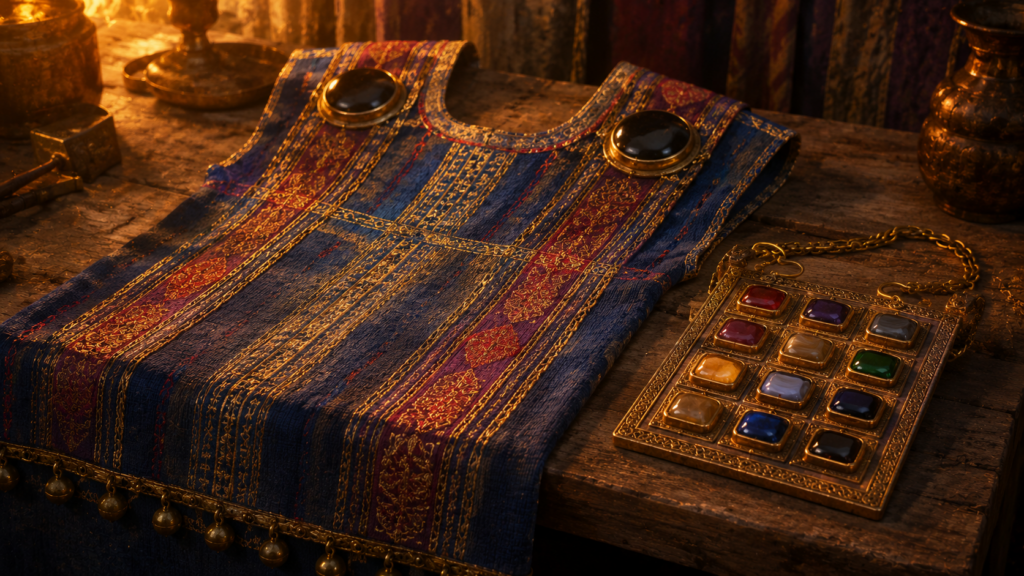
Exodus 28 dresses the priesthood. The previous three chapters built the rooms; this chapter clothes the people who will live and work inside them. Aaron and his sons are to be set apart as priests, kohanim, those who stand between the people and the holy. The chapter is unusually concerned with what they wear: ephod, breastpiece, robe, tunic, turban, sash, and (for the high priest) a gold plate engraved with the words Holy to YHWH.
It is a chapter about clothing as theology. The garments are not vestments-as-fashion; they are vestments-as-vocation. The Hebrew Bible cares about what the priest looks like because what he looks like is a public declaration of what he is doing. The names of the twelve tribes are written on his shoulders. The names of the twelve tribes are written on his heart. When the high priest enters the holy place, he carries the whole people, bodily, with him.
The patristic and Reformation traditions both heard chapter 28 as the foundation of an entire Christology. Christ as the high priest, bearing the names of his people on his heart, wearing Holy to YHWH on his forehead, entering the holy place with the cost of his own life rather than the blood of bulls, is Hebrews’s central image. The chapter is, in that sense, one of the canonical roots of the New Testament’s portrait of Jesus.
A · Exodus 28:1-14 · The priestly call, and the ephod with the names on the shoulders
¹ “Bring Aaron your brother, and his sons with him, near to you from among the children of Israel, that he may minister to me in the priest’s office: Aaron, Nadab and Abihu, Eleazar and Ithamar, Aaron’s sons. ² You shall make holy garments for Aaron your brother, for glory and for beauty. ³ You shall speak to all who are wise hearted, whom I have filled with the spirit of wisdom, that they make Aaron’s garments to sanctify him, that he may minister to me in the priest’s office. ⁴ These are the garments which they shall make: a breastplate, an ephod, a robe, a coat of checker work, a turban, and a sash. They shall make holy garments for Aaron your brother and his sons, that he may minister to me in the priest’s office. ⁵ They shall take the gold, and the blue, and the purple, and the scarlet, and the fine linen. ⁶ “They shall make the ephod of gold, blue, purple, scarlet, and fine twined linen, the work of the skillful workman. ⁷ It shall have two shoulder straps joined to the two ends of it, that it may be joined together. ⁸ The skillfully woven band, which is on it, that is on him, shall be like its work and of the same piece; of gold, blue, purple, scarlet, and fine twined linen. ⁹ You shall take two onyx stones, and engrave on them the names of the children of Israel: ¹⁰ six of their names on the one stone, and the names of the six that remain on the other stone, in the order of their birth. ¹¹ With the work of an engraver in stone, like the engravings of a signet, you shall engrave the two stones, according to the names of the children of Israel. You shall make them to be enclosed in settings of gold. ¹² You shall put the two stones on the shoulder straps of the ephod, to be stones of memorial for the children of Israel; and Aaron shall bear their names before the LORD on his two shoulders for a memorial. ¹³ You shall make settings of gold, ¹⁴ and two chains of pure gold; you shall make them like cords of braided work. You shall fasten the braided chains to the settings.
- Aaron your brother (v. 1). The first appointment of a priest in the Hebrew Bible names a brother. Moses is not the priest; his older brother is. The priesthood begins as a fraternal office, not a solo one. Moses speaks to YHWH face to face (33:11); Aaron mediates between YHWH and the people through the sacrificial system. The book is distinguishing two vocations that the rest of the Hebrew Bible will keep distinct: the prophet who hears YHWH’s word, and the priest who tends YHWH’s presence. They are family. They serve the same Name. They do not do the same job.
- Nadab and Abihu, Eleazar and Ithamar (v. 1). The four sons of Aaron are named. Two of them (Nadab and Abihu) will die at the altar in Lev 10 for offering strange fire. The chapter is consecrating the priesthood with full disclosure that consecration does not guarantee fidelity. The text records the names with knowledge of what is coming. The priesthood will have to learn that the proximity of the holy is dangerous as well as gracious.
- Holy garments for glory and for beauty (v. 2). The Hebrew is bigdei qodesh le-kavod ul-tif’eret: “holy garments for kavod and for tif’eret.” Kavod is glory, the weight of YHWH’s presence (the same word used at 24:16-17 for the glory of YHWH on Sinai, and at 40:34-35 for the glory filling the tabernacle). Tif’eret is beauty, splendor, ornament. The chapter is committing the Hebrew Bible to a strong aesthetic theology: the priesthood is to look beautiful. The book will use this same word later for the beauty of YHWH himself (Ps 71:8, my mouth is filled with your praise, with your splendor all day long). The chapter is teaching: the work of worship is not aesthetically indifferent; the holy is to be served in kavod and tif’eret.
- Wise-hearted whom I have filled with the spirit of wisdom (v. 3). The first explicit use of spirit-filling language in the Hebrew Bible names craft workers. Not prophets, not priests, not kings, but the artisans who will weave the ephod. Bezalel and Oholiab (named in 31:1-6) are the chapter’s named bearers of this Spirit-given craft-wisdom. The book is saying that artistic skill, the hand that weaves and engraves and gilds, is itself a charism of the Spirit of God. The same Hebrew construction (ruach chochma, “spirit of wisdom”) will be used later for the spirit on Joshua (Deut 34:9) and on the Davidic messiah (Isa 11:2). The first place it appears is on the seamstresses and metalworkers of the tabernacle.
- The ephod. The garment is the priesthood’s most distinctive piece: a sleeveless, apron-like vestment made of gold, blue, purple, scarlet, and fine twined linen, the same five materials as the inner curtains, the veil, and the gate-screen of the courtyard. The high priest is visually woven into the architecture of the sanctuary: when Aaron stands in his ephod, he is wearing the colors of the holy space. The chapter is teaching that the high priest is, in a sense, part of the building. He does not visit the sanctuary; he is dressed in it.
Word study: kohen (כֹּהֵן) and kavod (כָּבוֹד)
The Hebrew word for priest is kohen. Its primary semantic field is to stand near, to attend, to minister to a great person. The kohen is the one who stands near the king. In Israel’s case, the King is YHWH and the kohen stands near in the tent of meeting. The other key word in chapter 28 is kavod, glory. The root kavad means to be heavy, to have weight. Kavod names weighty presence, the substantial felt-reality of someone who matters. The priest is the one who stands near to the Weight. The garments are designed for kavod ve-tif’eret, weight and beauty. The two words together name the chapter’s theological aesthetic: what is closest to God’s presence should look like it.
- Two onyx stones on the shoulder straps, engraved with the names of the children of Israel (vv. 9-12). The ephod has two precious stones at the shoulders, each engraved with six of the tribes’ names, in the order of their birth. When Aaron walks into the holy place, he is carrying Israel on his shoulders. The verb in v. 12 is nasa, “to lift, bear, carry,” the same verb used for bearing iniquity in the sacrificial system. The high priest bears the twelve tribes literally on his body. The chapter is teaching the priest’s vocation as a carrying vocation. He does not represent the people abstractly. He carries them, named, into the presence of God.
B · Exodus 28:15-30 · The breastpiece of judgment, the twelve stones, and the Urim and Thummim
¹⁵ “You shall make a breastplate of judgment, the work of the skillful workman; like the work of the ephod you shall make it; of gold, of blue, and purple, and scarlet, and fine twined linen, you shall make it. ¹⁶ It shall be square and folded double; a span shall be its length, and a span its width. ¹⁷ You shall set in it settings of stones, four rows of stones: a row of ruby, topaz, and beryl shall be the first row; ¹⁸ and the second row a turquoise, a sapphire, and an emerald; ¹⁹ and the third row a jacinth, an agate, and an amethyst; ²⁰ and the fourth row a chrysolite, an onyx, and a jasper: they shall be enclosed in gold in their settings. ²¹ The stones shall be according to the names of the children of Israel, twelve, according to their names; like the engravings of a signet, everyone according to his name, they shall be for the twelve tribes. ²² You shall make on the breastplate chains like cords, of braided work of pure gold. ²³ You shall make on the breastplate two rings of gold, and shall put the two rings on the two ends of the breastplate. ²⁴ You shall put the two braided chains of gold in the two rings at the ends of the breastplate. ²⁵ The other two ends of the two braided chains you shall put on the two settings, and put them on the shoulder straps of the ephod in its forepart. ²⁶ You shall make two rings of gold, and you shall put them on the two ends of the breastplate, on its edge, which is toward the side of the ephod inward. ²⁷ You shall make two rings of gold, and shall put them on the two shoulder straps of the ephod underneath, in its forepart, close by its coupling, above the skillfully woven band of the ephod. ²⁸ They shall bind the breastplate by its rings to the rings of the ephod with a lace of blue, that it may be on the skillfully woven band of the ephod, and that the breastplate may not swing out from the ephod. ²⁹ Aaron shall bear the names of the children of Israel in the breastplate of judgment on his heart, when he goes in to the holy place, for a memorial before the LORD continually. ³⁰ You shall put in the breastplate of judgment the Urim and the Thummim; and they shall be on Aaron’s heart, when he goes in before the LORD: and Aaron shall bear the judgment of the children of Israel on his heart before the LORD continually.
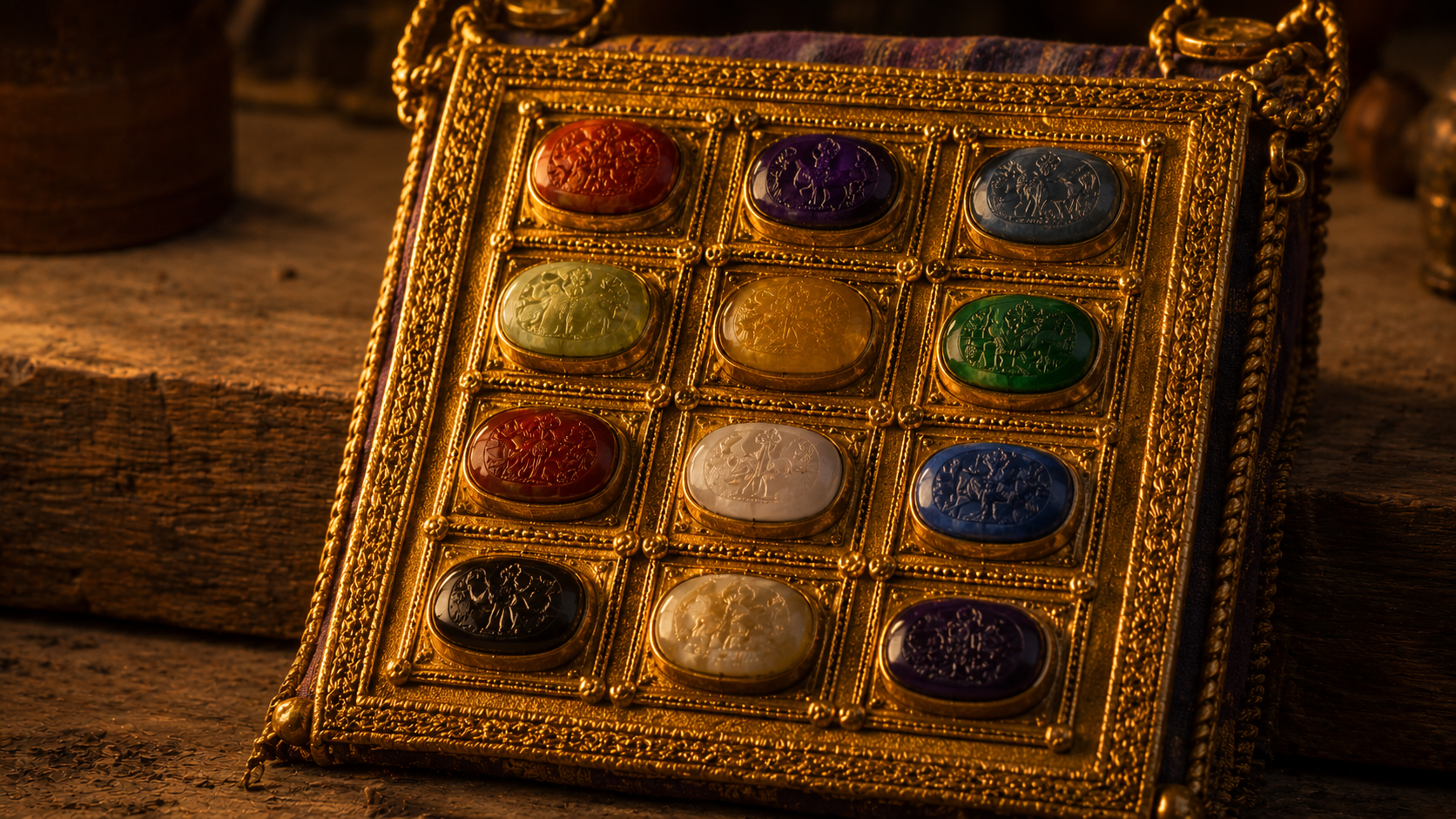
- A breastplate of judgment (v. 15). The Hebrew is choshen mishpat, “breastpiece of mishpat.” Mishpat is the standard word for judgment, justice, legal verdict. The breastpiece is not jewelry; it is a judicial instrument. The priest wears it because part of his vocation is to seek YHWH’s judgment on questions Israel cannot resolve on its own. The Urim and Thummim (v. 30) are the means; the breastpiece is the housing. The chapter is teaching that the priest’s heart-vestment is constitutionally tied to just decisions.
- Twelve stones in four rows of three, engraved with the twelve tribes (vv. 17-21). The shoulder stones carried the tribes’ names grouped (six and six). The breastpiece carries each tribe separately, each on its own stone, in its own setting, in its own row. The two pieces work together: the shoulders carry the people as a collective load, the heart carries each tribe as a distinct member. The priest’s posture is corporate and individual at once. He does not bear Israel in the abstract; he bears Judah and Levi and Reuben, each named, each on its own stone, each over his heart.
- Over his heart, continually (v. 29). The chapter uses al-libo (over his heart) three times in this passage (vv. 29 and 30 twice). The high priest’s heart-position is not metaphorical decoration; it is the chapter’s most repeated structural claim. The Hebrew lev (heart) is the seat of the will and the affections; al-libo names where decisions are made and where love is held. The priest carries the tribes there. The book is teaching that mediation between God and the people is a cardiac office. You cannot do this job without your heart engaged.
Word study: Urim and Thummim (אוּרִים וְתֻמִּים)
The two Hebrew words name the priest’s decision-making instrument: Urim (from the root or, light) means lights; Thummim (from the root tam, complete, perfect, blameless) means completenesses or perfections. The text never describes them physically. They were apparently two objects (stones? lots? marked tokens?) kept in a pouch behind the breastpiece, used by the high priest to discern YHWH’s answer to yes-or-no questions in moments of national crisis (cf. Num 27:21, Deut 33:8, 1 Sam 14:41, Ezra 2:63). The Septuagint translates the pair as delosis kai aletheia, “manifestation and truth.” Whatever their exact mechanics, the chapter is teaching that the priest does not give his own verdicts; he carries an instrument from YHWH that gives YHWH’s verdicts. The vocabulary is light and truth. The judgment passes from the heart of God to the heart of the priest, in the form of lights and completenesses. The tradition that later coalesces around the term Word of God (the Torah read in the synagogue, the oracle from the prophet, the verdict from the priest) has one of its roots here.
- A memorial before the LORD continually (v. 29). The Hebrew zikkaron tamid names the breastpiece’s function in YHWH’s sight: it reminds YHWH of the children of Israel. The Hebrew Bible is, of course, not naively suggesting YHWH forgets; the memorial language is liturgical (the same word names the Passover, the ark, the bread of the presence). It names the fact that the priest is bringing the people’s named existence into the divine attention. The book is teaching that the priest’s job is, partly, to keep the people present to God. The presence-of-presence is the priestly vocation.
- The chapter so far has named three locations on the priest’s body where Israel is carried: the two shoulders (collective), the heart (individual), and (in the next section) the forehead. The high priest, fully vested, is covered in Israel. The book is teaching that mediation does not happen at a distance; it happens in the body of the mediator. The whole later New Testament reading of Christ as high priest is staged on this image: he carries us in his body, on his shoulders, on his heart, on his head.
C · Exodus 28:31-43 · The robe with bells, “Holy to YHWH,” and the garments for the sons
³¹ “You shall make the robe of the ephod all of blue. ³² It shall have a hole for the head in its midst: it shall have a binding of woven work around its hole, as it were the hole of a coat of mail, that it not be torn. ³³ On its hem you shall make pomegranates of blue, and of purple, and of scarlet, around its hem; and bells of gold between and around them: ³⁴ a golden bell and a pomegranate, a golden bell and a pomegranate, around the hem of the robe. ³⁵ It shall be on Aaron to minister: and its sound shall be heard when he goes in to the holy place before the LORD, and when he comes out, that he not die. ³⁶ “You shall make a plate of pure gold, and engrave on it, like the engravings of a signet, ‘HOLY TO THE LORD.’ ³⁷ You shall put it on a lace of blue, and it shall be on the turban; on the front of the turban it shall be. ³⁸ It shall be on Aaron’s forehead, and Aaron shall bear the iniquity of the holy things, which the children of Israel shall make holy in all their holy gifts; and it shall be always on his forehead, that they may be accepted before the LORD. ³⁹ “You shall weave the coat in checker work of fine linen, and you shall make a turban of fine linen, and you shall make a sash, the work of the embroiderer. ⁴⁰ “You shall make coats for Aaron’s sons, and you shall make sashes for them and you shall make headbands for them, for glory and for beauty. ⁴¹ You shall put them on Aaron your brother, and on his sons with him, and shall anoint them, and consecrate them, and sanctify them, that they may minister to me in the priest’s office. ⁴² You shall make them linen breeches to cover the flesh of their nakedness; from the waist even to the thighs they shall reach: ⁴³ They shall be on Aaron, and on his sons, when they go in to the Tent of Meeting, or when they come near to the altar to minister in the holy place; that they not bear iniquity, and die: it shall be a statute forever to him and to his offspring after him.
- A blue robe, with pomegranates and bells alternating around the hem (vv. 31-35). The robe is all blue (tekheleth, the same color the Hebrew Bible later uses for the tassels on the corner of every Israelite’s garment, Num 15:38-39). At the hem, alternating fruit and bells: pomegranates (woven in blue, purple, scarlet) and golden bells. The verse names the bells’ function: its sound shall be heard when he goes in to the holy place before the LORD, and when he comes out, that he not die. The bells are an audible signal: the people outside hear the priest moving inside. The book is teaching that even when the priest is invisible behind the curtain, the sound of his ministry continues to be heard. The pomegranates carry the same theological reference the rest of the Hebrew Bible will pick up: fertility, abundance, the Promised Land (Num 13:23, Song 4:13, 1 Kings 7:18-20 will use them throughout the Solomonic temple). The high priest moves through the holy place trailing the sound of bells and the image of fruit.
- A plate of pure gold engraved ‘HOLY TO YHWH’ (v. 36). The Hebrew is qodesh la-YHWH, “holy to YHWH,” and the engraving is like the engravings of a signet, like a king’s seal. The phrase will reappear at the end of the book of the prophets (Zech 14:20-21) as the eschatological vision: on that day, even the cooking pots in Jerusalem will have qodesh la-YHWH engraved on them; the bells of horses will read qodesh la-YHWH; the whole world will be like the high priest’s forehead. The chapter’s small gold plate is the seed of a cosmic theological aspiration.
- On Aaron’s forehead (vv. 37-38). The position is geographically deliberate: shoulders (collective), heart (individual), forehead (publicly visible, the highest point, the place the worshipper sees first). The high priest’s whole head is signed. The chapter says it is that they may be accepted before the LORD (v. 38). Aaron bears the iniquity of the holy things: even Israel’s sacrifices are not pure enough to stand on their own; the priest’s qodesh la-YHWH covering makes them acceptable. The book is teaching that worship itself needs mediation. There is no offering Israel can make that does not need the priest’s holy-to-YHWH sign over it for it to count.
- Linen breeches from waist to thighs (vv. 42-43). The chapter’s last detail is the most modest. The priest’s undergarments are linen, knee-length, to cover the flesh of their nakedness. The text gives the reason directly: that they not bear iniquity, and die. The chapter is making a careful theological-anatomical point. The priest’s body, on duty, is covered. The Hebrew Bible is doing two things at once: refusing the surrounding ANE pattern of cultic nudity (some Mesopotamian and Egyptian priests served stripped to the waist or fully nude), and naming the priest’s body as itself a kind of sacred container whose covering matters. Goldingay’s note: the high priest stands in YHWH’s presence not as a body to be looked at but as a vestment to be worn through. The covering protects both the priest and the holy.
Influence callout: Tim Mackie (BibleProject, “Priests and the Tabernacle” series)
Mackie’s reading of Exodus 28 names the high priest as Israel’s embodied tabernacle. The same five materials that make the inner curtains, the veil, and the gate-screen also make the ephod and the breastpiece: gold, blue, purple, scarlet, fine twined linen. The high priest is, materially, walking architecture. When Aaron, dressed in his vestments, enters the holy place, the tabernacle is, in a sense, going inside itself. Mackie traces this image forward through the Hebrew Bible: the prophet Zechariah sees the high priest Joshua in dirty garments, has him cleansed and re-clothed, and declares (Zech 3) that he will be a priestly figure announcing the coming branch. The vision is then quoted in the New Testament. John’s gospel reads Christ as the tabernacle pitched among us (Jn 1:14, eskenosen), and Hebrews reads him as the high priest who carries us into the inner sanctuary (Heb 4:14-16; 9:11-12). Mackie’s pastoral note: the chapter is teaching that mediation works through covering. The mediator wears something for the people. The names go on the shoulders, the names go on the heart, holy to YHWH goes on the forehead. Christ, in this reading, is the priest who wears his people’s names on himself permanently. The chapter’s deepest claim, in Mackie’s reading, is that to be carried by a priest is to be safely brought into the holy place.
- The chapter ends with a statute forever to him and to his offspring after him (v. 43). The vestments are a multi-generational commitment. The priesthood, like the lampstand and the tabernacle itself, is on the tamid rhythm: not a moment, but a covenantal long horizon. The book is teaching: the priesthood is built for centuries, and the chapter just walked it into being.
Reflection prompts
- The high priest carries the names of the twelve tribes on his shoulders and on his heart. Who in your life is carrying you, named, before God right now? Whom are you carrying in the same way?
- Holy to YHWH on the forehead means the priest’s whole identity is signed. What would it look like for the same sign to be visible on your own life? What would it cover?
- The chapter joins holy and beautiful (kavod ve-tif’eret) as inseparable vestments of worship. In what areas of your spiritual practice have you separated them, settling for the functional but not beautiful, or the beautiful but not holy?
Frameworks at play in this chapter: the tabernacle as cosmic temple, bearing God’s name.