

Romans 11 is the chapter where Paul’s three-chapter Israel argument climaxes. Chapter 9 named God’s purposive freedom in covenant election and ended with Israel’s stumbling. Chapter 10 named Israel’s zeal without knowledge and YHWH’s outstretched hands toward a disobedient people. Chapter 11 now answers the question the previous two chapters have raised: has God therefore rejected his people? The answer is the strongest possible negation: by no means! The chapter develops the present-tense remnant (11:1-10), the cultivated olive tree (11:11-24), the mystery of partial hardening and eschatological restoration (11:25-32), and the doxology of praise for God’s unsearchable judgments (11:33-36). The chapter is the single most important Pauline text against Christian supersessionism and the theological foundation for the olive tree framework.
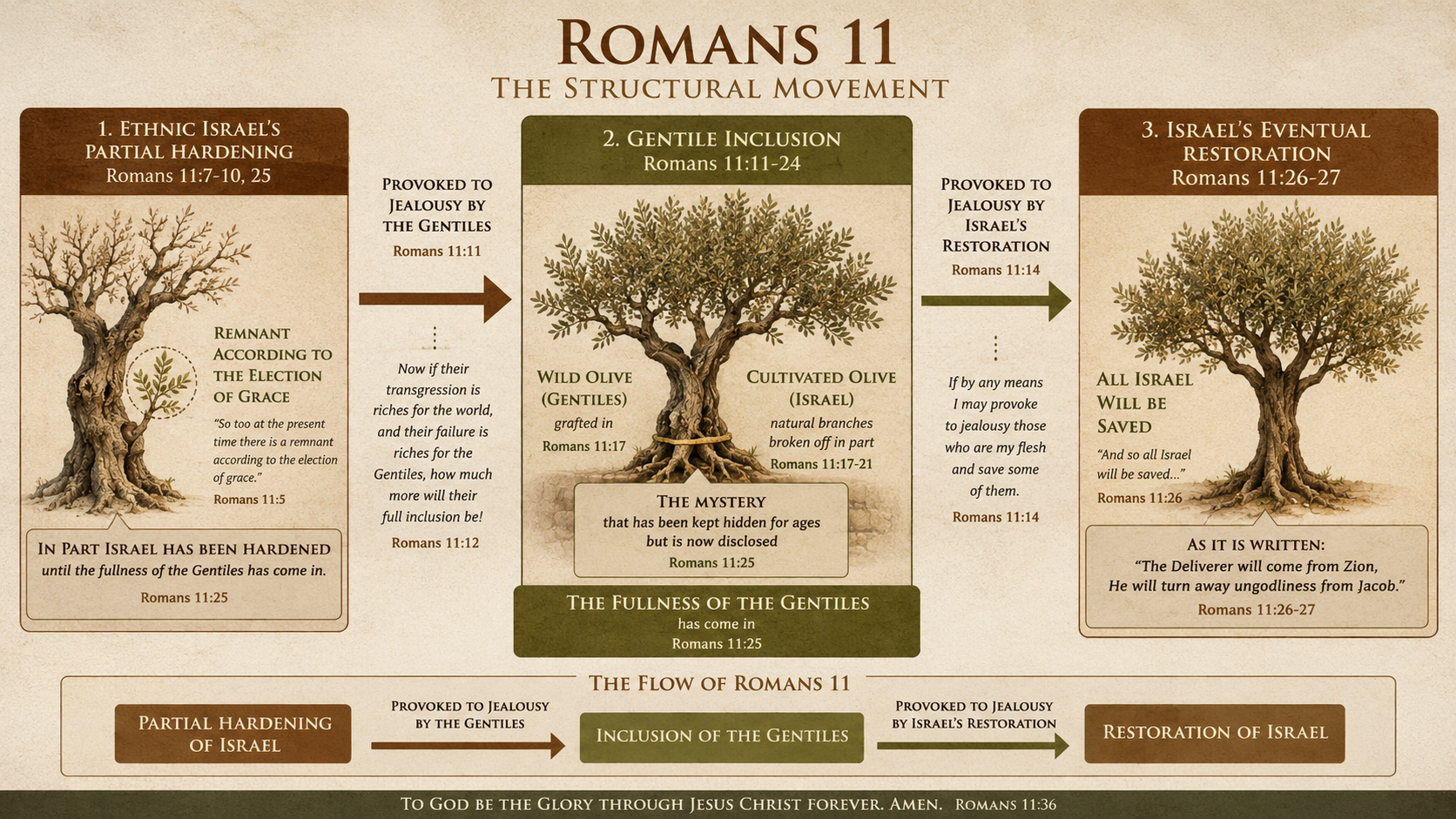
The chapter divides into four movements. Verses 1-10 affirm God has not rejected his people and develop the present-tense remnant chosen by grace. Verses 11-24 introduce the cultivated olive tree metaphor: gentiles are grafted in, but the root remains Jewish, and gentile arrogance over the natural branches is explicitly forbidden. Verses 25-32 name the mystery: a hardening has come on part of Israel until the fullness of the gentiles has come in, and so all Israel will be saved. Verses 33-36 close the entire three-chapter argument with one of the deepest doxologies in the New Testament: Oh the depth of the riches both of the wisdom and knowledge of God!
The chapter is the theological floor of the site’s reading of Romans. Israel’s election is irrevocable (11:29). The olive tree is cultivated, not replanted (11:17-24). All Israel will be saved (11:26). Marty Solomon’s Bema podcast Romans 9-11 episodes are the primary modern voice for the site’s reading, with Wright, McKnight, Sanders, Dunn, and Gaventa supporting.
A · Romans 11:1-10 · The remnant chosen by grace
¹ I ask then, did God reject his people? May it never be! For I also am an Israelite, a descendant of Abraham, of the tribe of Benjamin. ² God didn’t reject his people, which he foreknew. Or don’t you know what the Scripture says about Elijah? How he pleads with God against Israel: ³ “Lord, they have killed your prophets, they have broken down your altars; and I am left alone, and they seek my life.” ⁴ But how does God answer him? “I have reserved for myself seven thousand men, who have not bowed the knee to Baal.” ⁵ Even so then at this present time also there is a remnant according to the election of grace. ⁶ And if by grace, then it is no longer of works; otherwise grace is no longer grace. But if it is of works, it is no longer grace; otherwise work is no longer work. ⁷ What then? That which Israel seeks for, that he didn’t obtain, but the chosen ones obtained it, and the rest were hardened. ⁸ According as it is written, “God gave them a spirit of stupor, eyes that they should not see, and ears that they should not hear, to this very day.” ⁹ David says, “Let their table be made a snare, a trap, a stumbling block, and a retribution to them. ¹⁰ Let their eyes be darkened, that they may not see. Always keep their back bent.”
- Did God reject his people? May it never be! (v. 1). The chapter’s opening claim. The Greek mē apōsato ho theos ton laon autou? mē genoito. The Greek construction expects the answer no: God has not rejected. The verse settles one of the most important questions in Christian theology: has God’s covenant with ethnic Israel been canceled? The Pauline answer is the strongest negation in koine Greek. The verse is one of the most important single lines in Romans 9-11 and the floor on which everything else stands.
Influence callout: Marty Solomon (Bema podcast, Romans series, especially the chapter 11 episodes)
Solomon’s reading of Romans 11 is the foundational modern voice for the site’s approach. Solomon’s pastoral payoff: the chapter cannot be read as anti-Jewish polemic; it is the most concentrated Pauline argument that ethnic Israel’s covenant standing is irrevocable. The chapter’s cultivated-olive-tree image (11:17-24), the partial-and-provisional hardening (11:25), and the all Israel will be saved declaration (11:26) together establish that God has not rejected and will not reject the covenant people through whom the Messiah has come. Solomon’s broader frame: two millennia of Christian engagement with the Jewish people have largely misread Romans 11, producing supersessionism, replacement theology, and the long catastrophe of Christian anti-Judaism. The chapter is the most important text the Christian church has not yet learned to read in its own terms. Solomon’s pastoral call: to read Romans 11 well is to break with two thousand years of Christian arrogance toward Israel and to return to the chapter’s actual claim: the gifts and calling of God are irrevocable (11:29).
- I also am an Israelite, a descendant of Abraham, of the tribe of Benjamin (v. 1). Paul’s autobiographical evidence. Paul himself is an Israelite who has received the Messiah; therefore God has not rejected his people. The verse is not just rhetorical; it is epistemological: Paul’s own existence as a Jewish believer in Messiah is the living evidence that God still has Jewish believers in his covenant family.
- God didn’t reject his people, which he foreknew (v. 2). The Greek hon proegnō (whom he foreknew). The verb proginōskō (foreknow) here names YHWH’s covenantal-prior-knowing of Israel, not an abstract divine omniscience claim. The Hebrew Bible’s YHWH knew Israel (cf. Amos 3:2: you only have I known of all the families of the earth) is covenant-elective knowing, loyal commitment, betrothal. The verse names God’s covenant-prior-commitment to Israel as the basis of not rejecting them.
- I have reserved for myself seven thousand men, who have not bowed the knee to Baal (v. 4). The quotation from 1 Kings 19:18. The Elijah context: Elijah, despairing under Jezebel’s threat, complains he is the only faithful Israelite left. YHWH’s answer: seven thousand remain who have not bowed to Baal. The point is not that Israel was largely faithless; the point is that the faithful remnant is always present, even when the prophet cannot see it. Paul applies the verse to the present moment: the Jewish believers in Messiah are the present-tense seven thousand.
- Even so then at this present time also there is a remnant according to the election of grace (v. 5). The chapter’s first explicit naming of the present-tense remnant. The Greek kat’ eklogēn charitos (according to election of grace). The remnant is not based on ethnic descent in a bare sense; it is based on the grace-election that has produced Jewish believers in Messiah in the present moment. The whole later church-history of Jewish believers in Messiah (the apostles, the Jerusalem community, the Messianic Jewish congregations, the present-tense Jewish Christians across the centuries) is the remnant Paul names.
- If by grace, then it is no longer of works; otherwise grace is no longer grace (v. 6). The Greek ei de chariti, ouketi ex ergōn, epei hē charis ouketi ginetai charis. The verse’s logical-grammatical argument: grace and works are categorically different modes of covenant entry. Grace by definition is not earned; works by definition is earned. The two cannot be blended without destroying the category of grace. The verse is not an abolition of Spirit-empowered ethical life (cf. Eph 2:10: we are his workmanship, created in Christ Jesus for good works); it is the categorical insistence that covenant entry is by grace, not by works of the law (the boundary-marker triad of circumcision, food, calendar).
- Israel sought . . . the chosen ones obtained it, and the rest were hardened (v. 7). The chapter’s paradoxical observation. Israel sought covenant-righteousness; the chosen ones (Greek hē eklogē, the election, the chosen-by-grace company) obtained it; the rest (Greek hoi loipoi) were hardened. The passive voice (were hardened, Greek epōrōthēsan) leaves the agent ambiguous: God? Israel itself? The chapter does not resolve the question definitively, leaving the moral mystery of the hardening in intentional grammatical tension.
- God gave them a spirit of stupor (v. 8). The quotation from Isaiah 29:10 + Deuteronomy 29:4. The combined quotation names the divine permission of Israel’s stupor in the present moment. The verse is not a declaration of permanent reprobation; it is the prophetic naming of the moment in which Israel resists the Messiah. The whole later chapter (vv. 25-32) will make clear that the stupor is provisional.
B · Romans 11:11-24 · The cultivated olive tree
¹¹ I ask then, did they stumble that they might fall? May it never be! But by their fall salvation has come to the Gentiles, to provoke them to jealousy. ¹² Now if their fall is the riches of the world, and their loss the riches of the Gentiles; how much more their fullness? ¹³ For I speak to you who are Gentiles. Since then as I am an apostle to Gentiles, I glorify my ministry; ¹⁴ if by any means I may provoke to jealousy those who are my flesh, and may save some of them. ¹⁵ For if the rejection of them is the reconciling of the world, what would their acceptance be, but life from the dead? ¹⁶ If the first fruit is holy, so is the lump. If the root is holy, so are the branches. ¹⁷ But if some of the branches were broken off, and you, being a wild olive, were grafted in among them, and became partaker with them of the root and of the richness of the olive tree; ¹⁸ don’t boast over the branches. But if you boast, it is not you who support the root, but the root supports you. ¹⁹ You will say then, “Branches were broken off, that I might be grafted in.” ²⁰ True; by their unbelief they were broken off, and you stand by your faith. Don’t be conceited, but fear; ²¹ for if God didn’t spare the natural branches, neither will he spare you. ²² See then the goodness and severity of God. Toward those who fell, severity; but toward you, goodness, if you continue in his goodness; otherwise you also will be cut off. ²³ They also, if they don’t continue in their unbelief, will be grafted in, for God is able to graft them in again. ²⁴ For if you were cut out of that which is by nature a wild olive tree, and were grafted contrary to nature into a good olive tree, how much more will these, who are the natural branches, be grafted into their own olive tree?
- Did they stumble that they might fall? May it never be! (v. 11). The chapter’s second mē genoito in eleven verses. The verse asks: was the purpose of Israel’s stumbling final fall? The answer is no. The stumbling serves a purpose; the purpose is gentile inclusion, which in turn serves Israel’s eventual restoration. The chapter’s teleological reading of Israel’s hardening is one of the most important Pauline arguments against the bare-rejection reading of chapter 9.
- By their fall salvation has come to the Gentiles, to provoke them to jealousy (v. 11). The Greek eis to parazēlōsai autous (to provoke them to jealousy). The verb parazēloō picks up Deuteronomy 32:21 (quoted at 10:19). The jealousy logic: gentile inclusion in the covenant family is intended to provoke Israel to return. The verse is not a triumph over Israel; it is strategic eschatology: the gospel’s gentile reach serves Israel’s eventual restoration.
- I am an apostle to Gentiles, I glorify my ministry; if by any means I may provoke to jealousy those who are my flesh (vv. 13-14). Paul names his own apostolic motive. Even his gentile mission is oriented toward Israel’s eventual return. The verse refuses any reading of Paul as anti-Jewish-mission; Paul’s whole gentile ministry is for the sake of his Jewish kinsmen’s eventual jealousy-provoked return.
- If the rejection of them is the reconciling of the world, what would their acceptance be, but life from the dead? (v. 15). The Greek prōslēmpsis (acceptance, reception, taking-back) is paired with apobolē (casting off, rejection). Israel’s current rejection of the Messiah has resulted in the world’s reconciliation (the gentile mission). Israel’s eventual acceptance of the Messiah will result in life from the dead. The life from the dead phrase (Greek zōē ek nekrōn) has been read as the general resurrection or as the world’s restoration; either way, the verse names Israel’s restoration as the eschatological event of cosmic consequence.
- If the first fruit is holy, so is the lump. If the root is holy, so are the branches (v. 16). The chapter introduces the olive tree metaphor. The first fruit (Greek aparchē, the Hebrew Bible’s reshit, the first portion dedicated to YHWH) and the root (Greek rhiza) are the patriarchs / Abraham. If the root is holy, the branches are holy. The Jewish covenant root is not abolished; it remains holy. The verse is the theological foundation for what follows: the olive tree is one tree, with one root (Jewish-Abrahamic), into which both natural branches (Jewish believers) and grafted-in branches (gentile believers) belong.
- If some of the branches were broken off, and you, being a wild olive, were grafted in (v. 17). The Greek agrielaios (wild olive). The chapter’s metaphor. Some natural branches (unbelieving Israel) have been broken off. Gentile believers (wild olive shoots) have been grafted in (Greek enekentristhēs, engrafted). The gentile believers are now partakers with the natural branches of the root and the richness. The metaphor is carefully limited: one tree, one root, both kinds of branches sharing the same root.
- Don’t boast over the branches (v. 18). The Greek mē katakauchō (do not boast against). The chapter’s direct address to gentile believers. The verse is the most important single line against Christian supersessionism in the New Testament. Gentile believers are forbidden to boast against the natural branches. The direct second-person address (Paul says you to gentile believers) makes the warning unmistakable. The whole later Christian tradition’s anti-Jewish polemic is exactly what Paul forbids.
Pushback note: supersessionism / replacement theology
The dominant historic Christian reading of Romans 11 (especially in the medieval Latin Western tradition and in much of the Reformation tradition) has produced supersessionism or replacement theology: the doctrine that the Christian church has replaced ethnic Israel as the people of God, with Israel’s covenant promises now transferred to the church. The doctrine carries from Justin Martyr’s Dialogue with Trypho (c. 160 CE) through Augustine’s adversus Iudaeos tradition through the medieval Western church’s treatment of Jews through Luther’s late writings (On the Jews and Their Lies, 1543) into the modern post-Holocaust Christian theological reckoning. The doctrine has contributed to and theologically supported two millennia of Christian engagement with the Jewish people that has produced enormous suffering, catalyzed pogroms, enabled the medieval church’s repression of Jewish communities, and contributed to the theological soil in which the Shoah was possible. The site names supersessionism the most consequential and most catastrophic historic Christian theological error. The chapter’s explicit prohibition of gentile boasting against the natural branches (11:18), the explicit naming of Israel’s election as irrevocable (11:29), the cultivated-olive-tree image’s one-tree-one-root logic, and the all Israel will be saved declaration (11:26) together refute supersessionism from within Paul’s own text. The site’s reading of Romans 11 is non-negotiably anti-supersessionist. The post-Holocaust Christian theological reckoning (the World Council of Churches’ Seelisberg Theses of 1947; Vatican II’s Nostra Aetate of 1965; the various denominational statements repudiating replacement theology) has been a long, important, and incomplete recovery of what Paul actually said. The site stands inside this recovery. See the olive tree for the framework’s fuller development.
- If God didn’t spare the natural branches, neither will he spare you (v. 21). The chapter’s warning to gentile believers. The Greek ei gar ho theos tōn kata physin kladōn ouk epheisato, mē pōs oude sou pheisetai. The verse is one of the most sobering in the New Testament for Christian readers. The gentile branches’ continued standing is not unconditional; it depends on continued faithful allegiance. If God broke off the natural branches in their unbelief, God can break off the grafted-in branches too. The verse is not a threat to the doctrine of assurance; it is the warning against Christian arrogance toward Israel and toward God’s continued covenant freedom.
- See then the goodness and severity of God (v. 22). The verse’s theological summation. Goodness (Greek chrēstotēta) and severity (Greek apotomia, cutting off) are paired. Gentile believers are now recipients of goodness; unbelieving Israel is presently under severity. But the verse continues: you also will be cut off if you do not continue in goodness. The cutting-off is not permanent for anyone; it is the consequence of unbelief, applicable to both groups equally.
- They also, if they don’t continue in their unbelief, will be grafted in, for God is able to graft them in again (v. 23). The chapter’s hope for unbelieving Israel. The verse is crucial: Israel’s current breaking-off is not final. God is able (Greek dynatos gar estin ho theos) to graft them in again. The verse is the most important single line in anti-supersessionist Pauline interpretation: Israel’s restoration is divinely possible, not foreclosed by divine fiat.
- How much more will these, who are the natural branches, be grafted into their own olive tree? (v. 24). The chapter’s a fortiori argument. If the unnatural grafting (gentile branches into the Jewish root) was possible by divine grace, how much more the natural grafting (Jewish branches back into their own root) will be possible. The verse names Israel’s restoration as more natural than the present-tense gentile inclusion. The verse anticipates 11:25-32‘s eschatological mystery.
C · Romans 11:25-32 · The mystery
²⁵ For I don’t desire you to be ignorant, brothers, of this mystery, so that you won’t be wise in your own conceits, that a partial hardening has happened to Israel, until the fullness of the Gentiles has come in, ²⁶ and so all Israel will be saved. Even as it is written, “There will come out of Zion the Deliverer, and he will turn away ungodliness from Jacob. ²⁷ This is my covenant with them, when I will take away their sins.” ²⁸ Concerning the Good News, they are enemies for your sake. But concerning the election, they are beloved for the fathers’ sake. ²⁹ For the gifts and the calling of God are irrevocable. ³⁰ For as you in time past were disobedient to God, but now have obtained mercy by their disobedience, ³¹ even so these also have now been disobedient, that by the mercy shown to you they may also obtain mercy. ³² For God has shut up all to disobedience, that he might have mercy on all.
- I don’t desire you to be ignorant, brothers, of this mystery (v. 25). The Greek mystērion (mystery). The Pauline mystery (cf. 1 Cor 15:51; Eph 3:3-6; Col 1:26-27) is not a puzzle to be solved but a previously hidden divine purpose now revealed. The chapter’s mystery is the structural plan of gentile inclusion and Israel’s eventual restoration. The verse warns gentile believers against being wise in your own conceits: the divine plan is bigger than what you can figure out from your current vantage.
- A partial hardening has happened to Israel, until the fullness of the Gentiles has come in (v. 25). The Greek apo merous (in part). Israel’s hardening is partial, not total. Until (Greek achris ou) names the temporal limit: the fullness of the gentiles (Greek plērōma tōn ethnōn) coming in is the trigger for what follows. The whole chapter’s eschatological logic: gentile fullness first, then Israel’s restoration.
- And so all Israel will be saved (v. 26). The Greek kai houtōs pas Israēl sōthēsetai. The single most-debated phrase in Romans. The traditional Reformed reading (following Calvin in part): all Israel refers to the totality of the elect across history, both Jewish and gentile, the spiritual Israel of the church. The Lutheran-spiritualizing reading: all Israel refers to the church as the new Israel. The site’s reading (Solomon, Wright, McKnight, modern scholarly consensus): all Israel refers to the eschatological inclusion of ethnic Israel at the end of the present age, following the gentile fullness. The Greek houtōs (so, thus, in this manner) names the manner of Israel’s salvation: through the jealousy-provoking gentile inclusion and the eventual recognition of the Messiah. The verse is not a universal-salvation claim about every individual ethnic Israelite; it is the eschatological-restoration claim about Israel as a covenant people.
- There will come out of Zion the Deliverer (v. 26). The quotation from Isaiah 59:20-21 (with elements of Isaiah 27:9 and Jeremiah 31:33-34). The verse names the Messiah as the one who turns ungodliness from Jacob. The verse joins the prophetic restoration tradition of the Servant-Deliverer with the Romans 11 eschatological vision. The whole chapter’s all Israel will be saved is not Pauline innovation; it is the prophetic tradition’s own expectation of Israel’s eschatological restoration through YHWH’s Anointed.
- Concerning the Good News, they are enemies for your sake. But concerning the election, they are beloved for the fathers’ sake (v. 28). The chapter’s dual-aspect assessment of Israel’s current state. Israel is enemies (Greek echthroi) of the gospel (in the sense that Israel currently resists the Messiah’s claim), for your sake (the gentile mission has been advanced through Israel’s resistance). But Israel is beloved (Greek agapētoi) of the election, for the fathers’ sake (the Abrahamic covenant remains in force). The verse holds both aspects in deliberate tension: Israel is resisting the Messiah now; Israel is still beloved of God. Both are true simultaneously.
- For the gifts and the calling of God are irrevocable (v. 29). The Greek ametamelēta gar ta charismata kai hē klēsis tou theou. The chapter’s structural anchor. The gifts (Greek charismata) and the calling (Greek klēsis) of God are irrevocable (Greek ametamelēta, without regret, irreversible). The verse is the foundation of every claim in the chapter and the entire three-chapter argument. Israel’s covenant standing is not in question; Israel’s election is irrevocable. The verse is the New Testament’s strongest single line against any theology that holds God has rejected Israel.
- God has shut up all to disobedience, that he might have mercy on all (v. 32). The chapter’s most cosmically generous claim. The Greek synekleisen gar ho theos tous pantas eis apeitheian, hina tous pantas eleēsē. All have been shut up to disobedience (Greek synekleisen, enclosed, hemmed in). The verse is not a deterministic claim about God orchestrating sin; it is the eschatological-theological summary of the human situation: both gentile and Jew have been bound under sin’s dominion (cf. Rom 3:9, all under sin; 7:14, sold under sin), and both are now objects of mercy. The verse parallels the Pauline eis pantas (to all) language at 5:18 and 11:26’s pas Israēl: the divine purpose operates in cosmic generosity. Whether the verse implies universal-eschatological salvation of every individual is theologically debated; the verse does name the divine intention toward mercy on all without specifying the precise scope of the mercy’s eschatological reach.
D · Romans 11:33-36 · The doxology
³³ Oh the depth of the riches both of the wisdom and the knowledge of God! How unsearchable are his judgments, and his ways past tracing out! ³⁴ “For who has known the mind of the Lord? Or who has been his counselor?” ³⁵ “Or who has first given to him, and it will be repaid to him again?” ³⁶ For of him, and through him, and to him, are all things. To him be the glory for ever! Amen.
- Oh the depth of the riches both of the wisdom and the knowledge of God! (v. 33). The chapter closes the three-chapter argument with one of the most-quoted doxological lines in the Pauline corpus. The Greek ō bathos ploutou kai sophias kai gnōseōs theou gathers three divine attributes (riches, wisdom, knowledge) into a single exclamation. The doxology is not just stylistic ornament; it is the appropriate response to the unsearchable mystery of God’s covenant faithfulness. The chapters have not solved the mystery; they have named it and worshipped before it.
- How unsearchable are his judgments, and his ways past tracing out! (v. 33). The Greek anexeraunēta ta krimata autou (unsearchable his judgments) and anexichniastoi hai hodoi autou (his ways untraceable). Both adjectives are Pauline coinages. God’s ways are not finally trackable by human reasoning. The chapter that has just developed the most complex theological argument in the Pauline corpus ends by naming the inadequacy of the very argument it has just made. The doxology is the appropriate response to having reached the limit of human theological articulation.
- Who has known the mind of the Lord? Or who has been his counselor? (v. 34). The quotation from Isaiah 40:13. The Isaiah context: the comforted-by-the-Servant Israel is reminded that YHWH’s wisdom is not derived from human counsel. Paul applies the verse to the present moment’s theological question: God’s covenant-purpose-in-Christ is not negotiated with human-theological-systems. The verse warns theologians against over-confident claims to have explained the divine plan.
- Who has first given to him, and it will be repaid to him again? (v. 35). The quotation from Job 41:11. The Job context: YHWH’s speech from the whirlwind names the radical asymmetry between Creator and creature. Paul applies the verse: no one has put God in their debt. The verse closes the chapter’s anti-arrogance trajectory: gentile believers should not boast (11:18); human theologians should not pretend to have advised the Creator; all human beings receive what they receive as gift, not as payment owed.
- Of him, and through him, and to him, are all things (v. 36). The Greek ex autou kai di’ autou kai eis auton ta panta. The chapter’s Trinitarian-cosmic-summary. All things are from God, through God, to God. The verse is the cosmic-scope summary of the Romans argument so far: the gospel that has been unfolded in the previous eleven chapters is the announcement of God’s purpose for all things. The verse anticipates the practical-pastoral chapters 12-16 that now apply this cosmic-purpose announcement to the actual Roman house-church community.
- To him be the glory for ever! Amen (v. 36). The chapter closes with the doxological refrain. The Greek autō hē doxa eis tous aiōnas (to him the glory unto the ages). The amen (Greek amēn, the Hebrew assent so be it) is the congregation’s response to the apostle’s praise. The verse functions as the theological climax of the entire first half of Romans. The next chapter (12:1) will begin the practical-pastoral application: I beseech you therefore, brothers, by the mercies of God.
Influence callout: N.T. Wright (Paul and the Faithfulness of God, ch 11; Into the Heart of Romans)
Wright reads Romans 11 as the climax of Paul’s argument about God’s covenant faithfulness. The chapter’s all Israel will be saved (11:26) is not a vague universalism; it is the precise eschatological-restoration claim the Hebrew prophetic tradition has been building toward throughout the Hebrew Bible. Wright’s pastoral payoff: the chapter is not a parenthesis in Paul’s theological argument; it is the structural climax. Without chapter 11’s “all Israel will be saved”, the whole letter unravels: God’s covenant faithfulness (the dikaiosynē theou of chapter 1) cannot fail to keep its promises to Israel without ceasing to be the covenant faithfulness it has claimed to be. The chapter secures the whole Pauline gospel: if God can be unfaithful to Israel, then God can be unfaithful to the gentile believers also. Israel’s irrevocable election (11:29) is the guarantee of the gentile believer’s irrevocable inclusion. The chapter’s pastoral implications for Christian engagement with the Jewish people are non-negotiable: humility, gratitude for the root, prayer for the natural branches’ return, refusal of any theology that displaces Israel.
Reflection prompts
- The chapter’s most concentrated single line is the gifts and the calling of God are irrevocable (11:29). God’s commitments do not expire. Where in your own life has God’s commitment to you been imagined as contingent on your continued performance? What changes if the divine commitment is as irrevocable in your life as it is in Israel’s covenant standing?
- The chapter forbids gentile arrogance against the natural branches (11:18). Where in your own engagement with the Jewish people (and with Jewish religious tradition more broadly) have you imported the supersessionist arrogance the chapter explicitly forbids? What would receiving the chapter’s correction require of your posture toward Israel?
- The chapter names Israel’s current resistance to the Messiah as partial and provisional (11:25). God is not finished with Israel. Where in your own discipleship has patience with people who do not yet recognize Christ been replaced by anxious certainty about their final state? What would holding the chapter’s eschatological hope look like in your current relationships?
- The chapter closes with doxology (11:33-36), not theological mastery. Paul has just made the most complex theological argument in the New Testament and ends not with a system but with worship. Where in your own theological engagement has the goal become explanation rather than worship? What would ending in doxology look like when you reach the limits of your own theological understanding?
Frameworks at play in this chapter: the olive tree · Paul Within Judaism · the new covenant · exile and return · gospel allegiance · the cruciform hermeneutic