
Romans
The gospel, systematically.
All 16 chapters drafted.
Romans
How to read it
Themes: the gospel of God’s righteousness for both Jew and gentile (1-4) · life in the Spirit and the redemption of creation (5-8) · God’s faithfulness to Israel and the future of the olive tree (9-11) · cruciform community life in the empire’s capital (12-13) · welcome between the Strong and the Weak (14-15) · the apostle’s mission and the household network of the Roman church (16) · the obedience of faith as the letter’s structural bracket (1:5 and 16:26) Literary design: a formal letter (not a sermon, not a treatise) written by Paul from Corinth around 56-57 CE to a mixed community of gentile and Jewish believers in the imperial capital; structured as a diatribe (Paul argues with an imagined interlocutor at key points, especially 2:1-29, 3:1-9, 6:1-23, 9:14-21); carried by Phoebe (16:1-2), a deacon from Cenchreae who likely read the letter aloud to the Roman house churches; the densest single piece of Pauline argumentation in the New Testament Frameworks at play: Paul Within Judaism · justification · works of the law · Adam Christology · the olive tree · the new covenant · gospel allegiance · counter-imperial reading · the cruciform hermeneutic · exile and return · the divine council · the image of God · the kipper / atonement framework
Romans is the New Testament book most often read out of context. The Christian theological tradition has, for sixteen centuries, treated Romans as the systematic-theological showpiece of the New Testament: the book where Paul lays out an abstract doctrine of salvation applicable to any individual in any time and place. Augustine read it that way; Luther read it that way; Calvin read it that way; Wesley read it that way; the Princeton Reformed tradition read it that way; the modern Romans Road evangelistic tract reads it that way. The site’s reading is different. Romans is a pastoral letter to a divided community in the imperial capital. It is not abstract systematics. It is not a theological textbook. It is a targeted intervention into a specific first-century conflict between Strong (mostly gentile, mostly Torah-relaxed) and Weak (mostly Jewish, Torah-observant) believers in the Roman house churches, written to persuade both groups toward peace in Christ.
The site reads Romans in the Paul Within Judaism lane, drawing on multiple voices whose readings overlap substantially while differing on the audience question. Scot McKnight (Reading Romans Backwards; Romans, NTEBS) provides the backward-read organizing thesis and the mixed-audience reconstruction of the Strong-Weak conflict. Timothy Gombis (Romans podcast lectures, 2024-25) provides the all-gentile-with-Judaizers audience reconstruction (following Stowers and Thiessen) and the cruciform-rhetorical-trap reading of Romans 1-3. N.T. Wright (Into the Heart of Romans; Romans for Everyone) provides the narrative-theological anchor especially at Romans 8. Marty Solomon (Bema podcast, Romans series) is the Hebrew-context voice especially across chapters 9-11. Matthew Bates (Salvation by Allegiance Alone) provides the pistis-as-allegiance lens. Nijay Gupta (Paul and the Language of Faith), Michael F. Bird (Romans, SGBC), James D.G. Dunn (Romans 1-8, Romans 9-16, WBC), and Beverly Roberts Gaventa (When in Romans) round out the scholarly anchor. Mark Nanos, Pamela Eisenbaum, and Paula Fredriksen provide the harder Paul-Within-Judaism positions when the reading needs them. Stanley Stowers (A Rereading of Romans) and Matthew Thiessen (Paul and the Gentile Problem) ground the all-gentile-audience reconstruction historically.
This page is a “how to read it” overview, meant to be read alongside the chapter commentaries (linked at the bottom). If you want the verse-by-verse work, follow a chapter link. If you want the lay of the land before you walk it, you’re in the right place.
The book is a pastoral letter, not a systematic theology
The first thing modern readers need to know about Romans is that it is a letter, not a theological treatise. The book opens (1:1-7) with the standard first-century Greco-Roman letter form (sender, recipient, greeting), closes (16:1-27) with personal greetings and a courier commendation, and conducts its argument in the middle with a specific community problem in view. Romans is not Paul sitting down to write his magnum opus for the sake of theological posterity. Romans is Paul writing to a specific church with specific tensions, hoping to win their financial support and prayer for his upcoming mission to Spain (15:23-28) and, more urgently, to heal the rift between the Jewish and gentile believers who have been at odds since Emperor Claudius’s expulsion of the Jews from Rome in 49 CE and the subsequent gentile-dominant period in the Roman house churches.
This matters interpretively. Letters have different structural conventions than treatises: they address concrete situations; they assume shared background knowledge; they use rhetoric aimed at persuading the recipients, not at establishing universal propositions. The Augustinian-Reformation tradition, by reading Romans as a systematic-theology textbook, has often missed the pastoral situation the letter actually addresses. The result has been five centuries of Christian theology built on a de-historicized Romans, with predictable consequences: justification floated free of its Jewish-gentile context; works of the law became moralistic self-righteousness in general; Romans 9 became individual predestination instead of God’s faithfulness to Israel; and Romans 13 became the divine right of kings instead of the most reluctant submission in the New Testament.
The author is Paul, the Jewish apostle to the gentiles. He wrote (or dictated to Tertius, 16:22) the letter from Corinth, probably during his three-month stay there in the winter of 56-57 CE (Acts 20:2-3). He had completed his collection from the gentile churches for the Jerusalem saints (Rom 15:25-27) and was about to deliver it. After Jerusalem, he planned to come to Rome for the first time (15:24, 28), then on to Spain. The letter introduces him to a community he has not yet met and prepares the ground for his mission westward.
The audience is contested in Pauline scholarship. Romans 1:5-6 and 1:13 address the recipients as among the gentiles (Greek en pasin tois ethnesin). Romans 11:13 explicitly addresses you gentiles. Two scholarly reconstructions of the Roman house churches both fit inside the Paul-Within-Judaism lane:
- The mixed audience reading (McKnight, Wright, Bird, much of the mainstream New Perspective). The Roman house churches contained both Jewish and gentile believers in Messiah. The Strong of Romans 14-15 are mostly gentile believers who have relaxed the Jewish boundary-marker practices; the Weak are mostly Jewish believers maintaining ancestral Torah practice. The conflict is between Jews and gentiles over food, days, and the priority of one another’s consciences. Romans 2’s “you who bear the name of a Jew” (2:17) is an ethnic Jewish believer claiming moral advantage from Torah-possession.
- The all-gentile audience with Judaizers reading (Stowers, Thiessen, Gombis). The Roman house churches were predominantly or entirely gentile by the time Paul wrote. Following Claudius’s 49 CE expulsion of the Jews from Rome (the Edict of Claudius; see Suetonius’s Life of Claudius 25.4 and Acts 18:2), the actual ethnic Jewish community had largely been removed from the city; in the leadership vacuum, gentile believers began to elevate their own status by adopting Jewish identity markers (some circumcision, Sabbath observance, food-rule keeping). When the Jewish believers returned after Claudius’s death in 54 CE, they encountered a gentile-dominant church culture in which some gentile believers had taken on Jewish customs as a marker of religious advancement. On this reading, the Strong are gentile believers who have not Judaized; the Weak are gentile believers who have Judaized; Romans 2:17’s “you who bear the name of a Jew” is a gentile who has taken on a Jewish identity claim for status-elevation; the whole letter is addressed to gentiles, with the Israel question of chs 9-11 being the theological backdrop that the gentile audience needs to understand rather than a direct Jewish-audience address.
The site’s editorial position: both readings are honored where they make the strongest exegetical contribution. For chapters 12-16, where the Strong-Weak welcome is the operative pastoral problem, the mixed-audience reading (McKnight) provides the cleanest framework. For chapters 1-3, where the rhetorical trap and the Judaizing-gentile moralist are most directly addressed, the all-gentile-with-Judaizers reading (Gombis, Stowers, Thiessen) sharpens the exegesis. For chapters 9-11, the Israel question is addressed to gentile believers in either reading, with Marty Solomon’s Hebrew-context lens preventing supersessionist drift. The site does not pretend to resolve the scholarly debate; it notes which reading is operative in each chapter cluster and reads accordingly.
The Roman house churches were not unified. They met in several different locations (Rom 16 names at least five: the church in their house, 16:5; those who belong to the family of Aristobulus, 16:10; those in the Lord who belong to the family of Narcissus, 16:11; the brothers who are with them, 16:14; all the saints who are with them, 16:15). The letter is written across this fragmented community network with the explicit hope of drawing them together.
The date is most likely the winter of 56-57 CE, late in Nero’s early reign. Nero became emperor in 54 CE; his golden five years of comparatively just rule were not yet over when Paul wrote, but the Christians in Rome had already lived through Claudius’s expulsion of the Jews (49 CE) and were heading toward the Neronian persecution of 64 CE that would martyr both Paul and Peter. The political weight of the letter’s Jesus is Lord and gospel of God’s Son vocabulary (see counter-imperial reading) is not abstract; it sat in the air of the imperial capital, where every other gospel announcement and every other lord were Caesar’s.
Read it backwards
Scot McKnight’s Reading Romans Backwards (Baylor, 2019) proposes that the way to recover Romans’s pastoral force is to read it from the end first. Chapters 12-16 reveal the community situation; chapters 9-11 reveal the narrative Paul is operating inside; chapters 1-8 then become theological exposition serving the pastoral and narrative work the later chapters do. The site adopts this thesis as its organizing principle.
The classical reading of Romans, the forward read, runs like this: Paul announces the gospel (1:16-17), describes the universal human predicament (1:18-3:20), unveils God’s solution in Christ (3:21-5:21), develops the believer’s new life in the Spirit (6-8), addresses Israel’s place in the divine plan (9-11), and concludes with practical ethics (12-16). The reading is not wrong as far as it goes. But it tends to front-load the abstract-systematic material and treat chapters 12-16 as application, sometimes barely reaching them at all. The result: a Romans dominated by individual soteriology and a Romans whose original community problem gets ignored.
The backward read reverses the order:
- Chapters 12-16 first. The chapters reveal Paul’s actual community problem: Strong and Weak believers in conflict over food, days, and the priority of one another’s consciences. The chapters reveal Paul’s pastoral solution: welcome one another, as Christ has welcomed you, for the glory of God (15:7). And the chapters reveal the cruciform Christology shaping the pastoral solution: each of us should please his neighbor for his good, to build him up; for even Christ did not please himself (15:2-3).
- Chapters 9-11 next. With the community problem in view, Romans 9-11 reads differently: it is not an abstract treatise on predestination. It is Paul addressing gentile believers’ temptation toward arrogance over Jewish believers by reminding them that Israel’s election is irrevocable, the olive tree is cultivated, not replanted, and all Israel will be saved (see the olive tree). The arrogance Paul targets at 11:17-24 is exactly the arrogance that produced the Strong/Weak rift the letter is trying to heal.
- Chapters 1-8 last. With the community problem and the Israel-question in view, Romans 1-8 reads as theological grounding for the pastoral intervention. All have sinned (3:23) and all are justified by God’s gracious gift through the faithfulness of Jesus Christ (3:24-26) means both Jew and gentile come into the covenant family on the same terms. The Romans 4 Abraham argument is not abstract; it is the proof that Abraham was justified before circumcision (4:9-12), which means gentiles are full members of Abraham’s family without becoming Jews. The Romans 6-8 life in the Spirit material is not abstract; it is the resource that makes cruciform community-life possible in the actual Roman house churches.
The site presents the chapters in canonical order for SEO and reader navigation, but each chapter commentary holds the backward-read thesis in view. The chapter overviews and reflection prompts repeatedly point readers back to the community situation chapters 12-16 reveal as the lens through which the earlier material was actually written.
The storyline
Romans has very little narrative plot. The book is argument, not story. But the argument has a clear shape, organized around four major movements interrupted by occasional pastoral asides.
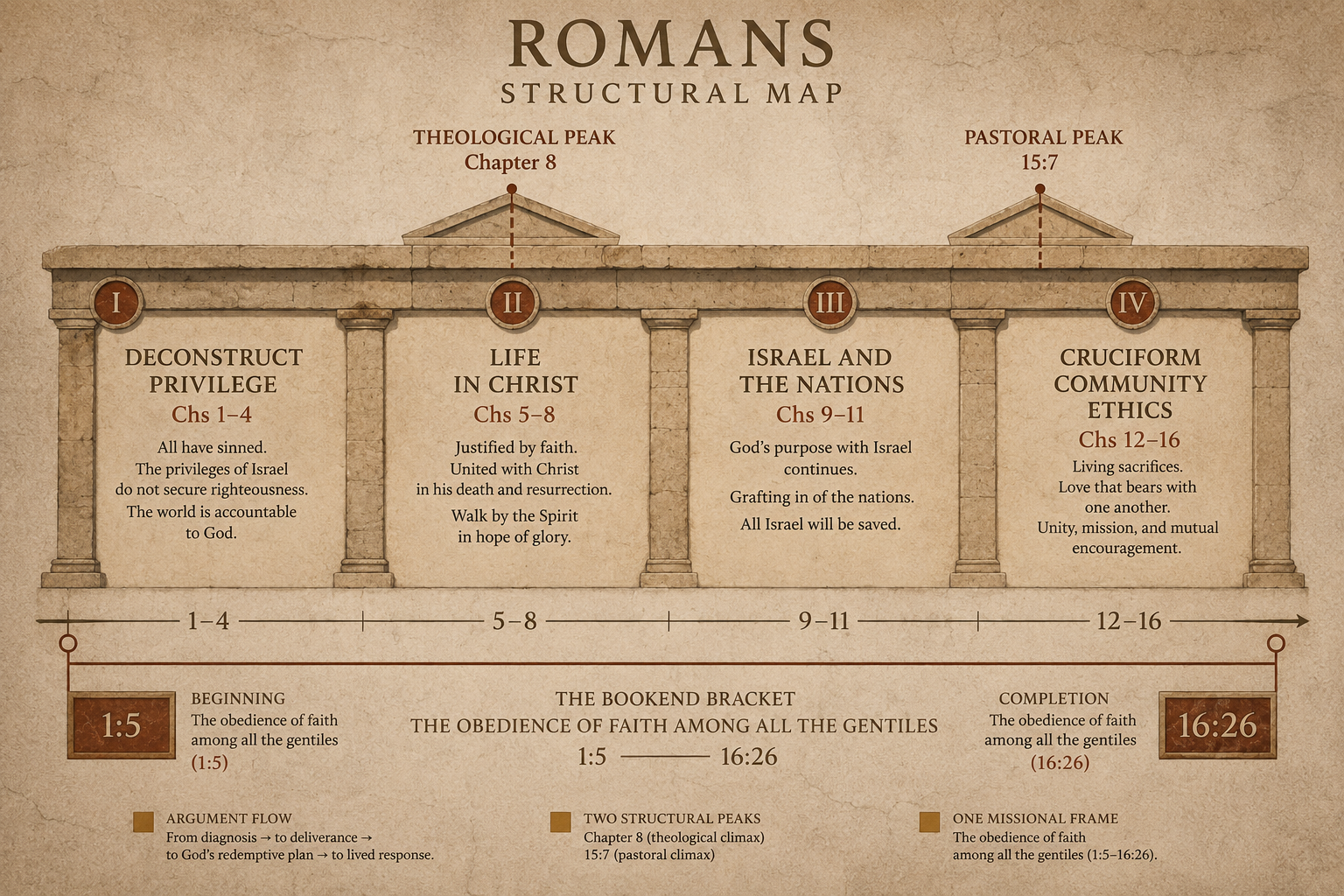
Chapters 1-4 establish the thesis and deconstruct privilege. The opening (1:1-7) layers counter-imperial vocabulary (gospel, Son of God, Lord, peace) into a single dense sentence aimed at a community in the shadow of Caesar. The thesis statement (1:16-17) names the gospel as God’s power for salvation to everyone who has faith, to the Jew first and also to the gentile, for in it the righteousness of God is revealed. The next three chapters then systematically deconstruct any claim to ethnic, religious, or moral privilege: the gentile world is named as under God’s wrath in a rhetorically loaded indictment (1:18-32); the moralizing reader is then turned on (you have no excuse, O man, every one of you who judges, 2:1) and named as equally accountable; the Hebrew Bible itself is quoted against any claim to Jewish privilege (3:9-20); and Abraham, the original Jewish patriarch, is reframed as the father of all who believe (4:11), justified by pistis before he was circumcised. The moralizing reader of 2:1 and the one who bears the name of a Jew at 2:17 are best read, in the Gombis / Stowers / Thiessen lane that the site holds for these chapters, as a Judaizing gentile claiming superiority over other gentile believers by taking on Jewish identity markers. The trap is sharper this way: the chapter targets the gentile believer who has constructed a religious identity that elevates him above his peers, not the ethnic Jew per se. The whole movement clears the ground: no one is in by privilege; everyone enters by the faithfulness of Christ and responding allegiance.
Chapters 5-8 develop life in Christ. Chapter 5 introduces peace with God through justification and contrasts Adam (5:12-21) with Christ as the two corporate-representative heads of humanity (see Adam Christology). Chapter 6 develops cruciform identity: all of us who were baptized into Christ Jesus were baptized into his death . . . that we too might walk in newness of life (6:3-4). Chapter 7 stages the agonized I of the Torah-without-internal-power condition (the I is best read as Israel-and-Adam speaking, not as a Christian’s autobiographical struggle). Chapter 8 is the letter’s theological climax: the Spirit of life sets the believer free; the adoption of children of God begins; the creation itself waits for liberation; nothing can separate believers from God’s love. Romans 8 is the letter’s deepest concentration of new covenant, exile-and-return, and cruciform themes (see exile and return, the new covenant, the cruciform hermeneutic).
Chapters 9-11 address Israel’s place. The opening (9:1-5) names Paul’s unceasing anguish for his kinsmen. The argument then moves through God’s election as a peoples-narrative (9:6-29, including the famous Esau / Jacob and Pharaoh texts), the present-tense remnant chosen by grace (11:1-10), the cultivated olive tree into which gentiles are grafted contrary to nature (11:17-24), and the mystery of all Israel will be saved after the fullness of the gentiles (11:25-32). The chapters end in doxology (11:33-36), praising God’s unsearchable judgments and inscrutable ways. The whole movement is built to refuse gentile arrogance over Israel and to affirm Israel’s irrevocable election.
Chapters 12-15:13 develop cruciform community ethics. Chapter 12 opens with present your bodies as a living sacrifice (12:1) and develops the body of Christ as the community-ordering image. The cruciform ethic is named: bless those who persecute you (12:14), repay no one evil for evil (12:17), if your enemy is hungry, feed him (12:20), overcome evil with good (12:21). Romans 13 addresses governing authorities in the context of legitimate civic order under reluctant submission. Romans 14:1-15:13 then turns to the central pastoral problem: welcome the one who is weak in faith (14:1); the strong ought to bear with the failings of the weak (15:1); welcome one another, as Christ has welcomed you (15:7). Christ’s own cruciform welcome is the model for community welcome across the Strong-Weak divide.
Chapters 15:14-16:27 close the letter. Paul names his planned mission to Spain via Rome (15:23-29), commends Phoebe the deacon (16:1-2), and greets twenty-six named individuals in the Roman house churches (16:3-16). The closing list is the New Testament’s most diverse first-century snapshot: men and women, Jews and gentiles, slaves and free, urban and household-network believers, including Junia (16:7), outstanding among the apostles, a woman the medieval Latin tradition mistranslated into Junias (a male name) to avoid the embarrassment of an apostolic woman. The final doxology (16:25-27) returns to the obedience of faith among all the gentiles (16:26), completing the bracket that began at 1:5.
Why the book matters
Romans matters because it has been the most-read and most-misread New Testament book in Christian history. Augustine’s Confessions was triggered by a passage from Romans. Luther’s Reformation began with his reading of Romans 1:17. Calvin’s Institutes are built on a Romans foundation. Wesley’s heart was strangely warmed at a reading of Luther’s preface to Romans. Barth’s Romerbrief (1922) ignited 20th-century theology. Every major Christian theological tradition has its Romans reading, and the differences between those readings have driven much of the church’s historic division.
The site does not pretend to resolve five centuries of Romans interpretation. What it does is name the Augustinian-Reformation overlay clearly and offer the Paul-Within-Judaism / New Perspective reading as a coherent contextual alternative. The reader is invited to see the lens before deciding to wear it. Romans deserves to be heard on its own terms before it is read through Augustine, Luther, or Calvin. Many of the historic insights still hold; some need significant revision; some need to be set aside.
The book also matters because Romans 8 is one of the deepest passages of Christian assurance in the canon. Whatever the chapter’s role in the Romans argument, neither death nor life, nor angels nor rulers, nor things present nor things to come, nor powers, nor height nor depth, nor anything else in all creation, will be able to separate us from the love of God in Christ Jesus our Lord (8:38-39) is exactly the verse Christians under persecution have clung to for two millennia. The site’s contextual reading does not diminish the chapter’s pastoral power; it deepens it by reading it as the return-from-exile assurance for a cruciform people in the imperial capital.
Literary architecture
Romans’s literary architecture rewards attention. The letter brackets begin and end with the obedience of faith among all the gentiles (1:5 and 16:26). The thesis (1:16-17) names the gospel, the power of God, salvation, Jew first and gentile, the righteousness of God, and the faithfulness. Every term will be developed across the next fifteen chapters.
Paul uses the diatribe form throughout, especially in chapters 1-7: an imagined interlocutor raises objections (do we then overthrow the law by this faith? By no means! 3:31; what shall we say then? Are we to continue in sin that grace may abound? By no means! 6:1; do you not know, brothers . . . ? 7:1). The diatribe is a teaching technique of the Hellenistic philosophical schools, and Paul deploys it expertly. The interlocutor is not a real person; it is a rhetorical character representing the typical objections a first-century Jewish or gentile reader might raise. The diatribe lets Paul develop the argument by anticipating and answering the objections in turn.
The letter’s theological climax sits at the end of chapter 8 (8:31-39): if God is for us, who can be against us? The letter’s pastoral climax sits at 15:7: welcome one another, as Christ has welcomed you. The two climaxes are coordinated. The cosmic-assurance climax of chapter 8 makes the cross-community welcome of chapter 15 possible.
The catenae (chains of Old Testament quotations) are dense throughout. Romans 3:10-18 strings together quotations from Psalms, Ecclesiastes, and Isaiah to indict the human condition. Romans 9-11 quotes the Hebrew Bible more than thirty times, often weaving multiple texts together to support a single argument. Paul is not flexing erudition; he is demonstrating from Israel’s own Scriptures that what he says about gentile inclusion and Israel’s future is what the Hebrew Bible itself teaches.
The letter’s named recipients are the New Testament’s most detailed first-century social-history record. Romans 16’s twenty-six greetings include nine women, several of whom hold ministry titles (Phoebe the deacon, 16:1; Prisca the co-worker, 16:3; Junia the outstanding-among-apostles, 16:7; Mary the hard-laborer, 16:6; Tryphaena, Tryphosa, and Persis the hard-laborers, 16:12). The Roman house-church network was more diverse and more woman-led than the medieval Western Christian tradition has typically acknowledged.
The frameworks at play
The site reads Romans through the lenses listed at the top of this page. The four Romans-era frameworks were written specifically for this book:
- Paul Within Judaism is the lane the whole letter is read in. Paul is a Jewish apostle to the gentiles; his arguments are intra-Jewish arguments about gentile inclusion, not Christian arguments against Judaism.
- Justification names the contested vocabulary of dikaiosynē theou (the righteousness of God) and pistis Christou (the faithfulness of Christ). The site holds the New Perspective / PWJ reading as primary, preserving the Reformation’s forensic insight inside a covenantal frame.
- Works of the law names the Pauline erga nomou as the Torah boundary-marker triad (circumcision, food, calendar), not generic moralistic effort. The Dunn reading restores Paul’s first-century target.
- Adam Christology names the Romans 5 typology that has carried the doctrine of original sin and federal headship across Western Christian history. The site holds Irenaeus’s recapitulation reading and Augustine’s inherited guilt reading as two historic articulations, with the Greek of 5:12 named as genuinely ambiguous.
- The olive tree names the Romans 9-11 argument’s structural anchor. Israel’s election is irrevocable. The olive tree is cultivated, not replanted. All Israel will be saved refers to ethnic Israel’s eschatological inclusion, not the church as the new Israel.
Several existing frameworks have Romans-specific extensions:
- Gospel allegiance carries the obedience of faith (1:5; 16:26) and Jesus is Lord (10:9) language.
- Counter-imperial reading reads the letter’s gospel, Son of God, Lord, peace vocabulary against Caesar’s claims.
- The cruciform hermeneutic reads Romans 6 and 12 as the New Testament’s most concentrated cruciform-ethics passages.
- Exile and return reads Romans 8 as the new-exodus / return-from-exile climax of Paul’s theology.
- The new covenant reads Romans 7-8 as the pneumatological dimension of Jeremiah’s promise.
What this site does with Romans
The site’s chapter commentary holds five commitments throughout:
- Romans is a pastoral letter, not a systematic theology. Each chapter is read with the Strong-Weak community problem of chs 14-15 in view, McKnight’s backward-read thesis serving as the organizing lens.
- The pistis Christou genitive is read as subjective. The faithfulness of Christ (Rom 3:22, 26; cf. Gal 2:16, 20; 3:22; Phil 3:9) is the basis of justification; the believer’s pistis is the responding allegiance. Hays, Wright, Bates, and Gupta are the modern voices.
- Augustine and the Reformed tradition are honored and engaged, not dismissed. Augustine’s reading of Romans 5-7 and Romans 9 shapes Western Christianity. The site names where Augustine’s contribution remains foundational and where his particular Latin-grammatical and anti-Pelagian context distorted Paul’s first-century Greek argument. Luther and Calvin are treated the same way.
- The Reformed reading is engaged with Pushback notes at the verses where it most dominates popular interpretation. Romans 1:18-32 (the wrath argument’s rhetorical context), Romans 3:21-26 (the imputed righteousness reading), Romans 4 (the sola fide proof-texting), Romans 5:12-21 (federal headship and inherited guilt), Romans 7:14-25 (the divided Christian self), Romans 8:29-30 (the golden chain), Romans 9:6-29 (individual unconditional election), Romans 10:9-13 (the Romans Road decisional gospel), Romans 11 (supersessionism), and Romans 13:1-7 (divine right of kings) each receive a Pushback note that names the dominant reading fairly, names what the text in its Second-Temple context is doing, and concedes where the dominant insight still holds.
- Romans 9-11 is read in the Marty Solomon lane. Israel’s election is irrevocable; the olive tree is cultivated, not replanted; supersessionism is the most consequential historic Christian error to refuse. Solomon’s Bema podcast Romans series is the primary modern voice across these three chapters, with Wright, McKnight, Sanders, Dunn, and Gaventa supporting.
Approaching the hard chapters
Romans contains chapters that have generated extensive Christian theological controversy. The site approaches each with a stated lens:
Romans 1:18-32, the wrath of God indictment of the gentile world: read as the opening move of a rhetorical trap. The chapter’s universal-condemnation language is not a freestanding moralistic catalog; it is bait the morally-confident reader takes up before Paul turns the indictment back on them at 2:1 (therefore you have no excuse, O man, every one of you who judges). On the Gombis / Stowers / Thiessen reading the site holds for these chapters, the morally-confident reader in Paul’s gentile audience is the Judaizing gentile who has adopted Jewish identity markers as a basis for moral elevation over other gentile believers. The chapter’s anti-gentile-immorality language has been weaponized for centuries against all sorts of out-groups. The site reads it as part of a rhetorical setup whose actual target is the moralizing reader’s privilege.
Romans 2:17-29, “you who bear the name of a Jew”: read with Gombis, Stowers, and Thiessen as a gentile who has taken on a Jewish identity claim, not as an ethnic Jewish believer. The historical context (Claudius’s 49 CE expulsion of Jews from Rome, the subsequent gentile-dominant church culture, the leadership vacuum filled by gentiles taking on Jewish customs) supports this reading. Real Jewishness (2:28-29) is of the heart, by the Spirit: the chapter is not an attack on Jewish ethnic identity but a deconstruction of gentile religious self-elevation through Judaizing. The reading is consistent with Paul Within Judaism and reinforces the chapter’s challenge to any religious identity construction that elevates one believer above another.
Romans 3:21-26, the hilastērion (atoning sacrifice / mercy seat / propitiation) and pistis Christou passage: read with Wright, Hays, Bates, and Gupta as Christ’s faithful death-and-resurrection as the covenant-vindicating act of God, with the believer’s pistis as the responding allegiance. The hilastērion word study (the kapporet of Lev 16’s mercy seat, see the kipper / atonement framework) supplies the Hebrew Bible background.
Romans 5:12-21, Adam and Christ: the Greek eph hō pantes hēmarton of 5:12 is read as because all sinned, not in whom (Adam) all sinned. Augustine’s inherited guilt reading is named as one historic articulation; Irenaeus’s recapitulation reading is named as an older alternative. See Adam Christology.
Romans 7:14-25, the I of the Torah-without-internal-power condition: read with Wright as Israel-and-Adam speaking, not as the Christian’s autobiographical struggle. Augustine’s reading (the divided Christian self) is named as the Western tradition’s foundational pre-modern voice; the Wright reading is named as the contextual alternative.
Romans 9-11, Israel and the nations: read with Solomon, Wright, and McKnight as God’s faithfulness to Israel as the gospel’s structural foundation, not as a treatise on individual predestination. See the olive tree.
Romans 13:1-7, submission to governing authorities: read as the most reluctant submission in the New Testament. The chapter is not a divine-right-of-kings text. The chapter is Paul’s pastoral counsel to a community in Nero’s capital about how to avoid unnecessary martyrdom while refusing the imperial loyalty oath at every other point in the letter.
The site reads Romans patiently. Each chapter gets a contextual commentary first; the systematic-theological tradition’s contributions are named in Influence callouts; the popular-Reformed reading is engaged in Pushback notes. Readers are invited to think with the long tradition and think with the contemporary scholarship and reach their own informed reading.
Chapters
- Romans 1 · The letter opening, the thesis statement, and the rhetorical indictment that sets the trap
- Romans 2 · The trap springs: the moralizing reader is named, and the Jew-Gentile distinction is reframed around the heart
- Romans 3 · The Jewish advantage qualified, the universal indictment, and the central justification text
- Romans 4 · Abraham, justified before circumcision, father of all who believe
- Romans 5 · Peace with God, the love of God poured out, and the two corporate heads of humanity
- Romans 6 · Baptized into Christ's death, the cruciform pattern as the shape of salvation
- Romans 7 · Released from the law, the law's diagnostic role, and the agonized 'I' of Torah without internal power
- Romans 8 · Life in the Spirit, the renewal of creation, and no separation from the love of God
- Romans 9 · Paul's anguish for Israel, God's purposive election, and the remnant chosen by grace
- Romans 10 · Christ the *telos* of the law, the word near you, and everyone who calls on the name of the Lord
- Romans 11 · Has God rejected his people? By no means. The olive tree, the mystery, and all Israel will be saved
- Romans 12 · Living sacrifice, one body with many gifts, and the cruciform ethics of the new community
- Romans 13 · Submission to authorities, love as the fulfilling of the law, and the night is far gone
- Romans 14 · The Strong and the Weak, food and days, and the call to not pass judgment
- Romans 15 · Welcome one another as Christ welcomed you, Paul's gentile mission, and the plans for Spain
- Romans 16 · Phoebe the deacon, Junia the apostle, the household-network greetings, and the closing doxology