
Genesis 9 is the chapter where the new world steps off the ark and into ordinary time. The flood is over. Noah has built his altar. God has promised the seasons will hold. Now comes the structure of the new arrangement: a renewed commission to humanity, dietary changes, the first universal covenant, and a sign in the sky.
Read carefully, Noah is a new Adam. He has been preserved through cosmic judgment, set on a renewed earth, given a renewed commission (“be fruitful, multiply, and fill the earth,” 9:1, echoing 1:28), and offered a renewed relationship with the cosmos under a new covenant. The ground is no longer cursed against him; the seasons are guaranteed; the bow is hung up in the cloud. The new world is not a continuation of the old one. It is a reset. The text wants us to feel the architectural parallel between Eden and the new earth: a new garden, a new humanity, a new beginning. The question the chapter is going to answer is the same question Eden asked: what does humanity do in a garden God has given them?
But the chapter ends in shadow. Noah, the rester, plants a vineyard and gets drunk. His son Ham sees something he shouldn’t have. The first family on the new earth has its own rupture. And in the chapter’s most disturbing scene, Noah pronounces a curse, on Canaan, that will echo through the rest of Genesis and the conquest narratives, and that has been ruinously misused in the centuries since. We’ll handle it carefully.
The shape of the chapter is striking. It moves from blessing (verses 1–7), to covenant (verses 8–17), to fall (verses 18–29). New creation, new covenant, new failure. The post-flood world is renewed but not perfected. The reset does not change the heart. The same disordered grasping the serpent planted in Genesis 3 is still operative in the man God has just rescued through the flood.
A · Genesis 9:1–7 · The new commission
¹ God blessed Noah and his sons and said to them, “Be fruitful and multiply and fill the earth. ² The fear and dread of you shall rest on every animal of the earth and on every bird of the air, on everything that creeps on the ground and on all the fish of the sea; into your hand they are delivered. ³ Every moving thing that lives shall be food for you, and just as I gave you the green plants, I give you everything. ⁴ Only, you shall not eat flesh with its life, that is, its blood. ⁵ For your own lifeblood I will surely require a reckoning: from every animal I will require it and from human beings, each one for the blood of another, I will require a reckoning for human life. ⁶ Whoever sheds the blood of a human, by a human shall that person’s blood be shed, for in his own image God made humans. ⁷ And you, be fruitful and multiply, fill the earth and multiply in it.”
(Genesis 9:1–7, NRSVue)
- “Be fruitful, multiply, and replenish the earth.” This is Genesis 1:28 again, the original blessing on humanity. After the flood, God doesn’t issue a new commission. He re-issues the old one. Humanity’s vocation hasn’t changed. Image-bearing, fruitfulness, filling the earth, all of it is being re-launched on the new ground.
- But notice what’s different. Genesis 1:29–30 specified a vegetarian diet for both humans and animals: “every herb yielding seed… every tree, which bears fruit yielding seed… It will be for you food. To every animal of the earth… I have given every green herb for food.” The post-flood world makes a concession: meat is now permitted. “Every moving thing that lives will be food for you.” Some scholars read this as accommodation, not endorsement: God meeting humans where they are after the flood, not where the original creation pictured them. The eschatological vision in Isaiah 11 (the lion lying down with the lamb) reverses it again. In the new creation, the Edenic vegetarianism returns.
- “But flesh with its life, that is, its blood, you shall not eat.” The first dietary restriction in scripture. Blood is treated as sacred. The reasoning is theological: blood carries life, and life belongs to God. Leviticus 17 will develop this at length. The point: even when meat is permitted, humans don’t have absolute authority over the life of animals. The blood remains God’s.
- “Whoever sheds the blood of a human, by a human shall that person’s blood be shed, for in his own image God made humans.” The first explicit prohibition of murder, grounded in image-bearing. Notice the logic. The reason murder is wrong isn’t simply that humans are valuable in themselves. It’s that humans bear the image of God. To kill a human is to attack the divine image. This is the same image of Genesis 1:26–28, and the chapter is going out of its way to reaffirm: even after the flood, even after the corruption that filled the earth with violence, the image is still borne by every human. The flood didn’t erase the image. Genesis 9:6 says so explicitly. This pushes back against a common framing in evangelical theology that treats the image as something lost at the fall and restored at conversion. The text doesn’t support that. It says the image is borne by every human, post-fall and post-flood. Damaged, distorted, dysfunctional, yes. Lost, no. The dignity that grounds the murder prohibition rests on every human being still made in God’s image. Frameworks that treat the image as a possession to be lost and regained collapse what Genesis is claiming.
→ Read the image of God framework for the deeper background of why image-bearing grounds the sanctity of human life, even after the fall and the flood.
- “Be fruitful and multiply. Increase abundantly in the earth.” The bracket repeats. The blessing of verse 1 is restated in verse 7. The text is anchoring this section in the language of generative life. Whatever the chapter’s later darkness (the drunkenness, the curse), the foundation of the post-flood arrangement is blessing and fruitfulness. The center holds.
B · Genesis 9:8–17 · The covenant and the bow
⁸ God spoke to Noah and to his sons with him, saying, ⁹ “As for me, behold, I establish my covenant with you, and with your offspring after you, ¹⁰ and with every living creature that is with you: the birds, the livestock, and every animal of the earth with you, of all that go out of the ship, even every animal of the earth. ¹¹ I will establish my covenant with you: All flesh will not be cut off any more by the waters of the flood, neither will there ever again be a flood to destroy the earth.” ¹² God said, “This is the token of the covenant which I make between me and you and every living creature that is with you, for perpetual generations: ¹³ I set my rainbow in the cloud, and it will be a sign of a covenant between me and the earth. ¹⁴ When I bring a cloud over the earth, that the rainbow will be seen in the cloud, ¹⁵ I will remember my covenant, which is between me and you and every living creature of all flesh, and the waters will no more become a flood to destroy all flesh. ¹⁶ The rainbow will be in the cloud. I will look at it, that I may remember the everlasting covenant between God and every living creature of all flesh that is on the earth.” ¹⁷ God said to Noah, “This is the token of the covenant which I have established between me and all flesh that is on the earth.”
- The Hebrew word for covenant, berit, was first used in 6:18, when God promised Noah he would establish his covenant before the flood. Now, post-flood, it’s formally enacted. This is the Noahic covenant, and it has features that distinguish it from every later covenant. It’s universal: it covers “every living creature,” not just humans, not just one people. It’s unconditional: it doesn’t require Noah’s continued obedience. It’s perpetual: the text says “everlasting” three times. And it’s one-sided: God promises; humans receive. The grace runs downhill.
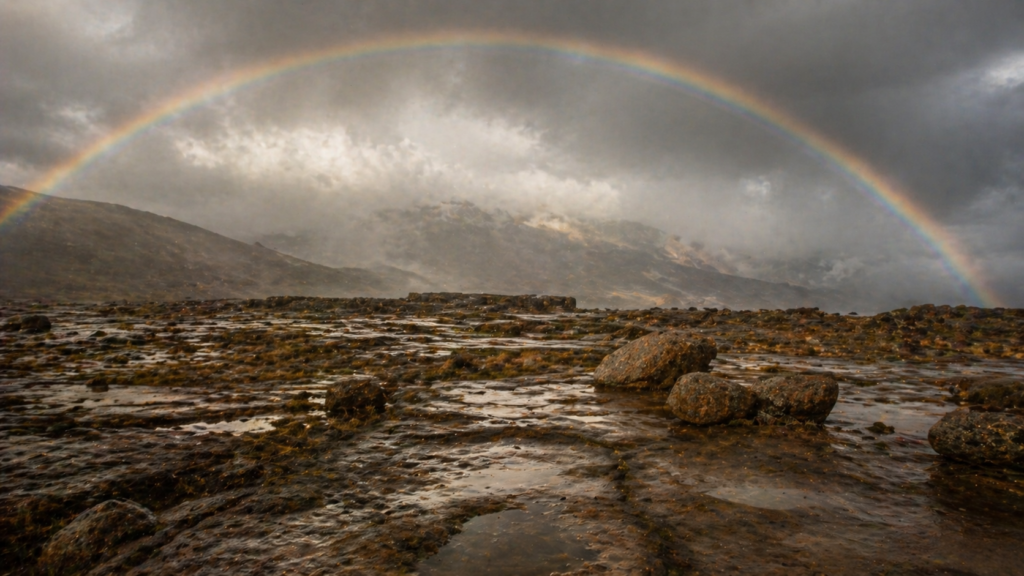
- “I set my rainbow in the cloud.” The Hebrew word for “rainbow” is just qeshet, bow. The same word is used elsewhere for a war bow, the weapon. ANE deities were often pictured drawing their bows in the heavens, raining arrows down on enemies. Genesis 9 picks up that imagery and inverts it. God’s bow is in the cloud, but it’s hung up. The string side is down, the curve up. The bow is at rest, pointing away from the earth. The divine warrior has set his weapon aside. Mackie has called this image “the disarming of God.”
- “I will remember my covenant.” The verb is zakar again, the same verb that turned the flood around in Genesis 8:1 (“God remembered Noah”). God’s remembering is now built into the structure of the cosmos: every time clouds gather, the bow is there, and God remembers. The promise is anchored in something the world will see. The rainbow isn’t a private mystical sign. It’s public, visible, recurring.
- The covenant extends to “every living creature of all flesh that is on the earth.” Notice this. The Noahic covenant isn’t just with Noah and his descendants. It’s with everything that breathes. The cosmos is included in the divine commitment. This shapes how scripture reads ecology, animal welfare, and the relationship between humanity and the rest of creation. The animals are not collateral. They are covenant partners with God.
- The covenant is one-sided in an important sense. There’s no “if you do X, then I will do Y” in this covenant. God simply commits. This is different from Sinai (a conditional covenant) and from the Davidic covenant (which has conditional and unconditional elements). The Noahic covenant is closer in shape to the Abrahamic: God promises, and the promise rests on God’s character, not human performance. The post-flood world is held together by divine commitment rather than by human merit.
C · Genesis 9:18–23 · The vineyard and the seeing
¹⁸ The sons of Noah who went out from the ship were Shem, Ham, and Japheth. Ham is the father of Canaan. ¹⁹ These three were the sons of Noah, and from these the whole earth was populated. ²⁰ Noah began to be a farmer, and planted a vineyard. ²¹ He drank of the wine and got drunk. He was uncovered within his tent. ²² Ham, the father of Canaan, saw the nakedness of his father, and told his two brothers outside. ²³ Shem and Japheth took a garment, and laid it on both their shoulders, went in backwards, and covered the nakedness of their father. Their faces were backwards, and they didn’t see their father’s nakedness.
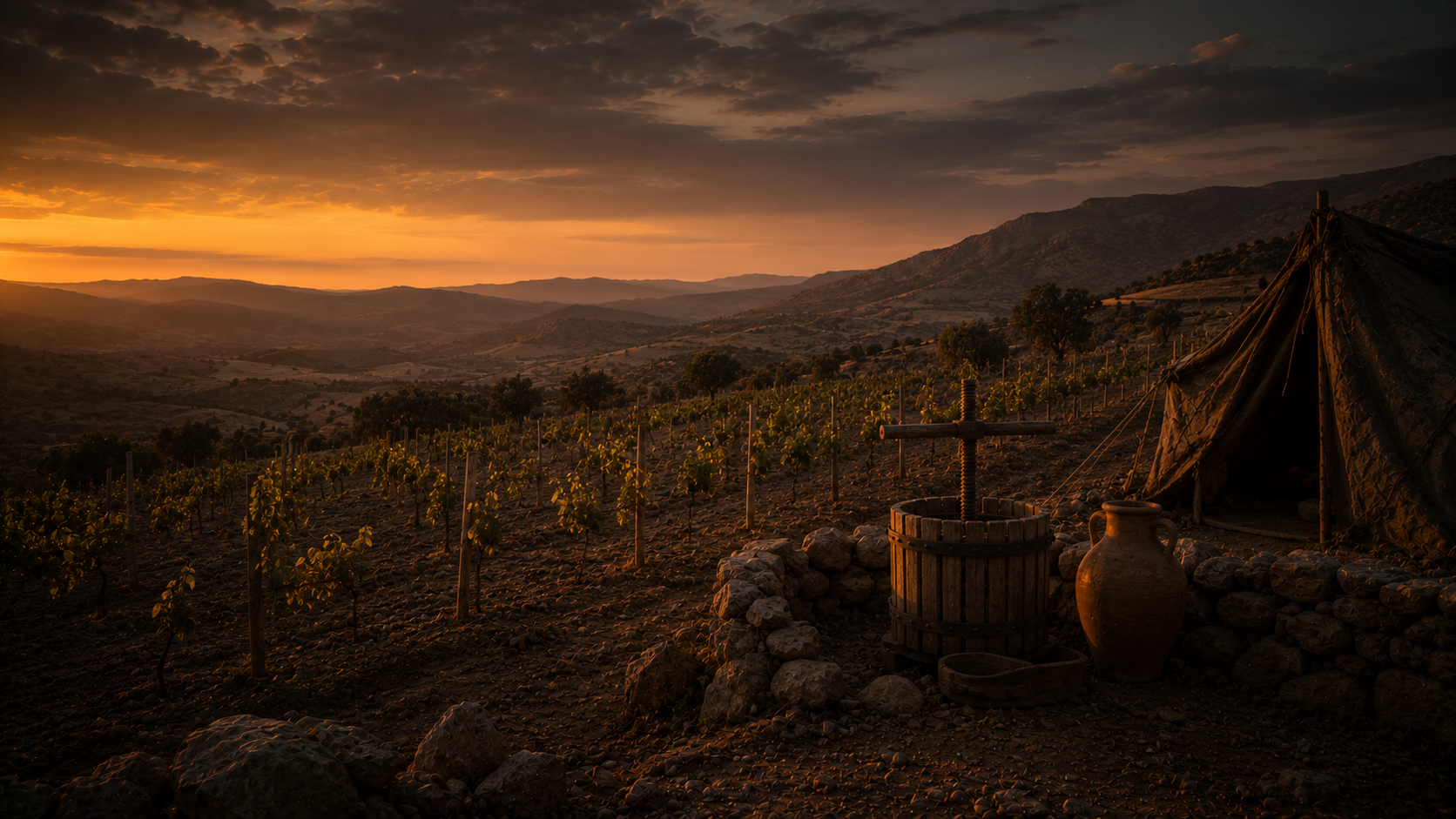
- The new world begins with vineyards. Noah, who has spent his life building, surviving, and worshiping, settles into the work of his father Lamech’s hope (the rest from cursed ground promised in 5:29). The first agricultural product mentioned in the post-flood narrative is wine. Genesis isn’t condemning viticulture; wine is a frequent symbol of joy in scripture. But the chapter is going to show what happens when the man who walked with God leans too hard on his vineyard.
Watch the slow drift. Noah began as the man who walked with God, who built the ark over a hundred years of public mockery, who heard God’s promise and trusted it through forty days of rain and many more of waiting. The new world has been given to him. Comfort, by definition, has arrived. And the comfort is what kills the vigilance. The man who walked with God begins to be a farmer; he plants a vineyard; he drinks the wine; he ends up uncovered in his tent. The new Adam, in a new garden, eats too much of what the new garden produces. The pattern echoes the first Adam in the first garden, but the mechanism is subtler. There is no serpent in this scene. The new Adam does it to himself.
→ Read the Abundance vs. Scarcity framework for the deeper pattern this scene exposes. Noah has been given an entire renewed earth, a covenant of fruitfulness, and a bow that promises the flood will not return. He turns toward the wine anyway. The lie that drove the eating in chapter 3 and the murder in chapter 4 is still operative here, in subtler form: the assumption that what has been given is not enough, that more must be grasped, that comfort must be self-administered. The reset did not change the heart.
Influence callout: Walter Brueggemann (Genesis: Interpretation Commentary; the warrior’s bow set aside)
Brueggemann’s reading of the Noahic covenant focuses on the rainbow (Hebrew qeshet) in 9:12-17. The Hebrew word qeshet is the same word the Hebrew Bible uses for a warrior’s bow (the weapon, drawn and aimed). The rainbow, on Brueggemann’s reading, is not a sweet meteorological reassurance; it is YHWH’s war-bow hung up in the sky, deliberately set aside, pointed away from the earth. The covenant gesture is military disarmament: the deity who once moved against creation with destructive waters is now hanging up the weapon. Brueggemann’s pastoral note is striking. The chapter is staging YHWH’s self-binding. The same God whose grief moved him to the flood (6:6) now binds himself never to do that again, regardless of human behavior. The covenant is unilateral, unconditional, cosmic. The chapter is teaching, before Abraham and before Sinai, that the God of the Hebrew Bible is a God who limits himself for the sake of his creatures. The whole later biblical theology of grace (unmerited, free, divinely committed) takes its first form not in justification language but in this image: a war-bow hung up in the sky, pointed nowhere, kept as a reminder by the warrior himself.
- “He drank of the wine and got drunk.” Genesis is unembarrassed about Noah’s failure. The same Noah who built the ark, who walked with God, who survived the flood, gets drunk in his tent and lies uncovered. The text doesn’t moralize. It just reports. Heroes in this Bible are not impressive. They are repeatedly shown as flawed, and the story still bends through them toward redemption. Hebrews 11 will later list Noah among the faithful, but Genesis here gives us the unvarnished man.
- “Ham, the father of Canaan, saw the nakedness of his father.” This sentence has been read in two main ways. The simple reading is that Ham literally saw Noah uncovered and either mocked him or failed to honor him by covering him up. The more involved reading takes “saw the nakedness of his father” as a euphemism: the same Hebrew phrase appears in Leviticus 18 and 20 in the context of forbidden sexual relations (“uncover the nakedness of”). Some scholars read Ham’s offense as something far worse than seeing: a sexual violation of his father, or of his father’s wife. The text is deliberately reticent. We don’t have to choose definitively, but it’s worth knowing that the Hebrew vocabulary is loaded. Whatever Ham did, the text considers it a serious violation of his father.
- Shem and Japheth’s response is striking. They take a garment, lay it on their shoulders, walk in backwards, and cover their father, refusing to look. They honor him by not seeing. The contrast with Ham is sharp: Ham saw and told; they refused to see and covered. Genesis is teaching something about how to handle a parent’s failure: with respect, with covering, without exploitation, without exposure to others.
The chapter is doing pastoral work that the New Testament will pick up directly. Galatians 6:1 instructs the church: “if anyone is caught in any wrongdoing, you who are spiritual should restore that person in a spirit of gentleness, looking to yourselves so that you also are not tempted.” The instruction is not “ignore the failure.” It is “cover, don’t expose.” There is a difference, and the chapter is teaching it. Covering refuses to broadcast the failure into shame; it does not pretend the failure didn’t happen; it does not deny that the failure has to be addressed; it just refuses to make the failure into entertainment. Ignoring lets the failure metastasize; covering protects the dignity of the one who failed while the harder work of restoration takes its time. In an age of public exposure, the brothers’ walking backwards is a small ethical lesson with very long reach. Ham saw, and his seeing produced a story he could tell to his brothers in the open. Shem and Japheth refused to let the seeing become the telling.
- The detail “Ham is the father of Canaan” is repeated twice in this section. The text wants us to remember Canaan. It’s preparing us for the curse that’s coming. By the time we get to verse 25, the connection has been stated, restated, and stated again. This is preparing the reader for what Noah will say.
D · Genesis 9:24–29 · The curse, the blessings, the death of Noah
²⁴ Noah awoke from his wine, and knew what his youngest son had done to him. ²⁵ He said, “Canaan is cursed. He will be a servant of servants to his brothers.” ²⁶ He said, “Blessed be Yahweh, the God of Shem. Let Canaan be his servant. ²⁷ May God enlarge Japheth. Let him dwell in the tents of Shem. Let Canaan be his servant.” ²⁸ Noah lived three hundred fifty years after the flood. ²⁹ All the days of Noah were nine hundred fifty years, then he died.
- We need to be very careful here, because this passage has been weaponized for centuries. The “curse of Ham” was used to justify African slavery in the Atlantic trade. American Christians built whole theological systems on misreading these verses. Before we read what the text says, let’s name what it doesn’t say. Ham is not cursed. Africa is not cursed. The text never connects Ham to Africa, and the curse falls explicitly on Canaan, Ham’s son, not on Ham himself or on his other descendants. Any reading that uses Genesis 9:25 to justify the enslavement of African people is a misreading at every level: historical, exegetical, and theological.
- So what is the text doing? Canaan, in the Genesis story, is the ancestor of the Canaanites, the people Israel will encounter when they enter the promised land in Joshua. The curse-language here functions as a narrative etiology: it explains, in story form, why the Canaanite peoples will later occupy the land Israel inherits, and why Israel’s encounter with them will be marked by conflict and judgment. The curse is about a specific people group in a specific narrative arc, not about race or skin color.
- Why specifically Canaan rather than Ham? Several readings exist. Some scholars suggest Ham acted in a way that prefigured the Canaanite practices condemned in Leviticus 18, and Noah pronounces the consequence on the lineage that will embody those practices. Others suggest the text is signaling that the consequences of one generation’s sin fall on the next, a sober claim about how moral damage propagates through families and cultures. The text itself is silent on the precise rationale.
What the chapter is also showing, in the curse landing one generation removed, is something about the long downstream cost of words. Noah’s pronouncement is spoken in shame, in anger, in hangover. It does not stay where he speaks it. It travels. It lands on Canaan, who had no part in the original offense. The chapter is being honest about how moral damage moves through families: words spoken in the worst moment of one generation become inheritances the next generation has to carry. Later texts (Ezekiel 18, Jeremiah 31) will explicitly push back against the idea that children are fated by the sins of their parents; the prophets will insist that each soul is responsible for its own choices. But Genesis 9 names a real and uncomfortable pattern: words have downstream lives that the speaker does not always see. What Noah says in the tent ripples through generations.
- The blessings on Shem and Japheth set up the rest of Genesis. Shem is the line of Abraham, of Israel, of the messianic story. The God of Shem is named “Yahweh,” the covenant name. Shem becomes the privileged line theologically. Japheth is the line that will spread broadly across the earth (the “Japhethites” cover much of the Mediterranean and Indo-European world). The promise that Japheth will “dwell in the tents of Shem” has been read by Christians as anticipating Gentile inclusion in the promises made to Shem’s line, a reading that’s hinted at, though not spelled out, in the original text.
- “Noah lived three hundred fifty years after the flood. All the days of Noah were nine hundred fifty years, then he died.” The toledot of Noah closes here. The man who walked with God, who built the ark, who saw the world end and begin again, who planted the first vineyard, who failed in his tent: he dies. The death-refrain of Genesis 5 returns. Mortality is still the inheritance. But the world he leaves behind has a covenant, a rainbow, and a promise. The line continues through Shem, and the next chapter (Genesis 10) will sketch the families that descend from Noah’s three sons before the human story takes another sharp turn at Babel.
Reflection prompts
- Genesis 9:6 reaffirms the image of God after the flood, after all the corruption of Genesis 6. The image isn’t lost in the broken world. Where in your life are you tempted to write off another person’s image-bearing because of what they’ve become? What does it mean to honor the image even in the fallen?
- The bow is hung up in the cloud, pointed away from the earth. The divine warrior has set down his weapon. What does it mean to live under that bow? How might it reshape your sense of who God is when storms gather in your life?
- Genesis 9 has been used to justify some of the worst evils in church history. Reading the text carefully shows that the misreading was always a misreading: Canaan, not Ham; a specific people in a specific story, not race. Where else in your reading of scripture do you sense that received tradition might have weaponized a text against its own grain? What would it look like to read it again, in its world?
- The chapter ends with Noah in his vineyard and a curse he should not have spoken. The Bible’s ending picks up the vineyard image and reverses it. Jesus, in John 15, names himself the true vine (ampelos alethine), the vineyard whose fruit does not produce shame but salvation. The wine of the last supper, which becomes the cup of the new covenant, is the wine the new Adam drinks faithfully. Where Noah’s wine led to nakedness and curse, Jesus’ wine leads to covenant and forgiveness. Where in your life does an image you associate with failure have a redeemed counterpart in Christ that has not yet been allowed to do its restorative work?