
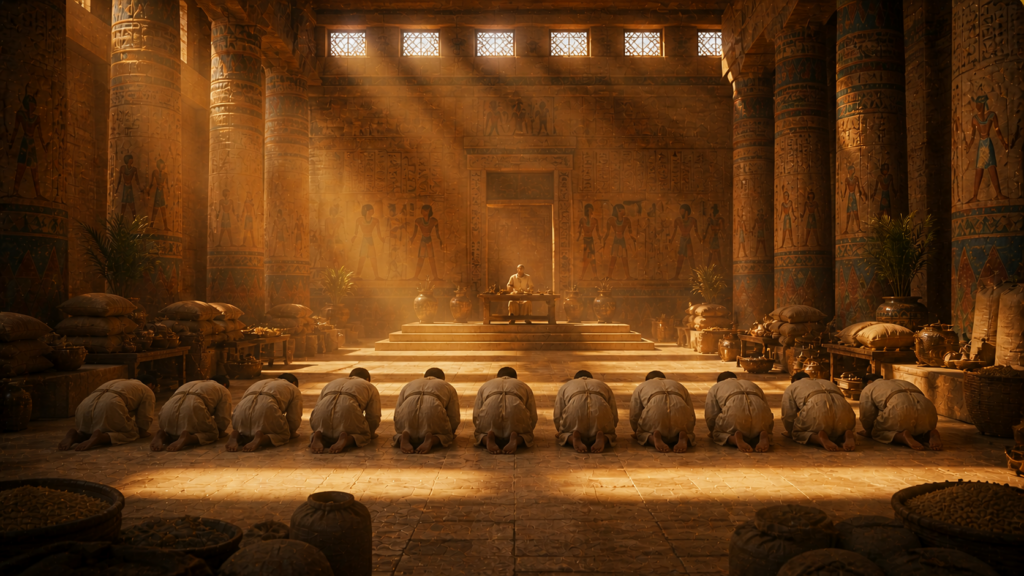
Genesis 42 begins the cycle’s reckoning. The famine that has reached “all countries” (41:57) has reached Canaan. Jacob, learning that grain is being sold in Egypt, sends ten of his sons (all except Benjamin, Rachel’s youngest, whom he keeps at home) to buy food. The brothers arrive at the Egyptian storehouses, where they encounter a foreign official they do not recognize but who recognizes them. Joseph sees his brothers for the first time in over twenty years.
What follows is the chapter’s most extended dramatic structure. Joseph speaks to his brothers harshly through an interpreter. He accuses them of being spies. He demands they prove their innocence by bringing the youngest brother (Benjamin) to him. He places them in custody for three days, then releases nine and holds Simeon as a hostage. He fills their sacks with grain and secretly returns their money. The brothers, on the road home, find the money and are terrified. Back in Canaan, they tell Jacob what happened. Jacob refuses to send Benjamin. Reuben offers his own two sons as collateral; Jacob still refuses. The chapter ends with the family in stalemate, Simeon held in Egypt, the grain dwindling, Benjamin still in Canaan.
The chapter is doing several things at once. It is showing Joseph testing the brothers, finding out whether they have changed. It is showing the brothers’ conscience awakening for the first time in twenty-two years, recognizing the famine and their own troubles as connected to what they did to Joseph. It is preparing the family for the second journey that chapter 43 will require. And it is recording, with characteristic restraint, Jacob’s deepening grief: he has lost Joseph; he has lost Simeon; he is being asked to risk Benjamin. The chapter ends with the patriarch saying all these things are against me.
A · Genesis 42:1–17 · The first audience and the accusation
¹ Now Jacob saw that there was grain in Egypt, and Jacob said to his sons, “Why do you look at one another?” ² He said, “Behold, I have heard that there is grain in Egypt. Go down there, and buy for us from there, so that we may live, and not die.” ³ Joseph’s ten brothers went down to buy grain from Egypt. ⁴ But Jacob didn’t send Joseph’s brother Benjamin with his brothers; for he said, “Lest perhaps harm happen to him.” ⁵ The sons of Israel came to buy among those who came, for the famine was in the land of Canaan. ⁶ Joseph was the governor over the land. It was he who sold to all the people of the land. Joseph’s brothers came, and bowed themselves down to him with their faces to the earth. ⁷ Joseph saw his brothers, and he recognized them, but acted like a stranger to them, and spoke roughly with them. He said to them, “Where did you come from?” They said, “From the land of Canaan to buy food.” ⁸ Joseph recognized his brothers, but they didn’t recognize him. ⁹ Joseph remembered the dreams which he dreamed about them, and said to them, “You are spies! You have come to see the nakedness of the land.” ¹⁰ They said to him, “No, my lord, but your servants have come to buy food. ¹¹ We are all one man’s sons; we are honest men. Your servants are not spies.” ¹² He said to them, “No, but you have come to see the nakedness of the land!” ¹³ They said, “We, your servants, are twelve brothers, the sons of one man in the land of Canaan; and behold, the youngest is today with our father, and one is no more.” ¹⁴ Joseph said to them, “It is like I told you, saying, ‘You are spies!’ ¹⁵ By this you shall be tested. By the life of Pharaoh, you shall not go out from here, unless your youngest brother comes here. ¹⁶ Send one of you, and let him get your brother, and you shall be bound, that your words may be tested, whether there is truth in you, or else by the life of Pharaoh surely you are spies.” ¹⁷ He put them all together into custody for three days. (Genesis 42:1–17, World English Bible)
- The chapter opens with Jacob’s question. Why do you look at one another? The Hebrew lammah titra’u, “why do you look at each other,” names a household of paralyzed adult sons. The famine is real; the grain is in Egypt; the brothers are doing nothing. The patriarch breaks the inertia.
- The brothers go down (verse 3). Joseph’s ten brothers went down to buy grain. The Hebrew vayredu, “and they went down,” is the same root used of Judah in 38:1 and Joseph in 39:1. The whole cycle has had brothers going down. Now the ten go down too.
- Verse 4 records the exception. Jacob didn’t send Joseph’s brother Benjamin with his brothers; for he said, “Lest perhaps harm happen to him.” The Hebrew construction Yosef achiv, “Joseph’s brother” (singular brother), is doing pointed work. Benjamin is, in the patriarch’s emotional life, not just one of twelve sons. He is Joseph’s brother in particular: the only other son of Rachel. Jacob has lost one Rachel-son; he is not risking the second.
- Verse 6 records the recognition scene’s setup. Joseph was the governor over the land. It was he who sold to all the people of the land. Joseph’s brothers came, and bowed themselves down to him with their faces to the earth. The Hebrew word for “governor” (shallit) is rare; the Hebrew word for “bowed themselves down” (vayishtachavu) is the same word the dream interpretations of chapter 37 used. Sheaves came around and bowed down to my sheaf. The sun and the moon and eleven stars bowed down to me. The dreams that the brothers hated him for, twenty-two years earlier, are being fulfilled. The chapter does not announce this; the verb does the work.
Influence callout: Tim Mackie
Mackie’s reading of the chapter’s structural payoff names this verse as the cycle’s most precise dream-fulfillment moment. Joseph’s brothers came, and bowed themselves down to him. Mackie argues that the Hebrew Bible’s view of dreams (especially in the patriarchal narrative) is that they are real divine communications about the future, and the future will reveal them. The chapter is, in this single verb, recording the interpretation that the brothers tried to refuse with their violence. We will see what will become of his dreams (37:20). The chapter is what becomes of his dreams. The brothers are bowing.
- Verse 8 is the chapter’s quiet pivot. Joseph recognized his brothers, but they didn’t recognize him. The Hebrew vayaker Yosef et-echav, vehem lo hikiruhu, “and Joseph recognized his brothers, but they did not recognize him,” uses the verb haker twice, the same verb that ran through chapters 37 and 38. The brothers asked Jacob to recognize Joseph’s bloody coat. Tamar asked Judah to recognize his signet, cord, and staff. Now Joseph recognizes his brothers. The brothers do not recognize him.
Word study: haker (הַכֶּר), revisited
The verb of recognition that has run through the cycle since chapter 37. In 37:32, the brothers ask Jacob: recognize, please, the coat of your son. In 38:25, Tamar asks Judah: recognize, please, whose these are. In 42:7-8, Joseph recognizes his brothers but they fail to recognize him. The verb is doing structural work across the cycle. Each time haker appears, the chapter is asking who is identifying what. The Joseph cycle is, in part, an extended meditation on recognition: who knows what they are looking at, and who refuses to see.
Influence callout: Walter Brueggemann
Brueggemann’s reading of the recognition asymmetry names it as the chapter’s central pastoral move. Joseph knows. The brothers do not know. The chapter could have shown us a Joseph who immediately reveals himself. Instead, the chapter shows us a Joseph who watches, who tests, who waits. Brueggemann argues that the chapter is recording, in narrative form, what reconciliation often actually requires: not just recognition but recognition that has become honest. The brothers are not yet ready to be reconciled with the brother they sold. They first have to face what they have become.
- Verse 9 is the chapter’s first explicit theological reference. Joseph remembered the dreams which he dreamed about them. The Hebrew vayizkor, “and he remembered,” is doing pointed work. Joseph is not just identifying the brothers; he is, in this moment, recognizing the long arc the dreams predicted. The chapter is signaling that what Joseph does next is shaped by his memory of what the dreams meant.
- The accusation of espionage (verses 9 to 16) is, by ANE convention, plausible. The Negev was the southern military approach to Egypt; foreign men coming through that territory in groups had to be scrutinized. You are spies! You have come to see the nakedness of the land. The Hebrew ervat ha-aretz, “the nakedness of the land,” is the standard idiom for military reconnaissance: the unprotected areas, the weak points. Joseph’s accusation is using credible language.
- The brothers’ protest (verses 11 to 13) reveals something the chapter has been waiting to reveal. We, your servants, are twelve brothers, the sons of one man in the land of Canaan; and behold, the youngest is today with our father, and one is no more. They name the family count. They count Joseph among the twelve, even now. One is no more, they say, naming the brother they sold as if he had died. The chapter is recording the brothers’ settled story about Joseph: he is dead. They have been telling themselves this for twenty-two years.
Pushback note
The brothers’ phrase one is no more (Hebrew ha-echad einennu, “the one is not”) is the chapter’s quiet record of how the family has metabolized what they did. They have not confessed to Jacob what happened. They have settled into a vocabulary of euphemism: Joseph is no more. The chapter is recording, with characteristic restraint, that the brothers’ twenty-two years of silence have shaped how they speak of him. They cannot name what they did. The chapter does not need to editorialize; the language does the work.
- Joseph’s test (verses 15 to 16) is severe. By the life of Pharaoh, you shall not go out from here, unless your youngest brother comes here. The Hebrew oath formula chey Paroh, “by the life of Pharaoh,” is the strongest non-divine oath available to an Egyptian official. Joseph is binding himself to the test by the gravest oath Egypt has. He does not yet know what he intends to do; he is creating the conditions for a longer reckoning.
- He put them all together into custody for three days (verse 17). The Hebrew vayte’esof otam el-mishmar shloshet yamim, “and he gathered them into custody three days,” is recording a specific time-marker. Three days. The same number Joseph used in his interpretations in chapter 40. The chapter is laying the test in the same time-frame the dreams operated in. Three days of custody for the brothers; a chance to think about what they have done.
B · Genesis 42:18–28 · The conscience awakening and the hidden money
¹⁸ Joseph said to them the third day, “Do this, and live, for I fear God. ¹⁹ If you are honest men, then let one of your brothers be bound in your prison; but you go, carry grain for the famine of your houses. ²⁰ Bring your youngest brother to me; so will your words be verified, and you won’t die.” They did so. ²¹ They said one to another, “We are certainly guilty concerning our brother, in that we saw the distress of his soul, when he begged us, and we wouldn’t listen. Therefore this distress has come on us.” ²² Reuben answered them, saying, “Didn’t I tell you, saying, ‘Don’t sin against the child,’ and you wouldn’t listen? Therefore also, behold, his blood is required.” ²³ They didn’t know that Joseph understood them; for there was an interpreter between them. ²⁴ He turned himself away from them, and wept. Then he returned to them, and spoke to them, and took Simeon from among them, and bound him before their eyes. ²⁵ Then Joseph gave a command to fill their bags with grain, and to restore each man’s money into his sack, and to give them food for the way. So it was done to them. ²⁶ They loaded their donkeys with their grain, and departed from there. ²⁷ As one of them opened his sack to give his donkey food in the lodging place, he saw his money. Behold, it was in the mouth of his sack. ²⁸ He said to his brothers, “My money is restored! Behold, it is in my sack.” Their hearts failed them, and they turned trembling to one another, saying, “What is this that God has done to us?” (Genesis 42:18–28, World English Bible)

- Joseph said to them the third day, “Do this, and live, for I fear God.” (verse 18). The Hebrew construction et-ha-Elohim ani yare, “the God I fear,” is the chapter’s first explicit invocation of divine reverence by Joseph in front of his brothers. The brothers do not yet know who is speaking; they hear an Egyptian official invoking Elohim. The chapter is setting up the reveal: the official whose moral framework is fear of God is, in fact, the brother whose dreams they tried to silence by violence.
- The modified terms (verses 19 to 20) replace the original arrangement. Instead of one going home to fetch Benjamin while the rest stay, one of your brothers will be held while the others go home with grain. The new terms are more practical: the family has to eat; only one needs to be detained. The chapter is recording Joseph’s adjusted plan after three days of thinking.
- Verses 21 and 22 are the chapter’s most pastorally important moment. They said one to another, “We are certainly guilty concerning our brother, in that we saw the distress of his soul, when he begged us, and we wouldn’t listen. Therefore this distress has come on us.” The Hebrew construction aval ashemim anachnu al-achinu, “indeed, we are guilty regarding our brother,” is the brothers’ first explicit confession in the cycle. For twenty-two years the chapter has not given us their interior. Now, in three days of custody, they speak.
Word study: ashemim (אֲשֵׁמִים), “guilty”
The Hebrew word the brothers use to name their state in 42:21. Ashem (guilty, culpable, deserving punishment) is a strong moral term, used elsewhere in the Hebrew Bible for the kind of guilt that requires sacrificial atonement (Leviticus 4-7 will use a related term, asham, for the guilt offering). The brothers are, in their own mouths, naming what they have done as the kind of guilt the law will treat as serious. The chapter is recording, with precise vocabulary, that their conscience is finally speaking.
- The brothers’ confession is also the chapter’s quiet revelation of what was happening when they sold Joseph. We saw the distress of his soul, when he begged us, and we wouldn’t listen. Chapter 37 did not record Joseph’s begging from the pit. Chapter 42 reveals, in the brothers’ confession, that he had begged. The cycle is returning to the original scene through their memory. They saw his distress; they refused to listen; the distress is now theirs.
Influence callout: Walter Brueggemann
Brueggemann’s reading of the brothers’ confession names it as the chapter’s central moral move. The Hebrew Bible is, by Brueggemann’s framing, a literature of conscience-awakening. The brothers have been silent for twenty-two years. The chapter records the silence breaking. The famine and the imprisonment are not the cause of the awakening; they are the occasion. Brueggemann argues that the chapter is teaching, in narrative form, that conscience often awakens not when we are comfortable but when our circumstances finally connect us to what we have suppressed. The brothers in custody for three days have time to think. The connection comes.
- Reuben’s response (verse 22) is interesting. Didn’t I tell you, saying, “Don’t sin against the child,” and you wouldn’t listen? The eldest brother is reminding them that he tried to stop the original violence. The Hebrew halo amarti aleichem lemor, “didn’t I say to you, saying,” uses the formal-reminder construction. Reuben is positioning himself as the one who tried to do the right thing. He is also being slightly unfair; the chapter’s record (37:21-22) does say Reuben tried to save Joseph, but Reuben’s language here makes him sound more clearly innocent than the chapter’s earlier record showed. The brothers, in their conscience-awakening, are also doing some self-positioning.
- Verse 23 is the chapter’s quietest dramatic line. They didn’t know that Joseph understood them; for there was an interpreter between them. The Hebrew ki ha-melitz benotam, “for the interpreter was between them,” names the language barrier that has been operating throughout the chapter. Joseph has been speaking through an interpreter; the brothers have been using Hebrew thinking he could not understand. He has understood every word.
Influence callout: Tim Mackie
Mackie’s reading of the interpreter detail names it as one of the cycle’s most precise structural moves. The cycle has been, since chapter 40, about the role of the interpreter (pater of dreams). Joseph in chapters 40 and 41 was the interpreter, the one who could read what others could not. In chapter 42, Joseph has placed an interpreter between himself and his brothers. The man who once disclaimed his interpretive gift in front of Pharaoh (it isn’t in me; God will give Pharaoh an answer of peace) is now using an interpreter as a tactical screen. Mackie reads this as the cycle’s quiet pastoral honesty: the same gift that was used in the service of others in chapter 40 is now being used in the service of a personal test in chapter 42. Joseph is not yet at the cycle’s final theological clarity. He is testing his brothers, and the interpreter is part of the test.
- He turned himself away from them, and wept (verse 24). The Hebrew vayisov me-aleihem, “and he turned aside from them,” is the chapter’s most touching moment. Joseph has heard his brothers’ confession in their own language. He cannot let them see what hearing it has done to him. He turns away. He weeps. He returns. The chapter is recording, in two short Hebrew phrases, the cost of the test on Joseph himself. He is not enjoying this. He is, in his hidden tears, struggling with what he has set in motion.
- He took Simeon from among them, and bound him before their eyes (verse 24). Joseph chooses Simeon as the hostage. Some commentators have noted that Simeon was likely the second-oldest brother (after Reuben) and so a natural choice for accountability; others have noted that Simeon was one of the two brothers (with Levi) who massacred Shechem in chapter 34, and Joseph may be selecting him because of that violent history. The chapter does not specify. It just records the binding.
- The hidden money (verses 25 to 28) is Joseph’s second test. He has given the order: fill their sacks, return their money, give them food for the road. The brothers find one of the bags with money on the way home and react with terror. What is this that God has done to us? The Hebrew mah-zot asah Elohim lanu, “what is this God has done to us,” is the brothers’ first explicit theological framing of their situation. They are reading their misfortune as God’s action. The conscience-awakening is now reading their circumstances theologically.
C · Genesis 42:29–38 · The return to Jacob and the stalemate
²⁹ They came to Jacob their father, to the land of Canaan, and told him all that had happened to them, saying, ³⁰ “The man, the lord of the land, spoke roughly with us, and took us for spies of the country. ³¹ We said to him, ‘We are honest men. We are no spies. ³² We are twelve brothers, sons of our father; one is no more, and the youngest is today with our father in the land of Canaan.’ ³³ The man, the lord of the land, said to us, ‘By this I will know that you are honest men: leave one of your brothers with me, and take grain for the famine of your houses, and go your way. ³⁴ Bring your youngest brother to me. Then I will know that you are not spies, but that you are honest men. So I will deliver your brother to you, and you shall trade in the land.’” ³⁵ As they emptied their sacks, behold, each man’s bundle of money was in his sack. When they and their father saw their bundles of money, they were afraid. ³⁶ Jacob, their father, said to them, “You have bereaved me of my children! Joseph is no more, Simeon is no more, and you want to take Benjamin away. All these things are against me.” ³⁷ Reuben spoke to his father, saying, “Kill my two sons, if I don’t bring him to you. Entrust him to my care, and I will bring him to you again.” ³⁸ He said, “My son shall not go down with you; for his brother is dead, and he only is left. If harm happens to him along the way in which you go, then you will bring down my gray hairs with sorrow to Sheol.” (Genesis 42:29–38, World English Bible)
- The brothers report to Jacob (verses 29 to 34). They retell the encounter with Joseph in compressed form. The retelling is shorter than the chapter’s original record; the brothers do not repeat all the details, but they convey the essentials: harsh treatment, accusation of spying, demand for the youngest brother, hostage in Egypt.
- As they emptied their sacks (verse 35), the rest of the family discovers what the brothers found on the road: every man’s money is in every sack. The brothers had only opened one sack; the rest are full of returned silver. They were afraid. The Hebrew vayir’u, “and they were afraid,” is the chapter’s repeated note. The fear is compounding.
- Jacob’s response (verse 36) is one of the patriarchal narrative’s most heartbroken speeches. You have bereaved me of my children! Joseph is no more, Simeon is no more, and you want to take Benjamin away. All these things are against me. The Hebrew is oti shikkaltem, “you have bereaved me,” a strong word for child-loss. The patriarch is naming what the family has cost him. He counts the losses: Joseph, then Simeon, now potentially Benjamin. All these things are against me.
Pushback note
Jacob’s all these things are against me (Hebrew alai hayu chullanah, “upon me have all these come”) is one of the patriarchal narrative’s most quoted phrases of self-pity. The chapter records it without softening. Jacob is reading his circumstances in the most pessimistic possible way. From the reader’s vantage (we know Joseph is alive, we know what Joseph is doing in Egypt), the patriarch’s reading is also wrong. The chapter is honest about the gap: the patriarch’s conviction that everything is against him will turn out to be the chapter’s most striking misreading. By the cycle’s end, all of these things will turn out to have been for him, not against. But the chapter does not yet show him that. The chapter records his grief at full volume.
- Reuben’s offer (verse 37) is desperate and morally strange. Kill my two sons, if I don’t bring him to you. Entrust him to my care, and I will bring him to you again. The eldest brother offers his own children as collateral. The chapter records the offer without commentary. It is a strange thing to offer; Jacob would not accept the killing of his grandsons in any circumstance. The offer is more rhetorical than literal: Reuben is signaling the seriousness of his commitment. Jacob refuses anyway.
Influence callout: N.T. Wright
Wright’s reading of Reuben’s failed offer here, paired with Judah’s eventual successful pledge in chapter 43, names it as the patriarchal narrative’s quiet preparation of Judah as the family’s true leader. Reuben tries and fails. Judah will try and succeed. The chapter is showing, in the contrast, who has the moral authority to actually move the patriarch. Wright argues that the cycle is preparing the reader for Genesis 49:8-12, Jacob’s deathbed blessing on Judah, where the kingship is named: the scepter shall not depart from Judah. The Reuben-fails-Judah-succeeds pattern is one of the chapter’s central structural moves.
- Jacob’s refusal (verse 38) is final. My son shall not go down with you; for his brother is dead, and he only is left. The Hebrew ki achiv met vehu levaddo nish’ar, “for his brother is dead and he alone remains,” is recording the patriarch’s conviction. Joseph is dead in Jacob’s mind; Benjamin is the only Rachel-son left; Benjamin will not be risked. The chapter ends here. The grain will run out. The family will be back in this argument before too long.
Reflection prompts
- The brothers in custody confess to one another: we are guilty concerning our brother. The conscience-awakening took twenty-two years. Where in your life is there a long-suppressed moral weight that may be waiting for the right pressure to surface? What does it mean to take seriously the chapter’s quiet teaching that conscience often awakens not when we are comfortable but when our circumstances finally connect us to what we have suppressed?
- Joseph turns away from his brothers and weeps. The chapter records the cost of the test on the tester. Where in your life have you set up a difficult process for the right reasons and found yourself bearing the weight of it more than you expected? What does it mean to keep going through the test while paying the cost of the test on yourself?
- Jacob says all these things are against me, and the reader knows the chapter is recording his most striking misreading. Where in your life are you currently convinced that everything is against you, and what does it mean to consider that the conviction itself may be a misreading the rest of the story will eventually correct?