
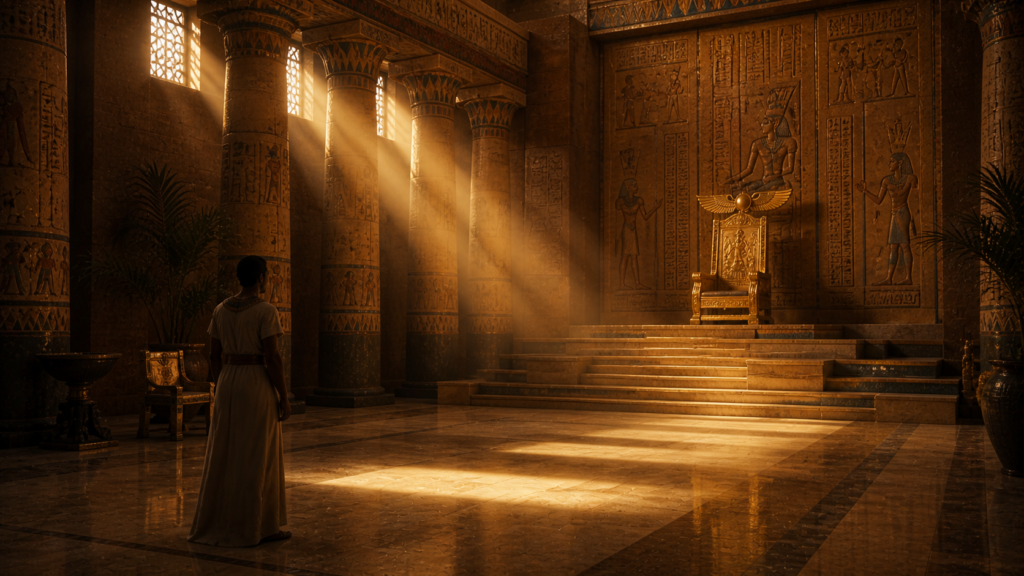
Genesis 41 is the chapter the cycle has been building toward since chapter 37. Two years after the cupbearer forgot Joseph, Pharaoh has two dreams in one night that none of his magicians or wise men can interpret. The cupbearer remembers Joseph. Joseph is brought up from the prison, shaved, given clean clothes, and placed before Pharaoh. He interprets the dreams and proposes a plan for the years of famine that the dreams predict. Pharaoh recognizes the gift, names Joseph as second-in-command of all of Egypt, gives him a new Egyptian name, marries him to the daughter of an Egyptian priest, and entrusts him with the responsibility of saving the entire country from starvation.
The chapter is the cycle’s longest single arc and one of the patriarchal narrative’s most stunning reversals. The thirty-year-old slave who entered Egypt in chains is now, by the chapter’s end, the second-most powerful man in the most powerful country of the ancient Near East. The cycle has been preparing for this moment for thirteen chapters; the chapter delivers it in eighty-three Hebrew verses.
The chapter is also the cycle’s most concentrated articulation of the Yahweh ito refrain. Pharaoh himself, the pagan king, names what the cycle has been claiming all along: can we find such a one as this, in whom is the Spirit of God? The rise of Joseph is, by the chapter’s own framing, the rise of a person whose divine accompaniment is conspicuous to the surrounding world. The Egyptian court can see what the cycle has been telling the reader: God is with this man.
A · Genesis 41:1–13 · The dreams and the cupbearer’s memory
¹ At the end of two full years, Pharaoh dreamed: and behold, he stood by the river. ² Behold, seven cattle came up out of the river. They were sleek and fat, and they fed in the marsh grass. ³ Behold, seven other cattle came up after them out of the river, ugly and thin, and stood by the other cattle on the brink of the river. ⁴ The ugly and thin cattle ate up the seven sleek and fat cattle. So Pharaoh awoke. ⁵ He slept and dreamed a second time; and behold, seven heads of grain came up on one stalk, healthy and good. ⁶ Behold, seven heads of grain, thin and blasted with the east wind, sprung up after them. ⁷ The thin heads of grain swallowed up the seven healthy and full ears. Pharaoh awoke, and behold, it was a dream. ⁸ In the morning, his spirit was troubled, and he sent and called for all of Egypt’s magicians and wise men. Pharaoh told them his dreams, but there was no one who could interpret them to Pharaoh. (Genesis 41:1–8, World English Bible)
- The chapter opens with a precise time-marker. At the end of two full years. The Hebrew miketz shenatayim yamim, “at the end of two years of days,” names the duration since the cupbearer’s release. Two years have passed. Joseph has been in the prison the whole time. The chapter is recording, with characteristic restraint, the long wait between the cupbearer’s restoration and Joseph’s release. The cycle does not speed past those two years. The narrator names them.
Influence callout: Walter Brueggemann
Brueggemann’s reading of the two-year wait names it as the cycle’s quiet pastoral teaching about divine timing. Joseph could have been freed when the cupbearer was restored. The cupbearer could have remembered. Pharaoh could have had his dreams two years earlier. The cycle does not say why none of these things happened. The cycle just records the gap. Brueggemann argues that the chapter is teaching, in its time-marker, that the rise the cycle has been preparing for required exactly this gap. The two years are not wasted; they are the preparation. The Joseph who walks out of the prison at thirty has been formed by the wait in ways the Joseph at twenty-eight could not have been.
- The two dreams (verses 1 to 7) follow a deliberate parallel structure. Seven good things, then seven bad things; the bad consume the good; the dreamer wakes. The first dream is agricultural-pastoral (cattle in the marsh grass beside the Nile); the second is purely agricultural (heads of grain on a single stalk, withered by the east wind). The Hebrew word for the wind that blasts the grain is qadim, the east wind, the dry desert wind that destroys Egyptian crops. The dreams are using Egyptian imagery throughout.
- Verse 7 records Pharaoh’s response with quiet precision. Pharaoh awoke, and behold, it was a dream. The Hebrew construction vehinneh chalom, “and behold, it was a dream,” signals the dreamer’s recognition that what he experienced was a dream. The same construction will be used in verse 25, when Joseph names what the dreams mean.
- Verse 8 records the chapter’s first failure. In the morning, his spirit was troubled, and he sent and called for all of Egypt’s magicians and wise men. Pharaoh told them his dreams, but there was no one who could interpret them. The Hebrew word chartumim, “magicians” (specifically, ritual practitioners of dream interpretation and protective magic), names the standard Egyptian court office. Egypt’s professional dream-interpreters cannot read the dreams. The chapter is preparing the reader: this is not a problem the empire can solve.
⁹ Then the chief cup bearer spoke to Pharaoh, saying, “I remember my faults today. ¹⁰ Pharaoh was angry with his servants, and put me in custody in the house of the captain of the guard, with the chief baker. ¹¹ We dreamed a dream in one night, he and I. Each man dreamed according to the interpretation of his dream. ¹² There was with us there a young man, a Hebrew, servant to the captain of the guard, and we told him, and he interpreted to us our dreams. To each man according to his dream he interpreted. ¹³ As he interpreted to us, so it was: he restored me to my office, and he hanged him.” (Genesis 41:9–13, World English Bible)
- The cupbearer’s memory (verses 9 to 13) is the chapter’s hinge. I remember my faults today. The Hebrew et-chata’ai ani mazkir hayom, “my sins I am calling to mind today,” uses the formal verb of memorial-confession. The cupbearer is naming his own forgetting as a fault. The chapter is recording the moment two years overdue: the cupbearer remembers Joseph, and remembers that he has been remembering wrongly the whole time.
- The cupbearer’s account (verses 11 to 13) describes Joseph in three precise descriptors: a young man, a Hebrew, servant to the captain of the guard. Each label is a status marker. Young (Hebrew na’ar, in this context probably meaning “young man” or “junior staff”), Hebrew (an ethnic-foreign marker), and slave (the Hebrew eved underneath the English “servant”). The cupbearer is naming Joseph’s external status accurately: he is foreign, junior, and enslaved. The chapter is making the eventual reversal the cupbearer’s exact rebuttal.
B · Genesis 41:14–32 · Pharaoh, Joseph, and the interpretation
¹⁴ Then Pharaoh sent and called Joseph, and they brought him hastily out of the dungeon. He shaved himself, changed his clothing, and came in to Pharaoh. ¹⁵ Pharaoh said to Joseph, “I have dreamed a dream, and there is no one who can interpret it. I have heard it said of you, that when you hear a dream you can interpret it.” ¹⁶ Joseph answered Pharaoh, saying, “It isn’t in me. God will give Pharaoh an answer of peace.” (Genesis 41:14–16, World English Bible)
- Joseph is brought from the prison hastily (Hebrew vayritzuhu, “they hurried him”). The court does not delay. Joseph shaves (a specifically Egyptian gesture; Hebrew men did not typically shave, but Egyptian protocol required it for an audience with Pharaoh). He changes clothes. He is presented.
- Pharaoh’s opening (verse 15) is precise. I have dreamed a dream, and there is no one who can interpret it. I have heard it said of you, that when you hear a dream you can interpret it. Pharaoh is locating Joseph within the role he is about to be asked to play. The Hebrew word for “interpret” (lifaror) is the same root we tracked in chapter 40. The whole chapter is hanging on Joseph’s response.
- Joseph’s reply (verse 16) is the cycle’s most theologically loaded sentence. It isn’t in me. God will give Pharaoh an answer of peace. The Hebrew is bil’adai, Elohim ya’aneh et-shelom Paroh, “apart from me, God will answer the peace of Pharaoh.” Joseph deflects the credit. He names the source. The Hebrew construction bil’adai (apart from me, not within me) explicitly disclaims his own gift. The interpretation comes from God; Joseph is the channel.
Influence callout: Tim Mackie
Mackie’s reading of bil’adai foregrounds the cycle’s central theological move. Joseph does not say I will interpret your dreams. He says it isn’t in me. The Hebrew is unambiguous. Mackie argues that this is the cycle’s pastoral teaching about how God’s gifts work in human lives: the gifted person is not the source. Joseph in chapter 40 said do not interpretations belong to God?; Joseph in chapter 41 says it again, in stronger form, before the most powerful man in the world. The cycle is recording, with consistent vocabulary, that the patriarch’s gifts are gifts, not possessions. The chapter is preparing the reader for the cycle’s later articulation in chapter 50: as for you, you meant evil against me, but God meant it for good. The same theological framing.
Word study: bil’adai (בִּלְעָדַי), “apart from me”
The Hebrew construction Joseph uses to disclaim the source of the gift. Bil’adai combines bil’a (without) with the first-person suffix. The word means “apart from me, not from me, not in me.” The same word will appear in 41:44 (Pharaoh’s commission of Joseph: without your consent, no man shall lift up his hand), where the meaning shifts: apart from your authority. The chapter is using the same word in two registers. Joseph’s bil’adai in 41:16 names the limit of his own contribution; Pharaoh’s bil’adekha in 41:44 names the extent of Joseph’s authority. The cycle is, in single-word repetition, recording the move from disclaimed gift to delegated authority.
¹⁷ Pharaoh spoke to Joseph, “In my dream, behold, I stood on the brink of the river: ¹⁸ and behold, seven cattle, fat and sleek, came up out of the river. They fed in the marsh grass; ¹⁹ and behold, seven other cattle came up after them, poor and very ugly and thin, such as I never saw in all the land of Egypt for ugliness. ²⁰ The thin and ugly cattle ate up the first seven fat cattle, ²¹ and when they had eaten them up, it couldn’t be known that they had eaten them, but they were still ugly, as at the beginning. So I awoke. ²² I saw in my dream, and behold, seven heads of grain came up on one stalk, full and good: ²³ and behold, seven heads of grain, withered, thin, and blasted with the east wind, sprung up after them. ²⁴ The thin heads of grain swallowed up the seven good heads of grain. I told it to the magicians, but there was no one who could explain it to me.” (Genesis 41:17–24, World English Bible)
- Pharaoh retells the dreams (verses 17 to 24) in slightly fuller form than the narrator’s first telling. The retelling is a Hebrew narrative convention; the variations carry meaning. Pharaoh adds details: such as I never saw in all the land of Egypt for ugliness (verse 19); when they had eaten them up, it couldn’t be known that they had eaten them, but they were still ugly (verse 21). Pharaoh’s retelling reveals what the dream did to him emotionally. He is haunted not just by the famine-imagery but by the way the famine consumes the plenty so completely that no trace remains.
²⁵ Joseph said to Pharaoh, “The dream of Pharaoh is one. What God is about to do he has declared to Pharaoh. ²⁶ The seven good cattle are seven years; and the seven good heads of grain are seven years. The dream is one. ²⁷ The seven thin and ugly cattle that came up after them are seven years, and also the seven empty heads of grain blasted with the east wind; they will be seven years of famine. ²⁸ That is the thing which I spoke to Pharaoh. What God is about to do he has shown to Pharaoh. ²⁹ Behold, seven years of great abundance throughout all the land of Egypt are coming. ³⁰ Seven years of famine will arise after them, and all the abundance will be forgotten in the land of Egypt. The famine will consume the land, ³¹ and the plenty will not be known in the land by reason of that famine which follows; for it will be very grievous. ³² The dream was doubled to Pharaoh, because the thing is established by God, and God will shortly bring it to pass.” (Genesis 41:25–32, World English Bible)
- Joseph’s interpretation (verses 25 to 32) is structurally clean. The dream of Pharaoh is one. The two dreams are saying the same thing. Seven cattle, seven heads of grain, seven years. Plenty followed by famine. The doubling is, in Joseph’s framing, a sign of certainty: the dream was doubled to Pharaoh, because the thing is established by God, and God will shortly bring it to pass.
- The interpretation is bracketed by two repetitions of the same theological phrase. What God is about to do he has declared to Pharaoh (verse 25). What God is about to do he has shown to Pharaoh (verse 28). The chapter is making the source-of-meaning claim three times in three verses. The dreams are not Egyptian magic; they are God’s communication to a pagan king. The chapter is recording a remarkable theological move: Yahweh communicates with Pharaoh in dreams that only a Hebrew prisoner can interpret.
Influence callout: Walter Brueggemann
Brueggemann’s reading of God’s communication to Pharaoh names it as one of the patriarchal narrative’s most striking theological moves. Yahweh is, by the chapter’s framing, sovereign over the agricultural cycles of Egypt and willing to communicate that sovereignty to the Egyptian king through dreams. The chapter is arguing, before the Exodus narrative will articulate it more strongly, that Yahweh is not just the God of the patriarchal family. He is, even in the patriarchal narrative, the God whose word reaches the Egyptian throne when needed. The chapter is laying down a theological foundation that will pay off across the entire Pentateuch.
C · Genesis 41:33–57 · The plan, the rise, the years
³³ “Now therefore let Pharaoh look for a discreet and wise man, and set him over the land of Egypt. ³⁴ Let Pharaoh do this, and let him appoint overseers over the land, and take up the fifth part of the land of Egypt’s produce in the seven plenteous years. ³⁵ Let them gather all the food of these good years that come, and lay up grain under the hand of Pharaoh for food in the cities, and let them keep it. ³⁶ The food will be for a store to the land against the seven years of famine, which will be in the land of Egypt; that the land not perish through the famine.” (Genesis 41:33–36, World English Bible)
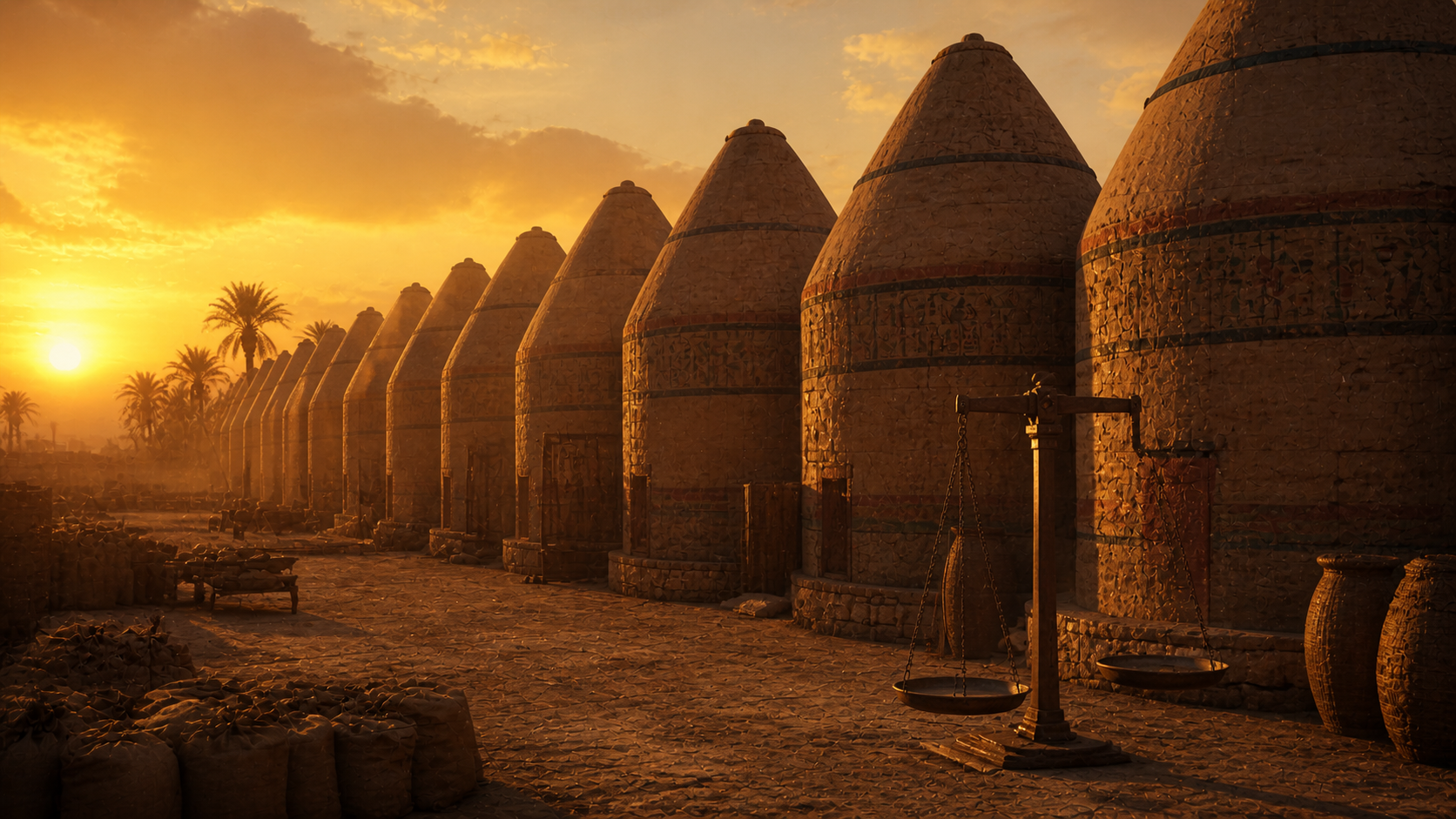
- Joseph’s plan (verses 33 to 36) is unsolicited. Pharaoh asked for an interpretation, not a policy. Joseph offers both. He proposes a discreet and wise man, a national overseer system, a 20% storage tax during the seven plenteous years, and a strategic grain reserve to carry the country through the famine. The plan is comprehensive, agricultural, fiscal, and administrative all at once.
Influence callout: Tim Mackie
Mackie’s reading of Joseph’s policy proposal names it as the chapter’s quiet structural pivot. The cycle has not yet shown us Joseph as a policy-maker. The cycle has shown us Joseph as a teenager, a slave, a prisoner, an interpreter. Mackie argues that the chapter is, in this single speech, revealing what Joseph has become during the long years in Egypt: a man capable of designing the kind of national-scale economic plan Pharaoh needs. The patriarchal narrative is recording Joseph’s full vocational range. The dream-interpreter is also the policy-maker. The chapter is preparing the cycle’s later move: Joseph as the savior of Egypt, of his family, and of the surrounding peoples.
³⁷ The thing was good in the eyes of Pharaoh, and in the eyes of all his servants. ³⁸ Pharaoh said to his servants, “Can we find such a one as this, a man in whom is the Spirit of God?” ³⁹ Pharaoh said to Joseph, “Because God has shown you all of this, there is no one so discreet and wise as you. ⁴⁰ You shall be over my house. All my people will be ruled according to your word. Only in the throne I will be greater than you.” (Genesis 41:37–40, World English Bible)
- The thing was good in the eyes of Pharaoh, and in the eyes of all his servants. The Hebrew vayitav ha-davar, “and the thing was good,” is the same construction the chapter has used for divine recognition (Genesis 1: and God saw that it was good). The chapter is, with subtle vocabulary, framing Pharaoh’s recognition of Joseph in language that echoes Yahweh’s recognition of creation.
- Verse 38 is the chapter’s pagan-king theological climax. Can we find such a one as this, a man in whom is the Spirit of God? The Hebrew ish asher ruach Elohim bo, “a man in whom the Spirit of God is,” is one of the patriarchal narrative’s most striking phrases. Ruach Elohim (Spirit of God) is the same construction that opens Genesis 1:2 (the Spirit of God moved over the waters). Pharaoh, the pagan king, is identifying Joseph by the same divine-presence language the patriarchal narrative reserves for its most sacred moments. The chapter is recording, with characteristic restraint, that the Egyptian throne can name what the Yahweh ito refrain has been claiming for two chapters.
Word study: ruach Elohim (רוּחַ אֱלֹהִים), “Spirit of God”
The Hebrew phrase Pharaoh uses for Joseph in Genesis 41:38. The construction is rare in the patriarchal narrative; this is one of its most striking instances. Ruach (spirit, breath, wind) plus Elohim (God) names a divine accompaniment that surpasses ordinary human capacity. The same construction opens Genesis 1:2 (the Spirit of God moved over the waters) and will name the divine equipping of Bezalel (Exodus 31:3, the artisan of the tabernacle). The chapter is, by Pharaoh’s mouth, applying the language of divine equipping to a Hebrew prisoner he has just heard interpret two dreams. The pagan king’s recognition is the chapter’s most theologically loaded acknowledgment.
- Pharaoh’s commission (verses 39 to 40) is comprehensive. You shall be over my house. All my people will be ruled according to your word. Only in the throne I will be greater than you. Joseph is being named as the second-in-command of Egypt. The chapter is recording the rise in three short Hebrew phrases.
⁴¹ Pharaoh said to Joseph, “Behold, I have set you over all the land of Egypt.” ⁴² Pharaoh took off his signet ring from his hand, and put it on Joseph’s hand, and arrayed him in robes of fine linen, and put a gold chain about his neck. ⁴³ He made him to ride in the second chariot which he had. They cried before him, “Bow the knee!” He set him over all the land of Egypt. ⁴⁴ Pharaoh said to Joseph, “I am Pharaoh. Without you, no man shall lift up his hand or his foot in all the land of Egypt.” ⁴⁵ Pharaoh called Joseph’s name Zaphenath-Paneah. He gave him Asenath, the daughter of Potiphera priest of On as a wife. Joseph went out over the land of Egypt. (Genesis 41:41–45, World English Bible)
- The investiture (verses 41 to 45) is recorded in dense Egyptian-court detail. The signet ring (the seal of authority). Robes of fine linen. A gold chain. The second chariot in the country. Heralds crying bow the knee (Hebrew avrekh, of debated etymology, possibly an Egyptian loanword for an honorific title). The new Egyptian name Zaphenath-Paneah (whose precise meaning is debated, possibly the god speaks and lives). The marriage to Asenath, the daughter of Potiphera priest of On. On (later Heliopolis) was a major Egyptian religious center, dedicated to the sun-god Re. Joseph is being married into the Egyptian priestly aristocracy.
Pushback note
Joseph’s marriage to Asenath has sometimes troubled Christian readers because Asenath was an Egyptian woman, daughter of a priest of an Egyptian god. The chapter does not editorialize about this. The narrator records the marriage as part of Joseph’s investiture, alongside the signet ring and the chariot. The narrator is not presenting the marriage as a moral problem or as a covenantal violation. Some later Jewish traditions (notably the apocryphal Joseph and Aseneth) imagined Asenath’s conversion to Yahweh-worship, but the canonical Genesis text does not narrate any such thing. We can read the chapter forward, accepting that Asenath is a non-Israelite woman who becomes the matriarch of two of the twelve tribes (Ephraim and Manasseh), and let the chapter’s silence about her religious identity stand as the chapter’s silence.
Influence callout: Ray Vander Laan
Vander Laan’s teaching on the Egyptian context here helps. The marriage to a daughter of a priest of On was, in ANE diplomatic terms, the formal binding of Joseph into the Egyptian elite. Ancient courts often sealed alliances by marriage. The signet ring, the linen robes, the gold chain, the second chariot, the new name, and the marriage are all parts of one comprehensive investiture. Joseph is not just being given a job; he is being formally adopted into the Egyptian aristocracy. The cycle is recording, with full ANE-court precision, a young Hebrew man becoming an Egyptian official.
⁴⁶ Joseph was thirty years old when he stood before Pharaoh king of Egypt. Joseph went out from the presence of Pharaoh, and went throughout all the land of Egypt. ⁴⁷ In the seven plenteous years the earth produced abundantly. ⁴⁸ He gathered up all the food of the seven years which were in the land of Egypt, and laid up the food in the cities. He stored food in every city from the fields around it. ⁴⁹ Joseph laid up grain as the sand of the sea, very much, until he stopped counting, for it was without number. ⁵⁰ Two sons were born to Joseph before the year of famine came, whom Asenath, the daughter of Potiphera priest of On, bore to him. ⁵¹ Joseph called the name of the firstborn Manasseh, “For,” he said, “God has made me forget all my toil, and all my father’s house.” ⁵² The name of the second, he called Ephraim: “For God has made me fruitful in the land of my affliction.” ⁵³ The seven years of plenty, that were in the land of Egypt, came to an end. ⁵⁴ The seven years of famine began to come, just as Joseph had said. There was famine in all lands, but in all the land of Egypt there was bread. ⁵⁵ When all the land of Egypt was famished, the people cried to Pharaoh for bread, and Pharaoh said to all the Egyptians, “Go to Joseph. What he says to you, do.” ⁵⁶ The famine was over all the surface of the earth. Joseph opened all the store houses, and sold to the Egyptians. The famine was severe in the land of Egypt. ⁵⁷ All countries came into Egypt, to Joseph, to buy grain, because the famine was severe in all the earth. (Genesis 41:46–57, World English Bible)
- Joseph was thirty years old when he stood before Pharaoh (verse 46). The age-marker is significant. Joseph was sold to Egypt at seventeen (chapter 37:2). Thirteen years have passed. The chapter is locating his rise at the same age David will become king (2 Samuel 5:4) and at the same age Jesus will begin his public ministry (Luke 3:23). The thirty-year mark is the canon’s quiet vocational threshold. The chapter is not announcing this; it is just recording Joseph’s age at the moment of his commission.
- The two sons of Joseph (verses 50 to 52) are named with theological precision. Manasseh (Hebrew Menasheh, from nasheh, to forget): God has made me forget all my toil, and all my father’s house. Ephraim (Hebrew Efrayim, from parah, to be fruitful): God has made me fruitful in the land of my affliction. The two names trace Joseph’s slow theological movement during the years of plenty. The first son’s name names the leaving-behind; the second son’s name names the new flourishing. The chapter is recording, in the etymologies of two children, what these years have done to him.
Word study: Menasheh and Efrayim
The two sons of Joseph by Asenath, named in Genesis 41:51-52. Menasheh is from the Hebrew nasheh (to forget); the verb’s only appearance in the patriarchal narrative is here. Efrayim is from parah (to be fruitful), the same verb used in Genesis 1:28’s blessing (be fruitful and multiply). The two etymologies trace Joseph’s theological arc through the years of his Egyptian rise. The chapter is using the names of his children to record what God has done in his interior life.
Pushback note
Joseph’s first son’s name, God has made me forget all my toil, and all my father’s house, has sometimes been read as evidence that Joseph had abandoned his Hebrew identity or had emotionally separated from his family. The text is more nuanced. Joseph in chapter 45 will weep on his brothers’ necks; he will arrange for the family’s preservation; he will name his identification with the patriarchal line repeatedly. The Hebrew word nasheh in Manasseh’s name is best read as “forget the pain of the toil and the loss,” not as “forget the family.” The chapter is recording, with characteristic restraint, that Joseph had been formed enough by his rise to no longer be defined by the wound. The forgetting in the name is the forgetting of the wound’s grip, not the forgetting of the family.
- The famine arrives (verses 53 to 57). The seven years of plenty came to an end. The seven years of famine began to come, just as Joseph had said. The chapter is recording the fulfillment of the interpretation. The plan works. In all the land of Egypt there was bread. Then the famine spreads beyond Egypt: the famine was severe in all the earth. The chapter ends with all countries came into Egypt, to Joseph, to buy grain.
Influence callout: N.T. Wright
Wright’s reading of the cycle’s culmination here names it as the patriarchal narrative’s quiet payoff of the Abrahamic blessing. In you and in your offspring all the families of the earth shall be blessed (12:3, 22:18). The chapter records Joseph as the keeper of the world’s grain during the global famine. Egypt feeds the world. The covenant family’s vocation, even through one dispersed son, is keeping the wider world from starvation. Wright argues that the chapter is recording the Abrahamic promise being kept in the most concrete possible way: through the food the surrounding peoples can buy from the family of Abraham. The cycle is not just about Joseph’s personal restoration; it is about the patriarchal family’s vocation being lived out at scale.
- The chapter ends with the world coming to Egypt. The next chapter will record the family coming too. The brothers will arrive at the same storehouses, with the same need, before the same brother they sold. The cycle’s reckoning is about to begin.
Reflection prompts
- It isn’t in me. God will give Pharaoh an answer of peace. Joseph at thirty has learned to disclaim the source of his gift before he uses it. Where in your life has a long formation taught you to attribute your gifts more carefully than you did when you were younger?
- The chapter records a two-year wait between the cupbearer’s restoration and Joseph’s rise. The wait is not the chapter’s failure; the wait is the chapter’s preparation. Where in your life are you currently in the kind of long wait that may turn out, in retrospect, to have been the formation rather than the delay?
- Joseph names his first son Manasseh: God has made me forget all my toil, and all my father’s house. The name is recording a real theological movement: not the erasure of memory, but the easing of the wound’s grip. Where in your life is the kind of forgetting you most need not the absence of memory but the loosening of the wound?