
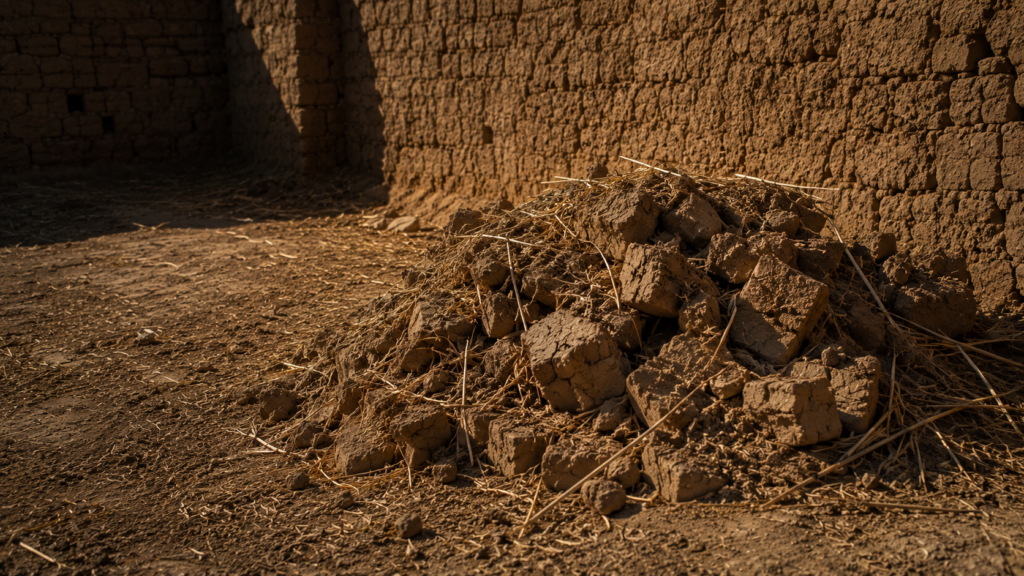
Exodus 5 is the chapter where the deliverance begins, and where everything immediately gets worse. Moses and Aaron deliver God’s word to Pharaoh, and Pharaoh responds by increasing the burden. The Israelites who had cried out and been promised deliverance are now told to gather their own straw and still meet the same daily quota of bricks. The foremen of Israel, middle-management Hebrews appointed by Pharaoh’s taskmasters, get beaten when their crews fall short. The deliverance has not begun to arrive; it has only made the captivity heavier.
This is one of the chapter’s most theologically honest moments. The Bible is not embarrassed to record that obedience to God can, at first, increase suffering. Moses is faithful, he goes, he speaks, he does what God said, and the immediate result is that his own people turn on him. Yahweh look on you and judge, the foremen tell Moses (v. 21). The deliverer is now blamed for what the deliverance has produced.
The chapter ends with Moses’s first real protest to God. why have you done evil to this people? It is the rough edge of biblical faith: a deliverer who has just done what he was told, complaining bitterly to the God who told him. The chapter teaches that early obedience does not always feel like victory, and that the God of the Bible is patient enough to receive the protest.
A · Exodus 5:1-5 · “I do not know YHWH”
¹ Afterward Moses and Aaron came, and said to Pharaoh, “This is what Yahweh, the God of Israel, says, ‘Let my people go, that they may hold a feast to me in the wilderness.’” ² Pharaoh said, “Who is Yahweh, that I should listen to his voice to let Israel go? I don’t know Yahweh, and moreover I will not let Israel go.” ³ They said, “The God of the Hebrews has met with us. Please let us go three days’ journey into the wilderness, and sacrifice to Yahweh, our God, lest he fall on us with pestilence, or with the sword.” ⁴ The king of Egypt said to them, “Why do you, Moses and Aaron, take the people from their work? Get back to your burdens!” ⁵ Pharaoh said, “Behold, the people of the land are now many, and you make them rest from their burdens.”
- Afterward Moses and Aaron came. The chapter opens with the elders’ worship of chapter 4 already faded into memory, and Moses and Aaron walking into Pharaoh’s court. The text gives no description of the throne room, no account of how they got the audience, no fanfare. Two men with a message walk in.
- Let my people go, that they may hold a feast to me in the wilderness. The Hebrew is shalach et ami ve-yachogu li ba-midbar, send my people out, and they will hold a festival to me in the wilderness. The verb chagag (to hold a festival, to make pilgrimage) gives us the noun chag: the same word for the three pilgrim feasts of Israel (Passover, Weeks, Booths). Moses is asking for a religious holiday, three days off to worship. The framing is theological. The contest is not first about liberation; it is about worship. The question on the table is whose feast Israel will hold. Egypt’s calendar is full of festivals to Egyptian gods. YHWH is asking that Israel be released to keep his.
- Who is Yahweh, that I should listen to his voice? Pharaoh’s response is the chapter’s foundational line. The Hebrew is mi YHWH asher eshma be-qolo, who is YHWH that I should listen to his voice? The verb shema (listen, obey) is the same root as the Shema, Israel’s central covenant prayer (Deut 6:4). The book is teaching, in Pharaoh’s mouth, the inverse of what Israel will be called to: where Israel will shema YHWH, Pharaoh refuses to. Pharaoh’s whole being is anti-shema.
- I do not know Yahweh. The Hebrew is lo’ yadati et YHWH. The verb yada, know, is the same verb the chapter 1 Pharaoh used (lo’ yada et Yosef, did not know Joseph) and the same verb the text used for God’s intimate awareness of Israel’s suffering in 2:25 (va-yeda elohim, God knew). The book is keeping accounts: Pharaoh “does not know” Joseph or YHWH; YHWH “knows” Israel. The plagues will be, in part, a sustained tutorial: and Egypt will know that I am YHWH (Ex 7:5; 14:4, 18). Pharaoh’s I do not know is the opening claim. The plagues are the answer.
- And moreover I will not let Israel go. The Hebrew adds ve-gam, and also. Pharaoh’s refusal is double-decked: he doesn’t know YHWH, and even if he did, he wouldn’t comply. The two layers will both have to be dismantled. The first will take ten plagues; the second will take the death of his firstborn.
- The God of the Hebrews has met with us. Moses and Aaron try a different framing. Where verse 1 said YHWH the God of Israel, verse 3 says the God of the Hebrews (elohey ha-ivrim). They are speaking Pharaoh’s language: identifying YHWH by the people he is associated with. Hebrew (ivri) was the term outsiders used for Israel; Israel was Israel’s self-designation. The text shows Moses code-switching, trying to find vocabulary that will land.
- Please let us go three days’ journey… lest he fall on us with pestilence. Moses and Aaron also frame the request softly: a three-day religious leave, not a permanent exit. They are not lying, exactly, three days is what God said in 3:18, but they are also not putting their full hand on the table. Goldingay’s note: this is the negotiation phase. The deliverance will not come through diplomacy; the request is being offered to give Pharaoh a minimum-cost path to compliance. He will refuse even the minimum. That refusal will become the basis for the maximum.
- Get back to your burdens! Pharaoh’s response is to dismiss Moses and Aaron as interrupting work. The Hebrew is lekhu le-sivloteykhem, go to your burdens. The same word sivlot will reappear in Ex 6:6 (I will bring you out from under the burdens of the Egyptians). The book is layering the keyword. Pharaoh sees Israel as labor units; God sees them as firstborn son. The conflict is over what Israel is for.
B · Exodus 5:6-14 · The brick quota without straw
⁶ The same day Pharaoh commanded the taskmasters of the people and their officers, saying, ⁷ “You shall no longer give the people straw to make brick, as before. Let them go and gather straw for themselves. ⁸ You shall require from them the number of the bricks which they made before. You shall not diminish anything of it, for they are idle. Therefore they cry, saying, ‘Let’s go and sacrifice to our God.’ ⁹ Let heavier work be laid on the men, that they may labor in it. Don’t let them pay any attention to lying words.” ¹⁰ The taskmasters of the people went out with their officers, and they spoke to the people, saying, “This is what Pharaoh says: ‘I will not give you straw. ¹¹ Go yourselves, get straw where you can find it, for nothing of your work shall be diminished.’” ¹² So the people were scattered abroad throughout all the land of Egypt to gather stubble for straw. ¹³ The taskmasters were urgent saying, “Fulfill your work quota daily, as when there was straw!” ¹⁴ The officers of the children of Israel, whom Pharaoh’s taskmasters had set over them, were beaten, and were asked, “Why haven’t you fulfilled your quota both yesterday and today, in making brick as before?”

- Pharaoh’s escalation is precise. He does not reduce the brick quota; he removes the straw. The Israelites must now scatter across Egypt to gather stubble (the inferior leftover material from harvested fields) and still produce the same daily output. The math is not just impossible; it is humiliating. Bricks made from stubble crumble; the foremen will be beaten when the bricks fail; the whole supply chain has been rigged to ensure Israel’s failure.
- They are idle. Therefore they cry, saying, “Let’s go and sacrifice to our God.” Pharaoh’s diagnosis is theological: the only reason Israel asks for time off to worship is that they have too much free time. The remedy, in Pharaoh’s mind, is more work. Goldingay’s pastoral note: this is one of the Hebrew Bible’s most acute observations about empire. Empire’s response to spiritual longing is more labor. Sabbath, when it comes at Sinai, will be the structural inverse: labor six days; rest one. Pharaoh’s Egypt is seven days of labor, no rest. Sinai’s Israel is six days of labor, one of rest. Sabbath is the anti-Pharaoh law.
- Don’t let them pay any attention to lying words. Pharaoh names Moses’s message as lying, Hebrew divrey-shaqer. The same word sheqer (lie / falsehood) will reappear at Sinai as the ninth commandment: you shall not bear false witness (Ex 20:16). The text is layering: Pharaoh accuses Moses of lying; Sinai will outlaw lying. The contest is, in part, over whose words tell the truth about reality.
- The people were scattered throughout all the land of Egypt to gather stubble. The Hebrew is vayafets ha-am be-khol erets mitsrayim, the people were scattered throughout all the land of Egypt. The verb puts (scatter) is the same verb used at Babel (Gen 11:4-9), where God scattered the nations. Here, Pharaoh scatters Israel. The empire’s response to the threat of unified Hebrew worship is forced dispersal, keep them scattered, exhausted, and unable to gather. The Hebrew Bible’s later prophets will read empire’s strategy in exactly these terms.
- The officers of the children of Israel… were beaten. The Hebrew is vayukku shotrey beney-yisra’el. The verb vayukku (were beaten) is the passive of makah, the same root as the verb the Egyptian was using on the Hebrew in Ex 2:11. The officers in the middle, Hebrews appointed by Egyptian taskmasters to manage Hebrew labor, are now caught between the impossible quota above them and the impossible reality below. Empire has a way of making the oppressed turn on the oppressed. The text is honest about this. The first violence Israel does to Israel in Exodus comes through the structure of empire, not through Hebrew malice.
Word study: sivlot (סִבְלוֹת)
“Burdens.” The Hebrew word sivlot in Ex 5:4-5 (and 1:11; 6:6, 7) is the technical term for the labor burden of forced labor. It is not the ordinary word for work; it is the word for the load on the back of a slave. Pharaoh tells Moses to “go back to your burdens” (5:4); God will tell Israel “I will bring you out from under the burdens of the Egyptians” (6:6). The same word brackets the contest. Burdens are what slavery is. Out from under burdens is what deliverance is. Sabbath, when it comes, will be God’s institutional answer to sivlot: a permanent rest from the back-bent labor empire requires.
C · Exodus 5:15-23 · The protest, and Moses’s complaint
¹⁵ Then the officers of the children of Israel came and cried to Pharaoh, saying, “Why do you deal this way with your servants? ¹⁶ No straw is given to your servants, and they tell us, ‘Make brick!’ and behold, your servants are beaten; but the fault is in your own people.” ¹⁷ But Pharaoh said, “You are idle! You are idle! Therefore you say, ‘Let’s go and sacrifice to Yahweh.’ ¹⁸ Go therefore now, and work; for no straw shall be given to you; yet you shall deliver the same number of bricks!” ¹⁹ The officers of the children of Israel saw that they were in trouble when it was said, “You shall not diminish anything from your daily quota of bricks!” ²⁰ They met Moses and Aaron, who stood along the way, as they came out from Pharaoh. ²¹ They said to them, “May Yahweh look at you and judge, because you have made us a stench to be abhorred in the eyes of Pharaoh, and in the eyes of his servants, to put a sword in their hand to kill us!” ²² Moses returned to Yahweh, and said, “Lord, why have you brought trouble on this people? Why is it that you have sent me? ²³ For since I came to Pharaoh to speak in your name, he has brought trouble on this people. You have not rescued your people at all!”
- The officers of the children of Israel came and cried to Pharaoh. The Hebrew foremen, beaten and exhausted, cry (tsa’aq). The same verb of cry-from-oppression that Israel cried in 2:23. But notice: this time the cry goes to Pharaoh, not to God. They are appealing to the very source of their oppression. The text is showing us the bewildered honesty of the early movement. The Israelites who heard Moses’s news in 4:31 and bowed in worship are now back to negotiating with Pharaoh. The deliverance has not yet rewired their imagination.
- You are idle! You are idle! Pharaoh’s response is to repeat his diagnosis. The Hebrew is nirpim attem nirpim, emphatic doubling. You are slack, you are slack! The accusation is the empire’s permanent move: the only thing wrong with you is that you don’t work hard enough. Goldingay’s note: empires always say this. The cure for spiritual hunger, on this view, is more output. Pharaoh’s prescription is the prescription every system of dehumanization has ever offered.
- They met Moses and Aaron, who stood along the way, as they came out from Pharaoh. The foremen, leaving the throne room, run into Moses and Aaron in the corridor. The encounter is staged. The empire just rejected the deliverance request, escalated the burden, beat the foremen, and now the foremen run into the men whose request started all of it. The chapter is making us feel the timing.
- May Yahweh look on you and judge. The Hebrew is yere YHWH aleykhem ve-yishpot, YHWH look upon you and judge. The foremen invoke the very God Moses claims to represent, and ask God to judge Moses. The bitterness is real. The same God who is supposed to deliver has, on the foremen’s experience, made things worse. Their cry is theologically ambiguous: it is faith that YHWH judges, and accusation that Moses has earned the judgment.
- You have made us a stench in the eyes of Pharaoh. The Hebrew is hivashtem et reychenu be-eyney far’oh, you have made our smell stink. The image is striking: the foremen are not just blamed; they are dehumanized in Pharaoh’s nostrils. The empire’s gaze, even on its own appointed managers, is contemptuous. Moses has made them visible to Pharaoh as a problem.
- To put a sword in their hand to kill us. The foremen accuse Moses of giving Pharaoh the justification for genocide. This is harsh, but the text records it without softening. The deliverance has, in their immediate experience, escalated the threat. The foremen are not wrong about the immediate facts. They are wrong about what is going to happen next. But chapter 5 is in the immediate facts phase. The next phase has not yet begun.
- Moses returned to Yahweh. This is the chapter’s pivot. Moses, accused by his own people, takes the accusation to God. Notice what he does not do: he does not retaliate, defend himself, blame the foremen, or quit. He goes to YHWH. The pattern is being established for the rest of his life: when Israel turns on Moses, Moses takes Israel’s complaint to God. He will do this again at Numbers 11, 14, 16, 20.
- Why have you brought trouble on this people? Why is it that you have sent me? Moses’s protest is sharp. The Hebrew is lamah hare’otah la-am ha-zeh, lamah zeh shelachtani, why have you brought evil upon this people, why have you sent me? The verb hare’otah shares its root with ra, evil. Moses accuses YHWH of doing evil to the people. This is one of the rare moments in the Hebrew Bible when a faithful person accuses God of evil-doing. The text records it. The text does not condemn it.
- You have not rescued your people at all. The Hebrew is ve-hatsel lo’ hitsalta et amekha, emphatic doubling: and rescuing, you have not rescued. The verb natsal (rescue, deliver) will be the dominant verb of the next chapter, I will rescue you (Ex 6:6). Moses uses it as accusation; God will use it as promise. The chapter ends with Moses’s protest hanging in the air. Chapter 6 will be God’s response.
Influence callout: Marty Solomon (Bema Discipleship, Episode 17 / 18)
Solomon notes that Exodus 5 is one of the chapter where the cost of God’s calling is laid bare. Moses has just done everything God said: gone back to Egypt, faced Pharaoh, delivered the message. The result is that Israel turns on him and he turns on God. Solomon’s pastoral note: the early days of obedience to God’s call often look exactly like this. Things get worse before they get better. The deliverance is not yet visible; the burden is now heavier; the people who should be allies are now enemies. The Hebrew Bible does not flinch from this. It records Moses’s protest in full. Lord, why have you brought trouble? Solomon: if you have ever felt this in your own walk with God, you are in good company. The Hebrew Bible’s deliverers all felt this before the deliverance came.
- The chapter ends without resolution. Pharaoh has refused. The burden is heavier. The foremen are wounded. Israel is angry at Moses. Moses is angry at God. The deliverance has produced, so far, only worse conditions. This is a deeply faithful place to end a chapter. The Hebrew Bible does not always tie its narrative arcs into neat resolution. Sometimes a chapter ends mid-protest, and the next chapter begins with God’s response.
- The structural reading: Exodus 5 is day one of the deliverance, and day one is hard. The chapters that follow will be days two through ten thousand. The book is teaching that obedience to a long deliverance involves accepting that the early days will not feel like victory. Moses learns this here. Israel will learn it more slowly. The reader, watching, is invited to learn it too.
Reflection prompts
- Pharaoh’s response to spiritual longing is more work: You are idle. Therefore you say, “Let’s go and sacrifice.” Where, in your own life, does the system around you respond to your need for rest, worship, and Sabbath by doubling down on output? What would it mean to refuse that diagnosis?
- The foremen accuse Moses of making things worse, and on the immediate facts they are right. The deliverance, on day one, has escalated the burden. Where, in your own faithful obedience to a call, has the immediate result been more difficulty, not less? What would it take to keep going through the chapter-five phase?
- Lord, why have you brought trouble on this people? Moses’s protest is honest, sharp, and faithful. What protest are you holding back from God right now because you think faithful people don’t say things like that? What if the next move in your prayer life is the same move Moses made: to bring the protest to God rather than around him?
Frameworks at play in this chapter: the cry of the oppressed, counter-imperial reading.