
Exodus 4 is one of the strangest chapters in the Bible. It begins as a coherent commissioning scene: Moses raising more objections, God giving him three signs, Moses finally agreeing to go. It ends with one of the most baffling paragraphs in all of Scripture: the LORD met him and tried to kill him. In between, there is a tender moment at Jethro’s house, a return to Egypt, a meeting with Aaron, the gathering of the elders, and Israel’s first act of worship after the long silence.
The chapter is doing several things at once. It is finishing the burning-bush conversation. It is preparing Moses to face Pharaoh. It is naming Israel as God’s firstborn son for the first time in Scripture. It is also revealing, through the strange Zipporah episode, that Moses has an unfinished issue in his own household before he can lead a nation: a son not yet circumcised, a covenant sign not yet honored. The chapter’s structure tells us: deliverers are not exempt from the covenant they are sent to deliver into.
Read carefully, the chapter is honest about Moses in a way later traditions are not. He resists. He bargains. He fails to keep covenant in his own home. And God patiently, persistently, sometimes terrifyingly, keeps making him into the man Israel will need.
A · Exodus 4:1-9 · The three signs
¹ Moses answered, “But, behold, they will not believe me, nor listen to my voice; for they will say, ‘Yahweh has not appeared to you.’” ² Yahweh said to him, “What is that in your hand?” He said, “A rod.” ³ He said, “Throw it on the ground.” He threw it on the ground, and it became a snake; and Moses ran away from it. ⁴ Yahweh said to Moses, “Stretch out your hand, and take it by the tail.” He stretched out his hand, and laid hold of it, and it became a rod in his hand. ⁵ “This is so that they may believe that Yahweh, the God of their fathers, the God of Abraham, the God of Isaac, and the God of Jacob, has appeared to you.” ⁶ Yahweh said furthermore to him, “Now put your hand inside your cloak.” He put his hand inside his cloak, and when he took it out, behold, his hand was leprous, as white as snow. ⁷ He said, “Put your hand inside your cloak again.” He put his hand inside his cloak again, and when he took it out of his cloak, behold, it had turned again as his other flesh. ⁸ “It will happen, if they will not believe you or listen to the voice of the first sign, that they will believe the voice of the latter sign. ⁹ It will happen, if they will not believe even these two signs or listen to your voice, that you shall take of the water of the river, and pour it on the dry land. The water which you take out of the river will become blood on the dry land.”
- They will not believe me. Moses’s second objection. The first (Ex 3:11) was who am I? The second is what if they don’t believe? The Hebrew is ve-hen lo’ ya’aminu li, and behold, they will not believe me. Moses is now arguing on behalf of Israel rather than himself. He is, in a way, more right than he knows: chapter 14 will show that Israel does not fully believe even after seeing the Sea split. But God’s response is to give him signs, three of them, escalating in scope.
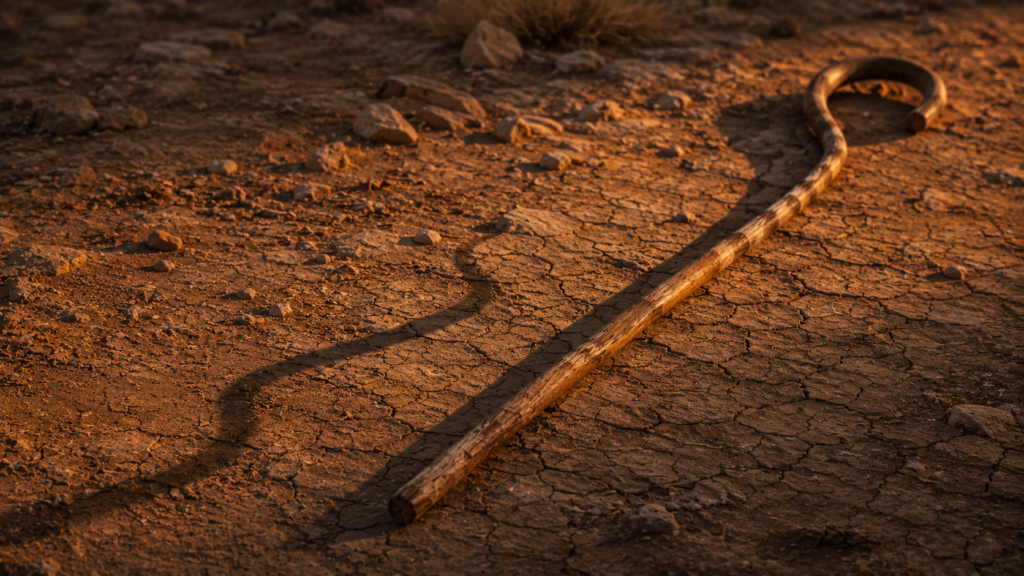
- What is that in your hand? The first sign begins with God’s question. Moses has a matteh: a shepherd’s staff, the tool of his ordinary life for forty years in Midian. God does not give Moses a new instrument. He uses what is already there. Solomon’s reading: God’s tools, throughout Scripture, are not the props God hands you; they are the things you already have. Moses has been holding the means of deliverance for forty years and has not known it. This is one of the chapter’s quiet pastoral notes: God’s deliverance often runs through the ordinary tools of ordinary lives.
- He threw it on the ground, and it became a snake. The Hebrew is nachash, serpent. The same word for the serpent in Genesis 3. The staff of a Hebrew shepherd, transformed, becomes a nachash. The very figure that has signified resistance to God’s purposes since Eden. Solomon: Pharaoh’s staff in Egyptian iconography is also a serpent (the uraeus, the cobra on Pharaoh’s crown, the symbol of his divine kingship). The sign is theologically loaded: Moses’s staff, on the ground, becomes the very symbol Pharaoh wears. And then Moses takes it by the tail and it returns to a staff. The chapter is signalling: in this contest, Pharaoh’s symbol of power is just a stick on the ground. God can pick it up by the tail.
- Take it by the tail. The instruction is striking. Snake handlers grab snakes behind the head, not by the tail, because tail-held snakes can turn and bite. God deliberately tells Moses to grab the snake the unsafe way. The faith-stretch is built into the obedience. Moses has to trust that God’s protection covers the moment when his own competence runs out.
- His hand was leprous, as white as snow. The second sign is more personal. Moses puts his hand inside his cloak; when he draws it out, it is metsoraat: a skin disease, ritually impure (the same condition that will require quarantine and offerings in Lev 13-14). Then he puts it back in, draws it out again, and it is healed. The sign is twofold: God can make the body unclean, and God can make it clean. The deliverer carries in his own person the visual demonstration that God’s authority extends to ritual purity itself.
- The leprosy sign also has a personal-narrative weight. Moses’s sister Miriam will, in Numbers 12, be struck with this same condition for opposing Moses. Aaron, his brother, will lead Israel into the calf-incident in Ex 32. The deliverer’s own family will be at the center of failure-and-restoration narratives. The sign at the bush is, in a way, a foreshadowing of how God will discipline and restore Moses’s own household over the course of the journey.
- The third sign… water from the river will become blood. This is the only sign that will not be performed at the bush; God simply describes it in advance. And it is, of course, the first plague (Ex 7:14-25). The chapter is layering the future across the present: by the time Moses leaves the bush, he has been told the first plague’s content. The signs are not random; they are a preview of what is coming.
- The three signs together form a triad: a staff that becomes the symbol of Pharaoh’s power, a hand that becomes ritually unclean and then clean, and water that becomes blood. They are signs to Israel (vv. 5, 8), to convince them that YHWH has sent Moses. The signs are not for Pharaoh; they are for Israel. Pharaoh will get a different kind of sign-language, the plagues. Israel needs to trust the deliverer; Pharaoh needs to fear the God.
Word study: matteh (מַטֶּה)
“Staff,” “rod,” “tribe.” The Hebrew word matteh is one of the chapter’s quiet keywords. Moses’s matteh is his shepherd’s staff, the ordinary tool of his ordinary work. God will use this staff to perform signs (Ex 4:2-4), to bring on plagues (Ex 7:9-15; 9:23; 10:13), to part the Sea (Ex 14:16), and to bring water from the rock (Ex 17:5-6). The same word matteh also means tribe, the metaphorical “staff” of an ancestor, the line that descends from a single rod. Israel will be twelve mattot (tribes). Moses’s matteh (staff) becomes God’s tool for delivering Israel’s mattot (tribes). The Hebrew is doing wordplay all the way through.
B · Exodus 4:10-17 · “Send someone else”
¹⁰ Moses said to Yahweh, “O Lord, I am not eloquent, neither before now, nor since you have spoken to your servant; for I am slow of speech, and of a slow tongue.” ¹¹ Yahweh said to him, “Who made man’s mouth? Or who makes one mute, or deaf, or seeing, or blind? Isn’t it I, Yahweh? ¹² Now therefore go, and I will be with your mouth, and teach you what you shall speak.” ¹³ He said, “Oh, Lord, please send someone else.” ¹⁴ The anger of Yahweh burned against Moses, and he said, “What about Aaron, your brother, the Levite? I know that he can speak well. Also, behold, he is coming out to meet you. When he sees you, he will be glad in his heart. ¹⁵ You shall speak to him, and put the words in his mouth. I will be with your mouth, and with his mouth, and will teach you what you shall do. ¹⁶ He will be your spokesman to the people. It will happen that he will be to you a mouth, and you will be to him as God. ¹⁷ You shall take this rod in your hand, with which you shall do the signs.”
- I am not eloquent. The Hebrew is lo’ ish devarim anokhi, I am not a man of words. Moses says he is slow of speech and of a slow tongue, kvad peh u-kvad lashon. The word kvad is the same root as kavod (glory, weight), heavy. His speech is heavy. The phrase will reappear in Ex 6:12, 30. I am of uncircumcised lips (aral sefatayim). Solomon’s reading: this is Moses’s third objection, and unlike who am I?, this one is not about humility. It is about insecurity. Stephen in Acts 7:22 calls Moses mighty in his words and works. He is not a stutterer. He has every rhetorical training Pharaoh’s house could give him. The objection is psychological, not physical. Moses is afraid of going back to the world that knew him as a fugitive killer.
- Who made man’s mouth? God’s response is to point to creation. Who makes the mute and the deaf, the seeing and the blind? The same God who made the mouth can use the mouth. The fact that Moses thinks his speech is inadequate is, on God’s reading, irrelevant; the question of competence is already answered by the question of authorship.
- Now therefore go, and I will be with your mouth. God repeats the I will be with you promise from 3:12, this time specifically applied to Moses’s speech. The promise of presence keeps narrowing in scope: I will be with you, then I will be with your mouth, then in v. 15 I will be with your mouth and his (Aaron’s). God’s presence is the chapter’s constant.
- Oh, Lord, please send someone else. The Hebrew is bi adonai shelach-na be-yad tishlach. Literally, please, Lord, send by the hand you will send. It is one of the most evasive sentences in the Hebrew Bible. Send anyone but me. Moses has run out of arguments and is now just refusing.
- The anger of Yahweh burned against Moses. This is the only place in the chapter where YHWH’s anger is named. God is patient with the first three objections but draws a line at the fourth. There is a kind of resistance God will reason with, and a kind God will not. Moses has crossed it. Notice, though: even God’s anger does not result in finding someone else. God gives him Aaron and keeps him on assignment. Anger and call are not in conflict.
- What about Aaron, your brother, the Levite? Aaron is now introduced. He is on his way already (v. 14: behold, he is coming out to meet you). Solomon’s reading: God’s plan included Aaron from before Moses asked. The “send someone else” objection was always going to be answered by bring your brother. Moses gets the help he asks for, but he does not get to be exempt from the call.
- He will be to you a mouth, and you will be to him as God. The Hebrew is ve-attah tihyeh-lo le-elohim, and you will be to him as God. Strong language. Moses, on God’s reading, speaks God’s word to Aaron the way God speaks to Moses. The prophetic chain is being established: God speaks to Moses; Moses speaks to Aaron; Aaron speaks to Israel and Pharaoh. Moses is being installed as a prophetic mediator, and the language to him as God is the Hebrew Bible’s strongest claim about prophetic authority short of divinity itself.
- You shall take this rod in your hand. The chapter’s final word in this scene is the rod. The same rod that became a serpent in v. 3 is now the tool Moses takes back to Egypt. God doesn’t elevate Moses to a new kind of weapon. The shepherd’s staff is the deliverer’s staff. Pharaoh’s staff is a counterfeit cobra of power; Moses’s staff is what God put in his hand for the work of deliverance. The contest of staffs in Ex 7-8 is foreshadowed here.
Influence callout: Marty Solomon (Bema Discipleship, Episode 17)
Solomon notes that Moses’s objection in Ex 4:10 (“I am of slow speech and slow tongue”) and his later objection in Ex 6:12, 30 (“I am of uncircumcised lips”) bracket a strange middle paragraph: the genealogy of Moses and Aaron, and the Zipporah-and-the-bloody-bridegroom episode. The structural reading: Moses’s speech problem is, in Solomon’s read, an identity problem. He doesn’t know if he belongs. Stephen calls Moses mighty in word; Pharaoh’s house had given him every rhetorical training on earth. The “speech” excuses are not about phonetics. They are about whether Moses can claim the identity of one of the children of Israel and stand in front of Pharaoh as a Hebrew. The genealogy of Ex 6 reasserts Moses’s place in the family. The Zipporah incident in Ex 4:24-26 will, in a moment, force Moses to honor the covenant sign he has not yet honored on his own son. The deliverer cannot deliver Israel into a covenant he has not honored in his own house.
C · Exodus 4:18-31 · The road back, the strange night, and the elders’ belief
¹⁸ Moses went and returned to Jethro his father-in-law, and said to him, “Please let me go and return to my brothers who are in Egypt, and see whether they are still alive.” Jethro said to Moses, “Go in peace.” ¹⁹ Yahweh said to Moses in Midian, “Go, return into Egypt; for all the men who sought your life are dead.” ²⁰ Moses took his wife and his sons, and set them on a donkey, and he returned to the land of Egypt. Moses took God’s rod in his hand. ²¹ Yahweh said to Moses, “When you go back into Egypt, see that you do before Pharaoh all the wonders which I have put in your hand, but I will harden his heart and he will not let the people go. ²² You shall tell Pharaoh, ‘Yahweh says, Israel is my son, my firstborn, ²³ and I have said to you, “Let my son go, that he may serve me;” and you have refused to let him go. Behold, I will kill your firstborn son.’” ²⁴ On the way at a lodging place, Yahweh met Moses and wanted to kill him. ²⁵ Then Zipporah took a flint, and cut off the foreskin of her son, and cast it at his feet; and she said, “Surely you are a bridegroom of blood to me.” ²⁶ So he let him alone. Then she said, “You are a bridegroom of blood,” because of the circumcision. ²⁷ Yahweh said to Aaron, “Go into the wilderness to meet Moses.” He went, and met him on God’s mountain, and kissed him. ²⁸ Moses told Aaron all Yahweh’s words with which he had sent him, and all the signs with which he had instructed him. ²⁹ Moses and Aaron went and gathered together all the elders of the children of Israel. ³⁰ Aaron spoke all the words which Yahweh had spoken to Moses, and did the signs in the sight of the people. ³¹ The people believed, and when they heard that Yahweh had visited the children of Israel, and that he had seen their affliction, then they bowed their heads and worshiped.
- Please let me go and return to my brothers who are in Egypt. Moses returns to Jethro and asks permission to leave. Notice the language: my brothers who are in Egypt. Moses, who was Egyptian by upbringing and Midianite by marriage, names his identity here as Israelite by family. The call has already begun to do its work.
- Yahweh said to Moses in Midian, “Go, return into Egypt; for all the men who sought your life are dead.” God removes the practical obstacle. The Pharaoh who wanted Moses dead in Ex 2:15 is gone. A new Pharaoh is on the throne. The way is clear.
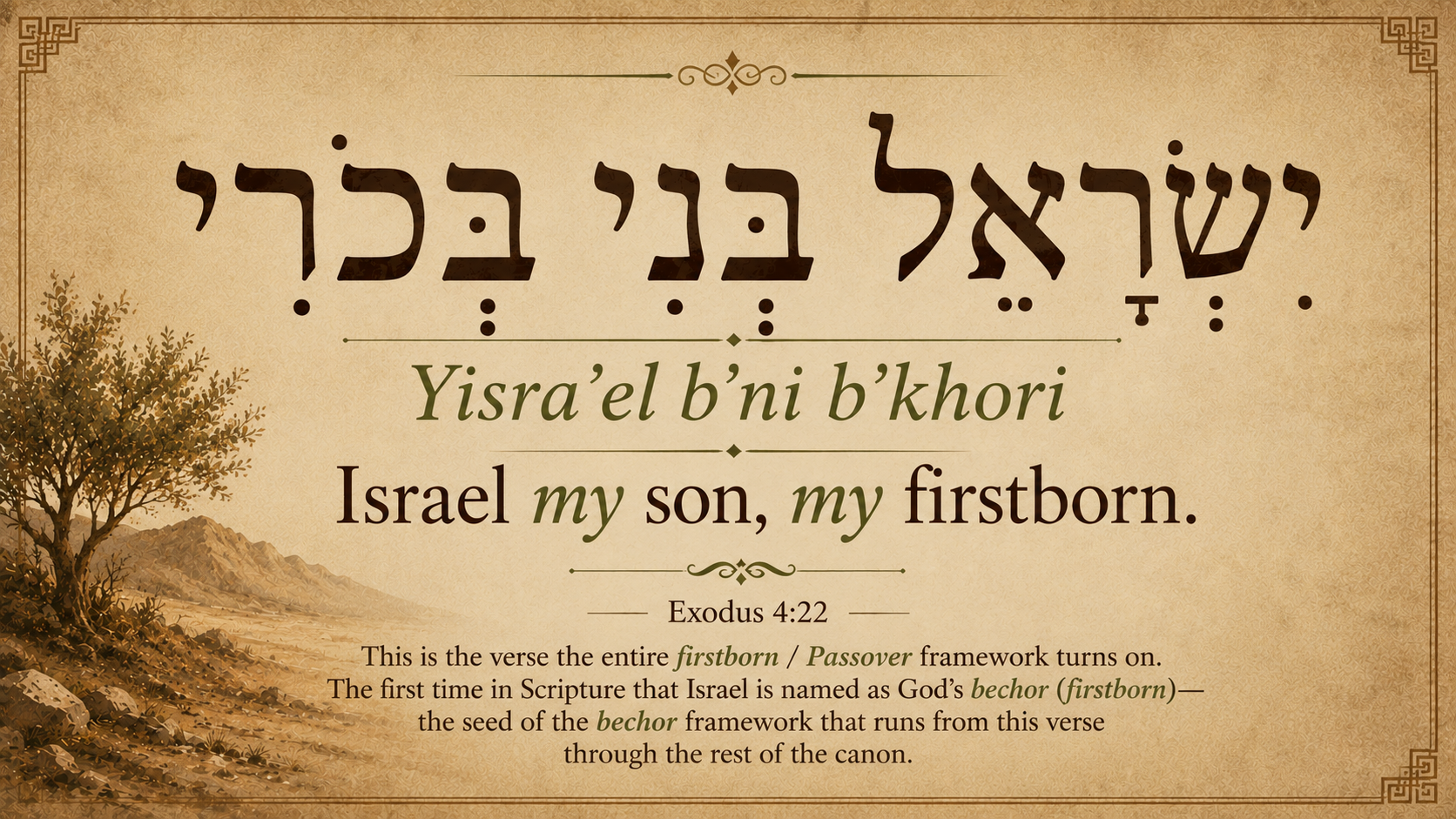
- Israel is my son, my firstborn. This is the chapter’s load-bearing theological line, and it is one of the most important verses in Exodus. The Hebrew is beni bekhori Yisra’el, my son, my firstborn, Israel. This is the first time in Scripture that Israel is named God’s firstborn son. The verse establishes the framework that the rest of the book will assume: Israel as bechor (firstborn), not the first-created nation, but the firstborn-by-vocation, the one given the responsibility to carry YHWH’s character to the rest of the family of nations. See The firstborn / bechor.
- Let my son go, that he may serve me. The Hebrew is shalach et beni ve-ya’avdeni, send my son out that he may worship me. The verb is avad: the same root as avodah: the same word for the slavery in Egypt and the worship at Sinai. The contest with Pharaoh is over whose son Israel is and whose service Israel is doing. Pharaoh has been treating Israel as his slaves. God claims them as his firstborn son. The plagues are the working out of this claim.
- I will kill your firstborn son. Already, in chapter 4, God names the tenth plague. The whole arc of the contest is foreshadowed: Pharaoh will refuse to let God’s firstborn go, and Pharaoh will lose his own firstborn. The text is signalling, before any plague happens, that the contest is firstborn for firstborn. The book is layering its theology in advance.
- On the way at a lodging place, Yahweh met Moses and wanted to kill him. Then comes the strangest paragraph in the chapter. The Hebrew is vayehi ba-derech ba-malon, vayifgashehu YHWH vay’vakesh hamito, and it happened on the way at the lodging-place, YHWH met him and sought to kill him. The pronouns are notoriously ambiguous: who is the him? Moses or his son? The ancient versions disagree; the modern commentaries disagree.
- Then Zipporah took a flint, and cut off the foreskin of her son, and cast it at his feet. Zipporah’s response makes the issue clear: circumcision. Moses, the Hebrew deliverer-elect, has not had his son circumcised. The covenant sign of Genesis 17 has not been honored in Moses’s own household. Zipporah, a Midianite woman, performs the circumcision herself with a flint knife and applies the blood to his feet (almost certainly a euphemism for the genitals, raglayim is the Hebrew Bible’s standard euphemism). She names the moment: you are a bridegroom of blood to me, chatan damim attah li.
- So he let him alone. The threat is averted. The crisis passes. Moses lives. The text gives us no explanation, no theological moralization. It simply records that the danger ended when Zipporah completed the covenant sign.
- What is the chapter teaching? Several layers:
- The covenant cuts both ways. Genesis 17:14 said clearly: the uncircumcised male… shall be cut off from his people; he has broken my covenant. Moses cannot lead a covenant people while his own son is outside the covenant. The covenant is not optional for the deliverer.
- Zipporah is a covenant participant. A Midianite woman performs the Hebrew covenant rite when her Hebrew husband has not. The deliverance of Moses depends, again, on a woman doing what should have been done. Like the midwives, like Pharaoh’s daughter, like Miriam: the women in this book keep saving things.
- The “bridegroom of blood” language signals covenant intimacy. Chatan damim: the language of blood-marriage, blood-covenant. Solomon’s reading: the hatan (bridegroom) word is one of the four words shared between Sodom (Gen 19) and Exodus (here and Ex 2:21), and the Hebrew Bible uses hatan in two precise contexts: a literal son-in-law and a covenantal blood-marriage. The Zipporah scene is, in a way, a re-marriage. Moses, by Zipporah’s act of bringing his son into covenant, is bound back to the covenant himself. The deliverer is re-married to the covenant by his Midianite wife.
- The deliverer is not exempt. This is the chapter’s pastoral edge. Moses cannot deliver Israel out of an unfinished obligation in his own house. God will not lower the standard for the deliverer. The path back to Egypt requires that the covenant be honored in Moses’s family before it can be the basis of Israel’s deliverance.
- Yahweh said to Aaron, “Go into the wilderness to meet Moses.” The chapter shifts back to its commissioning narrative. Aaron leaves Egypt while Moses is leaving Midian. They meet on God’s mountain, Horeb / Sinai again. The two brothers, separated for forty years, embrace at the mountain where God has already met Moses alone. Kissed him. The chapter records the tenderness without commentary.
- Moses and Aaron went and gathered together all the elders of the children of Israel. The deliverance begins, as so much of the Bible’s leadership begins, with a meeting of elders. The chapter is structurally consistent with the Hebrew Bible’s pattern: Moses does not bypass Israel’s existing leadership structures; he gathers them.
- Aaron spoke all the words… and did the signs in the sight of the people. The plan of vv. 14-16 is enacted: Aaron speaks for Moses, Moses works the signs. The two-brother team is operational from the start.
- The people believed. The Hebrew is vaya’amen ha’am. Moses’s first objection (they will not believe me) is answered. The signs work. The signs were for Israel, not for Pharaoh, and Israel believes.
- When they heard that Yahweh had visited the children of Israel. The verb is paqad, visited, the same word from Ex 3:16 and Joseph’s deathbed prophecy in Gen 50:24-25. The promise that Joseph spoke on his deathbed centuries ago is being kept now. Israel hears it and recognizes it.
- They bowed their heads and worshiped. The Hebrew is vayikdu vayishtachavu: they bowed their heads and prostrated themselves. The chapter ends with Israel’s first recorded worship in Exodus. Before the deliverance is accomplished: before the plagues, before the Sea, before Sinai: Israel responds to the news of God’s visiting with worship. The text is naming a pattern: worship is the right response to the news that God has heard, even before the deliverance is complete.
Influence callout: Carmen Joy Imes (Bearing God’s Name)
Imes reads the Zipporah incident as a foreshadowing of the larger pattern: the covenant relationship cannot be entered without blood. The Passover blood on the doorposts (Ex 12), the covenant blood at Sinai (Ex 24), and the temple sacrificial system all participate in the same logic. Chatan damim, the bridegroom of blood, names Moses’s first encounter with this logic. The deliverer goes back to Egypt only after blood has been applied to his own household. The pattern repeats at every level: Israel goes free only after blood has been applied to every Israelite household. The covenant cuts both ways. The God who delivers is the God who claims, and the claim is sealed in blood.
Reflection prompts
- What is that in your hand? God’s first question to Moses points to the ordinary tool of his ordinary work. The shepherd’s staff is the deliverance tool. Where, in your own ordinary tools, is God already preparing the means of his work? What have you been holding for years without recognizing what it is for?
- Moses keeps offering objections, and God keeps answering with a deeper version of I will be with you. The promise narrows in scope each time, with you, with your mouth, with you and Aaron, but never disappears. Where, in your own resistance to a call, are you trying to argue God out of the assignment? What if the right response is not the next objection but to go?
- The Zipporah incident teaches that the deliverer cannot deliver Israel out of an unfinished obligation in his own house. What unfinished obligation is in your own house, your own family, your own life, that you have been carrying into your work without honoring? What needs to be circumcised before you can keep going?
Frameworks at play in this chapter: the firstborn / bechor, the exodus pattern.