
Exodus 34 is the most theologically dense single chapter in the Pentateuch. The covenant was given on Sinai; the people broke it with the calf; the tablets were smashed at the base of the mountain. Moses interceded twice. YHWH has agreed to send his presence (33:14) and to let Moses see his back (33:23). Now chapter 34 records the actual passing-by. YHWH descends in the cloud and proclaims his Name: YHWH, YHWH, a God merciful and gracious, slow to anger, abounding in steadfast love and faithfulness, keeping steadfast love for thousands, forgiving iniquity and transgression and sin, but who will by no means clear the guilty. This thirteen-word self-description (in Hebrew) is the most-quoted single verse in the rest of the Hebrew Bible. The prophets quote it (Joel 2:13, Jon 4:2, Nah 1:3, Mic 7:18-19); the Psalms quote it (Ps 86:15, 103:8, 145:8); the Hebrew Bible’s whole theology of YHWH’s character is built on it.
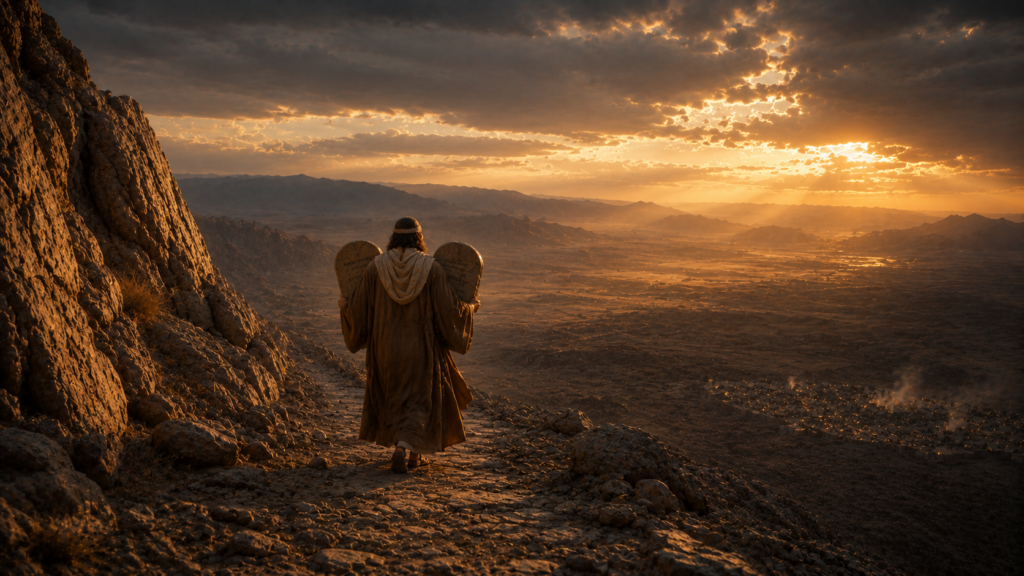
After the self-revelation, the chapter records covenant renewal: a fresh set of stipulations (a re-issuing, in updated form, of the covenant the calf broke), forty more days on the mountain without food or water, and a second set of tablets written. The chapter ends with Moses descending. His face shines. He does not know it. The people are afraid. He veils his face when speaking to them but unveils it when speaking with YHWH.
The chapter is the Hebrew Bible’s clearest answer to the question Exodus 32 raised: how does the covenant continue after it has been broken? The answer is: by the proclamation of a Name whose first word is mercy. The whole later theological tradition reads this chapter as the most concentrated revelation of God’s character in the Pentateuch.
A · Exodus 34:1-9 · The new tablets, the passing-by, and the proclaimed Name
¹ Yahweh said to Moses, “Chisel two stone tablets like the first: and I will write on the tablets the words that were on the first tablets, which you broke. ² Be ready by the morning, and come up in the morning to Mount Sinai, and present yourself there to me on the top of the mountain. ³ No one shall come up with you; neither let anyone be seen throughout all the mountain; neither let the flocks nor herds feed before that mountain.” ⁴ He chiseled two tablets of stone like the first; and Moses rose up early in the morning, and went up to Mount Sinai, as Yahweh had commanded him, and took in his hand two stone tablets. ⁵ Yahweh descended in the cloud, and stood with him there, and proclaimed the name of Yahweh. ⁶ Yahweh passed by before him, and proclaimed, “Yahweh! Yahweh, a merciful and gracious God, slow to anger, and abundant in loving kindness and truth, ⁷ keeping loving kindness for thousands, forgiving iniquity and disobedience and sin; and that will by no means clear the guilty, visiting the iniquity of the fathers on the children, and on the children’s children, on the third and on the fourth generation.” ⁸ Moses hurried and bowed his head toward the earth, and worshiped. ⁹ He said, “If now I have found favor in your sight, Lord, please let the Lord go in the middle of us; although this is a stiff-necked people; pardon our iniquity and our sin, and take us for your inheritance.”
- Chisel two stone tablets like the first (v. 1). The Hebrew is pesol-lekha shenei luchot avanim ka-rishonim. This time, Moses is to chisel the tablets. The first set was the work of God, the writing of God, engraved on the tablets (32:16). The second set is chiseled by Moses; YHWH will write the words on them, but the stone itself is now Moses’s manual work. The chapter is teaching that the renewed covenant requires more human participation than the first one did. The mediator is now responsible for the stone; YHWH supplies the words. The rabbinic tradition reads this as a deliberate signal of grace mediated through human labor. The Torah is, on this reading, not less holy because Moses chiseled the stone; it is more deeply integrated into the people’s life because the mediator carried it up.
- No one shall come up with you (v. 3). The chapter is unusually careful. At the original giving of the law (19:10-25), the people stood at the foot of the mountain while elders climbed partway. Now, after the calf, no one is allowed on or near the mountain. The flocks and herds are excluded. The chapter is teaching that the renewed covenant is given in tighter perimeter. Israel has shown that proximity to the holy is dangerous to them; the perimeter is set back. The whole later Hebrew Bible’s careful handling of access to the sanctuary (graded by priestly rank, ritual purity, gender) takes its texture from this chapter.
- Yahweh descended in the cloud, and stood with him there, and proclaimed the name of Yahweh (v. 5). The chapter’s first climax. The same cloud that has framed YHWH’s presence since the bush (3:2) and the Exodus (13:21) and the Sinai theophany (19:9) now descends with him. The verb vayityatzev (stood with him) is unusually intimate; the same root names taking a stand alongside, standing in solidarity. The chapter is teaching that YHWH’s revelation here is companionate, not distant. YHWH stands with Moses while proclaiming.
- Yahweh! Yahweh, a merciful and gracious God, slow to anger, and abundant in loving kindness and truth, keeping loving kindness for thousands, forgiving iniquity and disobedience and sin (vv. 6-7a). The chapter’s most theologically loaded sentence. The Hebrew is YHWH YHWH El rachum ve-channun erekh appayim ve-rav chesed ve-emet, notzer chesed la-alafim, nose avon va-fesha ve-chatta’ah. Note the structure. The Name is spoken twice (the only place in the Hebrew Bible where YHWH’s name is doubled in self-proclamation). Then thirteen attributes in three groupings: (a) merciful and gracious; (b) slow to anger; (c) abundant in chesed and emet. Then the durative claim: keeping chesed for thousands. Then the forgiveness triad: forgiving iniquity (avon), transgression (pesha), and sin (chatta’t). The three Hebrew words for sin are the comprehensive triad: avon names twisted moral character; pesha names rebellion, breach of covenant; chatta’t names missing the mark. The proclamation covers them all. The chapter is teaching: YHWH forgives the whole structure of sin.
- That will by no means clear the guilty, visiting the iniquity of the fathers on the children, and on the children’s children, on the third and on the fourth generation (v. 7b). The proclamation does not stop at unconditional mercy. It includes judgment. The chapter is teaching that the Name is the whole of YHWH’s character: mercy and justice are not in tension; they are the single divine self-description. The Hebrew syntax allows the verses to read as paired truths: YHWH forgives sin, and YHWH does not pretend sin had no consequences. The whole later prophetic tradition will hold these together (Mic 7:18-20 quotes the verse for mercy; Nah 1:2-3 quotes it for judgment). The chapter refuses to choose. The reader is invited to hold both.
Word study: chesed (חֶסֶד) and emet (אֱמֶת)
The Hebrew word chesed is the chapter’s deepest theological term. It is usually translated steadfast love, loving kindness, mercy. Its semantic core is covenant loyalty in action: the chesed-doer goes beyond what is owed, in faithful kindness toward the one to whom they are bound. Emet is truth, but the Hebrew sense is more firmness, fidelity, reliability than abstract correctness. Chesed and emet together name faithful and reliable covenant love. The Hebrew Bible’s later theology will repeatedly bind these two together (Ps 25:10, 40:11, 85:10, 89:14). In John 1:14, the gospel writer describes the incarnate Word as full of grace and truth, which is the standard Septuagint and rabbinic Greek translation of chesed ve-emet. The chapter is the canonical seed of John’s grace and truth description of Christ.
- Pardon our iniquity and our sin, and take us for your inheritance (v. 9). Moses, the moment he hears the proclamation, prays its language back. He uses the same words avon and chatta’t the proclamation just used. The chapter is teaching that hearing the Name proclaimed is hearing how to pray. Moses’s intercession is shaped by YHWH’s own self-description. The chapter is teaching what prayer looks like: YHWH says who he is; the people pray accordingly. The verb nachal (to inherit, to take possession) is the chapter’s last petition. Take us for your inheritance asks YHWH to claim Israel as his own permanent property. The chapter is recording the deepest possible request: make us yours, irrevocably.
B · Exodus 34:10-28 · The covenant renewal
¹⁰ He said, “Behold, I make a covenant: before all your people I will do marvels, such as have not been worked in all the earth, nor in any nation; and all the people among which you are shall see the work of Yahweh; for it is an awesome thing that I do with you. ¹¹ Observe that which I command you this day. Behold, I drive out before you the Amorite, the Canaanite, the Hittite, the Perizzite, the Hivite, and the Jebusite. ¹² Be careful, lest you make a covenant with the inhabitants of the land where you are going, lest it be for a snare in the middle of you: ¹³ but you shall break down their altars, and dash in pieces their pillars, and you shall cut down their Asherah poles; ¹⁴ for you shall worship no other god: for Yahweh, whose name is Jealous, is a jealous God. ¹⁵ “Don’t make a covenant with the inhabitants of the land, lest they play the prostitute after their gods, and sacrifice to their gods, and one call you and you eat of his sacrifice; ¹⁶ and you take of their daughters to your sons, and their daughters play the prostitute after their gods, and make your sons play the prostitute after their gods. ¹⁷ “You shall make no cast idols for yourselves. ¹⁸ “You shall keep the feast of unleavened bread. Seven days you shall eat unleavened bread, as I commanded you, at the time appointed in the month Abib; for in the month Abib you came out of Egypt. ¹⁹ “All that opens the womb is mine; and all your livestock that is male, the firstborn of cow and sheep. ²⁰ The firstborn of a donkey you shall redeem with a lamb: and if you will not redeem it, then you shall break its neck. All the firstborn of your sons you shall redeem. No one shall appear before me empty. ²¹ “Six days you shall work, but on the seventh day you shall rest: in plowing time and in harvest you shall rest. ²² “You shall observe the feast of weeks with the first fruits of wheat harvest, and the feast of harvest at the year’s end. ²³ Three times in the year all your males shall appear before the Lord Yahweh, the God of Israel. ²⁴ For I will drive out nations before you and enlarge your borders; neither shall any man desire your land when you go up to appear before Yahweh, your God, three times in the year. ²⁵ “You shall not offer the blood of my sacrifice with leavened bread; neither shall the sacrifice of the feast of the Passover be left to the morning. ²⁶ “You shall bring the first of the first fruits of your ground to the house of Yahweh your God. “You shall not boil a young goat in its mother’s milk.” ²⁷ Yahweh said to Moses, “Write these words: for in accordance with these words I have made a covenant with you and with Israel.” ²⁸ He was there with Yahweh forty days and forty nights; he neither ate bread, nor drank water. He wrote on the tablets the words of the covenant, the ten commandments.
- Behold, I make a covenant (v. 10). The Hebrew verb is koret (cut). The chapter is using the technical idiom for covenant-making: to cut a covenant (cf. Gen 15:18, YHWH cut a covenant with Abram). The chapter is recording the renewal of the broken covenant in formal covenant-cutting language. The book is teaching that the Sinai covenant is not patched; it is re-cut. The same theological move underlies the New Testament’s language of the new covenant (Jer 31:31; Lk 22:20): a fresh cutting, not a repair.
- Marvels such as have not been worked in all the earth (v. 10). The chapter promises future marvels of the same magnitude as the plagues. The Hebrew nifla’ot (wonders, marvels) is the standard Hebrew Bible word for miraculous acts. The chapter is teaching that the renewed covenant comes with a renewed promise of YHWH’s action in the world. The same God who worked the plagues, the Sea, and the manna will continue to work. The book is teaching that the renewed covenant is forward-facing. It does not just memorialize the rescue; it commits YHWH to more work on Israel’s behalf.
- Break down their altars, dash in pieces their pillars, cut down their Asherah poles (v. 13). The chapter’s strongest commandment for entering Canaan. The Hebrew Bible is unambiguous about Canaanite cultic infrastructure: it must be broken, dashed, cut down. The verbs are violent. The chapter is teaching that coexistence with the surrounding altars is not an option for Israel. The Hebrew Bible’s later anxieties about high places not being torn down (a recurring lament in 1-2 Kings) take their authority from this verse. The pastoral reception of this commandment in the Christian tradition has, of course, varied widely. The chapter’s literal historical command was, in its first reading, an ancient Near Eastern command for the early settlement period. The chapter’s theological core, the refusal to combine YHWH-worship with the altars of other gods, is the durable point that the prophets carry forward.
- For Yahweh, whose name is Jealous, is a jealous God (v. 14). The Hebrew is YHWH qana shemo, El qana hu. The name Qana (jealous, zealous) is, in this verse, named as YHWH’s actual name. The chapter is teaching that jealousy, in the Hebrew Bible’s idiom, is the love that refuses to share the beloved. It is the protective intensity of covenant fidelity. The verb qana shares a root with the Hebrew Bible’s word for zeal, qin’ah. The chapter is using the language of marital exclusivity to name YHWH’s covenant relationship with Israel. The whole later prophetic tradition (Hos 1-3, Jer 2-3, Ezek 16) will develop the marriage-covenant theology that takes this verse as its anchor.
- Three times in the year all your males shall appear before the Lord Yahweh (v. 23). The chapter institutes the three pilgrim festivals: Unleavened Bread (Passover), Weeks (Pentecost), and Harvest (Booths/Tabernacles). The Hebrew word chag (pilgrim festival) names a cyclical festival requiring physical travel to the central sanctuary. The chapter is establishing the rhythm that will structure Israel’s calendar for the next twelve hundred years (and that still structures the Jewish liturgical year). The whole later prophetic tradition’s reference to the festivals (Isa 1:13-14; Amos 5:21-23; Jn 7:2 for the Feast of Booths) presumes this chapter’s institution.
- You shall not boil a young goat in its mother’s milk (v. 26). The chapter’s most cryptic single line. The same prohibition appears three times in the Torah (also at 23:19 and Deut 14:21). The rabbinic tradition reads it as the basis for the kashrut (kosher dietary law) of not mixing meat and dairy, and the rabbinic kitchen practice that follows from it. The historical-critical reading suggests an ANE polemic against a specific Canaanite fertility rite. The chapter’s force, in either reading, is refusal to participate in the cultic patterns of the surrounding nations. The chapter does not explain why; it commands.
- He was there with Yahweh forty days and forty nights; he neither ate bread, nor drank water (v. 28). The chapter’s most physically extreme detail. Moses’s second forty-day fast on the mountain is complete: no bread, no water. The Hebrew Bible’s typological pattern of forty days in the wilderness (Elijah at 1 Kings 19:8; Jesus at Mt 4:2) takes its texture from this chapter. The chapter is teaching that sustained encounter with YHWH enables the body to live in ways that ordinary physiology cannot account for. The whole later Christian tradition of fasting in preparation for spiritual encounter has roots here.
C · Exodus 34:29-35 · The shining face and the veil
²⁹ When Moses came down from Mount Sinai with the two tablets of the testimony in Moses’ hand, when he came down from the mountain, Moses didn’t know that the skin of his face shone by reason of his speaking with him. ³⁰ When Aaron and all the children of Israel saw Moses, behold, the skin of his face shone; and they were afraid to come near him. ³¹ Moses called to them, and Aaron and all the rulers of the congregation returned to him; and Moses spoke to them. ³² Afterward all the children of Israel came near, and he gave them all the commandments that Yahweh had spoken with him on Mount Sinai. ³³ When Moses was done speaking with them, he put a veil on his face. ³⁴ But when Moses went in before Yahweh to speak with him, he took the veil off, until he came out; and he came out, and spoke to the children of Israel that which he was commanded. ³⁵ The children of Israel saw Moses’ face, that the skin of Moses’ face shone: and Moses put the veil on his face again, until he went in to speak with him.
- The skin of his face shone (v. 29). The Hebrew is qaran or panav, “the skin of his face had become horn-like.” The verb qaran shares a root with the noun qeren (horn) and can mean either radiate light or grow horns. Jerome’s Latin Vulgate famously translated this cornuta esset facies (his face was horned), which is why Michelangelo’s Moses statue has horns on his head. The standard reading is shine, radiate, but the horn-ambiguity has theological resonance: Moses’s face has become something other than ordinary, marked permanently by the encounter. The chapter is teaching that prolonged exposure to YHWH’s presence visibly alters the mediator. The shining is not chosen; it is the physical residue of being with God.
- Moses didn’t know that the skin of his face shone (v. 29). The chapter’s most pastorally tender line. Moses himself does not know. The transformation is unselfconscious. The chapter is teaching that the truest signs of having been with God are the ones the saint does not notice. The Hebrew Bible refuses to make Moses’s shining face a matter of pride or display. He does not know it is there. He proceeds to do his work normally. The whole later Christian tradition’s commitment to unselfconscious holiness (Mt 6:1-18, “do not let your left hand know what your right hand is doing”) takes its image from this verse.
- They were afraid to come near him (v. 30). The chapter records Israel’s reaction. The same fear that gripped the people at the sight of the cloud and fire on Sinai (20:18) now grips them at the sight of the reflected glory on Moses’s face. The chapter is teaching that contact with mediated holiness is itself overwhelming. Israel’s distance is not faithlessness but appropriate awe. The mediator has to call them back: Moses called to them.
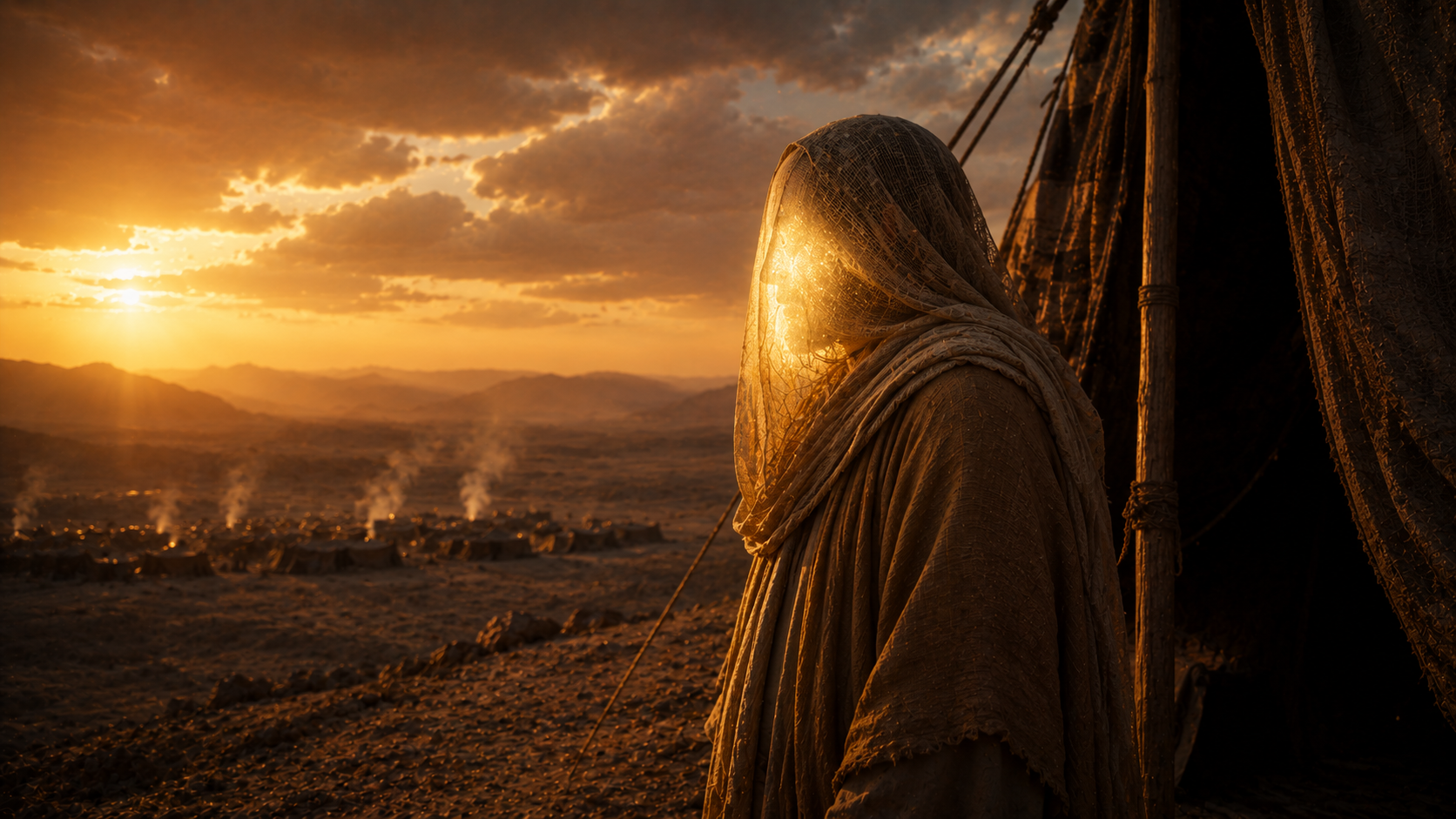
- He put a veil on his face (v. 33). The Hebrew masveh (veil) names a covering cloth. The chapter is teaching that the mediator’s covered face is a concession to the people. The veil does not protect Moses; it protects Israel from a brightness they cannot bear. The same logic that ran through the priestly garments (linen for the priest’s body, that the priest not die at 28:43) runs here: the holy must be appropriately covered for the people to remain in its presence. The chapter is teaching that mediation requires veiling, not because the holy is shameful but because the unprepared cannot bear it raw.
- When Moses went in before Yahweh to speak with him, he took the veil off (v. 34). The chapter establishes the pattern: Moses unveils when speaking with YHWH; he veils when speaking with the people. The two postures are different. The chapter is teaching that the mediator has two faces: one toward God (open, unmediated), one toward the people (covered, appropriately mediated). The whole later prophetic and apostolic tradition will know this rhythm: time alone with God, then proclamation to the people.
Influence callout: Paul on the Veil (2 Corinthians 3:7-18, the Christological-eschatological reading)
Paul’s reading of Exodus 34:29-35 in 2 Corinthians 3:7-18 is the New Testament’s deepest engagement with this chapter. Paul reads Moses’s veil as a sign of the fading glory of the old covenant: Moses veiled his face not (Paul argues, with some interpretive license) just to protect Israel, but to hide the fact that the glory was fading. The new covenant’s glory, in Paul’s reading, does not fade; therefore, we who have come under the new covenant proceed unveiled (2 Cor 3:18: we all, with unveiled face, beholding the glory of the Lord, are being transformed into the same image from one degree of glory to another). The chapter, on Paul’s reading, sets up the contrast structure the New Testament will use to describe the indwelling Spirit’s transformation of the believer. Christ is the unveiled glory; the church is the unveiled face. The chapter, in Paul’s reading, foreshadows a moment when the veil comes off permanently and the transformation is mutual. Modern readers should hold both readings together: the chapter in its own first-century Jewish Israel-after-Sinai context (the literal historical situation Exodus is recording), and the chapter as Paul read it through a Christological-eschatological lens (the reading that has shaped Christian doctrine for two thousand years). The chapter is one of the most theologically reused single passages in the canon. Paul’s reading, whatever one thinks of its hermeneutical method, is itself part of the chapter’s canonical legacy.
Reflection prompts
- The chapter teaches that YHWH’s deepest self-description (vv. 6-7) is merciful, gracious, slow to anger, abundant in chesed and emet, forgiving iniquity, transgression, and sin. This thirteen-word self-description is the most quoted single verse in the rest of the Hebrew Bible. Memorize it. Pray it. Let it shape what you assume about God when you do not know what to assume.
- Moses’s face shines, and he does not know it. The signs of having been with God are often the ones the saint cannot see. Where in your own life might someone else be seeing the residue of an encounter you yourself have not noticed?
- The chapter institutes three annual pilgrim festivals. Three times a year the people are to travel to YHWH. What three times of year do you deliberately travel to God in your own calendar? If there are none, what would it look like to establish even one?
Frameworks at play in this chapter: bearing God’s name, the Sinai covenant.