
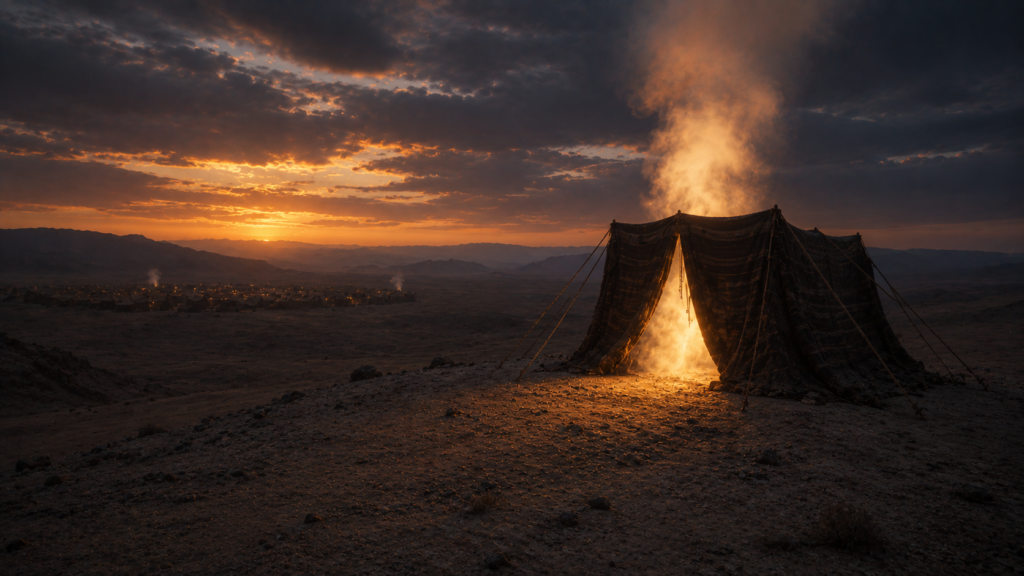
Exodus 33 is the book’s deepest theological chapter. The calf has been made and broken; the three thousand have fallen; Moses has interceded twice. Now the chapter we have before us asks what becomes possible when an unfaithful people and a faithful mediator stand together before a holy God who is rightly angry. YHWH announces that he will send Israel up to the land but he himself will not go with them. The people mourn. Moses pitches a tent outside the camp and there speaks to YHWH face to face, as a man speaks to his friend. The mediator argues: if your presence does not go with us, do not bring us up from here. The chapter’s climactic exchange is Moses’s request, show me your glory, and YHWH’s response: I will make all my goodness pass before you (a hand will shield Moses in the cleft of a rock as YHWH passes; Moses will see the back, not the face).
The chapter is structurally the theological foundation of every later Hebrew Bible doctrine of the presence of God. The Hebrew word panim (face, presence) appears eighteen times in the chapter. The Hebrew word kavod (glory) appears at the climactic v. 18. The Hebrew word tov (goodness) appears at the response v. 19. The chapter is teaching what the holy looks like when humans want to see it: it is composed of presence, glory, and goodness, and even the mediator cannot see the face directly.
Christian and Jewish traditions have both read this chapter as one of Scripture’s deepest texts on the visible-invisible tension at the heart of theological epistemology. Augustine, Cyril of Alexandria, and Gregory of Nyssa wrote major treatises on it. The New Testament quotes it at 2 Cor 3-4 (Paul’s reading of the veil on Moses’s face) and at John 1:18 (no one has ever seen God; the only begotten Son has made him known). The chapter is foundational.
A · Exodus 33:1-11 · The threatened absence, the people’s mourning, and the tent outside the camp
¹ Yahweh spoke to Moses, “Depart, go up from here, you and the people that you have brought up out of the land of Egypt, to the land of which I swore to Abraham, to Isaac, and to Jacob, saying, ‘I will give it to your offspring.’ ² I will send an angel before you; and I will drive out the Canaanite, the Amorite, and the Hittite, and the Perizzite, the Hivite, and the Jebusite: ³ to a land flowing with milk and honey: for I will not go up in the midst of you, for you are a stiff-necked people, lest I consume you on the way.” ⁴ When the people heard this evil news, they mourned: and no one put on his jewelry. ⁵ Yahweh said to Moses, “Tell the children of Israel, ‘You are a stiff-necked people: if I were to go up into your midst for one moment, I would consume you. Therefore now take off your jewelry from you, that I may know what to do to you.’” ⁶ The children of Israel stripped themselves of their jewelry from Mount Horeb onward. ⁷ Now Moses used to take the tent and to pitch it outside the camp, far away from the camp, and he called it “The Tent of Meeting.” Everyone who sought Yahweh went out to the Tent of Meeting, which was outside the camp. ⁸ When Moses went out to the Tent, that all the people rose up, and stood, everyone at their tent door, and watched Moses, until he had gone into the Tent. ⁹ When Moses entered into the Tent, the pillar of cloud descended, stood at the door of the Tent, and Yahweh spoke with Moses. ¹⁰ All the people saw the pillar of cloud stand at the door of the Tent, and all the people rose up and worshiped, everyone at their tent door. ¹¹ Yahweh spoke to Moses face to face, as a man speaks to his friend. He turned again into the camp, but his servant Joshua, the son of Nun, a young man, didn’t depart out of the Tent.
- I will not go up in the midst of you, for you are a stiff-necked people, lest I consume you on the way (v. 3). YHWH’s announcement is the chapter’s first crisis. The deliverance will be completed (the land will be given), but YHWH himself will not travel with the people. An angel will go in his place. The Hebrew is anokhi lo e’eleh be-qirbekha, “I myself will not go up in your midst.” The prepositional phrase be-qirbekha (in your midst) is precisely the language of indwelling from 29:45: I will dwell in the midst of the children of Israel. The chapter is announcing the withdrawal of the very thing the tabernacle was being built to enable. The whole project of chapters 25-31 is threatened.
- Lest I consume you on the way (v. 3). YHWH names the danger of his own presence to an unfaithful people. The holy is, in the Hebrew Bible’s logic, dangerous to the unholy. Closeness to YHWH is not benign for a stiff-necked people. The chapter is teaching that the divine presence is not a sentimental nearness; it is a weight (cf. kavod) that the unprepared cannot bear. The withdrawal is, in this sense, mercy. But it is not the mercy the people need; they need the presence itself.
- They mourned: and no one put on his jewelry (v. 4). The people respond not with festival, but with mourning. The Hebrew vayit’abalu names the formal mourning posture: torn garments, ashes, no ornaments. Note the irony. The same jewelry (Hebrew edyo, ornament) that was used to make the calf in 32:2-3 is now stripped off in grief. The people who gave their gold to the calf now strip their gold to mourn. The chapter is teaching that genuine repentance involves the same materials that produced the sin. The gold that became the idol must now be taken off the body that worshipped it. The chapter is recording an act of genuine penitence in the form of un-adorned mourning.
- Moses used to take the tent and to pitch it outside the camp (v. 7). The Hebrew verb is in the iterative imperfect, signaling habitual action: this is what Moses kept doing, not just one instance. The chapter is recording a new practice. Moses sets up a tent outside the camp, far from the people, and he calls it the Tent of Meeting (ohel mo’ed, the same name that the formal tabernacle will receive once it is built). The book is teaching that the meeting-with-YHWH must, in this transitional moment, happen outside the camp. The camp is unclean from the calf. The tent that will eventually sit at the center of the camp (cf. Num 2) is, at this provisional stage, exiled to the perimeter. The whole later prophetic tradition of the prophet outside the gate (Jer 38:6; Heb 13:13) takes its texture from this chapter.
- Yahweh spoke to Moses face to face, as a man speaks to his friend (v. 11). The chapter’s first climactic line. The Hebrew is vediber YHWH el-moshe panim el-panim ka-asher yedaber ish el-re’ehu. Panim el-panim, “face to face,” is the Hebrew Bible’s most direct idiom for full personal encounter. Ka-asher yedaber ish el-re’ehu, “as a man speaks to his friend,” is even more striking: the encounter is conversational, peer-language. Moses is being given access to YHWH that is, the Hebrew Bible’s later texts will say, unprecedented and unequaled (cf. Deut 34:10: there has not arisen a prophet since in Israel like Moses, whom YHWH knew face to face). The chapter is teaching that the mediator’s access is qualitatively different from anyone else’s. This will be the chapter’s deepest theological pivot: even Moses, who speaks face to face, cannot finally see the face. The two will be distinguished at v. 20.
Word study: panim (פָּנִים) and kavod (כָּבוֹד)
Two Hebrew words structure this chapter. Panim is the plural noun face or faces; it doubles as the standard word for presence (the bread of the presence in 25:30 is lechem ha-panim, “bread of the face”). To seek the face of someone, in Hebrew Bible idiom, is to seek their full personal presence. The chapter uses panim eighteen times, more than any other chapter in Exodus. The Hebrew Bible’s later vocabulary of seeking the face of YHWH (Ps 27:8, 1 Chron 16:11) takes its theological depth from this chapter. Kavod is glory, weight, substantial presence. The same root kavad names being heavy. Kavod is YHWH’s visible weight, what appeared on Sinai as cloud and fire, what filled the tabernacle in 40:34-35, what departed the temple in Ezek 10. The chapter is staging Moses’s request as a movement from panim (presence in conversation) to kavod (visible glorious weight). The shift will turn out to be impossible. Panim is the chapter’s reachable register; kavod is the chapter’s untranslatable horizon.
B · Exodus 33:12-17 · The prayer for the presence
¹² Moses said to Yahweh, “Behold, you tell me, ‘Bring up this people:’ and you haven’t let me know whom you will send with me. Yet you have said, ‘I know you by name, and you have also found favor in my sight.’ ¹³ Now therefore, if I have found favor in your sight, please show me your way, now, that I may know you, so that I may find favor in your sight: and consider that this nation is your people.” ¹⁴ He said, “My presence will go with you, and I will give you rest.” ¹⁵ He said to him, “If your presence doesn’t go with me, don’t carry us up from here. ¹⁶ For how would people know that I have found favor in your sight, I and your people? Isn’t it that you go with us, so that we are separated, I and your people, from all the people who are on the surface of the earth?” ¹⁷ Yahweh said to Moses, “I will do this thing also that you have spoken; for you have found favor in my sight, and I know you by name.”

- Whom you will send with me (v. 12). Moses’s first complaint addresses the replacement-by-angel offer in v. 2. He is, in effect, refusing it. You haven’t told me who is going with me. The chapter is teaching that Moses will not accept an angelic substitute for the presence of YHWH himself. The same pattern that emerged at chapter 32 (Moses refusing the offer to be the new Abraham) reappears here: Moses insists on the original arrangement. He does not want an angel; he wants YHWH.
- Please show me your way, that I may know you (v. 13). The Hebrew hodi’eni-na et-derakhekha ve-edaakha, “let me know your way, so that I may know you.” The verb yada (to know) appears twice, in the sense of intimate, experiential knowing. The chapter is teaching that knowledge of YHWH is not propositional information; it is familiarity with how YHWH does things. YHWH’s way is YHWH’s characteristic pattern. Moses wants to know YHWH by knowing how he moves. This will reappear later in the Hebrew Bible at Ps 25:4 and Jer 9:23-24. The chapter is recording a deep epistemological commitment: to know God is to know how God acts in the world, not (only) to know correct things about God.
- Consider that this nation is your people (v. 13). Moses returns to the pronoun-question of 32:7. YHWH had called the people your people, whom you brought up. Moses had returned the pronouns to your people, whom you have brought up in 32:11. Now, again, Moses presses: this nation is your people. The chapter is teaching that intercession is the work of restoring the divine claim. The mediator does not generate the relationship; he keeps reminding YHWH that it exists.
- My presence will go with you, and I will give you rest (v. 14). YHWH’s response is brief and decisive. Panai yelechu va-hanichoti lakh, “my face/presence will go, and I will give you rest.” The same panim that Moses has been using is now used by YHWH. The chapter is teaching that the right word, repeatedly used, opens the door. Moses has prayed panim prayers; YHWH responds with a panim promise. The added gift is rest (menuchah), the same word that names the Sabbath-rest of Gen 2:2 and the Promised Land of Deut 12:9. To have YHWH’s panim with you is to have menuchah. The chapter is binding these two together.
- If your presence doesn’t go with me, don’t carry us up from here (v. 15). Moses’s response is the chapter’s deepest theological declaration. Im-ein panekha holekhim al-ta’aleinu mizzeh. The conditional is total. If there is no panim, there is no journey. The land itself is worthless without the presence. The chapter is teaching that the purpose of the Exodus is not the land; the purpose is being with YHWH. Land without presence is not the Promised Land. The geography is meaningful only because of the theology. The verse is one of the Hebrew Bible’s deepest single statements of Christological-Trinitarian orientation, in retrospect: the land is not the gift; the presence is the gift.
- How would people know that I have found favor in your sight, I and your people (v. 16). Moses’s argument is also covenant-identity: Israel’s distinctness from all the peoples on the face of the earth depends on YHWH’s accompanying presence. Israel is not, in the chapter’s logic, the most ethically advanced people, nor the most numerous people, nor the most accomplished people. Israel is the people whom YHWH walks with. Take away the walking-with, and the distinction collapses. The chapter is teaching that Israel’s identity is relational, not essentialist. The same theology will inform the New Testament’s image of the church.
C · Exodus 33:18-23 · “Show me your glory” and the cleft of the rock
¹⁸ He said, “Please show me your glory.” ¹⁹ He said, “I will make all my goodness pass before you, and will proclaim the name of Yahweh before you. I will be gracious to whom I will be gracious, and will show mercy on whom I will show mercy.” ²⁰ He said, “You cannot see my face, for man may not see me and live.” ²¹ Yahweh also said, “Behold, there is a place by me, and you shall stand on the rock. ²² It will happen, while my glory passes by, that I will put you in a cleft of the rock, and will cover you with my hand until I have passed by; ²³ then I will take away my hand, and you will see my back; but my face shall not be seen.”
- Please show me your glory (v. 18). The Hebrew is har’eni-na et-kevodekha, “let me see your kavod.” Moses, having already received the promise of presence (panim), now asks for more. The Hebrew Bible is recording one of its deepest patterns: the more YHWH gives, the more the mediator asks. Moses already speaks face to face, has the promised journey, has the divine presence guaranteed. He asks for one more thing: to see the visible weight of God. The chapter is teaching that the desire to know God is insatiable in the saint, and that the desire is not condemned. YHWH does not rebuke Moses for asking. He answers the request.
- I will make all my goodness pass before you, and will proclaim the name of Yahweh before you (v. 19). YHWH translates the request. Kavod (glory, visible weight) is reframed as tov (goodness) and shem (name). The chapter is teaching that the glory of YHWH is not, primarily, visual fire; it is goodness and name. The same translation happens at 34:6-7, when YHWH actually passes by: the proclaimed name is YHWH, YHWH, a God merciful and gracious, slow to anger, abounding in steadfast love and faithfulness. The chapter is teaching that to see God’s glory is to hear God’s character. The Hebrew Bible’s preference for ear-knowledge over eye-knowledge is foundational here.
- I will be gracious to whom I will be gracious, and will show mercy on whom I will show mercy (v. 19). The Hebrew is ve-channoti et-asher achon ve-richamti et-asher arachem. The construction is grammatically tautological: I will favor whom I favor. The chapter is teaching that grace and mercy are sovereignly free. YHWH does not owe them; he gives them. Paul will quote this verse at Rom 9:15 to ground his doctrine of divine election. The chapter is the New Testament’s deepest single Old Testament prooftext for unconditional grace.
- You cannot see my face, for man may not see me and live (v. 20). The chapter’s hardest sentence. The same Moses to whom YHWH speaks face to face (v. 11) is told he cannot see the face. The two statements are not contradictory in the Hebrew Bible’s idiom: panim el-panim in v. 11 means intimate personal conversation (the peer-meeting idiom); to see the face in v. 20 means visual reception of the unfiltered divine being. The first is possible for the mediator; the second is not possible for any human in mortal life. The Hebrew Bible’s later texts will affirm this consistently (Jn 1:18, no one has ever seen God; 1 Tim 6:16, who dwells in unapproachable light, whom no one has ever seen or can see). The chapter is the canonical seed of this theological reserve.
- Behold, there is a place by me, and you shall stand on the rock (v. 21). YHWH offers a specific place. The Hebrew maqom itti, “a place with me,” is the chapter’s most spatially intimate phrase. There is a with-me-place. The chapter is teaching that the mediator’s station is not abstract; it has location. The rabbinic tradition will later use ha-maqom (the place) as one of YHWH’s own names, with reference to this chapter. The standing-place is on the rock. The Hebrew ha-tzur (the rock) will reappear in Deut 32:4 as YHWH himself: the rock, his work is perfect. The chapter is layering the geography with theology.
- I will put you in a cleft of the rock, and will cover you with my hand (v. 22). The chapter’s most patristically-quoted image. Moses is placed in a cleft (Hebrew niqrat ha-tzur, “a fissure of the rock”) and covered by YHWH’s hand while the kavod passes. The patristic tradition (Origen, Gregory of Nyssa, Cyril of Alexandria) read the cleft of the rock Christologically: the place in the rock is the place in Christ. The hand of YHWH that covers the mediator is the protection of the Father in the moment of revelation. The Reformation tradition (Calvin, Augustus Toplady’s “Rock of Ages, cleft for me, let me hide myself in Thee”) amplified the reading. The chapter does not dictate this reading, but the image is theologically loaded in a way that has carried far.
- You will see my back; but my face shall not be seen (v. 23). The chapter ends with the careful theological boundary. The mediator will see YHWH’s back (Hebrew achorai, “my hind parts, my behind”), not his face. The image is, deliberately, partial. To see God is to see what has passed. The mediator catches the trailing edge of divine action, the receding wake, the visible aftermath of presence. The chapter is teaching that we know God by what has passed through the world, not by direct unmediated vision. The doctrine of retrospective theology (we see God’s footprints, not God’s face) has roots here. Pascal will later quote this in the Pensées: I would not have known you, had you not first found me.
Influence callout: Gregory of Nyssa (The Life of Moses, II.219-255)
Gregory’s fourth-century treatise The Life of Moses reads chapter 33 as the canonical foundation for the Christian doctrine of epektasis, the never-ending pursuit of the inexhaustible God. Moses’s prayer show me your glory is, in Gregory’s reading, the soul’s deepest longing answered with the deepest paradox. YHWH refuses the face but offers the back. The mediator is not denied access; he is given infinite access in a specific direction. Gregory reads the seeing the back as the soul’s discovery that to seek God is itself to find God: the pursuit is the union, the chase is the embrace. The infinite character of God means that the satisfied soul is the still-pursuing soul. Gregory writes: the never-stopping going forward is the desire of one who looks upon goodness, and the perpetual seeking is the perpetual finding. The chapter, in Gregory’s reading, is teaching that the saint’s life is not a journey from desire to satisfaction; it is desire and satisfaction perpetually woven. The chapter’s deepest claim, on Gregory’s reading, is that seeing the back is not a deficit; it is the very mode in which the infinite is properly known. Christian contemplative theology from Bernard of Clairvaux through John of the Cross to Thomas Merton has read Exodus 33 in this Gregorian register. The chapter is one of the canonical seeds of Christian mystical theology.
Reflection prompts
- The chapter teaches that Moses refuses any deliverance without the presence. Land without YHWH is not the Promised Land. Where in your own life are you currently working hard for the land (the outcome, the goal, the destination) while neglecting to ask whether the presence is going with you?
- Moses asks show me your glory and is told he will see goodness and hear a name. The chapter is teaching that the vision of God arrives, in this life, as encounter with goodness and proclamation of character. Where, in the past month, have you actually seen the back of God passing? What goodness, what character, what name has been proclaimed in your hearing?
- The mediator is covered by the hand in the cleft of the rock. The same hand that hides is the hand that holds. Where in your own life right now are you being hidden in a way that you suspect is also being held? What might be passing by that you cannot see directly but will recognize, later, from the back?
Frameworks at play in this chapter: bearing God’s name, outside the camp.