

1 Timothy 3 is the New Testament’s most concentrated single-chapter portrait of ecclesial leadership. The overseer qualifications (3:1-7) and the deacon qualifications (3:8-13) together give the church its two most consequential leadership-office descriptions, and the chapter closes (3:14-16) with the household of God metaphor and the mystery of godliness six-clause Christ-hymn that has been read across the church’s life as one of the earliest crystallized statements of the whole gospel narrative. The chapter’s practical instruction (qualifications, testing, family life, character) is grounded in the theological climax (pillar and ground of the truth, the manifested Christ) in the same practice-grounded-in-gospel logic that runs through Titus and the rest of the Pastorals.
The chapter has three movements. The first (verses 1-7) gives the overseer qualifications, parallel to but somewhat different from the parallel list in Titus 1:6-9 (the two lists overlap substantially; each has its distinctive emphases). The second (verses 8-13) gives the deacon qualifications, and includes the contested verse 11 that either names women deacons or deacons’ wives depending on the reading. The third (verses 14-16) closes with two distinct theological statements: the pillar and ground of the truth ecclesiological claim and the mystery of godliness Christological hymn.
The chapter’s dominant metaphor is the household of God (oikou theou, 3:15). The church is a house, and the house has structure. The overseer manages the house (3:5’s if someone doesn’t know how to rule his own house, how can he take care of God’s assembly?). The deacons serve inside the house. The whole household stands as the pillar and ground of the truth against the pressures of a Greco-Roman city whose gods, philosophies, and social structures pulled in every other direction. The chapter’s careful qualifications list is not administrative bureaucracy; it is the specifying of whose character can bear the structural weight of the church’s public witness in a difficult context. See early church leadership: elders and overseers for the fuller framework treatment.
A · 1 Timothy 3:1-7 · The overseer qualifications
¹ This is a faithful saying: someone who seeks to be an overseer desires a good work. ² The overseer therefore must be without reproach, the husband of one wife, temperate, sensible, modest, hospitable, good at teaching; ³ not a drinker, not violent, not greedy for money, but gentle, not quarrelsome, not covetous; ⁴ one who rules his own house well, having children in subjection with all reverence; ⁵ (for how could someone who doesn’t know how to rule his own house take care of God’s assembly?) ⁶ not a new convert, lest being puffed up he fall into the same condemnation as the devil. ⁷ Moreover he must have good testimony from those who are outside, to avoid falling into reproach and the snare of the devil. (1 Timothy 3:1-7, World English Bible)
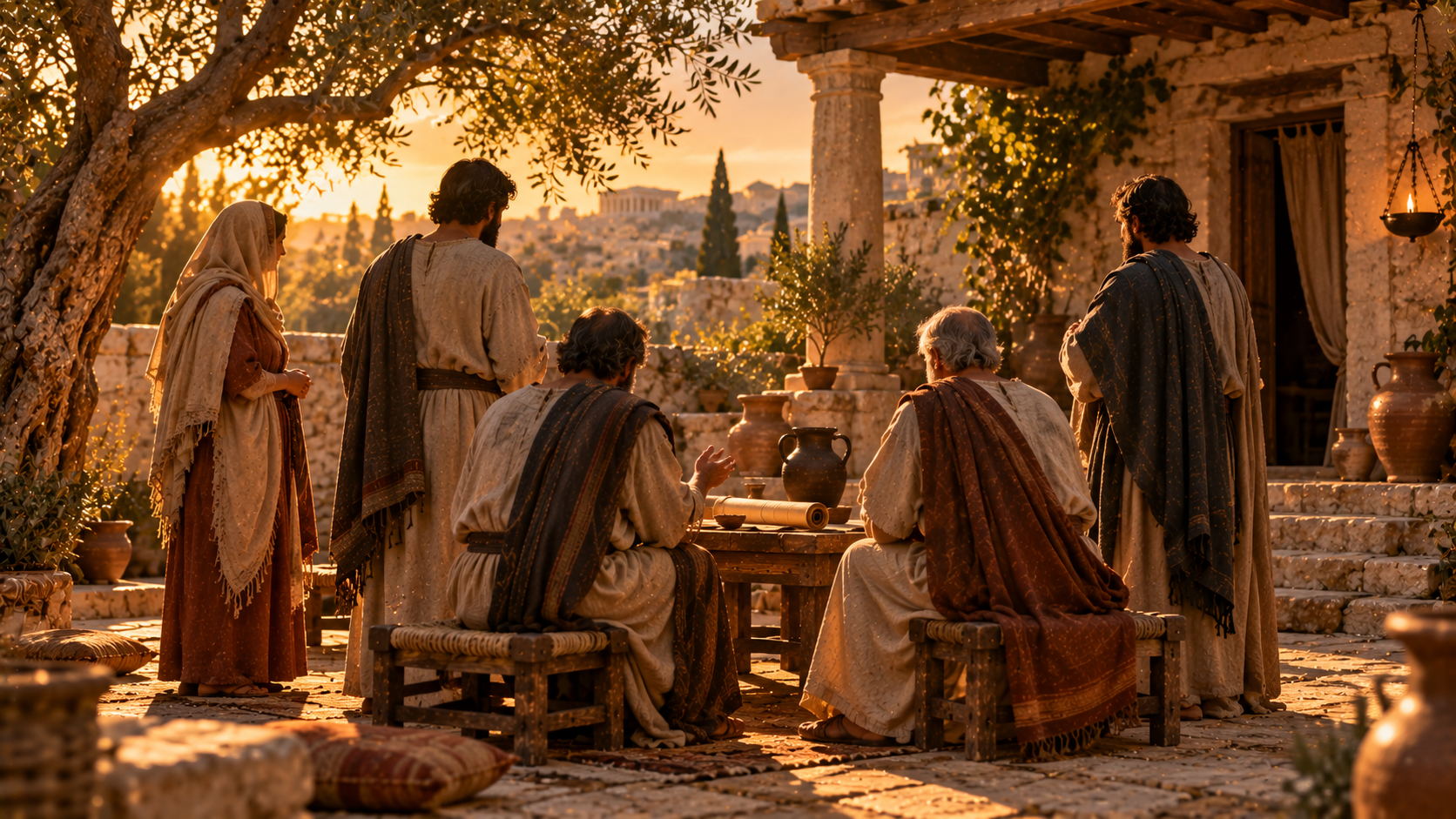
- This is a faithful saying: someone who seeks to be an overseer desires a good work (verse 1). The letter’s second faithful saying (after 1:15’s Christ Jesus came to save sinners), affirming the legitimacy of aspiring to church leadership. Against the false teachers who wanted the status of Torah-scholarship (1:7), the verse affirms that seeking overseer-ship is a good work (kalou ergou, “a noble work”), not a lust for power. The Greek episkopēs (“overseer-ship, oversight”) is the abstract noun for the office; the corresponding personal noun episkopos (“overseer”) will appear in verse 2. The word choice matters: this is not primarily about bishop in the later hierarchical sense (that development is post-apostolic, becoming clear in Ignatius of Antioch c. 110) but about the person who oversees a local congregation. In this apostolic-era setting, the episkopos is functionally the same person as the presbyteros (“elder”); Titus 1:5-7 uses the two terms interchangeably in a single character-list, and Acts 20:17, 28 does the same. See early church leadership: elders and overseers for the vocabulary.
- The overseer therefore must be without reproach, the husband of one wife, temperate, sensible, modest, hospitable, good at teaching (verse 2). The qualifications begin. Seven traits stacked. Without reproach (anepilēmpton, “un-accusable”) is the summary term. Husband of one wife (mias gynaikos andra, literally “a one-woman man”) is the same phrase from Titus 1:6, and receives the same treatment: primarily character-language about the man’s marital faithfulness, not necessarily a strict prohibition of remarriage or a requirement of marriage as such. Temperate (nēphalion, “sober”), sensible (sōphrona, self-mastered), modest (kosmion, orderly), hospitable (philoxenon, stranger-welcoming), good at teaching (didaktikon). The last, didaktikon, is the Pastorals’ distinctive addition to the overseer qualifications: not just teachable, but able to teach, capable of both instruction and refutation (Titus 1:9’s exhort in the sound doctrine and convict those who contradict).
- not a drinker, not violent, not greedy for money, but gentle, not quarrelsome, not covetous (verse 3). Six additional traits, three negative and three positive. Not a drinker (mē paroinon, addicted to wine), not violent (mē plēktēn, literally “not a striker”), not greedy for money (aphilargyron, “not-money-loving”). The three prohibitions target the same pathologies as the corresponding Titus 1:7 list (with slight variation in Greek). Gentle (epieikē, forbearing), not quarrelsome (amachon, non-combative), not covetous (aphilargyron repeated; some manuscripts read aphilargyron only once). The verse’s cumulative portrait is a settled, non-combative, generous man, the opposite of the false teachers’ disputes-and-word-battles (6:4).
- one who rules his own house well, having children in subjection with all reverence; (for how could someone who doesn’t know how to rule his own house take care of God’s assembly?) (verses 4-5). The verses name the domestic test of the overseer’s qualification. Rules his own house well (tou idiou oikou kalōs proistamenon, “leading his own household nobly”). Having children in subjection with all reverence (tekna echonta en hypotagē meta pasēs semnotētos, “keeping children in submission with all gravity”). The parenthetical explains the underlying logic: if a man cannot manage his own household, he cannot manage the church, because the church is a household. The verse presupposes 3:15’s house of God metaphor. The verse’s structure runs from the small house (the man’s family) to the great house (the church-as-household); the former is the training ground for the latter. The verse’s connection to Titus 1:6 (having believing children who are not accused of loose or unruly behavior) is close, but 1 Tim 3:4 emphasizes management while Titus 1:6 emphasizes believing-and-behaving.
- not a new convert, lest being puffed up he fall into the same condemnation as the devil (verse 6). The verse names the maturity test. Not a new convert (mē neophyton, literally “not newly-planted”, the same botanical metaphor from which the English “neophyte” derives). The reason: lest being puffed up (typhōtheis, from typhos, “smoke, mist, delusion of grandeur”), he fall into the same condemnation as the devil. The devil’s own fall is here traced to pride (a reading that draws on Isaiah 14:12-15’s how you are fallen from heaven, morning star and Ezekiel 28:12-19’s oracle against the king of Tyre, both often read in the tradition as veiled references to Satan’s fall). The verse’s pastoral point: premature elevation to leadership breeds pride, and pride is Satan’s own sin. The Ephesian false teachers may have themselves been neophytes rapidly elevated to teaching status; the verse targets that specific pastoral failure.
- Moreover he must have good testimony from those who are outside, to avoid falling into reproach and the snare of the devil (verse 7). The verse names the external witness qualification. Good testimony from those who are outside (martyrian kalēn apo tōn exōthen, “good witness from those outside”). The overseer’s public reputation among non-Christians is a qualification for church leadership. This is striking: the verse treats the outsiders’ verdict as pastorally significant. If the man is known in his neighborhood as dishonest, angry, sexually loose, financially crooked, or otherwise disgraceful, he cannot serve as overseer even if the church’s internal assessment is more favorable. The reason: to avoid falling into reproach and the snare of the devil. The overseer whose public witness is compromised becomes a trap the devil uses to discredit the whole gospel. The verse’s application to modern church-leadership is direct: pastors, elders, and overseers whose neighbors, coworkers, or business partners tell a different story than the church tells about them are not qualified, on the chapter’s own terms.
Word study: episkopos and the character-versus-competency emphasis (1 Tim 3:1-7)
The chapter’s overseer qualifications, taken as a unit and compared with the parallel list in Titus 1:6-9, are striking for what they do not say. There is no mention of seminary education, theological credentials, homiletic gifting, organizational sophistication, fundraising ability, visionary leadership, cultural relevance, communication skills, entrepreneurial energy, or executive competence. The list is almost entirely character language: fifteen character traits, one competency (didaktikon, “able to teach”), and two testable domains (rules his own house well, has good outsider testimony). The Greek verb dei (“must”) in verse 2 is emphatic: the overseer must be characterized by these traits; they are not preferences but requirements. The Pastorals’ vision of church leadership is character-first, and the contemporary church has often inverted the priorities, treating character as a nice-to-have and competency as the actual test. Where the chapter’s priorities have been recovered (in denominations, movements, or local congregations that have taken the qualifications seriously), the fruit has been visible: leaders whose lives match the churches they serve, and churches that do not implode when the leader’s private life is examined. See early church leadership: elders and overseers.
B · 1 Timothy 3:8-13 · The deacon qualifications, and the contested verse 11
⁸ Servants, in the same way, must be reverent, not double-tongued, not addicted to much wine, not greedy for money, ⁹ holding the mystery of the faith in a pure conscience. ¹⁰ Let them also first be tested; then let them serve if they are blameless. ¹¹ Their wives in the same way must be reverent, not slanderers, temperate, and faithful in all things. ¹² Let servants be husbands of one wife, ruling their children and their own houses well. ¹³ For those who have served well gain for themselves a good standing and great boldness in the faith which is in Christ Jesus. (1 Timothy 3:8-13, World English Bible)
- Servants, in the same way, must be reverent, not double-tongued, not addicted to much wine, not greedy for money (verse 8). The chapter turns to the deacon office. The Greek diakonoi (“servants, deacons”) names a distinct ecclesial office alongside the episkopoi, first documented as such in Phil 1:1 (to all the saints in Christ Jesus who are at Philippi, with the overseers and deacons), and paralleling the office of Phoebe as diakonon tēs ekklēsias tēs en Kenchreais (“deacon of the church that is in Cenchreae”, Rom 16:1). The WEB translation’s servants is defensible but understates the office; the Greek is naming a specific ecclesial role, not merely a general servant-attitude. The hōsautōs (“in the same way”) that opens the deacon list parallels the deacons’ qualifications structurally with the overseers’. Four traits are named. Reverent (semnous, “grave, dignified”). Not double-tongued (mē dilogous, literally “not two-worded”, saying different things to different audiences). Not addicted to much wine (mē oinō pollō prosechontas). Not greedy for money (mē aischrokerdeis, “not shamefully-gain-seeking”). Two of the four are shared with the overseer list; the not double-tongued trait is distinctive to the deacon office, and probably reflects the deacon’s practical-serving role (deacons in the early church managed the community’s food distribution, financial care, and cross-household administration, all roles where saying one thing to one household and another thing to another would be catastrophically damaging).
- holding the mystery of the faith in a pure conscience (verse 9). The verse names the deacon’s theological qualification. Holding the mystery of the faith (echontas to mystērion tēs pisteōs, “holding the mystery of the faith”) is the same mystērion term the chapter will use in verse 16 of the mystery of godliness. The deacon holds (present participle, ongoing possession) the mystery of the faith, the gospel-content, the compressed apostolic tradition. And the how is critical: in a pure conscience (en kathara syneidēsei), the same good conscience pairing that ran through chapter 1 (1:5, 1:19). The deacon holds the gospel not just in the head but in a conscience unmarked by the compromises that would erode the office’s integrity. The verse presupposes the diaconal ministry’s closeness to the church’s most vulnerable (the poor, widows, sick, marginalized), where a compromised conscience does immediate and specific damage.
- Let them also first be tested; then let them serve if they are blameless (verse 10). The verse names the testing qualification. The Greek dokimazesthōsan prōton (“let them be tested first”) uses the same dokim- root (“testing for genuineness”) that runs through 2 Cor 8:22, 13:5, and 1 Thess 5:21. The deacon office is not entered on charisma or volunteer availability; the candidate is tested first, and only if blameless (anenklētoi, the same “un-accusable” root as verse 2’s anepilēmpton) then serves. The specific mechanism of testing is not named; the verse presupposes local-church discernment through observation over time. The verse’s implicit warning: rushing people into ministry, especially in vulnerable-facing ministries like the diaconate, is a categorical failure on the letter’s terms.
- Their wives in the same way must be reverent, not slanderers, temperate, and faithful in all things (verse 11). Verse 11 is the most contested single verse in the deacon-qualifications section, and the interpretive question is whether it names women deacons or the deacons’ wives. The Greek gynaikas hōsautōs semnas mē diabolous nēphalious pistas en pasin (“women in the same way, reverent, not slanderers, temperate, faithful in all things”) is ambiguous on its face. Three readings compete. First, the deacons’ wives reading: the verse addresses the wives of the male deacons, giving qualifications for them because the diaconal ministry involves household-visiting where the deacon’s wife is a natural partner in the work. Second, the women deacons reading: the verse addresses women who serve as deacons, giving parallel qualifications for the female half of the office. Third, the deaconesses as a distinct office reading: the verse addresses a distinct female office alongside the male deacons, functionally an assistant or specialized role. The lane reads with the women deacons option, on four converging grounds. First, the Greek gynaikas has no possessive pronoun (no “their wives”; the WEB and NIV supply the their interpretively); the term simply means women. Second, the hōsautōs (“in the same way”) pattern parallels the deacons’ list structurally, in exactly the same way it parallels the overseer’s list to the deacons’ list; a third parallel naming a third category is grammatically natural. Third, the corresponding parallel treatment in the Pauline corpus of Phoebe as diakonos of the church at Cenchreae (Rom 16:1) already documents a woman holding this office in another Pauline church. Fourth, the second-century evidence for deaconesses (in Pliny the Younger’s letter to Trajan c. 112, which mentions ministrae, the Latin equivalent, and the Apostolic Tradition of Hippolytus c. 215) documents the continuity of the female diaconal office from the New Testament era forward. See women in ministry and leadership for the framework treatment.
Influence callout: Nijay K. Gupta and the case for women deacons (1 Tim 3:11)
Gupta’s Tell Her Story (2023) makes the case for reading verse 11 as women deacons with force. His argument: the entire chapter is treating the deacon office structurally; verse 11’s gynaikas introduces a subset of the office (women who serve as deacons) rather than a separate category (deacons’ wives) that would break the chapter’s structural logic. The lack of a possessive pronoun (their wives is a translational supplement, not a Greek construction) tips the reading toward women deacons. The parallel witness of Phoebe (Rom 16:1) and the second-century evidence for deaconesses corroborate. Gupta’s book documents extensive women’s leadership across the early church, including women who evidently held the deacon office in various congregations (Phoebe of Cenchreae, likely Junia named as “apostle” in Rom 16:7, the household-hosts Lydia and Nympha, the female prophets of 1 Cor 11, the kalodidaskaloi of Titus 2). The lane reads with Gupta: verse 11 is naming women deacons, and the chapter’s overall treatment of leadership includes both men and women in the diaconal office. The parallel implicit affirmation about the episkopoi is more contested (the husband of one wife clause of verse 2 has been read variously); the deacon office at 3:11, however, opens explicitly.
- Let servants be husbands of one wife, ruling their children and their own houses well. For those who have served well gain for themselves a good standing and great boldness in the faith which is in Christ Jesus (verses 12-13). The verses close the deacon section with two additional qualifications and a promise. Verse 12’s husbands of one wife parallels the overseer qualification of verse 2; the household management test parallels verses 4-5. Verse 13 names the fruit of faithful deacon-service: a good standing (bathmon kalon, “a good step” or “a good grade”), and great boldness in the faith (pollēn parrēsian en pistei). The good standing is the deacon’s ecclesial standing within the congregation; the boldness is the frank speech the tested deacon can now use in the church’s public life. The verse hints at a possible ministerial progression from the diaconate into further leadership, though the chapter does not make this explicit.
C · 1 Timothy 3:14-16 · The household of God and the mystery of godliness
¹⁴ These things I write to you, hoping to come to you shortly, ¹⁵ but if I wait long, that you may know how men ought to behave themselves in God’s house, which is the assembly of the living God, the pillar and ground of the truth. ¹⁶ Without controversy, the mystery of godliness is great:
God was revealed in the flesh, justified in the spirit, seen by angels, preached among the nations, believed on in the world, and received up in glory. (1 Timothy 3:14-16, World English Bible)
- These things I write to you, hoping to come to you shortly, but if I wait long, that you may know how men ought to behave themselves in God’s house, which is the assembly of the living God, the pillar and ground of the truth (verses 14-15). The verse names the purpose of the letter. Paul is writing in case he is delayed; the letter serves as instruction-in-absentia. The Greek pōs dei en oikō theou anastrephesthai (“how one ought to behave in God’s house”) is best read as how one ought to conduct oneself in God’s household. The chapter’s dominant metaphor is now explicit: the church is God’s household, and the letter’s instructions on prayer, teaching, leadership, widows, elders, slaves, and wealth are all household-order instructions. Two additional descriptions follow. The assembly of the living God (ekklēsia theou zōntos, echoing OT descriptions of Israel as the congregation of the living God). And the striking image: the pillar and ground of the truth (stylos kai hedraiōma tēs alētheias, “pillar and foundation of the truth”). The pillar (stylos) is the load-bearing column of a Greco-Roman public building; the ground (hedraiōma, from hedra, “seat, foundation”) is the base on which the pillar stands. The metaphor names the church as the structural bearer of the gospel in the world: without the church’s visible, structured, disciplined life, the truth has no place to stand. The claim is high ecclesiology, grounded in the church’s witness-function rather than in any bureaucratic pretension.
- Without controversy, the mystery of godliness is great (verse 16a). The chapter’s final theological climax opens with a striking rhetorical marker. Without controversy (homologoumenōs, “confessedly, admittedly, by common confession”) signals that what follows is shared confession, probably an early Christian hymn or creedal formula that Paul is citing rather than composing. The mystery of godliness (to tēs eusebeias mystērion) is the letter’s second use of mystery (after 3:9’s mystery of the faith). Mystērion in Paul’s usage is not “a puzzle to be solved” but the revealed hidden plan of God, the same term that runs through Ephesians (1:9, 3:3-9, 6:19) and Colossians (1:26-27, 2:2, 4:3). And eusebeia (“godliness, reverent devotion”) is the Pastorals’ signature virtue. The mystery of the godliness-shaped life is now revealed in a six-clause hymn.
- The six-clause hymn (verse 16b): – God was revealed in the flesh (ephanerōthē en sarki) – justified in the spirit (edikaiōthē en pneumati) – seen by angels (ōphthē angelois) – preached among the nations (ekērychthē en ethnesin) – believed on in the world (episteuthē en kosmō) – received up in glory (anelēmphthē en doxē).
The six clauses trace the full Christ-narrative in compressed hymn form. The Greek is metrically balanced (each line has the same aorist-passive-verb-plus-prepositional-phrase structure), and the six lines can be read as three pairs (heaven-earth-heaven, or incarnation-vindication-exaltation) or as a chronological progression. The textual variation at the opening is significant: the majority Byzantine text reads theos (“God”), giving God was revealed in the flesh; the earlier Alexandrian manuscripts read hos (“who”), giving who was revealed in the flesh. The relative pronoun hos is grammatically strange (there is no explicit antecedent) and probably points to a christological confession that circulated with an antecedent supplied by context. The lane reads with the majority-of-modern-critical-texts (hos, “who”), interpreting the clause as a Christ-hymn opener whose antecedent is the confessional understanding of the assembly rather than a systematic-theological identification.
Influence callout: I. Howard Marshall (ICC Pastoral Epistles) on the mystery-of-godliness hymn
Marshall’s treatment of the 3:16 hymn is one of the most thorough in modern scholarship, and his reading has shaped subsequent commentary. Marshall argues the hymn is a pre-Pauline Christian hymn incorporated into the letter, with the six clauses organized in three couplets structured on a heaven-earth-heaven pattern: (1) revealed in the flesh / justified in the spirit (Christ’s earthly life and vindication), (2) seen by angels / preached among the nations (the twin proclamations, heavenly and earthly), (3) believed on in the world / received up in glory (the church’s ongoing response and Christ’s ascended state). On the heaven-earth-heaven pattern, the hymn moves from Christ’s incarnation-humiliation (heaven-to-earth) through his vindication and dual proclamation (the middle pair) to his ascended-glorified state (earth-to-heaven). The hymn’s presence at this point in the letter is doing significant work: it grounds the practical household-management instruction (leadership qualifications, deacon roles) in the cosmic Christ narrative. The church-as-household of verse 15 exists inside a cosmically comprehensive gospel whose sweep runs from incarnation to ascension. The overseer qualifications of verses 1-7 are therefore not mere ecclesial bureaucracy; they are the structural bearing of a truth that stretches from heaven to earth to heaven again. The lane reads with Marshall’s structural analysis and pastoral application.
Pre-modern callout: John Chrysostom on 3:16 as the whole gospel (Homily 11 on 1 Timothy)
Chrysostom’s homily on 3:16 reads the six-clause hymn as the whole gospel compressed, and his exegetical instincts anticipate Marshall’s modern structural analysis by fifteen centuries. Chrysostom notes the dizzying movement of the six clauses: the eternal Word takes flesh, the incarnate one is vindicated as righteous, the angelic hosts witness what humans could not see, the apostles proclaim to the ethnē what Israel had been waiting to hear, the world’s peoples believe what the philosophers could not reach, and the ascended one returns to the glory from which he came. Chrysostom uses the verse to press his congregation to inhabit the wonder: the same Jesus whose incarnation and ascension the hymn traces is present in the eucharistic gathering they are participating in. The pastoral force of the hymn, on Chrysostom’s reading, is that it collapses the distance between the cosmic Christology and the ordinary Christian’s Sunday morning. That collapse is exactly what the chapter’s placement of the hymn (at the end of the practical household-management instruction) is doing.
Reflection prompts
- Verse 5’s if someone doesn’t know how to rule his own house, how can he take care of God’s assembly? runs the qualification-test from the small house to the great house. Where in your own church or Christian community is church leadership being extended to people whose domestic life is quietly in disorder? What does the chapter’s structural priority ask of the community?
- Verse 7’s he must have good testimony from those who are outside names the external witness as a qualification. Where in your own church is leadership being evaluated primarily by internal metrics (attendance, giving, program growth, doctrinal alignment) while the outsider verdict on the leader’s character is ignored? What would it produce to recover the chapter’s specific test?
- Verse 11’s women in the same way must be reverent, not slanderers, temperate, and faithful in all things, read as naming women deacons, opens the diaconal office explicitly to women. Where in your own church is the deacon-office (or its equivalent) already occupied by faithful women whose ministry is being informally treated as valuable but formally treated as marginal? What would it look like to align the formal recognition with the actual ministry?
- The 3:16 hymn traces incarnation, vindication, angelic witness, gentile proclamation, world-belief, and ascended glory in six clauses. Which of the six do you find least present in your own gospel-imagination, and how would recovering it change how you inhabit the ordinary Christian life?