
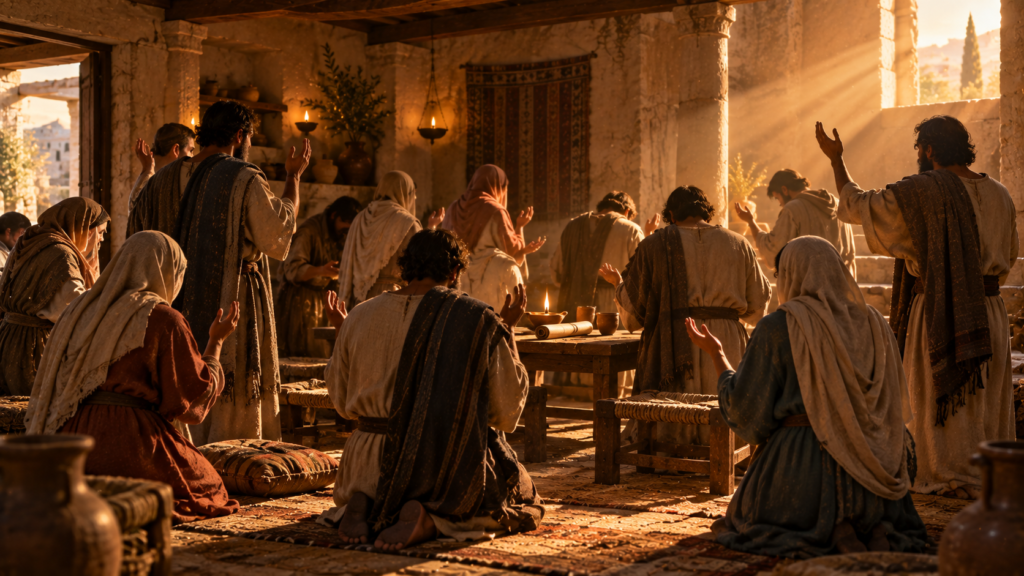
1 Timothy 2 contains two things that could not be more different in tone and in the interpretive weight they have carried across church history. The first three-quarters of the chapter (verses 1-10) is a straightforward set of instructions on prayer for all people, grounded in the Pauline gospel-summary that there is one God and one mediator between God and men, the man Christ Jesus, who gave himself as a ransom for all (2:5-6), and closing with parallel instructions to men and women in the assembly’s prayer-and-adornment practice. The final four verses (2:11-15) is the single most-debated passage in Pauline studies on women’s ministry, containing instructions that a woman is to learn in quietness with full submission, that Paul does not permit a woman to teach nor to exercise authority over a man, and an appeal to the Genesis creation and fall narratives (Adam was formed first, then Eve; Adam wasn’t deceived, but the woman, being deceived, has fallen into disobedience), followed by the notoriously difficult she will be saved through her childbearing clause.
The chapter has three movements. The first (verses 1-7) instructs the assembly on prayer for all people, grounded in the gospel of the ransom-for-all. The second (verses 8-10) instructs the men and women of the assembly on their prayer-life and their public presentation. The third (verses 11-15) contains the contested passage. This chapter commentary treats all three movements carefully, with the fullest engagement on verses 11-15, deploying the women in ministry and leadership framework and the three-position spectrum (egalitarian, complementarian, third-way) the lane reads inside.
The pastoral question the chapter is answering is not the modern debate over women’s ordination. The pastoral question is how the Ephesian assembly conducts its life in a Greco-Roman city where the false teachers of chapter 1 have been destabilizing households, where the ascetic teaching (which will be named in chapter 4) is dividing families, and where the church’s public witness has to hold together across gender and social lines. Reading the chapter inside that situation is the lane’s methodological commitment, and the interpretation follows from the reading.
A · 1 Timothy 2:1-7 · Prayer for all people, and the one mediator
¹ I exhort therefore, first of all, that petitions, prayers, intercessions, and givings of thanks be made for all men, ² for kings and all who are in high places, that we may lead a tranquil and quiet life in all godliness and reverence. ³ For this is good and acceptable in the sight of God our Savior, ⁴ who desires all people to be saved and come to full knowledge of the truth. ⁵ For there is one God and one mediator between God and men, the man Christ Jesus, ⁶ who gave himself as a ransom for all, the testimony at the proper time, ⁷ to which I was appointed a preacher and an apostle, I am telling the truth in Christ, not lying, a teacher of the Gentiles in faith and truth. (1 Timothy 2:1-7, World English Bible)
- I exhort therefore, first of all, that petitions, prayers, intercessions, and givings of thanks be made for all men, for kings and all who are in high places (verses 1-2a). The chapter opens with the letter’s first practical instruction: prayer. The word therefore (oun) connects to the closing charge of chapter 1; the pastoral fight begins with intercession. Four distinct terms for prayer are stacked: petitions (deēseis, requests for specific needs), prayers (proseuchai, the general term), intercessions (enteuxeis, mediation on behalf of others), and givings of thanks (eucharistiai, thanksgivings). The Greek variety is deliberate; Paul is naming the full range of the assembly’s prayer life. And the scope is comprehensive: for all men (hyper pantōn anthrōpōn, “on behalf of all people”), including kings and all who are in high places. The Ephesian church is being commanded to pray for the emperor Nero (probably the emperor in view at the time of the letter) and the local Roman provincial officials. See Christians and the state for the fuller framework treatment of the church’s civic posture.
- that we may lead a tranquil and quiet life in all godliness and reverence (verse 2b). The verse names the purpose of the prayer for the political authorities. The Greek ēremon kai hēsychion bion diagōmen en pasē eusebeia kai semnotēti is best translated that we may lead a tranquil and settled life in all godliness and gravity. Two things are notable. First, the goal is not political-Christian influence, or a Christianized empire, or any specifically social-transformative outcome. The goal is a tranquil church-life that can do its actual work of formation in godliness. Second, the tranquil life the assembly is praying for is not passive: it is in all godliness and gravity, the same eusebeia term that runs through the Pastorals and names the whole-life response to the gospel. The church’s prayer for the political authorities aims at the conditions under which the church’s actual work of formation can proceed.
- For this is good and acceptable in the sight of God our Savior, who desires all people to be saved and come to full knowledge of the truth (verses 3-4). The verse grounds the prayer for all people in the desire of God our Savior for the salvation of all. The Greek hos pantas anthrōpous thelei sōthēnai kai eis epignōsin alētheias elthein (who desires all people to be saved and to come to full knowledge of the truth) is one of the New Testament’s most striking statements about the scope of God’s saving will. The passage has been variously interpreted (universalist readings, Calvinist readings that read all people as “all kinds of people”, Arminian readings that read it straightforwardly, Barthian readings that ground universal election here). The lane reads the verse in its natural sense: God desires all people to be saved. The verse does not resolve the mystery of the ultimate fate of every person (the New Testament allows both universal-hope and non-universal readings elsewhere), but it does establish the disposition of God as toward all, and it grounds the church’s prayer for all in that disposition.
- For there is one God and one mediator between God and men, the man Christ Jesus, who gave himself as a ransom for all, the testimony at the proper time (verses 5-6). The chapter’s theological core. The verse is one of the most theologically dense two-sentence statements in the Pauline corpus. Five theological claims are stacked. First, one God (heis theos): monotheism, the Shema’s confession applied here. Second, one mediator between God and men (heis kai mesitēs theou kai anthrōpōn): Christ as the unique go-between; not one of many mediators as in the pagan cults or in the syncretistic mystery religions the Ephesian church was surrounded by, but one. Third, the man Christ Jesus (anthrōpos Christos Iēsous): the incarnation, the humanity of the mediator, and specifically the human (not angelic, not demigod) status of Jesus as the ground of his mediatorial work. Fourth, who gave himself as a ransom for all (ho dous heauton antilytron hyper pantōn): the atonement, in ransom-image, with the striking preposition anti-lytron (an intensified form of the standard lytron of Mark 10:45’s ransom for many). The Greek anti- prefix names substitution: the ransom is in place of those it redeems. Fifth, for all (hyper pantōn): the scope of the ransom, matching verse 4’s all people. The verse is compressed and comprehensive: monotheism, Christology, incarnation, atonement, universal scope, in twenty-eight Greek words.
Word study: antilytron hyper pantōn (ἀντίλυτρον ὑπὲρ πάντων), “a substitutionary ransom for all” (1 Tim 2:6)
The compound Greek noun antilytron is a Pauline coinage (the word appears only here in the New Testament). It is built from anti- (“in place of, in exchange for, in substitution for”) and lytron (“ransom, redemption-price”). The base word lytron itself is the standard Greco-Roman term for the price paid to free a slave, a hostage, or a prisoner of war; the word runs through the Septuagint’s redemption vocabulary (Lev 25:24-52 uses lytroō verbs extensively for the redemption of Israelite land, kin, and slaves). Jesus’ own saying in Mark 10:45 uses the standard lytron (the Son of Man came to give his life as a ransom for many). Paul’s Pastorals coinage anti-lytron intensifies the substitutionary dimension by adding the anti- prefix. The compound word is doing three specific things. First, it names the ransom as substitutionary in the strongest possible grammatical sense: not just a payment for the freed party (which the simple lytron would name) but a payment in place of the freed party. Second, it aligns with the hyper pantōn (“for all”) that follows: the ransom is in place of all who are freed by it. Third, it echoes the Servant Song of Isaiah 53 (he poured out his soul to death… he bore the sin of many, and made intercession for the transgressors), which the Pauline tradition consistently applied to Christ. The lane reads the verse as the letter’s soteriological center, aligning the Pauline gospel of Rom 3:24-25, Rom 5:8, 2 Cor 5:14-15, and Gal 1:4 with the letter’s specific emphasis on scope (for all).
- to which I was appointed a preacher and an apostle, I am telling the truth in Christ, not lying, a teacher of the Gentiles in faith and truth (verse 7). The verse names Paul’s own appointed role in relation to the gospel just summarized. Three titles: preacher (kēryx, “herald”), apostle (apostolos, “sent one”), and teacher of the Gentiles (didaskalos ethnōn). The parenthetical I am telling the truth in Christ, not lying (alētheian legō, ou pseudomai) is striking; the same oath-formula Paul uses in Romans 9:1 for a similarly weighty claim. Paul is underlining the truthfulness of what he has just said. Why? The reading depends on what the Ephesian false teachers had been claiming; the most plausible read is that they had been disputing Paul’s Gentile-mission credentials or the scope of the gospel he had just named (for all people, for all Gentiles). Paul’s oath-formula defends both his mission and the gospel’s universal scope in a single sentence.
B · 1 Timothy 2:8-10 · Men and women at prayer, and the adornment instruction
⁸ I desire therefore that the men in every place pray, lifting up holy hands without anger and doubting. ⁹ In the same way, that women also adorn themselves in decent clothing, with modesty and propriety, not with braided hair, gold, pearls, or expensive clothing, ¹⁰ but with good works, which is appropriate for women professing godliness. (1 Timothy 2:8-10, World English Bible)
- I desire therefore that the men in every place pray, lifting up holy hands without anger and doubting (verse 8). The chapter shifts from the content of prayer (verses 1-7) to its practice. The Greek tous andras (“the men”, using the gendered term anēr rather than the inclusive anthrōpos) is deliberate; the instruction is specifically to the males of the assembly. In every place (en panti topō) may echo Malachi 1:11 (in every place incense is offered to my name, a passage the early church read as prophesying the Christian expansion beyond Jerusalem). The instruction has three elements: lifting up holy hands (the standard first-century posture of prayer, arms raised, palms open; the holy hands qualifier names the man’s character rather than mere ritual purity), without anger (chōris orgēs), and without doubting (dialogismou, “arguing, disputing”). The two prohibitions, anger and disputing, are pointed. The Ephesian assembly’s men were apparently praying angrily and arguing during prayer, the natural fruit of a congregation destabilized by the disputes-and-controversies of chapter 1. The verse addresses a specific pastoral problem, not a universal norm about male hand-raising.
- In the same way, that women also adorn themselves in decent clothing, with modesty and propriety, not with braided hair, gold, pearls, or expensive clothing, but with good works, which is appropriate for women professing godliness (verses 9-10). The women’s instruction parallels the men’s, opening with the same hōsautōs (“in the same way”) that will introduce the deacons in 3:8 and the older women in Titus 2:3. The Greek en katastolē kosmiō meta aidous kai sōphrosynēs (“in decent clothing with modesty and propriety”) names the external dimension. Then the negative list of what not to do: braided hair (plegmasin, “elaborate braided hairstyles”, the pseudo-elite hairstyle of first-century Ephesian society), gold, pearls, expensive clothing. All four are markers of social status display: the Ephesian church’s wealthy women were using the assembly as a venue for social competition, dressing to be seen and admired above the poor women of the church. And the positive alternative: good works (ergōn agathōn), which is appropriate for women professing godliness (epangellomenais theosebeian, “professing reverence for God”). The verse’s target is status-display in the assembly, not modest attire as such. The Greco-Roman moralists (Plutarch, Seneca, Musonius Rufus) all wrote very similar instructions to women, so the verse’s form is culturally recognizable; the verse’s innovation is that it addresses Christian women in the assembly, where the display of wealth was creating social division between rich and poor believers.
Influence callout: Nijay K. Gupta (Tell Her Story, 2023)
Gupta’s reading of 2:9-10 relocates the passage from the modesty-and-purity frame in which conservative-evangelical culture has typically read it, into the social-class-and-assembly-order frame the ancient context requires. On Gupta’s reading, the wealthy Ephesian women were displaying their status in the assembly through their hairstyles, jewelry, and clothing, and the effect was to create a class stratification inside the community that undermined the gospel’s leveling claim. Paul’s instruction is not about hemlines or hair length; it is about not letting the assembly become another Greco-Roman social hierarchy. Gupta traces the same concern through 1 Cor 11 (the head coverings passage, similarly about social markers), 1 Cor 12 (the different-parts-of-the-body passage, about equal honor), and James 2 (the rich-man-and-poor-man in the assembly). The lane reads with Gupta: the verses are about the church’s internal social order, not about female modesty as a stand-alone ethic. The application in the contemporary church is therefore not primarily about women’s dress codes; it is about whether the assembly is stratified by wealth, or whether the gospel’s equality is visible in how the community gathers.
C · 1 Timothy 2:11-15 · The contested passage
¹¹ Let a woman learn in quietness with full submission. ¹² But I don’t permit a woman to teach, nor to exercise authority over a man, but to be in quietness. ¹³ For Adam was formed first, then Eve. ¹⁴ Adam wasn’t deceived, but the woman, being deceived, has fallen into disobedience; ¹⁵ but she will be saved through her childbearing, if they continue in faith, love, and holiness with sobriety. (1 Timothy 2:11-15, World English Bible)

The five verses of 2:11-15 have carried more interpretive weight in modern debates about women’s ministry than perhaps any other short passage in the New Testament. The lane reads them carefully, without either the dismissive posture that treats them as a mere first-century artifact to be ignored, or the maximalist posture that reads them as a universal timeless restriction on women’s ministry. The chapter has to be read in its Ephesian context, with attention to its grammatical peculiarities, and inside the broader Pauline picture of women’s ministry that the rest of the corpus attests. See women in ministry and leadership for the three-position spectrum treatment.
- Let a woman learn in quietness with full submission (verse 11). The verse’s primary claim is easily missed under the weight of what follows. Let a woman learn (gynē en hēsychia manthanetō, imperative): the verse positively commands that women learn. In first-century Greco-Roman society, women’s formal learning was rare and often actively discouraged; in Jewish rabbinic tradition, women were generally not trained in Torah at the level men were. The verse’s first move is therefore counter-cultural: women are commanded to learn, to be catechized, to be taught the apostolic tradition. The two qualifiers are in quietness (en hēsychia, “in stillness, in a settled state”) and with full submission (en pasē hypotagē, “in all subjection”). Two things about these qualifiers. First, hēsychia is the same term Paul uses in verse 2 of the tranquil and quiet life the whole assembly is to lead; it is a learner’s posture, not a silencer’s ban. Second, hypotagē names proper receptive posture toward the teacher and the apostolic tradition, not blanket subjection to any-and-all men. The Ephesian women, likely including some who had been dissemninating or susceptible to the false teaching of chapter 1, are being told to sit at the feet of the apostolic teachers rather than to teach out of their unformed grasp of the gospel.
- But I don’t permit a woman to teach, nor to exercise authority over a man, but to be in quietness (verse 12). The verse’s grammatical construction is important. The Greek didaskein de gynaiki ouk epitrepō oude authentein andros uses two paired infinitives (teach and exercise authority), joined by oude (“nor”), governed by ouk epitrepō (“I do not permit”). The construction can be read three ways: (a) as two separate prohibitions (I don’t permit her to teach; I also don’t permit her to exercise authority); (b) as a single joint prohibition (I don’t permit her to teach-in-such-a-way-as-to-exercise-authority-over a man, i.e., abusive-domineering teaching); (c) as a specific-situation prohibition (in this Ephesian situation, I do not permit these women to teach the men who need to be taught the apostolic gospel by qualified teachers, and I do not permit these women to usurp authority over the male leadership Timothy is trying to establish). The lane reads with the third option, on the ground that the tense of the verb epitrepō is present indicative (I am not permitting, an ongoing situational stance) rather than a universal aorist, and on the ground that the entire chapter is addressed to a specific Ephesian pastoral situation. The verse’s authentein is the critical term and receives fuller treatment below.
Word study: authentein (αὐθεντεῖν) (1 Tim 2:12)
The Greek verb authentein is a New Testament hapax legomenon; it appears nowhere else in the canonical text, and its meaning has to be reconstructed from Greek usage outside the New Testament. Three streams of scholarship have proposed three overlapping semantic ranges. First, the authority range: the word can mean to have authority over, to hold rule, to exercise dominion. This is the reading that supports the traditional complementarian interpretation (I do not permit a woman to teach or to exercise authority over a man). Second, the domineering range: the word can mean to dominate, to lord it over, to abusively assert. This is the reading that supports the third-way and egalitarian interpretations (I do not permit a woman to teach domineeringly, or to lord it over, a man). Third, the originate/authoring range: the word’s root authent- can mean to be the origin of, to author, to be the source of, and some readings connect the term to the false-teaching context (I do not permit a woman to teach or to author a novel doctrine in the assembly). Cynthia Long Westfall’s Paul and Gender (2016) provides the most thorough scholarly analysis, tracing the term’s semantic range through Greek literature from the 5th century BCE through the 5th century CE, and concluding that the domineering range is best-attested in the immediate pre- and post-Pauline period. Linda Belleville’s work on the term reaches similar conclusions. The lane reads with Westfall and Belleville: the verse likely names a domineering or usurping mode of teaching authority, not authority-as-such. The verse’s target is Ephesian women who were using teaching as a means of domination or as a platform for the false doctrine, not women’s teaching in general.
- For Adam was formed first, then Eve. Adam wasn’t deceived, but the woman, being deceived, has fallen into disobedience (verses 13-14). The verses appeal to the Genesis creation and fall narratives. The complementarian reading takes the appeal to establish a creation-order hierarchy that grounds the verse-12 prohibition as a creation-order teaching. The lane reads differently, on three grounds. First, the grammatical construction gar (“for”) introduces a reason for the specific situation being addressed, not necessarily a universal timeless principle; the same gar construction in Paul’s letters often carries situational rather than universal force (cf. 1 Cor 11:9, where the parallel Genesis appeal similarly grounds a specific situational instruction). Second, the Genesis appeal is asymmetric: verse 14 does not say Eve was inferior; it says she was deceived. Deception is a specific vulnerability that the Ephesian situation (with its false teachers deceiving people, chapter 1’s heterodidaskalein) makes acutely relevant. Third, the very same Paul who cites Adam-first in this verse cites Adam-alone as the responsible party for the fall (Rom 5:12-21), because Adam’s federal-headship role in Romans requires it. The Genesis-appeal is doing situational rhetorical work, not laying down a universal creation-order rule. On the lane’s third-way reading, the verses are saying: the Ephesian women, like Eve, are currently the primary victims and disseminators of the deceptive false teaching; therefore in this situation they should learn rather than teach. The verses are pastoral-situational, not creation-order-normative.
- but she will be saved through her childbearing, if they continue in faith, love, and holiness with sobriety (verse 15). Verse 15 is notoriously difficult. The Greek sōthēsetai de dia tēs teknogonias (“but she will be saved through the childbearing”, with the definite article tēs) has been read four principal ways. First, the literal-childbirth reading: women are preserved through the physical act of childbirth if they persevere in faith; a reading that treats the verse as a promise of safe delivery to believing women. Second, the the-childbearing reading (with definite article): women are saved through the specific childbearing, referring to Mary’s bearing of Christ (the Messiah’s incarnation), which reverses the deception of Eve. This is the reading favored by many patristic interpreters and by some modern scholars (Cornelius Van der Walt, Andreas Köstenberger in his sense). Third, the domestic-vocation reading: women are saved (in the sense of being made spiritually mature) through the domestic vocation of childbearing and household work; a reading that has been used to press women toward specifically maternal-domestic roles. Fourth, the counter-cultural against ascetic error reading: the false teachers of chapter 4 will be named as forbidding marriage (4:3), and verse 15 may be countering an ascetic teaching that had told women marriage and childbearing were incompatible with Christian holiness; on this reading, Paul is affirming the ordinary faithful married-with-children life as fully compatible with salvation, against the ascetic wing. The lane leans toward reading (2) as the primary anchoring (the Messiah’s coming through the woman reverses Eve’s specific role in the deception) with (4) as the operative pastoral force (against the ascetic error in Ephesus that would eventually be named at 4:3). The plural if they continue (the Greek shifts from singular she will be saved to plural if they continue) probably names believing women together with their households continuing in faith, love, holiness, and sobriety.
Where this lands: the three-position spectrum on 1 Tim 2:11-15
The chapter has been read across three principal positions in modern debate, and the lane names them honestly rather than pretending the debate is settled. First, the complementarian reading holds that verses 11-12 establish a permanent restriction on women’s teaching and authoritative leadership over men in the church, grounded in the creation-order appeal of verses 13-14. Modern proponents include Andreas Köstenberger, Wayne Grudem, John Piper, Douglas Moo. The reading takes the verses at face value as universal timeless norm. Second, the egalitarian reading holds that the verses address a specific Ephesian situation (women disseminating or susceptible to false teaching), and that the broader Pauline picture (Phoebe as deacon and letter-carrier, Junia as apostle, Priscilla as catechist, Lydia and Nympha as house-church hosts, the women prophets of 1 Cor 11, Euodia and Syntyche as coworkers, the kalodidaskaloi older women of Titus 2:3) attests women in teaching and leadership roles. Modern proponents include Nijay Gupta, Cynthia Long Westfall, Lucy Peppiatt, Aida Spencer, Linda Belleville, Craig Keener. The reading treats the verses as situational instruction, not universal norm. Third, the third-way reading holds that the verses address a real gendered-authority dynamic without collapsing into either full egalitarianism or complementarianism, often emphasizing mutual submission, contextual application, and the recovery of forgotten women leaders in church history. Modern proponents include Michelle Lee-Barnewall, Sarah Coakley, some Anglican and Orthodox scholars. The lane reads with the third-way framing as the most theologically responsible, while acknowledging the strongest egalitarian arguments. The pastoral posture that follows: honor the theological seriousness of complementarian brothers and sisters; hold to the fuller Pauline picture of women’s ministry; do not weaponize this passage against the many faithful women whose gifts of teaching, prophecy, and leadership have obviously borne fruit in the church across the centuries. See women in ministry and leadership for the full framework treatment.
Pre-modern callout: John Chrysostom (Homily 9 on 1 Timothy, c. 390s)
Chrysostom’s homily on 1 Timothy 2 is one of the earliest and most careful patristic readings of the passage, and its emphases are worth naming. Chrysostom reads verse 11’s let a woman learn as a significant affirmation in its historical context: the assumption in his fourth-century Antioch was that women’s spiritual instruction was to be taken seriously, and Chrysostom uses the verse to press the men of his congregation to ensure that their wives and daughters were being catechized. On verse 12, Chrysostom takes the prohibition at face value for the church’s public-teaching offices, but simultaneously affirms (as elsewhere in his corpus) the significant ministry roles women held (widow-orders, hospitality, discipleship of younger women, care for the poor, prophetic ministry). On verse 15, Chrysostom leans toward the Mary-as-the-childbearing reading, though he is not dogmatic. The value of Chrysostom’s reading for the lane is that it holds together reverent submission to the text with practical honoring of women’s ministry roles, without collapsing into either dismissiveness or the modern debate’s polarization. The pre-modern voice is not a settling of the modern debate; it is a testimony that the church has always read this passage with care and has always found ways to honor women’s ministry within its interpretation.
Reflection prompts
- Verses 1-2’s prayer for all people, for kings and all who are in high places commands the church to pray for the political authorities under which it lives. Where in your own prayer-life is your posture toward political leaders (of whichever party or ideology) actually intercessory, and where is it adversarial or neglectful? What would it look like to recover the chapter’s specific practice?
- The gospel core of 2:5-6 (one God, one mediator, the man Christ Jesus, who gave himself as a ransom for all) is one of the New Testament’s densest single statements. Where in your own gospel-summary does one of these five elements (monotheism, mediation, incarnation, ransom-atonement, universal scope) tend to drop out? What would it look like to hold the full compressed summary together?
- The chapter’s contested passage on women (verses 11-15) has been used both to silence faithful gifted women and to dismiss the biblical text as culturally-bound. Neither reading is the lane’s. Where in your own engagement with this passage have you defaulted to one of the two easy readings? What would a slower, more situated reading produce?
- Verse 9’s targeting of braided hair, gold, pearls, or expensive clothing is not about women’s fashion in the modern sense; it is about social-status display in the assembly. Where in your own church or Christian community is wealth-display currently doing the class-stratifying work the verse warns against? What would it look like to recover the assembly’s leveling effect?