
Exodus 16 is the chapter where Sabbath enters the Bible’s vocabulary as something Israel practices. Genesis 2:2-3 named the seventh day as the day God rested and blessed; that day’s holiness has been waiting in the canon for fifteen chapters of Exodus to find its first practical form. Exodus 16 is where the form arrives. The mechanism is the most ordinary thing imaginable: bread on the ground every morning, with a doubled portion on Friday and nothing on Saturday. The Sabbath enters Israel’s life through the daily food.
The chapter is also where Israel’s wilderness apprenticeship really begins. The grumbling at Marah in chapter 15 was about water (a single crisis); the grumbling here is about food, the ongoing daily-existence question. Israel says, in v. 3, that they would have rather died in Egypt with full bellies than die in the wilderness with empty ones. The complaint is honest: hunger is real. God’s response is twofold. First, he provides (manna and quail). Second, he forms: the manna comes only on six days; the seventh is rest. The provision is shaped to teach.
Goldingay names the chapter’s deepest theological move as the manna economy. Pharaoh’s Egypt ran on quotas (Ex 5: bricks-without-straw, more output, less material, no rest). The manna economy is the deliberate inverse: a daily ration, equal portions for everyone, no stockpiling allowed (it bred worms), and one full day off. Sabbath is the anti-Pharaoh law. The chapter is teaching that the people God just delivered will be re-formed by the rhythm of their daily food.
A · Exodus 16:1-12 · The wilderness of Sin and the grumbling for bread
¹ They took their journey from Elim, and all the congregation of the children of Israel came to the wilderness of Sin, which is between Elim and Sinai, on the fifteenth day of the second month after their departing out of the land of Egypt. ² The whole congregation of the children of Israel murmured against Moses and against Aaron in the wilderness; ³ and the children of Israel said to them, “We wish that we had died by Yahweh’s hand in the land of Egypt, when we sat by the meat pots, when we ate our fill of bread, for you have brought us out into this wilderness, to kill this whole assembly with hunger.” ⁴ Then Yahweh said to Moses, “Behold, I will rain bread from the sky for you, and the people shall go out and gather a day’s portion every day, that I may test them, whether they will walk in my law, or not. ⁵ It shall come to pass on the sixth day, that they shall prepare that which they bring in, and it shall be twice as much as they gather daily.” ⁶ Moses and Aaron said to all the children of Israel, “At evening, then you shall know that Yahweh has brought you out from the land of Egypt; ⁷ and in the morning, then you shall see Yahweh’s glory; because he hears your murmurings against Yahweh. Who are we, that you murmur against us?” ⁸ Moses said, “Now Yahweh shall give you meat to eat in the evening, and in the morning bread to satisfy you; because Yahweh hears your murmurings which you murmur against him. And who are we? Your murmurings are not against us, but against Yahweh.” ⁹ Moses said to Aaron, “Tell all the congregation of the children of Israel, ‘Come close to Yahweh, for he has heard your murmurings.’” ¹⁰ As Aaron spoke to the whole congregation of the children of Israel, they looked toward the wilderness, and behold, Yahweh’s glory appeared in the cloud. ¹¹ Yahweh spoke to Moses, saying, ¹² “I have heard the murmurings of the children of Israel. Speak to them, saying, ‘At evening you shall eat meat, and in the morning you shall be filled with bread. Then you shall know that I am Yahweh your God.’”
- The wilderness of Sin. The Hebrew is midbar Sin. The name has nothing to do with the English word sin; it likely shares a root with Sinai. The wilderness of Sin sits between Elim and Sinai (v. 1). Geographically, this is the journey toward the mountain. Israel is now on the road that leads, eventually, to the covenant.
- On the fifteenth day of the second month. The text marks the date precisely. One month, fifteen days after the Pesach. The chapter is keeping calendar. The redemption-time is now becoming wilderness-time.
- We wish that we had died by YHWH’s hand in the land of Egypt, when we sat by the meat pots, when we ate our fill of bread. The Hebrew is be-shivtenu al-sir ha-basar, be-akhlenu lechem la-sova. The grumbling is sharp. Israel remembers Egypt as a land of meat pots and bread to satisfaction. This is, of course, edited memory. They were slaves. The food in Egypt was, mostly, the food of slaves. But hunger does its work on the memory. Goldingay’s pastoral note: this is human. Hunger remembers Egypt better than freedom does. The chapter is honest that the same body that walked through the sea is now hungry, and the hungry body’s memory revises the past.
- Behold, I will rain bread from the sky for you. The Hebrew is himtir lakhem lechem min-ha-shamayim. Rain bread from the heavens. The image is striking. Rain is what an agricultural economy needs from God; here the rain is the food itself. The deliberate counterpoint to Pharaoh’s storehouse cities (Pithom and Raamses, Ex 1:11): in Egypt, the granaries belonged to Pharaoh and the slaves dug bricks. In the wilderness, the granary is the sky and the bread comes daily.
- That I may test them, whether they will walk in my law, or not. The Hebrew is le-ma’an anassenu ha-yelekh be-torati im-lo. The verb nissah (test) is the wilderness narrative’s signature word (also at Marah, Ex 15:25). The chapter is explicit: the manna is a test. Of what? Of walking in YHWH’s torah. The first piece of torah (instruction) is, in this chapter, the manna ration: gather a day’s portion, no stockpiling, double on Friday. The test is whether Israel will trust the daily ration. This is the foundation of the rest of the Hebrew Bible’s torah-piety.
- They shall prepare that which they bring in, and it shall be twice as much as they gather daily. The double portion on the sixth day is named before the chapter introduces the seventh-day rest. The provision is structured to prepare for Sabbath before Sabbath has even been named to Israel. The economy is teaching the holy day before the holy day is taught.
- In the morning, then you shall see YHWH’s glory. The Hebrew is u-vo-vo-qer u-r’item et-kavod YHWH. Kavod: glory, weight. The same word that named Pharaoh’s heart through the plague cycle. Now it names YHWH’s visible weight coming in the cloud. The chapter is staging a final wordplay: Pharaoh’s kavod heart drowned in the sea; YHWH’s kavod now shows up in the wilderness.
- Yahweh’s glory appeared in the cloud. The Hebrew is ve-hineh kevod YHWH nirah be-anan. The pillar of cloud (introduced in Ex 13:21) is now revealed as the vehicle of YHWH’s glory. The same cloud that has been guiding Israel by day is the visible form of YHWH’s presence. The Hebrew Bible is layering: the cloud is not just guidance; it is kavod. The whole later vocabulary of the shekinah (the indwelling glory) starts here.
Word study: manna (מָן)
The Hebrew word man derives from Israel’s first response to the substance: man hu, what is it? (v. 15). The food is named for Israel’s confusion. The chapter’s etymology is in the puzzle. The Hebrew Bible loves these naming-by-question moments: Israel sees the substance, asks man hu, and the question becomes the noun. Numbers 11 will later describe manna as like coriander seed, white, and the taste of it like wafers with honey; Ps 78:25 will call it the bread of angels. The vocabulary survives directly into the New Testament: John 6, where Jesus says I am the bread of life, takes the manna as the typological backdrop. The substance Israel ate every morning for forty years becomes Christ’s most explicit single self-identification across a Gospel.
B · Exodus 16:13-30 · Manna, the gomer, and the Sabbath
¹³ At evening, the quails came up and covered the camp; and in the morning the dew lay around the camp. ¹⁴ When the dew that lay had gone, behold, on the surface of the wilderness was a small round thing, small as the frost on the ground. ¹⁵ When the children of Israel saw it, they said to one another, “What is it?” For they didn’t know what it was. Moses said to them, “It is the bread which Yahweh has given you to eat. ¹⁶ This is the thing which Yahweh has commanded: ‘Gather of it everyone according to his eating; an omer a head, according to the number of your persons, you shall take it, every man for those who are in his tent.’” ¹⁷ The children of Israel did so, and gathered some more, some less. ¹⁸ When they measured it with an omer, he who gathered much had nothing over, and he who gathered little had no lack. They each gathered according to his eating. ¹⁹ Moses said to them, “Let no one leave of it until the morning.” ²⁰ Notwithstanding they didn’t listen to Moses, but some of them left of it until the morning, and it bred worms, and became foul: and Moses was angry with them. ²¹ They gathered it morning by morning, everyone according to his eating. When the sun grew hot, it melted. ²² On the sixth day, they gathered twice as much bread, two omers for each one; and all the rulers of the congregation came and told Moses. ²³ He said to them, “This is that which Yahweh has spoken, ‘Tomorrow is a solemn rest, a holy Sabbath to Yahweh. Bake that which you want to bake, and boil that which you want to boil; and all that remains over lay up for yourselves to be kept until the morning.’” ²⁴ They laid it up until the morning, as Moses ordered, and it didn’t become foul, neither was there any worm in it. ²⁵ Moses said, “Eat that today, for today is a Sabbath to Yahweh. Today you shall not find it in the field. ²⁶ Six days you shall gather it, but on the seventh day is the Sabbath. In it there shall be none.” ²⁷ It happened on the seventh day, that some of the people went out to gather, and they found none. ²⁸ Yahweh said to Moses, “How long do you refuse to keep my commandments and my laws? ²⁹ Behold, because Yahweh has given you the Sabbath, therefore he gives you on the sixth day the bread of two days. Every man stay in his place. Let no man go out of his place on the seventh day.” ³⁰ So the people rested on the seventh day.
- At evening, the quails came up and covered the camp. The chapter is, again, layered. Meat in the evening, bread in the morning. Both Moses had promised (vv. 8, 12). The quail are the meat; the manna is the bread. The Hebrew Bible’s narrative of the wilderness will mention quail again at Numbers 11 (where they will be the source of judgment because of grumbling); here at Ex 16, the quail are simply the evening meat YHWH provides without complication. The chapter is patient: this is the first wilderness meal of trust.
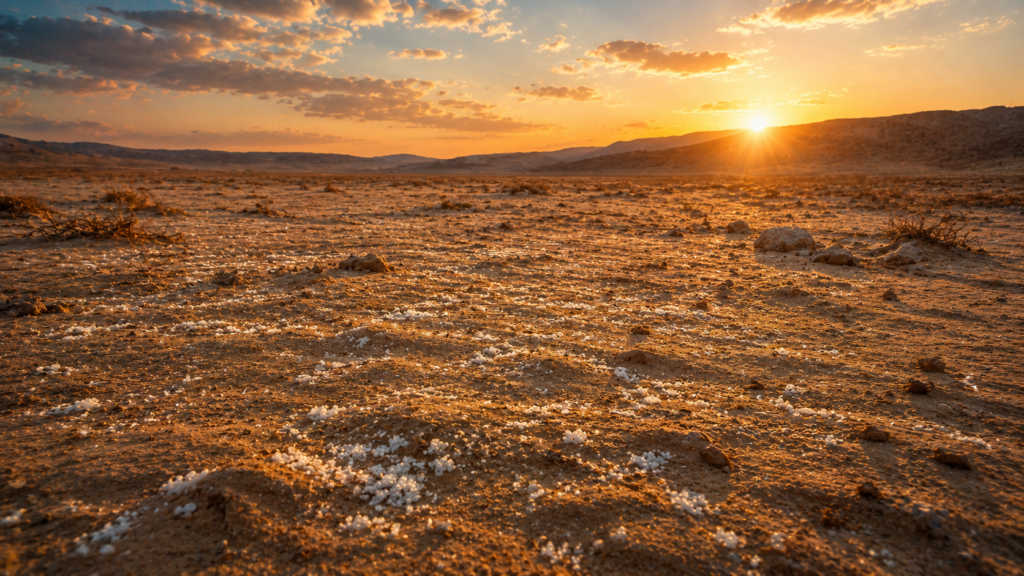
- A small round thing, small as the frost on the ground. The Hebrew is daq mechuspas, daq ka-kefor al-ha-arets. The chapter’s description is concrete: small, white, scaly, like frost. Numbers 11:7 will add: the manna was like coriander seed, and its appearance like the appearance of bdellium. The Hebrew Bible has a precise material image for the substance.
- Gather of it everyone according to his eating; an omer a head. The Hebrew is gulgolet: a head, i.e., per person. An omer per person is approximately two liters of manna per day, per person. The ration is fixed. Goldingay’s note: the verse establishes equality. Everyone gets the same share, regardless of social standing.
- He who gathered much had nothing over, and he who gathered little had no lack. The Hebrew is lo’ he’edif ha-marbeh ve-ha-mam’it lo’ hechsir. The verse is, on its face, a small miracle: whatever the gatherer brought home, when measured, became exactly an omer per person. Some scholars read this as straightforwardly miraculous (the manna multiplied or shrank to fit the measure). Solomon (drawing on the rabbinic tradition) reads it as communal generosity: those who gathered extra brought it back to share with those who could not gather enough. Either way, the principle is the same: the manna economy is equal sufficiency. Pharaoh’s economy was about output and accumulation; the manna economy is about enough. Paul will quote this verse at 2 Cor 8:15 in his collection-for-the-Jerusalem-saints argument: as it is written, he who gathered much had nothing over, and he who gathered little had no lack. The chapter is shaping the New Testament’s economic theology directly.
- Let no one leave of it until the morning… it bred worms, and became foul. The Hebrew is vayyarum tola’im va-yiv’ash. The word vayyarum means bred worms / went rancid. The lesson is sharp: the manna cannot be stockpiled. The economy depends on daily trust. Brueggemann (in Sabbath as Resistance) reads this as the Hebrew Bible’s foundational economic critique. The accumulation that Pharaoh’s empire was built on cannot be reproduced in YHWH’s economy. Stockpiling rots.
- On the sixth day, they gathered twice as much bread. The Friday double portion is automatic. Israel gathers as usual; on Friday they find their omer-per-person becomes two-omers-per-person. The economy itself trains the rhythm. The Sabbath is being taught through the bread before the Sabbath is taught through any explicit law.
- Tomorrow is a solemn rest, a holy Sabbath to YHWH. The Hebrew is shabbaton shabbat-qodesh la-YHWH. Shabbaton (a Sabbath observance) is intensifying. Shabbat-qodesh (a holy Sabbath). The seventh day is now explicitly named for Israel for the first time in Exodus. The day of YHWH’s rest at Genesis 2:2-3 is now Israel’s day. Goldingay’s note: this is the first commandment Israel receives in the wilderness. Before Sinai, before the Decalogue, before any of the law-collection, the foundational Israelite practice is Sabbath. The chapter is teaching that Sabbath is first.
- They laid it up until the morning, as Moses ordered, and it didn’t become foul, neither was there any worm in it. The Friday double portion does not breed worms when kept overnight. The same substance that rotted on every other night does not rot on Friday night. The miracle is precise to the Sabbath. The manna’s biology is keeping the Sabbath rhythm.
- Some of the people went out to gather, and they found none. The first Sabbath-violation, on the very first Sabbath. Israel learns the rhythm by failing it. Moses is angry. How long do you refuse to keep my commandments and my laws? (v. 28). The chapter is honest: the rhythm has to be learned, and the learning is by failure as much as by faithfulness.
- So the people rested on the seventh day. The Hebrew is vayishbetu ha-am ba-yom ha-shevi’i. The verb shabat (cease, rest) is the same root as shabbat (Sabbath). The chapter ends with Israel finally resting. The first national Sabbath in Hebrew Bible narrative happens here, before Sinai. Israel’s identity as a Sabbath-keeping people begins in the wilderness, taught by bread.
Word study: omer (עֹמֶר)
The omer is a unit of dry measure, approximately two liters or about half a gallon. It appears in Ex 16 as the ration unit of the manna (one omer per person per day). The same word also names the sheaf of barley offered on the second day of Pesach (Lev 23:10-11), beginning the counting of the omer (sefirat ha-omer) from Pesach to Shavuot (the seven weeks between the Exodus and the giving of the Torah at Sinai). The connection is theological: the omer of Pesach (the new grain) and the omer of the wilderness (the daily manna) bracket the journey from redemption to covenant. The word ties the redemption to its destination at Sinai.
C · Exodus 16:31-36 · The jar of manna for the generations
³¹ The house of Israel called its name “Manna,” and it was like coriander seed, white; and its taste was like wafers with honey. ³² Moses said, “This is the thing which Yahweh has commanded, ‘Let an omer-full of it be kept throughout your generations, that they may see the bread with which I fed you in the wilderness, when I brought you out from the land of Egypt.’” ³³ Moses said to Aaron, “Take a pot, and put an omer-full of manna in it, and lay it up before Yahweh, to be kept throughout your generations.” ³⁴ As Yahweh commanded Moses, so Aaron laid it up before the Testimony, to be kept. ³⁵ The children of Israel ate the manna forty years, until they came to an inhabited land. They ate the manna until they came to the borders of the land of Canaan. ³⁶ Now an omer is one tenth of an ephah.
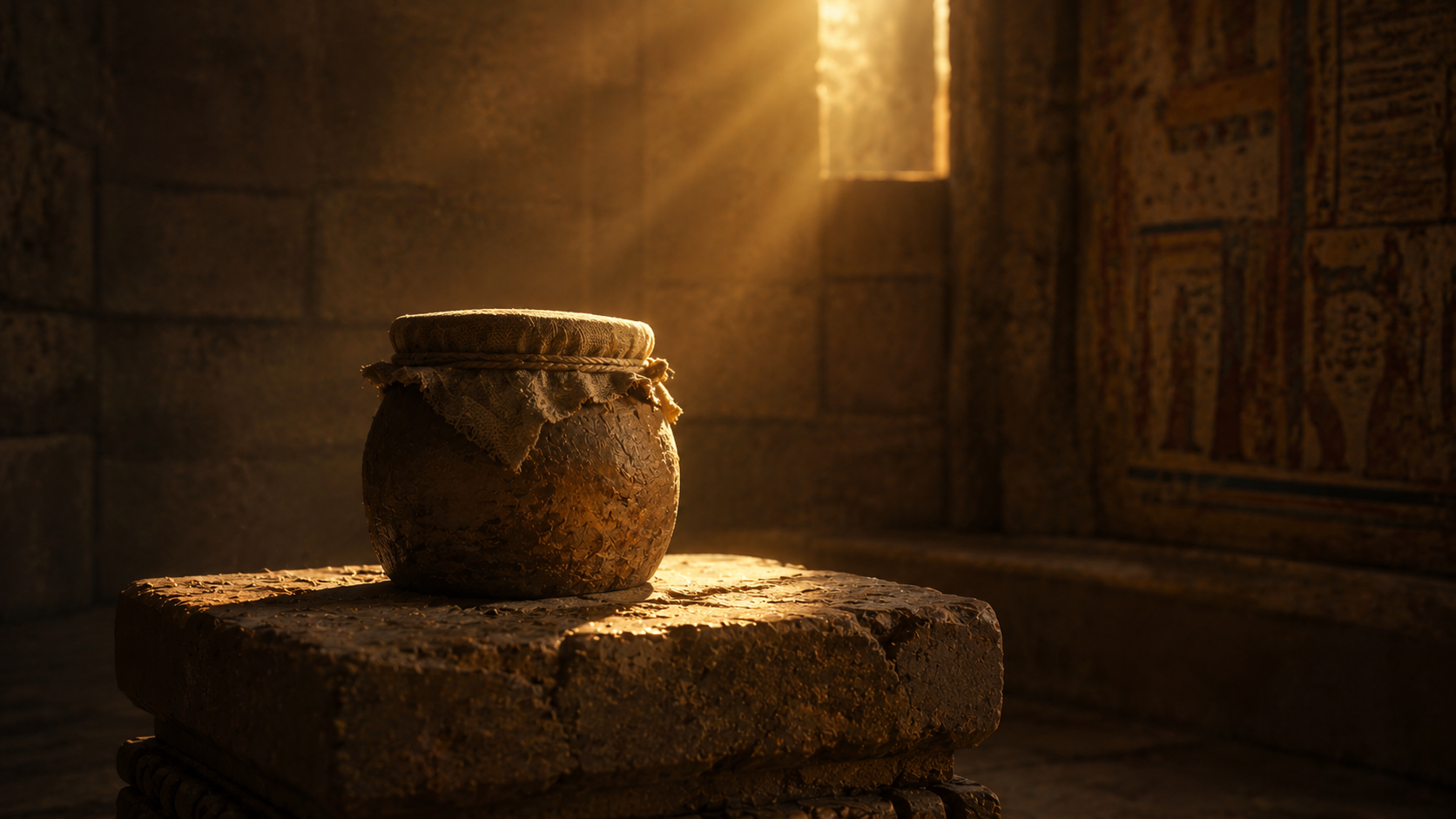
- Let an omer-full of it be kept throughout your generations. The Hebrew is lemi-shmeret le-doroteykhem. Mishmeret (a kept-thing, a custody) is the same word for the things kept in the sanctuary. An omer of manna is to be kept as a sanctuary object for all future generations. The chapter is naming the manna as holy.
- Lay it up before YHWH. The Hebrew is hannah liphney YHWH. The jar of manna will be placed before YHWH, in the future tabernacle, alongside the tablets of the covenant and Aaron’s budded rod (Heb 9:4 will list these three together as the contents of the ark). The chapter is establishing one of the three sacred objects of Israel’s holiest place. The manna that fed the wilderness generation is also a physical relic of the covenant memory.
- The children of Israel ate the manna forty years. The chapter’s closing note. Forty years. The wilderness generation will eat manna every morning of their lives until they enter the land. The provision is permanent until the destination is reached. Joshua 5:12 will record the manna’s cessation on the morning Israel eats the produce of the land for the first time. The manna ends when the dependence is no longer needed in that form. The chapter is narrating the full rhythm of wilderness provision.
- Now an omer is one tenth of an ephah. The chapter ends with a small editorial note (now an omer is one tenth of an ephah) explaining the unit of measure for later readers. The Hebrew Bible is patient with its own readers, providing the conversion table for future generations who would not know the older ration unit.
Influence callout: Walter Brueggemann (Sabbath as Resistance)
Brueggemann reads the chapter as the foundational Hebrew Bible’s economic theology. The manna economy is the deliberate inverse of Pharaoh’s economy. Pharaoh’s Egypt ran on quotas (more bricks, less straw, no rest); the manna economy runs on daily ration, equal sufficiency, no stockpiling, and Sabbath. Brueggemann’s pastoral claim: every later Hebrew Bible economic instruction (the gleaning laws of Lev 19:9-10 and 23:22, the Sabbath-year debt-release of Deut 15, the Jubilee of Lev 25) is built on the foundation of Ex 16. Sabbath is the anti-Pharaoh law. The Israelite economy is to be not Egypt, all the way down. And the rhythm starts in the wilderness, taught by bread. Brueggemann’s larger argument is that the modern industrial-capitalist economy that runs on ever-increasing output, accumulation, and the erasure of Sabbath is, theologically, Pharaoh’s economy reasserting itself. The chapter is not antique. It is the Hebrew Bible’s permanent counter-economic claim, and it lands in any setting where the rhythm of Sabbath is being threatened by the demand for more output.
- The chapter ends. Israel has eaten manna and quail. Israel has rested on the Sabbath for the first time. The pillar still travels. The wilderness keeps unfolding. The next chapter will narrate the third wilderness test (water from the rock at Massah and Meribah) and the first battle (Amalek at Rephidim). But this chapter is the foundation of Israel’s daily-life trust. Sabbath is taught by bread. The economy of the people of God begins in the wilderness, on the dew, with a question: what is it?
Reflection prompts
- Sabbath was taught through bread before it was taught through any law. Israel learned to keep the seventh day not because Sinai required it but because the bread on the ground forced the rhythm. Where, in your own life, is your Sabbath rhythm being taught through what you actually need (sleep, food, attention) rather than through any rule? What would it mean to let the rhythm of provision teach the rhythm of rest?
- He who gathered much had nothing over, and he who gathered little had no lack. The manna economy is equal sufficiency. Pharaoh’s economy was about output. Where, in your own working life, are you operating in Pharaoh’s economy when the Hebrew Bible’s word is enough? What does the manna economy ask you to surrender?
- Some of them left of it until the morning, and it bred worms, and became foul. The first instinct of the redeemed is still to stockpile against tomorrow. Where, in your own faith life, are you stockpiling what was meant to be received daily? What would it look like to gather only one day’s portion?
Frameworks at play in this chapter: wilderness and liminality, sabbath rest.