

Exodus 15 is the chapter that answers chapter 14 in poetry. The crossing has happened; the Egyptians are dead on the sand; Israel stands on the far shore in trust. And then they sing. The Song of the Sea (vv. 1-18) is, by most scholarly accounts, the oldest poem in the Hebrew Bible. The song’s archaic Hebrew is older than the surrounding prose. The Hebrew Bible has been shaped around an inherited poem, set deliberately at this canonical hinge. Israel’s first act as a redeemed people is to sing.
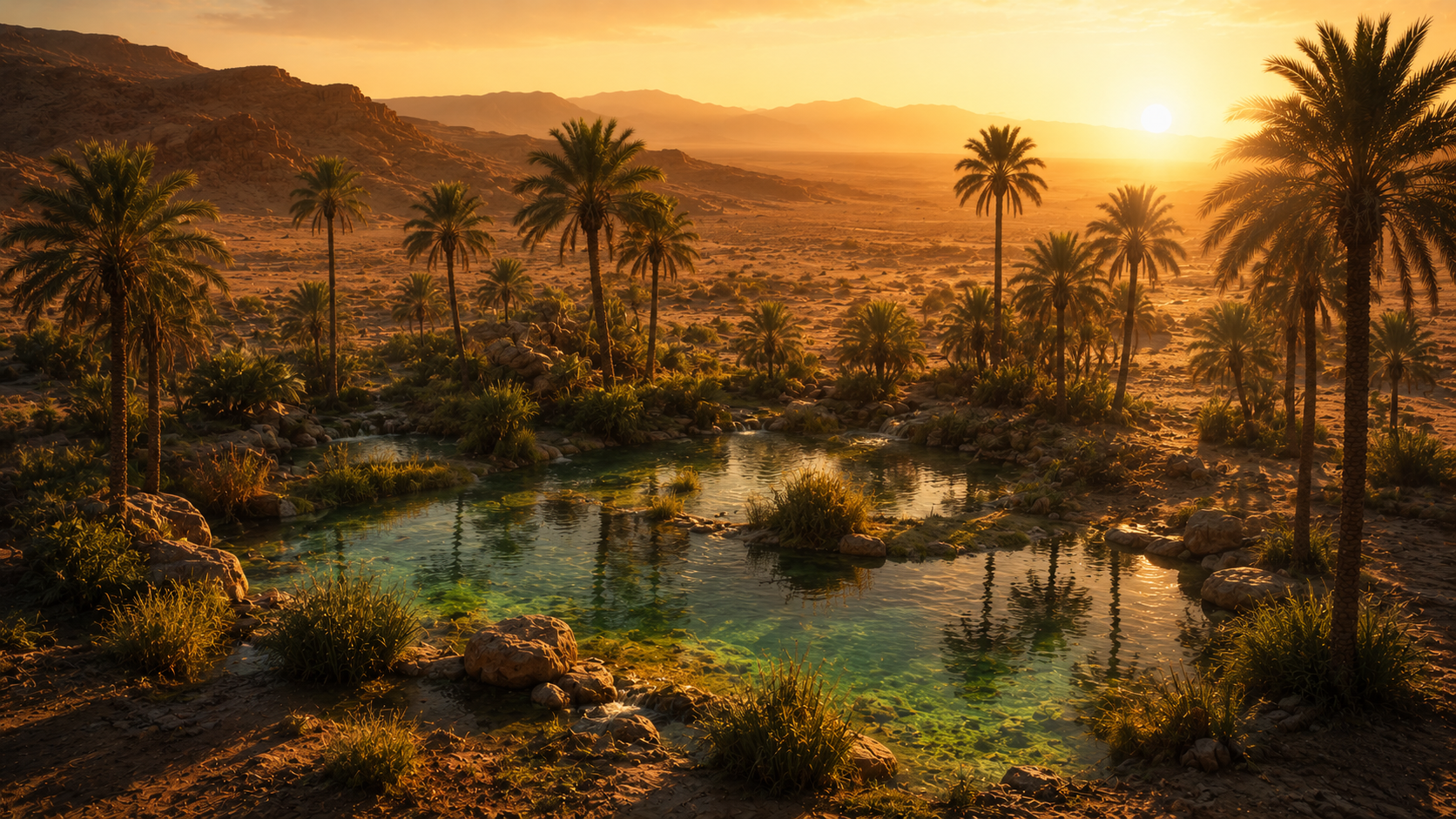
The chapter then turns. After the song comes the wilderness. Three days into the journey, Israel finds bitter water at Marah, and grumbles for the first time since the redemption. God shows Moses a tree; the tree is thrown into the water; the water becomes sweet. A statute and an ordinance are given. Then the chapter ends at Elim, where there are twelve springs and seventy palm trees. The numbers are theological: twelve for the tribes, seventy for the nations. Israel’s first wilderness encampment is, in its very geography, an image of God’s provision matched to the people God is forming.
The chapter is the structural pivot of the book. From here forward, Israel walks toward Sinai. The wilderness has begun.
A · Exodus 15:1-18 · The Song of the Sea
¹ Then Moses and the children of Israel sang this song to Yahweh, and said, “I will sing to Yahweh, for he has triumphed gloriously. He has thrown the horse and his rider into the sea. ² Yah is my strength and song. He has become my salvation. This is my God, and I will praise him; my father’s God, and I will exalt him. ³ Yahweh is a man of war. Yahweh is his name. ⁴ He has cast Pharaoh’s chariots and his army into the sea. His chosen captains are sunk in the Red Sea. ⁵ The deeps cover them. They went down into the depths like a stone. ⁶ Your right hand, Yahweh, is glorious in power. Your right hand, Yahweh, dashes the enemy in pieces. ⁷ In the greatness of your excellency, you overthrow those who rise up against you. You send out your wrath. It consumes them as stubble. ⁸ With the blast of your nostrils, the waters were piled up. The floods stood upright as a heap. The deeps were congealed in the heart of the sea. ⁹ The enemy said, ‘I will pursue. I will overtake. I will divide the plunder. My desire shall be satisfied on them. I will draw my sword. My hand shall destroy them.’ ¹⁰ You blew with your wind. The sea covered them. They sank like lead in the mighty waters. ¹¹ Who is like you, Yahweh, among the gods? Who is like you, glorious in holiness, fearful in praises, doing wonders? ¹² You stretched out your right hand. The earth swallowed them. ¹³ “You, in your loving kindness, have led the people that you have redeemed. You have guided them in your strength to your holy habitation. ¹⁴ The peoples have heard. They tremble. Pangs have taken hold of the inhabitants of Philistia. ¹⁵ Then the chiefs of Edom were dismayed. Trembling takes hold of the mighty men of Moab. All the inhabitants of Canaan are melted away. ¹⁶ Terror and dread falls on them. By the greatness of your arm they are as still as a stone, until your people pass over, Yahweh, until the people you have purchased pass over. ¹⁷ You shall bring them in, and plant them in the mountain of your inheritance, the place, Yahweh, which you have made for yourself to dwell in; the sanctuary, Lord, which your hands have established. ¹⁸ Yahweh shall reign forever and ever.”
- Then Moses and the children of Israel sang. The Hebrew is az yashir Mosheh u-vney-yisra’el. The verb yashir is technically future-tense in form (will sing) used for a past action, an unusual construction the Hebrew Bible uses for songs as ongoing events. The song is happening and continues to happen. Israel sings this song at Pesach for thousands of years, and the Hebrew preserves the unending-quality of that singing in the verb’s grammar.
- I will sing to YHWH, for he has triumphed gloriously. The Hebrew is ki ga’oh ga’ah. The doubled root ga’ah (rise up, exalt, triumph) is emphatic. Triumphing he has triumphed. The song’s first word names YHWH’s complete victory. The Hebrew Bible’s poetry loves these doubled-root constructions for emphasis.
- Yahweh is a man of war. Yahweh is his name. The Hebrew is YHWH ish milchamah, YHWH shemo. The line is striking. The God who has just delivered Israel is named, in the song, as a warrior. The Hebrew Bible is honest about this. YHWH fights. The cruciform reading of the canon will eventually reframe this (the warrior-God ultimately conquers through the non-violence of the cross; see The cruciform hermeneutic), but the song’s first naming is direct: YHWH fights for the oppressed against the oppressor.
- Who is like you, YHWH, among the gods? Who is like you, glorious in holiness, fearful in praises, doing wonders? (v. 11). The Hebrew is mi-khamokha ba-elim YHWH. Mi-khamokha (who is like you) becomes a Hebrew Bible refrain. It surfaces in the prophets, the Psalter, and is the source of the medieval Jewish song Mi Khamocha sung in Pesach liturgy. The chapter’s poetry has shaped Jewish prayer for thousands of years.
- Ba-elim literally means among the gods. The song does not deny the existence of other elim (deities, divine beings); it asserts YHWH’s incomparability among them. This matches the divine council framework (see The divine council). The plagues have been judgment on the elohey mitsrayim (gods of Egypt, Ex 12:12); the song answers with the question that the plagues have already answered: who is like YHWH among the gods? No one.
- You stretched out your right hand. The earth swallowed them (v. 12). The Hebrew is vatival’em arets. The verb bala (swallow) is the same word used in Ex 7:12 of Aaron’s staff swallowing the Egyptian magicians’ staffs. The chapter is closing the loop the staff-contest opened. Aaron’s tannin swallowed Pharaoh’s tannins; YHWH swallowed Pharaoh’s army. The contest of bala-ings runs from Ex 7 to Ex 15.
- You, in your loving kindness, have led the people that you have redeemed (v. 13). The Hebrew is nachita ve-chasdekha am-zu ga’alta. Chesed (lovingkindness, covenant loyalty) is the word for God’s faithful family-love. Ga’alta (you have redeemed) is from ga’al (kinsman-redeemer), the same root that first appeared in Ex 6:6 (see The firstborn / bechor). The song names YHWH’s deliverance as family redemption: God acted as go’el for Israel, his covenant family.
- You shall bring them in, and plant them in the mountain of your inheritance, the place which you have made for yourself to dwell in; the sanctuary which your hands have established (v. 17). The Hebrew is be-har nachalatekha makhon le-shivtekha pa’alta YHWH miqdash adonay konenu yadeykha. The song looks forward to a mountain of inheritance, a sanctuary, a place YHWH has made for himself to dwell. Most scholars read this as the eventual Jerusalem temple, but in the chapter’s immediate horizon it points first to Sinai. The song is structurally prophetic: it names Israel’s destination as already accomplished. The Hebrew Bible’s poetry has the freedom to speak in present tense about future-but-certain realities.
- YHWH shall reign forever and ever. The Hebrew is YHWH yimlokh le-olam va-ed. The song’s closing line names YHWH’s kingship. The Hebrew Bible’s first articulation of the kingdom of God in poetic form. The Egyptian Pharaoh has just been swallowed; YHWH is now the king the song names. Wright’s reading: this is the foundational moment of the Hebrew Bible’s kingdom-of-God theology. Every later kingdom-claim, including Jesus’s, runs in this line.
Word study: ga’al (גָּאַל), “redeemed” in v. 13
Ga’al is the kinsman-redeemer verb that appeared first at Ex 6:6 in God’s seven I-will statements. Its appearance in the song confirms the chapter’s theological reading of the deliverance: God has acted as go’el for Israel. The same verb is used of Boaz redeeming Ruth (Ruth 3-4), of the kinsman-redeemer’s right to buy back family land (Lev 25), of Job’s confidence (I know that my Redeemer (go’el) lives, Job 19:25), and across Isaiah of YHWH as Israel’s go’el (Isa 41:14, 43:14, 44:6, 22, 24, 47:4, 48:17, 49:7, 26, 54:5, 8, 59:20, 60:16, 63:16). The Sea-crossing is the canonical founding of the go’el vocabulary. Every later use is in echo of Ex 6 and 15.
B · Exodus 15:19-21 · Miriam’s song
¹⁹ For the horses of Pharaoh went in with his chariots and with his horsemen into the sea, and Yahweh brought back the waters of the sea on them; but the children of Israel walked on dry land in the middle of the sea. ²⁰ Miriam the prophetess, the sister of Aaron, took a tambourine in her hand; and all the women went out after her with tambourines and with dances. ²¹ Miriam answered them, “Sing to Yahweh, for he has triumphed gloriously. The horse and his rider he has thrown into the sea.”
- Miriam the prophetess, the sister of Aaron. This is the first time in the Hebrew Bible that a woman is called prophetess (nevi’ah). Miriam, who has been on the page since Ex 2:4 (the unnamed sister watching over Moses’s basket), is now named with the technical title. Goldingay’s note: the Hebrew Bible has three named co-leaders of the Exodus generation. Mic 6:4 makes this explicit: I sent before you Moses, Aaron, and Miriam. The chapter is the first to give Miriam her title.
- Took a tambourine in her hand; and all the women went out after her with tambourines and with dances. The Hebrew is vatikkach ha-tof be-yadah, vatetsenah khol ha-nashim achareyha be-tuppim u-vi-mecholot. The picture is of the women of Israel leading a public victory dance, with percussion and choreography, on the seashore. The chapter is making space for a women’s-led liturgy at the moment of Israel’s becoming-a-nation. Solomon’s note: in many manuscripts, Miriam’s song is placed first in the chapter (vv. 1-18 may be the larger song that Israel sings after Miriam’s song, with Moses leading). Whether or not the song-order is reconstructed, the canonical text is making a point: the women lead. The Hebrew Bible’s first prophetic song after the deliverance is sung by a woman, with women.
- Sing to YHWH, for he has triumphed gloriously. The horse and his rider he has thrown into the sea. Miriam’s song is the song of Moses in compressed form. Same opening, same images, same ga’oh ga’ah doubling. The Hebrew preserves both the long Mosaic version (likely sung by Israel together) and Miriam’s terse refrain. Both belong in the canon. The chapter refuses to choose one over the other.
C · Exodus 15:22-27 · Bitter water at Marah, and the springs at Elim
²² Moses led Israel onward from the Red Sea, and they went out into the wilderness of Shur; and they went three days in the wilderness, and found no water. ²³ When they came to Marah, they couldn’t drink from the waters of Marah, for they were bitter. Therefore its name was called Marah. ²⁴ The people murmured against Moses, saying, “What shall we drink?” ²⁵ Then he cried to Yahweh. Yahweh showed him a tree, and he threw it into the waters, and the waters were made sweet. There he made a statute and an ordinance for them, and there he tested them; ²⁶ and he said, “If you will diligently listen to Yahweh your God’s voice, and will do that which is right in his eyes, and will pay attention to his commandments, and keep all his statutes, I will put none of the diseases on you, which I have put on the Egyptians; for I am Yahweh who heals you.” ²⁷ They came to Elim, where there were twelve springs of water, and seventy palm trees: and they encamped there by the waters.
- They went three days in the wilderness, and found no water. Three days. The most basic biological need. Israel’s first wilderness experience after the great deliverance is a crisis of thirst. The Hebrew Bible is honest: redemption does not exempt the redeemed from the body’s needs. The wilderness will keep teaching this.
- They couldn’t drink from the waters of Marah, for they were bitter. The Hebrew is marim hem. Marah literally means bitter. The same Hebrew root is the source of maror (bitter herbs of the Pesach seder, Ex 12:8) and Naomi’s renaming of herself as Mara in Ruth 1:20. Bitter in Hebrew is a thick, layered word. Israel’s first water on the road from redemption is the same word that names the bitterness of slavery they have just left.
- The people murmured against Moses. The Hebrew is vayilonu ha-am al-Mosheh. The verb lun (grumble, murmur) is the wilderness narrative’s signature word. It will appear repeatedly: at the manna (Ex 16), at Massah (Ex 17), at Kadesh (Num 14), at Korah’s rebellion (Num 16), at Meribah (Num 20). The grumbling pattern starts at Marah, three days out. Mackie’s structural reading: the Hebrew Bible deliberately places grumbling stories before Sinai (Ex 15-17) and grumbling stories after Sinai (Numbers 11+) to bracket the covenant-giving with the same human heart-condition. Israel has been delivered, but Israel has not yet been formed. The wilderness work has only just begun. See Wilderness and liminality.
- YHWH showed him a tree, and he threw it into the waters, and the waters were made sweet. The Hebrew is vayyorehu YHWH ets. God teaches / shows Moses a particular tree. The tree is thrown into the bitter water; the water becomes sweet. The mechanism is uncertain (some scholars suggest a known plant-species with water-sweetening properties; others read it as a sign without natural explanation). The theological move is clear: YHWH provides what Israel needs at the moment Israel cannot provide it themselves. The tree-in-the-water is also typologically loaded. Christian readers have heard the cross in this image since the patristic period (Tertullian, Against Marcion; Origen). The tree thrown into bitter water that turns it sweet is, in figural reading, the cross thrown into the bitterness of the world. The Hebrew Bible does not state this; the church’s later reading hears it.
- There he made a statute and an ordinance for them, and there he tested them. The Hebrew is sham sam lo chok u-mishpat ve-sham nissahu. The verb nissah (test, try) is the wilderness narrative’s other signature word. Marah is the first test. Solomon’s reading (see Wilderness and liminality): the wilderness will be a series of tests that map to the Shema’s clauses. Marah is the test of the vav (heart / will): will the people trust YHWH for what they need? The unstated statute, per the rabbinic tradition, is the weak and marginalized go first: the strong wait so the weak can drink. The chapter does not spell this out, but the rabbinic reading is in the text’s grain.
- I am YHWH who heals you. The Hebrew is ani YHWH rofe’ekha. This is the first divine self-identification using the rofe (healer) form. From this verse comes the name YHWH-Rofe (the LORD who heals). The chapter is naming a permanent attribute of God: the healing word is now in the divine vocabulary.
- They came to Elim, where there were twelve springs of water, and seventy palm trees. The Hebrew is sham shtem-esrei eynot mayim ve-shiv’im temarim. The numbers are deliberate. Twelve springs: one for each tribe of Israel. Seventy palms: the seventy nations of Genesis 10, or the seventy souls of Israel that came down to Egypt (Gen 46:27). The chapter’s geography is a theological map. The next encampment after Marah is a place of abundance perfectly matched to the people’s structure. Solomon’s note: Marah was the test; Elim is the answer. Israel had to grumble and learn to trust at Marah before they could see Elim. Elim was waiting the whole time, just past Marah, but Israel had to walk through Marah to find it.
Influence callout: John Goldingay (Exodus and Leviticus for Everyone)
Goldingay reads the chapter’s structural pivot from song to grumbling as the Hebrew Bible’s quiet realism. Three days: that is how long the song lasted before the grumbling started. The chapter is honest that even the most powerful spiritual experience does not, by itself, transform the heart. Israel sang on the seashore in the morning and grumbled at Marah three days later. Goldingay’s pastoral note: this is normal. The Hebrew Bible is not embarrassed by it. Spiritual highs do not exempt the heart from formation. The wilderness exists because the heart that sang at the Sea is the same heart that grumbled at Marah, and the only way through is the long road of testing and provision until Sinai. The chapter is teaching that the same people God delivered are the people God will form, and the formation will take longer than the deliverance.
Reflection prompts
- Three days in the wilderness, and no water. Three days after the most powerful spiritual experience of their lives, Israel was grumbling. The chapter is honest that high spiritual moments do not, by themselves, transform the heart. Where, in your own life, are you embarrassed about a recent grumble that came on the heels of a recent worship? The Hebrew Bible is not embarrassed. Why are you?
- YHWH showed Moses a tree, and he threw it into the waters. The bitter became sweet because something was added to it, not because the bitterness was magically removed. Where, in your own life, is bitter water sitting that needs not removal but something thrown in? What might that something be?
- Twelve springs and seventy palms. Elim was waiting. Israel had to walk through Marah to find it. Where, in your own life right now, is Elim waiting just past a Marah you would rather skip?
Frameworks at play in this chapter: the divine council, wilderness and liminality, the exodus pattern.