

Exodus 14 is the most iconic chapter in the Hebrew Bible. The crossing of the Sea is the single image the rest of Scripture keeps quoting back: the prophets read the return from Babylon as a new sea-crossing (Isa 43:16-19); the Psalter rehearses the splitting of the waters generation after generation (Pss 77, 78, 106, 114); 1 Cor 10:1-2 reads baptism as crossing the sea; Hebrews 11:29 names the crossing as a hall-of-faith moment; Revelation closes the canon with the saints standing on the sea of glass mingled with fire, singing the song of Moses and of the Lamb (Rev 15:2-3). The chapter is the visual center of the whole Bible’s redemption-vocabulary.
But the chapter is also more theologically loaded than its iconic image suggests. Three deliberate moves are at work. First, creation language. The Hebrew of v. 21 (YHWH drove back the sea by a strong east wind all the night, and made the sea dry land, and the waters were divided) deliberately echoes Genesis 1:9-10 (let the waters under the heavens be gathered together to one place, and let the dry land appear). The same Hebrew vocabulary names the sea’s separation, the waters’ division, the dry land emerging. The exodus is being narrated as a second creation. Second, un-creation of Egypt. Pharaoh’s chariots, the symbol of Egypt’s military might, are swallowed (v. 28) by the waters that part for Israel. Third, the bechor / firstborn motif reaches its visual climax. Israel-as-God’s-firstborn (Ex 4:22) is delivered through a birth canal of water; Egypt drowns.
The chapter ends with a single line that names what has just happened: Israel saw the great work which YHWH did to the Egyptians, and the people feared YHWH; and they believed in YHWH, and in his servant Moses (v. 31). The Israel that left Egypt has now been baptized into trust. The Israel that walked into the sea is not the Israel that walked out the other side.
A · Exodus 14:1-14 · The trap, the cry, the silence
¹ Yahweh spoke to Moses, saying, ² “Speak to the children of Israel, that they turn back and encamp before Pihahiroth, between Migdol and the sea, before Baal Zephon. You shall encamp opposite it by the sea. ³ Pharaoh will say of the children of Israel, ‘They are entangled in the land. The wilderness has shut them in.’ ⁴ I will harden Pharaoh’s heart, and he will follow after them; and I will get honor over Pharaoh, and over all his armies; and the Egyptians shall know that I am Yahweh.” They did so. ⁵ The king of Egypt was told that the people had fled; and the heart of Pharaoh and of his servants was changed toward the people, and they said, “What is this we have done, that we have let Israel go from serving us?” ⁶ He prepared his chariot, and took his army with him; ⁷ and he took six hundred chosen chariots, and all the chariots of Egypt, and captains over all of them. ⁸ Yahweh hardened the heart of Pharaoh king of Egypt, and he pursued after the children of Israel; for the children of Israel went out with a high hand. ⁹ The Egyptians pursued after them: all the horses and chariots of Pharaoh, his horsemen, and his army; and overtook them encamping by the sea, beside Pihahiroth, before Baal Zephon. ¹⁰ When Pharaoh came near, the children of Israel lifted up their eyes, and behold, the Egyptians were marching after them; and they were very afraid. The children of Israel cried out to Yahweh. ¹¹ They said to Moses, “Because there were no graves in Egypt, have you taken us away to die in the wilderness? Why have you treated us this way, to bring us out of Egypt? ¹² Isn’t this the word that we spoke to you in Egypt, saying, ‘Leave us alone, that we may serve the Egyptians?’ For it would have been better for us to serve the Egyptians, than that we should die in the wilderness.” ¹³ Moses said to the people, “Don’t be afraid. Stand still, and see the salvation of Yahweh, which he will work for you today; for you will never again see the Egyptians whom you have seen today. ¹⁴ Yahweh will fight for you, and you shall be still.”
- Speak to the children of Israel, that they turn back and encamp. God orchestrates the geographic position. He instructs Israel to turn back and camp at a specific place between Migdol (a fortress) and the sea. The position is, militarily, a trap. There is no exit. Pharaoh, hearing of the strange Hebrew movements, will see Israel as cornered.
- Pharaoh will say… “They are entangled in the land. The wilderness has shut them in.” God predicts Pharaoh’s military analysis. Pharaoh, looking at the map, will read Israel’s position as confused, lost, hemmed in by the wilderness. He will not see God’s hand in the geography. He will see only what his Egyptian-trained military mind can see. The chapter is teaching that God deliberately stages the impossible-looking trap as the means of his glory.
- I will harden Pharaoh’s heart, and he will follow after them. The Hebrew is vechizaqti et-lev par’oh. The verb is chazaq (strengthen, fortify, resolve). Pharaoh’s heart is chazaq-ed one final time, in the same direction it has been moving the whole book. The heart-condition that began with kavod (heavy, dull) and intensified to chazaq (resolved, fortified) reaches its terminal expression here. Pharaoh’s pursuit of Israel into the seabed is the consequence of his sustained refusal. The Egyptian Ma’at framework continues in the background: by the standard of his own theology, Pharaoh’s heart was already too heavy at the firstborn night. The pursuit into the Sea is the public verdict of that weighing.
- They were very afraid. The children of Israel cried out to YHWH. The Hebrew is vayitsa’aqu bney-yisra’el el-YHWH. The verb tsa’aq (cry out from oppression) is the same word Israel cried in Ex 2:23 from Egypt. Israel cries the same cry again, but this time to YHWH (not just up to God as in chapter 2). The trauma of slavery has formed the cry; the deliverance is teaching them whom to cry to. Solomon’s note: this is the people’s first explicit prayer to YHWH by name. Egypt is gone, and Israel is starting to learn that the God who delivered them is theirs.
- Because there were no graves in Egypt, have you taken us away to die in the wilderness? Israel’s first complaint to Moses. The Hebrew is sharply ironic: because there were no graves in Egypt. Egypt was famous for its tombs. The Pyramid culture, the Valley of the Kings, the elaborate burial industry. Israel’s complaint is acid: was Egypt suddenly out of graves, that you brought us out here to die? The first time Israel will rebuke Moses, but very far from the last. The grumbling pattern that will fill the wilderness narrative starts here. Mackie’s note: the chapter’s structural placement of this grumbling, immediately before the great deliverance, is the Hebrew Bible’s deliberate way of teaching that the people Israel will be will not be made better by deliverance alone. The wilderness still has work to do.
- Don’t be afraid. Stand still, and see the salvation of YHWH… YHWH will fight for you, and you shall be still. Moses’s reply is not a battle plan. It is stand still. The Hebrew is hityatsvu u-r’u et-yeshu’at YHWH. The verb hityatsvu (stand firm, take your position) is military, but the action commanded is passive (stand and see). You shall be still in v. 14 is atem tacharishun: be silent. Moses tells Israel to be silent and still while YHWH fights. This is a foundational moment in biblical theology: the deliverance is YHWH’s. Israel is to be still. The chapter is naming an entire grammar of biblical deliverance: God acts; Israel watches and is still.
Word study: yeshu’at YHWH (יְשׁוּעַת יְהוָה)
“The salvation of YHWH.” The Hebrew word yeshu’ah means deliverance, rescue, salvation. Its verbal form is yasha’. The personal name Yeshua (Jesus) is built from the same root. Yeshua literally means YHWH saves. When Moses says *see the *yeshu’at YHWH** at Ex 14:13, he is, in Hebrew, naming the very category of action that will, fifteen hundred years later, be embodied in a person: Yeshua of Nazareth. The Hebrew Bible’s vocabulary of redemption converges on a name. See the salvation of YHWH and behold, the lamb of God are pointing at the same divine action across the canon’s whole arc.
B · Exodus 14:15-25 · The sea splits
¹⁵ Yahweh said to Moses, “Why do you cry to me? Speak to the children of Israel, that they go forward. ¹⁶ Lift up your rod, and stretch out your hand over the sea, and divide it: and the children of Israel shall go into the middle of the sea on dry ground. ¹⁷ Behold, I myself will harden the hearts of the Egyptians, and they shall go in after them: and I will get myself honor over Pharaoh, and over all his armies, over his chariots, and over his horsemen. ¹⁸ The Egyptians shall know that I am Yahweh, when I have gotten myself honor over Pharaoh, over his chariots, and over his horsemen.” ¹⁹ The angel of God, who went before the camp of Israel, moved and went behind them; and the pillar of cloud moved from before them, and stood behind them. ²⁰ It came between the camp of Egypt and the camp of Israel; and there was the cloud and the darkness, yet gave it light by night: and the one didn’t come near the other all the night. ²¹ Moses stretched out his hand over the sea, and Yahweh caused the sea to go back by a strong east wind all the night, and made the sea dry land, and the waters were divided. ²² The children of Israel went into the middle of the sea on the dry ground, and the waters were a wall to them on their right hand, and on their left. ²³ The Egyptians pursued, and went in after them into the middle of the sea: all of Pharaoh’s horses, his chariots, and his horsemen. ²⁴ In the morning watch, Yahweh looked out on the Egyptian army through the pillar of fire and of cloud, and confused the Egyptian army. ²⁵ He took off their chariot wheels, and they drove them heavily; so that the Egyptians said, “Let’s flee from the face of Israel, for Yahweh fights for them against the Egyptians!”
- Why do you cry to me? Speak to the children of Israel, that they go forward. The Hebrew is mah-titsa’aq elay. God’s question is striking. Moses (or Israel) is crying out; God says stop crying, move forward. The chapter is teaching that there is a kind of prayer that becomes a substitute for the next obedient step. The deliverance now requires action. Speak to Israel. Go forward.
- Lift up your rod, and stretch out your hand over the sea, and divide it. The instrument of the deliverance is, again, Moses’s matteh: the shepherd’s staff that has been YHWH’s tool from chapter 4 forward. The same staff that became a serpent before Pharaoh, that struck the Nile to blood, now divides the sea. The shepherd’s staff has been doing redemption-work the whole book.
- The angel of God, who went before the camp of Israel, moved and went behind them; and the pillar of cloud moved from before them, and stood behind them. The pillar of cloud, which had been leading Israel, moves to the rear and stands between Israel and the pursuing Egyptians. The same divine presence that guides now guards. The pillar’s geometry teaches: God’s protection is on every side of the deliverance. He goes before; he comes behind; he stands between.
- YHWH caused the sea to go back by a strong east wind all the night. The Hebrew is be-ruach qadim azzah kol-ha-laylah. The same east wind (ruach qadim) that brought the locusts in chapter 10 now drives back the sea. The wind is YHWH’s instrument throughout. And the verb ruach (wind) is the same word as ruach (Spirit) at Genesis 1:2 (the Spirit / wind of God hovered over the waters). Both creation and exodus involve the ruach over waters. The Hebrew Bible is doing typology in real time: the same ruach that ordered the chaos at creation orders the chaos at the Sea. Solomon’s reading: the parallel is deliberate. The exodus is new creation.
- Made the sea dry land, and the waters were divided. The Hebrew is vayasem et-ha-yam le-charavah, vayibaq’u ha-mayim. Charavah (dry land) is the same word the Hebrew Bible uses at Genesis 1:9 (let the dry land appear). Yibaq’u (divided) is the niphal of baqa, the same root used in Gen 7:11 (the fountains of the great deep split open). The text is layering creation language. The exodus is, on the chapter’s own argument, the fundamental act of new creation. Israel walks through, on the ground that emerges, into a new world.
- The children of Israel went into the middle of the sea on the dry ground, and the waters were a wall to them on their right hand, and on their left. The walls of water on both sides. Solomon’s reading (and Fohrman’s) makes much of the birth canal image: water on both sides, the people emerging from the corridor onto dry land, the bechor (firstborn) born into the world from a body of water. Read alongside Ex 4:22 (Israel is my firstborn son), the sea-crossing is the birth of God’s firstborn. The chapter’s most iconic image is, at its theological deepest level, a birth.
- In the morning watch, YHWH looked out on the Egyptian army through the pillar of fire and of cloud. The Hebrew is vayashqef YHWH, YHWH gazed out. The verb shaqaph is used elsewhere for divine looking down in judgment (Gen 18:16 toward Sodom; Gen 19:28 the morning after). YHWH looks at the Egyptian army the way he once looked at Sodom. The same word, the same verdict.
- Took off their chariot wheels. The Hebrew is vayasar et-ofan markevotav. The wheels of the chariots come off. The military symbol of Pharaoh’s empire breaks down at the moment of attempted pursuit. YHWH fights for them against the Egyptians: the Egyptians’ own confession (v. 25). At the chapter’s climax, the Egyptian soldiers, watching their chariot-wheels fall off, recognize what Pharaoh refused to: YHWH is fighting against us. The pedagogical purpose of the plagues (and Egypt will know that I am YHWH) reaches its consummation in the mouths of dying Egyptian soldiers.
C · Exodus 14:26-31 · The waters return, and Israel believes
²⁶ Yahweh said to Moses, “Stretch out your hand over the sea, that the waters may come again on the Egyptians, on their chariots, and on their horsemen.” ²⁷ Moses stretched out his hand over the sea, and the sea returned to its strength when the morning appeared; and the Egyptians fled against it. Yahweh overthrew the Egyptians in the middle of the sea. ²⁸ The waters returned, and covered the chariots and the horsemen, even all Pharaoh’s army that went in after them into the sea. There remained not so much as one of them. ²⁹ But the children of Israel walked on dry land in the middle of the sea, and the waters were a wall to them on their right hand, and on their left. ³⁰ Thus Yahweh saved Israel that day out of the hand of the Egyptians; and Israel saw the Egyptians dead on the seashore. ³¹ Israel saw the great work which Yahweh did to the Egyptians, and the people feared Yahweh; and they believed in Yahweh, and in his servant Moses.
- The sea returned to its strength when the morning appeared. The Hebrew is vayashov ha-yam… le-eytano. The waters’ return at morning completes the chapter’s day-cycle: pursuit at evening, crossing at night, judgment at dawn. The morning of the new day finds Egypt drowned and Israel on the far shore. Le-eytano (to its strength) suggests the sea returns to its proper, natural force. The waters are not attacking; they are simply being released from the unnatural restraint that had held them back for the crossing.
- YHWH overthrew the Egyptians in the middle of the sea. The Hebrew verb is naar (shake off, overthrow). Mackie’s note: the same verb is used at Neh 5:13 and several Psalms for YHWH shaking the wicked out of the land. The chapter is using a particular Hebrew Bible verb for divine judgment, and applying it to the Egyptian army. Bala (swallow) is the verb at Ex 15:12 in the song; that and naar together name the totality of the judgment.
- There remained not so much as one of them. The Hebrew is lo’ nish’ar ba-hem ad-echad. Pharaoh’s chariot army is destroyed entirely. The verse will be picked up at Heb 11:29 (the Egyptians, attempting to do so, were swallowed up). The chapter’s military picture is total.
- But the children of Israel walked on dry land. Verse 29 repeats the chapter’s central image one final time. Israel walks. Israel arrives. The contrast with Egypt’s drowning is unsoftened. The chapter is patient with the difficulty: Egyptian families lost husbands, fathers, and sons in the night. The Hebrew Bible records this without pretending the cost was small. But the chapter also names what it has been showing: YHWH saved Israel that day out of the hand of the Egyptians. The deliverance is real.
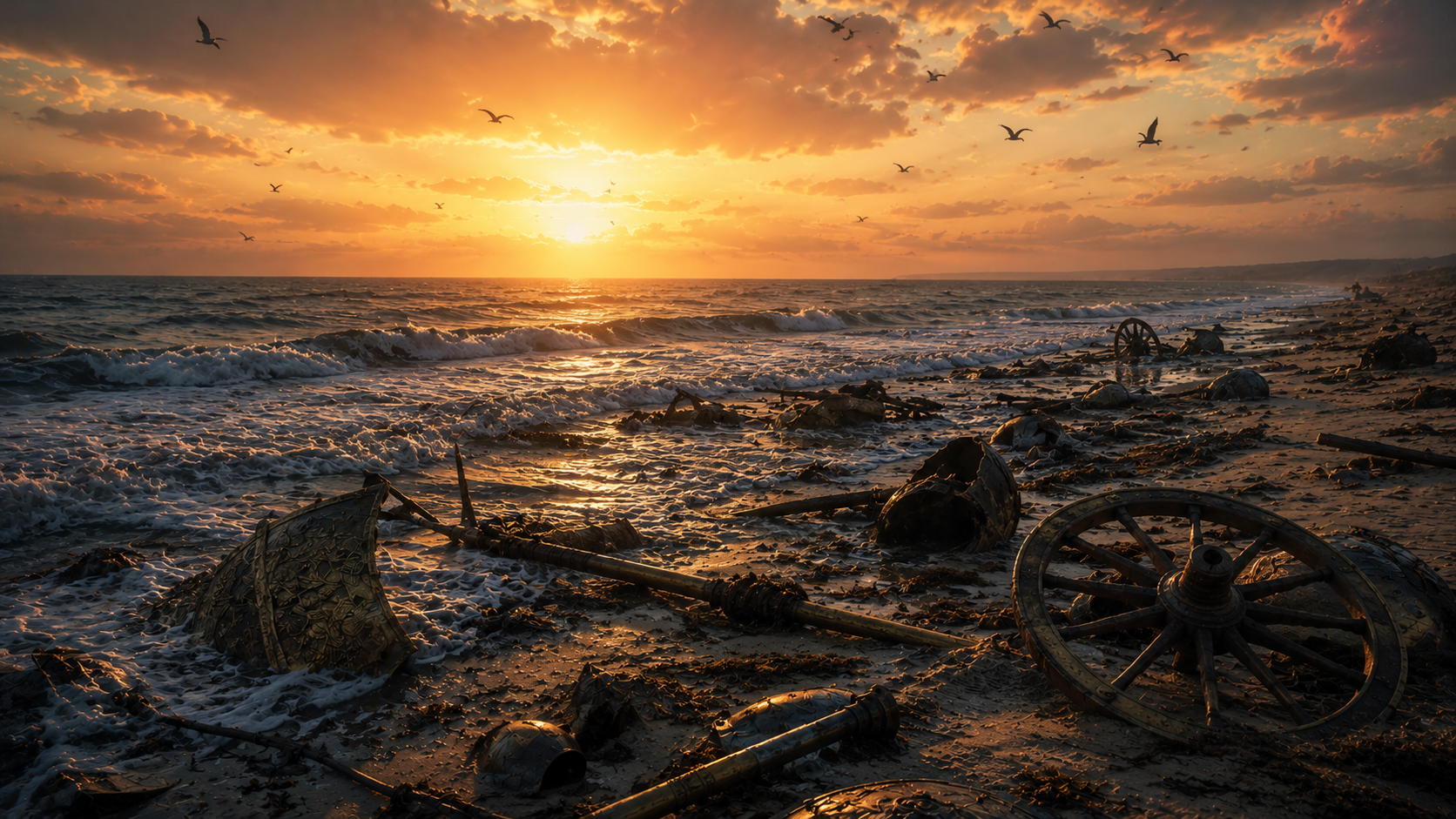
- Israel saw the Egyptians dead on the seashore. The chapter’s most haunting verse. Israel emerges and sees the bodies. The same hand that had held them in slavery for four hundred years lies still on the sand. Goldingay’s pastoral note: Israel needs to see this. The sight of the dead Egyptians is theologically necessary. Without seeing the dead enemies, Israel cannot believe the deliverance is real. The post-traumatic reality of slavery is that you do not believe you are free until you see the slave-master cannot follow. The chapter is patient with that human truth.
- Israel saw the great work which YHWH did to the Egyptians, and the people feared YHWH; and they believed in YHWH, and in his servant Moses. The chapter’s closing line. The Hebrew is vaya’aminu ba-YHWH u-ve-Mosheh avdo. The verb is aman (trust, believe, rely on). For the first time in the book, Israel believes. Their incapacity-to-hear in 6:9 is now overcome. The chapter that began with Israel’s terror at Pharaoh’s approach ends with Israel’s trust in YHWH and in Moses. The deliverance has accomplished, in the people, what the seven I-wills of chapter 6 announced. They have been brought out, freed, redeemed, and taken as YHWH’s people.
Influence callout: Marty Solomon (Bema Discipleship) and the new-creation reading
Solomon reads the Sea-crossing as the canonical Bible’s most explicit new creation event. The verbal echoes of Genesis 1 are deliberate: ruach over the waters, the separation of waters, dry land emerging, the new people walking out into a world that did not exist on the other side. Combined with the bechor / firstborn framework, the reading lands theologically: Israel is born as a nation through a birth canal of water. The blood of the doorpost (Ex 12) was the conception; the water of the Sea (Ex 14) is the birth. From this morning forward, Israel exists as a nation in a way it did not before. Solomon’s note: the New Testament will pick up this typology directly. Jesus tells Nicodemus (John 3) that one must be born of water and Spirit to enter the kingdom. The vocabulary is exactly the chapter’s: water and ruach, the same combination that brought Israel through. Baptism in the New Testament is not a new metaphor; it is the Sea-crossing extended. The whole canon is being patient with one image: redemption is being born again through judging waters.
- The chapter ends. Pharaoh is gone. Israel is on the far shore. The pillar still stands. The wilderness lies ahead. The next chapter will narrate the song Moses and Miriam will sing on the seashore: the oldest poem in the Hebrew Bible, the song that the prophets and the Apocalypse will keep singing back. Chapter 14 is the act; chapter 15 is the music.
Reflection prompts
- Stand still, and see the salvation of YHWH… YHWH will fight for you, and you shall be still. The chapter’s most counterintuitive instruction is to be silent while God fights. Where, in your own life right now, are you reaching for an action when the chapter’s word is be still? What is the difference between active waiting and passive resignation, and which one is the chapter calling you to?
- The chapter is patient with Israel’s grumbling complaint (because there were no graves in Egypt…) even as God prepares the deliverance. The Hebrew Bible is honest that God’s people complain on the way to the very deliverance God is about to give. Where, in your own life, are you complaining at the threshold of a deliverance you cannot yet see?
- Israel saw the Egyptians dead on the seashore. The post-traumatic reality is that you do not believe you are free until you see the master cannot follow. What is the master in your life that you have not yet seen lying on the sand? What does it look like to wait for the morning when the bodies will become visible?
Frameworks at play in this chapter: the exodus pattern, counter-imperial reading, the divine council.