
Exodus 12 is the longest chapter in Exodus and one of the most theologically dense in the Bible. The contest with Pharaoh that has run for ten plagues reaches its hinge: the firstborn night. But before the chapter narrates the night itself, it spends thirteen verses giving the liturgy. The instructions for the Passover meal come first. The plague comes second. The text is teaching that the deliverance is structured, from the start, to be re-enacted: every Passover seder for the next three thousand years is being scripted in real time, with details (the year-old lamb, the bitter herbs, the unleavened bread, the doorposts, the eating in haste) that will become the backbone of Jewish liturgical memory.
The chapter contains three discrete movements: the institution of the Passover (vv. 1-28), the night itself (vv. 29-36), and the road out (vv. 37-51). It also contains some of the Hebrew Bible’s most striking images: the lamb tied to the doorpost for four days, the blood applied with hyssop, the meal eaten standing with sandals on, the great cry of Egypt at midnight, the mixed multitude that goes up with Israel, the four-hundred-thirty years exact to the day, the Hebrew people leaving with great wealth. By the chapter’s end, Israel is a nation. They were a slave-people in the morning. They are God’s firstborn son by midnight.
The chapter is the canonical source of nearly every later biblical theme that comes back to Passover: the lamb, the blood, the meal, the threshold, the firstborn substitution, the redemption-by-blood pattern. Read carefully, the chapter is also the seedbed of the New Testament. Jesus will die at Passover. The Last Supper will be a seder. Paul will call Christ our Passover lamb (1 Cor 5:7). John will quote Exodus 12:46 directly (not one of his bones will be broken) at the cross (John 19:36). Without Exodus 12, the New Testament has no vocabulary for what Jesus did.
A · Exodus 12:1-28 · The institution of the Passover
¹ Yahweh spoke to Moses and Aaron in the land of Egypt, saying, ² “This month shall be to you the beginning of months. It shall be the first month of the year to you. ³ Speak to all the congregation of Israel, saying, ‘On the tenth day of this month, they shall take to them every man a lamb, according to their fathers’ houses, a lamb for a household; ⁴ and if the household is too little for a lamb, then he and his neighbor next to his house shall take one according to the number of the souls. According to what everyone can eat, you shall make your count for the lamb. ⁵ Your lamb shall be without defect, a male a year old. You shall take it from the sheep, or from the goats. ⁶ You shall keep it until the fourteenth day of the same month; and the whole assembly of the congregation of Israel shall kill it at evening. ⁷ They shall take some of the blood, and put it on the two doorposts and on the lintel, on the houses in which they shall eat it. ⁸ They shall eat the meat in that night, roasted with fire, and unleavened bread. They shall eat it with bitter herbs. ⁹ Don’t eat it raw, nor boiled at all with water, but roasted with fire; with its head, its legs and its inner parts. ¹⁰ You shall let nothing of it remain until the morning; but that which remains of it until the morning you shall burn with fire. ¹¹ This is how you shall eat it: with your belt on your waist, your sandals on your feet, and your staff in your hand; and you shall eat it in haste: it is Yahweh’s Passover. ¹² For I will go through the land of Egypt in that night, and will strike all the firstborn in the land of Egypt, both man and animal. I will execute judgments against all the gods of Egypt. I am Yahweh. ¹³ The blood shall be to you for a token on the houses where you are. When I see the blood, I will pass over you, and no plague will be on you to destroy you when I strike the land of Egypt. ¹⁴ This day shall be a memorial for you. You shall keep it as a feast to Yahweh. You shall keep it as a feast throughout your generations by an ordinance forever.
- This month shall be to you the beginning of months. The Hebrew is ha-chodesh ha-zeh lakhem rosh chodashim, this month is for you the head of months. The Passover night becomes the start of Israel’s liturgical calendar. Israel’s new year is now anchored to the night of redemption. Mackie’s note is precise: every later moment in Israel’s liturgical life will be dated from this night. The redemption is not just an event; it is the new center around which time itself is organized.
- On the tenth day… they shall take a lamb… you shall keep it until the fourteenth day. Why four days of waiting? Solomon (drawing on Fohrman) catches the strangeness: God commands Israel to bring the lamb into their houses for four days before they slaughter it. Why? Because the lamb is also a sacred Egyptian animal. Lambs and goats were sacred in Egyptian worship. To tie a lamb to your door for four days is a public act of theological defiance. The Egyptian neighbors would see, and ask, and know that something theological was about to happen. By the time Israel slaughters the lamb on the fourteenth, the act is iconoclasm in the open air. They are publicly killing the gods of Egypt at their own thresholds.
- Your lamb shall be without defect, a male a year old. The Hebrew is seh tamim zakhar ben-shanah. Tamim (without blemish, complete, whole) will become the technical term for sacrificial perfection in Leviticus. Ben-shanah (a year old) is precise. The animal’s age is part of the theology: a young, unblemished, male lamb. The same vocabulary will be applied at the cross. 1 Pet 1:19, the precious blood of Christ, as of a lamb without blemish and without spot. Christ is the tamim lamb.
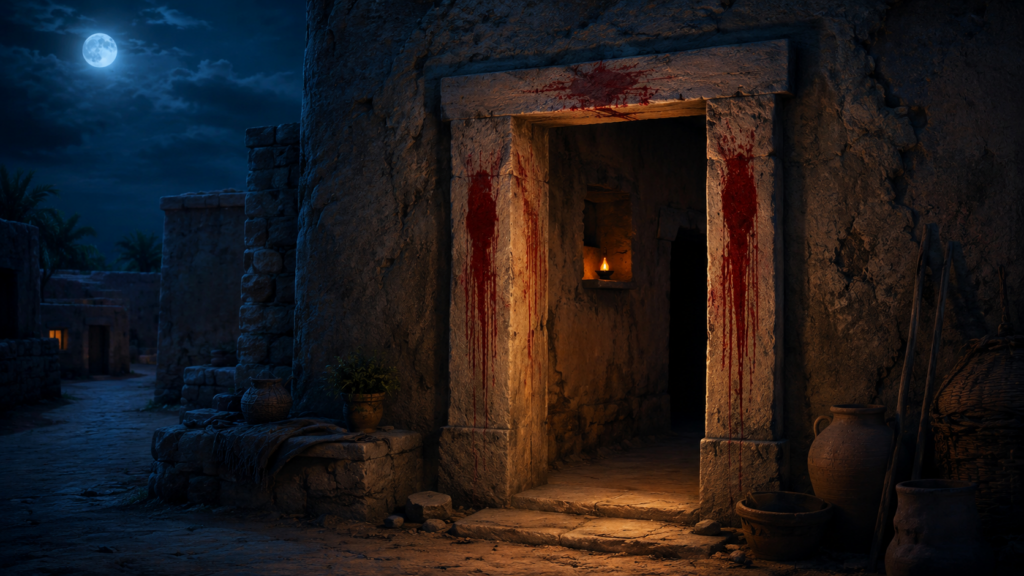
- They shall take some of the blood, and put it on the two doorposts and on the lintel. The Hebrew names three structural elements of the doorway: the mezuzot (two doorposts) and the mashqof (the lintel). The blood is applied with hyssop (Ex 12:22), making the doorway itself the sign of Israel’s allegiance. Solomon’s reading (drawing on Fohrman): the lintel is the head, the two doorposts are the sides, and the threshold is the foot. Read the marked door as a body. Blood on the head, blood on both sides. The marked doorway forms the shape of someone shielded by blood. The image will reach the cross: the blood at the head and at both sides of the body that takes Israel’s place.
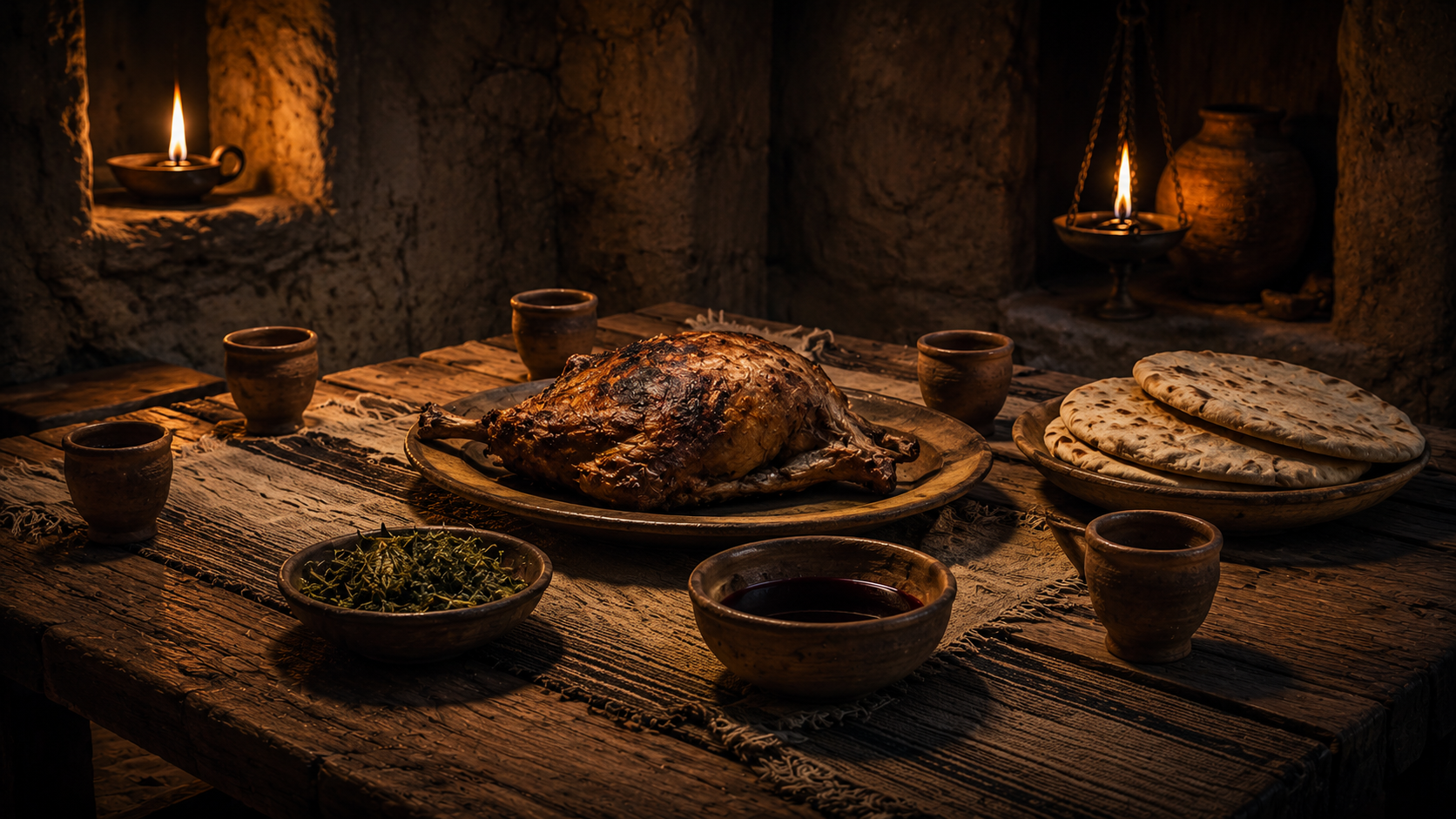
- They shall eat the meat in that night, roasted with fire, and unleavened bread. They shall eat it with bitter herbs. The meal has three elements that will define the seder for thousands of years. Lamb (roasted, not boiled, not raw, all of it consumed). Unleavened bread (matzah, no fermentation, no Egyptian additive). Bitter herbs (the maror that recalls the bitterness of slavery). Every Passover seder for three millennia has built its meal around these three elements. The chapter is, again, structuring the liturgy in real time.
Word study: pesach (פֶּסַח)
Usually translated “passover,” from the verb pasach in v. 13: I will pass over you. Imes notes that the verb pasach in its other Hebrew Bible occurrences means to protect, hover over, shield, more than “skip past.” The cleanest example is Isa 31:5, where YHWH *like birds hovering, so YHWH of armies will protect Jerusalem; he will protect and deliver, he will pasach and rescue*. The verb pasach there cannot mean “skip past”; it means protect / hover over. Imes argues the same is true at Ex 12:13: YHWH does not skip the marked Hebrew houses; YHWH stands over them, hovering, shielding them from the plague. The blood is not a sign that says “skip this house” to a passing destroyer; it is a sign that says “here is YHWH’s people,” and YHWH stations himself over them protectively. The reading reframes the theology: Passover is not first about avoidance of judgment but about active divine protection. The God who hovered (meraḥephet) over the waters at Genesis 1:2 now hovers (pasach) over the marked Hebrew houses on the firstborn night.
- With your belt on your waist, your sandals on your feet, and your staff in your hand; and you shall eat it in haste. The instructions describe the meal as if it is a journey-meal. They eat standing, belted, shod, with staff in hand, in haste. This is not a relaxed family dinner. It is a meal eaten while waiting to leave. The whole posture is theology: be ready to go. The meal forms the bodies of the eaters into traveling bodies. Goldingay’s pastoral note: every Passover seder for thousands of years has remembered this posture. Israel eats Passover as if on the verge of departure, even after they have lived in the land for centuries.
- I will execute judgments against all the gods of Egypt. The Hebrew is u-ve-khol elohey mitsrayim e’eseh shefatim. The plagues have, all along, been judgments against Egypt’s pantheon (the Nile/Hapi, the frogs/Heqet, the cattle/Hathor and Apis and Khnum, the sun/Ra, the firstborn-of-Pharaoh/Ra-as-father). The tenth plague is the summary judgment: every god of Egypt. The text is closing the theological argument the plagues have been making. By midnight, every Egyptian deity has been exposed as empty.
- This day shall be a memorial for you. The Hebrew is zikkaron (memorial, remembrance). The chapter explicitly names the day as a perpetual liturgical memory. You shall keep it as a feast throughout your generations by an ordinance forever. The text is structuring its own afterlife. The redemption that happens tonight is being structured for re-enactment forever.
- And when your children ask you, “What do you mean by this service?” then you shall say… (vv. 26-27, paraphrased; the verses appear in the chapter). The chapter explicitly anticipates the seder‘s Four Questions (Mah Nishtana) that every Jewish child for the next three thousand years will ask. The deliverance is being structured, from the night itself, for intergenerational telling. This will reach the New Testament’s do this in remembrance of me (1 Cor 11:24-25) in direct continuity. The Hebrew Bible’s table-liturgy of memory becomes the church’s eucharistic table-liturgy.
Influence callout: David Fohrman (The Exodus You Almost Passed Over)
Fohrman reads the Korban Pesach (the Passover offering) as a “oneness offering” against Egypt’s pantheon. Every parameter of the meal confirms a oneness statement: a one-year-old animal (not a family of animals), eaten by one group (the household, never split between households), roasted whole (not boiled or stewed, both of which fragment the body into pieces), with no bones broken (Ex 12:46), eaten bechipazon (in haste, in the narrowest possible window of time), bound to the doorpost for three days in plain view of Egyptian neighbors before the slaughter. The lamb (a sacred Egyptian animal) is being publicly slaughtered at the door of every Hebrew home. The Korban Pesach is iconoclasm in act. In affirming the One God, Israel symbolically rejects Egypt’s pantheon. The Korban is, theologically, Israel’s Shema-spoken-in-blood. Fohrman’s reading anchors the bechor / firstborn framework’s central claim: Israel becomes God’s firstborn on this night through this offering.
B · Exodus 12:29-36 · The night, and the great cry
²⁹ At midnight, Yahweh struck all the firstborn in the land of Egypt, from the firstborn of Pharaoh who sat on his throne to the firstborn of the captive who was in the dungeon; and all the firstborn of livestock. ³⁰ Pharaoh rose up in the night, he, and all his servants, and all the Egyptians; and there was a great cry in Egypt, for there was not a house where there was not one dead. ³¹ He called for Moses and Aaron by night, and said, “Rise up, get out from among my people, both you and the children of Israel; and go, serve Yahweh, as you have said! ³² Take both your flocks and your herds, as you have said, and be gone; and bless me also!” ³³ The Egyptians were urgent with the people, to send them out of the land in haste, for they said, “We are all dead men.” ³⁴ The people took their dough before it was leavened, their kneading troughs being bound up in their clothes on their shoulders. ³⁵ The children of Israel did according to the word of Moses; and they asked of the Egyptians jewels of silver, and jewels of gold, and clothing. ³⁶ Yahweh gave the people favor in the sight of the Egyptians, so that they let them have what they asked. They plundered the Egyptians.
- At midnight, Yahweh struck all the firstborn. The Hebrew is vayhi ba-chatsi ha-laylah. The text marks the time precisely. Midnight. The exact midpoint of the night. The structural midpoint of the deliverance. From this verse forward, everything reverses.
- From the firstborn of Pharaoh who sat on his throne to the firstborn of the captive who was in the dungeon. The plague’s social scope is total: every tier of Egyptian society. The text names the highest (Pharaoh’s heir, the next king) and the lowest (the captive in the dungeon, a slave below even the slave-overseers) and includes everyone in between. Empire’s hierarchy does not protect anyone from the cost of the king’s refusal. The slave-girl behind the mill (named in Ex 11:5) and the Pharaoh-heir die the same night. The text records this without softening. Empire’s harm always falls heaviest on the empire’s most vulnerable, and this time also on its most powerful.
- There was a great cry in Egypt. The Hebrew is vatehi tse’aqah gedolah be-mitsrayim. The verb is tsa’aq (to cry from oppression), the same word Israel cried in Ex 2:23. The structural reversal is complete. Egypt did not hear Israel’s tse’aqah; now Egypt’s own tse’aqah fills the country. The cry-of-the-oppressed framework (see The cry of the oppressed) reaches its most piercing biblical instance: the oppressor cries the cry the oppressed used to cry. Middah ke-neged middah (measure for measure).
- There was not a house where there was not one dead. Every Egyptian household is grieving. The chapter records this with painful weight. The Hebrew Bible will later remember (Isa 19:25) that Egypt is, in the end, my people, beloved by YHWH. The chapter does not flinch from the cost; it also does not let us forget that this is grief at scale.
- He called for Moses and Aaron by night. Pharaoh, who in Ex 10:28 swore Moses would never see his face again on pain of death, now summons Moses by night. Moses warned in Ex 11:8 that Pharaoh’s officials would come down to me, and bow down themselves to me, saying, “Get out.” The prophecy is fulfilled. Pharaoh himself does the calling.
- Rise up, get out from among my people. Pharaoh’s surrender is total. He has moved from I do not know YHWH (5:2) to go, serve YHWH, take everything, and bless me also. The man who once refused even to release the men is now begging the slaves to leave with their flocks, herds, families, and Pharaoh’s own blessing-request. The proud heart of Egypt has been broken at last.
- Bless me also. The Hebrew is u-verakhtem gam oti. Pharaoh asks Moses for a blessing. The man who claimed divine sonship from Ra is now asking the Hebrew prophet for a Hebrew blessing. The theological inversion is complete. Egypt’s pantheon has fallen; the only blessing available in Egypt now comes through Moses.
- They plundered the Egyptians. The Hebrew is vaye-natslu et-mitsrayim. The verb natsal (rescue, deliver, plunder) is the same root God uses of himself delivering Israel (“I will rescue you,” Ex 6:6). The text plays on the word: God natsals Israel from Egypt; Israel natsals Egypt of its silver and gold. The wealth Genesis 15:14 promised is being delivered. Four hundred years of unpaid labor are being paid in a single night. The same gold will, in chapter 25, become the tabernacle. The same gold will, in chapter 32, become the calf. The chapter is seeding what later chapters will harvest.
C · Exodus 12:37-51 · The road out, and the mixed multitude
³⁷ The children of Israel traveled from Rameses to Succoth, about six hundred thousand on foot who were men, in addition to children. ³⁸ A mixed multitude went up also with them, with flocks, herds, and even very much livestock. ³⁹ They baked unleavened cakes of the dough which they brought out of Egypt; for it wasn’t leavened, because they were thrust out of Egypt, and couldn’t wait, neither had they prepared for themselves any food. ⁴⁰ Now the time that the children of Israel lived in Egypt was four hundred thirty years. ⁴¹ At the end of four hundred thirty years, to the day, all of Yahweh’s armies went out from the land of Egypt. ⁴² It is a night to be much observed to Yahweh for bringing them out from the land of Egypt. This is that night of Yahweh, to be much observed of all the children of Israel throughout their generations. ⁴³ Yahweh said to Moses and Aaron, “This is the ordinance of the Passover. No foreigner shall eat of it, ⁴⁴ but every man’s servant who is bought for money, when you have circumcised him, then shall he eat of it. ⁴⁵ A foreigner and a hired servant shall not eat of it. ⁴⁶ It must be eaten in one house. You shall not carry any of the meat outside of the house. Don’t break any of its bones. ⁴⁷ All the congregation of Israel shall keep it. ⁴⁸ When a stranger lives as a foreigner with you, and would like to keep the Passover to Yahweh, let all his males be circumcised, and then let him come near and keep it; and he shall be as one who is born in the land: but no uncircumcised person shall eat of it. ⁴⁹ One law shall be to him who is born at home, and to the stranger who lives as a foreigner among you.” ⁵⁰ All the children of Israel did so. As Yahweh commanded Moses and Aaron, so they did. ⁵¹ That same day, Yahweh brought the children of Israel out of the land of Egypt by their armies.
- About six hundred thousand on foot who were men, in addition to children. The number is debated. The Hebrew word eleph can mean thousand or clan/military unit; some scholars argue the actual number is much smaller (closer to six hundred clan-units). Whatever the precise count, the text’s point is that Israel is now a nation. They entered Egypt as seventy souls (Gen 46:27); they leave as a multitude. Genesis’s covenant family has become Exodus’s covenant nation.
- A mixed multitude went up also with them. The Hebrew is ve-gam erev rav. Erev rav literally means a great mixture or a great mingling. Other Egyptians, other foreigners, who had seen the plagues and chosen to leave with Israel. Goldingay’s note: from the very first night, Israel is not ethnically pure. The exodus community includes Egyptians who feared YHWH’s word (Ex 9:20) and others who joined for whatever reason. The covenant people, from its first night as a people, includes outsiders who chose to belong. The framework that the prophets later push (Isa 56, foreigners welcomed at the temple) and that the New Testament harvests (Eph 2, Gentiles grafted in) is here in seed at the moment Israel becomes Israel.
- They baked unleavened cakes… they were thrust out of Egypt, and couldn’t wait. The Hebrew gives the etymology of the Festival of Unleavened Bread (Pesach + Matzot, the seven-day festival that Israel will observe forever). They had no time for leaven. The matzah is, theologically, the bread of the haste. Every Pesach for three thousand years will eat unleavened bread for seven days as a way of physically remembering the haste of the deliverance.
- Four hundred thirty years, to the day. The text gives a precise temporal marker. The Hebrew is u-mosheh ar-ba mei’ot ve-shloshim shanah va-yhi be-etsem ha-yom ha-zeh. To the day. The deliverance happens on the exact day, four hundred thirty years after the descent into Egypt. God is keeping a calendar. The promise of Genesis 15:13-14 (your descendants will be sojourners in a land that is not theirs, and will serve them, and they will afflict them four hundred years) is being kept, to the day. Goldingay’s note: this is the Hebrew Bible’s clearest single instance of God keeps appointments. Even four-hundred-year promises are kept on the appointed day.
- No uncircumcised person shall eat of it… let his males be circumcised, and then let him come near and keep it. The chapter’s closing verses establish the rule for inclusion in the Passover: covenant sign required, but the door is open. Foreigners who choose to enter the covenant by circumcision are included. The Hebrew is unmistakable: one law shall be to him who is born at home and to the stranger (v. 49). The same Hebrew word torah (law / instruction) governs both. Israel’s rule of life is offered to anyone willing to enter it. The framework is universal, not ethnic. The chapter is, again, seeding the New Testament’s later expansion of the covenant people through Christ.
- Don’t break any of its bones. Verse 46. The detail seems small but will be picked up by John 19:36 (these things happened that the Scripture might be fulfilled, “A bone of him will not be broken”). The unbroken-bones rule of the Passover lamb becomes, at the cross, a sign that Jesus is the Passover lamb whose body is whole even in death. Fohrman’s reading (the oneness offering) is in the background: the unbroken body is theologically required. The Korban cannot be fragmented. Christ as the new Korban is not fragmented either.
Influence callout: Carmen Joy Imes (Bearing God’s Name)
Imes reads the chapter’s central claim through the bechor / firstborn framework. Israel did not enter the night as God’s firstborn; Israel becomes God’s firstborn through the Korban Pesach. The lamb dies in the firstborn’s place. The blood at the doorposts marks the household as belonging to YHWH. The blood at the doorposts also forms a body-shape, the door becoming the marked threshold of identity. From this night forward, every Israelite firstborn is redeemed (pidyon haben) in remembrance of the night when YHWH’s firstborn was spared. The pattern reaches the New Testament directly: Mary and Joseph perform pidyon haben on Jesus at the temple (Lk 2:22-24). Christ becomes the firstborn from the dead (Col 1:18). The night of Exodus 12 establishes the framework that the rest of the canon assumes. Imes’s pastoral note: to be God’s firstborn is to be conscripted into a vocation, not granted exemption from struggle. Israel goes out tonight as God’s firstborn, and the rest of the book is the working out of what that means.
- The chapter ends with the deliverance accomplished. Israel has become a nation. The Passover liturgy is established. The road out is open. The next two chapters will narrate the road, the consecration of the firstborn, the sea-crossing, and the song. But this chapter is the structural hinge. Everything in the book before chapter 12 is preparation; everything after chapter 12 is consequence. The whole canonical pattern of redemption-by-blood begins here.
Reflection prompts
- The Passover liturgy is given before the Passover plague. Israel is told how to remember the night before the night happens. The deliverance is structured, from the start, to be told forward. Where, in your own life, are you living something now whose meaning is meant to be remembered later? What does it look like to live a present moment that is also being scripted, in real time, as testimony for generations to come?
- Pasach probably means protect / hover over, not skip past. YHWH stations himself over the marked households on the firstborn night. Where, in your own life, are you imagining God as a deity who passes by you, when the actual Hebrew of the redemption-night is that God stands over you, shielding you? How does that change the prayer-grammar of your hardest night?
- A mixed multitude went up also with them. The covenant people, from its first night as a people, included outsiders who chose to belong. The framework was always universal, never ethnic. Where, in your own community, is the erev rav (great mixture) showing up that the covenant should welcome? What does it look like to be a Passover people whose door is open to everyone willing to enter the covenant?
Frameworks at play in this chapter: the exodus pattern, the firstborn / bechor, the cruciform hermeneutic.