
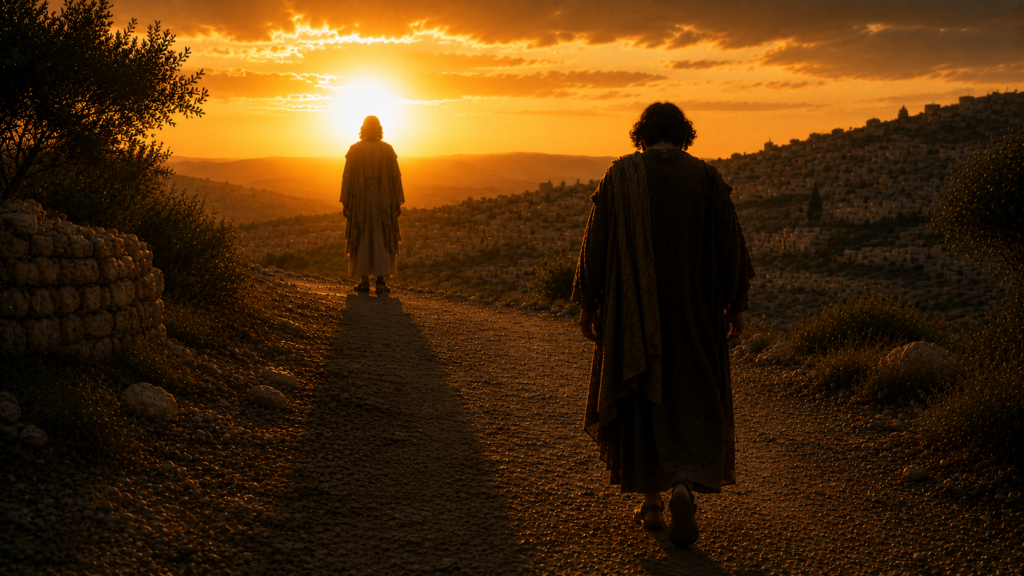
Matthew 19 is the chapter that turns the gospel decisively toward Jerusalem. The chapter opens with Jesus leaving Galilee (a deliberate narrative seam) and travels through the region beyond the Jordan, where the Pharisees test him with a question about divorce, parents bring children for him to bless, and a wealthy young man approaches with the question that will define the chapter: what good thing must I do to inherit eternal life? The chapter records the answers Jesus gives: to the Pharisees, to the disciples about divorce, to the children who are welcomed, to the young man whose face falls when he hears the cost, to Peter who asks what then will we have?
The chapter has three movements. The first (verses 1 to 12) is the divorce question: the Pharisees’ test, Jesus’s response from Genesis 1-2, the Mosaic-permission discussion, and the disciples’ troubled follow-up. The second (verses 13 to 15) is the brief children scene: the disciples turning the children away, Jesus calling them to him, and the kingdom-belongs-to-such-as-these saying. The third (verses 16 to 30) is the rich young ruler and its aftermath: the good teacher dialogue, the if you would be perfect invitation, the young man’s grief, the camel-and-the-eye-of-the-needle saying, Peter’s what about us?, and the hundredfold-and-first-last promise.
Beneath the chapter’s surface flow is a sustained argument about what kingdom-allegiance actually requires. The Pharisees ask a legal question about divorce; Jesus answers with a creation-pattern that reorients the whole frame. The disciples treat the children as interruptions; Jesus names them as the kingdom’s actual citizens. The young man wants to add eternal life to his already-comfortable life; Jesus offers him a re-organization of life around a different center. Peter asks what the disciples will get for what they have left; Jesus answers with the kingdom’s hundredfold reversal-economy. The chapter is teaching, through five connected scenes, the kind of allegiance the kingdom is asking for.
A · Matthew 19:1–12 · The divorce question
¹ When Jesus had finished these words, he departed from Galilee, and came into the borders of Judea beyond the Jordan. ² Great multitudes followed him, and he healed them there. ³ Pharisees came to him, testing him, and saying, “Is it lawful for a man to divorce his wife for any reason?” ⁴ He answered, “Haven’t you read that he who made them from the beginning made them male and female, ⁵ and said, ‘For this cause a man shall leave his father and mother, and shall be joined to his wife; and the two shall become one flesh?’ ⁶ So that they are no more two, but one flesh. What therefore God has joined together, don’t let man tear apart.” ⁷ They asked him, “Why then did Moses command us to give her a certificate of divorce, and divorce her?” ⁸ He said to them, “Moses, because of the hardness of your hearts, allowed you to divorce your wives, but from the beginning it has not been so. ⁹ I tell you that whoever divorces his wife, except for sexual immorality, and marries another, commits adultery; and he who marries her when she is divorced commits adultery.” ¹⁰ His disciples said to him, “If this is the case of the man with his wife, it is not expedient to marry.” ¹¹ But he said to them, “Not all men can receive this saying, but those to whom it is given. ¹² For there are eunuchs who were born that way from their mother’s womb, and there are eunuchs who were made eunuchs by men; and there are eunuchs who made themselves eunuchs for the Kingdom of Heaven’s sake. He who is able to receive it, let him receive it.” (Matthew 19:1–12, World English Bible)
- When Jesus had finished these words, he departed from Galilee, and came into the borders of Judea beyond the Jordan (verses 1 to 2). The Greek kai egeneto hote etelesen, “and it happened, when he had finished,” is the fourth of Matthew’s five teaching-discourse closing formulas (the community discourse just delivered). The chapter’s geographic move is significant: Jesus is leaving the Galilean ministry-base and traveling through Perea (the region east of the Jordan) on the way to Jerusalem. The chapter is recording, with characteristic narrative-structural precision, that the journey to the cross has begun.
- Pharisees came to him, testing him, and saying, “Is it lawful for a man to divorce his wife for any reason?” (verse 3). The Greek kata pasan aitian, “for any reason,” is the chapter’s most rabbinically-loaded phrase. First-century Jewish divorce law was governed by the interpretation of Deuteronomy 24:1, which permitted a man to divorce his wife if he found something indecent (Hebrew ervat davar) in her. Two major rabbinic schools had divided over what something indecent meant. The school of Shammai (the strict school) read it as referring specifically to sexual unfaithfulness. The school of Hillel (the more lenient school) read it as covering virtually any cause, including, famously, burning the husband’s dinner. The Pharisees’ question is asking Jesus to take a side in this Hillel-versus-Shammai debate.
Influence callout: Marty Solomon (Hillel and Shammai on divorce, and Jesus’s response)
Solomon’s reading of the divorce-question scene names it as the gospel’s most explicit single staging of Jesus’s relationship to first-century rabbinic-school disputes. The Pharisees are not asking a general theological question; they are asking Jesus to position himself within a specific contemporary debate. The Hillelite reading (divorce for any cause) had become the more widely practiced position by the first century, while the Shammaite reading (divorce only for sexual unfaithfulness) was the stricter minority. Solomon argues that Jesus’s response is structurally Shammaite (his exception clause in verse 9, except for sexual immorality, takes the Shammaite line) but is grounded in something deeper than school-allegiance: he reaches behind the Mosaic-divorce-permission of Deuteronomy 24:1 to the original creation-pattern of Genesis 1-2. From the beginning it has not been so (verse 8) is the chapter’s most theologically loaded phrase. Solomon names this as the kingdom’s interpretive-deepening pattern: not abolishing Torah, not picking a school, but going behind the legal accommodation to the original-creation intention. The kingdom is structurally restorative; the kingdom is operating on the deepest layer of the text. The chapter is recording, in the dialogue, the rabbi’s actual move: Jesus is doing rabbinic-deepening of a kind that exceeds both Hillel and Shammai by reaching for the Genesis pattern that the Mosaic permission was already a concession to hardness of heart.
- Haven’t you read that he who made them from the beginning made them male and female (verse 4). The Greek cites Genesis 1:27. The chapter is recording, with characteristic Hebrew Bible literacy, that Jesus’s argument for the marriage-unity is not from Mosaic legal accommodation but from the original creation-design. The pattern Genesis 1 named (male and female he created them) is, on Jesus’s reading, the actual reference-point for marriage’s structure.
- For this cause a man shall leave his father and mother, and shall be joined to his wife; and the two shall become one flesh? (verse 5). The Greek cites Genesis 2:24. The chapter is recording, with characteristic Hebrew Bible-citation care, that the leaving-and-cleaving-and-becoming-one-flesh pattern is the intended marriage-shape. The covenant-creation-image is the chapter’s actual basis for marriage’s permanence.
- Moses, because of the hardness of your hearts, allowed you to divorce your wives, but from the beginning it has not been so (verse 8). The Greek pros ten sklerokardian, “with reference to the hardness-of-heart,” names the chapter’s most sophisticated theological move. The Mosaic divorce-permission is being characterized as an accommodation to human brokenness, not the original-creation design. The chapter is recording, with characteristic theological care, the kingdom’s interpretive principle: read the legal accommodation in light of the original design, not the other way around.
- Not all men can receive this saying, but those to whom it is given… there are eunuchs who made themselves eunuchs for the Kingdom of Heaven’s sake (verses 11 to 12). The Greek eunouchoi, “eunuchs,” names a wide range of conditions: biological, surgical, vocational. The chapter is recording, with characteristic narrative care, the kingdom’s allowance for celibacy-for-the-kingdom (Paul will develop the same option in 1 Corinthians 7). Marriage is the creation-design pattern; for-the-sake-of-the-kingdom celibacy is the recognized legitimate alternative.
B · Matthew 19:13–15 · Jesus blessing the children
¹³ Then little children were brought to him, that he should lay his hands on them and pray; and the disciples rebuked them. ¹⁴ But Jesus said, “Allow the little children, and don’t forbid them to come to me; for the Kingdom of Heaven belongs to ones like these.” ¹⁵ He laid his hands on them, and departed from there. (Matthew 19:13–15, World English Bible)
- Little children were brought to him, that he should lay his hands on them and pray; and the disciples rebuked them (verse 13). The Greek epetimesan autois, “they rebuked them,” names the disciples’ impulse to manage the rabbi’s time and attention by turning the children away. The chapter is recording, with characteristic narrative honesty, the disciples’ instinct that the children are interruption rather than ministry-priority. The chapter has just opened (in 18:1-5) with Jesus’s gesture of placing a child in the middle as the kingdom’s status-answer; the disciples have not yet absorbed the lesson.
- Allow the little children, and don’t forbid them to come to me; for the Kingdom of Heaven belongs to ones like these (verse 14). The Greek ton gar toiouton estin he basileia ton ouranon, “for the kingdom of the heavens belongs to those of this kind,” names the chapter’s continuing claim: the kingdom’s actual citizens have the social standing of children. The chapter is recording, with characteristic narrative-pedagogical continuity, that the community discourse’s opening lesson is still being applied. The kingdom belongs to those who occupy the child’s position.
- He laid his hands on them, and departed from there (verse 15). The Greek epitheis tas cheiras autois, “having laid his hands on them,” uses the standard Hebrew Bible blessing-vocabulary (Genesis 48:14, Jacob blessing Joseph’s sons; the Aaronic blessing pattern). The chapter is recording, with characteristic narrative restraint, the kingdom’s actual practice: the children are blessed, not lectured. The blessing is the kingdom’s substance.
C · Matthew 19:16–30 · The rich young ruler and the hundredfold reversal
¹⁶ Behold, one came to him and said, “Good teacher, what good thing shall I do, that I may have eternal life?” ¹⁷ He said to him, “Why do you call me good? No one is good but one, that is, God. But if you want to enter into life, keep the commandments.” ¹⁸ He said to him, “Which ones?” Jesus said, “‘You shall not murder.’ ‘You shall not commit adultery.’ ‘You shall not steal.’ ‘You shall not offer false testimony.’ ¹⁹ ‘Honor your father and your mother.’ And, ‘You shall love your neighbor as yourself.’” ²⁰ The young man said to him, “All these things I have observed from my youth. What do I still lack?” ²¹ Jesus said to him, “If you want to be perfect, go, sell what you have, and give to the poor, and you will have treasure in heaven; and come, follow me.” ²² But when the young man heard this, he went away sad, for he was one who had great possessions. ²³ Jesus said to his disciples, “Most certainly I say to you, a rich man will enter into the Kingdom of Heaven with difficulty. ²⁴ Again I tell you, it is easier for a camel to go through a needle’s eye, than for a rich man to enter into the Kingdom of God.” ²⁵ When the disciples heard it, they were exceedingly astonished, saying, “Who then can be saved?” ²⁶ Looking at them, Jesus said, “With men this is impossible, but with God all things are possible.” ²⁷ Then Peter answered, “Behold, we have left everything, and followed you. What then will we have?” ²⁸ Jesus said to them, “Most certainly I tell you that you who have followed me, in the regeneration when the Son of Man will sit on the throne of his glory, you also will sit on twelve thrones, judging the twelve tribes of Israel. ²⁹ Everyone who has left houses, or brothers, or sisters, or father, or mother, or wife, or children, or lands, for my name’s sake, will receive one hundred times, and will inherit eternal life. ³⁰ But many will be last who are first; and first who are last.” (Matthew 19:16–30, World English Bible)
- Good teacher, what good thing shall I do, that I may have eternal life? (verse 16). The Greek zoen aionion, “eternal life,” is the chapter’s first use of the phrase. The Greek translates the Hebrew olam haba (“the age to come”), the standard Second Temple Jewish phrase for the long-promised messianic age in which God would set things right and reign over Israel and the nations. The standard first-century Jewish framework had two ages: olam ha-zeh, the present age (characterized by sin, exile, foreign occupation, broken justice), and olam ha-ba, the age to come (characterized by God’s reign, new covenant, peace, full restoration). The young man is not, in his own ear, asking how do I get to heaven when I die. He is asking how he secures his place in the age to come that the prophets had promised. The English translation eternal life tends to flatten this into a duration-question (life that goes on forever); the Hebrew underneath is more a quality-question (life that belongs to the kingdom God is bringing). Jesus’s actual ministry has been announcing that the age to come is now breaking in, and the chapter is recording, with characteristic narrative honesty, the assumption underlying the question: the man wants in on what is happening, and he wants to know what specific righteous-act will secure his place.
- Why do you call me good? No one is good but one, that is, God (verse 17). The Greek ti me erotas peri tou agathou, “why do you ask me about the good,” names the chapter’s first counter-move. Jesus is destabilizing the question’s assumption. Goodness belongs to God alone. The chapter is recording, with characteristic theological care, the rabbi’s pedagogy: rather than answering the surface question, he opens the deeper one.
- If you want to enter into life, keep the commandments (verse 17b). The Greek ei de theleis eis ten zoen eiselthein, terison tas entolas, “but if you want to enter into life, keep the commandments,” names what the man is being told to do. The chapter is recording, with characteristic narrative care, that Jesus is not bypassing the Torah. The Decalogue is the answer to the question as asked. The young man’s specific question (which ones?) and Jesus’s specific list (verses 18-19) are worth a slow read, because the list is not random. Jesus names the second-table commandments (the social-relational ones: do not murder, do not commit adultery, do not steal, do not bear false witness, honor father and mother) and adds love your neighbor as yourself (Leviticus 19:18). The first-table commandments (the God-ward ones: no other gods, no idols, no taking the name in vain, keep the Sabbath) are not in the list. And one second-table commandment is conspicuously missing: do not covet. The omission of do not covet from a rabbi’s list of Decalogue commandments is striking on its own, and it becomes pointed when the man’s possessions turn out to be the obstacle in verses 21-22. The chapter is recording, with characteristic narrative-pedagogical subtlety, that Jesus has framed the question in such a way that the man is set up to recognize the actual diagnostic himself. The commandment Jesus did not name turns out to be the one the conversation is really about. The young man’s exit, in grief, when he is asked to surrender his possessions, supplies the missing commandment in the form of his own response.
- All these things I have observed from my youth. What do I still lack? (verse 20). The Greek ti eti hystero, “what do I still lack,” names the young man’s continuing dissatisfaction. He has done what he was told to do, and he senses that he has not arrived. The chapter is recording, with characteristic narrative honesty, the young man’s actual condition: outwardly compliant, inwardly aware that something is still missing.
- If you want to be perfect, go, sell what you have, and give to the poor, and you will have treasure in heaven; and come, follow me (verse 21). The Greek ei theleis teleios einai, “if you wish to be perfect,” uses teleios, the same word the Sermon on the Mount used at 5:48 (be perfect, as your heavenly Father is perfect), the tamim-vocabulary of patriarchal integrity. The chapter is recording, with characteristic verbal continuity, that the teleios-call of the Sermon is now being applied to the specific case of a man whose wealth is the obstacle to it. The kingdom-allegiance the chapter is teaching requires the relocation of the man’s whole economic life.
Influence callout: N.T. Wright (the rich young ruler and kingdom-allegiance)
Wright’s reading of the rich-young-ruler scene names it as one of the gospel’s most concrete single applications of the kingdom-allegiance principle. The young man is not being told to become destitute as a moral-ascetic ideal. He is being told to relocate the center of his life. His wealth is sitting where the kingdom should be sitting, and the only way for him to enter the kingdom is to move the wealth out of the center and let the kingdom take its place. Wright argues that the chapter is doing precisely the work Philippians 3 does in autobiographical form: the re-pricing of what was gain into loss for the surpassing-greatness of the knowledge of Christ. The young man’s possessions are not bad in themselves; they are gain by the world’s-system accounting. But in light of the kingdom that has now arrived, they are zemia (loss) compared to the treasure of following the king. The young man’s grief at the cost (verse 22) is the chapter’s most pastoral honesty: kingdom-allegiance is genuinely costly, and the cost is genuinely felt. The camel-and-the-needle saying that follows (verses 23-24) names the structural difficulty: wealth is, in itself, not just a possession but an organizing-loyalty that competes with the kingdom for the disciple’s center. The chapter is recording, with characteristic narrative-theological care, the kingdom’s specific challenge to the rich and the kingdom’s specific promise to those who have made the relocation.
- It is easier for a camel to go through a needle’s eye, than for a rich man to enter into the Kingdom of God (verse 24). The Greek kamelon dia trypematos rhaphidos, “a camel through the eye of a needle,” is the gospel’s most quoted single image about wealth-and-the-kingdom. (Some readers have proposed that kamelos should be read as kamilos, “thick rope,” or that there was a small Jerusalem gate called the needle’s eye through which a camel had to crawl on its knees. Both readings are almost certainly later attempts to soften the image; the original is straightforward hyperbole.) The chapter is recording, with characteristic narrative care, the structural difficulty of wealth-and-kingdom-allegiance.
- With men this is impossible, but with God all things are possible (verse 26). The Greek para anthropois touto adynaton estin, para de theo panta dynata, “with men this is impossible, but with God all things are possible,” names the chapter’s closing-of-the-loop. The disciples’ question (who then can be saved?) is answered not by softening the cost but by relocating the agency. Salvation is God’s work, not the disciple’s achievement. The chapter is recording, with characteristic theological care, that the camel-needle-eye saying is not an exclusion-of-the-rich; it is a relocation-of-the-source. The kingdom’s actual entry is, for everyone, divine gift.
- Behold, we have left everything, and followed you. What then will we have? (verse 27). The Greek idou hemeis aphekamen panta, “behold we have left everything,” names Peter’s question. The chapter is recording, with characteristic narrative honesty, the disciples’ (very human) question: if the cost is real, what is the corresponding compensation? Peter is asking on behalf of all twelve. The young man has just walked away grieved; the disciples are wondering aloud whether they have made the right call.
- Everyone who has left houses, or brothers, or sisters, or father, or mother, or wife, or children, or lands, for my name’s sake, will receive one hundred times, and will inherit eternal life (verse 29). The Greek hekatontaplasiona, “a hundredfold,” names the kingdom’s reversal-economy. The disciple who has left family, possessions, lands for the kingdom’s sake will receive a hundredfold (in this life and the next, on Mark’s parallel reading at 10:30). The chapter is recording, with characteristic narrative-economic care, the kingdom’s compensation-promise. What is given up is given back at scale, in different form.
- Many will be last who are first; and first who are last (verse 30). The Greek polloi de esontai protoi eschatoi kai eschatoi protoi, “many shall be first last and last first,” is the chapter’s most quoted single inversion. The chapter is recording, with characteristic narrative-eschatological care, the kingdom’s reversal-pattern. The first-last reversal is the kingdom’s structural shape, and chapter 20 will open with the parable of the workers in the vineyard, which is the same reversal in extended-narrative form.
Reflection prompts
- The Pharisees ask a legal question about divorce; Jesus answers with a creation-pattern. The kingdom’s interpretive method is to read the legal accommodation in light of the original design, not the other way around. Where in your life are you currently arguing about which Mosaic-permission applies, and what would it mean to take Jesus’s deeper move: ask what God’s original intention was, and let the legal accommodation be read as a concession to hardness of heart?
- The rich young man has been morally compliant since his youth. He senses something is still missing. Jesus’s diagnosis is that his wealth is sitting where the kingdom should be sitting. Where in your life is something legitimately good (a possession, a position, a security, a relationship) currently occupying the center where only the kingdom should be, and what would it mean to take Jesus’s specific diagnosis seriously: relocate that thing, so the kingdom can actually take its place?
- Peter asks what the disciples will get for what they have left. Jesus’s answer is not modest; it is a hundredfold reversal-promise that culminates in the first-last inversion. The kingdom’s economy compensates the disciple at a scale the world’s economy cannot. Where in your life are you currently calculating the cost of kingdom-allegiance and finding the math discouraging, and what would it mean to consider the chapter’s actual answer: the king who is asking everything is also promising a hundredfold?