
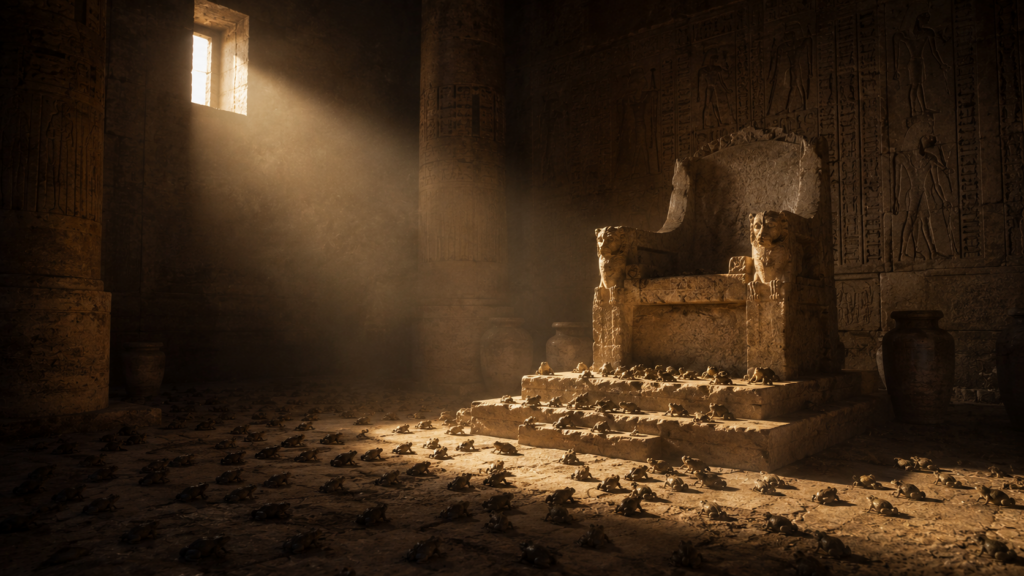
Exodus 8 is the chapter where three more plagues fall, frogs, gnats, flies, and where the first cracks appear in Pharaoh’s resistance. He bargains for the first time. He asks Moses to pray for him for the first time. The Egyptian magicians, after replicating the first two plagues, fail at the third and confess: this is the finger of God. And from the fourth plague onward, the Hebrew text makes a new structural move: God sets Goshen apart. The plagues, from now on, will fall on Egypt but spare Israel. The text is teaching, plague by plague, that Israel’s God can distinguish between his people and the empire that holds them.
Each of the three plagues targets a specific Egyptian deity (Heqet the frog-goddess, the dust-and-ground gods, the swarming-insect symbolism of Egyptian magic). Each plague comes with a refrain Pharaoh refuses to learn. let my people go that they may serve me. Each plague ends with Pharaoh’s kavod-heart settling deeper. The pattern is being set: relief produces relapse. As soon as the plague lifts, Pharaoh changes his mind. The chapter is teaching that Pharaoh’s heart-problem is not, primarily, a one-time decision; it is a pattern of returning to the same refusal every time the pressure is removed.
A · Exodus 8:1-15 · The plague of frogs
¹ Yahweh spoke to Moses, “Go in to Pharaoh, and tell him, ‘This is what Yahweh says, “Let my people go, that they may serve me. ² If you refuse to let them go, behold, I will plague all your borders with frogs. ³ The river shall swarm with frogs, which shall go up and come into your house, and into your bedroom, and on your bed, and into the house of your servants, and on your people, and into your ovens, and into your kneading troughs. ⁴ The frogs shall come up both on you, and on your people, and on all your servants.”‘” ⁵ Yahweh said to Moses, “Tell Aaron, ‘Stretch out your hand with your rod over the rivers, over the streams, and over the pools, and cause frogs to come up on the land of Egypt.’” ⁶ Aaron stretched out his hand over the waters of Egypt; and the frogs came up, and covered the land of Egypt. ⁷ The magicians did the same thing with their enchantments, and brought up frogs on the land of Egypt. ⁸ Then Pharaoh called for Moses and Aaron, and said, “Entreat Yahweh, that he take away the frogs from me, and from my people; and I will let the people go, that they may sacrifice to Yahweh.” ⁹ Moses said to Pharaoh, “I give you the honor of setting the time that I should pray for you, and for your servants, and for your people, that the frogs be destroyed from you and your houses, and remain in the river only.” ¹⁰ He said, “Tomorrow.” He said, “Be it according to your word, that you may know that there is no one like Yahweh our God. ¹¹ The frogs shall depart from you, and from your houses, and from your servants, and from your people. They shall remain in the river only.” ¹² Moses and Aaron went out from Pharaoh, and Moses cried to Yahweh concerning the frogs which he had brought on Pharaoh. ¹³ Yahweh did according to the word of Moses, and the frogs died out of the houses, out of the courts, and out of the fields. ¹⁴ They gathered them together in heaps, and the land stank. ¹⁵ But when Pharaoh saw that there was a respite, he hardened his heart, and didn’t listen to them, as Yahweh had spoken.
- Let my people go, that they may serve me. The chapter opens with the formal demand, repeated. The Hebrew is shalach et ami ve-ya’avduni, send my people that they may serve / worship me. The verb avad keeps doing its double work: same word for slavery and worship. The contest is over whose avodah Israel will perform.
- I will plague all your borders with frogs. The Hebrew word for plague here is negaph (smite, strike). The verb appears across the plague cycle and will reach a crescendo at the death of the firstborn. The “I will smite” framing is not arbitrary; it is judicial language. The plagues are strikes, and YHWH is the striker.
- The frog plague targets Heqet (Heqat), the frog-headed Egyptian goddess of fertility, childbirth, and the annual flooding of the Nile that produced new life. Egyptian midwives wore amulets of Heqet during deliveries. Mackie’s note: the plague is theologically pointed. Pharaoh’s policy in chapter 1 was to murder Hebrew babies at the birth-stool (Ex 1:16); the goddess presiding over Egyptian birth-stools is now turning Egypt into a frog-infested nightmare. The Hebrew Bible is making the connection. The fertility-goddess Pharaoh’s empire honored is now the agent of Egypt’s torment. Middah ke-neged middah (measure for measure) again.
- The river shall swarm with frogs. The Hebrew is ve-sharats ha-yeor. The verb sharats (swarm, teem) is Genesis 1:20-21 vocabulary: let the waters teem with swarming creatures. The text is using creation-language against Egypt: the same verbal root that named God’s good creation now names the Nile’s plague. The plagues are an un-creation. Where Genesis 1’s creatures were good, Egypt’s swarming frogs are judgment.
- Into your house, and into your bedroom, and on your bed. The frogs are everywhere. There is no clean space. The geographical scope is total. Pharaoh’s most private rooms, the kneading troughs where bread is made, the ovens. Egyptian household life has been invaded by the very symbol of Egyptian fertility. Goldingay’s note: the plague doesn’t kill anyone; it just makes life intolerable. The point is not body-count; the point is exposure. Pharaoh cannot get away from the frogs even in his bedroom.
- The magicians did the same thing. For the second time, Egypt’s magicians replicate. Fohrman’s amused observation: by this point, Egypt already has too many frogs. What the magicians produce is more of what is already destroying their country. Their “magic” can replicate harm but cannot reverse it. They are now competing in a contest where their performance only worsens the situation.
- Pharaoh called for Moses and Aaron… Entreat YHWH that he take away the frogs from me. This is the first moment Pharaoh asks for relief. The Hebrew is ha’tiru el-YHWH, intercede with YHWH. He uses YHWH’s name. He admits, implicitly, that YHWH is the agent of the plague. The first crack in his theology has appeared. He still does not call YHWH his god, but he is acknowledging YHWH’s reality.
- I will let the people go, that they may sacrifice to YHWH. Pharaoh’s first concession. He is not yet at let them leave Egypt; he is at let them sacrifice. But it is the first concession. The bargaining phase has begun.
- I give you the honor of setting the time. Moses’s response is striking. Hitpa’er alay, glorify yourself over me, set the time. The Hebrew is courteous, almost ironic: you choose when. I will pray for you on whatever timetable you specify. Moses lets Pharaoh name the moment. Why? Solomon’s reading: to make the connection between Moses’s prayer and the cessation unmistakable. If Pharaoh sets the time, the plague stopping at that exact moment proves YHWH is the agent. Moses is structuring the contest so the result cannot be attributed to coincidence.
- Tomorrow. Pharaoh says tomorrow. He could have said now. The text records this without comment, but the comment is felt: even in his desperation, Pharaoh is still in control. He is willing to spend one more night with frogs in his bed if it means preserving the appearance of his sovereignty. Tomorrow is a small word that says a lot.
- That you may know that there is no one like YHWH our God. Moses’s formula again. that you may know. The plagues are pedagogical. Pharaoh is being taught, again, what he already knows. The frogs disappear on schedule.
- The land stank. The Hebrew is vatib’ash ha-arets: the same verb as Ex 7:21 (the river stank). Two consecutive plagues end with the same Hebrew word: stink. Egypt is becoming, plague by plague, a country whose kavod (heaviness) is now sensory. The smell of the dead frogs is the smell of Pharaoh’s refusal piling up.
- When Pharaoh saw that there was a respite, he hardened his heart. The Hebrew is vayar par’oh ki haytah ha-revachah, ve-hakhbed et libo, Pharaoh saw the relief, and made his heart heavy. The verb is hakhbed, the causative of kavod. Pharaoh makes his own heart heavy the moment the pressure lifts. The pattern is being set. As soon as the plague stops, Pharaoh’s heart goes back to kavod. The chapter is teaching: relief without repentance always reproduces the same heart-condition.
Word study: revachah (רְוָחָה)
“Relief,” “respite,” “breathing room.” The Hebrew word in Ex 8:15, *and when Pharaoh saw that there was a *revachah**, comes from the verb ravach, “to be wide / spacious / breathable.” It is the same root as ruach (spirit, breath, wind). When the plague lifts, Pharaoh can breathe again. And the moment he can breathe, his heart goes back to its previous state. The text is naming a piercing spiritual truth: the moment we can breathe, we forget who we cried to for breath. The whole later wilderness narrative will repeat this pattern. Every time Israel finds revachah, they are tempted to forget the God who provided it. The plague-cycle is not just about Pharaoh; it is the human heart’s pattern in miniature.
B · Exodus 8:16-19 · “This is the finger of God”
¹⁶ Yahweh said to Moses, “Tell Aaron, ‘Stretch out your rod, and strike the dust of the earth, that it may become lice throughout all the land of Egypt.’” ¹⁷ They did so; and Aaron stretched out his hand with his rod, and struck the dust of the earth, and there were lice on man, and on animal; all the dust of the earth became lice throughout all the land of Egypt. ¹⁸ The magicians tried with their enchantments to bring out lice, but they couldn’t. There were lice on man, and on animal. ¹⁹ Then the magicians said to Pharaoh, “This is God’s finger.” Pharaoh’s heart was hardened, and he didn’t listen to them, as Yahweh had spoken.
- Strike the dust of the earth, that it may become lice. The Hebrew word translated lice is kinnim: variously translated as gnats, lice, sandflies, or some kind of biting insect. Whatever the species, the plague is on a smaller scale than the frogs but more invasive. The bugs come from the dust, the very ground of Egypt, and infest every man and animal.
- The plague targets the Egyptian land itself. Egyptian priests in particular kept ritual cleanliness as a vocational requirement; lice would render them ritually impure and unable to perform their priestly duties. Mackie’s note: the third plague immobilizes Egypt’s priesthood. Pharaoh has temple priests who maintain Egypt’s cosmological order, and now they cannot serve their gods because they are crawling with vermin. The contest with Pharaoh is also a contest with Pharaoh’s priesthood. And Pharaoh’s priesthood is now incapacitated.
- The magicians tried with their enchantments to bring out lice, but they couldn’t. The Hebrew is ve-lo’ yakholu, and they were not able. This is the chapter’s structural turn. After two plagues of replication, the magicians fail. They cannot produce the third sign. The contest has been definitively decided in favor of YHWH at the level of power. The magicians have run out of enchantment.
- This is God’s finger. The Hebrew is etsba elohim hi, the finger of God this is. The magicians make the theological confession. Elohim (the generic word for divine power), they don’t yet say YHWH. But they recognize that they are not dealing with magic on a human scale. The finger of God is the Hebrew Bible’s idiom for divine direct action. Jesus uses the phrase in Luke 11:20: if I cast out demons by the finger of God, then the kingdom of God has come upon you. The kingdom of God arriving in Jesus is the same finger that turned Egypt’s dust into lice. The plagues and the kingdom are connected by Jesus’s own self-identification with this verse.
- The magicians’ confession is the chapter’s quiet climax. Pharaoh’s own court advisors, the trained priests of Egyptian religion, admit, on the record, that what is happening is the finger of God. The contest has been theologically decided. Pharaoh’s own institution has conceded. And yet:
- Pharaoh’s heart was hardened, and he didn’t listen. The Hebrew is vayechezaq lev par’oh, Pharaoh’s heart was strengthened. Notice the verb: chazaq, not kavod. The Hebrew is precise. Pharaoh’s heart, having heard his own magicians confess YHWH’s hand, hardens in a different mode. He has moved from kavod (heavy / dull / not-perceiving) to chazaq (strengthened / resolved / fortified) for the first time. He is no longer just not perceiving; he is resisting what he perceives. The chapter is tracking the deepening. Pharaoh has heard the confession of his own priests and is choosing, against the testimony of his own theological system, to refuse.
Influence callout: Marty Solomon (Bema Discipleship, Episode 18)
Solomon catches the structural moment carefully. The shift from kavod (the heart that does not see) to chazaq (the heart that has seen and resolved to refuse anyway) is the threshold the plague-cycle is moving toward. Once the magicians say this is the finger of God and Pharaoh hears it, his heart cannot be merely kavod anymore. He has been given the testimony of his own court. From this point forward, his refusal is no longer ignorance; it is willed resistance. Solomon’s pastoral note: the Hebrew Bible is honest about this kind of heart. There comes a moment when the evidence is so clear that to refuse is no longer to fail to see; it is to refuse to act on what one has seen. Pharaoh has crossed that threshold by Ex 8:19. We can cross it too.
C · Exodus 8:20-32 · The plague of flies, and Goshen set apart
²⁰ Yahweh said to Moses, “Rise up early in the morning, and stand before Pharaoh; behold, he comes out to the water; and tell him, ‘This is what Yahweh says, “Let my people go, that they may serve me. ²¹ Else, if you will not let my people go, behold, I will send swarms of flies on you, and on your servants, and on your people, and into your houses. The houses of the Egyptians shall be full of swarms of flies, and also the ground they are on. ²² I will set apart in that day the land of Goshen, in which my people dwell, that no swarms of flies shall be there; that you may know that I am Yahweh in the middle of the earth. ²³ I will put a division between my people and your people. This sign shall happen by tomorrow.”‘” ²⁴ Yahweh did so; and there came grievous swarms of flies into the house of Pharaoh, and into his servants’ houses. In all the land of Egypt the land was corrupted by reason of the swarms of flies. ²⁵ Pharaoh called for Moses and for Aaron, and said, “Go, sacrifice to your God in the land!” ²⁶ Moses said, “It isn’t appropriate to do so; for we shall sacrifice the abomination of the Egyptians to Yahweh our God. Behold, if we sacrifice the abomination of the Egyptians before their eyes, won’t they stone us? ²⁷ We will go three days’ journey into the wilderness, and sacrifice to Yahweh our God, as he shall command us.” ²⁸ Pharaoh said, “I will let you go, that you may sacrifice to Yahweh your God in the wilderness, only you shall not go very far away. Pray for me.” ²⁹ Moses said, “Behold, I am going out from you. I will pray to Yahweh that the swarms of flies may depart from Pharaoh, from his servants, and from his people, tomorrow; only don’t let Pharaoh deal deceitfully any more in not letting the people go to sacrifice to Yahweh.” ³⁰ Moses went out from Pharaoh, and prayed to Yahweh. ³¹ Yahweh did according to the word of Moses, and he removed the swarms of flies from Pharaoh, from his servants, and from his people. There remained not one. ³² Pharaoh hardened his heart this time also, and he didn’t let the people go.
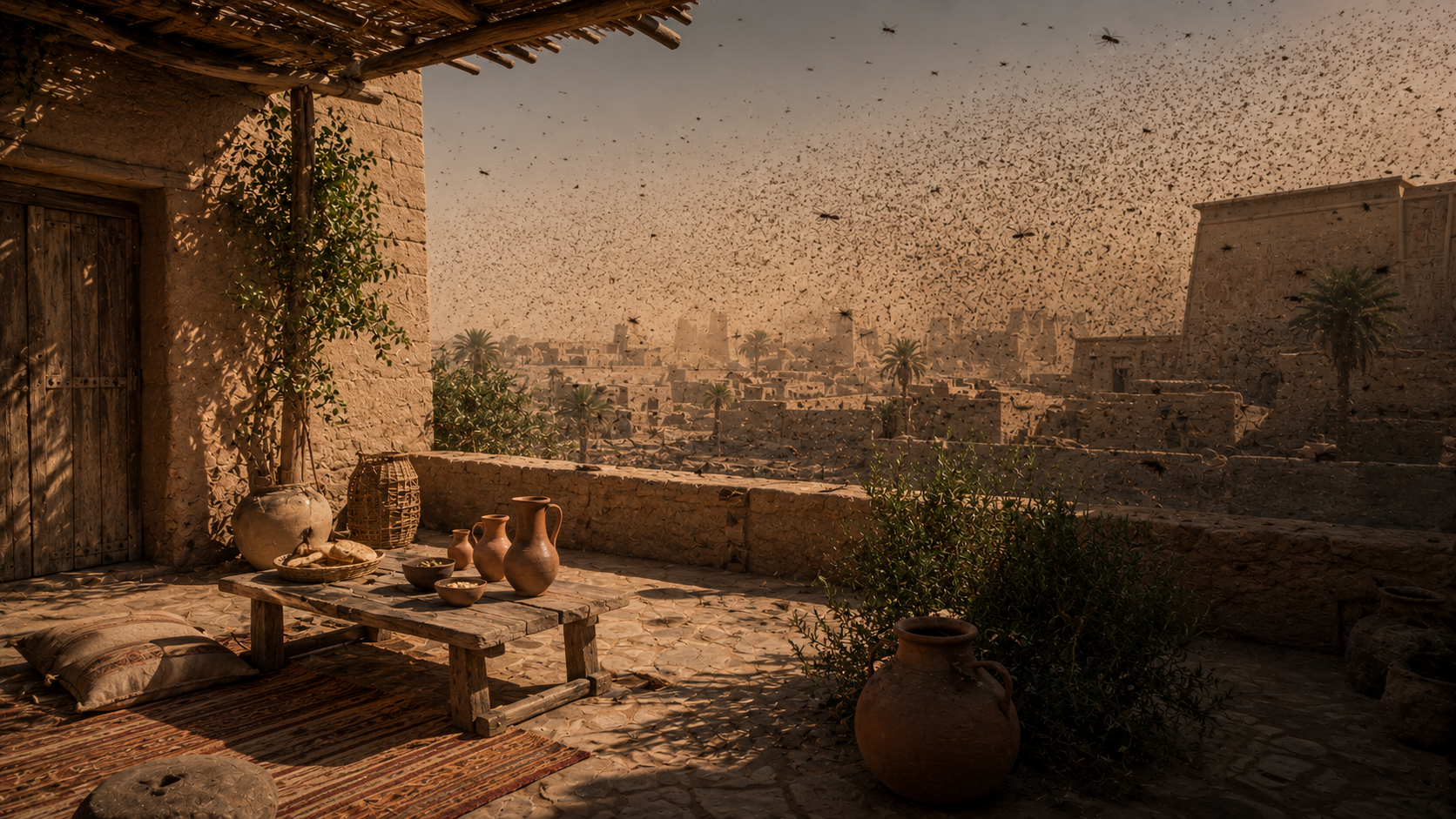
- Rise up early in the morning, and stand before Pharaoh; behold, he comes out to the water. The text returns to the morning-Nile setting of the first plague. Pharaoh is again performing his daily ritual visit to the river when Moses meets him. The fourth plague will be announced in the same liturgical-ritual setting Pharaoh keeps trying to use to maintain Egypt’s cosmic order.
- Swarms of flies. The Hebrew word is arov, variously translated as flies, swarms of insects, gadflies, or mixed swarms. The Septuagint translated it as the dog-fly (a particularly vicious biting insect). Whatever the species, the plague is overwhelming and biological, biting, infesting, breeding in the wounds of livestock and humans. The plague is severe.
- I will set apart in that day the land of Goshen, in which my people dwell. The Hebrew is ve-hifleyti ba-yom ha-hu et erets goshen, I will distinguish on that day the land of Goshen. The verb palah (to distinguish, set apart) is the chapter’s most important new vocabulary. From this plague forward, the text makes a structural distinction: Egypt suffers; Israel does not. Goshen, the region in northeastern Egypt where Israel had settled (Gen 47:6, 11), becomes the visible boundary line.
- That you may know that I am YHWH in the middle of the earth. The Hebrew is be-qerev ha-arets, in the midst of the land/earth. The setting-apart of Goshen is itself revelatory. The plague’s selective falling demonstrates that YHWH is present, active, able to distinguish. Egyptian gods could not be everywhere at once; YHWH is in the midst, capable of judging Egypt and sparing Goshen in the same instant. The plague is doing theology by geography.
- I will put a division between my people and your people. The Hebrew is ve-samti pedut beyn ami u-veyn amekha, *I will set a pedut between my people and your people*. The word pedut is striking: it can mean division, redemption, or ransom. The same Hebrew root padah will be used in Ex 13:13 of the redemption of the firstborn. The “division” between Egypt and Israel is itself a kind of redemption-distinction. Israel is being publicly redeemed. Set apart from Egypt’s judgment, even before the Sea-crossing makes the redemption complete.
- Go, sacrifice to your God in the land! Pharaoh’s second concession. He has moved from no (5:2) to let them sacrifice (8:8) to sacrifice in the land. He is offering compromise: worship YHWH, but inside Egypt’s borders. Don’t leave. This is the Hebrew Bible’s archetypal compromise-offer from empire to the people of God. You can have your religion, but don’t let it disrupt the imperial order. Throughout church history, the same offer has been made and refused.
- We shall sacrifice the abomination of the Egyptians. Moses’s reply is precise: to’avat mitsrayim. Israelite worship involves animals (especially sheep and bulls) that the Egyptians considered sacred or otherwise to’avah, abominable. To sacrifice such animals in Egypt would be an inflammatory religious act inviting violent retaliation. Moses’s pragmatic argument is also a theological one: Israelite worship and Egyptian religion cannot occupy the same space. The wilderness is not just geographical separation; it is theological space-clearing. The two cosmologies cannot share a courtyard.
- I will let you go… only you shall not go very far away. Pharaoh’s third concession. He is now willing to let Israel leave to worship, but not too far. He is still trying to maintain control. Don’t go far. Stay where I can call you back. Empires let the people of God leave only on a leash.
- Pray for me. Pharaoh asks for prayer for the second time (8:8 was the first). The chapter is teaching that empire, when sufficiently pressed, asks for the very prayers it ridicules. Pharaoh does not pray to YHWH himself; he asks Moses to do it for him. He wants the benefit of YHWH’s mercy without the posture of submission.
- Don’t let Pharaoh deal deceitfully any more. The Hebrew is al-yosef par’oh hatel: let Pharaoh not continue to mock. Moses warns him explicitly. The text shows Moses learning. After the frog plague’s relief produced relapse (8:15), Moses now names the pattern. Don’t do that again. The deliverer is being trained in the long contest with the deceptive heart.
- Pharaoh hardened his heart this time also, and he didn’t let the people go. The Hebrew is vayakhbed par’oh et libo gam ba-pa’am ha-zot, and Pharaoh made his heart heavy this time also. The chapter ends with the same pattern as the second plague. Relief; relapse. The verb is again kavod (he is the agent of his own hardening), but the gam (also) is doing structural work. The text is teaching us to count: this time also, also, also. Pharaoh’s heart is on a repeating loop. Each loop sinks deeper.
Influence callout: Tim Mackie (BibleProject, The Plagues of Egypt)
Mackie reads the structure of the plague cycle as three triads of three, plus the climactic tenth. The first triad (blood, frogs, gnats) is announced and falls; the magicians replicate the first two and fail at the third. The second triad (flies, livestock, boils) introduces the Goshen distinction and the magicians’ incapacitation. The third triad (hail, locusts, darkness) escalates the cosmic scope. The tenth plague (firstborn) breaks the pattern. Each plague has its own theological weight, but the architecture is doing larger work: the un-creation of Egypt is proceeding in stages. Mackie’s note: the structural shift from kavod (Pharaoh’s own heart-hardening) to chazaq (God’s strengthening of Pharaoh’s heart) tracks the moral architecture. Pharaoh’s free agency is being honored even as the consequences of his refusal lock in. By the time we reach the seventh plague (Ex 9:12), the verb shifts permanently to chazaq. The hardening has become irreversible because Pharaoh’s resolved refusal has crossed the threshold.
Reflection prompts
- When Pharaoh saw that there was a respite, he hardened his heart. The Hebrew word for respite is revachah: the same root as ruach, breath. The moment Pharaoh can breathe again, he forgets the God who gave him the breath. Where, in your own life, have you found that relief without repentance reproduces the same heart-condition you cried out to be saved from?
- This is God’s finger. Pharaoh’s own magicians make the theological confession he refuses to make. They are professionally invested in the Egyptian cosmology, and they tell him, on the record, that YHWH is doing this. He hears them and refuses anyway. Whose voice in your life has been telling you what you do not want to hear about God? What would it take to listen?
- Sacrifice to your God in the land. Pharaoh’s offer is the empire’s eternal compromise: keep your religion, but don’t let it disrupt the order. Moses refuses. Where is empire offering you the same compromise. Your faith allowed, as long as it stays inside the imperial perimeter? What does it look like, in your situation, to insist on going into the wilderness?
Frameworks at play in this chapter: the divine council, counter-imperial reading.