
Exodus 6 is the chapter where God answers Moses’s protest. After the disaster of chapter 5, Pharaoh’s refusal, the increased burden, the foremen’s accusation, Moses’s own bitter complaint, God speaks. And he does not first justify himself, explain his timing, or reassure Moses. He names himself. Three times in this chapter (v. 2, v. 6, v. 8) God says I am YHWH. The whole movement of the chapter is anchored in the disclosure of the Name.
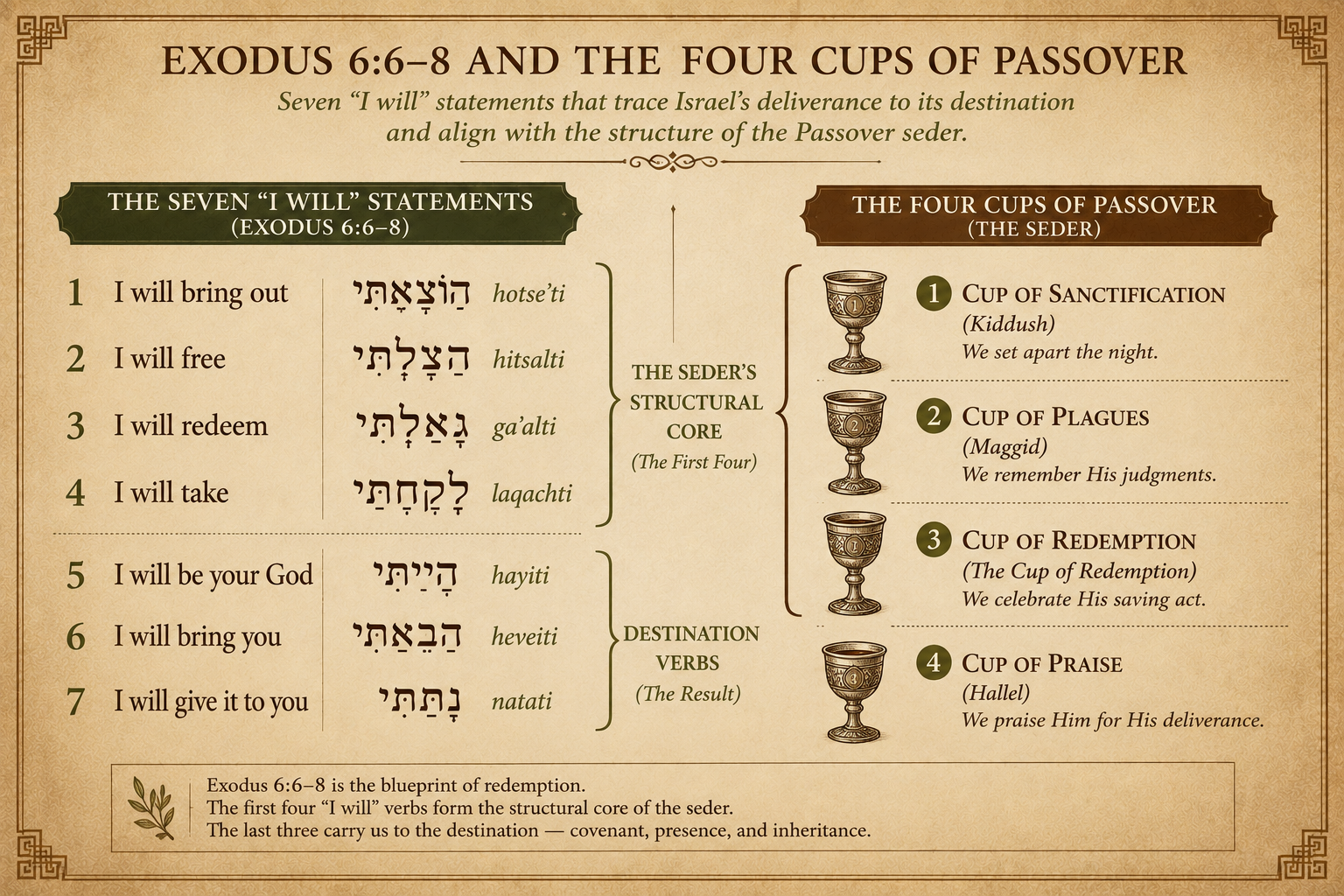
The chapter contains one of the densest theological paragraphs in the Hebrew Bible: the seven I-will statements (vv. 6-8). These verbs name what God is going to do for Israel. Bring out, free, redeem, take, be, bring, give. Every Passover seder for over two thousand years has recited the first four of them as the structural core of the holiday. The chapter then breaks into a genealogy of Moses and Aaron. Placed in what looks like a strange spot, and ends with Moses’s last objection: I am of uncircumcised lips. The text is closing the loop on Moses’s who am I? question by re-anchoring him in the family he belongs to. You are not just a fugitive from Pharaoh’s court. You are Moses ben Amram, of the house of Levi, descended from Israel.
The chapter is a theological recovery from chapter 5. It does not deny that the deliverance has begun in struggle. It re-grounds the deliverance in the Name that began the conversation at the bush.
A · Exodus 6:1-9 · The seven I-wills, and the people who could not hear
¹ Yahweh said to Moses, “Now you shall see what I will do to Pharaoh, for by a strong hand he shall let them go, and by a strong hand he shall drive them out of his land.” ² God spoke to Moses, and said to him, “I am Yahweh. ³ I appeared to Abraham, to Isaac, and to Jacob, as God Almighty; but by my name Yahweh I was not known to them. ⁴ I have also established my covenant with them, to give them the land of Canaan, the land of their travels, in which they lived as aliens. ⁵ Moreover I have heard the groaning of the children of Israel, whom the Egyptians keep in bondage, and I have remembered my covenant. ⁶ Therefore tell the children of Israel, ‘I am Yahweh, and I will bring you out from under the burdens of the Egyptians, and I will rid you out of their bondage, and I will redeem you with an outstretched arm, and with great judgments. ⁷ I will take you to myself for a people. I will be your God; and you shall know that I am Yahweh your God, who brings you out from under the burdens of the Egyptians. ⁸ I will bring you into the land which I swore to give to Abraham, to Isaac, and to Jacob; and I will give it to you for a heritage: I am Yahweh.’” ⁹ Moses spoke so to the children of Israel, but they didn’t listen to Moses for anguish of spirit, and for cruel bondage.
- Now you shall see what I will do to Pharaoh. The chapter opens with God’s answer to Moses’s protest of 5:22-23. You said I have not rescued? Watch. The Hebrew attah tireh, now you will see, is precise. The deliverance is on the verge of becoming visible. Chapter 5 was about not seeing; chapter 6 is about what is about to be seen.
- By a strong hand he shall let them go, and by a strong hand he shall drive them out. The Hebrew is be-yad chazaqah, by a strong hand. The phrase will become a refrain through the rest of Exodus and Deuteronomy (Ex 13:9; Deut 5:15; 6:21; 7:8; 9:26 and many more). It is the technical term for God’s deliverance of Israel from Egypt. Strong hand will also become Pharaoh’s hand, in a different sense, Pharaoh’s chazaq heart in the plagues. The same Hebrew word chazaq will name both God’s saving strength and Pharaoh’s resolved refusal. The contest is strong hand against strong heart.
- I am Yahweh. The Hebrew is ani YHWH, and this is the chapter’s spine. It will appear in v. 2, v. 6, v. 7, v. 8, and v. 29. Five times in one chapter. The “I am YHWH” formula is the Hebrew Bible’s most distinctive divine self-identification and will recur throughout Leviticus 18-26 (the Holiness Code) as the punctuation mark on every commandment. I am YHWH is not a label; it is a claim. This is who is doing the speaking. This is who is making the promise. This is who keeps the covenant.
- I appeared to Abraham, to Isaac, and to Jacob, as God Almighty; but by my name Yahweh I was not known to them. This verse has puzzled readers for centuries. The Hebrew Bible itself uses the name YHWH in the Genesis narratives (Gen 4:26; 12:8 and many more). How then can YHWH say to Moses that he was not known to the patriarchs by this name?
The most likely reading: the patriarchs had heard the name (the narrator uses it) but had not known the name in the sense of having seen it lived out as the active-saving God of redemption-from-Egypt. Yada (to know) is more than information; it is experiential knowing. The patriarchs knew God as El Shaddai, the God of restraint, of patience, of promise-making. The exodus generation will know God as YHWH, the God who acts in history to deliver. Same God; different layer of self-disclosure.
Solomon’s reading (drawing on rabbinic tradition): El Shaddai derives from Mi She’amar Le-Olamo Dai, the rabbinic gloss “the One who said to his world, ‘enough.’” El Shaddai is the God of restraint, the God who says enough and stops the waters of judgment. YHWH is the timeless God who acts. The patriarchs needed the God of restraint, Abraham did not need a deliverer-from-Pharaoh. The exodus generation needs a different layer of God’s character. The same God; the next chapter of self-disclosure.
- The chapter now lays out God’s seven I-will statements, the densest theological paragraph in the book. They are arranged in four covenant-action verbs (vv. 6-7a) and three destination verbs (vv. 7b-8):
- I will bring you out (ve-hotse’ti) from under the burdens of the Egyptians.
- I will rid you / free you (ve-hitsalti) from their bondage.
- I will redeem you (ve-ga’alti) with an outstretched arm.
- I will take you to myself for a people (ve-laqachti).
- I will be your God (ve-hayiti lakhem le-elohim).
- I will bring you (ve-heveiti) into the land.
- I will give it to you (ve-natati) for a heritage.
Seven verbs. Imes notes the structure carefully: the first four (out, free, redeem, take) are the verbs of delivering and claiming; the last three (be, bring, give) are the verbs of destination and dwelling. The seven name the whole arc of the book, out of Egypt, into covenant, into the land. Read them slowly. They are the book’s own promise to itself.
The first four (“I will bring out / I will free / I will redeem / I will take”) are the four cups of the Passover seder. Every observant Jewish family for over two thousand years has rehearsed these four verbs across the four cups of wine of the Passover meal. The chapter is the seder’s textual home.
- I will redeem you with an outstretched arm. The Hebrew is ve-ga’alti etkhem. The verb ga’al, to redeem, to act as a kinsman-redeemer, appears here for the first time in the Hebrew Bible. Ga’al will become the foundational vocabulary for redemption: Boaz redeeming Ruth (Ruth 3-4), the kinsman-redeemer laws of Lev 25, Job’s I know that my Redeemer (go’el) lives (Job 19:25). And the New Testament’s redemption-language draws from this Hebrew well. Mackie’s note: the first occurrence of “redeem” in the Bible is here. Every later use is in echo of this verse.
Word study: ga’al (גָּאַל)
“Redeem”, but not in the abstract sense. The Hebrew ga’al is the verb for the kinsman-redeemer: a near relative who buys back a family member from slavery, buys back family land that has been sold, or avenges the family’s blood. It is an intimate, family verb. When YHWH calls himself the go’el of Israel, the claim is staggering: the high God of the universe is family to a slave-people, near enough to step in and pay the cost. The Hebrew Bible’s whole later theology of redemption, Boaz/Ruth, Lev 25, the Psalms, Isaiah 40-55, Job, the cross, runs on this Hebrew root. Christ as our go’el is the canonical fulfillment of what Ex 6:6 plants. Read the verse slowly. I will go’al you with an outstretched arm. The God of the bush is naming himself as Israel’s family.
- I will take you to myself for a people. The verb laqach, take, is the Hebrew Bible’s marriage verb. Take a wife in Genesis is laqach ishah. God’s I will take you in Ex 6:7 is, in the cultural register, a marriage promise. The Sinai-as-wedding framework (see The Sinai covenant) is being seeded here. God is not just freeing slaves; he is engaging a bride. The wedding will happen at the mountain.
- I will be your God; and you shall know that I am Yahweh your God. The Hebrew is hayiti lakhem le-elohim… vi-yda’tem ki ani YHWH eloheykhem. The covenant formula is laid down: I will be God to you; you will be people to me. This formula will appear over and over in the Hebrew Bible: Lev 26:12; Jer 31:33; Ezek 36:28; and in the New Testament at 2 Cor 6:16 and Rev 21:3. The covenant is mutual. Both parties are bound.
- Moses spoke so to the children of Israel, but they didn’t listen to Moses for anguish of spirit, and for cruel bondage. The chapter’s painful pivot. Moses delivers the seven I-wills exactly as God said. Israel does not listen. The Hebrew is lo’ shame’u el-Mosheh mi-qotser ruach u-me’avodah qashah, they did not listen to Moses, from shortness of spirit and from hard service. Goldingay translates qotser ruach as broken spirit; Imes as crushed spirit. The point is precise: the people who needed the deliverance most could not hear the announcement of it. Trauma had narrowed their capacity to receive good news. The text is honest about this. Even the sevenfold promise of God did not, on its own, move a broken people.
- The narrative implication: God’s deliverance had to do something, not just say something. The seven I-wills were true; they were not yet sufficient. Pharaoh would have to be unmade. The plagues are the working out of what I am YHWH means in practice when Israel cannot yet hear it in promise.
B · Exodus 6:10-13 · “Uncircumcised lips”, Moses’s last objection
¹⁰ Yahweh spoke to Moses, saying, ¹¹ “Go in, speak to Pharaoh king of Egypt, that he let the children of Israel go out of his land.” ¹² Moses spoke before Yahweh, saying, “Behold, the children of Israel haven’t listened to me. How then shall Pharaoh listen to me, who am of uncircumcised lips?” ¹³ Yahweh spoke to Moses and to Aaron, and gave them a command to the children of Israel, and to Pharaoh king of Egypt, to bring the children of Israel out of the land of Egypt.
- Behold, the children of Israel haven’t listened to me. How then shall Pharaoh listen to me? Moses’s logic is precise: if the people on whose behalf the deliverance is being worked could not hear it, the man on whose throne it threatens cannot be expected to either. The argument is reasonable. It is also another excuse.
- Who am of uncircumcised lips. The Hebrew is aral sefatayim, uncircumcised lips. Solomon’s reading is the chapter’s interpretive key. Aral, uncircumcised, is the same word from Gen 17 and from the Zipporah episode in Ex 4:24-26. It is covenant vocabulary. To be aral is to be outside the covenant. Moses is not saying his speech is impeded; he is saying I do not belong. He is saying I am not part of the people I am being asked to speak for.
The objection is psychological-theological. Moses, the Levite raised as Egyptian, then Midianite by marriage, is asking am I really a Hebrew? The “speech” excuses (4:10 and 6:12, 30) are bookends; what they bracket is the genealogy that follows in 6:14-25. The chapter is structured around the question Moses keeps asking in Hebrew code: do I belong? And the genealogy is going to answer it.
- Yahweh spoke to Moses and to Aaron, and gave them a command. God does not engage Moses’s argument. He simply commissions Moses and Aaron together. The chapter’s verbal economy is striking: the protest is registered, the command is given, the narrative moves on. God is not negotiating; God is sending.
C · Exodus 6:14-30 · The genealogy: “you belong”
¹⁴ These are the heads of their fathers’ houses. The sons of Reuben the firstborn of Israel: Hanoch, Pallu, Hezron, and Carmi; these are the families of Reuben. ¹⁵ The sons of Simeon: Jemuel, Jamin, Ohad, Jachin, Zohar, and Shaul the son of a Canaanite woman; these are the families of Simeon. ¹⁶ These are the names of the sons of Levi according to their generations: Gershon, Kohath, and Merari; and the years of the life of Levi were one hundred thirty-seven years. ¹⁷ The sons of Gershon: Libni and Shimei, according to their families. ¹⁸ The sons of Kohath: Amram, Izhar, Hebron, and Uzziel; and the years of the life of Kohath were one hundred thirty-three years. ¹⁹ The sons of Merari: Mahli and Mushi. These are the families of the Levites according to their generations. ²⁰ Amram took Jochebed his father’s sister to himself as wife; and she bore him Aaron and Moses. The years of the life of Amram were one hundred thirty-seven years. ²¹ The sons of Izhar: Korah, Nepheg, and Zichri. ²² The sons of Uzziel: Mishael, Elzaphan, and Sithri. ²³ Aaron took Elisheba, the daughter of Amminadab, the sister of Nahshon, as his wife; and she bore him Nadab and Abihu, Eleazar and Ithamar. ²⁴ The sons of Korah: Assir, Elkanah, and Abiasaph; these are the families of the Korahites. ²⁵ Eleazar Aaron’s son took one of the daughters of Putiel as his wife; and she bore him Phinehas. These are the heads of the fathers’ houses of the Levites according to their families. ²⁶ These are that Aaron and Moses to whom Yahweh said, “Bring out the children of Israel from the land of Egypt according to their armies.” ²⁷ These are those who spoke to Pharaoh king of Egypt, to bring out the children of Israel from Egypt. These are that Moses and Aaron. ²⁸ On the day when Yahweh spoke to Moses in the land of Egypt, ²⁹ Yahweh said to Moses, “I am Yahweh. Speak to Pharaoh king of Egypt all that I speak to you.” ³⁰ Moses said before Yahweh, “Behold, I am of uncircumcised lips, and how shall Pharaoh listen to me?”
- The genealogy looks, at first, like an interruption. It is anything but. The chapter is doing precise structural work. Moses has just said I am of uncircumcised lips (v. 12). The genealogy is the answer.
- The list begins with Reuben (Israel’s actual firstborn) and Simeon (the second son), then stops short. Why these two? Reuben is Jacob’s firstborn; Simeon is the next son. The genealogy is heading toward Levi, the third son, and then will linger over Levi’s line in detail, because Moses and Aaron are Levites. The structure is ANE convention: a genealogy proceeds in birth-order until it arrives at the line that matters for the story being told, then it dwells.
- Verses 16-25 are entirely about Levi. Levi → Kohath → Amram → Aaron and Moses. The lineage is given with precision. Moses and Aaron are not floating Hebrews; they are Levi’s great-grandsons. The line is named.
- Amram took Jochebed his father’s sister to himself as wife. Verse 20 names Moses’s parents for the first time. Chapter 2 had simply called them a man of the house of Levi and a daughter of Levi. Now they have names. The text is doing on a personal scale what it did at the start of chapter 1 (these are the names). Naming is not optional. Moses’s claim to identity runs through named ancestors.
- These are that Aaron and Moses to whom YHWH said, “Bring out the children of Israel.” Verse 26 closes the genealogy with explicit narrative bookending: these are that Aaron and Moses. The Hebrew demonstrative zeh hu, this is the one, points back at the genealogy: the men we are talking about are these specific men, located in this specific family, descended from this specific tribe of this specific Israel. Moses’s identity is no longer abstract. It is documented.
- Then verses 28-30 repeat the speech-objection of v. 12. The Hebrew Bible is doing one of its favorite literary moves: resumptive repetition. The genealogy is set inside an inclusio formed by the two appearances of uncircumcised lips (v. 12, v. 30). The structural argument is unmistakable: Moses, you say you don’t belong? Here is your family tree. You belong. The genealogy, sandwiched between two “I don’t belong” statements, is the Hebrew Bible’s textual equivalent of placing a hand on Moses’s shoulder.
Influence callout: Marty Solomon (Bema Discipleship, Episode 17)
Solomon’s reading of the Ex 6 genealogy is one of the most pastorally useful single observations in the Bema arc. The “speech excuses” (Ex 4:10; Ex 6:12, 30) are not about pronunciation. They are about identity. Stephen in Acts 7:22 calls Moses mighty in word and deed; he had every rhetorical training Pharaoh’s house could provide. The objection is psychological. Moses is asking, in Hebrew code, am I really one of you? The genealogy is God’s answer. The text places the family tree exactly where Moses’s identity-doubt is loudest. Solomon’s punchline: whatever your “I don’t belong” objection is, the answer is often that you belong more deeply than you think. The text is patient with Moses’s question. It does not dismiss the doubt; it answers the doubt with names. Read the genealogy as God’s hand on Moses’s shoulder. “You are Moses ben Amram, of the house of Levi, of the tribe of Israel. Yes, you belong.”
- Phinehas (v. 25) is named at the end of the Levitical genealogy. He will appear later (Num 25) as the priest whose zeal stops the plague at Baal-peor. The text plants him here, in passing, as part of the line that is being commissioned. The book is layering long-arc information.
- The chapter closes with Moses repeating his objection (v. 30), and the chapter ends without God answering it again. Chapter 7 will open with God’s reply: I have made you as God to Pharaoh. The objection is held, and answered structurally rather than discursively. The genealogy is the answer; the next chapter is the action.
- Notice what the chapter has accomplished theologically. Chapter 5 ended in Moses’s protest. Chapter 6 begins with God’s seven I-wills, then is interrupted by Israel’s incapacity to hear, then by Moses’s identity crisis, then by the genealogy that places Moses in his family, and ends with Moses still objecting. The deliverance is moving forward through layers of human resistance. The book is teaching: YHWH’s deliverance does not wait for everyone to be on board. It begins, and the people catch up.
Reflection prompts
- The seven I-will statements (vv. 6-8) are dense with promise. Which of them is your soul most in need of right now? Where do you need bring me out, where do you need redeem me, where do you need take me as your own? Read the verbs slowly and notice which one your heart asks for first.
- They didn’t listen to Moses for anguish of spirit and cruel bondage. The text records that the people who needed the deliverance most could not, at first, hear the announcement of it. Have you ever been so worn down that good news could not land? What does this verse say about how patient God’s deliverance is willing to be with our incapacity to receive it?
- The genealogy is God’s answer to I do not belong. Where, in your own life, have you said in some form “I am of uncircumcised lips”. I am not really one of these people, I do not really belong here, I am not the one for this work? What names, what family tree, what tradition, what community, does God put on your shoulder by way of answer?
Frameworks at play in this chapter: the Sinai covenant, the exodus pattern, bearing God’s name.