

Exodus 3 is one of the great chapters of the Bible. It is the moment the God of Abraham, Isaac, and Jacob speaks to Moses by name, gives Moses a name to give back to Israel, and announces that he has come down to deliver. The chapter holds together a cluster of moments any one of which would be canonical on its own: a fire that does not consume, a divine voice from the fire, a holy ground where shoes come off, the disclosure of the Name YHWH, the first commission of a deliverer, and the first of Moses’s many objections. Read carefully, the chapter is not a private mystical experience; it is God committing himself in writing, committing his Name, his memory, his power, his presence, to a slave-people whose cry has reached him.
The chapter sets the theological vocabulary the rest of the Bible will use. Holy ground. I have surely seen. I have come down. I will be with you. I AM WHO I AM. These are not just memorable lines; they are the foundational grammar of how God meets people in the rest of Scripture.
A · Exodus 3:1-6 · The bush, the ground, the God
¹ Now Moses was keeping the flock of Jethro, his father-in-law, the priest of Midian, and he led the flock to the back of the wilderness, and came to God’s mountain, to Horeb. ² Yahweh’s angel appeared to him in a flame of fire out of the middle of a bush. He looked, and behold, the bush burned with fire, and the bush was not consumed. ³ Moses said, “I will go now, and see this great sight, why the bush is not burned.” ⁴ When Yahweh saw that he came over to see, God called to him out of the middle of the bush, and said, “Moses! Moses!” He said, “Here I am.” ⁵ He said, “Don’t come close. Take off your sandals, for the place you are standing on is holy ground.” ⁶ Moreover he said, “I am the God of your father, the God of Abraham, the God of Isaac, and the God of Jacob.” Moses hid his face; for he was afraid to look at God.
- He led the flock to the back of the wilderness, and came to God’s mountain, to Horeb. The text quietly notes: Moses, doing his ordinary work as a shepherd, ends up at Horeb, God’s mountain. The same mountain where, in chapter 19, all Israel will assemble to receive the covenant. Moses arrives at Sinai forty years before the people do. The encounter the people will have together in chapter 19, Moses has alone in chapter 3. The geography is not coincidental. Sinai is the mountain.
- Horeb and Sinai are two names for the same mountain (or the same range; some scholars distinguish a peak called Sinai within a range called Horeb). The text uses the names interchangeably. Either way, the mountain has been waiting.
- A flame of fire out of the middle of a bush… the bush was not consumed. The Hebrew word for bush is seneh, and the word Sinai is the same root. The bush is a tiny Sinai, and Sinai will be a much larger bush. The whole later experience of the mountain (Ex 19), fire, smoke, voice, the people kept at a distance, is prefigured here in a single shrub. Solomon’s note: the Hebrew is doing wordplay all the way through. Read seneh and Sinai together and the chapter comes into focus.
- Yahweh’s angel appeared to him in a flame of fire… God called to him out of the middle of the bush. Verse 2 says the angel of YHWH; verse 4 says YHWH and Elohim directly. This is a recurring Hebrew Bible construction: the malak (messenger / angel) of YHWH speaks for YHWH and is, in the way the text presents him, indistinguishable from YHWH. Heiser’s reading (the divine council framework) names this as the language of the Angel of the LORD who acts as YHWH’s visible presence among his people. Ex 14:19 will identify this angel with the pillar of cloud at the Sea. The chapter is opening the Bible’s theology of God’s visible presence.
- Moses! Moses! The doubled vocative is the Hebrew Bible’s pattern for an urgent personal call: Abraham, Abraham (Gen 22:11), Jacob, Jacob (Gen 46:2), Samuel, Samuel (1 Sam 3:10), Saul, Saul (Acts 9:4). Each is a moment of conscription. God knows Moses’s name. Moses has not yet been told God’s.
- Take off your sandals, for the place you are standing on is holy ground. The Hebrew is shal-na’alekha me’al raglekha, ki ha-maqom asher attah omed alav admat-qodesh hu. Admat-qodesh, holy ground, is the chapter’s first introduction of the word qodesh (holy / set apart). The whole later vocabulary of holy spaces, holy times, holy people in the rest of the Hebrew Bible begins here. The first holy place is not a temple. It is a piece of desert dirt around a burning bush.
- Don’t come close. The first instruction God gives Moses is to not approach further. This will become a structural feature of the Sinai story: the people are kept at the foot of the mountain (Ex 19:12-13), only Moses goes up, only the high priest will eventually enter the Holy of Holies once a year. Holiness includes distance. The chapter is teaching, in its first scene, that God is near (the God of your father) and holy (don’t come close) at the same time.
Word study: qodesh (קֹדֶשׁ)
“Holy,” “set apart.” The Hebrew word that organizes the rest of Exodus and Leviticus. To be qodesh is to be set apart for a particular purpose: devoted, dedicated, distinct from the ordinary. The bush is not holy in itself; the ground around it is qodesh because YHWH is present. The same word will name the tabernacle (the qodesh, the holy place; and the qodesh ha-qodashim, the Holy of Holies), the priests, the Sabbath, Israel itself (goy qadosh, holy nation, Ex 19:6), and the high priest’s plate (qodesh la-YHWH, “holy to YHWH”). The chapter’s first introduction of the concept is the simplest: ground around a bush, because God is here.
- I am the God of your father, the God of Abraham, the God of Isaac, and the God of Jacob. The God who has come down is not a new god. He is the God Moses already knows about, the God of his ancestors. The continuity is theological: the exodus is in continuity with Genesis. The same God who promised Abraham land and descendants and blessing-of-the-nations is now coming down to deliver those descendants out of Egypt. This will be repeated in Ex 6:3 (“I appeared to Abraham, to Isaac, and to Jacob, as El Shaddai; but by my name YHWH I was not known to them”), the God is the same; the Name is being newly disclosed.
- Moses hid his face; for he was afraid to look at God. This is Moses’s first response and it is the right one. The fear of God Shiphrah and Puah modeled in chapter 1, Moses now learns at the bush. The chapter’s first act ends in reverent silence. The theology lands before the conversation begins.
B · Exodus 3:7-12 · I have come down. Therefore go.
⁷ Yahweh said, “I have surely seen the affliction of my people who are in Egypt, and have heard their cry because of their taskmasters, for I know their sorrows. ⁸ I have come down to deliver them out of the hand of the Egyptians, and to bring them up out of that land to a good and large land, to a land flowing with milk and honey; to the place of the Canaanite, the Hittite, the Amorite, the Perizzite, the Hivite, and the Jebusite. ⁹ Now, behold, the cry of the children of Israel has come to me. Moreover I have seen the oppression with which the Egyptians oppress them. ¹⁰ Come now therefore, and I will send you to Pharaoh, that you may bring my people, the children of Israel, out of Egypt.” ¹¹ Moses said to God, “Who am I, that I should go to Pharaoh, and that I should bring the children of Israel out of Egypt?” ¹² He said, “Certainly I will be with you. This will be the token to you, that I have sent you: when you have brought the people out of Egypt, you shall serve God on this mountain.”
- I have surely seen… I have heard… I know… I have come down. God’s speech is built around four verbs of personal investment. Ra’oh ra’iti, I have surely seen, uses the Hebrew infinitive-absolute construction for emphasis: I have really, fully, intensely seen. The verbs of 2:25 (God saw, God knew) are now restated by God himself in the first person, with God adding a fifth verb the narrator hadn’t yet supplied: I have come down.
- I have come down is the chapter’s most decisive theological claim. The Hebrew is va-ered, God has descended. Goldingay’s note: the Hebrew Bible repeatedly uses coming down language for God’s saving interventions (Gen 11:5 at Babel, Gen 18:21 toward Sodom, Ex 19:18, 19:20 at Sinai). The God of the Bible is not a deistic absentee who waits for things to sort themselves out. The God of the Bible comes down. This pattern reaches its consummation in the incarnation: the Word became flesh and lived among us (John 1:14). Christmas is what I have come down sounds like at the New Testament’s center.
- To a good and large land, to a land flowing with milk and honey. The promise echoes Genesis 12 and is now activated. The land Abraham was promised, the land Isaac and Jacob lived in as foreigners, is being prepared as a destination. Notice the Hebrew Bible’s geographic specificity: the place of the Canaanite, the Hittite, the Amorite, the Perizzite, the Hivite, and the Jebusite. The land is not empty. The text names six peoples already living there. The conquest narrative of Joshua will need to be read carefully and within its full canonical context (and with Imes’s haram / “removed from common use” framing, see the Sinai covenant, to be heard rightly).
- Now, behold, the cry of the children of Israel has come to me. God repeats the cry-language of 2:23, this time in his own voice. The cry is the trigger. God has heard. God acts.
- Come now therefore, and I will send you to Pharaoh. The Hebrew is ve-attah lekha ve-eshlachakha, and now, go, and I will send you. God’s response to the cry is to send a deliverer. He could have sent thunder. He could have sent angels. He sends Moses. The book is teaching, from the first commission, that God’s deliverance comes through human agency that has been called and sent. The pattern will reach the church in Matthew 28:19 (go therefore) and the apostolic mission.
- Who am I, that I should go to Pharaoh? Moses’s first objection. The Hebrew is mi anokhi, who am I? This is the man the text has just shown us at Pharaoh’s court (raised in privilege, fluent in court protocol, trained in administration), now asking who am I? The forty years in Midian have done their work. Moses no longer thinks he can do this on his own strength. The version of Moses who killed an Egyptian and hid him in the sand is gone. What stands in front of the bush is a man who knows he can’t.
- Solomon’s reading: who am I? is the right question. The wrong answer is “you are Moses, raised in Pharaoh’s house, mighty in deed and word.” God does not give that answer. God’s answer is not about Moses at all. God’s answer is I will be with you. The promise is not about Moses’s resume. It is about God’s presence. Mi anokhi is the wrong frame; anokhi immakh (I am with you) is the right frame. Don’t ask who you are. Ask who’s going with you.
- Certainly I will be with you. The Hebrew is ki ehyeh immakh, for I will be with you. The verb ehyeh, I will be / I am, is the same verb God will use in v. 14 to give his Name. The promise of presence and the disclosure of the Name are linguistically one. The God whose Name will be I AM is the God who will be with you. Moses gets the deliverance answer first; the Name will follow.
- This will be the token to you, that I have sent you: when you have brought the people out of Egypt, you shall serve God on this mountain. The sign God gives Moses is, in a way, no sign at all. There is no immediate proof. The proof is retrospective: when the deliverance is over, when Israel is back at this mountain, then Moses will know that God sent him. The whole exodus is being structured as a faith journey. Moses has to step out before the sign is given. Goldingay’s pastoral note: this is the regular shape of God’s calls. The sign comes after the obedience, not before.
- You shall serve God on this mountain. The Hebrew is ta’avdun et ha-elohim al ha-har ha-zeh, and the verb ta’avdun is from avad, the same root as avodah in Ex 1:13-14 (the slavery). The point is precise: Israel is in avodah for Pharaoh; God is going to take them out of that avodah and into a different avodah, the avodah of God on this mountain. You shall serve (worship) God on this mountain. Slavery and worship are the same Hebrew verb pointed in different directions. The book’s whole arc is named here.
Influence callout: Marty Solomon (Bema Discipleship, Episode 17)
Solomon’s reading on mi anokhi: God never argues with Moses on the basis of qualifications. Moses was raised in the most powerful house on earth, fluent in three languages, trained in Egyptian rhetoric, and Stephen in Acts 7:22 calls him mighty in his words and works. Moses had every credential. God is not interested in the credentials. I will be with you is the only credential God gives him. Solomon’s punchline: God isn’t interested in your qualifications. He’s interested in your availability. The man at the bush is available in a way the man in Pharaoh’s house was not. Forty years in Midian was for that.
C · Exodus 3:13-22 · The Name, and the long view
¹³ Moses said to God, “Behold, when I come to the children of Israel, and tell them, ‘The God of your fathers has sent me to you;’ and they ask me, ‘What is his name?’ What should I tell them?” ¹⁴ God said to Moses, “I AM WHO I AM,” and he said, “You shall tell the children of Israel this: ‘I AM has sent me to you.’” ¹⁵ God said moreover to Moses, “You shall tell the children of Israel this, ‘Yahweh, the God of your fathers, the God of Abraham, the God of Isaac, and the God of Jacob, has sent me to you.’ This is my name forever, and this is my memorial to all generations. ¹⁶ Go and gather the elders of Israel together, and tell them, ‘Yahweh, the God of your fathers, the God of Abraham, of Isaac, and of Jacob, has appeared to me, saying, “I have surely visited you, and seen that which is done to you in Egypt. ¹⁷ I have said, I will bring you up out of the affliction of Egypt to the land of the Canaanite, the Hittite, the Amorite, the Perizzite, the Hivite, and the Jebusite, to a land flowing with milk and honey.”‘ ¹⁸ They will listen to your voice. You shall come, you and the elders of Israel, to the king of Egypt, and you shall tell him, ‘Yahweh, the God of the Hebrews, has met with us. Now please let us go three days’ journey into the wilderness, that we may sacrifice to Yahweh, our God.’ ¹⁹ I know that the king of Egypt won’t give you permission to go, no, not by a mighty hand. ²⁰ I will reach out my hand and strike Egypt with all my wonders which I will do among them, and after that he will let you go. ²¹ I will give this people favor in the sight of the Egyptians, and it will happen that when you go, you shall not go empty-handed. ²² But every woman shall ask of her neighbor, and of her who visits her house, jewels of silver, jewels of gold, and clothing. You shall put them on your sons, and on your daughters. You shall plunder the Egyptians.”
- What is his name? Moses asks the chapter’s most theologically loaded question. The Hebrew Bible up to this point has used several names for God: Elohim, El Shaddai, El Elyon, El Roi. Now Moses asks: which name shall I give them? The answer will reframe everything.
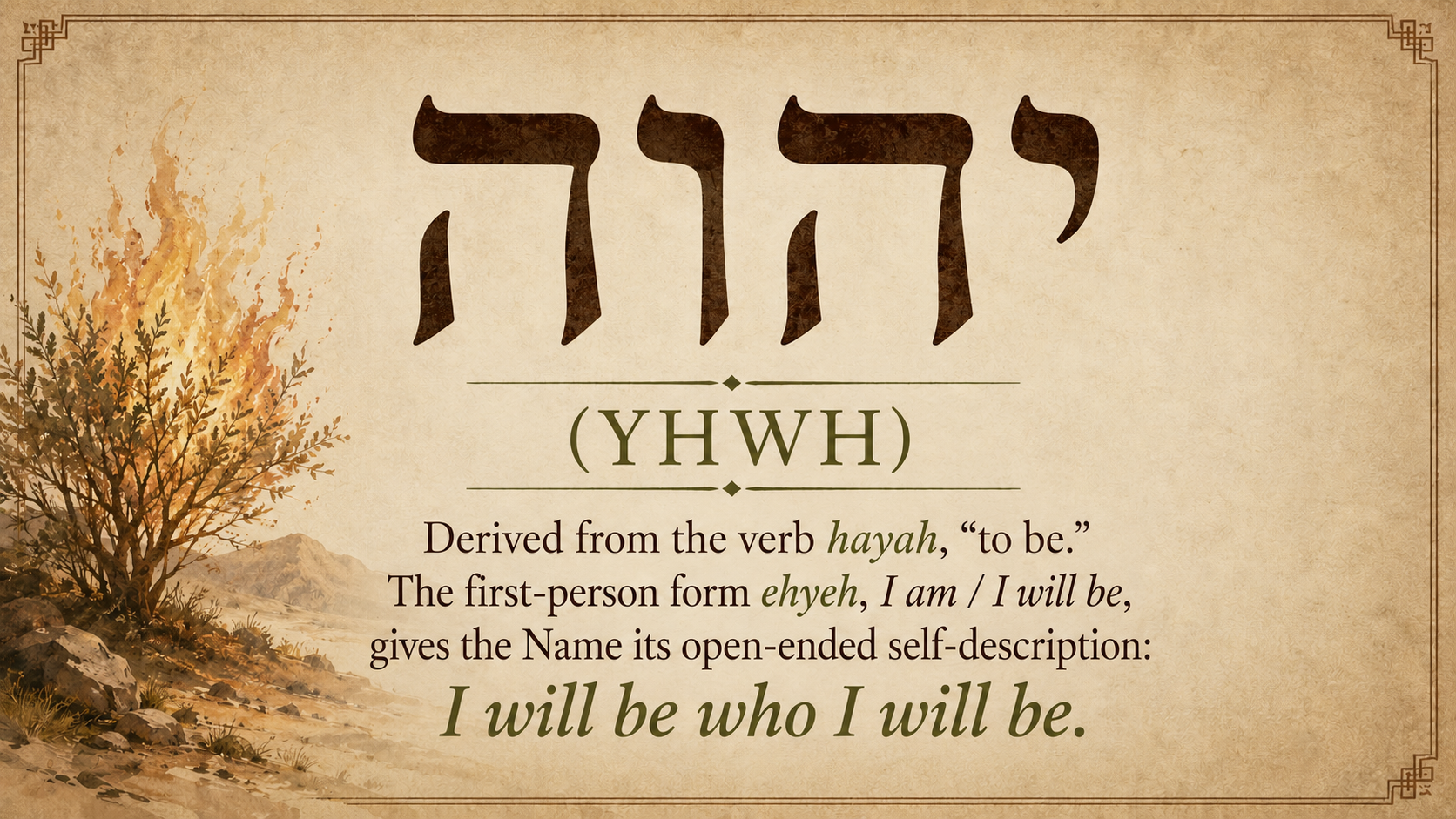
- I AM WHO I AM. The Hebrew is ehyeh asher ehyeh. The verb is hayah, to be, to exist, to become. The first-person form is ehyeh, I am or I will be. The clause ehyeh asher ehyeh can be translated several ways: I am who I am (current state), I will be who I will be (future state), I will be what I will be (open-ended), or, as some scholars argue, I am the one who is (essential being). The Septuagint translated it ego eimi ho on, I am the one who is. John’s Jesus picks up the same vocabulary in his I AM sayings (John 6:35, 8:58, 14:6). Whatever the translation, the Name is not a label; it is a self-description that resists being domesticated. I will be who I will be. The Name does not let itself be controlled.
- I AM has sent me to you. God then gives Moses the short form. Ehyeh alone, I AM. Then in v. 15, the formal third-person form: YHWH. The Hebrew is the four consonants YHWH: the Tetragrammaton: derived from the same verb hayah. The pronunciation has been lost (Jewish reverence for the Name led to substituting Adonai, Lord, when reading aloud, and this practice has continued for over two millennia). Most scholars reconstruct the original pronunciation as Yahweh. The WEB transliterates the Tetragrammaton as Yahweh in this and many other places.
- This is my name forever, and this is my memorial to all generations. The Hebrew is zeh shemi le-olam, ve-zeh zikhri le-dor dor. Zeh shemi, this is my name; Zeh zikhri, this is how I am to be remembered. The Name is not a private label between Moses and God; it is the name God is to be called by and remembered as across all generations. The whole later vocabulary of the Name (the temple as the place where God causes his Name to dwell, Israel as the people who bear God’s Name, the third commandment about taking the Name in vain) starts here. See Bearing God’s Name.
Word study: YHWH (יהוה)
The four-consonant Hebrew name of God, the Tetragrammaton. Derived from the verb hayah, “to be.” Transliterated as Yahweh (most scholarly reconstructions) or, with vowel pointing borrowed from Adonai, Jehovah (older English transliteration). Jewish reverence for the Name led, by the second-temple period, to substituting Adonai (Lord) when reading aloud, and to writing Hashem (the Name) in informal contexts. In this commentary, the WEB’s transliteration Yahweh appears in direct biblical quotations; in our prose, we generally use YHWH (the unvocalized consonants) or the LORD (the convention many English Bibles use to render the Name in small caps). The Name appears about 6,800 times in the Hebrew Bible, by far the most-used name for God. Its disclosure here, at the burning bush, is one of the most theologically dense moments in all of Scripture.
- I have surely visited you. The Hebrew is paqod paqadti, another infinitive-absolute construction for emphasis. Visited (paqad) is a verb of attentive remembering. The same word will appear in Gen 50:24-25, Joseph’s deathbed promise that God will surely visit (paqad) you, and bring you out of this land. The text is now activating Joseph’s promise. The visit Joseph predicted is happening now.
- I know that the king of Egypt won’t give you permission to go, no, not by a mighty hand. God tells Moses, before he leaves the bush, that Pharaoh will refuse. The struggle is foreseen. God’s I know (Hebrew yadati) is not a casual prediction; it is the same verb (yada) used in 2:25 and 3:7 of God’s intimate covenantal knowing. God knows Pharaoh. God knows what Pharaoh will do. The plagues are not a surprise to God, even if they will be a surprise to Pharaoh.
- I will reach out my hand and strike Egypt with all my wonders. The Hebrew is eshlach et yadi, I will send my hand. The wonders (nifle’oti) are the same word the Hebrew Bible uses for God’s most distinctive interventions in history. The plagues are not magic tricks; they are signs of who YHWH is and sentences on who Egypt has become.
- You shall not go empty-handed… you shall plunder the Egyptians. The chapter’s final note is striking. Israel will leave with payment. The Egyptians will give them silver, gold, and clothing. The wages they were never paid for four hundred years of slavery will be paid in a single night. Goldingay’s note: this is severance, back-wages owed and finally paid. Solomon’s note: it is also a fulfillment of Genesis 15:14, where God told Abraham that his descendants would come out with great possessions. The promise was made centuries ago; the chapter is keeping it.
- The chapter ends. Moses has been called, named, sent. The Name has been given. The plan has been outlined. Pharaoh has been previewed. The plunder has been promised. Everything is in place, except Moses’s willingness to go. Chapter 4 will narrate the next two objections, the staff, the leprous hand, and the strange dark night at the lodging place. The bush has burned. The Name has been spoken. The book has fully begun.
Reflection prompts
- The chapter teaches that holiness is, first, a piece of ordinary ground around a burning bush. The place where you are standing is holy. Where, in your own ordinary life, is the ground holy that you have not yet noticed? What would it look like to take off your sandals there?
- Moses’s first objection is who am I? God’s answer is I will be with you: not a counter-argument about Moses’s qualifications, but a different question entirely. When you ask who am I?, are you asking the wrong question? What changes if the question becomes who is going with me?
- I AM WHO I AM. The Name resists domestication. It is not a label God lets us own. Where, in your theology or your life, have you tried to make God smaller, more controllable, more usable than the Name allows? What would it mean to let the God who will be who I will be be God on God’s own terms?
Frameworks at play in this chapter: bearing God’s name, the cry of the oppressed, the exodus pattern.