

The chapter that introduces Moses is, on close reading, less about Moses than about the women around him. His mother (unnamed in this chapter; named Jochebed in Ex 6:20) hides him. His sister Miriam (also unnamed here; named at Ex 15:20) watches over him. Pharaoh’s own daughter (the one female in Pharaoh’s house) defies Pharaoh’s edict and draws him out of the river. In Midian, seven daughters of a priest are abused at a well, and Moses defends them; one of them, Zipporah, becomes his wife. The chapter is a sustained witness to a reality the rest of the book will keep showing: Israel’s deliverance is borne, repeatedly, by women whom history would otherwise have left in the margins. Pharaoh’s own house, and God’s people, are saved by women.
Moses himself, in this chapter, is not yet a deliverer. He is a man caught between two worlds, Hebrew by birth, Egyptian by upbringing, who acts impulsively, kills a man, runs, and ends up tending sheep in a foreign land. The text does not flatter him. It is honest about the unfinished man God has called.
By the end of the chapter, the cry has finally risen. Whatever decades have passed in Pharaoh’s house, in the wilderness, in Midian. Israel is still in slavery, and the cry has finally reached the level the text has been waiting for. God heard. God remembered. God saw. God knew. The book pivots.
A · Exodus 2:1-10 · The mother, the sister, and the daughter of Pharaoh
¹ A man of the house of Levi went and took a daughter of Levi as his wife. ² The woman conceived and bore a son. When she saw that he was a fine child, she hid him three months. ³ When she could no longer hide him, she took a papyrus basket for him, and coated it with tar and with pitch. She put the child in it, and laid it in the reeds by the river’s bank. ⁴ His sister stood far off, to see what would be done to him. ⁵ Pharaoh’s daughter came down to bathe at the river. Her maidens walked along by the riverside. She saw the basket among the reeds, and sent her servant to get it. ⁶ She opened it, and saw the child, and behold, the baby cried. She had compassion on him, and said, “This is one of the Hebrews’ children.” ⁷ Then his sister said to Pharaoh’s daughter, “Should I go and call a nurse for you from the Hebrew women, that she may nurse the child for you?” ⁸ Pharaoh’s daughter said to her, “Go.” The young woman went and called the child’s mother. ⁹ Pharaoh’s daughter said to her, “Take this child away, and nurse him for me, and I will give you your wages.” The woman took the child, and nursed it. ¹⁰ The child grew, and she brought him to Pharaoh’s daughter, and he became her son. She named him Moses, and said, “Because I drew him out of the water.”
- The chapter opens without names. A man of the house of Levi went and took a daughter of Levi. The text knows their names (Amram and Jochebed; Ex 6:20) but withholds them here. The withholding is deliberate. The chapter focuses our attention on what the women do, not on their pedigree. The mother and sister are subjects of verbs (hid, placed, stood, spoke) before they are named.
- She saw that he was a fine child. The Hebrew is ki tov hu, that he was good. This is Genesis 1 vocabulary. And God saw that it was good, repeated seven times in Genesis 1, is being whispered over a Hebrew baby boy a Pharaoh has commanded thrown into the Nile. The text is signalling: the creation blessing is alive in this child; the boy who is supposed to be drowned is good; Pharaoh’s policy is at war with Genesis 1. Read this and Ex 1:7 together (the five-fold creation-blessing verbs) and the chapter’s theological frame becomes obvious: God’s good creation is breaking out under empire’s worst.
- A papyrus basket… coated with tar and pitch. The Hebrew word for “basket” here is tevah, and it appears only in two places in the entire Hebrew Bible: here, and the ark of Noah (Gen 6:14). The mother’s basket is a miniature ark. The same vocabulary, the same waterproofing, the same logic: a vessel of salvation through judging waters. Mackie’s structural reading is right: Moses’s deliverance is a Noah-typology. The Hebrew baby in the Nile is the new Noah, riding out judgment in a tevah.
- The reeds by the river’s bank. The Hebrew is be-suph al sephat ha-yeor: in the reeds at the lip of the river. The word suph (reeds) will reappear at the next great deliverance: the yam suph, the Sea of Reeds (Ex 13:18; 15:4, 22). The text is layering the Hebrew typology already: Moses is drawn out of the suph; Israel will be drawn out of the yam suph. What happens to the deliverer at the start of his life will happen to the people at the start of theirs. The Hebrew Bible loves this kind of nested narrative architecture.
- Pharaoh’s daughter came down to bathe. The chapter’s irony lands here: the deliverance of Moses depends on the daughter of the man who issued the death-decree. The princess goes down to the very river her father has just filled with Hebrew sons, and finds one Hebrew son in a basket. She had compassion on him. The Hebrew is vatachmol alav, she spared him. She is doing exactly what her father has forbidden anyone to do. The whole chapter, like the chapter before it, is held up by women who refuse to do what Pharaoh said.
- This is one of the Hebrews’ children. She knows. She does not pretend the baby is hers, does not pretend he is anyone other than what he is. Her compassion is informed. She defies her father’s policy with full knowledge of what she is doing. The Talmud (b. Sotah 12b) names her Bithiah (“daughter of YHWH”), the rabbinic tradition understands her as a covenant participant by her courage.
- The sister’s improvisation in v. 7 is masterful. Without missing a beat, she offers what looks like helpfulness, a Hebrew nurse, but is actually the boy’s mother. Pharaoh’s daughter pays Jochebed to nurse her own son. The text records this with no comment, letting the comedy and providence sit together. The infanticide policy is now being undone and Pharaoh’s own daughter is paying for it.
- She named him Moses. The Hebrew name is Mosheh and the explanation is ki min ha-mayim m’shitihu, “because I drew him out of the water.” Mashah is the Hebrew verb “to draw out.” But the form Mosheh is grammatically active, “the one who draws out.” The princess names the baby for what she has just done; the name secretly names what he will one day do. He will draw a people out of the same waters he has just been drawn out of. The naming is the chapter’s quiet prophecy.
Word study: tevah (תֵּבָה)
The Hebrew word for the basket Moses’s mother makes is tevah. It occurs in only two places in the Hebrew Bible: here (Ex 2:3, 5) and Noah’s ark (Gen 6-9). Both are vessels of deliverance through judging waters. Both are sealed with kopher (pitch / atonement). Both carry a single life through the waters of God’s coming reordering of the world. The same Hebrew word ties the two greatest water-deliverances of Genesis-Exodus together. When the text wants you to remember Noah, it gives you the same word.
- He became her son. Moses grows up Egyptian. The text does not narrate his childhood; chapter 2:11 jumps to now in those days, when Moses had grown up. But the gap matters. Solomon’s note: Stephen, in Acts 7:22, says Moses was educated in all the wisdom of the Egyptians and was mighty in his words and works. He is the most qualified man on earth to lead an exodus: raised in Pharaoh’s house, fluent in court, trained in administration. When God calls him in chapter 3, the resistance to the call cannot be that Moses lacks credentials. He has every credential. The resistance is something else.
B · Exodus 2:11-22 · The killing, the flight, and the well in Midian
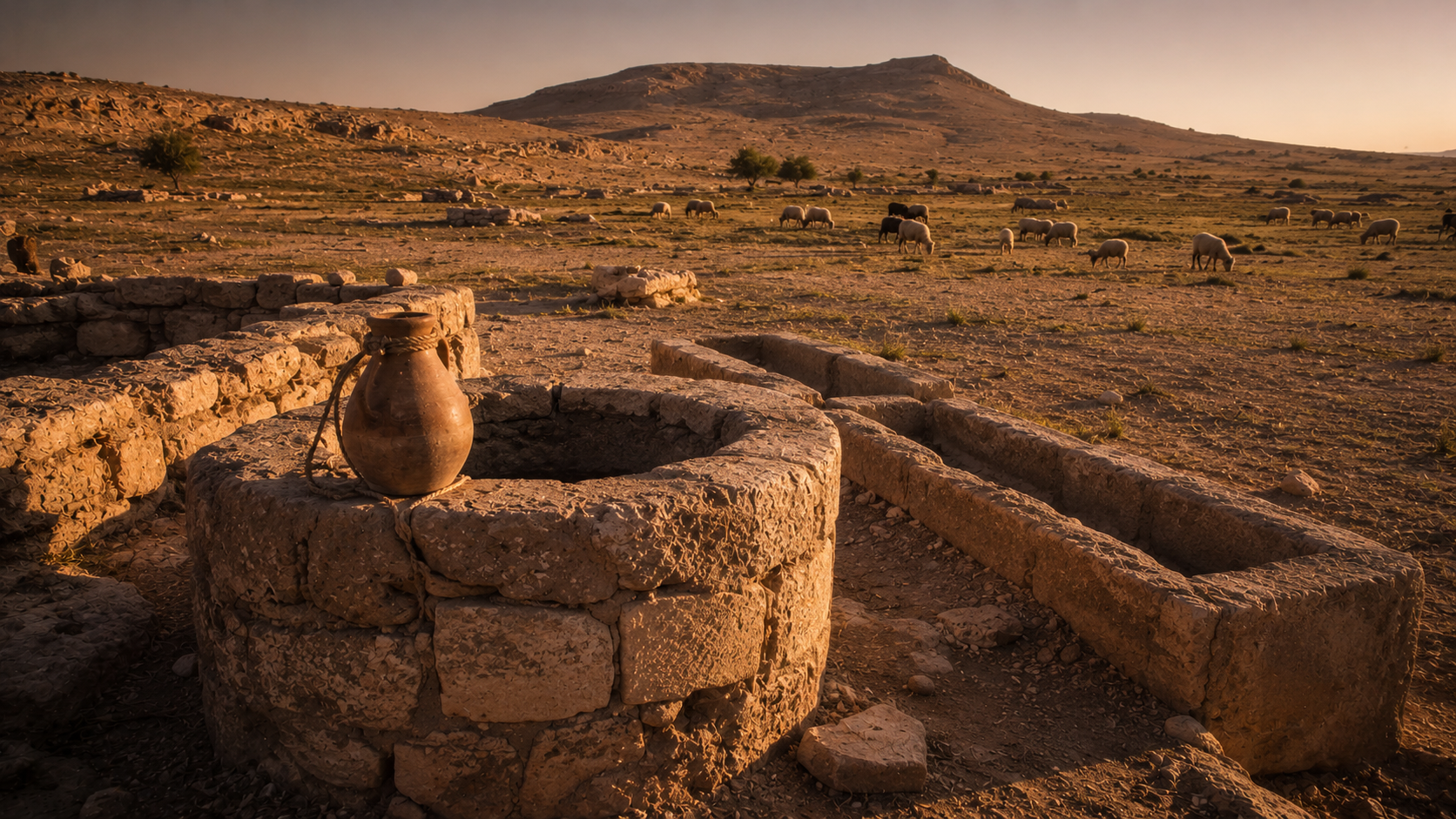
¹¹ In those days, when Moses had grown up, he went out to his brothers and saw their burdens. He saw an Egyptian striking a Hebrew, one of his brothers. ¹² He looked this way and that way, and when he saw that there was no one, he killed the Egyptian, and hid him in the sand. ¹³ He went out the second day, and behold, two men of the Hebrews were fighting with each other. He said to him who did the wrong, “Why do you strike your fellow?” ¹⁴ He said, “Who made you a prince and a judge over us? Do you plan to kill me, as you killed the Egyptian?” Moses was afraid, and said, “Surely this thing is known.” ¹⁵ Now when Pharaoh heard this thing, he sought to kill Moses. But Moses fled from the face of Pharaoh, and lived in the land of Midian, and he sat down by a well. ¹⁶ Now the priest of Midian had seven daughters. They came and drew water, and filled the troughs to water their father’s flock. ¹⁷ The shepherds came and drove them away; but Moses stood up and helped them, and watered their flock. ¹⁸ When they came to Reuel, their father, he said, “How is it that you have returned so early today?” ¹⁹ They said, “An Egyptian delivered us out of the hand of the shepherds, and moreover he drew water for us, and watered the flock.” ²⁰ He said to his daughters, “Where is he? Why is it that you have left the man? Call him, that he may eat bread.” ²¹ Moses was content to dwell with the man. He gave Moses Zipporah, his daughter. ²² She bore a son, and he named him Gershom, for he said, “I have lived as a foreigner in a foreign land.”
- He went out to his brothers and saw their burdens. Moses identifies, deliberately, with the Hebrews. The text doesn’t tell us how he knows; it doesn’t tell us when he learned. But by the time he goes out, he knows. His brothers. He owns the identity Pharaoh’s daughter could not give him.
- He looked this way and that way, and when he saw that there was no one. The Hebrew is vayifen koh va-koh, vayar ki ein ish, he turned this way and that, and saw that there was no man. Solomon catches the irony: Moses was the man. The verse can be read two ways: he checks for witnesses, and finds none; or he looks for anyone else who would intervene, and finds no one. He becomes the man because there is no other man.
- He killed the Egyptian. The Hebrew is vayak, he struck. Same verb the Egyptian was using on the Hebrew (makeh in v. 11). Moses uses Pharaoh’s violence to interrupt Pharaoh’s violence. The text records the killing without explicit moral judgment, but the consequences make the judgment: Moses is now wanted, his act is known, and he has to flee. Acts 7:23-29 reads this as Moses’s first attempt at deliverance, premature, on his own strength, before God has called him. The text leaves room for that reading.
- Two men of the Hebrews were fighting with each other. The next day, Moses tries to mediate between two Hebrews. The Hebrews refuse the mediation: who made you a prince and a judge over us? The line foreshadows everything Moses will face for the next forty years. Israel will, repeatedly, throw the same line back at him. Who made you a leader? (Num 16:13). The chapter is teaching that Moses’s leadership crisis begins on day two.
- Surely this thing is known. The killing is reported. Pharaoh hears. Moses, who began the day looking for someone to deliver his brothers, ends it as a fugitive. The chapter has shown us the young Moses: identified with his people, willing to act, but also impulsive, secretive, dependent on his own arm. The whole forty-year stretch in Midian that follows will be God’s slow undoing of all of that. The first deliverer Moses will become is not the man who killed the Egyptian. That man has to die first.
- Moses fled from the face of Pharaoh, and lived in the land of Midian, and he sat down by a well. Three quick verbs: fled, lived, sat down. He goes from running to dwelling. And he sits by a well, which any reader of Genesis 24 (Rebekah at the well) and Genesis 29 (Rachel at the well) will recognize as a Hebrew Bible type-scene. When a Hebrew man sits at a well in a foreign land, he is about to meet his wife. The text is signalling, through narrative form, that the next chapter of Moses’s life is opening.
- The priest of Midian had seven daughters. Reuel (also called Jethro, Ex 3:1; possibly two names of the same person, possibly a clan-name and a personal name) is a priest of Midian. Midian is in the broader Abrahamic family. Midian was a son of Abraham by Keturah (Gen 25:2). Jethro’s priestly office is not of Egypt, not yet of Sinai. The text shows that some of the broader Abrahamic family kept faithful worship outside Israel’s particular line. Moses’s first father-in-law and theological mentor is a non-Israelite priest. The Hebrew Bible is not embarrassed by this.
- Moses stood up and helped them. The pattern repeats: Moses sees abuse, intervenes, defends the abused. This time, it is shepherds against women: a different configuration of the same pattern as Egyptian against Hebrew in v. 11. He is consistent. The chapter is naming a deep characteristic of Moses: he cannot watch the strong abuse the weak without acting. It will get him in trouble in Egypt; it will get him a wife in Midian. God will use this trait, eventually, to deliver a nation.
- An Egyptian delivered us. The daughters identify Moses, by his clothes and bearing, as Egyptian. He has been raised in Pharaoh’s court; he looks the part. They didn’t see his identity, only his appearance. He is between worlds: a Hebrew by blood, an Egyptian by upbringing, a fugitive from both, sitting at a Midianite well. The text is patient with this in-between-ness. Moses does not yet know who he is. God does. God is in no hurry.
- He named his son Gershom, for he said, “I have lived as a foreigner in a foreign land.” The Hebrew name Gershom contains ger (foreigner) and sham (there). Moses names his firstborn for his own dislocation. He is, on his own self-understanding, a stranger in a foreign land. The sentiment will reappear in the Sinai law-collection: for you were strangers in the land of Egypt (Ex 22:21; 23:9). Moses’s lived experience will become the moral memory of the whole nation.
Influence callout: Marty Solomon (Bema Discipleship, Episode 17 / 18)
Solomon reads Moses’s flight to Midian as the beginning of God’s un-making of Moses. The man who left Pharaoh’s house was the most powerful, qualified, well-trained man on earth: a future deliverer with every credential the world recognizes. Forty years in the wilderness with sheep removes every credential. By the time God meets him at the bush, Moses speaks for himself: who am I that I should go to Pharaoh? (Ex 3:11). Solomon’s punchline: God is not interested in your qualifications. God is interested in your availability. The forty-year detour in Midian is not lost time. It is the dismantling of every reason the world had Moses on the short-list, so that when he goes back to Egypt he goes with nothing in his hand but a staff and a Name.
C · Exodus 2:23-25 · The cry rises, and God remembers
²³ In the course of those many days, the king of Egypt died, and the children of Israel sighed because of the bondage, and they cried, and their cry came up to God because of the bondage. ²⁴ God heard their groaning, and God remembered his covenant with Abraham, with Isaac, and with Jacob. ²⁵ God saw the children of Israel, and God was concerned about them.
- The chapter pivots in three short verses. The text moves from Moses’s life in Midian back to the people in Egypt. In the course of those many days, Hebrew vayehi va-yamim ha-rabim ha-hem, covers an unspecified long stretch. The king of Egypt died. A new Pharaoh is on the throne, but the slavery continues. The text is making the point: it isn’t this particular Pharaoh that is the problem; it is the system. New Pharaoh, same engine.
- And the children of Israel sighed because of the bondage, and they cried, and their cry came up to God. Four verbs in three lines: sighed (vaye’anchu), cried (vayiz’aqu), came up (vata’al), and the bondage (ha-avodah) is named twice. The Hebrew za’aq (cry) is one of the two technical words for the cry of the oppressed (the other is tsa’aq, used in 3:7). It is not the language of prayer in any normal sense; it is the language of protest from the depths. Israel does not cry out to God. They simply cry, and their cry goes up to God because the cry is, by its very nature, a thing that rises. See The cry of the oppressed.
- The text’s grammar is striking. They cried, and their cry came up to God. Israel is not even named as crying to God. They are just crying. And God hears anyway. Solomon’s reading: this is the moral architecture of the Hebrew Bible. If you are the one crying, this is good news. If you are the one causing the cry, this is a warning. God’s hearing of Israel’s cry is not a reward for their faith; the chapter has not narrated their faith. God’s hearing is a function of who God is. The cry rises; the God who hears, hears.
- God heard their groaning, and God remembered his covenant with Abraham, with Isaac, and with Jacob. This is the chapter’s theological climax. Four verbs, all with God as subject: heard, remembered, saw, knew. The verbs cluster the whole pattern of biblical deliverance. God heard is the response to the cry. God remembered is the activation of covenant memory. God saw is the recognition of suffering. God knew is the personal investment: the Hebrew yada, the deepest verb of intimate awareness. The four verbs together name the moment the book turns.
- God remembered his covenant with Abraham, with Isaac, and with Jacob. The exodus is not the start of the relationship between God and Israel. The covenant was already made: at Genesis 12, ratified at Genesis 15, sealed at Genesis 17. God’s hearing of the cry is the activation of a promise that has been in force the whole time. Sinai (chapters 19-24) will be the renegotiation of the Abrahamic covenant into mutual form, but the basis is already in place. God is not improvising. God is keeping a promise.
- The chapter ends with God’s concern. Hebrew vayeda elohim, “God knew.” Some translations render this God took notice or God acknowledged them. The verb yada is the same one used in Gen 4:1 (“Adam knew Eve”) and across the Hebrew Bible for deepest knowing. God’s response to the cry is not bureaucratic acknowledgment; it is intimate, covenantal recognition. The next chapter will narrate the consequence: God comes down.
Influence callout: Carmen Joy Imes (Bearing God’s Name)
Imes notes that the structure of Exodus 2:23-25 is the seed of the whole book. Sigh, cry, hear, remember, see, know, the same vocabulary will recur at Ex 6:5 (when God restates his commitment to Moses) and Ex 22:23 (when the Sinai law makes the same sequence the moral obligation of Israel to its own oppressed). Israel’s experience of being heard becomes Israel’s vocation: be a people who hears the cry the way YHWH hears the cry. The Hebrew Bible’s whole ethical architecture grows from this paragraph. Hearing the cry is not just God’s character; it is the calling of the people who bear God’s Name.
- Notice the chapter’s structural arc. It begins with the women hiding a Hebrew baby in a basket on the river. It ends with God hearing a Hebrew people crying from the brick-pits. Between them: a man’s birth, his self-discovery, his violent failure, his exile, his marriage, his fatherhood, his naming of his son for his own dislocation. The whole chapter is held inside two acts of seeing: a woman seeing a baby is good (v. 2), and God seeing a people and knowing them (v. 25). The chapter is teaching: God’s deliverance begins with seeing, by people, by women, ultimately by God himself, and the rest of the story is the working out of what the seeing produces.
- The book has set its world (chapter 1), introduced its deliverer (chapter 2:1-22), and rung the bell (chapter 2:23-25). Chapter 3 will narrate what God does next. The bush is on fire and the Name is about to be given.
Reflection prompts
- The whole chapter is, on close reading, a story about women who refuse to do what Pharaoh said: Moses’s mother, his sister, the daughter of Pharaoh, the seven daughters of Reuel. The chapter is honest that Israel’s deliverance is borne, repeatedly, by women whose courage history would otherwise have left in the margins. Where, in your own community or family, are the small acts of refusal happening right now? Whose courage are you depending on without naming it?
- Moses spends forty years in Midian becoming someone different from the man he was at the start of chapter 2. The text gives us no narration of that interior change; it just shows us the result at chapter 3. What is your Midian. The long, slow, unglamorous middle where God is undoing the version of you that thought it could deliver on its own strength?
- They cried, and their cry came up to God. The text does not say Israel cried to God; it says they just cried, and their cry went up. What in your life right now is in the just crying stage? Can you trust that the cry rises on its own, that the God who hears is in fact already hearing?
Frameworks at play in this chapter: the cry of the oppressed, the exodus pattern.