
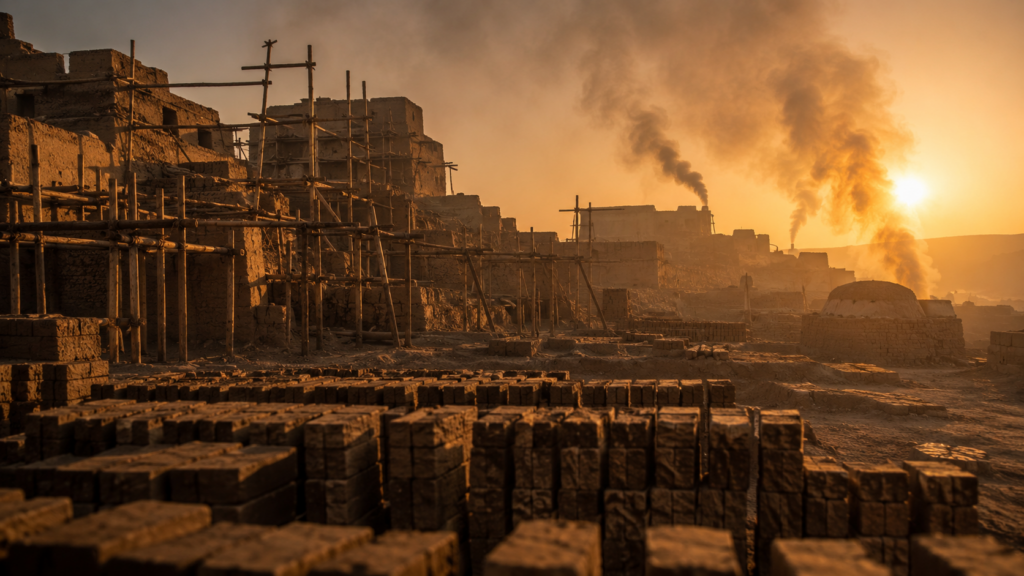
The Hebrew name of the book is Shemot, “names.” It is taken from the first phrase of the chapter: and these are the names of the sons of Israel. The book that delivers the Name of God begins by naming the seventy souls who came down to Egypt. Names matter from the first verse, and the chapter’s central crime is, in part, an attempt to un-name a people: to grind seventy named souls into anonymous brick-makers, and then to murder their newborn sons before anyone can name them.
The chapter is short, dense, and disturbing. It introduces the engine that drives the whole book, fear of the other, paranoid power, industrial cruelty, and it introduces, against that engine, the first deliverers of Israel: not Moses, but two midwives whose names the text takes the trouble to record while the Pharaoh of Egypt remains nameless throughout the entire book.
Exodus 1 is the world the rest of the book has to dismantle.
A · Exodus 1:1-7 · The names of Israel
¹ Now these are the names of the sons of Israel, who came into Egypt (every man and his household came with Jacob): ² Reuben, Simeon, Levi, and Judah, ³ Issachar, Zebulun, and Benjamin, ⁴ Dan and Naphtali, Gad and Asher. ⁵ All the souls who came out of Jacob’s body were seventy souls, and Joseph was in Egypt already. ⁶ Joseph died, as did all his brothers, and all that generation. ⁷ The children of Israel were fruitful, and increased abundantly, and multiplied, and grew exceedingly mighty; and the land was filled with them.
- The chapter opens by tying Exodus directly to Genesis. The list of names (vv. 2-4) is the same list Genesis 46 closed with; the seventy souls (v. 5) is the same number Gen 46:27 named. Exodus is not a new story; it is the continuation. The patriarchal family that came down to Egypt for grain is now becoming the nation that will come up out of Egypt for covenant.
- Shemot, the Hebrew name of the book, opens the chapter and frames the whole work. The naming of Jacob’s twelve sons matters: each name is the seed of a tribe, each tribe a part of the people about to be made. Genesis was the story of one family; Exodus is the story of one nation made out of twelve named families. The book begins by remembering that distinction.
- Verse 7 is the chapter’s first theological hinge. The Hebrew piles up five verbs of fertility and growth in a single line: paru (were fruitful), vayishretsu (swarmed), vayirbu (multiplied), vayatsmu (grew mighty), vatimale (filled). This is Genesis 1:28 vocabulary, be fruitful and multiply and fill the earth, and Genesis 9:1 vocabulary, after the flood. The author is signalling: the creation blessing is at work in Israel, in Egypt, even now. The promise to Abraham (Gen 12:2-3, 15:5, 22:17) is being kept while the book opens.
Word study: shemot (שְׁמוֹת)
“Names.” The Hebrew title of the book. Names matter from the first phrase: the sons of Israel are named, the midwives are named, Moses is named (“drawn out”), Aaron’s sons will be named, Bezalel and Oholiab will be named, and at the heart of the book, in chapter 3, YHWH will give the Name. The book that gives Israel the divine Name begins by remembering Israel’s own. Pharaoh, by contrast, is never named in the entire book. The Hebrew text has its judgments to make about who is worth naming and who is not.
- Notice what the text does not say. There is no description of how the family grew, no internal narrative of the four hundred years between Joseph’s death and the new Pharaoh. The text passes over four centuries in two verses. The pacing is deliberate: Exodus is not the story of those centuries; it is the eruption at the end of them. Israel was God’s people through the silence. The cry is about to start.
B · Exodus 1:8-14 · The new Pharaoh and the engine of empire
⁸ Now there arose a new king over Egypt, who didn’t know Joseph. ⁹ He said to his people, “Behold, the people of the children of Israel are more and mightier than we. ¹⁰ Come, let’s deal wisely with them, lest they multiply, and it happen that when any war breaks out, they also join themselves to our enemies and fight against us, and escape out of the land.” ¹¹ Therefore they set taskmasters over them to afflict them with their burdens. They built storage cities for Pharaoh: Pithom and Raamses. ¹² But the more they afflicted them, the more they multiplied and the more they spread out. They were grieved because of the children of Israel. ¹³ The Egyptians ruthlessly made the children of Israel serve, ¹⁴ and they made their lives bitter with hard service in mortar and in brick, and in all kinds of service in the field, all their service, in which they ruthlessly made them serve.
- A new king who did not know Joseph. The Hebrew is precise: lo’ yada, “did not know.” The verb is the same one Pharaoh will use in 5:2: I do not know YHWH. The book opens with a ruler whose problem is fundamentally ignorance of the saving past, both Joseph (the man who saved Egypt from famine) and YHWH (the God who has been at work all along). Empires rise on a kind of historical amnesia: a willingness to forget who actually built the prosperity, who actually deserves credit, what the original story was. The text is naming this from verse one.
- Pharaoh’s speech in vv. 9-10 is a tutorial in how empire talks. Notice the moves: the people of Israel are more and mightier than we (a numerical exaggeration to seed fear); let us deal wisely with them (a euphemism for cruelty); lest they multiply (hostility to the very fertility that is itself God’s blessing); lest they join our enemies (paranoid projection, Israel is, in the text, doing nothing of the kind); and escape out of the land (the real fear underneath: not that they’ll fight us, but that they’ll leave us). Goldingay catches the irony: Pharaoh’s deepest fear is the loss of his slave labor force. The whole speech is the engine of empire visible in plain language.
- The Hebrew phrase let us deal wisely is navah-na lo’, and the verb root chakam (wisdom) is the same root the Hebrew Bible elsewhere uses for true wisdom (Solomon, Proverbs, the wisdom of the Sinai craftsmen). Pharaoh’s “wisdom” is a perversion of the word: cleverness in service of cruelty. The book is teaching, from chapter 1, that there is wisdom that builds and wisdom that destroys, and that empire reaches for the second while pretending it is the first.
- The two storage cities are Pithom and Raamses. Pithom is “house of Atum,” an Egyptian creator-deity; Raamses is “Ra has begotten him,” named for the sun-god whose son Pharaoh claims to be. The Hebrews, in slavery, are building the storage-cities of the gods Pharaoh worships. The labor is theological as well as economic: every brick lays foundation for an alternative cosmology in which Ra is the Son and Pharaoh is the Son’s representative. The ten plagues, when they come, will dismantle this theology brick by brick.
- The more they were afflicted, the more they multiplied and spread. Verse 12 is the chapter’s first ironic twist. Pharaoh’s whole strategy is meant to limit Israel’s growth. Instead, Israel grows under the affliction. The verb in v. 12 is parats, to break out, burst out, spread. It will reappear in Gen 38:29 (Perez, “the one who broke out”) and at every moment in the Hebrew Bible when the unstoppable surfaces against the powerful. The text is teaching: empire’s projects do not work the way the empire thinks they will.
Word study: avodah (עֲבֹדָה)
The Hebrew word translated “service” in verses 13-14 is avodah. It can mean work, labor, service, or worship. Same word, all four meanings. Israel is doing avodah for Pharaoh in Egypt; God will tell Pharaoh to let my people go that they may serve / worship me (Ex 7:16; same root). The book’s whole arc is a question of whose avodah Israel is doing. Slavery is avodah miscast, service to the wrong master, work that builds the wrong god’s cities. Worship is avodah rightly directed. The two are the same verb. Read everything that follows with this in mind.
- Notice what the text doesn’t say. There is no explicit cry yet. Israel is enslaved, embittered, ruthlessly worked. But the tsa’aqah (the technical word for the cry of the oppressed; see The cry of the oppressed) does not appear until 2:23. Solomon’s reading: the cry has to rise before YHWH responds; the chapter is showing us the conditions under which a cry forms. The text is not impatient. It lets the affliction settle in.
C · Exodus 1:15-22 · The midwives, and the first refusal
¹⁵ The king of Egypt spoke to the Hebrew midwives, of whom the name of the one was Shiphrah, and the name of the other Puah, ¹⁶ and he said, “When you perform the duty of a midwife to the Hebrew women, and see them on the birth stool; if it is a son, then you shall kill him; but if it is a daughter, then she shall live.” ¹⁷ But the midwives feared God, and didn’t do what the king of Egypt commanded them, but saved the baby boys alive. ¹⁸ The king of Egypt called for the midwives, and said to them, “Why have you done this thing, and have saved the boys alive?” ¹⁹ The midwives said to Pharaoh, “Because the Hebrew women aren’t like the Egyptian women; for they are vigorous, and give birth before the midwife comes to them.” ²⁰ God dealt well with the midwives, and the people multiplied, and grew very mighty. ²¹ Because the midwives feared God, he gave them families. ²² Pharaoh commanded all his people, saying, “You shall cast every son who is born into the river, and every daughter you shall save alive.”
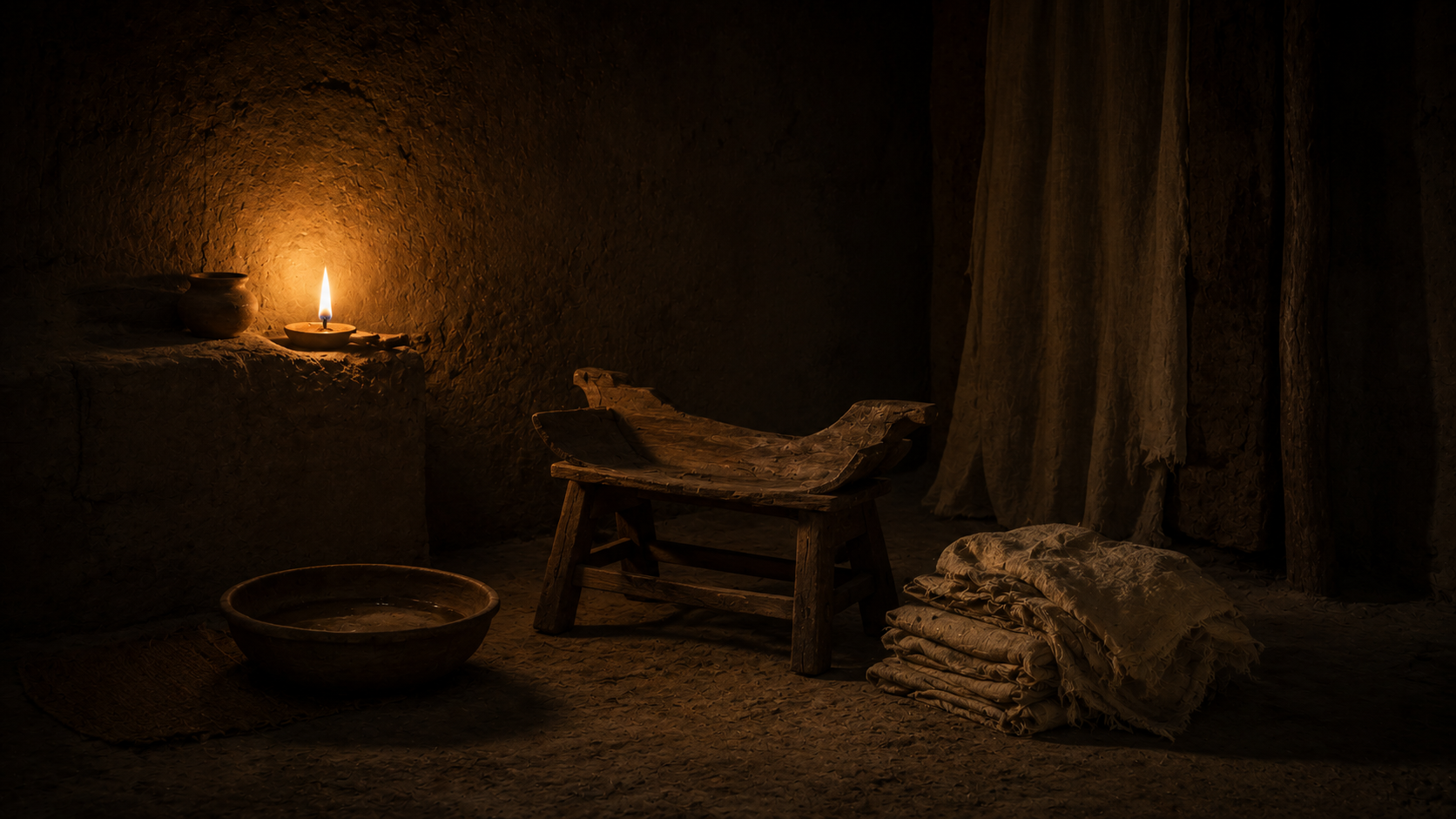
- The midwives are named. Pharaoh is not. The text’s editorial hand here is unmistakable: in the contest between the most powerful man in the world and two Hebrew (or possibly Egyptian-attending-Hebrew) midwives, the text records the midwives’ names for permanent canonical memory and lets Pharaoh fade into anonymity. Shiphrah (“beauty”) and Puah (“brilliance” or “girl”). They are the first deliverers in the book that bears Moses’s name.
- Pharaoh’s instruction is the first explicit infanticide command in the Hebrew Bible. Notice the gendered logic: kill the boys, leave the girls. Boys grow up into potential soldiers; girls can be assimilated, married off, used. Pharaoh’s policy is a textbook ancient genocide-by-attrition strategy. The text records it without comment, letting it stand as the bare horror it is.
- The midwives feared God. This is the chapter’s load-bearing theological line, and the Hebrew is vatire’na ha-meyaldot et ha-elohim. Yir’at elohim, fear of God, is the wisdom-tradition’s foundational phrase (Prov 1:7; 9:10). The midwives have the true wisdom Pharaoh’s let us deal wisely perverts. They fear God more than they fear Pharaoh. This is the book’s first ethical claim: there is a fear that liberates and a fear that enslaves, and to fear the right one is to be free of the wrong one.
- The midwives lie to Pharaoh’s face (v. 19). The Hebrew women are not in fact more vigorous than Egyptian women in any biological sense the text suggests; the midwives are improvising. The text shows no disapproval. God dealt well with the midwives (v. 20). The narrative is teaching, from chapter 1, that civil disobedience against an infanticidal regime is not just permitted; it is rewarded. The midwives are vindicated by the text and by God. Read this against later evangelical hand-wringing about whether their lie was sinful: the text is uninterested in that question.
- He gave them families (v. 21). The Hebrew is vaya’as lahem batim, he made them houses. The same idiom is used of the house of David in 2 Sam 7. The midwives, through their righteous refusal, are given the same promise-form God will later give to David. Their courage in the face of empire generates a house (a continuation, a name, a future). The text is clear: women who fear God and protect children are not bystanders to Israel’s story; they are co-authors.
Influence callout: Tim Mackie (Strange Bible, Torah Crash Course Part 2)
Mackie reads Exodus 1 by asking the most pastorally honest question: “Where is God in this dark chapter?” The answer is not lightning from heaven. It is in the obedient action of women who fear God. Shiphrah and Puah are Mackie’s image of how God works in dark seasons, through faithful human agency the empire never sees coming. The pastoral note he draws: when readers ask where is God when the world is this dark?, the Bible’s stories often answer back, well, what are you doing? The midwives are doing something. The text begins with that.
- Verse 22 is the chapter’s terrible final line. Pharaoh, defeated by two midwives, escalates: every son who is born into the Nile. The instruction is no longer to the midwives but to all his people. The whole society is conscripted into the murder. The Nile, Egypt’s source of life, deified as Hapi, becomes the instrument of Hebrew death. The first plague will turn this very river to blood; the lex talionis-pattern is being seeded already. The river that drowns the Hebrew sons will, in chapter 2, become the river that delivers one Hebrew son into Pharaoh’s own household.
- Solomon’s deeper reading: the text has set up the engine of empire in three escalating moves. First Pharaoh enslaves (vv. 8-14); second Pharaoh tries covert infanticide (vv. 15-21); third Pharaoh tries open infanticide (v. 22). At every step, the engine fails. The Hebrews multiply under affliction; the midwives refuse covertly; Pharaoh’s daughter, his own daughter, is about to refuse openly. Empire’s response to the failure of its violence is always more violence. And empire is always undone, in the Hebrew Bible’s reading, by women whose fear of God is greater than their fear of empire.
- Notice what the chapter has not yet introduced. Moses is not named. Yahweh has not spoken. The cry has not been heard. The book has set the world it has to dismantle. Chapter 2 will begin by introducing, in a single Levite household, the deliverer Pharaoh’s policy is about to deliver into his own daughter’s arms.
Reflection prompts
- The chapter records the names of two midwives and lets Pharaoh remain nameless. What does it mean that the canonical memory of God’s people remembers the small faithful acts of women whose names history would otherwise have forgotten, and lets the powerful go unrecorded? Where, in your own life, are the small faithful acts being done?
- The midwives feared God and did not do what the king of Egypt commanded. To fear God is to be free from the fear of empire. What are you afraid of right now that, on this chapter’s reading, you would not be afraid of if you feared God more?
- The chapter’s engine is fear of the other, projected as numerical threat. Pharaoh’s first move is to convince his people that the Hebrews have become too many. Where does fear of the other operate as the seed of cruelty in your own time and place? Where is the navah-na lo’, the let’s deal wisely with them, being said about whom right now?
Frameworks at play in this chapter: the cry of the oppressed, counter-imperial reading, the exodus pattern.