
Genesis 10 is another genealogy chapter, the kind most readers skip. Like Genesis 5, it looks like a list. Like Genesis 5, it’s an argument made through structure.
After the flood, the world repopulates through Noah’s three sons: Japheth, Ham, and Shem. Genesis 10 catalogues the nations that descend from each, mapping the world the original audience knew. The structure isn’t random. It’s a theology of the nations. Seventy of them, by traditional count. Three lines spreading north, south, and east. The whole earth filled with humans, each carrying the image, each part of God’s larger story.
The chapter also includes one inset narrative: Nimrod, “a mighty hunter before the LORD,” whose kingdom begins with Babel. Genesis 11 is about to zoom in on what Babel becomes. Genesis 10 is the wider lens before the zoom.
A note on what to avoid. The Table of Nations has been used historically, especially in nineteenth-century American Christianity, to build theological frameworks for racial hierarchy. Paired with a misreading of Genesis 9 (the so-called “Hamitic curse,” which we addressed there), this table was conscripted to argue that God had permanently divided humanity into races with different statuses. None of that is in the text. The Table of Nations is a theological catalogue of the peoples Israel knew and would interact with. It’s about empire, geography, and divine purposes, not race.
A note on what to do with the names. Some are familiar (Egypt, Canaan, Babylon, Asshur). Many are not. We don’t need to track every one. The chapter is making three big moves: it’s locating the world Israel knew within God’s broader purposes; it’s introducing a thread (Nimrod, Babel, the empire-builders) that the next chapter will pursue; and it’s narrowing the focus from “all the nations” to the line of Shem, the line that will lead to Abraham. We’ll follow those three moves.
→ Read the divine council framework for the broader background on how the Bible thinks about God and the nations. Genesis 10 lays the groundwork; Deuteronomy 32 will name the framework explicitly.
A · Genesis 10:1–5 · The descendants of Japheth
¹ Now this is the history of the generations of the sons of Noah and of Shem, Ham, and Japheth. Sons were born to them after the flood. ² The sons of Japheth were: Gomer, Magog, Madai, Javan, Tubal, Meshech, and Tiras. ³ The sons of Gomer were: Ashkenaz, Riphath, and Togarmah. ⁴ The sons of Javan were: Elishah, Tarshish, Kittim, and Dodanim. ⁵ Of these were the islands of the nations divided in their lands, everyone after his language, after their families, in their nations.
- The chapter opens with another toledot, “the history of the generations of the sons of Noah.” Genesis is moving forward by way of family trees, each one zooming closer to the line that will matter most. We’re now in the toledot of Noah’s sons: Japheth, Ham, Shem. The order changes from chapter to chapter, but here Japheth is treated first.
- Japheth’s descendants populate the lands generally to the north and west of Israel. Gomer is Cimmeria (modern southern Russia and Ukraine). Magog is identified variously, often with the same northern region. Javan is Greece and the Aegean (Ionia in archaic Greek). Tubal and Meshech are eastern Anatolia. Tiras is probably the Aegean as well. The Japhethites are the maritime peoples and the Indo-European-speaking groups across the Mediterranean and to the north.
- Verse 5: “of these were the islands of the nations divided in their lands, everyone after his language, after their families, in their nations.” The phrase “islands” is a Hebrew term often used for “coastlands,” the maritime world. The verse also already mentions division by language, anticipating the Babel narrative in chapter 11. The chapter is presenting the post-Babel state of the world, even before Babel has been narrated. This isn’t a chronological problem; it’s a literary structure. Genesis 10 gives the panorama. Genesis 11 explains how it came to be.
B · Genesis 10:6–20 · The descendants of Ham (and Nimrod)
⁶ The sons of Ham were: Cush, Mizraim, Put, and Canaan. ⁷ The sons of Cush were: Seba, Havilah, Sabtah, Raamah, and Sabteca. The sons of Raamah were: Sheba and Dedan. ⁸ Cush became the father of Nimrod. He began to be a mighty one in the earth. ⁹ He was a mighty hunter before Yahweh. Therefore it is said, “like Nimrod, a mighty hunter before Yahweh.” ¹⁰ The beginning of his kingdom was Babel, Erech, Accad, and Calneh, in the land of Shinar. ¹¹ Out of that land he went into Assyria, and built Nineveh, Rehoboth Ir, Calah, ¹² and Resen between Nineveh and Calah (the same is the great city). ¹³ Mizraim became the father of Ludim, Anamim, Lehabim, Naphtuhim, ¹⁴ Pathrusim, Casluhim (which the Philistines descended from), and Caphtorim. ¹⁵ Canaan became the father of Sidon (his firstborn), Heth, ¹⁶ the Jebusite, the Amorite, the Girgashite, ¹⁷ the Hivite, the Arkite, the Sinite, ¹⁸ the Arvadite, the Zemarite, and the Hamathite. Afterward the families of the Canaanites were spread abroad. ¹⁹ The border of the Canaanites was from Sidon, as you go toward Gerar, to Gaza; as you go toward Sodom, Gomorrah, Admah, and Zeboiim, to Lasha. ²⁰ These are the sons of Ham, after their families, after their languages, in their lands and nations.
- Ham’s line populates the south and the lands closest to Israel. Cush is Nubia and Ethiopia. Mizraim is Egypt (the Hebrew for Egypt is mizraim throughout the Bible). Put is Libya. Canaan is, well, Canaan, the land that will become Israel’s promised inheritance. The Hamite line is the line of empires Israel will encounter and contend with: Egypt to the south, Assyria and Babylon (via Nimrod) to the east, Canaan in between.
- Verse 8 introduces Nimrod, the only individual in the Table of Nations who gets a narrative description. “He began to be a mighty one in the earth. He was a mighty hunter before Yahweh.” The Hebrew word for “mighty one” is gibbor, the same word used in Genesis 6:4 for the Nephilim, “mighty men of old, men of renown.” The connection isn’t accidental. Nimrod inherits the pattern of the pre-flood hybrid heroes: large in stature, large in deed, large in influence. The flood didn’t end the trajectory.
- “A mighty hunter before Yahweh” has been read various ways. Most modern scholars read “before Yahweh” as either intensification (“an exceptionally mighty hunter, in Yahweh’s sight”) or, more pointedly, as opposition (“a mighty hunter against Yahweh,” with “before” carrying a sense of confrontation). The latter reading fits the broader narrative: Nimrod founds Babel and builds the cities Israel will later see as symbols of imperial rebellion. Nimrod isn’t praised. He’s catalogued.
- “The beginning of his kingdom was Babel, Erech, Accad, and Calneh, in the land of Shinar.” Babel is Babylon. Erech is Uruk, the great Sumerian city of Gilgamesh fame. Accad is Akkad, the seat of the Akkadian Empire. Shinar is Mesopotamia. The world’s first imperial cities, the cradle of the great human empires, founded by a gibbor in the line of Ham. Genesis 11 is about to focus on Babel itself. Genesis 10 has already named what kind of project it is.
- “Out of that land he went into Assyria, and built Nineveh.” Assyria, the empire that will destroy the northern kingdom of Israel. Nineveh, the city Jonah will be sent to, the city Nahum will pronounce judgment over. Genesis is sketching the architecture of the imperial world long before the prophets have to address it. Empires have a long pedigree in this story.
- The Canaanite list (verses 15–19) names the peoples Israel will displace in the conquest narratives: Sidon, Heth (the Hittites), Amorites, Jebusites, Hivites, Girgashites, and others. Sodom and Gomorrah are named in passing; they’ll have their own story in Genesis 19. Genesis 10 is doing geopolitical mapping of Israel’s future world, with all the interpretive shadows already cast.
C · Genesis 10:21–32 · The descendants of Shem (and the line to Abraham)
²¹ Children were also born to Shem (the elder brother of Japheth), the father of all the children of Eber. ²² The sons of Shem were: Elam, Asshur, Arpachshad, Lud, and Aram. ²³ The sons of Aram were: Uz, Hul, Gether, and Mash. ²⁴ Arpachshad became the father of Shelah. Shelah became the father of Eber. ²⁵ To Eber were born two sons. The name of the one was Peleg, for in his days the earth was divided. His brother’s name was Joktan. ²⁶ Joktan became the father of Almodad, Sheleph, Hazarmaveth, Jerah, ²⁷ Hadoram, Uzal, Diklah, ²⁸ Obal, Abimael, Sheba, ²⁹ Ophir, Havilah, and Jobab. All these were the sons of Joktan. ³⁰ Their dwelling extended from Mesha, as you go toward Sephar, the mountain of the east. ³¹ These are the sons of Shem, after their families, after their languages, in their lands, after their nations. ³² These are the families of the sons of Noah, after their generations, in their nations. The nations divided from these in the earth after the flood.
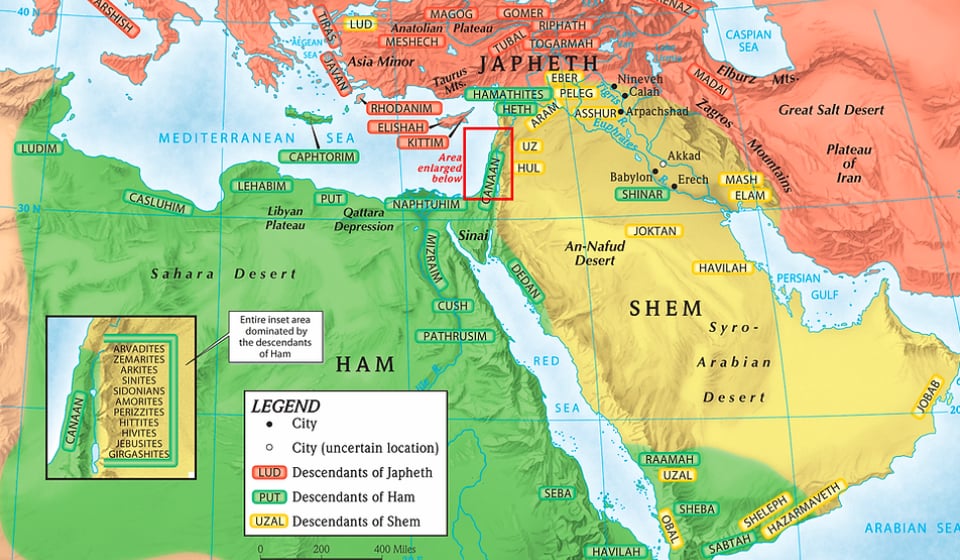
- Shem’s line is described last and most carefully. The text introduces him with a particular note: “the father of all the children of Eber.” Eber is the etymological source of Ibri, the Hebrew word for Hebrew. The Shemite line is being tagged from the very beginning as the one that will become the people of Israel. The signposting is deliberate.
- Verse 25 is small but loaded: “To Eber were born two sons. The name of the one was Peleg, for in his days the earth was divided.” Peleg means “division” or “split.” The text doesn’t explain what division is meant. Many readers connect it to the Babel scattering in the next chapter. Others read it as a reference to the geographic division of nations (the earth divided into different lands after the flood). The ambiguity is probably intentional. Genesis 10 keeps gesturing at Genesis 11.
- Notice the lifespans aren’t listed in this chapter. Genesis 5 had detailed ages; Genesis 10 doesn’t. The genealogical work has shifted from “feel the death-refrain” to “trace the family tree of the nations.” The next chapter (11:10–26) will return to lifespans for Shem’s line specifically, narrowing the focus toward Abraham.
- “These are the families of the sons of Noah, after their generations, in their nations. The nations divided from these in the earth after the flood.” The chapter ends by summarizing what it’s done. Seventy nations (by traditional count) populate the post-flood earth. The whole inhabited world, in its original audience’s geographic imagination, traces back to Noah’s three sons.
- The number 70 isn’t named in the text but is reached by counting: 14 from Japheth, 30 from Ham, 26 from Shem. (Different counting methods produce slightly different totals; the Septuagint counts 72.) Seventy will become a recurring number for “the nations.” When Deuteronomy 32:8 says God divided the nations “according to the number of the sons of God,” and the Dead Sea Scrolls preserve the reading that names 70 sons of God, the alignment is intentional. The Babel scattering produces 70 nations; God assigns each to a member of his divine council; Israel he keeps for himself. Genesis 10 sets the stage for that whole framework, even before the text is ready to articulate it.
Reflection prompts
- Genesis 10 takes time to name the nations of the world. Most of them aren’t Israel. Many of them will be Israel’s enemies. But all of them are present in God’s account. What does it mean that the chapter takes the time to list the nations Israel didn’t and won’t claim?
- Nimrod is the only individual the chapter pauses to describe. He’s a gibbor, a builder of empires, a founder of Babel and Nineveh. Where in your life or your culture do you see the pattern of gibbor energy: large stature, large deed, large city, large influence? What does it mean that the text catalogues this rather than celebrates it?
- Shem’s line gets the closing focus, narrowing toward Eber and the line that will become Abraham’s. The story is moving from “all the nations” toward “one particular family that will become a blessing for all the nations” (Genesis 12). What does it look like to live with the long horizon of God’s purposes, knowing the particular story you’re in is part of a much larger one?