
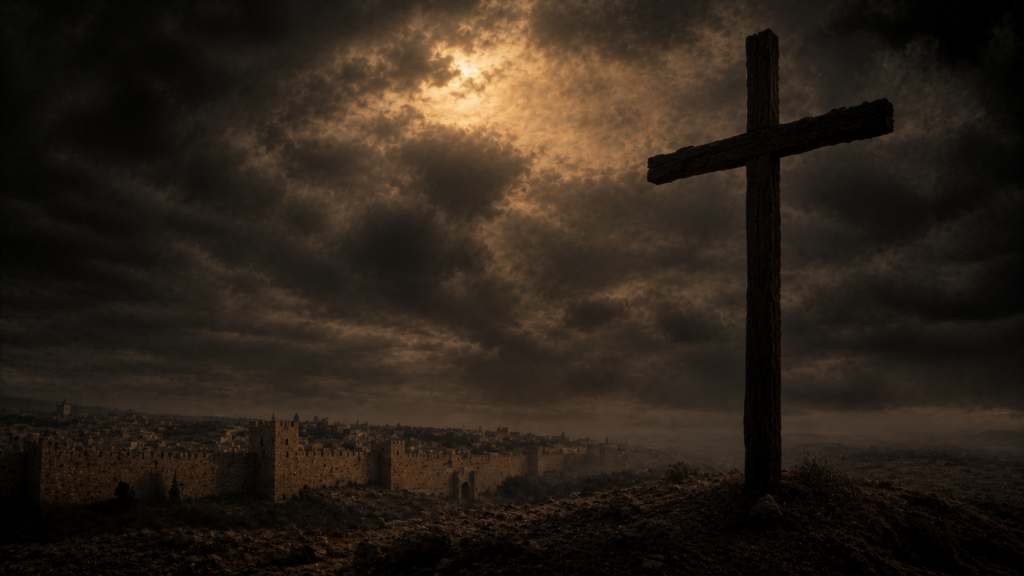
Matthew 27 is the gospel’s most somber chapter. After the night-trial of chapter 26, the chapter turns to the morning Roman-trial before Pilate, the crowd’s choice of Barabbas, the mock-coronation by the soldiers, the procession to Golgotha, the crucifixion itself, and the burial. The chapter is recording, with deliberate restraint and dense Hebrew Bible-allusion, what the gospel has been moving toward since chapter 16’s first passion prediction. The cross is the kingdom’s coronation; Matthew is going to record it that way.
The chapter has four movements. The first (verses 1 to 26) is the morning sequence: the binding of Jesus, the chief priests’ decision to send him to Pilate, Judas’s remorse and death, the trial before Pilate, the choice of Barabbas, the crowd’s let his blood be on us. The second (verses 27 to 44) is the mock-enthronement and the crucifixion proper: the soldiers’ purple robe and crown of thorns, the procession to Golgotha, the crucifixion at the third hour, the placement between two robbers, the mockers passing by. The third (verses 45 to 56) is the death scene: the darkness from the sixth to the ninth hour, the cry of dereliction, the death itself, the torn veil, the earthquake, and the centurion’s confession. The fourth (verses 57 to 66) is the burial: Joseph of Arimathea, the new tomb, the women keeping watch, and the chief priests’ guard set against the body.
Beneath the chapter’s surface flow is the gospel’s most concentrated single working-out of its cruciform-king claim. The mock-coronation by the soldiers is, in Matthew’s telling, the actual coronation. The titulus (This is Jesus, the King of the Jews) is, in the chapter’s quiet irony, accurate. The torn veil and the centurion’s confession are the chapter’s two unmistakable signs that the cross has accomplished what the cross has accomplished. The chapter is recording, with characteristic narrative restraint, what the rest of the New Testament will spend forty years working out: the king reigns from a tree, the temple’s separation between God and people has been torn open, and a Roman centurion is the chapter’s first explicit Gentile-confession of truly this was the Son of God.
A · Matthew 27:1–26 · Pilate’s trial and the choice of Barabbas
¹ Now when morning had come, all the chief priests and the elders of the people took counsel against Jesus to put him to death: ² and they bound him, and led him away, and delivered him up to Pontius Pilate, the governor. ³ Then Judas, who betrayed him, when he saw that Jesus was condemned, felt remorse, and brought back the thirty pieces of silver to the chief priests and elders, ⁴ saying, “I have sinned in that I betrayed innocent blood.” But they said, “What is that to us? You see to it.” ⁵ He threw down the pieces of silver in the sanctuary and departed. He went away and hanged himself. ⁶ The chief priests took the pieces of silver, and said, “It’s not lawful to put them into the treasury, since it is the price of blood.” ⁷ They took counsel, and bought the potter’s field with them, to bury strangers in. ⁸ Therefore that field was called “The Field of Blood” to this day. ⁹ Then that which was spoken through Jeremiah the prophet was fulfilled, saying, “They took the thirty pieces of silver, the price of him upon whom a price had been set, whom some of the children of Israel priced, ¹⁰ and they gave them for the potter’s field, as the Lord commanded me.” ¹¹ Now Jesus stood before the governor: and the governor asked him, saying, “Are you the King of the Jews?” Jesus said to him, “So you say.” ¹² When he was accused by the chief priests and elders, he answered nothing. ¹³ Then Pilate said to him, “Don’t you hear how many things they testify against you?” ¹⁴ He gave him no answer, not even one word, so that the governor marveled greatly. ¹⁵ Now at the feast the governor was accustomed to release to the multitude one prisoner, whom they desired. ¹⁶ They had then a notable prisoner, called Barabbas. ¹⁷ When therefore they were gathered together, Pilate said to them, “Whom do you want me to release to you? Barabbas, or Jesus, who is called Christ?” ¹⁸ For he knew that because of envy they had delivered him up. ¹⁹ While he was sitting on the judgment seat, his wife sent to him, saying, “Have nothing to do with that righteous man, for I have suffered many things this day in a dream because of him.” ²⁰ Now the chief priests and the elders persuaded the multitudes to ask for Barabbas, and destroy Jesus. ²¹ But the governor answered them, “Which of the two do you want me to release to you?” They said, “Barabbas!” ²² Pilate said to them, “What then shall I do to Jesus, who is called Christ?” They all said to him, “Let him be crucified!” ²³ But the governor said, “Why? What evil has he done?” But they cried out exceedingly, saying, “Let him be crucified!” ²⁴ So when Pilate saw that nothing was being gained, but rather that a disturbance was starting, he took water, and washed his hands before the multitude, saying, “I am innocent of the blood of this righteous person. You see to it.” ²⁵ All the people answered, “May his blood be on us, and on our children!” ²⁶ Then he released to them Barabbas, but Jesus he flogged and delivered to be crucified. (Matthew 27:1–26, World English Bible)
- Then Judas, who betrayed him, when he saw that Jesus was condemned, felt remorse, and brought back the thirty pieces of silver to the chief priests and elders (verse 3). The Greek metameletheis, “having repented” or “having regretted,” names a specific Greek shading. Metamelomai (to regret, to feel remorse) is distinct from metanoeo (to repent in the sense of turning toward God). The chapter is recording, with characteristic narrative-vocabulary precision, that Judas’s response is regret without the turn-toward-grace that might have produced restoration. The chapter is being careful here. Judas does feel something; what he feels does not move him toward the kind of repentance that could have, on the gospel’s pattern, brought him back. Peter’s tears in 26:75 will turn out to be the kind of grief that does come back; Judas’s regret will not.
- I have sinned in that I betrayed innocent blood (verse 4). The Greek paredoka haima athoon, “I have betrayed innocent blood,” is Judas’s confession. The chapter is recording, with characteristic narrative-honest precision, that Judas himself recognizes Jesus’s innocence. The chapter’s most direct testimony against the chief priests’ verdict comes from the man they paid to deliver Jesus to them. What is that to us? You see to it (verse 4b) is the chief priests’ refusal to acknowledge what their bargain has produced.
- He threw down the pieces of silver in the sanctuary and departed. He went away and hanged himself (verse 5). The Greek apenxato, “hanged himself,” is the chapter’s terse account of Judas’s end. (Acts 1:18-19 supplies a different account of Judas’s death; harmonizing has historically been difficult. The chapter does not need a perfect harmony; both accounts agree on the central fact of Judas’s death and on the Field of Blood connection.) The chapter is recording, with characteristic narrative restraint, the betrayer’s grief running its course in destruction rather than in restoration.
- They took counsel, and bought the potter’s field with them, to bury strangers in (verse 7). The Greek records the chief priests’ workaround. The thirty pieces of silver, contaminated by their origin as blood money, cannot enter the temple treasury (their own scrupulous purity-logic catches them); they buy a burial-ground for foreigners. The chapter is recording, with characteristic narrative-ironic precision, the establishment’s continuing fastidiousness about ritual purity even as they have just engineered the execution of an innocent man.
- Then that which was spoken through Jeremiah the prophet was fulfilled (verse 9). The Greek records the chapter’s first passion-fulfillment formula. The citation that follows blends Zechariah 11:12-13 (the thirty pieces of silver and the potter) with Jeremiah 19:1-13 (the potter’s field purchased with money-of-blood). The chapter is recording, with characteristic Hebrew Bible-blended-citation pattern (the same pattern used at 2:6 and elsewhere), that the events of the passion are tracking the prophets’ patterns. The fulfillment is not mechanical-prediction-meeting-event; it is the same God-shaped pattern recurring.
- Are you the King of the Jews? (verse 11). The Greek sy ei ho basileus ton Ioudaion, “are you the king of the Jews,” is Pilate’s central question. The chapter is recording, with characteristic narrative-political precision, that Pilate’s question is the political-charge version of the Sanhedrin’s religious-charge question of 26:63. The Sanhedrin asked are you the Christ?; Pilate’s translation of the same charge into Roman-political vocabulary is are you the king of the Jews? The chapter is recording the same charge from two different angles.
- So you say (verse 11b). The Greek sy legeis, “you say,” is the same affirmative-but-oblique answer Jesus gave the Sanhedrin (26:64). The chapter is recording, with characteristic verbal-narrative continuity, the king’s measured affirmation. He does not deny the charge; he refuses to embrace it on Pilate’s terms.
- He gave him no answer, not even one word, so that the governor marveled greatly (verse 14). The Greek hoste thaumazein ton hegemona lian, “so the governor marveled greatly,” echoes Isaiah 53:7 (as a sheep before its shearers is silent, so he opened not his mouth). The chapter is recording, with characteristic Hebrew Bible-fulfillment care, that the king’s silence before his accusers is the suffering-servant’s silence. The chapter is also recording Pilate’s reaction: he is, by the chapter’s testimony, genuinely impressed. Roman trials usually involved a strong defense; this defendant is offering none.
- They had then a notable prisoner, called Barabbas (verse 16). The Greek Barabban, “Barabbas,” is Aramaic for son of the father (bar = son, abba = father). The chapter is recording, with characteristic narrative-ironic precision, that the choice presented to the crowd is between two figures both called son of the father: Barabbas, the literal son of the father, an insurrectionist (Mark 15:7 specifies his crime as insurrection-and-murder); and Jesus, the Son of the Father, the messianic king. (Some early manuscripts of Matthew preserve a textual variant naming Barabbas as Jesus Barabbas, making the irony even sharper: Jesus son-of-the-father versus Jesus called Christ.) The chapter is recording the choice in its full ironic weight.
- His wife sent to him, saying, “Have nothing to do with that righteous man, for I have suffered many things this day in a dream because of him” (verse 19). The Greek records Pilate’s wife’s intervention. Matthew alone preserves this scene. The chapter is recording, with characteristic narrative-pagan-witness care, that even a Gentile woman, by way of a dream-warning, has perceived Jesus’s innocence. The chapter is recording the same pagan-perception pattern that the Magi (chapter 2) and the centurion (chapter 8) have already demonstrated. Many things in a dream recalls the dream-revelation pattern that ran through chapters 1-2 (Joseph’s dreams; the Magi’s dream).
- May his blood be on us, and on our children! (verse 25). The Greek to haima autou eph’ hemas kai epi ta tekna hemon, “his blood on us and on our children,” names the chapter’s most-debated and most-misused single line. The verse has been used through Christian history as proof-text for Christian anti-Semitism (the blood-curse-reading), with disastrous historical consequences for Jewish communities. The chapter is recording, with characteristic narrative-honest care, what the crowd actually says, but the chapter does not endorse the crowd’s claim as a permanent racial-curse. The chapter has already established, through the genealogy of chapter 1 and the women named there, that Jesus is genealogically a Jew, that all his disciples are Jews, that the gospel is being preached first to Jews (10:5-6), and that the new covenant in his blood (26:28) is poured out for many. The verse records what the crowd shouted; the chapter’s larger frame interprets it. The blood that the crowd called down on themselves is, on the chapter’s deeper reading, the very blood the new covenant will offer for forgiveness. The crowd’s curse-language is, in the chapter’s deepest theological irony, the petition for the blessing they did not know they were asking for.
- Then he released to them Barabbas, but Jesus he flogged and delivered to be crucified (verse 26). The Greek records the trial’s outcome. Pilate has washed his hands; Pilate has issued the verdict anyway. The chapter is recording, with characteristic narrative-political honesty, that the official Roman judgment has been rendered: Jesus is to be crucified, and Barabbas is to be released. The chapter is closing the trial-section on the chapter’s most direct single irony: the literal son of the father (the insurrectionist) goes free, while the actual Son of the Father is taken to be killed.
B · Matthew 27:27–44 · The mock coronation and the crucifixion
²⁷ Then the governor’s soldiers took Jesus into the Praetorium, and gathered the whole garrison together against him. ²⁸ They stripped him, and put a scarlet robe on him. ²⁹ They braided a crown of thorns and put it on his head, and a reed in his right hand; and they kneeled down before him, and mocked him, saying, “Hail, King of the Jews!” ³⁰ They spat on him, and took the reed and struck him on the head. ³¹ When they had mocked him, they took the robe off of him, and put his clothes on him, and led him away to crucify him. ³² As they came out, they found a man of Cyrene, Simon by name, and they compelled him to go with them, that he might carry his cross. ³³ When they came to a place called “Golgotha,” that is to say, “The place of a skull,” ³⁴ they gave him sour wine to drink mixed with gall. When he had tasted it, he would not drink. ³⁵ When they had crucified him, they divided his clothing among them, casting lots, ³⁶ and they sat and watched him there. ³⁷ They set up over his head the accusation against him written, “THIS IS JESUS, THE KING OF THE JEWS.” ³⁸ Then there were two robbers crucified with him, one on his right hand and one on the left. ³⁹ Those who passed by blasphemed him, wagging their heads, ⁴⁰ and saying, “You who destroy the temple, and build it in three days, save yourself! If you are the Son of God, come down from the cross!” ⁴¹ Likewise the chief priests also mocking, with the scribes, the Pharisees, and the elders, said, ⁴² “He saved others, but he can’t save himself. If he is the King of Israel, let him come down from the cross now, and we will believe in him. ⁴³ He trusts in God. Let God deliver him now, if he wants him; for he said, ‘I am the Son of God.’” ⁴⁴ The robbers also who were crucified with him cast on him the same reproach. (Matthew 27:27–44, World English Bible)
- Then the governor’s soldiers took Jesus into the Praetorium, and gathered the whole garrison together against him (verse 27). The Greek holen ten speiran, “the whole cohort,” names the gathering of the entire Roman military unit (roughly 600 soldiers). The chapter is recording, with characteristic narrative-cultural specificity, that what follows is staged on the scale of an imperial-cohort event, not a casual abuse. The whole cohort is being assembled.
Influence callout: Marty Solomon and the mock-coronation as actual coronation
Solomon’s reading of 27:27-44 names the mock-coronation as the gospel’s most elaborately-staged single irony. Roman imperial coronations followed a recognized pattern: the candidate was assembled before the cohort, robed in royal purple, crowned, given a scepter, hailed by the troops, and led in procession to the place of public-acclamation, where the senate’s decree was read aloud. The soldiers in this scene are mockingly performing exactly this Roman-coronation pattern. They strip Jesus and put a scarlet robe (the soldier’s robe, made to imitate imperial purple) on him; they braid a crown of thorns (mocking the imperial laurel-crown); they put a reed in his hand (mocking the imperial scepter); they kneel and hail him (the imperial acclamatio); they lead him in procession to Golgotha, the place of the skull (which Solomon connects to the Roman Capitoline Hill, capit-, the Latin for head); they crucify him between two thieves (the imperial-coronation pattern of the king flanked by his chief officers); they set the titulus over his head (the official imperial-decree announcement). The chapter is recording, on Solomon’s reading, exactly the Roman coronation-pattern, performed in mockery, and Matthew’s gospel is recording it as the actual coronation. The cross is, on the gospel’s claim, the throne. The titulus is the chapter’s most direct single statement of the truth: This is Jesus, the King of the Jews. Matthew is recording, with characteristic narrative-ironic care, the kingdom’s most thoroughgoing inversion. The mockers thought they were mocking; the gospel records them as performing the coronation they did not know they were performing.
- Hail, King of the Jews! (verse 29). The Greek chaire, basileu ton Ioudaion, “hail, king of the Jews,” echoes the Roman soldiers’ standard Ave, Caesar greeting. The chapter is recording, with characteristic narrative-political precision, the soldiers’ parody. They are performing the Caesar-acclamation toward a man who, the chapter has just established, actually is the king they are mocking.
- They found a man of Cyrene, Simon by name, and they compelled him to go with them, that he might carry his cross (verse 32). The Greek eggareusan, “they compelled / pressed into service,” uses the same verb the Sermon on the Mount used at 5:41 (if anyone forces you to go one mile, go with him two). The chapter is recording, with characteristic narrative-verbal continuity, that the very kind of imperial impressment the Sermon on the Mount addressed is now happening to Simon. (Mark 15:21 identifies Simon as the father of Alexander and Rufus, names that suggest his sons were known to Mark’s audience and may have become disciples: the impressment producing eventual discipleship.)
- When they came to a place called “Golgotha,” that is to say, “The place of a skull” (verse 33). The Greek Golgotha transliterates the Aramaic gulgolta, “skull.” (The Latin equivalent is Calvaria, from which English Calvary derives.) The chapter is recording the location’s name with characteristic narrative-cultural precision. The location was outside the city wall, near a major road, where Roman crucifixions were staged for maximum public visibility.
- They gave him sour wine to drink mixed with gall. When he had tasted it, he would not drink (verse 34). The Greek oxos meta choles memigmenon, “sour wine mixed with gall,” echoes Psalm 69:21 (they gave me also gall for my food, and in my thirst they gave me vinegar to drink). The chapter is recording, with characteristic Hebrew Bible-fulfillment precision, the suffering-servant pattern continuing.
- They divided his clothing among them, casting lots (verse 35). The Greek echoes Psalm 22:18 (they divide my garments among them, and for my clothing they cast lots). Psalm 22 is the chapter’s most-quoted Hebrew Bible passage; verses 1, 7-8, 18 are all directly cited or alluded to in the crucifixion-scene. The chapter is recording, with characteristic Hebrew Bible-citation density, that Psalm 22 is operating as the chapter’s lyric backdrop. The whole psalm (which moves from my God, my God, why have you forsaken me in verse 1 to triumphant vindication by the end) is in view.
- They set up over his head the accusation against him written, “THIS IS JESUS, THE KING OF THE JEWS” (verse 37). The Greek He houtos estin Iesous ho basileus ton Ioudaion, “this is Jesus, the king of the Jews,” is the titulus, the official Roman placard announcing the crucified person’s crime. The Roman intent was deterrent-mockery; the gospel records the titulus as accidentally truthful. The chapter is recording, with characteristic narrative-ironic precision, that the chapter’s most central single statement is delivered by the Roman state in the Roman state’s own attempt to mock.
- Two robbers crucified with him, one on his right hand and one on the left (verse 38). The Greek lestai, “robbers / brigands,” names the two co-crucified as the same kind of armed-revolutionary figures Jesus was being arrested as in 26:55 (as against a brigand). The chapter is recording, with characteristic narrative-political care, that Rome is staging the execution as a multi-prisoner suppression of insurrection. Jesus is being executed as an insurrectionist, with two actual insurrectionists at his side. (The same pairing also fulfills Isaiah 53:12, he was numbered with the transgressors.)
- You who destroy the temple, and build it in three days, save yourself! If you are the Son of God, come down from the cross! (verses 39 to 40). The Greek records the passersby’s mockery. The chapter is recording, with characteristic narrative-thematic care, that the mockery is a precise echo of the wilderness-temptation (if you are the Son of God, throw yourself down, 4:6). The same temptation has returned at the chapter’s most painful single moment: prove your divine sonship by spectacular self-rescue. The chapter is recording the king’s silent refusal of the same temptation he refused in chapter 4.
- He saved others, but he can’t save himself (verse 42). The Greek allous esosen, heauton ou dynatai sosai, “others he saved, himself he is not able to save,” names the chief priests’ most ironically-revealing single line. The chapter is recording, with characteristic narrative-theological care, that the religious establishment has stated the cross’s actual logic without realizing it. The cross is precisely the place where the king who could save himself does not, in order to save others. The chapter is recording, in five Greek words, the gospel’s whole cruciform-soteriology, delivered (without intent) by the king’s most active enemies.
C · Matthew 27:45–56 · The death
⁴⁵ Now from the sixth hour there was darkness over all the land until the ninth hour. ⁴⁶ About the ninth hour Jesus cried with a loud voice, saying, “Eli, Eli, lima sabachthani?” That is, “My God, my God, why have you forsaken me?” ⁴⁷ Some of them who stood there, when they heard it, said, “This man is calling Elijah.” ⁴⁸ Immediately one of them ran, and took a sponge, and filled it with vinegar, and put it on a reed, and gave him a drink. ⁴⁹ The rest said, “Let him be. Let’s see whether Elijah comes to save him.” ⁵⁰ Jesus cried again with a loud voice, and yielded up his spirit. ⁵¹ Behold, the veil of the temple was torn in two from the top to the bottom. The earth quaked and the rocks were split. ⁵² The tombs were opened, and many bodies of the saints who had fallen asleep were raised; ⁵³ and coming out of the tombs after his resurrection, they entered into the holy city and appeared to many. ⁵⁴ Now the centurion, and those who were with him watching Jesus, when they saw the earthquake, and the things that were done, feared exceedingly, saying, “Truly this was the Son of God.” ⁵⁵ Many women were there watching from afar, who had followed Jesus from Galilee, serving him. ⁵⁶ Among them were Mary Magdalene, Mary the mother of James and Joses, and the mother of the sons of Zebedee. (Matthew 27:45–56, World English Bible)
- From the sixth hour there was darkness over all the land until the ninth hour (verse 45). The Greek skotos egeneto epi pasan ten gen, “darkness was over all the land,” echoes Amos 8:9 (on that day, says the Lord GOD, I will make the sun go down at noon, and darken the earth in broad daylight). The chapter is recording, with characteristic Hebrew Bible-prophetic precision, the cosmic-sign accompanying the death. The three hours of midday-darkness (roughly noon to 3 PM) are unmistakably theological: the prophet’s day-of-the-LORD imagery is happening at the cross.
- Eli, Eli, lima sabachthani? That is, “My God, my God, why have you forsaken me?” (verse 46). The Greek transliterates the Aramaic-Hebrew opening of Psalm 22:1. The chapter is recording, with characteristic Hebrew Bible-citation precision, that Jesus is praying Psalm 22 from the cross. The whole psalm, which the chapter has been quietly citing throughout the crucifixion-scene (the dividing of garments, the mockery, the all who see me mock me), is now being prayed aloud from its opening verse. Christian readers have differed over centuries about how much of the psalm Jesus is praying: only the opening verse, or the whole psalm by allusion to its first line. The chapter does not specify; the chapter is content to let the psalm itself do its work as the readers continue.
- Some of them who stood there, when they heard it, said, “This man is calling Elijah” (verse 47). The Greek records the bystanders’ mishearing. Eli (Aramaic for my God) sounds like Elias (the Greek transliteration of Elijah). The chapter is recording, with characteristic narrative-cultural precision, the bystanders’ folk-belief that Elijah comes to rescue the righteous in distress. The chapter is recording the misunderstanding without correction; the king’s prayer is being misheard.
- Jesus cried again with a loud voice, and yielded up his spirit (verse 50). The Greek aphaken to pneuma, “released the spirit,” uses unusually active vocabulary for dying. Jesus does not simply die; he releases his spirit. The chapter is recording, with characteristic narrative-theological care, the king’s voluntary surrender of his life. He is not killed against his will; he gives his life. (John 10:18 makes the same point explicitly: no one takes my life from me, but I lay it down of my own accord.)
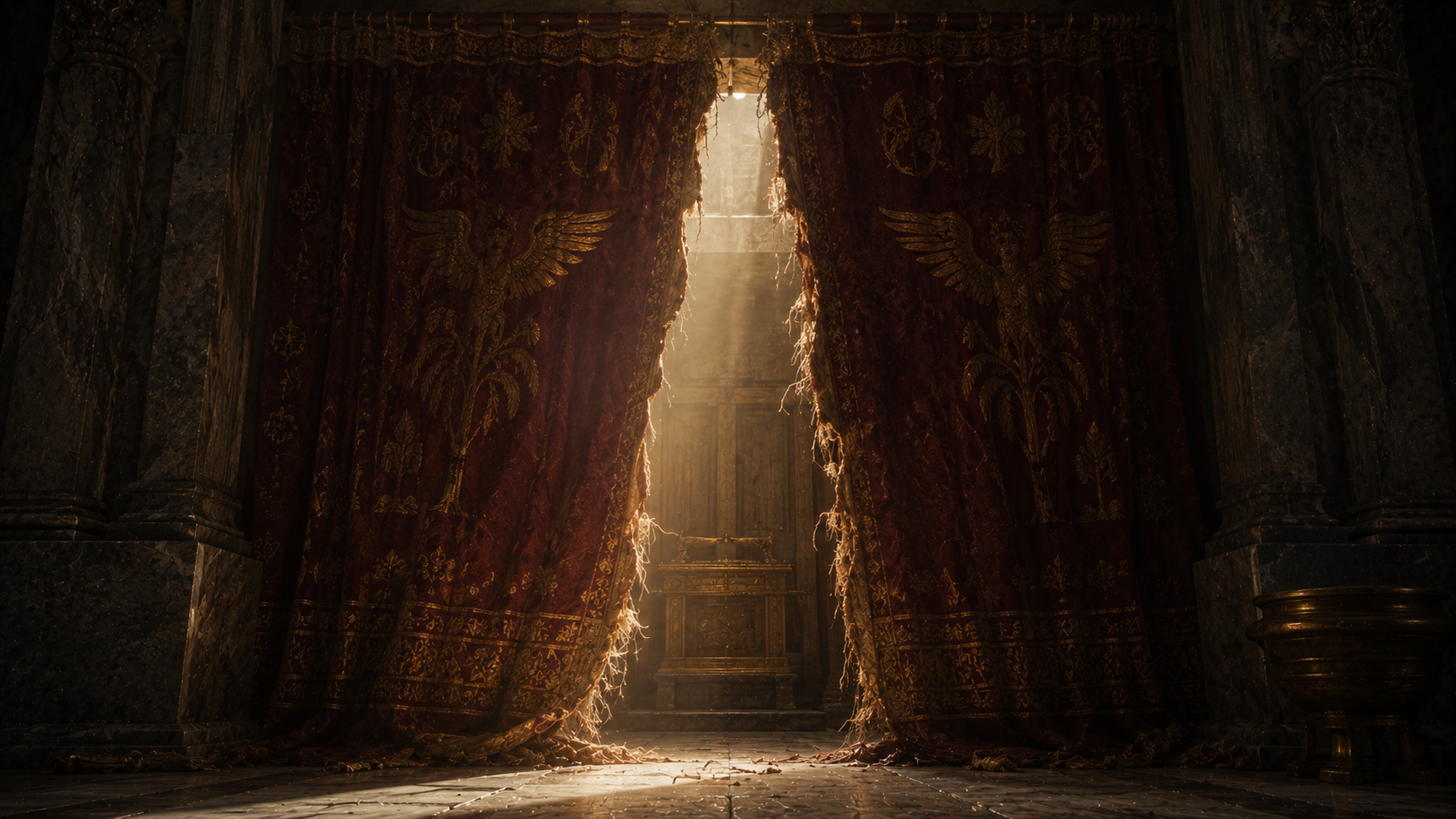
- The veil of the temple was torn in two from the top to the bottom (verse 51). The Greek eschisthe ap’ anothen heos kato, “torn from above unto below,” names the chapter’s most theologically loaded single sign. The temple veil (Hebrew parokhet) separated the Holy of Holies (where God’s presence was understood to dwell) from the rest of the temple. Only the high priest could enter through the veil, only on Yom Kippur, only after extensive purification. The veil being torn is, on the chapter’s reading, the most direct possible sign that the separation between God and the people has been ended. The from above-to-below direction matters: the tearing is from God’s side, not from human-effort. The chapter is recording, with characteristic narrative-theological care, that the cross has accomplished what the temple-system was always reaching for. The Holy of Holies is now open. (Hebrews 10:19-20 will work this out theologically: we have boldness to enter the holy place by the blood of Jesus, by the way which he dedicated for us, a new and living way, through the veil, that is to say, his flesh.)
- The earth quaked and the rocks were split. The tombs were opened, and many bodies of the saints who had fallen asleep were raised (verses 51b to 52). The Greek records signs unique to Matthew’s account. The earthquake-and-tombs-opened image echoes Ezekiel 37 (the valley of dry bones rising) and the prophetic resurrection-imagery. The chapter is recording, with characteristic narrative-Hebrew-Bible-eschatological precision, that the resurrection-of-the-righteous-saints (which Daniel 12:2 promised at the end of the age) is somehow already starting at the cross. The chapter is recording, with characteristic narrative restraint, an event that does not fit standard chronology: the saints rise after his resurrection (verse 53), meaning that the tombs open at the cross but the visible appearances follow Easter morning. The chapter is recording, in this strange double-event, the cross’s eschatological-significance: the end of the age has, in some sense, started.
- Truly this was the Son of God (verse 54). The Greek alethos theou huios en houtos, “truly this was God’s son,” is the chapter’s most pivotal single confession. The speaker is the Roman centurion (and those who were with him watching Jesus, possibly the entire execution-detail). The chapter is recording, with characteristic narrative-ironic-precision, that the chapter’s first explicit Son of God confession from a Gentile comes from the Roman officer who has just supervised the execution. The same kind of Gentile (Roman centurion) who Jesus said had faith greater than I have found in Israel (8:10) is the chapter’s first cross-bearing-witness. The chapter is recording, with characteristic narrative-theological care, that the cross has produced exactly the kind of recognition the gospel has been preparing for since chapter 1.
- Many women were there watching from afar, who had followed Jesus from Galilee, serving him (verse 55). The Greek gynaikes pollai… apo Galilaias diakonousai, “many women from Galilee serving,” names the women-disciples who had supported the ministry from the start. The chapter is recording, with characteristic narrative-honest precision, that the cross-witnesses are the women. The twelve have scattered (26:56); the women have remained. The chapter is recording, in one sentence, the gospel’s most direct single statement about who actually showed up.
D · Matthew 27:57–66 · The burial
⁵⁷ When evening had come, a rich man from Arimathaea, named Joseph, who himself was also Jesus’s disciple came. ⁵⁸ This man went to Pilate, and asked for Jesus’s body. Then Pilate commanded the body to be given up. ⁵⁹ Joseph took the body, and wrapped it in a clean linen cloth, ⁶⁰ and laid it in his own new tomb, which he had cut out in the rock, and he rolled a great stone to the door of the tomb, and departed. ⁶¹ Mary Magdalene was there, and the other Mary, sitting opposite the tomb. ⁶² Now on the next day, which was the day after the Preparation Day, the chief priests and the Pharisees were gathered together to Pilate, ⁶³ saying, “Sir, we remember what that deceiver said while he was still alive, ‘After three days I will rise again.’ ⁶⁴ Command therefore that the tomb be made secure until the third day, lest perhaps his disciples come at night and steal him away, and tell the people, ‘He is risen from the dead;’ and the last deception will be worse than the first.” ⁶⁵ Pilate said to them, “You have a guard. Go, make it as secure as you can.” ⁶⁶ So they went with the guard and made the tomb secure, sealing the stone. (Matthew 27:57–66, World English Bible)
- A rich man from Arimathaea, named Joseph, who himself was also Jesus’s disciple (verse 57). The Greek plousios apo Arimathaias, “rich man from Arimathaea,” names a previously-unnamed disciple. (Mark 15:43 adds that he was a respected member of the council, meaning a Sanhedrin member; Luke 23:51 adds that he had not consented to the council’s decision.) The chapter is recording, with characteristic narrative-honest precision, that one of the religious establishment’s own members has been a secret disciple, and the burial is being arranged through his influence. The same establishment that demanded the execution is providing, via one of its own, the dignified burial.
- He laid it in his own new tomb, which he had cut out in the rock (verse 60). The Greek en to kaino autou mnemeio, “in his own new tomb,” names the burial-place as Joseph’s own previously-prepared family tomb. New (Greek kainos, never used) is significant: no other body has lain here. The chapter is recording, with characteristic narrative-cultural specificity, the burial’s particular dignity. (Isaiah 53:9, they made his grave with the wicked, and with a rich man in his death, is in the chapter’s background.)
- Mary Magdalene was there, and the other Mary, sitting opposite the tomb (verse 61). The Greek closes the burial-section on the women’s continued vigil. The chapter is recording, with characteristic narrative-honest care, that the women (named here for the second time in the chapter, after verse 55-56) are the kingdom’s continuing witnesses. They sit opposite the tomb. The chapter is leaving them there.
- Now on the next day, which was the day after the Preparation Day, the chief priests and the Pharisees were gathered together to Pilate (verse 62). The Greek records the Sabbath-day meeting (the chief priests, by their own purity-rules, should not have been transacting political business on the Sabbath; the chapter is being honest about their willingness to violate their own rules to seal the tomb). The chapter is recording, with characteristic narrative-ironic precision, the religious establishment’s continuing involvement in the events even after the death.
- Sir, we remember what that deceiver said while he was still alive, “After three days I will rise again” (verse 63). The Greek records the chief priests’ awareness of Jesus’s resurrection-prediction. The chapter is recording, with characteristic narrative-theological precision, that the establishment has heard Jesus’s third day prediction (which the chapter has recorded at 16:21, 17:23, 20:19, 26:32) and is taking it seriously enough to want it pre-empted. They have understood the prediction better than the disciples, who, by chapter 28’s testimony, will be entirely unprepared for the resurrection morning.
- You have a guard. Go, make it as secure as you can (verse 65). The Greek records Pilate’s authorization. The chapter is closing the chapter with the Roman seal placed on the tomb. The chapter is recording, with characteristic narrative-ironic precision, that the chapter’s most extensive single attempt to prevent the resurrection from happening (or from being credibly proclaimed) is being put in place. The chapter is leaving the tomb sealed, the guards posted, the women watching, the disciples scattered, and the king dead. The chapter is leaving the kingdom in its quietest single hour.
Reflection prompts
- The mock-coronation by the Roman soldiers is, in the chapter’s quiet irony, the actual coronation. The scarlet robe, the crown of thorns, the reed-scepter, the hail, the procession to the place of the skull, the titulus This is Jesus, the King of the Jews. All of these are the imperial coronation-pattern performed in mockery, and the gospel records them as straightforwardly true. Where in your life are you currently expecting the kingdom to look like the world’s-system version of victory, and what would it mean to recognize the kingdom’s actual coronation in the chapter’s place: the cross is the throne, and the king reigns from the tree?
- He saved others, but he can’t save himself. The chief priests’ mockery is, on the chapter’s deeper reading, the most theologically precise single statement of what the cross is doing. The king who could save himself does not, in order to save others. Where in your life are you currently unwilling to not save yourself in some specific situation where the king’s pattern would call for it, and what would it mean to take the chapter’s pattern seriously: the saving of others happens in the place where the self does not save itself?
- Truly this was the Son of God. The chapter’s first explicit Gentile-confession of Jesus as the Son of God is the Roman centurion who has just supervised the execution. The chapter is recording, with characteristic narrative-ironic precision, that the cross has produced exactly the kind of cross-cultural recognition the gospel has been preparing for since chapter 1. Where in your life is the cross currently producing recognition in places (and people) you would not have predicted, and what would it mean to take the chapter’s pattern as the gospel’s running shape: the centurion at the cross is the gospel’s first Gentile-confession, and the kingdom keeps showing up where the religious establishment did not put it?