
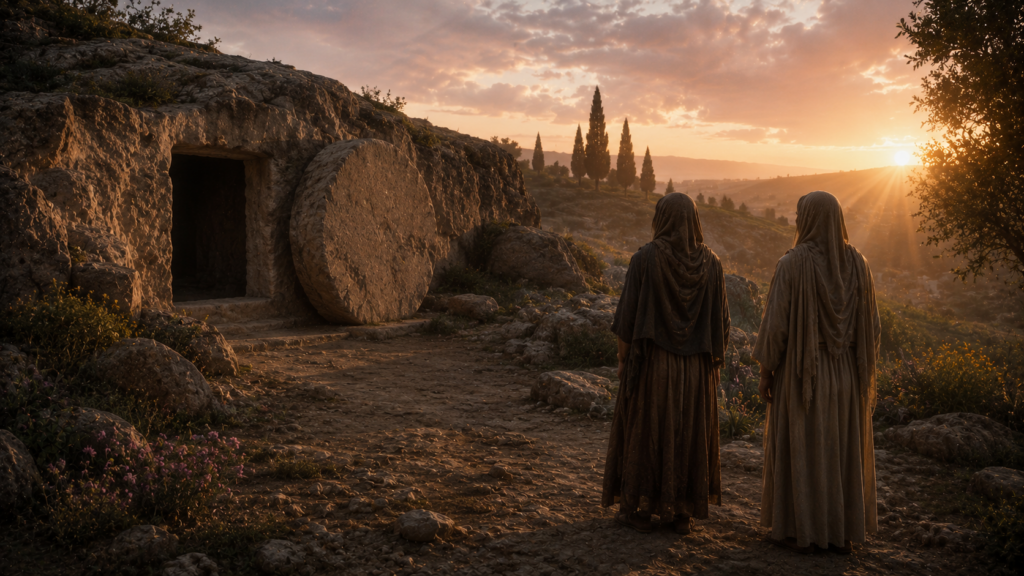
Matthew 28 is the gospel’s final chapter, and it is short. After the dense, sustained narrative of chapters 26-27 (the trials, the crucifixion, the burial), the resurrection-and-commission of chapter 28 unfolds in only twenty verses. The chapter has the women’s arrival at the empty tomb at dawn, the angel’s announcement, the encounter with the risen Jesus on the way back from the tomb, the chief priests’ bribing of the guards, and the climactic mountain-meeting in Galilee where Jesus issues the Great Commission and promises I am with you always, to the end of the age. The chapter is recording, with characteristic narrative restraint, the kingdom’s vindication, the gospel’s universal scope, and the king’s continuing presence with his disciples.
The chapter has three movements. The first (verses 1 to 10) is the resurrection morning: the women’s arrival, the earthquake, the angel’s announcement, the women’s two responses (fear and joy) and their meeting with the risen Jesus. The second (verses 11 to 15) is the brief account of the bribed guards and the cover story spread by the chief priests. The third (verses 16 to 20) is the Galilee mountain-meeting and the Great Commission: all authority has been given to me, go and make disciples of all the nations, baptizing them in the name of the Father and of the Son and of the Holy Spirit, teaching them to observe all things, I am with you always, to the end of the age.
Beneath the chapter’s surface flow is the gospel’s most concentrated single closing-of-the-arc. The genealogy that opened the gospel in chapter 1 traced Jesus’s roots through the patriarchs and the four foreign-blooded women who anticipated the Gentile mission; the Great Commission in chapter 28 sends the disciples to all the nations in fulfillment of that opening promise. The Immanuel (God-with-us) of 1:23 is now the I am with you always of 28:20. The chapter is recording, with characteristic narrative-structural-precision, the gospel’s deliberate frame: God-with-us at the beginning, God-with-us at the end, with the entire kingdom-narrative hung between the two.
A · Matthew 28:1–10 · The resurrection morning
¹ Now after the Sabbath, as it began to dawn on the first day of the week, Mary Magdalene and the other Mary came to see the tomb. ² Behold, there was a great earthquake, for an angel of the Lord descended from the sky, and came and rolled away the stone from the door, and sat on it. ³ His appearance was like lightning, and his clothing white as snow. ⁴ For fear of him, the guards shook, and became like dead men. ⁵ The angel answered the women, “Don’t be afraid, for I know that you seek Jesus, who has been crucified. ⁶ He is not here, for he has risen, just like he said. Come, see the place where the Lord was lying. ⁷ Go quickly and tell his disciples, ‘He has risen from the dead, and behold, he goes before you into Galilee; there you will see him.’ Behold, I have told you.” ⁸ They departed quickly from the tomb with fear and great joy, and ran to bring his disciples word. ⁹ As they went to tell his disciples, behold, Jesus met them, saying, “Rejoice!” They came and took hold of his feet, and worshiped him. ¹⁰ Then Jesus said to them, “Don’t be afraid. Go tell my brothers that they should go into Galilee, and there they will see me.” (Matthew 28:1–10, World English Bible)
- Now after the Sabbath, as it began to dawn on the first day of the week (verse 1). The Greek te epiphoskouse eis mian sabbaton, “as it was dawning toward the first of the week,” names the chapter’s most theologically loaded single timing. The first day of the week (the day after the Sabbath, our Sunday) became the church’s primary day of gathered worship from the earliest period (Acts 20:7; 1 Corinthians 16:2; Revelation 1:10). The chapter is recording, with characteristic narrative-historical precision, that the resurrection happens on the first day. The first day of Genesis 1 (when God said let there be light) is being mirrored: the new creation is starting on the first day of a new week.
- Mary Magdalene and the other Mary came to see the tomb (verse 1b). The Greek records the women’s arrival. The chapter is recording, with characteristic narrative-honest care, that the resurrection’s first witnesses are women. The chapter has been preparing this throughout the gospel: the women have been the cross-witnesses (27:55-56), the burial-witnesses (27:61), and now the resurrection-witnesses. The chapter is recording, with characteristic narrative-counter-cultural precision, the women’s primary witness-role. (In first-century Jewish legal practice, women’s testimony was generally not accepted in court; the chapter is recording, in the women-as-first-witnesses pattern, that the kingdom’s witnessing-economy operates differently from the world’s-system witnessing-economy.)
- Behold, there was a great earthquake, for an angel of the Lord descended from the sky (verse 2). The Greek seismos megas, “great earthquake,” uses the same word the gospel used at 27:51-54 (the earthquake at the death) and at 8:24 (the seismos on the Sea of Galilee). The chapter is recording, with characteristic verbal-narrative continuity, the cosmic-shaking that has accompanied the kingdom’s most decisive moments. The angel descends; the angel rolls away the stone; the angel sits on the stone. The chapter is recording, with characteristic narrative-restraint, the deliberate-confidence of the angel’s posture. The angel is not breaking in; the angel is taking the stone’s seat.
- His appearance was like lightning, and his clothing white as snow (verse 3). The Greek hos astrape, “like lightning,” and leukon hos chion, “white as snow,” echo Daniel 7:9 (the Ancient of Days, his clothing was white as snow) and Daniel 10:6 (the angelic figure, his face like the appearance of lightning). The chapter is recording, with characteristic Hebrew Bible-eschatological precision, that the angel’s appearance is in the prophetic-eschatological register. The end-of-the-age figures of Daniel are present at the dawn of the new age.
- He is not here, for he has risen, just like he said (verse 6). The Greek ouk estin hode, egerthe gar kathos eipen, “he is not here, for he is risen, just as he said,” names the chapter’s most theologically central single line. The angel’s announcement does three things: it confirms the absence (he is not here), it announces the resurrection (he is risen), and it grounds the announcement in Jesus’s own words (just as he said). The chapter is recording, with characteristic narrative-pedagogical care, that the resurrection is not surprise-news to attentive readers; the gospel has been predicting it since 16:21. The disciples have not absorbed the prediction, but the chapter is recording the angel’s gentle reminder: just as he said.
- Go quickly and tell his disciples (verse 7). The Greek poreuthesai tachy eipate, “going quickly, tell,” names the women’s commissioning. The chapter is recording, with characteristic narrative-counter-cultural precision, that the women are the first commissioned-messengers of the resurrection. They have been told to go and tell. (The early church’s tradition called Mary Magdalene the apostle to the apostles on the basis of this commissioning.)
- They departed quickly from the tomb with fear and great joy (verse 8). The Greek meta phobou kai charas megales, “with fear and great joy,” names the women’s mixed response. The chapter is recording, with characteristic narrative-honest precision, the disciple’s actual response to the resurrection: not unalloyed celebration, but the trembling-and-joy combination that the resurrection actually produces in human-sized hearts. The chapter is being honest. The resurrection is not first-of-all reassuring; it is first-of-all overwhelming.
- Behold, Jesus met them, saying, “Rejoice!” (verse 9). The Greek idou Iesous hypentesen autais, “behold, Jesus met them,” names the chapter’s first appearance. The chapter is recording, with characteristic narrative-honest precision, that the women meet Jesus on their own way back from the tomb. The first encounter does not happen at the tomb (the angel told them he was not there); the first encounter happens on the road as they go. Chairete, “rejoice / hail,” is a standard greeting that also carries genuine joy-vocabulary. The chapter is recording the king’s first post-resurrection word.
- They came and took hold of his feet, and worshiped him (verse 9b). The Greek ekratesan autou tous podas kai prosekynesan auto, “they grabbed his feet and worshiped him,” names the women’s response. The chapter is recording, with characteristic narrative-physical precision, that the women have not been seeing a vision: Jesus has feet, and the women take hold of them. The resurrection is bodily; the king is recognizable, touchable, real. Prosekynesan, “they worshiped” (literally bowed down to), uses the same worship-vocabulary the gospel has been using for kingdom-recognition (the Magi at 2:11, the leper at 8:2, etc.). The kingdom’s worship has reached its definitive moment.
- Don’t be afraid. Go tell my brothers that they should go into Galilee, and there they will see me (verse 10). The Greek tois adelphois mou, “my brothers,” is the chapter’s most pastorally-loaded single phrase. The disciples who scattered, the Peter who denied, the Judas who betrayed and is now dead: these are still, in the king’s vocabulary, my brothers. The chapter is recording, with characteristic narrative-pastoral mercy, the resurrection’s first instruction: the family is being called back together. The chapter is recording the Galilee-meeting that chapter 26:32 had pre-arranged: after I am raised up, I will go before you into Galilee. The promise is being kept.
B · Matthew 28:11–15 · The bribed guards
¹¹ Now while they were going, behold, some of the guards came into the city, and told the chief priests all the things that had happened. ¹² When they were assembled with the elders, and had taken counsel, they gave a large amount of silver to the soldiers, ¹³ saying, “Say that his disciples came by night, and stole him away while we slept. ¹⁴ If this comes to the governor’s ears, we will persuade him and make you free of worry.” ¹⁵ So they took the money and did as they were told. This saying was spread abroad among the Jews, and continues until today. (Matthew 28:11–15, World English Bible)
- Some of the guards came into the city, and told the chief priests all the things that had happened (verse 11). The Greek ap angelan tois archiereusin hapanta, “they reported all things to the chief priests,” names the guards’ first instinct: report. The chapter is recording, with characteristic narrative-honest precision, that the guards (who had been placed at the tomb by the chief priests in 27:65-66) understood themselves as accountable to the Jewish authorities, not to Pilate. The chapter is recording the guards’ report-channel.
- They gave a large amount of silver to the soldiers (verse 12). The Greek argyria hikana edokan, “they gave sufficient silvers,” uses the same argyria vocabulary that named the thirty pieces of silver of 26:15 and 27:3. The chapter is recording, with characteristic narrative-verbal-thematic continuity, that the chief priests are now in their second silver-payment of the gospel. They paid Judas to deliver Jesus to them; now they are paying the guards to deny that Jesus has been raised. The chapter is recording, with characteristic narrative-ironic precision, the religious establishment’s continuing willingness to use bribery to manage the truth.
- Say that his disciples came by night, and stole him away while we slept (verse 13). The Greek records the cover-story. The chapter is recording, with characteristic narrative-historical precision, the version of events the early-church-era critics of the resurrection (and some later critics) actually circulated. The chapter is recording the alternative-explanation as part of the historical record, while quietly noting its incoherence (sleeping guards cannot, by definition, testify about what happened while they slept).
- This saying was spread abroad among the Jews, and continues until today (verse 15). The Greek diephemisthe… mechri tes semeron, “is widely-said until today,” names the chapter’s most direct single piece of evidence about its own historical setting. Matthew’s gospel is being written within the lifetime of those who could remember the early-church-era debates; the until today phrase is recording that the cover-story circulated as a counter-explanation in the gospel’s own time. The chapter is being honest about the controversy. The early church’s claim of resurrection had a specific counter-story; the chapter is recording the counter-story while leaving the truth-question to its readers.
C · Matthew 28:16–20 · The Great Commission
¹⁶ But the eleven disciples went into Galilee, to the mountain where Jesus had sent them. ¹⁷ When they saw him, they bowed down to him, but some doubted. ¹⁸ Jesus came to them and spoke to them, saying, “All authority has been given to me in heaven and on earth. ¹⁹ Go, and make disciples of all nations, baptizing them in the name of the Father and of the Son and of the Holy Spirit, ²⁰ teaching them to observe all things that I commanded you. Behold, I am with you always, even to the end of the age.” Amen. (Matthew 28:16–20, World English Bible)

- The eleven disciples went into Galilee, to the mountain where Jesus had sent them (verse 16). The Greek hoi hendeka mathetai, “the eleven disciples,” names the diminished group. Judas has not been replaced (Acts 1’s Matthias-selection is still in the future); the chapter is recording, with characteristic narrative-honest precision, the gap-shaped community that is hearing the commission. The kingdom’s continuing community is not the perfect-twelve; it is the broken-and-restored eleven.
- To the mountain where Jesus had sent them (verse 16b). The Greek eis to oros hou etaxato autois, “to the mountain he had appointed for them,” names the location. The chapter is recording, with characteristic narrative-Mosaic-typology care, that the gospel ends on a mountain. The Sermon on the Mount was delivered from a mountain (chapter 5); the Transfiguration happened on a mountain (chapter 17); the kingdom’s commissioning happens on a mountain. The Mosaic-typology that has been running since chapter 1 reaches its closing-bracket here. Moses delivered the Torah from a mountain; Jesus delivers the Great Commission from a mountain.
- When they saw him, they bowed down to him, but some doubted (verse 17). The Greek hoi de edistasan, “but some doubted,” is the chapter’s most pastorally-loaded honest-detail. Even at the resurrection-meeting itself, even with the risen Lord standing in front of them, some doubted. The chapter is recording, with characteristic narrative-honest precision, that the disciples’ faith is not magically uniform after the resurrection. The chapter is being honest about what kingdom-faith actually looks like in a community: worship and doubt, side by side, in the same group of people. The chapter is recording, with characteristic pastoral-care, that the commission that follows is given to a community that includes both.
- All authority has been given to me in heaven and on earth (verse 18). The Greek edothe moi pasa exousia en ourano kai epi ges, “all authority has been given to me in heaven and on earth,” echoes Daniel 7:13-14 (the son of man coming on the clouds and being given dominion and glory and a kingdom). The chapter is recording, with characteristic Hebrew Bible-prophetic-precision, that the resurrection has accomplished the Daniel-7 vindication. The Son of Man has been given the kingdom. The cross was the coronation; the resurrection is the public investiture. The chapter is recording, with characteristic narrative-theological care, that the all authority claim is the basis for everything that follows. The Great Commission is being issued from a position of universal authority, not from a position of organizational ambition.
- Go, and make disciples of all nations (verse 19). The Greek poreuthentes oun mathetousate panta ta ethne, “going therefore, disciple all the nations,” names the commission. The chapter is recording, with characteristic narrative-structural precision, the closing of the gospel’s frame. The genealogy of chapter 1 named four foreign-blooded women (Tamar, Rahab, Ruth, Bathsheba) who anticipated the Gentile-inclusion the commission now formally opens. The Magi of chapter 2 came from the east; the Canaanite woman of chapter 15 was named Canaanite in deliberate Joshua-conquest-reversal vocabulary; the centurion of chapter 8 had faith Jesus had not found in Israel; the centurion at the cross of chapter 27 made the gospel’s first explicit Gentile-confession. All of these were prefigurations. All the nations is the chapter’s formal opening of the door the gospel has been opening throughout. The kingdom that started among the lost-sheep of Israel is now formally being sent out to the whole oikoumene.
Influence callout: Marty Solomon, N.T. Wright, and Scot McKnight (the Great Commission as the gospel’s closing-bracket)
The combined reading from Solomon, Wright, and McKnight names 28:18-20 as the gospel’s most concentrated single statement of the kingdom’s mission, structurally bracketing the gospel’s opening. Solomon names the Mosaic-typology completion: Moses delivered the Torah from a mountain to one people; Jesus delivers the kingdom-Torah (teaching them to observe all things that I commanded you, verse 20) from a mountain to all peoples. Wright names the Daniel-7 fulfillment: all authority in heaven and on earth is the Son-of-Man’s vindication-claim, and the go, make disciples of all the nations is the kingdom’s exercise of that authority. McKnight names the gospel-allegiance dimension: make disciples (Greek matheteusate) is not just get converts; it is form people in the kingdom-life-pattern, and the baptizing-in-the-triune-name combined with the teaching them to observe all things names what discipling actually involves. The combined reading sees the chapter as the gospel’s deliberate closing-bracket. The genealogy’s son of David, son of Abraham (1:1) opened the gospel by anchoring Jesus in the covenant family; the commission’s all the nations closes the gospel by sending the kingdom out to the all the families of the earth shall be blessed of Genesis 12:3. The Immanuel (God-with-us) of 1:23 is now the I am with you always of 28:20. The frame is deliberate. The chapter is recording, with characteristic narrative-structural precision, that the gospel’s whole arc has been pointing here. Every chapter has been preparing this commission, and the king’s I am with you always, to the end of the age is the kingdom’s continuing presence as the disciple-community moves out into the world.
- Baptizing them in the name of the Father and of the Son and of the Holy Spirit (verse 19b). The Greek eis to onoma tou patros kai tou huiou kai tou hagiou pneumatos, “into the name of the Father and of the Son and of the Holy Spirit,” is the New Testament’s most explicit single Trinitarian formula. The chapter is recording, with characteristic narrative-theological precision, the church’s foundational baptismal-formula in the king’s own words. The formula is singular (the name, not the names); the three persons share the single divine name. The chapter is recording, with characteristic narrative-theological care, the seed of every later Trinitarian theology in one short verse.
- Teaching them to observe all things that I commanded you (verse 20). The Greek didaskontes autous terein panta hosa eneteilamen hymin, “teaching them to observe all things I commanded you,” names the kingdom’s content. The chapter is recording, with characteristic narrative-pedagogical precision, that the disciple-making is not just baptismal-initiation; it is teaching them to observe, the same word the Sermon on the Mount used for the kingdom’s actual practice. The whole gospel’s accumulated teaching (the Sermon on the Mount, the missionary discourse, the parables, the community discourse, the Olivet discourse) is the content the disciple-makers are now sent to teach. The kingdom’s commission is to form people in the kingdom’s actual practice, not just to get them to believe particular propositions about the king.
- Behold, I am with you always, even to the end of the age (verse 20b). The Greek idou ego meth’ hymon eimi pasas tas hemeras heos tes synteleias tou aionos, “behold, I am with you all the days, until the consummation of the age,” is the chapter’s closing-bracket on the gospel’s Immanuel opening. Ego eimi, “I am,” uses the divine self-identification vocabulary the gospel has been using throughout (most explicitly at 14:27, walking on the water). The chapter is recording, with characteristic narrative-structural precision, that the God-with-us of 1:23 is the I am with you always of 28:20. The gospel ends, with characteristic narrative restraint, on the king’s promise of continuing presence. The disciples are not being sent out alone. The king who has just been given all authority in heaven and on earth is going with them, all the days, until the age comes to its consummation.
Reflection prompts
- The chapter’s first commissioned-messengers of the resurrection are the women. The chapter’s first community-of-disciples-meeting-the-risen-Christ on the mountain includes those who bow down and those who doubt. The chapter is honest about who actually shows up in the kingdom’s witnessing-and-discipling community: women whose testimony was not legally accepted, disciples whose faith is not yet uniform. Where in your life are you currently expecting kingdom-witnessing to come from a more credentialed or more uniformly-confident community than the chapter’s first witnesses, and what would it mean to take the chapter’s actual community as the kingdom’s actual model?
- All authority has been given to me in heaven and on earth. The Great Commission is issued from a position of universal authority. The disciple-community is not being sent out to negotiate with the world’s authorities; the disciple-community is being sent out as representatives of the king who has just been given all authority. Where in your life is your kingdom-engagement currently operating as if the kingdom were one religious option among many that needed to win a market-share, and what would it mean to take the chapter’s authority-claim as the basis for the disciple’s actual posture?
- I am with you always, to the end of the age. The gospel that opened with God-with-us (1:23) closes with the king’s promise of continuing presence. The disciples are not being sent out and then left; the disciples are being sent out with the king walking among them. Where in your life is your kingdom-faithfulness currently operating as if the king were absent until the end of the age, and what would it mean to take the chapter’s closing-promise as the disciple’s daily condition: I am with you always?