

Matthew 25 closes the Olivet Discourse (and the gospel’s fifth and final teaching block) with three sustained parables of judgment. After chapter 24’s prediction-and-instruction about the temple’s coming destruction and the Son of Man’s coming, chapter 25 turns to the disciple’s actual posture: how to live in the gap between the king’s leaving and his return. The three parables function as a triptych. The ten virgins are about being prepared; the talents are about being productive; the sheep and the goats are about being compassionate. Together they form the gospel’s most concentrated single teaching on what the disciple’s faithfulness in the in-between time actually looks like.
The chapter has three movements, each an extended parable. The first (verses 1 to 13) is the parable of the ten virgins: five wise and five foolish bridesmaids, the bridegroom’s delay, the oil-and-no-oil contrast, the closing of the door. The second (verses 14 to 30) is the parable of the talents: the master who entrusts varying amounts to three servants, the two who invest and double, the one who buries and returns the original, and the master’s response to each. The third (verses 31 to 46) is the parable of the sheep and the goats: the Son of Man on his throne, the separation of the nations, the criterion (treatment of the least of these), and the surprise on both sides.
Beneath the chapter’s surface flow is the gospel’s most direct single answer to chapter 24’s question about how to live in the in-between. Chapter 24 said no one knows the day or hour; chapter 25 fills out what readiness actually looks like in practice. The three parables address three different but related dimensions of disciple-life: spiritual preparation, faithful productivity, and compassionate service to the suffering. The third parable in particular has been one of the most-quoted single texts in the church’s history of attention to the poor.
A · Matthew 25:1–13 · The ten virgins
¹ “Then the Kingdom of Heaven will be like ten virgins, who took their lamps, and went out to meet the bridegroom. ² Five of them were foolish, and five were wise. ³ Those who were foolish, when they took their lamps, took no oil with them, ⁴ but the wise took oil in their vessels with their lamps. ⁵ Now while the bridegroom delayed, they all slumbered and slept. ⁶ But at midnight there was a cry, ‘Behold! The bridegroom is coming! Come out to meet him!’ ⁷ Then all those virgins arose, and trimmed their lamps. ⁸ The foolish said to the wise, ‘Give us some of your oil, for our lamps are going out.’ ⁹ But the wise answered, saying, ‘What if there isn’t enough for us and you? You go rather to those who sell, and buy for yourselves.’ ¹⁰ While they went away to buy, the bridegroom came, and those who were ready went in with him to the marriage feast, and the door was shut. ¹¹ Afterward the other virgins also came, saying, ‘Lord, Lord, open to us.’ ¹² But he answered, ‘Most certainly I tell you, I don’t know you.’ ¹³ Watch therefore, for you don’t know the day nor the hour in which the Son of Man is coming.” (Matthew 25:1–13, World English Bible)
- The Kingdom of Heaven will be like ten virgins, who took their lamps, and went out to meet the bridegroom (verse 1). The Greek parthenoi, “virgins,” names the bridesmaids in the first-century Jewish wedding-procession. The standard wedding pattern in the period: the bridegroom would leave to make final arrangements at his father’s house, sometimes for an extended and unspecified period; the bride and her attendants would wait, prepared to join the procession when the bridegroom finally came to fetch the bride. The chapter is recording, with characteristic narrative-cultural specificity, the wedding-procession context. The bridesmaids’ role was to attend the bride and welcome the bridegroom with lit lamps when he arrived.
- Five of them were foolish, and five were wise (verse 2). The Greek moroi (foolish, dull) and phronimoi (prudent, sensible) are the standard wisdom-literature pairing (Proverbs 1:7, 9:8-9; the kesil and the chakam). The chapter is recording, with characteristic Hebrew Bible-wisdom precision, that the parable is operating in the Jewish wisdom-tradition genre.
- Those who were foolish, when they took their lamps, took no oil with them, but the wise took oil in their vessels with their lamps (verses 3 to 4). The Greek records the parable’s central single distinction. All ten virgins have lamps; the difference is whether they have brought additional oil. Both groups planned for the bridegroom’s arrival; only one group planned for the bridegroom’s possible delay. The chapter is recording, with characteristic narrative-pedagogical care, that the foolish are not those who failed to prepare at all; the foolish are those who under-prepared for the duration they could not predict.
- Now while the bridegroom delayed, they all slumbered and slept (verse 5). The Greek chronizontos de tou nymphiou, “while the bridegroom delayed,” names the parable’s most pastorally-loaded single phrase. The chapter is recording, with characteristic narrative-pastoral honesty, the disciple-community’s actual experience: the bridegroom is taking longer than anyone expected. The early church’s epistles repeatedly address the same situation (2 Peter 3:3-9; James 5:7-8). The parable’s wise-and-foolish distinction is not about staying awake (all ten sleep) but about what was prepared before the sleeping.
- Behold! The bridegroom is coming! Come out to meet him! (verse 6). The Greek idou ho nymphios, exerchesthe eis apantesin autou, “behold the bridegroom, come out to meet him,” uses the apantesis (going-out-to-meet) vocabulary. Apantesis is the technical Greek term for the official welcome of an arriving dignitary, the same word Paul will use for the meeting in the air at Christ’s return (1 Thessalonians 4:17). The chapter is recording, with characteristic Greek-cultural precision, that the bridesmaids’ role is to be among the apantesis, the welcoming party.
- The foolish said to the wise, “Give us some of your oil, for our lamps are going out.” But the wise answered, saying, “What if there isn’t enough for us and you? You go rather to those who sell, and buy for yourselves” (verses 8 to 9). The Greek records the parable’s most often-discussed single exchange. The wise virgins’ refusal seems harsh on first reading; the parable’s logic is that the oil is something the foolish virgins should have brought themselves, and the wise cannot supply someone else’s preparation. Most readings (patristic and modern) take the oil as the personal-spiritual-life that cannot be borrowed: faith, devotion, the disciple’s own walk with the Lord. The chapter is recording, with characteristic narrative-theological care, that the disciple’s preparation is not transferable. Each disciple has to bring her own oil.
- While they went away to buy, the bridegroom came, and those who were ready went in with him to the marriage feast, and the door was shut (verse 10). The Greek kai ekleisthe he thyra, “and the door was shut,” names the parable’s most somber single image. The wedding-feast door, in ancient practice, was indeed shut at the start of the celebration. The chapter is recording, with characteristic narrative-theological care, the irreversibility of having missed the moment. Late-arriving guests cannot re-enter; the celebration has begun.
- Lord, Lord, open to us (verse 11). The Greek Kyrie kyrie, “Lord, Lord,” echoes 7:21-23 (the Sermon on the Mount’s closing warning: not everyone who says to me, ‘Lord, Lord,’ will enter the Kingdom of Heaven, but he who does the will of my Father). The chapter is recording, with characteristic narrative-thematic continuity, the same warning the Sermon on the Mount delivered: the address Lord, Lord alone is not the kingdom’s currency; the doing (the wise virgins’ bringing of oil; the disciple’s actual preparation) is.
- Watch therefore, for you don’t know the day nor the hour in which the Son of Man is coming (verse 13). The Greek closes the parable with the chapter-24:42 imperative repeated: gregoreite, watch. The chapter is recording, with characteristic narrative-thematic continuity, that the watching of chapter 24 is the bringing-of-oil of chapter 25. The watching is not staring at the sky; the watching is preparing well for the duration.
B · Matthew 25:14–30 · The talents
¹⁴ “For it is like a man, going into another country, who called his own servants, and entrusted his goods to them. ¹⁵ To one he gave five talents, to another two, to another one; to each according to his own ability. Then he went on his journey. ¹⁶ Immediately he who received the five talents went and traded with them, and made another five talents. ¹⁷ In the same way, he also who got the two gained another two. ¹⁸ But he who received the one talent went away and dug in the earth, and hid his lord’s money. ¹⁹ “Now after a long time the lord of those servants came, and reconciled accounts with them. ²⁰ He who received the five talents came and brought another five talents, saying, ‘Lord, you delivered to me five talents. Behold, I have gained another five talents besides them.’ ²¹ “His lord said to him, ‘Well done, good and faithful servant. You have been faithful over a few things, I will set you over many things. Enter into the joy of your lord.’ ²² “He also who got the two talents came and said, ‘Lord, you delivered to me two talents. Behold, I have gained another two talents besides them.’ ²³ “His lord said to him, ‘Well done, good and faithful servant. You have been faithful over a few things, I will set you over many things. Enter into the joy of your lord.’ ²⁴ “He also who had received the one talent came and said, ‘Lord, I knew you that you are a hard man, reaping where you didn’t sow, and gathering where you didn’t scatter. ²⁵ I was afraid, and went away and hid your talent in the earth. Behold, you have what is yours.’ ²⁶ “But his lord answered him, ‘You wicked and slothful servant. You knew that I reap where I didn’t sow, and gather where I didn’t scatter. ²⁷ You ought therefore to have deposited my money with the bankers, and at my coming I should have received back my own with interest. ²⁸ Take away therefore the talent from him, and give it to him who has the ten talents. ²⁹ For to everyone who has will be given, and he will have abundance, but from him who doesn’t have, even that which he has will be taken away. ³⁰ Throw out the unprofitable servant into the outer darkness, where there will be weeping and gnashing of teeth.’ (Matthew 25:14–30, World English Bible)
- To one he gave five talents, to another two, to another one; to each according to his own ability (verse 15). The Greek talanton, “talent,” is the largest unit of currency in the ancient Mediterranean world (one talent equaled roughly twenty years’ wages for a day-laborer). Even one talent represented an enormous trust. The chapter is recording, with characteristic narrative-economic care, that the master is entrusting the servants with major resources, scaled to each servant’s capacity. The English word talent (meaning natural ability or skill) actually derives from this parable’s later use in the Christian tradition; the Greek originally meant only the monetary unit.
- Immediately he who received the five talents went and traded with them, and made another five talents (verse 16). The Greek eirgasato en autois, “worked with them,” names the productive servant’s action. The chapter is recording, with characteristic narrative care, the most basic responsible-stewardship pattern: the entrusted resources are put to work and produce more. The two-talent servant does the same in proportion (verse 17).
- But he who received the one talent went away and dug in the earth, and hid his lord’s money (verse 18). The Greek orukse gen kai apekrypsen, “dug in the earth and hid,” names a recognized first-century Jewish legal-protection practice: burying valuables in a clay jar in the ground was, under rabbinic law, the only fool-proof way to protect a deposit (a depositary was held legally responsible for any loss except for buried funds). The chapter is recording, with characteristic narrative-cultural specificity, that the third servant is not being negligent; he is being maximally cautious. He is choosing the legally-safe option that requires no risk.
- Lord, I knew you that you are a hard man, reaping where you didn’t sow, and gathering where you didn’t scatter. I was afraid (verses 24 to 25). The Greek records the third servant’s self-explanation. The chapter is recording, with characteristic narrative-honest care, the servant’s actual disposition: fear of the master, leading to risk-avoidance, leading to non-productivity. The third servant has not lost the talent; he has simply preserved it. By his own logic, he has been faithful (he has not been irresponsible). On the master’s reading, the preservation-without-investment is the failure.
- You wicked and slothful servant… you ought therefore to have deposited my money with the bankers, and at my coming I should have received back my own with interest (verses 26 to 27). The Greek records the master’s response. The master’s complaint is not that the third servant lost the money; the complaint is that the third servant did nothing with the money. Even depositing it at the bank (which would have produced minimal-but-real interest) would have been better than burial. The chapter is recording, with characteristic narrative-pastoral care, that the kingdom’s fault-line is not between perfect-investment-success and failure; the fault-line is between engaged work and passive preservation.
- For to everyone who has will be given, and he will have abundance, but from him who doesn’t have, even that which he has will be taken away (verse 29). The Greek records the parable’s harshest single principle. The chapter has used this principle once before (13:12, the parables-discourse). The principle is the kingdom’s growth-economy: faithful engagement produces more capacity for engagement; non-engagement atrophies the capacity. The chapter is recording, with characteristic narrative-theological care, the kingdom’s pattern: those who actually deploy what they have been given grow into more; those who passively preserve lose what they had.
Influence callout: Marty Solomon (the talents and the disciple’s deployed life)
Solomon’s reading of the talents-parable names it as the gospel’s most pointed single statement about the disciple’s relationship to risk. The third servant is not a thief or a wastrel; he is, by his own description, afraid. His fear of the master produces his caution, and his caution produces his uselessness. Solomon argues that this is the parable’s most pastorally-loaded single point. Many disciples, especially those formed in religious environments that emphasized the master’s strictness over the master’s generosity, recognize themselves immediately in the third servant. The fear that produces non-engagement looks pious; the fear that produces non-engagement is not piety but a misreading of the master’s actual disposition. The first two servants understood the master differently: they saw the original entrustment itself as the master’s vote of confidence in them, and they responded with the kind of engaged work that the trust assumed they would do. The chapter is recording, with characteristic narrative-pastoral care, that the kingdom’s master gives talents to be used, not preserved. Solomon also notes that the parable should be read against chapter 24’s no one knows the day or hour: the servants did not know when the master would return, and the parable is recording what each of them did with the unknown duration. The chapter is closing on the disciple’s deployed life, in tension with the foolish virgins’ under-prepared anticipation in the previous parable. Both parables are saying, in different forms, that the in-between time is for engaged faithfulness, not for sky-watching.
- Throw out the unprofitable servant into the outer darkness, where there will be weeping and gnashing of teeth (verse 30). The Greek eis to skotos to exoteron, “into the outer darkness,” echoes 8:12 and 22:13. The chapter is recording, with characteristic narrative-theological continuity, the same outer-darkness vocabulary the gospel has been using for those who fail the kingdom’s actual criteria.
C · Matthew 25:31–46 · The sheep and the goats
³¹ “But when the Son of Man comes in his glory, and all the holy angels with him, then he will sit on the throne of his glory. ³² Before him all the nations will be gathered, and he will separate them one from another, as a shepherd separates the sheep from the goats. ³³ He will set the sheep on his right hand, but the goats on the left. ³⁴ Then the King will tell those on his right hand, ‘Come, you blessed of my Father, inherit the Kingdom prepared for you from the foundation of the world; ³⁵ for I was hungry, and you gave me food to eat. I was thirsty, and you gave me drink. I was a stranger, and you took me in. ³⁶ I was naked, and you clothed me. I was sick, and you visited me. I was in prison, and you came to me.’ ³⁷ “Then the righteous will answer him, saying, ‘Lord, when did we see you hungry, and feed you; or thirsty, and give you a drink? ³⁸ When did we see you as a stranger, and take you in; or naked, and clothe you? ³⁹ When did we see you sick, or in prison, and come to you?’ ⁴⁰ “The King will answer them, ‘Most certainly I tell you, because you did it to one of the least of these my brothers, you did it to me.’ ⁴¹ Then he will say also to those on the left hand, ‘Depart from me, you cursed, into the eternal fire which is prepared for the devil and his angels; ⁴² for I was hungry, and you didn’t give me food to eat; I was thirsty, and you gave me no drink; ⁴³ I was a stranger, and you didn’t take me in; naked, and you didn’t clothe me; sick, and in prison, and you didn’t visit me.’ ⁴⁴ “Then they will also answer, saying, ‘Lord, when did we see you hungry, or thirsty, or a stranger, or naked, or sick, or in prison, and didn’t help you?’ ⁴⁵ “Then he will answer them, saying, ‘Most certainly I tell you, because you didn’t do it to one of the least of these, you didn’t do it to me.’ ⁴⁶ These will go away into eternal punishment, but the righteous into eternal life.” (Matthew 25:31–46, World English Bible)
- When the Son of Man comes in his glory, and all the holy angels with him, then he will sit on the throne of his glory (verse 31). The Greek records the parable’s eschatological frame. The Son of Man is the Daniel-7 figure who has been Jesus’s preferred self-designation throughout the gospel. The throne-of-his-glory image picks up Isaiah 6:1, Daniel 7:9-14, and the Hebrew Bible’s enthroned-king tradition. The chapter is recording, with characteristic Hebrew Bible-prophetic precision, the eschatological judgment-scene.
- Before him all the nations will be gathered, and he will separate them one from another, as a shepherd separates the sheep from the goats (verse 32). The Greek panta ta ethne, “all the nations” (or all the Gentiles), names the parable’s most contested single phrase. Ta ethne in the New Testament most often means the Gentiles (the non-Jewish nations); some readers therefore restrict the parable’s scope to Gentile-judgment specifically. Other readers take ta ethne in the broader sense (all the world’s peoples). The shepherd-separating-sheep-from-goats image is the standard Palestinian shepherding pattern: sheep and goats grazed together during the day and were separated at night because the goats needed warmer night-shelter. The chapter is recording, with characteristic narrative-cultural-prophetic precision, the eschatological separation.
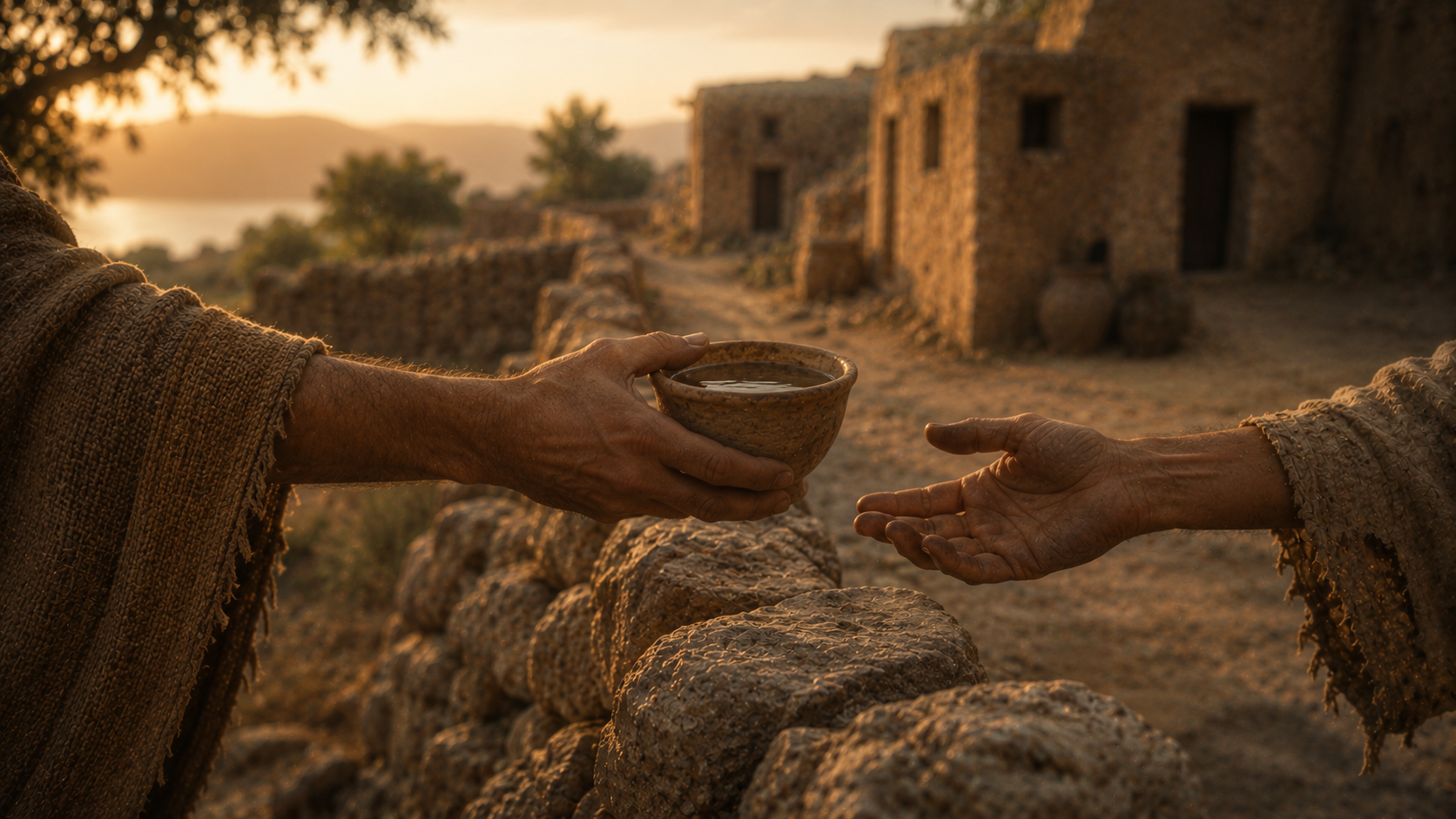
- Inherit the Kingdom prepared for you from the foundation of the world; for I was hungry, and you gave me food to eat. I was thirsty, and you gave me drink. I was a stranger, and you took me in. I was naked, and you clothed me. I was sick, and you visited me. I was in prison, and you came to me (verses 34 to 36). The Greek lists six specific acts of compassion: feeding the hungry, giving drink to the thirsty, welcoming the stranger, clothing the naked, visiting the sick, visiting the prisoner. The list maps closely onto the prophetic-tradition’s standard description of righteous behavior (Isaiah 58:6-10, Ezekiel 18:7, Job 31:16-22). The chapter is recording, with characteristic Hebrew Bible-prophetic precision, that the criterion of judgment is the disciple’s actual engagement with the suffering of the disciple’s actual neighbors.
- Lord, when did we see you? (verse 37). The Greek records the righteous’s surprise. They did not know they had been serving Jesus when they served the hungry, the stranger, the prisoner. The chapter is recording, with characteristic narrative-theological care, the parable’s most theologically dense single move: Jesus has been present-with-and-as the least of these throughout the encounter, and the righteous did not know it. The acts of compassion were not performed for messianic-credit; they were performed because the righteous saw a hungry person and acted as people of compassion. The parable is recording that this is exactly the kingdom’s criterion.
- Most certainly I tell you, because you did it to one of the least of these my brothers, you did it to me (verse 40). The Greek ton adelphon mou ton elachiston, “of these least brothers of mine,” is the parable’s most contested single phrase. The phrase my brothers has been read in two main ways. The narrower reading (more common in early patristic and recent more conservative scholarship): my brothers refers specifically to Jesus’s followers / fellow disciples / Christian missionaries; the parable is therefore about how the world’s nations treat the church. The wider reading (more common in modern liberation-theology and broader pastoral readings): my brothers refers to all suffering humans; the parable is about how the disciple-community treats the suffering of the world. The chapter’s argument can be made either way; the wider reading has tended to dominate in modern Christian engagement with the poor, while the narrower reading is more grammatically-defensible given the gospel’s previous use of my brothers (12:48-50, where Jesus identifies his disciples as his brothers). The chapter is recording, with characteristic narrative-theological richness, both possibilities.
Influence callout: Brian Zahnd and the church’s care for the least of these
Zahnd’s reading of the sheep-and-goats parable names it as the gospel’s most direct single application of the cruciform pattern to the disciple’s actual life. The cruciform-king who came not to be served but to serve (20:28) is, in this parable, identifying himself with the suffering throughout history. The disciple’s encounter with the hungry, the stranger, the prisoner is not a side-project; it is, on the parable’s reading, the encounter with the king himself. Zahnd argues that this parable has been the foundation of every major Christian movement of compassion-ministry across two thousand years: the early-church’s care for plague victims (when pagan neighbors fled, Christians stayed and nursed); the medieval monastic hospitals; the abolitionist movement (which read this parable as identifying the enslaved as the least of these); the worker-priests of the twentieth century; the Catholic Worker Movement; the church’s hospitals, food banks, and prison-ministries through every generation. Zahnd argues that the parable’s I was a stranger in particular is theologically explosive in any era when the church is asked to position itself against immigrants and refugees: the king has, in this parable, named himself as the stranger. To turn away the stranger is, on the parable’s reading, to turn away the king. The cruciform pattern is not just personal piety; it is the disciple’s whole orientation toward the world’s suffering. The parable is recording, in one extended scene, the kingdom’s whole pastoral vision: the disciple is found in faithful compassion to the suffering, and the king is met where the disciple does not expect to meet him.
- Most certainly I tell you, because you didn’t do it to one of the least of these, you didn’t do it to me (verse 45). The Greek records the parallel construction with the goats. The chapter is recording, with characteristic narrative-pastoral honesty, that the goats’ failure was not active cruelty but passive non-engagement. They did not see the hungry; they did not see the stranger; they did not visit the sick. The chapter is recording, with characteristic narrative-pastoral care, the same kind of failure the third servant in the talents-parable demonstrated: not active malice, but failure to deploy what they had toward the suffering they could have addressed.
- These will go away into eternal punishment, but the righteous into eternal life (verse 46). The Greek kolasin aionion, “eternal correction/punishment,” and zoen aionion, “eternal life,” close the parable with eschatological-finality vocabulary. The chapter is recording, with characteristic narrative-prophetic care, the gospel’s clearest single statement that the disciple’s response to the suffering of the least of these has eternal weight. The chapter is closing the entire teaching-discourse-of-the-gospel (chapters 5 to 25, the five major discourses) on this single criterion.
Reflection prompts
- While the bridegroom delayed, they all slumbered and slept. All ten virgins slept; the difference was what they had brought before the sleeping. The chapter is recording the kingdom’s most basic readiness-principle: prepare in advance for the duration you cannot predict. Where in your life is your spiritual life currently dependent on tomorrow’s conditions being like today’s, and what would it mean to bring the chapter’s extra oil now, while the bridegroom’s timing is still unknown?
- The third servant in the talents-parable was, by his own logic, faithful: he did not lose what he was given. The master’s complaint was that he did nothing with what he had. The kingdom’s fault-line is between engaged work and passive preservation. Where in your life is your fear of the master currently producing risk-avoidance that looks pious but is, on the parable’s reading, the failure the master named, and what would it mean to take the chapter’s measure: deploy what you have been given?
- I was hungry, and you gave me food to eat. I was a stranger, and you took me in. The sheep-and-goats parable names the kingdom’s criterion as the disciple’s actual engagement with the suffering of the disciple’s actual neighbors. The righteous did not know they were serving the king when they served the hungry; the goats did not know they were ignoring the king when they ignored the prisoner. Where in your life is the king currently meeting you in the hungry, the stranger, or the prisoner you have been positioned to serve, and what would it mean to take the chapter’s claim seriously: because you did it to one of the least of these my brothers, you did it to me?