
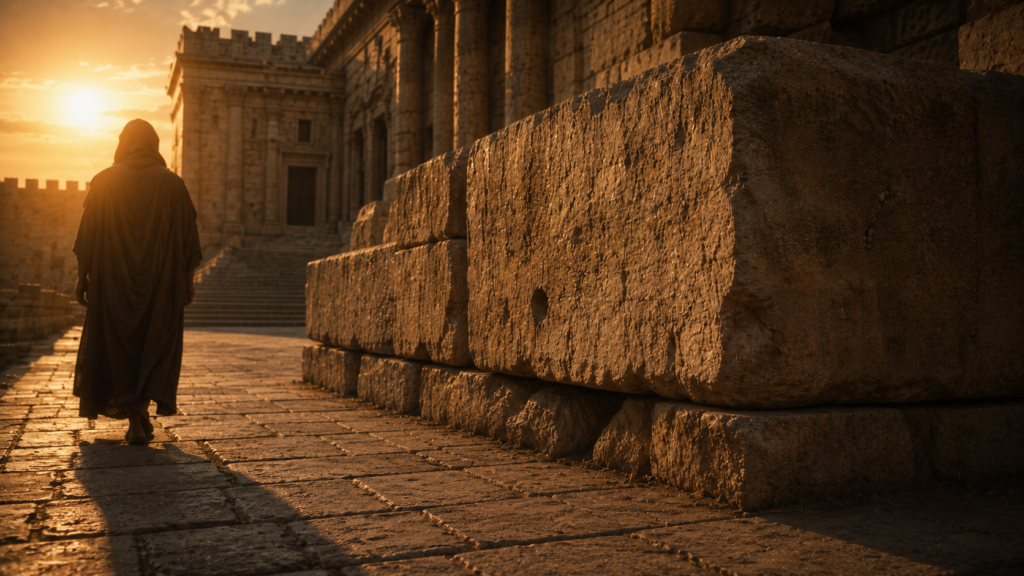
Matthew 24 is the first half of the gospel’s fifth and final teaching discourse, the Olivet Discourse (which continues into chapter 25’s parables of judgment). After the seven woes and the lament over Jerusalem of chapter 23, Jesus walks out of the temple, and his disciples point out the temple’s magnificent stones. He tells them that not one stone will be left on another. The disciples ask three questions on the Mount of Olives: when will these things be? what will be the sign of your coming? what is the sign of the end of the age? The chapter’s answers to these questions have generated more theological dispute than any other single chapter in Matthew.
The chapter has three movements. The first (verses 1 to 14) is the warning about deception, wars, famines, and persecution leading up to the temple-event: the disciples should not be alarmed by these as the end-itself, but should expect them as the beginning of the birth pangs. The second (verses 15 to 35) is the abomination-of-desolation passage and the coming of the Son of Man: the immediate response to the desolating event (flee from Judea), the cosmic signs, and the gathering of the elect. The third (verses 36 to 51) is the no one knows the day teaching and the parable of the faithful and unfaithful servant: the disciple’s posture is readiness in the present rather than calculation about the future.
Beneath the chapter’s surface flow is a deep interpretive question: how much of the chapter is about the temple’s destruction in 70 AD (which Jesus is unambiguously predicting), and how much is about the Parousia (Jesus’s second coming and the consummation of all things)? The chapter is structured in such a way that both questions are present and intertwined. The disciples in the chapter ask both questions at once, possibly because they assume the events are simultaneous; the chapter’s answers seem to address both, sometimes layered. The site does not need to settle every interpretive dispute; the chapter does what every prophetic discourse does, holding immediate and ultimate fulfillments in the same poetic register.
A · Matthew 24:1–14 · The disciples’ question and the beginning of birth pangs
¹ Jesus went out from the temple, and was going on his way. His disciples came to him to show him the buildings of the temple. ² But he answered them, “You see all of these things, don’t you? Most certainly I tell you, there will not be left here one stone on another, that will not be thrown down.” ³ As he sat on the Mount of Olives, the disciples came to him privately, saying, “Tell us, when will these things be? What is the sign of your coming, and of the end of the age?” ⁴ Jesus answered them, “Be careful that no one leads you astray. ⁵ For many will come in my name, saying, ‘I am the Christ,’ and will lead many astray. ⁶ You will hear of wars and rumors of wars. See that you aren’t troubled, for all this must happen, but the end is not yet. ⁷ For nation will rise against nation, and kingdom against kingdom; and there will be famines, plagues, and earthquakes in various places. ⁸ But all these things are the beginning of birth pains. ⁹ “Then they will deliver you up to oppression, and will kill you. You will be hated by all of the nations for my name’s sake. ¹⁰ Then many will stumble, and will deliver up one another, and will hate one another. ¹¹ Many false prophets will arise, and will lead many astray. ¹² Because iniquity will be multiplied, the love of many will grow cold. ¹³ But he who endures to the end, the same will be saved. ¹⁴ This Good News of the Kingdom will be preached in the whole world for a testimony to all the nations, and then the end will come.” (Matthew 24:1–14, World English Bible)
- Jesus went out from the temple, and was going on his way. His disciples came to him to show him the buildings of the temple (verse 1). The Greek epideixai auto tas oikodomas tou hierou, “to show him the buildings of the temple,” names the disciples’ tour-guide gesture. Herod the Great’s temple-renovation (begun in 19 BCE, still not complete in Jesus’s day) was one of the largest building projects in the ancient Mediterranean world. Some of the Western Wall stones still standing today weigh several hundred tons. The chapter is recording, with characteristic narrative-cultural specificity, the disciples’ awe at the architectural-religious accomplishment. They have not absorbed chapter 23’s prophetic-grief; they are still showing the rabbi the impressive stones.
- There will not be left here one stone on another, that will not be thrown down (verse 2). The Greek ou me aphethe lithos epi lithon, “there will not be left a stone upon a stone,” is the chapter’s first prophetic-prediction statement. The chapter is recording, with characteristic narrative-prophetic precision, the temple’s coming destruction. Forty years later (in 70 AD, during the First Jewish-Roman War), the Roman general Titus would burn and dismantle the temple structure exactly as Jesus described.
- Tell us, when will these things be? What is the sign of your coming, and of the end of the age? (verse 3). The Greek records the disciples’ three questions. Pote tauta estai (when will these things be) addresses the temple-destruction Jesus has just predicted. Ti to semeion tes ses parousias (what is the sign of your coming) uses parousia, the Greek term for the official arrival of an emperor or dignitary, applied here to Jesus’s eschatological coming. Tes synteleias tou aionos (the consummation of the age) names the end of the present age and the inauguration of the age-to-come. The disciples are asking three questions; the chapter answers all three, and the answers are not always cleanly separable. The chapter is recording, with characteristic narrative-prophetic ambiguity, that the disciples (and the chapter itself) hold these events as related, even when they are not simultaneous.
- Be careful that no one leads you astray. For many will come in my name, saying, “I am the Christ,” and will lead many astray (verses 4 to 5). The Greek records the chapter’s first warning. The first-century period from Jesus’s death to the temple’s destruction in 70 AD did, in fact, produce multiple messianic claimants: Theudas (around 44 AD; Acts 5:36), the Egyptian (around 56 AD; Acts 21:38), Simon bar Giora and others during the Jewish-Roman war. The chapter is recording, with characteristic narrative-historical precision, the prediction that historical events fulfilled.
- You will hear of wars and rumors of wars… nation will rise against nation, and kingdom against kingdom; and there will be famines, plagues, and earthquakes in various places. But all these things are the beginning of birth pains (verses 6 to 8). The Greek arche odinon, “beginning of birth-pangs,” uses the Hebrew Bible’s birth-pains image (Isaiah 13:8; 26:17; Jeremiah 4:31; Hosea 13:13) for the suffering that precedes the new age. The chapter is recording, with characteristic Hebrew Bible-imagery precision, that the wars, famines, and earthquakes the disciples will witness are not the end-itself; they are the painful contractions that announce a new birth. The first-century period leading up to 70 AD saw exactly this kind of turbulence: Roman civil wars, the great famine in Judea (around 46 AD; Acts 11:28), earthquakes at Pompeii and Phrygia, plagues across the empire.
- Then they will deliver you up to oppression, and will kill you. You will be hated by all of the nations for my name’s sake (verse 9). The Greek records the chapter’s prediction of disciple-persecution. The Acts and Pauline-letters record exactly this: Stephen martyred (Acts 7), James the brother of John beheaded (Acts 12:2), Paul’s repeated arrests and eventual execution, James the brother of Jesus killed by the Sanhedrin (around 62 AD, recorded by Josephus), Peter martyred under Nero (church tradition), and the broader Neronian persecution of 64-65 AD. The chapter is recording, with characteristic narrative-prophetic precision, the early church’s actual experience.
- This Good News of the Kingdom will be preached in the whole world for a testimony to all the nations, and then the end will come (verse 14). The Greek en hole te oikoumene, “in the whole inhabited world,” uses oikoumene, the standard Greek term for the Roman Empire’s known world. By the time of the temple’s destruction in 70 AD, the gospel had reached Rome itself (Paul’s house-arrest there is described in Acts 28), Asia Minor, Greece, North Africa, and likely India (via the apostle Thomas in early church tradition). The chapter is recording, with characteristic narrative-prophetic precision, the gospel’s pre-temple-destruction reach to the oikoumene. Some readers extend the oikoumene to mean the wider world (which would press the verse into our own time); the oikoumene in first-century Greek usually meant the Roman world specifically.
B · Matthew 24:15–35 · The abomination of desolation and the coming of the Son of Man
¹⁵ “When, therefore, you see the abomination of desolation, which was spoken of through Daniel the prophet, standing in the holy place (let the reader understand), ¹⁶ then let those who are in Judea flee to the mountains. ¹⁷ Let him who is on the housetop not go down to take out the things that are in his house. ¹⁸ Let him who is in the field not return back to get his clothes. ¹⁹ But woe to those who are with child and to nursing mothers in those days! ²⁰ Pray that your flight will not be in the winter nor on a Sabbath, ²¹ for then there will be great oppression, such as has not been from the beginning of the world until now, no, nor ever will be. ²² Unless those days had been shortened, no flesh would have been saved. But for the sake of the chosen ones, those days will be shortened. ²³ “Then if any man tells you, ‘Behold, here is the Christ,’ or, ‘There,’ don’t believe it. ²⁴ For there will arise false christs, and false prophets, and they will show great signs and wonders, so as to lead astray, if possible, even the chosen ones. ²⁵ Behold, I have told you beforehand. ²⁶ If therefore they tell you, ‘Behold, he is in the wilderness,’ don’t go out; ‘Behold, he is in the inner rooms,’ don’t believe it. ²⁷ For as the lightning flashes from the east, and is seen even to the west, so will the coming of the Son of Man be. ²⁸ For wherever the carcass is, there is where the vultures gather together. ²⁹ “But immediately after the oppression of those days, the sun will be darkened, the moon will not give its light, the stars will fall from the sky, and the powers of the heavens will be shaken; ³⁰ and then the sign of the Son of Man will appear in the sky. Then all the tribes of the earth will mourn, and they will see the Son of Man coming on the clouds of the sky with power and great glory. ³¹ He will send out his angels with a great sound of a trumpet, and they will gather together his chosen ones from the four winds, from one end of the sky to the other. ³² “Now from the fig tree learn this parable. When its branch has now become tender, and produces its leaves, you know that the summer is near. ³³ Even so you also, when you see all these things, know that it is near, even at the doors. ³⁴ Most certainly I tell you, this generation will not pass away, until all these things are accomplished. ³⁵ Heaven and earth will pass away, but my words will not pass away.” (Matthew 24:15–35, World English Bible)

- When, therefore, you see the abomination of desolation, which was spoken of through Daniel the prophet, standing in the holy place (verse 15). The Greek to bdelygma tes eremoseos, “the abomination of desolation,” is a direct quotation from Daniel 9:27, 11:31, and 12:11. Daniel’s original reference is most directly to Antiochus IV Epiphanes’s desecration of the temple in 167 BCE (when Antiochus erected an altar to Zeus over the temple’s altar and sacrificed a pig, the event that triggered the Maccabean revolt). Jesus is reusing Daniel’s vocabulary to predict a similar desecrating event in the disciples’ own future. The chapter is recording, with characteristic Hebrew Bible-prophetic precision, that Jesus expects another abomination of desolation in the holy place. Most readers identify the historical fulfillment as the Roman standards (carrying images of the emperor) being brought into the temple complex during the 70 AD siege, or the Roman general Titus entering the holy of holies, or the eventual erection of pagan structures on the temple mount. The let the reader understand parenthesis (likely Matthew’s editorial signal, not Jesus’s words) flags the verse as needing-careful-attention.
- Then let those who are in Judea flee to the mountains (verse 16). The Greek records the most concrete single instruction in the chapter. The chapter is recording, with characteristic narrative-pastoral care, what the disciples should actually do when the desolating event happens. The early Christian community in Jerusalem appears to have followed this instruction: the church historian Eusebius records (citing earlier sources) that the Jerusalem Christians fled to Pella (in the Decapolis, across the Jordan) before the city’s fall in 70 AD, possibly heeding this very prediction. The chapter’s instruction is not abstract eschatology; it is practical evacuation-counsel for a specific historical moment.
- For then there will be great oppression, such as has not been from the beginning of the world until now, no, nor ever will be (verse 21). The Greek thlipsis megale, “great affliction,” names what Josephus’s Jewish War describes in graphic detail: the siege of Jerusalem in 70 AD produced famine, internal Jewish factional warfare, mass crucifixions outside the city, the destruction of the temple, and the deaths of (by Josephus’s count) over a million Jewish people. Whether the no, nor ever will be phrase confines the prediction to the 70 AD event or extends it to a later great-tribulation is debated; the patristic tradition divided on this question. What is unambiguous is that the chapter is predicting an event whose horror the disciples are right to be grieved by in advance.
- Immediately after the oppression of those days, the sun will be darkened, the moon will not give its light, the stars will fall from the sky, and the powers of the heavens will be shaken; and then the sign of the Son of Man will appear in the sky (verses 29 to 30). The Greek records the chapter’s most contested single passage. The cosmic-signs vocabulary (sun darkened, moon not giving light, stars falling) is direct prophet-language from Isaiah 13:10 (against Babylon), Isaiah 34:4 (against Edom), Joel 2:10, 31 (the day of the LORD), Ezekiel 32:7 (against Egypt). In every Hebrew Bible occurrence, this cosmic-signs vocabulary is metaphorical-political, naming the destruction of a major political-religious order rather than a literal cosmic dissolution. On the Wright reading, Jesus is using the same prophetic-imagery genre to name the destruction of the temple-system as a cosmic-political event of comparable weight: the end of the Jewish-political order centered in the temple is, theologically, an event of the same magnitude that the prophets described in cosmic-imagery terms. The sign of the Son of Man in heaven is, on this reading, the public vindication of Jesus as the Son of Man (Daniel 7:13-14) by the destruction of the temple that condemned him. Other readers (the more dispensational and some patristic readings) take the cosmic signs more literally as predictions of the eventual Parousia. The site does not need to settle the dispute; the chapter holds both readings in productive tension.
Influence callout: N.T. Wright (the Olivet Discourse and the destruction of the temple)
Wright’s reading of Matthew 24 names the chapter as the gospel’s most sustained single piece of prophetic-foreshortening: the technique by which Hebrew Bible prophets often combined a near-fulfillment and a far-fulfillment in the same poetic-prophetic vision. Wright argues that the chapter’s primary referent is the destruction of the temple in 70 AD, an event Jesus is predicting with extraordinary specificity (the not one stone left on another in verse 2, the abomination of desolation in verse 15, the flee to the mountains in verse 16, the great tribulation in verse 21, the cosmic signs in verses 29-30, and the this generation will not pass away in verse 34 are all about the 70 AD event). The cosmic-signs language is, on Wright’s reading, the standard Hebrew Bible-prophetic genre for naming the political-theological collapse of a major order; the disciples and Matthew’s first audience would have heard the language in its prophetic-tradition register, not as predictions of literal cosmic dissolution. The coming of the Son of Man in verse 30, on Wright’s reading, is the Daniel-7 vindication-event: the Son of Man comes to the Ancient of Days (Daniel 7:13, the original direction of motion) and is given the kingdom; the temple’s destruction is the public-historical sign that this vindication has happened. Wright argues that this reading does not eliminate the Parousia (Christ’s second coming); it locates the Parousia-question primarily in chapter 25 (the parables of judgment) and in the gospel’s broader eschatological frame. Wright’s reading allows verse 34’s this generation will not pass away to be taken literally (the generation that heard Jesus did, in fact, see the temple destroyed within forty years) without producing the apocalyptic-failure problem some readers see when the verse is applied to the Parousia. The chapter is recording, on this reading, the kingdom’s first major historical vindication-event, and the broader apocalyptic-future is held over for the next chapter and the gospel’s broader frame.
- Now from the fig tree learn this parable. When its branch has now become tender, and produces its leaves, you know that the summer is near (verses 32 to 33). The Greek records the chapter’s most accessible single image. The fig tree’s seasonal pattern is universally observable; the disciples are being trained to read the signs of the times the way they read the signs of the seasons. The chapter is recording, with characteristic narrative-pedagogical care, the disciples’ formation in spiritual perceptiveness.
- Most certainly I tell you, this generation will not pass away, until all these things are accomplished (verse 34). The Greek he genea haute, “this generation,” names the time-frame. The most natural reading takes this generation as Jesus’s contemporaries; the events Jesus has been describing (the temple’s destruction, primarily) will happen within their lifetime. The Roman destruction of the temple in 70 AD, roughly 37 years after Jesus’s crucifixion (around 33 AD), did indeed occur within the lifetime of many of Jesus’s hearers. The chapter is recording, with characteristic narrative-prophetic precision, the time-frame. Other readings stretch this generation to mean the human race or the Jewish people in order to extend the prediction to the Parousia; these readings press the verse harder than its straightforward meaning permits.
C · Matthew 24:36–51 · No one knows the day, and the parable of the faithful servant
³⁶ “But no one knows of that day and hour, not even the angels of heaven, but my Father only. ³⁷ As the days of Noah were, so will the coming of the Son of Man be. ³⁸ For as in those days which were before the flood they were eating and drinking, marrying and giving in marriage, until the day that Noah entered into the ship, ³⁹ and they didn’t know until the flood came, and took them all away, so will the coming of the Son of Man be. ⁴⁰ Then two men will be in the field: one will be taken and one will be left; ⁴¹ two women grinding at the mill, one will be taken and one will be left. ⁴² Watch therefore, for you don’t know in what hour your Lord comes. ⁴³ But know this, that if the master of the house had known in what watch of the night the thief was coming, he would have watched, and would not have allowed his house to be broken into. ⁴⁴ Therefore also be ready, for in an hour that you don’t expect, the Son of Man will come. ⁴⁵ “Who then is the faithful and wise servant, whom his lord has set over his household, to give them their food in due season? ⁴⁶ Blessed is that servant whom his lord finds doing so when he comes. ⁴⁷ Most certainly I tell you that he will set him over all that he has. ⁴⁸ But if that evil servant should say in his heart, ‘My lord is delaying his coming,’ ⁴⁹ and begins to beat his fellow servants, and eat and drink with the drunkards, ⁵⁰ the lord of that servant will come in a day when he doesn’t expect it, and in an hour when he doesn’t know it, ⁵¹ and will cut him in pieces, and appoint his portion with the hypocrites. There is where the weeping and grinding of teeth will be.” (Matthew 24:36–51, World English Bible)
- No one knows of that day and hour, not even the angels of heaven, but my Father only (verse 36). The Greek peri de tes hemeras ekeines kai horas oudeis oiden, “concerning that day and hour no one knows,” names the chapter’s pivot. The chapter has just been describing a wealth of signs (wars, famines, the abomination, cosmic signs); now Jesus says that the day and hour are unknown even to the angels and even to himself. The chapter is recording, with characteristic narrative-theological care, the deliberate refusal of the date-setting impulse the chapter’s earlier specificity might seem to invite. The signs are visible; the precise timing is not.
- As the days of Noah were, so will the coming of the Son of Man be… they were eating and drinking, marrying and giving in marriage, until the day that Noah entered into the ship, and they didn’t know until the flood came, and took them all away (verses 37 to 39). The Greek records the chapter’s most striking single analogy. The flood-generation was not unusually wicked in the immediate run-up; they were ordinary, going about ordinary life (eating, drinking, marrying), until the flood came. The chapter is recording, with characteristic Hebrew Bible-narrative precision, that the coming of the Son of Man will arrive into ordinary life, not into a moment of obvious cosmic preparation. The disciples are not waiting for an unmistakable preliminary signal; they are living their ordinary lives, in which the kingdom’s arrival will be as decisive as the flood was for those who were not in the ark.
- Then two men will be in the field: one will be taken and one will be left; two women grinding at the mill, one will be taken and one will be left (verses 40 to 41). The Greek records the chapter’s most often-quoted single image. The verse has been read in two main ways. The dispensational-rapture reading: the taken are gathered to Christ, the left remain on earth for tribulation. The alternative reading (the more common patristic-and-modern reading): the taken are taken in judgment (as in the flood image just preceding, where those taken by the flood were destroyed); the left are spared for the kingdom. The chapter does not specify which group is the favored one; the immediate flood-context favors the second reading, where being taken parallels the flood-generation being taken away. The chapter’s point either way is the suddenness and the differentiation: ordinary life will be interrupted, and the interruption will distinguish.
- Watch therefore, for you don’t know in what hour your Lord comes (verse 42). The Greek gregoreite oun, “watch therefore,” is the chapter’s first imperative-instruction. The Greek gregoreo (to be awake, watchful, alert) names the disciple’s ongoing posture. The chapter is recording, with characteristic narrative-pedagogical precision, the disciple’s call to wakefulness. The unknowable timing is not a problem to solve; the unknowable timing is precisely what produces the call to ongoing readiness.
- Who then is the faithful and wise servant, whom his lord has set over his household, to give them their food in due season? (verse 45). The Greek records the chapter’s first parable-of-readiness. The faithful-servant image names what the readiness should look like in practice: not staring at the sky, but doing the master’s actual work (feeding the household at the proper time). The chapter is recording, with characteristic narrative-pastoral care, what the watching of verse 42 looks like in practice: faithful service in the master’s actual concerns.
- But if that evil servant should say in his heart, “My lord is delaying his coming,” and begins to beat his fellow servants, and eat and drink with the drunkards (verses 48 to 49). The Greek records the chapter’s most pointed single description of failed disciple-leadership. The evil servant’s logic is the master is taking too long; therefore I can do whatever I want. The chapter is recording, with characteristic narrative-pastoral honesty, what the failure of readiness actually looks like: not the absence of religious practice but the abuse of fellow servants and the indulgence of personal appetite. The chapter is recording the same kind of leadership-failure that chapter 23 has just delivered seven woes against. The unfaithful servant is, structurally, the religious establishment Jesus has been critiquing.
- The lord of that servant will come in a day when he doesn’t expect it, and in an hour when he doesn’t know it, and will cut him in pieces, and appoint his portion with the hypocrites (verses 50 to 51). The Greek closes the chapter with the unfaithful servant’s portion-with-the-hypocrites. The chapter is recording, with characteristic narrative-theological precision, the kingdom’s accountability. The chapter has not been a passive prediction-text; the chapter has been a formation-text for disciples whose own faithfulness is being shaped by the vocabulary they are being given to live inside.
Reflection prompts
- The disciples ask Jesus about the temple, his coming, and the end of the age. Three questions at once, possibly because they assumed the events were simultaneous. The chapter’s answer holds the questions together without collapsing them. Where in your life are you currently asking eschatological questions in a way that wants the answers to be simpler than they actually are, and what would it mean to hold the chapter’s productive tension: signs visible, precise timing unknown, kingdom unfolding through history?
- No one knows of that day and hour, not even the angels of heaven. The chapter pairs detailed prophecy with explicit refusal of date-setting. The disciple’s posture is wakefulness, not calculation. Where in your life is a particular eschatological speculation currently absorbing energy that the chapter is redirecting toward faithful service in the master’s actual household concerns, and what would it mean to take the chapter’s pivot seriously: watch, but watch by serving?
- The faithful servant is the one the master finds doing so when he comes: feeding the household at the proper time. The unfaithful servant is the one who used the master’s delay to abuse his fellow servants. The chapter is recording the kingdom’s most concrete single description of disciple-readiness: faithful service of the household. Where in your life is your readiness for the kingdom currently disconnected from the actual household-of-fellow-servants you have been given to feed, and what would it mean to take the chapter’s measure: the watching is the serving?