
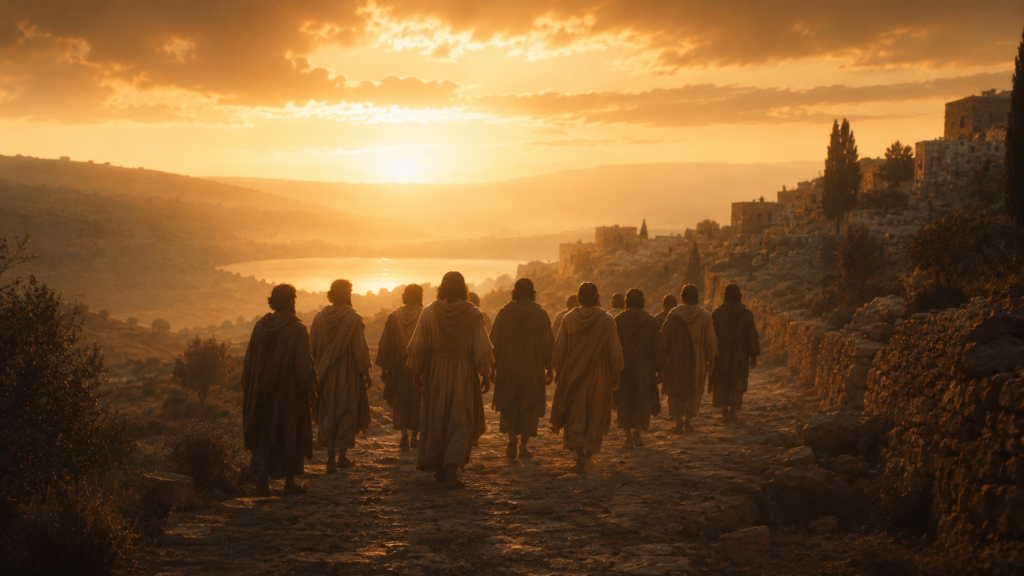
Matthew 10 is the gospel’s second of five teaching discourses, the missionary discourse. The miracle block of chapters 8 and 9 closed with Jesus seeing the harassed crowds and naming the harvest as plentiful but the laborers as few; the missionary discourse begins as the Father’s first answer to the prayer Jesus had just commanded the disciples to pray. The chapter has Jesus naming the twelve, giving them authority over disease and the demonic, sending them out into the towns of Galilee with specific instructions, and warning them at length about the cost. The chapter is the gospel’s most extended single teaching on what it costs to be a disciple under the kingdom’s commission.
The chapter has four movements. The first (verses 1 to 4) names the twelve, the apostles who will become the new tribal heads of the kingdom-Israel. The second (verses 5 to 15) gives the practical instructions for the mission: where to go, what to take, how to enter towns, what to do if rejected. The third (verses 16 to 33) is the sustained warning section: persecution will come, families will divide, the disciple will be hated for the master’s name. The fourth (verses 34 to 42) closes with the discourse’s most theologically loaded sayings: I have not come to bring peace but a sword, whoever finds his life will lose it, and the famous cup of cold water benediction.
Beneath the practical-instruction layer is the chapter’s deeper claim about what kingdom-allegiance actually requires. Following the king is not adding a religious dimension to an otherwise normal life; it is the surrender of every other allegiance the disciple holds. Family loyalty, self-preservation, social respectability, professional reputation, even physical safety can all be lost. What the disciple gains is the king’s own name and the king’s own welcome, which the chapter promises will outlast every loss.
A · Matthew 10:1–15 · The twelve named and sent
¹ He called to himself his twelve disciples, and gave them authority over unclean spirits, to cast them out, and to heal every disease and every sickness. ² Now the names of the twelve apostles are these. The first, Simon, who is called Peter; Andrew, his brother; James the son of Zebedee; John, his brother; ³ Philip; Bartholomew; Thomas; Matthew the tax collector; James the son of Alphaeus; and Lebbaeus, who was also called Thaddaeus; ⁴ Simon the Zealot; and Judas Iscariot, who also betrayed him. ⁵ Jesus sent these twelve out and commanded them, saying, “Don’t go among the Gentiles, and don’t enter into any city of the Samaritans. ⁶ Rather, go to the lost sheep of the house of Israel. ⁷ As you go, preach, saying, ‘The Kingdom of Heaven is at hand!’ ⁸ Heal the sick, cleanse the lepers, and cast out demons. Freely you received, so freely give. ⁹ Don’t take any gold, silver, or brass in your money belts. ¹⁰ Take no bag for your journey, neither two coats, nor sandals, nor staff: for the laborer is worthy of his food. ¹¹ Into whatever city or village you enter, find out who in it is worthy; and stay there until you go on. ¹² As you enter into the household, greet it. ¹³ If the household is worthy, let your peace come on it, but if it isn’t worthy, let your peace return to you. ¹⁴ Whoever doesn’t receive you or hear your words, as you go out of that house or that city, shake the dust off your feet. ¹⁵ Most certainly I tell you, it will be more tolerable for the land of Sodom and Gomorrah in the day of judgment than for that city.” (Matthew 10:1–15, World English Bible)
- He called to himself his twelve disciples (verse 1). The Greek prosekalesato tous dodeka mathetas autou, “he called to himself the twelve, his disciples,” names a group the chapter has not formally enumerated before. The number twelve is theologically loaded: twelve tribes of Israel, twelve patriarchs, twelve months, twelve thrones the disciples will eventually be promised (Matthew 19:28). The chapter is recording, with characteristic narrative care, the formation of a structurally Israel-shaped band of representatives.
Influence callout: Marty Solomon (the twelve as restored tribal heads)
Solomon’s reading of the calling-and-naming of the twelve names them as the gospel’s most explicit symbolic-numerical announcement that the kingdom is the renewal of Israel. The number twelve is not casual. The patriarchal sons of Jacob, the twelve tribes that organized Israel from Sinai onward, the twelve stones in the high priest’s breastplate, the twelve loaves of the bread of the presence, the twelve stones in Joshua’s Jordan-crossing memorial. All of these numerical-symbolic anchors are now being recapitulated in twelve specific Galilean men. Solomon argues that Jesus’s choice of twelve (rather than seven, ten, or any other meaningful number) is the gospel’s quiet but unmistakable claim that Israel is being reconstituted around him. The Pharisaic religious establishment will read this as a direct Christological-political claim, because in their tradition the regathering of the twelve tribes is a marker of the messianic age (Isaiah 11:11 to 12; Ezekiel 37:15 to 28). Solomon names the mumzer note: the twelve new tribal heads are not the religious-establishment scholars or the Levitical priests but four fishermen, a tax collector, and a politically-suspect Zealot (verse 4). The renewed Israel has the same demographic shape as everything else in the gospel. The kingdom keeps gathering the people the cultural center has not been gathering.
- Don’t go among the Gentiles, and don’t enter into any city of the Samaritans. Rather, go to the lost sheep of the house of Israel (verses 5 to 6). The Greek eis hodon ethnon me apelthete, “do not go on the road of Gentiles,” names the initial geographic restriction. The mission to the Gentiles will come (Matthew 28:19); the mission begins, deliberately, with Israel. The chapter is recording, with characteristic theological care, that the gospel is not a Jewish-to-Gentile replacement move but a Jewish-first move that opens to include the Gentiles. The covenant runs through Israel before it reaches the nations.
- The Kingdom of Heaven is at hand (verse 7). The Greek engiken he basileia ton ouranon, “the kingdom of heaven has drawn near,” is the third explicit use of this opening sermon (after John in 3:2 and Jesus in 4:17). The chapter is recording, with characteristic verbal continuity, that the message the disciples carry is the same message Jesus carried, which was the same message John carried. The kingdom is the news, metanoia is the response, and the messenger does not change the message.
- Heal the sick, cleanse the lepers, and cast out demons. Freely you received, so freely give (verse 8). The Greek dorean elabete, dorean dote, “freely you received, freely give,” names the kingdom’s economic shape for ministry. The disciples are not to charge for the kingdom-work. The healing, the cleansing, the deliverance is not a service offered for payment; it is a gift given out of a gift. The chapter is establishing, in five Greek words, the kingdom’s anti-monetization principle.
- Don’t take any gold, silver, or brass in your money belts (verse 9). The Greek me ktesethe chryson mede argyron, “do not acquire gold or silver,” names the radical economic dependence the disciples are being sent into. They are not to fund the mission from prior savings, on-the-road earnings, or sponsorship. They are to depend on the hospitality of the towns they enter. The chapter is staging, in narrative form, the same teaching the Sermon on the Mount delivered (Matthew 6:25 to 34: do not be anxious about food, drink, clothing).
- Find out who in it is worthy; and stay there until you go on (verse 11). The Greek axios, “worthy,” names the disciple-identifying-question for the host. The disciples are to find a household receptive to the kingdom-announcement and stay there for the duration of their work in that town. The pattern is grounded hospitality, not wandering itinerancy. The chapter is recording, with characteristic cultural care, the first-century Mediterranean honor-shame hospitality system the mission is operating within.
- Shake the dust off your feet (verse 14). The Greek ektinaxate ton koniorton ton podon hymon, “shake off the dust of your feet,” is a deliberate Jewish-cultural gesture. First-century Jews returning to Israel from Gentile territory traditionally shook off the dust at the border, refusing to bring even the unclean dust home with them. The gesture, performed against an unwelcoming Jewish town, is a reverse-application: the disciples treat the rejecting town as Gentile-unclean. The chapter is recording, with characteristic cultural specificity, a gesture that would have landed with sharp-edged clarity on its first-century audience.
- It will be more tolerable for the land of Sodom and Gomorrah in the day of judgment than for that city (verse 15). The Sodom comparison rewards careful reading, because most modern Christian instinct hears Sodom as shorthand for sexual sin. The Hebrew Bible’s own internal commentary on Sodom is less narrow. Ezekiel 16:48-50 explicitly names what Sodom’s sin actually was: behold, this was the iniquity of your sister Sodom: she and her daughters had pride, surfeit of food, and prosperous ease, but did not aid the poor and needy. The connecting note between the missionary chapter and the Sodom-warning is hospitality. The Hebrew Bible’s hospitality tradition runs deep: Abraham and Sarah host the three strangers; Lot welcomes the angels into Sodom precisely while the rest of the city refuses to; Manoah, the Shunammite woman, Rebekah and her family, and many more are commended in the text for the way they receive strangers. Love the stranger, for you were strangers in the land of Egypt is one of the most-repeated commands in the Torah (Deuteronomy 10:19; Exodus 22:21; 23:9; Leviticus 19:33). The disciples are now being sent into Israelite towns expecting to receive that hospitality. When a town refuses, the chapter places it in the Sodom category not because of its sexual ethics but because the failure to welcome the stranger and aid the kingdom-messenger is precisely the failure for which Sodom was judged. The chapter’s whole logic is that God’s people are supposed to be the kind of people who recognize and welcome those carrying the kingdom’s announcement; the towns that don’t are doing what Sodom did.
B · Matthew 10:16–33 · Sheep among wolves and the cost of the name
¹⁶ “Behold, I send you out as sheep among wolves. Therefore be wise as serpents, and harmless as doves. ¹⁷ But beware of men: for they will deliver you up to councils, and in their synagogues they will scourge you. ¹⁸ Yes, and you will be brought before governors and kings for my sake, for a testimony to them and to the nations. ¹⁹ But when they deliver you up, don’t be anxious how or what you will say, for it will be given you in that hour what you will say. ²⁰ For it is not you who speak, but the Spirit of your Father who speaks in you. ²¹ “Brother will deliver up brother to death, and the father his child. Children will rise up against parents, and cause them to be put to death. ²² You will be hated by all men for my name’s sake, but he who endures to the end will be saved. ²³ But when they persecute you in this city, flee into the next, for most certainly I tell you, you will not have gone through the cities of Israel until the Son of Man has come. ²⁴ “A disciple is not above his teacher, nor a servant above his lord. ²⁵ It is enough for the disciple that he be like his teacher, and the servant like his lord. If they have called the master of the house Beelzebul, how much more those of his household! ²⁶ Therefore don’t be afraid of them, for there is nothing covered that will not be revealed; and hidden that will not be known. […] ²⁸ Don’t be afraid of those who kill the body, but are not able to kill the soul. Rather, fear him who is able to destroy both soul and body in Gehenna. ²⁹ Aren’t two sparrows sold for an assarion coin? Not one of them falls on the ground apart from your Father’s will, ³⁰ but the very hairs of your head are all numbered. ³¹ Therefore don’t be afraid. You are of more value than many sparrows. ³² Everyone therefore who confesses me before men, I will also confess him before my Father who is in heaven. ³³ But whoever denies me before men, I will also deny before my Father who is in heaven.” (Matthew 10:16–33, World English Bible, abridged)
- I send you out as sheep among wolves (verse 16). The Greek hos probata en meso lykon, “as sheep in the midst of wolves,” sets the chapter’s tone. The kingdom’s representatives are vulnerable; the world they are being sent into is not safe. The chapter is naming, with characteristic narrative honesty, that the kingdom’s expansion will not be triumphal procession; it will be sheep-shaped vulnerability inside hostile structures.
- Be wise as serpents, and harmless as doves (verse 16b). The Greek phronimoi hos hoi opheis kai akeraioi hos hai peristerai, “wise as the serpents and unmixed as the doves,” names the dual posture. The disciple is to be perceptive (the serpent’s wisdom) and morally pure (the dove’s simplicity). The chapter is rejecting both naive activism (which gets the disciples eaten) and cynical compromise (which loses the dove). The kingdom’s representatives are to be both shrewd and clean.
- They will deliver you up to councils, and in their synagogues they will scourge you (verse 17). The Greek eis synedria… en tais synagogais auton, “to councils… in their synagogues,” names the religious-legal context the disciples will be persecuted in. The earliest Christian persecution was internal to the Jewish community before it became Roman-imperial. The chapter is recording, with characteristic accuracy, the actual conditions the early church faced (Acts 5; 22; 26; etc.).
- Brother will deliver up brother to death, and the father his child (verse 21). The Greek paradosei, “will deliver up,” is the same verb the gospel uses for Judas’s betrayal of Jesus. The chapter is recording, with characteristic verbal precision, that the disciple’s experience will pattern the master’s: the same betrayal-vocabulary, often from the same family-bench. The kingdom’s allegiance-claim is sharp enough to break the deepest natural loyalties.
Influence callout: Matthew Bates and Scot McKnight (the gospel-allegiance reading)
Bates’s and McKnight’s reading of the chapter’s persecution and confession sayings names them as the gospel’s most explicit pistis-as-loyalty texts. The chapter culminates in a dual statement: everyone who confesses me before men, I will also confess him before my Father; whoever denies me before men, I will also deny before my Father (verses 32 to 33). Bates argues that this is allegiance-language at its most direct. To confess Jesus in this context is not first to mentally believe propositions about him; it is to publicly swear loyalty to him as Lord, especially in the contexts where that loyalty will cost something (the synagogue council, the Roman governor’s tribunal, the family-bench). McKnight pairs this with the cross-bearing teaching at verses 38 to 39: the disciple’s loyalty is so total that even the most powerful natural loyalties (self-preservation, family allegiance) are subordinated to the king. The early Christian martyrs (Polycarp, Perpetua, the martyrs of Lyon, the centuries of believers under Roman persecution) read this chapter as the precise template for their situation: when called before the magistrate and asked to deny the Lord, confess. The chapter is laying down, in this allegiance-vocabulary, the kingdom’s entire theology of discipleship-under-pressure. The gospel is not asking for a religious add-on to a normal life. The gospel is asking for the loyalty Caesar has been claiming, given to the rightful King.
- Don’t be afraid of those who kill the body, but are not able to kill the soul (verse 28). The Greek me phobeisthe apo ton apoktennonton to soma, “do not fear those killing the body,” names the chapter’s most demanding instruction. The first-century disciple was not paranoid; the threat was real. The early church had to face the actual prospect of martyrdom. Jesus does not minimize the threat; he relocates the disciple’s fear. The fear of God displaces the fear of the killer. The Greek Gehenna names the Valley of Hinnom (Hebrew Ge-Hinnom), a real geographical valley on the southwestern edge of Jerusalem with a dark history: Jeremiah 7:31 records that this is where some Israelites had built the high places of Topheth and burned children to Molech, a practice God names as something I did not command, nor did it come into my mind. By the first century, the valley had been desecrated and turned into the city’s smoldering refuse heap, with constant fires for waste and worms in the rotting matter, exactly the imagery Jesus’s audience would have heard in the prophetic phrase where the worm does not die and the fire is not quenched (Isaiah 66:24). Some readers, including N.T. Wright, argue that the one who can destroy soul and body in Gehenna is not the Father but the satan: Wright reads the verse as identifying the real enemy of the disciple (not Rome, who can only kill the body) as the accuser whose path leads the unfaithful into the kind of comprehensive ruin that Jeremiah had warned would turn Jerusalem itself into a Hinnom-wasteland (Jeremiah 19, eventually fulfilled in 587 BCE and again in 70 CE). On this reading, the chapter’s verse is not naming God as a torturer but naming the demonic-political path of vengeance and holy-war as the path that ends in self-destruction. Whether the verse is read with the Father or the satan as the destroyer, the chapter’s point holds: the disciple’s fear is to be relocated. The fear of God or the holy-dread of the path of evil displaces the fear of the killer; the disciple is set free from the regime’s primary control mechanism.
Influence callout: John Chrysostom (Homilies on Matthew, Homily 34, on 10:28)
Chrysostom’s homily on this verse, delivered around 390 AD at Antioch (and later at Constantinople), became the foundational patristic reading of do not fear those who kill the body. Chrysostom preached the ninety homilies on Matthew during a period when the Roman state’s relationship to the church had only recently shifted from persecution to favor; the memory of the great persecutions (Decius in 250, Diocletian in 303) was still fresh. He reads Jesus’s instruction as the kingdom’s anti-empire formation of the disciple’s fear. The disciple who has rightly relocated her fear cannot be controlled by the fear of death, and the regime that has lost its ability to use fear of death has lost its primary control mechanism. Chrysostom argues that the kingdom forms a free people precisely by reordering what they are afraid of. Every Christian generation since has read this verse with Chrysostom in the background: from the medieval martyrs in the Mongol invasions, to the Anabaptist congregations in the Thirty Years’ War, to the East African Christians in the Ugandan and Sudanese persecutions of the twentieth century, to the church under Communist regimes. The chapter is the church’s catechism for living in any era when the regime claims the power that only God should hold.
- The very hairs of your head are all numbered (verse 30). The Greek hai triches tes kephales pasai erithmemenai eisin, “the hairs of the head all are numbered,” is the chapter’s most pastorally tender reassurance. The God who is to be feared (verse 28) is the same God whose attention to the disciple is granular to the point of counting the hairs. The kingdom’s God is not distant; the kingdom’s God is detailed.
C · Matthew 10:34–42 · The sword and the cup of cold water
³⁴ “Don’t think that I came to send peace on the earth. I didn’t come to send peace, but a sword. ³⁵ For I came to set a man at odds against his father, and a daughter against her mother, and a daughter-in-law against her mother-in-law. ³⁶ A man’s foes will be those of his own household. ³⁷ He who loves father or mother more than me is not worthy of me; and he who loves son or daughter more than me isn’t worthy of me. ³⁸ He who doesn’t take his cross and follow after me, isn’t worthy of me. ³⁹ He who seeks his life will lose it; and he who loses his life for my sake will find it. ⁴⁰ He who receives you receives me, and he who receives me receives him who sent me. ⁴¹ He who receives a prophet in the name of a prophet will receive a prophet’s reward. He who receives a righteous man in the name of a righteous man will receive a righteous man’s reward. ⁴² Whoever gives one of these little ones just a cup of cold water to drink in the name of a disciple, most certainly I tell you, he will in no way lose his reward.” (Matthew 10:34–42, World English Bible)
- Don’t think that I came to send peace on the earth. I didn’t come to send peace, but a sword (verse 34). The Greek machaira, “sword,” is the chapter’s most uncomfortable metaphor. Jesus is not commissioning literal violence (5:38 to 48 has already settled that). He is naming the kingdom’s social-divisive effect: the kingdom-allegiance creates real divisions, often along family lines, and the disciple should not be surprised when those divisions arrive. The verses that follow (35-36) directly quote Micah 7:6, and reading the saying inside its Micah context tightens its meaning. Micah 7 sits at the bottom of the prophet’s accusations against an Israel that is failing to do justice and love mercy (the do justice, love kindness, walk humbly of Micah 6:8 sits two chapters earlier). When Micah describes a household where the son treats the father with contempt, the daughter rises up against her mother, the daughter-in-law against her mother-in-law, he is describing the social fracture that comes when the day of your watchmen, the day of your visitation arrives (Micah 7:4); when God shows up to set things right, the existing social order quivers. Micah 7:7 then names the disposition of the faithful: as for me, I will look to the LORD; I will wait for the God of my salvation; my God will hear me. Jesus’s reuse of Micah 7:6 in 10:34-36 is, on this reading, deliberate: the kingdom’s arrival is producing the same kind of social fracture, and the disciple’s posture is to look to the Lord and keep going rather than to take up arms or smooth the fracture over. The chapter is recording, with characteristic Hebrew Bible literacy, that the kingdom is not a religious smoothing-over; it is a kingdom-claim that some will accept and some will not, and the household where the acceptance is split will know it.
- He who loves father or mother more than me is not worthy of me (verse 37). The Greek ho philon patera e metera hyper eme, “the one loving father or mother above me,” is the chapter’s most demanding prioritization. The first-century Mediterranean honor-shame culture organized identity around family loyalty above almost every other commitment. Jesus’s claim that the kingdom-allegiance must take precedence even over the family is, by every cultural measure, radical. The chapter is recording, with characteristic narrative directness, the depth of the allegiance-restructuring the gospel requires.
- He who doesn’t take his cross and follow after me, isn’t worthy of me (verse 38). The Greek ton stauron autou, “his cross,” is the chapter’s first explicit cross-vocabulary. In the first-century Roman world, taking up the cross named one specific thing: the condemned criminal was made to carry the crossbeam of his own crucifixion to the execution site. The metaphor is, on its first hearing, viscerally specific. The disciple is being called to walk the route of the condemned. The chapter is laying down the gospel’s most thoroughgoing discipleship-claim. Take up your cross is not a metaphor for inconvenience; it is a metaphor for surrender to the worst Rome could do.
- He who seeks his life will lose it; and he who loses his life for my sake will find it (verse 39). The Greek ho heuron ten psychen autou apolesei auten, kai ho apolesas ten psychen autou heneken emou heuresei auten, “the one finding his life will lose it, and the one losing his life for my sake will find it,” is the chapter’s most paradoxical saying. The Greek psyche (life, soul, self) is what the disciple is being asked to release. The chapter is teaching, in one tightly constructed paradox, the kingdom’s deepest economic principle: the self that is grasped is lost; the self that is released is found. The cross-bearing of verse 38 leads naturally to the self-losing of verse 39.
- He who receives you receives me, and he who receives me receives him who sent me (verse 40). The Greek ho dechomenos hymas eme dechetai, “the one receiving you receives me,” names the chapter’s chain of representation. The disciple represents Jesus, who represents the Father. To welcome the disciple is to welcome the Father. The chapter is recording, with characteristic theological care, that the disciple’s mission carries the Father’s own presence into the towns they enter.
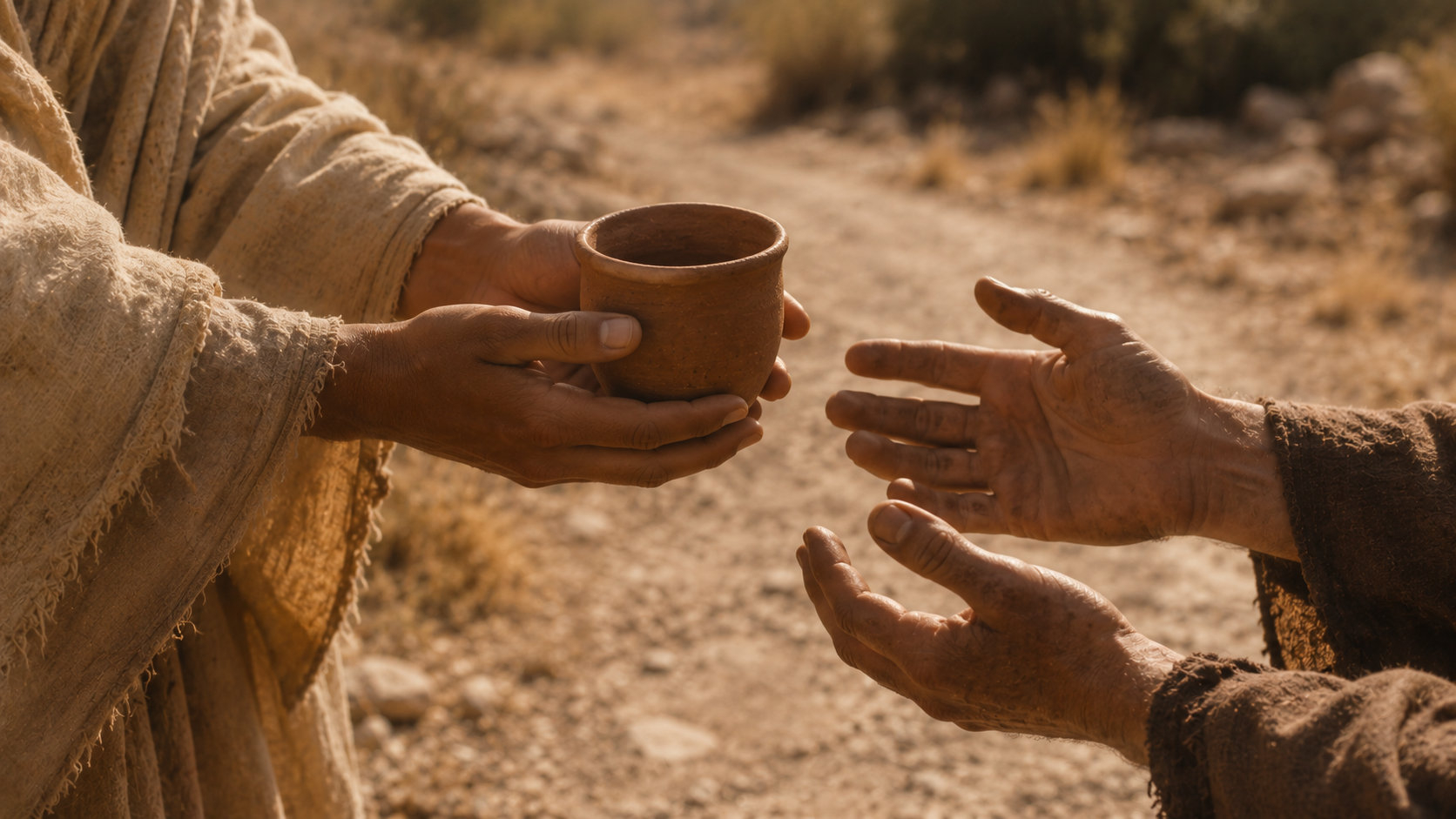
- Whoever gives one of these little ones just a cup of cold water to drink in the name of a disciple, most certainly I tell you, he will in no way lose his reward (verse 42). The Greek poterion psychrou, “a cup of cold water,” is the chapter’s quietest closing image. After all the radical demands (sheep among wolves, the killing of the body, the cross, the divided household, the lost life), the chapter ends with the smallest hospitality: a cup of cold water given to one of the disciples. The kingdom’s economy notices even this. The chapter is closing the missionary discourse with a benediction on the hosts who will receive the disciples it has just sent. The cup of cold water and the lost life turn out to be on the same scale.
Reflection prompts
- The twelve named in verses 2 to 4 are not the religious-establishment scholars but four fishermen, a tax collector, a Zealot, and seven other Galileans whose names the gospel records but never returns to in detail. The renewed Israel has the same demographic shape as the four women in the genealogy and the magi from the east. Where in your life are you currently waiting for the religious establishment’s credentialed leaders before the kingdom-work can begin, and what does it mean to consider that the king has always preferred to call the people the credentialed have not been calling?
- The chapter’s persecution warnings are not abstract. Brother will deliver up brother. A man’s foes will be those of his own household. The kingdom-allegiance is sharp enough to break the deepest natural loyalties. Where in your life is the king’s claim currently sitting against another loyalty (family expectation, professional advancement, personal safety, a community’s approval), and what does it mean to consider that the chapter’s whoever loves father or mother more than me is not a hypothetical question?
- The chapter ends with the cup of cold water. After all the radical demands, the kingdom’s economy notices the smallest gesture of welcome to one of the king’s people. Where in your life are you currently in a position to receive a disciple, support a kingdom-worker, or offer the cup of cold water to one of the king’s little ones, and what does it mean to consider that this small gesture and the lost life turn out to be on the same scale?