

Genesis 43 picks up the family’s stalemate. The grain bought in chapter 42 has run out. Jacob tells the brothers to go back. Judah refuses unless Benjamin goes too, citing the Egyptian official’s explicit terms. Judah personally guarantees Benjamin’s safety, pledging his own life if anything happens to the boy. Jacob, overruled by the famine and Judah’s pledge, agrees. He sends gifts of the local specialties (balm, honey, gum, myrrh, pistachios, almonds), double the silver to repay what was found in the sacks, and Benjamin himself.
The brothers travel down to Egypt and present themselves at Joseph’s house. The unnamed steward reassures them about the silver. Simeon is released. Joseph arrives. The brothers bow with the gifts. Joseph asks about the family, and at the sight of Benjamin (his only full brother by Rachel), is overcome and has to retire to weep. He returns, controls himself, and orders the meal served. The brothers are seated by birth order (which mystifies them). Benjamin’s portion is five times that of the others. They eat. They drank, and were merry with him.
The chapter is the cycle’s quietest hinge. Nothing dramatic happens; no recognition, no confrontation, no resolution. The brothers eat with Joseph, and they do not yet know who he is. Joseph eats with his brothers, and he is not yet ready to tell them. The chapter is a held breath. The reader knows the reveal is coming. The chapter waits.
A · Genesis 43:1–14 · Judah’s pledge
¹ The famine was severe in the land. ² When they had eaten up the grain which they had brought out of Egypt, their father said to them, “Go again, buy us a little more food.” ³ Judah spoke to him, saying, “The man solemnly warned us, saying, ‘You shall not see my face, unless your brother is with you.’ ⁴ If you will send our brother with us, we will go down and buy you food, ⁵ but if you will not send him, we will not go down, for the man said to us, ‘You shall not see my face, unless your brother is with you.’” ⁶ Israel said, “Why did you treat me so badly, telling the man that you had another brother?” ⁷ They said, “The man asked directly concerning ourselves, and concerning our relatives, saying, ‘Is your father still alive? Have you another brother?’ We just answered his questions. Is there any way we could know that he would say, ‘Bring your brother down?’” ⁸ Judah said to Israel, his father, “Send the boy with me, and we will arise and go, that we may live, and not die, both we, and you, and also our little ones. ⁹ I will be collateral for him. From my hand will you require him. If I don’t bring him to you, and set him before you, then let me bear the blame forever, ¹⁰ for if we hadn’t delayed, surely we would have returned a second time by now.” ¹¹ Their father, Israel, said to them, “If it must be so, then do this. Take from the choice fruits of the land in your bags, and carry down a present for the man, a little balm, a little honey, spices and myrrh, nuts, and almonds; ¹² and take double money in your hand, and take back the money that was returned in the mouth of your sacks. Perhaps it was an oversight. ¹³ Take your brother also, get up, and return to the man. ¹⁴ May God Almighty give you mercy before the man, that he may release to you your other brother and Benjamin. If I am bereaved of my children, I am bereaved.” (Genesis 43:1–14, World English Bible)
- The chapter opens with two short sentences. The famine was severe in the land. When they had eaten up the grain which they had brought out of Egypt, their father said to them, “Go again, buy us a little more food.” The Hebrew is plain. The chapter is recording the practical pressure that will overcome the patriarch’s resistance: hunger.
- Verses 3 to 5 are Judah’s first speech. He reminds Jacob of the Egyptian official’s terms: you shall not see my face, unless your brother is with you. The Hebrew construction lo tir’u panai uses the face-vocabulary that has run through the cycle (panei Elohim in 32:30 and 33:10; the various face-vocabularies in 32-33). Judah is recording, in his retelling, that the test is structured around face: the brothers cannot see Joseph’s face unless Benjamin is with them.
- Jacob’s complaint (verse 6) is bitter. Why did you treat me so badly, telling the man that you had another brother? The Hebrew lammah hare’otem li lehagid la-ish ha’od lakem ach, “why did you do harm to me by telling the man you had another brother,” is the patriarch’s first explicit accusation. The brothers are, in his framing, the cause of his current dilemma. They told the Egyptian official too much. The chapter does not flatter the patriarch. He is, at this moment, looking for someone to blame.
- The brothers’ defense (verse 7) is plausible. The man asked directly concerning ourselves, and concerning our relatives. The Hebrew construction is precise: the official asked specific questions, and the brothers answered. They could not have known the questions were preparing a test. The chapter is recording, with characteristic restraint, that the brothers’ answers in chapter 42 were not strategic; they were responsive. Joseph was the strategist.
Influence callout: Walter Brueggemann
Brueggemann’s reading of the brothers’ defense names it as the chapter’s quiet structural reminder that the brothers are not the orchestrators of what is happening. Joseph is. The brothers, who twenty-two years ago controlled the family’s narrative through their violence and their lie about the bloody coat, are now being moved by an Egyptian official’s questions they cannot read. Brueggemann argues that the chapter is teaching, in this small detail, that the cycle’s reckoning is not under the brothers’ control. They are no longer the actors; they are the actors-being-acted-upon. The chapter is recording the asymmetry without commentary.
- Verse 8 is Judah’s pivotal speech. Send the boy with me, and we will arise and go, that we may live, and not die, both we, and you, and also our little ones. The Hebrew is direct. Judah is naming the survival stakes for the entire family. The patriarch’s grandchildren are at risk. The food is gone. The trip cannot be deferred.
- Verse 9 is Judah’s pledge. I will be collateral for him. From my hand will you require him. If I don’t bring him to you, and set him before you, then let me bear the blame forever. The Hebrew anokhi e’ervennu, “I will be his pledge/surety,” uses the technical term for legal collateral. Judah is binding himself by his own person. Mi-yadi tevakshennu, “from my hand you shall require him,” puts Judah’s life on the line for Benjamin’s safety. The Hebrew vechata’ti lecha kol-ha-yamim, “and I will have sinned against you all the days,” names the permanent moral weight if he fails.
Influence callout: N.T. Wright
Wright’s reading of Judah’s pledge here pairs it with Judah’s later speech in chapter 44 as the patriarchal narrative’s preparation of Judah as the line’s true leader. Reuben in chapter 42 had offered his two sons as collateral, a strange and rejected offer. Judah in chapter 43 offers himself, with precise legal language. Wright argues that the chapter is showing what the kingship requires: not the willingness to risk others, but the willingness to risk oneself. Judah’s pledge is the fourth-son brother becoming the leader the family actually follows. The cycle is preparing the reader for Genesis 49:8-12, where Judah will receive the kingship promise. Chapter 43:9 is the seed of that whole arc.
- Jacob’s reluctant agreement (verses 11 to 14) is the chapter’s quiet capitulation. If it must be so, then do this. The patriarch sends gifts (the choice fruits of Canaan: balm, honey, spices, myrrh, nuts, almonds), double the silver, and Benjamin. The Hebrew construction is full of qualifiers: if it must be so, perhaps it was an oversight, may God Almighty give you mercy. Jacob is sending Benjamin under duress, hedging the risk with gifts and silver and prayer.
- Verse 14 is the patriarch’s blessing-and-resignation speech. May God Almighty give you mercy before the man, that he may release to you your other brother and Benjamin. The Hebrew El Shaddai is the same divine name used at Bethel in chapter 35. The patriarch is invoking the patriarchal name. Then the closing line: if I am bereaved of my children, I am bereaved. The Hebrew ka’asher shakholti shakhalti, “as I am bereaved, I am bereaved,” is one of the cycle’s saddest constructions. The patriarch is not hopeful. He is performing the act of sending Benjamin while internally surrendering to whatever loss may come.
Pushback note
Some readings of Jacob’s if I am bereaved, I am bereaved have softened it into a faith statement, as though the patriarch is trusting Yahweh’s outcome. The Hebrew is more weary than that. The construction repeats the verb of bereavement. It is closer to “whatever loss is coming, let it come.” Jacob is not articulating faith; he is articulating exhausted resignation. The chapter is honest about that. The patriarch can be a recipient of God’s covenant blessing and a man who, at this specific moment, cannot quite muster faith. Both are true. The chapter records both.
B · Genesis 43:15–25 · The arrival and the steward’s reassurance
¹⁵ The men took that present, and they took double money in their hand, and Benjamin; and got up, went down to Egypt, and stood before Joseph. ¹⁶ When Joseph saw Benjamin with them, he said to the steward of his house, “Bring the men into the house, and butcher an animal, and prepare; for the men will dine with me at noon.” ¹⁷ The man did as Joseph commanded, and the man brought the men to Joseph’s house. ¹⁸ The men were afraid, because they were brought to Joseph’s house; and they said, “Because of the money that was returned in our sacks at the first time, we are brought in; that he may seek occasion against us, attack us, and seize us as slaves, along with our donkeys.” ¹⁹ They came near to the steward of Joseph’s house, and they spoke to him at the door of the house, ²⁰ and said, “Oh, my lord, we indeed came down the first time to buy food. ²¹ When we came to the lodging place, we opened our sacks, and behold, each man’s money was in the mouth of his sack, our money in full weight. We have brought it back in our hand. ²² We have brought down other money in our hand to buy food. We don’t know who put our money in our sacks.” ²³ He said, “Peace be to you. Don’t be afraid. Your God, and the God of your father, has given you treasure in your sacks. I received your money.” He brought Simeon out to them. ²⁴ The man brought the men into Joseph’s house, and gave them water, and they washed their feet. He gave their donkeys fodder. ²⁵ They prepared the present for Joseph’s coming at noon, for they heard that they should eat bread there. (Genesis 43:15–25, World English Bible)
- The brothers arrive in Egypt and are presented to Joseph. When Joseph saw Benjamin with them, the chapter’s tone changes. The Hebrew construction vayar Yosef itam et-Binyamin, “and Joseph saw with them Benjamin,” is the chapter’s first revelation that Joseph was waiting specifically for Benjamin. The brother he has not seen since Benjamin was an infant or perhaps not yet born. The chapter does not describe what Joseph feels in this moment. It records the order he gives: bring them home, prepare a meal, slaughter an animal, they will dine with me at noon.
- The brothers’ reading of the situation (verse 18) is fearful. They were afraid, because they were brought to Joseph’s house; and they said, “Because of the money that was returned in our sacks at the first time, we are brought in; that he may seek occasion against us, attack us, and seize us as slaves, along with our donkeys.” The Hebrew construction names their interpretation: the silver in the sacks is the trap. They are about to be enslaved. The chapter is recording, with characteristic restraint, the brothers’ worst-case anticipation.
- The steward’s response (verses 19 to 23) is one of the chapter’s most theologically loaded moments. The brothers explain the silver. The steward’s reply is striking. Peace be to you. Don’t be afraid. Your God, and the God of your father, has given you treasure in your sacks. I received your money. The Hebrew Eloheikhem v’Elohei avikhem natan lakhem matmon b’amteichoteichem, “your God and the God of your father has given you a treasure in your sacks,” is the steward speaking the patriarchal divine name. The Egyptian household servant is invoking Elohei avikhem, the God of your father.
Pushback note
The steward’s invocation of the God of your father has been read variously. Some commentators see this as evidence that the steward had been brought into Joseph’s faith. Others see it as a coached statement Joseph asked his steward to deliver. Others see it as the chapter’s quiet theological framing: the steward, in a casual reassurance, names what is theologically true regardless of how he knows it. The chapter does not specify. What is clear is that the brothers, for the second time in the cycle, hear an Egyptian household member invoke the patriarchal God in a moment of reassurance. The chapter is using the steward’s words to do theological work. Whatever happens in the silver trap turns out to be, in the steward’s framing, your God’s treasure, not the official’s ambush.
- He brought Simeon out to them (verse 23). The hostage is released. The chapter records the release in one short clause. The brothers do not yet know what to make of any of this: their money returned, their brother released, an Egyptian steward invoking their father’s God. The chapter is layering the strangenesses.
- The hospitality begins (verses 24 to 25). The men are brought into the house; water is given for foot-washing (the standard ANE reception); the donkeys are fed; the gifts are prepared for the noon meal. The chapter is recording, in proper ANE-hospitality detail, that the brothers are being received as honored guests, not as accused criminals. The mismatch between their fears and the actual reception is the chapter’s quiet pastoral move.
C · Genesis 43:26–34 · The meal
²⁶ When Joseph came home, they brought him the present which was in their hand into the house, and bowed themselves down to him to the earth. ²⁷ He asked them of their welfare, and said, “Is your father well, the old man of whom you spoke? Is he yet alive?” ²⁸ They said, “Your servant, our father, is well. He is still alive.” They bowed down humbly. ²⁹ He lifted up his eyes, and saw Benjamin, his brother, his mother’s son, and said, “Is this your youngest brother, of whom you spoke to me?” He said, “God be gracious to you, my son.” ³⁰ Joseph hurried, for his heart yearned over his brother; and he sought a place to weep. He entered into his room, and wept there. ³¹ He washed his face, and came out. He controlled himself, and said, “Serve the meal.” ³² They served him by himself, and them by themselves, and the Egyptians, that ate with him, by themselves, because the Egyptians don’t eat with the Hebrews, for that is an abomination to the Egyptians. ³³ They sat before him, the firstborn according to his birthright, and the youngest according to his youth, and the men marveled with one another. ³⁴ He sent portions to them from before him, but Benjamin’s portion was five times as much as any of theirs. They drank, and were merry with him. (Genesis 43:26–34, World English Bible)
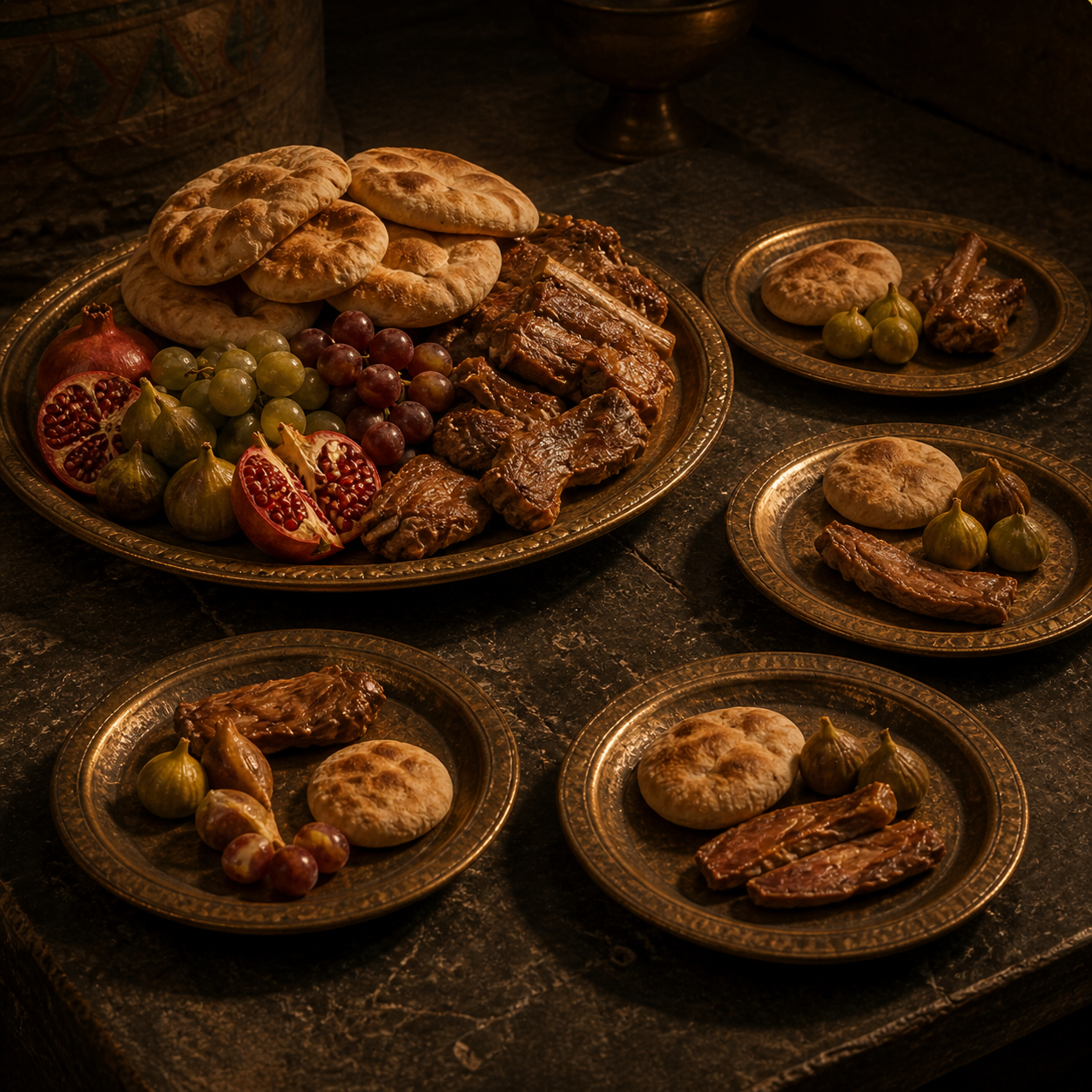
- Joseph arrives. The brothers bow with their gifts. They brought him the present which was in their hand into the house, and bowed themselves down to him to the earth. The Hebrew vayishtachavu lo arzah, “and they bowed themselves down to him to the earth,” is the same vocabulary the chapter has been using since 42:6. The dreams continue to be fulfilled.
- Joseph’s question (verse 27) is precise. Is your father well, the old man of whom you spoke? Is he yet alive? The Hebrew avikhem ha-zaken… ha-odennu chai, “your father the old man… is he still alive,” names the question with care. Joseph has not seen his father in over twenty-two years. He does not know if Jacob is still alive. The chapter is recording, with characteristic restraint, the question that has been on his heart since chapter 42’s information that the patriarch was still living.
- The brothers’ answer (verse 28) is also precise. Your servant, our father, is well. He is still alive. They bowed down humbly. The Hebrew is sparse. They confirm; they bow again.
- Verse 29 is the chapter’s deepest emotional moment. He lifted up his eyes, and saw Benjamin, his brother, his mother’s son. The Hebrew construction Binyamin achiv ben-immo, “Benjamin, his brother, son of his mother,” is doing genealogical-precision work the chapter has not done before. Joseph has eleven brothers; only one shares his mother. The chapter is naming, in the moment of seeing, exactly who Benjamin is to him.
- Is this your youngest brother, of whom you spoke to me? Joseph’s words are formal, addressing the brothers as the official has been. God be gracious to you, my son, addressed to Benjamin, is the warmest phrase Joseph has used in two chapters. The Hebrew Elohim yochnka beni, “God be gracious to you, my son,” uses the priestly-blessing formula (compare Numbers 6:25). Joseph is, in his first words to Benjamin, blessing him with the patriarchal benediction.
Influence callout: Tim Mackie
Mackie’s reading of this scene names it as the chapter’s central pastoral move. Joseph has been controlled, formal, harsh, calculating throughout chapters 42 and 43 so far. The sight of Benjamin breaks something. Mackie reads this as the cycle’s quiet teaching about the limits of disguise. Joseph can sustain the test for a long time. He cannot sustain it in the presence of his only full brother. The chapter is recording, in the body’s response, that the test has its emotional limit. The full brother breaks the formality. The full brother is the one who makes Joseph weep again.
- Joseph hurried, for his heart yearned over his brother; and he sought a place to weep. The Hebrew nikhmeru rachamav, “his womb-feelings were stirred up” (the Hebrew uses the body-vocabulary of deep maternal-fraternal feeling), names what is happening to him. He retires; he weeps in private; he washes his face; he comes out and says serve the meal. The Hebrew vayit’apaq, “and he controlled himself,” names the recovery. The chapter is recording the cost of the disguise on the disguised one.
- Verse 32 is the chapter’s quiet anthropological note. They served him by himself, and them by themselves, and the Egyptians, that ate with him, by themselves, because the Egyptians don’t eat with the Hebrews, for that is an abomination to the Egyptians. The Hebrew word to’evah, “abomination,” is the strong term for cultic-cultural taboo. The chapter is recording, in a single verse, that Egyptian and Hebrew custom did not allow shared meals. Three tables: Joseph alone, the brothers together, the Egyptian household members separately. The chapter is being honest about the cultural distance.
Pushback note
The detail about Egyptian-Hebrew table separation has been read by some commentators as evidence of Egyptian racial prejudice or anti-Hebrew sentiment. The chapter’s language is more cultural than racial. To’evah (abomination) is used elsewhere for ritual taboos and cultic boundaries; the Egyptians had specific food and pollution rules that often prevented inter-cultural meals. The chapter is recording, with characteristic restraint, the cultural reality of the moment. Joseph is positioned as part of the Egyptian elite (he eats by himself in Egyptian honor-position), the Egyptians are at their own table, and the Hebrews are at theirs. The chapter does not editorialize. The reality is recorded.
- Verse 33 records one of the chapter’s most striking details. They sat before him, the firstborn according to his birthright, and the youngest according to his youth, and the men marveled with one another. The Hebrew vayishavu… ish el-re’ehu, “and they sat… they were astonished, each man at his neighbor,” names what the brothers experienced. They had been seated by Joseph’s order. The seating arrangement was correct: Reuben at the place of the eldest, Benjamin at the place of the youngest, every other brother in between. The Egyptian official has, somehow, known the family’s birth order. The chapter is recording the brothers’ bewilderment without naming the source.
- He sent portions to them from before him, but Benjamin’s portion was five times as much as any of theirs (verse 34). The Hebrew chamesh yadot, “five hands” (i.e., five times the amount), names the disparity. Benjamin is being honored. The chapter is recording, in the meal’s portions, what Joseph cannot yet say in words: this is my brother. The five-times portion is the chapter’s coded language of family preference.
- They drank, and were merry with him. The Hebrew vayishtu vayishkeru imo, “and they drank and were intoxicated with him,” is the chapter’s closing line. The brothers, who arrived afraid and bowed in apology, end the chapter sharing wine with the Egyptian official they cannot identify. The reconciliation is happening at a level the brothers cannot yet name. Joseph is feeding them and not yet revealing himself. The cycle is being prepared for chapter 44, where the test will reach its climax.
Influence callout: Walter Brueggemann
Brueggemann’s reading of the chapter’s closing meal names it as the cycle’s quietest hinge. Nothing definitive happens here. The brothers do not learn who Joseph is; Joseph does not yet reveal himself; the test is not yet over. And yet they eat together. They drink together. They drank, and were merry with him. Brueggemann argues that the chapter is recording a small, partial reconciliation that has not yet been named: the family is sharing a table, even if the family does not yet know it. The chapter’s quiet teaching is that reconciliation, in the patriarchal narrative’s framing, can be happening before the recognition that names it. The meal precedes the reveal. The eating together prepares the recognition.
Reflection prompts
- Judah pledges himself for Benjamin: I will be collateral for him. If I don’t bring him to you, then let me bear the blame forever. The eldest by birth (Reuben) had offered his sons; the fourth son offers himself. Where in your life have you been Judah, putting your own person on the line rather than someone else’s? What does it cost to be the one who is willing to be required?
- Joseph weeps in private and returns to the meal in control. The chapter records the cost of the test on the tester. Where in your life are you currently bearing a cost that no one around you can see, and what does it mean to keep going through the test you have set up while bearing the weight of it alone?
- The brothers eat with Joseph and do not yet know who he is. They drank and were merry with him. The reconciliation is happening at a level they cannot name. Where in your life have you been participating in a relationship’s healing without knowing what was actually happening? What does it mean to consider that the meal itself was doing the work the recognition would later confirm?