
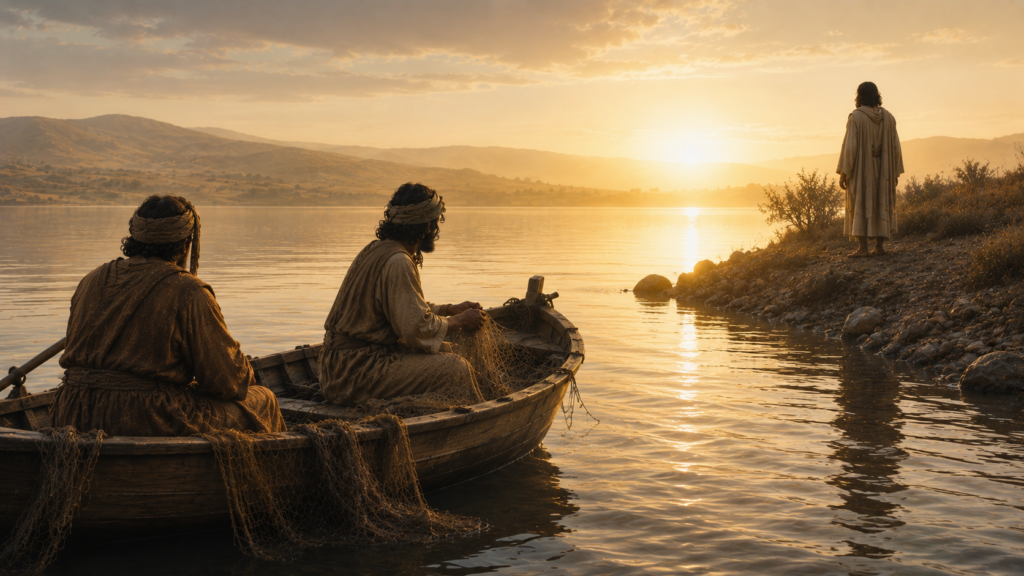
Matthew 4 takes Jesus from the river to the wilderness to the lake. The chapter has three movements. In the first (verses 1-11), the Spirit who descended on Jesus at the baptism leads him directly into the wilderness, where he fasts forty days and is tested by the devil. In the second (verses 12-17), Jesus hears that John has been arrested, withdraws to Galilee, and begins his public preaching with the same opening sermon John preached: repent, for the kingdom of heaven is at hand. In the third (verses 18-25), he calls the first four disciples (Peter, Andrew, James, John) along the shore of the Sea of Galilee, and his fame begins to spread across the whole region.
The chapter is dense with Israel-recapitulation typology. The forty days in the wilderness echoes Israel’s forty years (and Moses’s two periods of forty days on Sinai). The three temptations echo Israel’s three signature failures (the grumbling for bread, the testing of God at Massah, the worship of the golden calf). Each of Jesus’s three answers comes from Deuteronomy 6-8, the section of the Pentateuch that explicitly reflects on Israel’s wilderness-testing. Where Israel failed, Jesus succeeds. The chapter is teaching, in narrative form, that the figure being introduced is Israel-in-one-person, the faithful son who fulfills the vocation Israel did not.
Beneath the typology is the chapter’s pivot from Judea to Galilee. The setting moves from the wilderness of Judea (chapter 3) to the Sea of Galilee (chapter 4). The pivot is theological as well as geographic. Galilee was the Jewish religious establishment’s least-favored region; the gospel deliberately locates the ministry there. Galilee of the nations (the Hebrew Bible’s name for the region in Isaiah 9:1, cited by Matthew at 4:15) becomes the gospel’s launching pad. The pattern that began with the four foreign-blooded women in chapter 1, continued with the magi from the east in chapter 2, and was preached to the am ha’aretz in chapter 3 now takes geographic form. The kingdom of heaven is being inaugurated in a region the religious center has been writing off for centuries.
A · Matthew 4:1–11 · The wilderness and the three temptations
¹ Then Jesus was led up by the Spirit into the wilderness to be tempted by the devil. ² When he had fasted forty days and forty nights, he was hungry afterward. ³ The tempter came and said to him, “If you are the Son of God, command that these stones become bread.” ⁴ But he answered, “It is written, ‘Man shall not live by bread alone, but by every word that proceeds out of God’s mouth.’” ⁵ Then the devil took him into the holy city. He set him on the pinnacle of the temple, ⁶ and said to him, “If you are the Son of God, throw yourself down, for it is written, ‘He will put his angels in charge of you,’ and, ‘On their hands they will bear you up, so that you don’t dash your foot against a stone.’” ⁷ Jesus said to him, “Again, it is written, ‘You shall not test the Lord, your God.’” ⁸ Again, the devil took him to an exceedingly high mountain, and showed him all the kingdoms of the world and their glory. ⁹ He said to him, “I will give you all of these things, if you will fall down and worship me.” ¹⁰ Then Jesus said to him, “Get behind me, Satan! For it is written, ‘You shall worship the Lord your God, and you shall serve him only.’” ¹¹ Then the devil left him, and behold, angels came and served him. (Matthew 4:1–11, World English Bible)
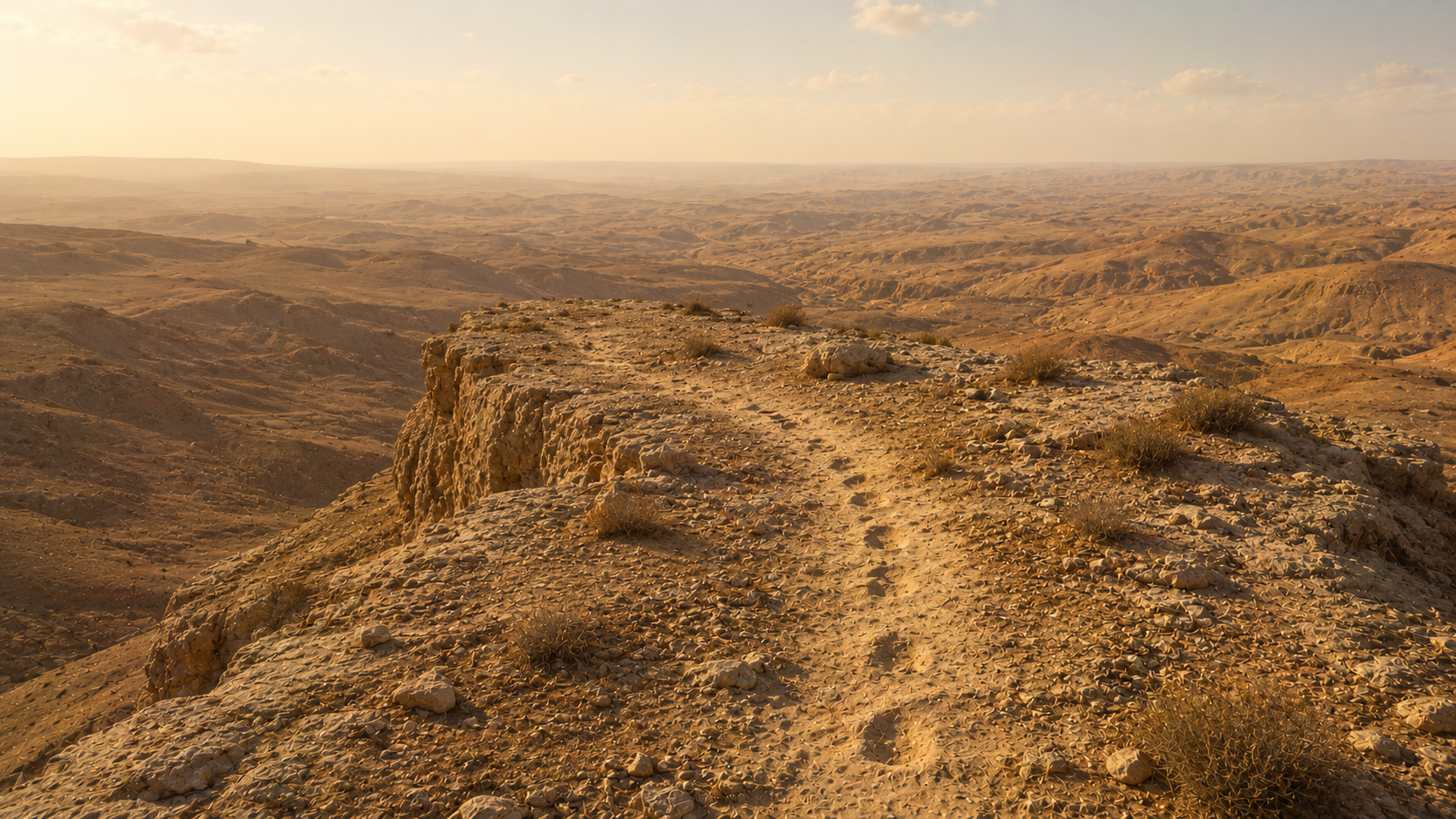
- Then Jesus was led up by the Spirit into the wilderness to be tempted by the devil (verse 1). The Greek anechthe hypo tou pneumatos eis ten eremon peirasthenai, “was led up by the Spirit into the wilderness to be tested,” names the agency. The Spirit who descended at the baptism is the same Spirit leading Jesus into the wilderness now. The chapter is recording, with characteristic narrative care, that the testing is not the devil’s idea; it is the Spirit’s leading. The wilderness is not a detour from the kingdom; the wilderness is where the kingdom’s representative gets tested.
Word study: peirazo (πειράζω), “to test, to tempt, to put on trial”
The Greek verb in 4:1 (peirasthenai, infinitive). Peirazo covers a wide range: to test, to examine, to tempt, to put on trial. The Septuagint uses the same root in Deuteronomy 8:2 for God’s testing of Israel in the wilderness: the Lord your God led you all the way these forty years in the wilderness, that he might humble you and test you. The chapter is doing deliberate Septuagint vocabulary. The word that names what God did to Israel is now naming what the Spirit does to Jesus through the devil’s challenge. The same testing that revealed Israel’s failures is now revealing Jesus’s faithfulness.
- When he had fasted forty days and forty nights, he was hungry afterward (verse 2). The Greek nesteusas hemeras tessarakonta kai nyktas tessarakonta, “having fasted forty days and forty nights,” uses the Septuagint’s exact phrasing for Moses’s two periods of fasting on Sinai (Exodus 24:18; 34:28). Jesus’s wilderness fast is being staged as a Mosaic pattern: he is in the wilderness, fasting forty days, about to receive a Torah-revelation event. The Sermon on the Mount in chapter 5 will be that revelation. The forty days also echoes Israel’s forty years (Numbers 14:33-34), and the chapter’s structure makes the deeper recapitulation explicit: each of the three temptations corresponds to one of Israel’s signature wilderness failures (the grumbling for bread in Exodus 16 and Numbers 11, the testing of God at Massah in Exodus 17, the worship of the golden calf in Exodus 32). Each of Jesus’s three answers comes from Deuteronomy 6-8, the Pentateuch’s deepest reflection on those failures. Where the corporate son grumbled, this son trusts. Where the corporate son tested, this son refuses to test. Where the corporate son worshiped the calf, this son worships only the Father. The chapter is the gospel’s most concentrated argument that Jesus is Israel-in-one-person.
Influence callout: Marty Solomon (the “order out of chaos” reading)
Solomon’s reading of the temptation names it as the gospel’s deliberate echo of Genesis 1. In Genesis 1:2, the Ruach Elohim (Spirit of God) was merahefet (hovering, brooding) over the tohu va-vohu (formless and empty waste, the primordial chaos). The Spirit’s work in Genesis 1 was bringing order out of chaos. The dove that descended on Jesus in Matthew 3:16 is the same Ruach (the dove imagery in Hebrew tradition is built on merahefet, the bird-like hovering of Genesis 1:2). When that Spirit immediately drives Jesus into the wilderness in Matthew 4:1, Solomon argues, the gospel is staging a deliberate creation-act. The Spirit is again hovering over a chaos (the wilderness, the place of testing, the place where Israel’s chaos was exposed), and the work being done is the same work as Genesis 1: order being brought out of chaos. Each of Jesus’s three Deuteronomy citations is, in Solomon’s reading, a small act of separation, a let there be order spoken into a chaos-suggestion. The chapter is recording, by deliberate Genesis-echo, that the new humanity has arrived in the wilderness with the original creation-Spirit on him, and is doing in real time what the Spirit did at the start of all things. The kingdom of heaven that arrives in chapter 4:17 is, on Solomon’s reading, the renewed-creation kingdom: the same Spirit’s same ordering work, now embodied in one human being who can carry it through.
- If you are the Son of God, command that these stones become bread (verse 3). The Greek ei huios ei tou theou, “if you are son of God,” picks up the heavenly voice from 3:17. The devil is testing the identity just declared. The chapter is recording, with characteristic narrative care, that the temptation is precisely the use of the divine sonship for self-provision. Bread from stones is not, in itself, sinful; the temptation is using the messianic identity to bypass the wilderness. The structural pattern across all three temptations is worth naming. Two voices have just spoken in the gospel. The first voice was the heavenly voice at the baptism: this is my beloved Son, with whom I am well pleased (3:17). The second voice is now the tempter’s, and the tempter’s voice opens with if you are the Son of God (4:3, 4:6). Each temptation is, at root, the offer of an alternative way to be the Son of God: a way that bypasses dependence on the Father’s word, a way that bypasses trust in the Father’s care, a way that bypasses the slow path through suffering to enthronement. The wilderness test is essentially a contest of voices. Jesus’s three Deuteronomy citations are the gospel’s first record of one Voice winning over another. Every later temptation in the gospel will be a re-run: the crowds urging political messianism in chapter 14, Peter rebuking the cross in chapter 16, the priests demanding signs at the cross in chapter 27. The chapter is teaching, by deliberate framing, that the deepest battle of the kingdom is not between Jesus and Satan as supernatural opponents; it is between the Father’s voice and every other voice that wants to redefine what Son of God means.
- Man shall not live by bread alone, but by every word that proceeds out of God’s mouth (verse 4). The citation is Deuteronomy 8:3, where Moses tells Israel that the wilderness manna was a teaching: the LORD humbled you and let you hunger and fed you with manna … that he might make you know that man does not live by bread alone, but … by everything that proceeds from the mouth of the LORD. Jesus answers the devil with Israel’s own wilderness lesson. The chapter is recording, with characteristic Hebrew Bible literacy, the deliberate Deuteronomy citation. The faithful son knows Israel’s wilderness Torah by heart and applies it.
- Then the devil took him into the holy city. He set him on the pinnacle of the temple (verse 5). The Greek to pterygion tou hierou, “the wing of the temple,” names the highest visible point of the temple complex, probably the southeastern corner overlooking the Kidron valley (a roughly four-hundred-foot drop). The chapter is recording, with characteristic cultural specificity, the most theologically charged location in the Jewish world: the temple, the place of God’s presence.
- He will put his angels in charge of you (verse 6). The devil quotes Psalm 91:11-12. The chapter is doing what every reader of scripture eventually encounters: the bible can be quoted out of context to make almost any point. The devil knows the text. He can cite it accurately. The temptation is to use a true biblical promise to manipulate God into a public demonstration.
- You shall not test the Lord, your God (verse 7). The citation is Deuteronomy 6:16, with the same context: you shall not put the LORD your God to the test, as you tested him at Massah. Massah was the wilderness location where Israel demanded water and complained against Moses (Exodus 17:7). Jesus refuses to repeat Massah. The temptation here is to do something spectacular at the religious center to compel God’s intervention and the people’s allegiance, and the kingdom Jesus is announcing will not run on spectacle. Every time someone later asks for a sign (12:38; 16:1), he will refuse. The pattern is being established now at the moment of testing.
- Again, the devil took him to an exceedingly high mountain, and showed him all the kingdoms of the world and their glory. He said to him, “I will give you all of these things, if you will fall down and worship me” (verses 8-9). The Greek panta tauta soi doso, “all these I will give to you,” is the chapter’s most loaded offer. The devil is offering the kingdoms; the gospel is announcing the kingdom of heaven. The temptation is to take the kingdoms-of-the-world version of kingship (military power, political authority, immediate global rule) instead of the kingdom-of-heaven version that comes through suffering, service, and the cross. The shortcut bypasses the cross. This is the same temptation Jesus will face throughout the gospel: the crowds’ wish to make him king by force (John 6:15), Peter’s rebuke at Caesarea Philippi (16:22-23), Pilate’s question about kingship (27:11). Get behind me, Satan! in 4:10 is the same rebuke Peter will receive in 16:23. The choice is being identified once at the wilderness and confirmed at every juncture.
- Get behind me, Satan! For it is written, “You shall worship the Lord your God, and you shall serve him only” (verse 10). The citation is Deuteronomy 6:13. The chapter is, in three Deuteronomy citations, completing the trilogy. By every word that proceeds from God’s mouth (Deut 8:3); you shall not test the Lord (Deut 6:16); you shall worship the Lord your God only (Deut 6:13). Three citations from the Pentateuch’s most concentrated reflection on Israel’s wilderness, each addressing one of the three temptations exactly. The Greek Satana is worth a quick note: it transliterates the Hebrew ha-satan, which is a title rather than a personal name. The Hebrew prefix ha- is the definite article (the); satan is the noun “accuser” or “adversary.” In the Hebrew Bible, ha-satan shows up as a heavenly courtroom figure (Job 1-2; Zechariah 3) whose role is to bring accusation, not as a fallen archangel with a personal name. By the first century, the figure has expanded in Jewish apocalyptic imagination, but the underlying vocabulary still names a function: this is the accuser, the one whose work is to prosecute the case against the Son of God’s vocation. Jesus’s get behind me, accuser is not personal-name banter; it is the Son refusing the prosecutor’s case.
- Then the devil left him, and behold, angels came and served him (verse 11). The Greek prosselthon kai diekonoun auto, “approached and were serving him,” uses the same verb (diakoneo) that Mark 1:13 uses in the parallel passage. The chapter is recording, with characteristic narrative restraint, the wilderness’s quiet end. The testing is over; the angels minister; the public ministry can begin.
B · Matthew 4:12–17 · The pivot to Galilee and the gospel’s opening sermon
¹² Now when Jesus heard that John was delivered up, he withdrew into Galilee. ¹³ Leaving Nazareth, he came and lived in Capernaum, which is by the sea, in the region of Zebulun and Naphtali, ¹⁴ that it might be fulfilled which was spoken through Isaiah the prophet, saying, ¹⁵ “The land of Zebulun and the land of Naphtali, toward the sea, beyond the Jordan, Galilee of the Gentiles, ¹⁶ the people who sat in darkness saw a great light; to those who sat in the region and shadow of death, to them light has dawned.” ¹⁷ From that time, Jesus began to preach, and to say, “Repent! For the Kingdom of Heaven is at hand.” (Matthew 4:12–17, World English Bible)
- Now when Jesus heard that John was delivered up, he withdrew into Galilee (verse 12). The Greek paredothe, “was handed over,” is the same passive verb the gospel will use of Jesus’s own arrest (10:4; 17:22; 26:2; etc.). The chapter is recording, with characteristic verbal precision, that John’s fate prefigures Jesus’s. The forerunner is handed over first; the one he forerun will follow the same path. The verb the English usually translates withdrew (Greek anechoresen) is worth flagging because the standard English translation can mislead. Anechoresen can mean withdrew in the sense of retreated, but it can equally mean returned or went back, which fits the geography better. Jesus is not retreating in fear from the news of John’s arrest. Herod Antipas, the same ruler who has just arrested John, has his Galilean capital at Tiberias on the Sea of Galilee, less than an hour’s walk from where Jesus settles in Capernaum. If Jesus were retreating from political danger, Galilee would be the wrong direction. The chapter is recording the opposite move: Jesus hears that John has been arrested by Herod, leaves the wilderness of Judea, and goes back north to set up shop under Herod’s nose, in the very region Herod claims to rule. The Galilean ministry is launched, by deliberate geographic placement, on the doorstep of the king who has just arrested the Messiah’s forerunner.
- Leaving Nazareth, he came and lived in Capernaum, which is by the sea, in the region of Zebulun and Naphtali (verse 13). Capernaum was a fishing town on the northwest shore of the Sea of Galilee, with a population of probably 1,500-2,000 in the first century. It sat at the boundary of the territories of Zebulun and Naphtali, two of the northern tribes whose land was the first to fall to the Assyrians in 732 BCE. The chapter is recording, with characteristic geographic precision, that Jesus has moved his base from a small inland village to a lakeshore trading town in the region the Hebrew Bible most associates with judgment, exile, and eventual restoration.
- That it might be fulfilled which was spoken through Isaiah the prophet (verse 14). The citation that follows is Isaiah 9:1-2. The chapter is recording, with characteristic narrative care, the gospel’s fourth fulfillment formula in four chapters (after Isaiah 7:14 in chapter 1, the Bethlehem composite and Hosea 11:1 in chapter 2, and Isaiah 40:3 in chapter 3). Matthew is teaching the reader to expect these formulas; he will keep using them.
- Galilee of the Gentiles, the people who sat in darkness saw a great light (verses 15-16). The Greek Galilaia ton ethnon, “Galilee of the nations,” is the citation’s most loaded phrase. Ethnos is the Greek word for Gentile. The Hebrew Bible has used this name for Galilee since Isaiah 9:1: the northern region had been settled by Gentiles after the Assyrian deportation, and the name had stuck even after Jewish repopulation in later centuries. By the first century, Galilee was a mixed region with a Jewish majority but significant non-Jewish presence. The Pharisaic religious center in Jerusalem was suspicious of Galilean Jewish piety as compromised by Gentile contact. The Messiah’s ministry is being launched, by deliberate quotation, in the region the religious establishment most associates with Gentile contamination. Light has dawned in Galilee of the nations, not in the temple; in the region of Zebulun and Naphtali, not in Judea. Capernaum itself sat on the Via Maris, the international trade road that connected Damascus to the Mediterranean, with toll stations and commercial traffic and a multilingual population (Aramaic, Greek, and some Latin and Phoenician would have been heard daily). The Messiah has set up base in a crossroads town designed for the message to spread.
- From that time, Jesus began to preach, and to say, “Repent! For the Kingdom of Heaven is at hand” (verse 17). The Greek metanoeite, engiken gar he basileia ton ouranon is identical to John’s opening sermon at 3:2. John and Jesus preach the same opening message: the kingdom is the news, metanoia (repentance) is the response. Jesus is not introducing a new gospel; he is continuing what John began. The forerunner has been handed over; the kingdom-announcer continues the announcement, in the same words, from a new geographic base.
C · Matthew 4:18–25 · The first four disciples and the spread of the ministry
¹⁸ Walking by the sea of Galilee, he saw two brothers: Simon, who is called Peter, and Andrew, his brother, casting a net into the sea; for they were fishermen. ¹⁹ He said to them, “Come after me, and I will make you fishers for men.” ²⁰ They immediately left their nets and followed him. ²¹ Going on from there, he saw two other brothers, James the son of Zebedee, and John his brother, in the boat with Zebedee their father, mending their nets. He called them. ²² They immediately left the boat and their father, and followed him. ²³ Jesus went about in all Galilee, teaching in their synagogues, preaching the Good News of the Kingdom, and healing every disease and every sickness among the people. ²⁴ The report about him went out into all Syria. They brought to him all who were sick, afflicted with various diseases and torments, possessed with demons, epileptics, and paralytics; and he healed them. ²⁵ Great multitudes from Galilee, Decapolis, Jerusalem, Judea, and from beyond the Jordan followed him. (Matthew 4:18–25, World English Bible)
- Walking by the sea of Galilee, he saw two brothers: Simon, who is called Peter, and Andrew, his brother (verse 18). The Greek thalassa (sea) is, technically, an exaggeration for what is actually a freshwater lake about thirteen miles long and seven wide. But thalassa is the Septuagint’s term, and Matthew uses it consistently. The chapter is recording, with characteristic narrative restraint, the start of the disciple-calling pattern.
- Casting a net into the sea; for they were fishermen (verse 18b). The Greek amphiblestron, “casting net,” names the small round throw-net the brothers were using from the shore (rather than a boat). The chapter is recording, with characteristic cultural specificity, the technique. Andrew and Simon are working close to the water’s edge.
- Come after me, and I will make you fishers for men (verse 19). The Greek deute opiso mou, kai poieso hymas halieis anthropon, “come after me and I will make you fishers of humans,” is the chapter’s most famous saying. The phrase fishers of men has Hebrew Bible resonance: Jeremiah 16:16 (I will send for many fishermen, says the LORD, and they shall catch them) and Amos 4:2 (they shall take you away with hooks) both use the fishing metaphor for divine gathering, sometimes for judgment. Matthew is doing the prophetic-language echo: the disciples are being commissioned for the gathering of God’s people.
Influence callout: Ray Vander Laan
Vander Laan’s reading of the call to Peter and Andrew names the rabbinic-discipleship texture. In first-century Jewish religious culture, a young man’s path to becoming a disciple of a famous rabbi was rigorous and selective. The most promising students of Torah were tested first under the village synagogue teacher (beit sefer, ages 6-10), then under more advanced study (beit talmud, ages 10-14), then those who excelled were eligible to apply to a famous rabbi for full discipleship (beit midrash, age 14 onward). The vast majority of Jewish boys did not make it past beit talmud. They went home to learn their father’s trade. Peter and Andrew are fishermen, which means they had been culled out of the rabbinic track. They are exactly the kind of young men the religious establishment had decided were not bright enough for serious Torah study. Vander Laan argues that the chapter is recording, by deliberate calling-of-fishermen, that the rabbi who is calling them is reversing the normal selection. He is calling the boys whose own community had decided they were not good enough. The pattern matches the gospel’s mumzer logic exactly.
- They immediately left their nets and followed him (verse 20). The Greek eutheos aphentes ta diktya ekolouthesan auto, “immediately leaving the nets they followed him,” names the response. Eutheos (immediately) is the chapter’s narrative pace. The chapter is not interested in deliberation; it is recording obedience. The same verb is used of James and John in verse 22.
- Going on from there, he saw two other brothers, James the son of Zebedee, and John his brother, in the boat with Zebedee their father, mending their nets. He called them. They immediately left the boat and their father, and followed him (verses 21-22). The Greek aphentes to ploion kai ton patera auton, “leaving the boat and their father,” names the cost. James and John leave both their family business and their family. Two pairs of brothers, two callings, two responses, two immediately-leavings. The chapter is establishing, at the start of the gospel’s ministry, the standard pattern of discipleship: it involves leaving (the nets, the boat, the father), and it involves immediate following. The pattern will be tested in chapter 8 (foxes have holes, but the Son of Man has nowhere to lay his head), in chapter 19 (go and sell what you have), and in chapter 26 (they all forsook him and fled). Each of those scenes is a variation on the four-fishermen call.
- Jesus went about in all Galilee, teaching in their synagogues, preaching the Good News of the Kingdom, and healing every disease and every sickness among the people (verse 23). The Greek triplet didaskon, kerysson, therapeuon, “teaching, preaching, healing,” names the threefold pattern of the gospel’s ministry. The pattern will recur at 9:35 in nearly identical wording. The chapter is establishing the structural template for the ministry sections that fill the gospel’s narrative blocks: Jesus teaches in synagogues, preaches the kingdom in the open, and heals the sick wherever they come.
- The report about him went out into all Syria. They brought to him all who were sick (verses 24). The Greek Syria names the Roman province north and east of Galilee. The chapter is recording, with characteristic geographic care, that the report has crossed the political boundary. People are coming from Syria for healing. The kingdom announcement is already crossing into Gentile territory.
- Great multitudes from Galilee, Decapolis, Jerusalem, Judea, and from beyond the Jordan followed him (verse 25). The Greek lists five regions. Decapolis (the ten cities) is a federation of Greek cities east of the Jordan, predominantly Gentile. Beyond the Jordan (Greek peran tou Iordanou) refers to Perea, the region east of the Jordan. The five-region list is worth slowing down on, because the regions named had been at cultural odds with each other for centuries. Judeans and Galileans regarded one another with the kind of mutual suspicion that runs along regional fault lines (Jerusalem-trained Pharisees regarded Galileans as religiously lax; Galileans regarded the Jerusalem establishment as politically compromised). The Decapolis was so thoroughly Gentile and Greco-Roman that observant Galilean Jews would have considered the very name unclean. Verse 24 also notes that the report spread into all Syria, the Roman province that bordered Galilee to the north and east, again predominantly Gentile. The chapter is recording, with characteristic narrative restraint, that the kingdom announcement is already gathering precisely the people who would have refused to share a meal with one another a year earlier. The list also pulls in those at the social margins (the demon-possessed, the epileptic, the paralytic), the people the religious community would have classified as ritually impure and kept at a distance. The chapter does not yet announce the formal Gentile mission (that will come in chapter 28); it is showing, in narrative form, that the all the families of the earth shall be blessed of Genesis 12:3 is already starting to happen at the launch, and that the kingdom’s first public crowd is the kind of crowd no respectable first-century religious figure would have wanted to be associated with. The Sermon on the Mount in chapter 5 will be delivered to this multi-region, mixed-status crowd. The new Moses speaks his Torah from the mountain, and the audience already includes the nations.
Reflection prompts
- The Spirit who descended on Jesus at the baptism is the same Spirit who leads him into the wilderness to be tested. The kingdom’s representative does not skip the wilderness; he is led there. Where in your life are you currently in some form of wilderness, and what does it mean to consider that the Spirit may have led you there for testing rather than abandoned you in it?
- Each of Jesus’s three answers to the devil comes from Deuteronomy 6-8, the Pentateuch’s deepest reflection on Israel’s wilderness failure. The faithful son knows Israel’s Torah by heart and applies it precisely where Israel did not. Where in your life is your knowledge of Scripture deep enough to be applied at the moment of testing, and where is it still surface-level, recited but not yet absorbed into action?
- The Messiah calls his first disciples from among the fishermen of an obscure lake town, the working-class boys whose own religious establishment had decided they were not bright enough for serious Torah study. Where in your life have you accepted the verdict of some establishment that you are not the kind of person God would call, and what does it mean to consider that this is exactly the kind of background the kingdom has always preferred?