
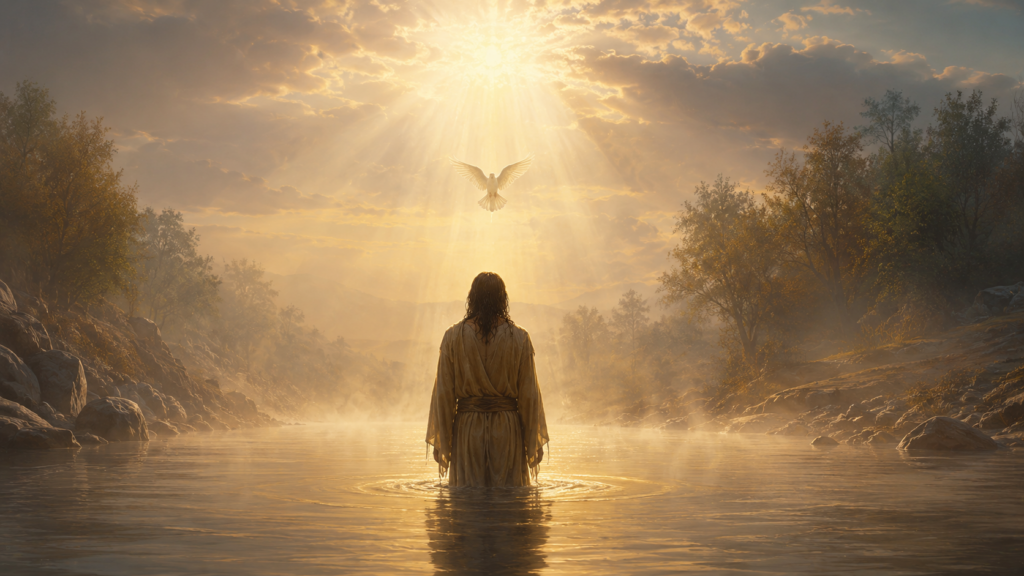
Matthew 3 is the gospel’s launching chapter. The narrative jumps roughly thirty years from chapter 2’s Nazareth settlement to the public ministry of John the Baptist in the Judean wilderness. The chapter has two scenes. In the first, John appears in the wilderness preaching repentance, baptizing crowds in the Jordan, and confronting the religious establishment when they show up to be baptized themselves. In the second, Jesus comes to John to be baptized, John resists, Jesus insists, and at the moment of baptism the heavens open, the Spirit descends, and a voice from heaven names Jesus as the beloved Son.
The chapter is, in narrative terms, the formal commissioning of Jesus’s ministry. In Hebrew Bible terms, the chapter is the convergence point of three major prophetic patterns. John fulfills the voice crying in the wilderness of Isaiah 40:3 (the new exodus prophecy). John fulfills the Elijah who is to come of Malachi 4:5 (the messianic-forerunner prophecy). The baptism of Jesus fulfills the spirit descending of Isaiah 11:2 and the beloved son of Psalm 2:7 (the messianic-anointing pattern). The chapter is gathering, in twenty-three verses, the three prophetic threads that the rest of the gospel will continue to weave.
Beneath those structural moves is the chapter’s deepest theological claim: the inauguration of the kingdom of heaven. Both John (verse 2) and Jesus (4:17) will preach the same message in identical Greek: repent, for the kingdom of heaven is at hand. The chapter is establishing the gospel’s primary vocabulary. The kingdom is breaking in, and the response is teshuvah, the Hebrew turning that the Greek metanoia translates.
A · Matthew 3:1–12 · The voice in the wilderness
¹ In those days, John the Baptizer came, preaching in the wilderness of Judea, saying, ² “Repent, for the Kingdom of Heaven is at hand!” ³ For this is he who was spoken of by Isaiah the prophet, saying, “The voice of one crying in the wilderness, make ready the way of the Lord. Make his paths straight.” ⁴ Now John himself wore clothing made of camel’s hair with a leather belt around his waist. His food was locusts and wild honey. ⁵ Then people from Jerusalem, all of Judea, and all the region around the Jordan went out to him. ⁶ They were baptized by him in the Jordan, confessing their sins. ⁷ But when he saw many of the Pharisees and Sadducees coming for his baptism, he said to them, “You offspring of vipers, who warned you to flee from the wrath to come? ⁸ Therefore produce fruit worthy of repentance! ⁹ Don’t think to yourselves, ‘We have Abraham for our father,’ for I tell you that God is able to raise up children to Abraham from these stones. ¹⁰ Even now the ax lies at the root of the trees. Therefore every tree that doesn’t produce good fruit is cut down, and cast into the fire. ¹¹ I indeed baptize you in water for repentance, but he who comes after me is mightier than I, whose sandals I am not worthy to carry. He will baptize you in the Holy Spirit. ¹² His winnowing fork is in his hand, and he will thoroughly cleanse his threshing floor. He will gather his wheat into the barn, but the chaff he will burn up with unquenchable fire.” (Matthew 3:1–12, World English Bible)
- In those days, John the Baptizer came, preaching in the wilderness of Judea (verse 1). The Greek en de tais hemerais ekeinais paraginetai Ioannes ho baptistes, “in those days John the baptist appeared,” uses prophetic-narrative idiom. The phrase in those days is the Septuagint’s standard transition for prophetic events; it deliberately blurs the chronological gap between chapter 2 (the infant in Nazareth) and chapter 3 (the adult ministry). Matthew is not interested in the silent years; he is signaling that the prophetic time has resumed.
- In the wilderness of Judea. The Greek en te eremo tes Ioudaias, “in the wilderness of Judea,” names a specific geographic region: the dry rocky terrain east of Jerusalem descending to the Jordan and the Dead Sea. The wilderness was, in Hebrew Bible memory, the place of Israel’s formation (Exodus 13:18; Deuteronomy 8:2-5), the place of Elijah’s flight (1 Kings 19), and the place to which the prophets repeatedly summoned Israel for renewal (Hosea 2:14: I will allure her, and bring her into the wilderness, and speak to her heart). The chapter is staging John in the prophetic wilderness deliberately.
- Repent, for the Kingdom of Heaven is at hand (verse 2). The Greek metanoeite, engiken gar he basileia ton ouranon, “repent, for the kingdom of the heavens has drawn near,” is the gospel’s first sermon, and it will be Jesus’s first sermon too (4:17, in identical Greek). John and Jesus preach the same opening message. The Greek metanoia (built from meta, “after/with,” and noia, “mind”) translates the Hebrew teshuvah, from the root shuv, to turn or to return. The Hebrew is more concrete than the Greek: teshuvah is a turning of the whole person back toward God. The chapter is calling for this Hebrew kind of turning, and teshuvah in first-century Jewish practice was not a one-time decision but the recurring pattern of the High Holy Days, the Yom Kippur cycle, the daily prayer-life of the observant Jew. John is not introducing a new concept; he is calling Israel back to its deepest practice with a new urgency. There is also a stepping-into dimension to John’s call that the river setting amplifies. Teshuvah in the Hebrew Bible is not only a turning away from something; it is a turning toward something, and at the Jordan that turning is being enacted bodily. The crowds are not simply confessing internally; they are walking down to the river, getting into the water, and emerging on the other side. The kingdom John is preaching is not something to be agreed with at a distance; it is something to be stepped into. The chapter is recording, in its Jordan-river setting, that the response the kingdom calls for is the kind of turning whose first movement is the body’s.
Influence callout: Marty Solomon (the Tavilah T’shuvah reading)
Solomon’s reading of John’s baptism names what is actually happening at the Jordan in its first-century Jewish context. John is not introducing Christian baptism (Christian baptism does not exist yet; Jesus is not yet on the scene). John is performing what David Stern’s Jewish New Testament Commentary calls the work of the Immerser, a Hebrew/Jewish ritual practice. The Hebrew word is tavilah, ritual immersion in a mikveh (a body of natural living water), and it has a long pre-Christian Jewish history. Tavilah was practiced for ritual purification (Leviticus 15), for conversion to Judaism by Gentiles, and as a public declaration of repentance. Solomon names what John is doing as Tavilah T’shuvah, “an immersion of repentance/return,” a Jewish liturgical act with the closest first-century parallel in the Essene community at Qumran (which practiced multiple daily ritual immersions in the wilderness, with a strong eschatological framing). Solomon argues that the chapter is recording, in its specifically Jewish vocabulary, that John’s baptism is not a renunciation of Judaism but its deepest expression. The person submitting to tavilah is making a public statement to the watching community: I am choosing to walk the path correctly. It is not a claim of perfection; it is a declared orientation. The chapter is honest about the cultural location of the act. John is in the wilderness, baptizing in the Jordan, calling Israel to a rite that was already part of their religious vocabulary, but with a new urgency: the kingdom of heaven is at hand.
Word study: basileia ton ouranon (βασιλεία τῶν οὐρανῶν), “the kingdom of the heavens”
Matthew’s signature phrase, used about thirty-two times in this gospel, almost never in the others. Mark and Luke use basileia tou theou (kingdom of God); Matthew prefers the plural kingdom of the heavens. The phrase is a first-century Jewish circumlocution for the kingdom of God, using heaven in place of God out of reverence for the divine name. The two phrases are functionally synonymous; the difference is the audience. Matthew is writing for a Jewish-Christian community that prefers the circumlocution. The chapter is using the gospel’s signature phrase from its very first sermon. The kingdom is breaking in, and the heavens is Matthew’s way of naming the breaking-in source.
- Voice of one crying in the wilderness, make ready the way of the Lord (verse 3). The citation is Isaiah 40:3. In the original Isaiah passage, the verse opens the great new-exodus oracle (Isaiah 40-55), the prophet’s announcement that God is about to lead the exiles back from Babylon along a wilderness highway. Matthew is identifying John as the voice and the new exodus as the kingdom now arriving. The chapter is making a sweeping theological claim: the long-promised new exodus, anticipated by Isaiah, is happening now.
- Now John himself wore clothing made of camel’s hair with a leather belt around his waist (verse 4). The Greek zonen dermatinen peri ten osphyn autou, “a leather belt around his waist,” is a deliberate verbal echo of 2 Kings 1:8, where Elijah is described as a hairy man, with a leather belt around his waist. Matthew is signaling, in a single sartorial detail, that John is the new Elijah. The Hebrew Bible’s last prophetic word, in the closing verses of Malachi (4:5-6), promised that Elijah would return before the great and terrible day of the Lord. John is, in his clothing, claiming that lineage. The chapter is closing the four-hundred-year prophetic silence in five Greek words about a man’s belt. There is also a plausible cultural-historical layer worth naming. John’s location (the Judean wilderness near the lower Jordan), his ascetic diet (locusts and wild honey, the wilderness food permissible under Levitical law), his immersion practice, and his eschatological intensity all overlap closely with the profile of the Essenes, the Jewish sectarian community based at Qumran on the northwest shore of the Dead Sea. The Essene community was famous for ritual immersions performed multiple times a day, for a strong wilderness orientation, for an apocalyptic expectation of a coming day of the Lord, and for a strict separation from what they regarded as a corrupted Jerusalem priesthood. The text of 1 Maccabees, Josephus, Philo, and the Dead Sea Scrolls themselves describe a community whose practices line up with John’s at striking points. Some scholars argue John was raised among the Essenes or trained in their orbit before going public; others argue he was an independent Jewish prophet who happened to share the wilderness real estate and some of the eschatological vocabulary. The text does not settle the question. What is clear is that the chapter is locating John in an actual Jewish religious world, not in a Christian-clerical one. Whatever John’s exact relationship to the Qumran sect, he is operating inside the kind of Second-Temple Jewish wilderness piety that was already preparing the ground for the kingdom announcement.
- Then people from Jerusalem, all of Judea, and all the region around the Jordan went out to him. They were baptized by him in the Jordan, confessing their sins (verses 5-6). The Greek eksomologoumenoi tas hamartias auton, “confessing their sins,” names the practice. The chapter is recording, with characteristic narrative restraint, a mass renewal movement. Crowds from the religious capital, the surrounding region, and the entire Jordan valley are coming to be immersed in the river by an Elijah-figure preaching the kingdom’s arrival.
Influence callout: Marty Solomon (the mumzer reading continues)
Solomon’s reading of John’s confrontation with the Pharisees and Sadducees names it as the gospel’s first explicit application of the mumzer agenda to the religious establishment. The crowds coming for repentance are the ordinary Jews of Judea, the people the religious establishment would have classified as am ha’aretz (the people of the land, a slightly dismissive Pharisaic term for the un-rabbinic majority). When the religious establishment itself shows up at the Jordan, John reverses the normal social ranking: the un-rabbinic crowds get baptism without challenge; the Pharisees and Sadducees get brood of vipers. Solomon argues that the chapter is enacting the gospel’s mumzer logic from the launching scene. The insiders are warned; the outsiders are welcomed. The pattern that began with the four women in the genealogy is now being preached from the riverbank.
- You offspring of vipers, who warned you to flee from the wrath to come? (verse 7). The Greek gennemata echidnon, “broods of vipers,” is the chapter’s most unsparing line. The serpent imagery echoes Genesis 3 (the serpent of Eden), Isaiah 59:5 (the wicked who hatch viper’s eggs), and the Hebrew Bible’s repeated use of the snake as a figure for deception. John is not flattering. He is naming.
- Don’t think to yourselves, “We have Abraham for our father,” for I tell you that God is able to raise up children to Abraham from these stones (verse 9). The Greek ek ton lithon touton, “from these stones,” is a Hebrew-Aramaic wordplay. The Hebrew word for children is banim; the Hebrew word for stones is avanim. The two words sound nearly identical, differing by a single Hebrew letter (aleph) at the front. John is making a pun that is also a theological argument: God can produce banim (children) from avanim (stones). Lineage from Abraham is not biological certainty but God’s creative power. The genealogy of chapter 1 prepared this argument; John is now preaching it directly.
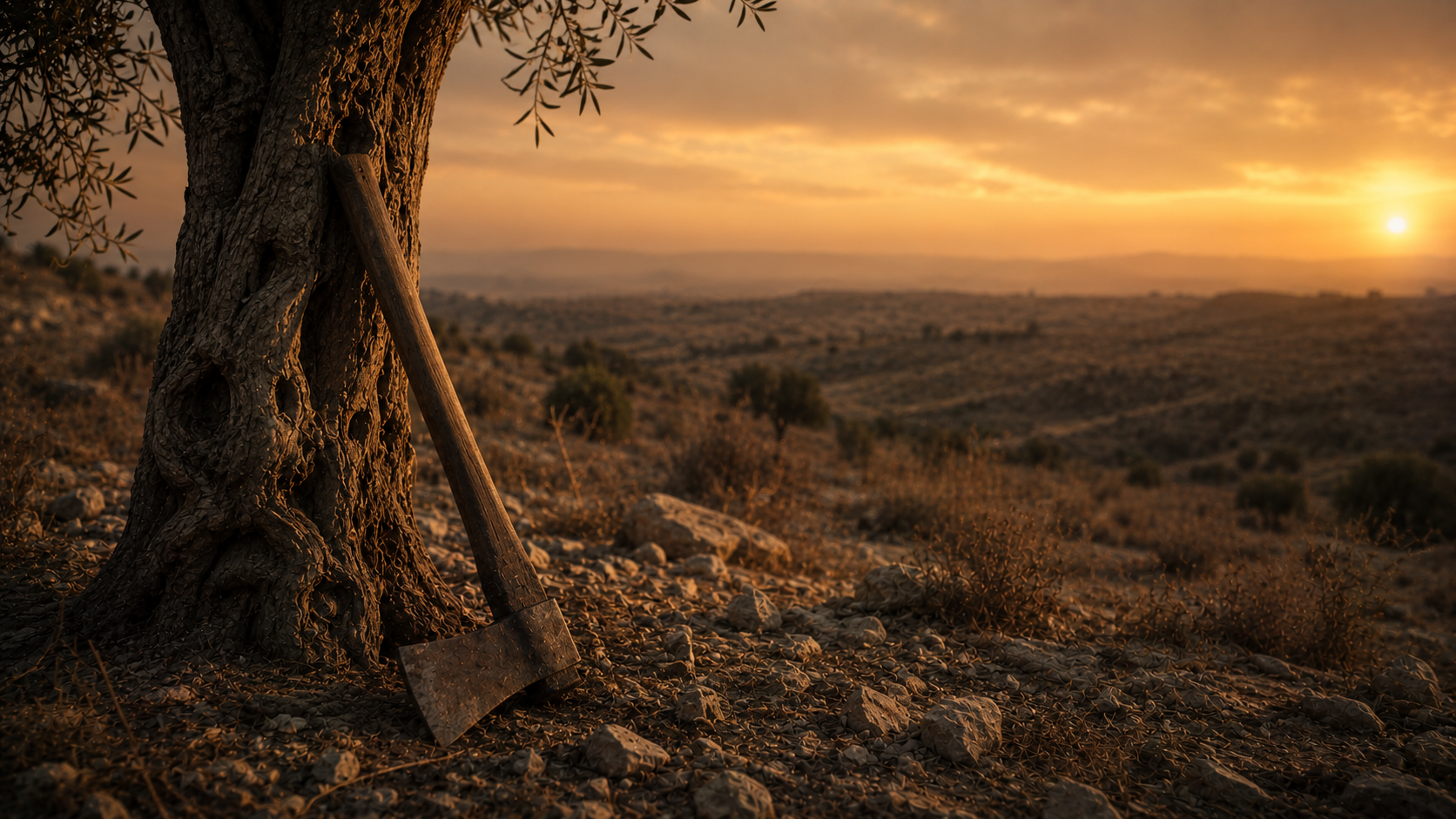
- Even now the ax lies at the root of the trees (verse 10). The image is judgment-arboriculture. The fruitless tree is cut down. The chapter is recording, with characteristic narrative directness, the urgency of John’s preaching. The kingdom’s arrival is also a moment of evaluation. The harvest-and-judgment imagery (the ax, the chaff, the unquenchable fire) will recur throughout the gospel.
- He who comes after me is mightier than I, whose sandals I am not worthy to carry. He will baptize you in the Holy Spirit (verse 11). The Greek en pneumati hagio kai pyri, “in the Holy Spirit and fire,” promises a baptism more thoroughgoing than John’s own. Whose sandals I am not worthy to carry invokes a rabbinic legal saying that a disciple does for his rabbi everything except carrying his sandals (which was reserved for slaves rather than disciples). John is saying he is unworthy to do for Jesus even the lowest service. The greatest prophet in the Hebrew tradition’s lineage (Jesus will later confirm in 11:11 that among those born of women there has not arisen anyone greater than John the Baptist) ranks himself below the slave-status of Jesus’s footwear. John points to Jesus and steps back. The chapter is establishing the model.
- His winnowing fork is in his hand, and he will thoroughly cleanse his threshing floor (verse 12). The Greek to ptyon en te cheiri autou, “the winnowing fork in his hand,” names an agricultural tool used to throw harvested grain into the air so the wind separates the heavier wheat (which falls back) from the lighter chaff (which blows away). The image is harvest judgment. The chapter is recording, with characteristic narrative directness, the urgency of the kingdom announcement. There is also a Hebrew Bible resonance worth tracing: the most famous threshing floor in the Hebrew Bible is the threshing floor of Araunah the Jebusite (2 Samuel 24:18-25), the spot David purchased and on which Solomon eventually built the temple (2 Chronicles 3:1). The temple itself sits on a threshing floor. By the first century, the temple has become, in the prophetic imagination, the place where God’s people were supposed to be sifted and purified, but which had become the place where the religious establishment kept the chaff and let the wheat blow away. John’s image, on this reading, is not just generic harvest imagery but a quiet prophetic indictment: the real threshing floor is wherever the Messiah is, and the cleansing of his threshing floor is going to do what the temple system has stopped doing. The pattern will recur in the gospel when Jesus walks into the temple in chapter 21 and overturns the tables. The winnowing fork that John names here is the same purifying work that Jesus will eventually carry out at the literal threshing floor where the temple stands.
B · Matthew 3:13–17 · The baptism of Jesus
¹³ Then Jesus came from Galilee to the Jordan to John, to be baptized by him. ¹⁴ But John would have hindered him, saying, “I need to be baptized by you, and you come to me?” ¹⁵ But Jesus, answering, said to him, “Allow it now, for this is the fitting way for us to fulfill all righteousness.” Then he allowed him. ¹⁶ Jesus, when he was baptized, went up directly from the water; and behold, the heavens were opened to him. He saw the Spirit of God descending as a dove, and coming on him. ¹⁷ Behold, a voice out of the heavens said, “This is my beloved Son, with whom I am well pleased.” (Matthew 3:13–17, World English Bible)
- Then Jesus came from Galilee to the Jordan to John (verse 13). The Greek paraginetai ho Iesous apo tes Galilaias, “Jesus came from the Galilee,” names the journey. Jesus has come from Nazareth, walked the day’s journey south, and joined the crowds at the Jordan. The chapter is recording, with characteristic narrative restraint, that Jesus’s first public action is to identify with the crowds the religious establishment has been dismissing.
- But John would have hindered him, saying, “I need to be baptized by you, and you come to me?” (verse 14). The Greek diekolyen auton, “was preventing him,” names John’s resistance. The chapter is recording John’s perception of the moment. He has just preached that the one coming after him is mightier; now that one is in the water-line waiting to be baptized for repentance. John reads the moment correctly and resists.
- Allow it now, for this is the fitting way for us to fulfill all righteousness (verse 15). The Greek plerosai pasan dikaiosynen, “to fulfill all righteousness,” is the chapter’s most theologically loaded clause. Pleroo (to fulfill) is the verb that runs through the chapter’s fulfillment-citations. Pasa dikaiosyne (all righteousness) is the comprehensive category that the Sermon on the Mount will spend three chapters defining. Righteousness, in the chapter’s vocabulary, is not abstract moral perfection; it is the right covenant alignment that the king is now embodying on behalf of the people. Jesus is not in the river because he needs repentance for his own sins; he is in the river because he is identifying with the people who do. The Messiah does not stand apart from the people he has come to save; he stands with them, in their water, in their Jordan, in their teshuvah. The Jordan itself amplifies the move: this is the river Joshua led Israel across to enter the land (Joshua 3-4), the river Elijah and Elisha crossed at the moment of prophetic succession (2 Kings 2), the river Naaman the Syrian was washed in for healing (2 Kings 5). The river of crossing-into-the-promise, prophetic transition, and outsider cleansing all converge at this baptism.
- Jesus, when he was baptized, went up directly from the water; and behold, the heavens were opened to him (verse 16). The Greek eneoichthesan hoi ouranoi, “the heavens were opened,” is a deliberate echo of Isaiah 64:1 (oh that you would tear the heavens and come down) and Ezekiel 1:1 (the heavens were opened, and I saw visions of God). The chapter is recording, with characteristic Hebrew Bible literacy, that the long-prayed-for tearing-open of the heavens has happened. The barrier between heaven and earth, the prophets’ deepest hope, is now permeable.
- He saw the Spirit of God descending as a dove, and coming on him (verse 16b). The dove imagery has been read several ways. The most likely Hebrew Bible echo is Genesis 1:2 (the Spirit of God hovered over the waters), where the verb merachepheth (hover, brood) suggests bird-imagery. The dove also appears in Genesis 8:8-12, where Noah sends a dove out from the ark over the post-flood world, looking for dry land, finally finding an olive branch and signaling that creation can begin again. In Matthew 3, the dove descends on a single human being and stays. The Spirit who has been looking for a dry place to land has found one. Jesus is, in the dove’s resting, the new humanity on whom the Spirit can permanently dwell.
- Behold, a voice out of the heavens said, “This is my beloved Son, with whom I am well pleased” (verse 17). The voice combines two Hebrew Bible passages. This is my beloved Son echoes Psalm 2:7 (you are my son; today I have begotten you), the messianic-coronation psalm. With whom I am well pleased echoes Isaiah 42:1 (here is my servant, whom I uphold; my chosen, in whom my soul delights), the first servant song. The chapter is, in one short heavenly speech, naming Jesus as both the messianic king (Psalm 2) and the suffering servant (Isaiah 42). The two great Hebrew Bible patterns converge. The messianic kingdom and the suffering-servant ministry are not two stories; they are one story. The king will reign through suffering; the servant will be exalted; the two patterns will run as one through the gospel’s narrative until the cross fulfills both.
Word study: agapetos (ἀγαπητός), “beloved”
The Greek adjective in 3:17 used by the heavenly voice. Agapetos is the Septuagint’s translation of the Hebrew yachid (only, beloved, unique), the term used at the binding of Isaac (Genesis 22:2: take your son, your only son [yachid], whom you love). The chapter is recording, with characteristic Hebrew Bible literacy, that the heavenly voice is invoking the binding-of-Isaac vocabulary. The beloved son going down into the water at the Jordan is, on the chapter’s reading, the new Isaac. The pattern that began with Abraham’s near-sacrifice on Moriah is being renewed at the Jordan; the offering will eventually take place outside Jerusalem on a hill the Hebrew tradition associates with Moriah’s same range.
Reflection prompts
- The crowds the religious establishment has been dismissing (the am ha’aretz, the un-rabbinic ordinary Jews) come to John for baptism without challenge; the religious establishment that arrives gets brood of vipers. Where in your life are you currently approaching God with the assumption that your background or credentials matter, and what does it mean to consider that John’s harshest words were reserved for the people who thought they had inherited the kingdom?
- Jesus, who has no sin to repent of, joins the line for the baptism of repentance to fulfill all righteousness. The Messiah’s first public action is solidarity with the crowd that needs the baptism. Where in your life are you currently being asked to identify with people whose situation you do not technically share, and what does it mean to consider that the king’s first move was to stand in the water with the people who needed cleansing?
- The heavens are opened, the Spirit descends, the voice from heaven speaks. The chapter records the moment when the long-closed sky has finally been torn open. Where in your life are you currently waiting for some kind of opening from above, and what does it mean to read your waiting inside the Hebrew Bible’s long pattern of oh that you would tear the heavens and come down finding its answer in a man going up out of a river?