
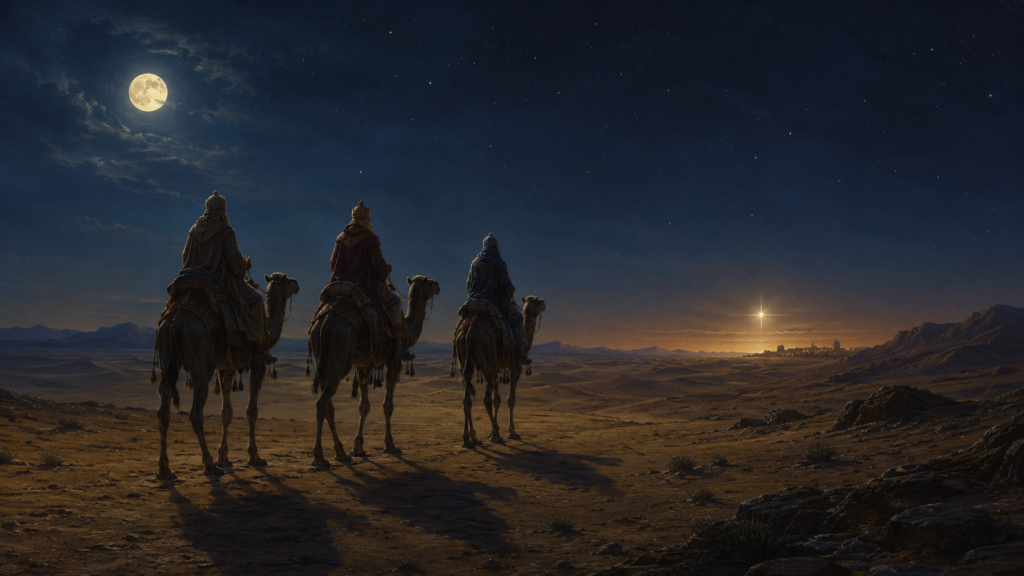
Matthew 2 is the gospel’s deliberate echo of the exodus. The chapter opens with magi from the east following a star to a Jewish king the Jewish religious authorities have not yet noticed. It closes with the holy family settling in a Galilean village so obscure the chapter has to invent a fulfillment citation to cover it. Between those two scenes, Matthew stages the gospel’s first political confrontation: Herod the Great, threatened by news of a rival king, orders the systematic murder of the male children of Bethlehem. The holy family escapes to Egypt by dream. They return only after Herod’s death, and even then Joseph diverts north to Galilee rather than back to Judea. The chapter is dense with Hebrew Bible echoes, fulfillment citations, and political theology, all in twenty-three verses.
The structuring move is the Mosaic typology. Pharaoh threatened the male children of the Hebrews; Herod threatens the male children of Bethlehem. Pharaoh’s daughter rescued one child by water; Joseph rescues one child by night-flight to Egypt. Moses fled Egypt to escape a king who wanted him dead and returned only when those who sought your life are dead (Exodus 4:19); Joseph returns to Israel only when those who sought the child’s life are dead (Matthew 2:20, the verbal parallel is exact). Matthew is teaching, by deliberate Hebrew Bible echo, that the figure being introduced is not just a Davidic Messiah; he is the new Moses, recapitulating the deliverer’s life pattern from the very beginning.
Beneath that is a second theological move that will run through the gospel from this point on. The first people to recognize the Messiah are not the religious insiders of Jerusalem; they are foreign astrologers from the east. The first people to threaten the Messiah are not the Roman occupiers; they are the Jewish king and his religious advisors. The chapter is sounding the gospel’s mumzer note again: the people who are supposed to be in are missing it; the people who are supposed to be out are finding it.
A · Matthew 2:1–12 · The magi from the east
¹ Now when Jesus was born in Bethlehem of Judea in the days of King Herod, behold, wise men from the east came to Jerusalem, saying, ² “Where is he who is born King of the Jews? For we saw his star in the east, and have come to worship him.” ³ When King Herod heard it, he was troubled, and all Jerusalem with him. ⁴ Gathering together all the chief priests and scribes of the people, he asked them where the Christ would be born. ⁵ They said to him, “In Bethlehem of Judea, for this is written through the prophet, ⁶ ‘You Bethlehem, land of Judah, are in no way least among the princes of Judah; for out of you shall come a governor who shall shepherd my people, Israel.’” ⁷ Then Herod secretly called the wise men, and learned from them exactly what time the star appeared. ⁸ He sent them to Bethlehem, and said, “Go and search diligently for the young child. When you have found him, bring me word, so that I also may come and worship him.” ⁹ They, having heard the king, went their way; and behold, the star, which they saw in the east, went before them until it came and stood over where the young child was. ¹⁰ When they saw the star, they rejoiced with exceedingly great joy. ¹¹ They came into the house and saw the young child with Mary, his mother, and they fell down and worshiped him. Opening their treasures, they offered to him gifts: gold, frankincense, and myrrh. ¹² Being warned in a dream that they shouldn’t return to Herod, they went back to their own country another way. (Matthew 2:1–12, World English Bible)

- Now when Jesus was born in Bethlehem of Judea in the days of King Herod. The Greek en hemerais Herodou tou basileos, “in the days of Herod the king,” sets the chapter’s political backdrop. Herod the Great ruled Judea as a Roman client-king from 37 to 4 BCE. Matthew is locating the birth in real political time. The opening clause is also doing theological work: Jesus is born under a king who calls himself King of the Jews (the title Herod claimed). The new king is born under the false king.
- Wise men from the east came to Jerusalem. The Greek magoi apo anatolon, “magi from the east,” names a class of Persian/Babylonian/Arabian astrologer-priests. The Septuagint uses magos for the Babylonian wise men in Daniel (Daniel 2:2, 2:10). The chapter is recording, with characteristic narrative restraint, that the first humans to recognize the Messiah are foreign astrologers, men whose practice (astrology, dream interpretation, court advising) is Jewishly suspect. They are, by every Jewish religious-legal measure, outsiders. The chapter is staging a deliberate reversal: the religious insiders of Jerusalem know the prophecy and can quote it from memory but have never traveled the five miles from Jerusalem to Bethlehem to see if anything has happened; the pagan astrologers from the east have traveled hundreds of miles on a star and a hunch. Knowing the right text is not the same as recognizing the right person. The directional vocabulary is also doing Hebrew Bible work. The Hebrew Bible’s eastward movement is almost always a movement away from God’s presence: Adam and Eve are driven east of Eden (Genesis 3:24), Cain settles east of Eden in the land of Nod (4:16), the builders of Babel migrate eastward and find a plain in Shinar (11:2), and Babylon itself sits east of the promised land. Abraham’s call in Genesis 12 is the first reversal: God calls him out of Ur (Babylonian territory) westward to the land. The exile in 587 BCE re-runs the eastward pattern: the covenant people are dragged east to Babylon. In Matthew 2, the magoi apo anatolon (literally “magi from the rising-place”) arrive carrying gifts to a Jewish king. The east is coming back. The descendants of the Chaldean wise men whose city had once carried Israel into exile are now at the cradle of Israel’s deliverer. The Hebrew Bible’s long eastward-and-back pattern is, by the chapter’s second verse, finding its first hint of full reversal. The eastern seers also stand in a long Hebrew Bible lineage: Balaam, the non-Israelite seer hired by a Moabite king to curse Israel, refused and instead delivered the star shall come out of Jacob, and a scepter shall rise out of Israel prophecy (Numbers 24:17). The magi who follow a star west to find a scepter are, structurally, Balaam’s heirs.
Influence callout: Marty Solomon (the “written in the stars” reading)
Solomon’s reading of the magi names them in their actual cultural-historical context: Babylonian astrologer-priests, heirs to a sophisticated star-tracking tradition that had been observing the heavens for thousands of years. In 146 BCE the Greek astronomer Hipparchus, working in Alexandria with Babylonian and Egyptian records, identified what we now call the precession of the equinoxes: the slow wobble of Earth’s axis that causes the sun to rise in a new zodiacal house roughly every 2,160 years. According to ancient Babylonian and Egyptian records, the Age of Aries was ending and the Age of Pisces was beginning around 5 to 2 BCE, exactly the window in which Jesus was born. Solomon argues that Babylonian astrologers, watching their own records, would have known that a cosmic age-shift was happening and would have been looking for what (or who) had caused it. The reigning Greco-Roman religion of the moment, Mithraism (the fastest-growing religion in the early first-century empire, faster than Christianity at its launch), was already telling a story about a divine figure who had killed the bull (Taurus) and torn into the cosmic sea to alter the zodiac. The magi from Babylon, whose own ancient prophet Balaam had said a star shall come out of Jacob, and a scepter shall rise out of Israel (Numbers 24:17), would have had both the astronomy and the inherited prophecy. Solomon reads the chapter as recording what the magi did with the convergence: they followed the star when it rose (Matthew 2:2, the verb anatello echoing the Septuagint of Numbers 24:17 anatelei astron ek Iakob), they knew Balaam had announced this rising long before, and they came west to find what their stars and their text had jointly predicted. The reading does not flatten the supernatural; it locates the supernatural inside real Babylonian astrology and inherited Hebrew Bible prophecy. The cosmic age was shifting; the prophet from the east had said this would happen; the magi recognized the moment and traveled.
- Where is he who is born King of the Jews? For we saw his star in the east, and have come to worship him (verse 2). The Greek proskynesai auto, “to bow down to him,” is the worship-vocabulary the Septuagint uses for the worship of God. The chapter is recording, with characteristic narrative care, that the magi are not coming to honor a political ruler; they are coming to worship. The pagan astrologers will, by the chapter’s end, be the gospel’s first worshipers of the Messiah.
- When King Herod heard it, he was troubled, and all Jerusalem with him (verse 3). The Greek etarakhe, “was disturbed/agitated,” is the chapter’s first character note for Herod. Herod was historically known for his political paranoia: he murdered his wife Mariamne, three of his sons, and many of his political rivals during his reign. The chapter’s all Jerusalem with him (Greek kai pasa Hierosolyma met’ autou) signals that Herod’s anxiety has rippled out across the city. The political center is destabilized by the news.
Influence callout: Marty Solomon (the “two kingdoms” reading)
Solomon’s reading of Herod’s troubling names it as the chapter’s structural set-up for the gospel’s central political-theological argument. There are two kingdoms now in collision. Herod’s kingdom is the ordinary kingdom of the world: held by political maneuvering, defended by violence, threatened by the very rumor of a rival. The kingdom of heaven that the magi have come to worship is the gospel’s announcement: a kingdom that arrives in a vulnerable child, supported by foreign astrologers and sleeping shepherds, with no army. Solomon argues that the chapter is staging, in its political backdrop, the gospel’s organizing argument: every page from this point forward will be a contest between these two kinds of kingship. Herod’s anxiety in 2:3 prefigures Pilate’s anxiety in 27:11; the slaughter of the innocents prefigures the crucifixion; the magi’s worship prefigures the centurion’s confession. The two kingdoms have been named at the chapter’s opening; the rest of the gospel is going to keep showing what each kingdom looks like in action.
- Gathering together all the chief priests and scribes of the people, he asked them where the Christ would be born (verse 4). Herod consults the religious establishment. They produce the answer immediately, citing Micah 5:2 (verse 6). The chapter is recording, with characteristic narrative irony, that the religious leadership functions in this scene as Herod’s consulting service. They deliver a correct biblical answer to a violent king who will use that answer to plan a massacre. The text does not condemn them in the moment, but the narrative is honest: from verse 4 onward, the chief priests and scribes will keep showing up on the wrong side of the kingdom. The chapter is, in fact, staging three different responses to the news of the Messiah’s birth, and the gospel will keep returning to all three. The pagan astrologers travel hundreds of miles, follow the star, and worship. Herod hears the news, is troubled, and responds with violence. The chief priests and scribes know exactly where the Messiah will be born, can quote chapter and verse, and do not move. The three-character pattern (the worshipers who travel from far off, the violent insider who fights to keep his throne, the religious experts who know the text but cannot recognize the moment) will run through the rest of the gospel. By chapter 27, Pilate will be playing the troubled-king role, the chief priests will still be the ones quoting law to engineer death, and the worshiping outsider will be a Roman centurion at the cross.
- In Bethlehem of Judea, for this is written through the prophet (verse 5). The citation that follows blends Micah 5:2 (the Bethlehem prophecy) and 2 Samuel 5:2 (the shepherd my people Israel phrase, originally said of David). Matthew, like other first-century Jewish interpreters, frequently combines two prophetic texts when their themes converge. The chapter is doing typical first-century Jewish midrashic reading: stitching texts together to bring out a layered meaning.
- Behold, the star, which they saw in the east, went before them until it came and stood over where the young child was (verse 9). The Greek proagei autous heos elthon estathe, “went before them until coming it stood,” is unusual astronomical language. The star is described as moving and stopping. Various proposals have been offered for what astronomical event Matthew may have in mind: a comet, a supernova, the triple conjunction of Jupiter and Saturn in Pisces in 7 BCE, the conjunctions of Jupiter and Venus in 3 to 2 BCE. The text itself is not interested in resolving these. The chapter treats the star as a guide, like the cloud and pillar that led Israel through the wilderness. The vocabulary is theological, but it is also historically textured: real first-century Babylonian astrologers were tracking real celestial events, and the gospel is not embarrassed to record that.
- They came into the house and saw the young child with Mary, his mother, and they fell down and worshiped him. Opening their treasures, they offered to him gifts: gold, frankincense, and myrrh (verse 11). The Greek eis ten oikian, “into the house,” signals that the magi arrive after the holy family has moved out of the stable into a residence (likely some weeks or months later). The number of magi is not stated; later Christian tradition fixed it at three because of the three gifts. The text gives no number.
- The three gifts (gold, frankincense, myrrh) have been read symbolically since the early church: gold for a king, frankincense for a priest (Exodus 30:34), myrrh for the burial (John 19:39). The chapter does not explicitly assign these meanings; the symbolic readings are the result of centuries of patristic and medieval interpretation. What the text does say is that these are treasures, the kind of luxury commodities that traveled the great east-west trade routes. The gifts likely funded the holy family’s escape to Egypt in the next scene. The chapter may be quietly noting that God has provided practically as well as theologically.
- Being warned in a dream that they shouldn’t return to Herod, they went back to their own country another way (verse 12). The chapter’s first dream-warning falls to the magi. The pagan astrologers are themselves dream-receivers. The chapter is recording, with characteristic narrative care, that the dream-revelation pattern that began with Joseph in chapter 1 now extends to the foreign visitors. God speaks to outsiders too.
B · Matthew 2:13–18 · The flight to Egypt and the slaughter of the innocents
¹³ Now when they had departed, behold, an angel of the Lord appeared to Joseph in a dream, saying, “Arise and take the young child and his mother, and flee into Egypt, and stay there until I tell you, for Herod will seek the young child to destroy him.” ¹⁴ He arose and took the young child and his mother by night, and departed into Egypt, ¹⁵ and was there until the death of Herod; that it might be fulfilled which was spoken by the Lord through the prophet, saying, “Out of Egypt I called my son.” ¹⁶ Then Herod, when he saw that he was mocked by the wise men, was exceedingly angry, and sent out and killed all the male children who were in Bethlehem and in all the surrounding countryside, from two years old and under, according to the exact time which he had learned from the wise men. ¹⁷ Then that which was spoken by Jeremiah the prophet was fulfilled, saying, ¹⁸ “A voice was heard in Ramah, lamentation, weeping and great mourning, Rachel weeping for her children; and she would not be comforted, because they are no more.” (Matthew 2:13–18, World English Bible)
- An angel of the Lord appeared to Joseph in a dream (verse 13). The chapter resumes the dream-revelation pattern from chapter 1. Joseph is, by this point, the gospel’s clear pattern-bearer: he hears in a dream, he wakes, he obeys. The chapter is recording, with characteristic narrative restraint, that the dream-vocabulary is becoming structural. The opening narrative is held together by Joseph’s nighttime dreams and immediate obedience.
- Arise and take the young child and his mother, and flee into Egypt (verse 13b). The Greek anastas paralabe to paidion kai ten metera autou kai pheuge eis Aigypton, “arising, take the child and his mother and flee to Egypt,” uses three urgent imperatives in succession. The chapter is recording the night’s emergency. There is no time for deliberation.
- That it might be fulfilled which was spoken by the Lord through the prophet, saying, “Out of Egypt I called my son” (verse 15). The citation is Hosea 11:1. In the original Hosea passage, the son is corporate Israel: when Israel was a child, I loved him, and out of Egypt I called my son. The original verse is not a prediction of a coming Messiah; it is a backward-looking statement about the exodus. Matthew is not misreading the prophet. He is doing typological reading: Israel as a corporate son was called out of Egypt; Jesus as the individual son is called out of Egypt. The pattern recurs because, on Matthew’s reading, Jesus is Israel-in-one-person, recapitulating Israel’s whole story without repeating its failures. The descent into Egypt that became bondage in Genesis-Exodus becomes refuge here; the return becomes new exodus. The Greek huios mou (“my son”) that Hosea applied to Israel and Matthew now applies to Jesus will become structurally central in the gospel: at the baptism, the heavenly voice will say this is my beloved son (3:17); at the transfiguration, this is my beloved son; listen to him (17:5); at the cross, the centurion will say truly this was the son of God (27:54).
- Then Herod, when he saw that he was mocked by the wise men, was exceedingly angry, and sent out and killed all the male children who were in Bethlehem and in all the surrounding countryside, from two years old and under (verse 16). The Greek thymothe lian, “raged exceedingly,” names Herod’s response. The chapter records the slaughter of the innocents with characteristic narrative restraint and no editorial comment. The verbs are direct: he was angry; he sent out; he killed. The story rhymes exactly with Pharaoh’s slaughter in Exodus 1, and that is the chapter’s point: the new Pharaoh has come; the new exodus is being staged. Bethlehem was a small village (first-century population estimated under a thousand), so the number of male children under two would have been small, perhaps fewer than twenty. The absence of the event from non-biblical sources is not surprising. For a king who had murdered his own wife and three of his sons, the killing of a handful of village children would not have made the historical record.
- Then that which was spoken by Jeremiah the prophet was fulfilled, saying, “A voice was heard in Ramah, lamentation, weeping and great mourning, Rachel weeping for her children; and she would not be comforted, because they are no more” (verses 17 to 18). The citation is Jeremiah 31:15. In Jeremiah, the verse refers to the matriarch Rachel weeping over the exile of her descendants (the northern kingdom carried into Assyrian captivity) at Ramah, the staging point. Matthew applies the verse to the mothers of Bethlehem weeping over the children Herod has killed. The fulfillment is typological: the Hebrew Bible’s deepest pattern of mothers grieving murdered or exiled children is happening again at the entry to the gospel. Matthew does not gloss the slaughter; he gives it a Hebrew Bible voice. The lament tradition is being honored here. It is also worth reading Jeremiah 31 in its full context, because the verse Matthew quotes is the lowest point in a chapter that immediately turns toward hope. Jeremiah 31:16-17, the very next two verses, answer Rachel’s lament: Restrain your voice from weeping, and your eyes from tears, for there is a reward for your work, declares the LORD, and they shall come back from the land of the enemy. There is hope for your future, declares the LORD, and your children shall come back to their own country. The chapter Jeremiah 31 then becomes the new-covenant chapter (I will put my law within them, and I will write it on their hearts, 31:33). Matthew is quoting only the lament, but his readers, who would have known Jeremiah 31 as a whole, would hear the fuller arc: tears that the Lord himself will end, exiled children who will come home, a new covenant that will be written on the heart. The kingdom of heaven arrives in a world where mothers weep, and the gospel does not pretend otherwise; but the prophetic citation also signals that the same God who allows the lament also writes the answer on the next page.
C · Matthew 2:19–23 · The return and the settling in Nazareth
¹⁹ But when Herod was dead, behold, an angel of the Lord appeared in a dream to Joseph in Egypt, saying, ²⁰ “Arise and take the young child and his mother, and go into the land of Israel, for those who sought the young child’s life are dead.” ²¹ He arose and took the young child and his mother, and came into the land of Israel. ²² But when he heard that Archelaus was reigning over Judea in the place of his father, Herod, he was afraid to go there. Being warned in a dream, he withdrew into the region of Galilee, ²³ and came and lived in a city called Nazareth; that it might be fulfilled which was spoken through the prophets that he will be called a Nazarene. (Matthew 2:19–23, World English Bible)
- When Herod was dead. Herod the Great died in 4 BCE (most modern scholars date Jesus’s birth to roughly 6-4 BCE for this reason). The chapter is recording, with characteristic narrative economy, the political condition that ends the Egyptian exile.
- Those who sought the young child’s life are dead (verse 20). The Greek tethnekasin gar hoi zetountes ten psychen tou paidiou, “those seeking the life of the child have died,” is a deliberate verbal echo of Exodus 4:19, where God tells Moses all the men who sought your life are dead. The Septuagint of Exodus 4:19 reads tethnekasi gar pantes hoi zetountes sou ten psychen. Matthew is, in the closing words of the verse, signing the Mosaic typology in the most explicit possible way. He is writing for a readership that knows the Septuagint and can hear the echo immediately. The new Moses returns when those seeking his life are dead, exactly as the old Moses did. From this point forward in the gospel, every Moses-shaped detail (the wilderness, the mountain, the Torah, the bread) will be reading itself against this opening claim.
- But when he heard that Archelaus was reigning over Judea in the place of his father, Herod, he was afraid to go there (verse 22). Archelaus, Herod the Great’s son, ruled Judea, Samaria, and Idumea from 4 BCE to 6 CE. The historian Josephus records that he inherited his father’s brutality and was eventually deposed by Rome for misrule. Joseph’s fear is politically reasonable. The chapter is recording, with characteristic cultural specificity, that the holy family is making practical decisions inside the real political conditions of the early Herodian dynasty.
- Being warned in a dream, he withdrew into the region of Galilee, and came and lived in a city called Nazareth (verses 22b to 23a). The chapter’s third dream-warning to Joseph diverts the family north to Galilee. Galilee was, in Pharisaic Jerusalem-centered religious imagination, a marginal region: agriculturally productive but theologically suspect. Nazareth itself was a small village (probably fewer than 500 residents in the first century), so obscure that no Hebrew Bible passage names it. A young man growing up in Nazareth would have learned Torah from the village synagogue’s teacher rather than from a famous rabbi in Jerusalem. By the cultural standards of first-century Jewish religious prestige, growing up in Nazareth would have ranked Jesus far below the Jerusalem-Pharisee circles he would later confront.
Influence callout: Marty Solomon (the mumzer reading continues)
Solomon’s reading of the settlement in Nazareth names it as the gospel’s continuing announcement that the kingdom will be located on the cultural margin. Galilee was the Pharisaic religious establishment’s least-favored region (can anything good come out of Nazareth?, John 1:46, will record the cultural attitude). Settling in Nazareth places the holy family permanently among the people the religious center has written off. The Messiah will grow up among the Galileans, will gather his disciples from among the Galilean fishermen, and will deliver his ministry primarily in the towns of the lake. Solomon argues that the chapter is teaching, by geography, that the kingdom of God runs through the marginal places. The pattern that began with the four women in the genealogy is now becoming geographic.
- That it might be fulfilled which was spoken through the prophets that he will be called a Nazarene (verse 23b). The citation is unusual. No specific Old Testament passage says he will be called a Nazarene. Matthew uses the plural the prophets (rather than naming a single prophet) and gives a paraphrastic citation. The most likely sources are wordplay on Isaiah 11:1 (*a branch [Hebrew netzer] from the root of Jesse will bear fruit*) and possibly the Nazirite theme in the Hebrew Bible (Numbers 6, Judges 13: Samson, the Nazirite). The Hebrew netzer is worth a closer look: it is the word for a fresh shoot or sprout that springs from a stump, the kind of small green stick that pushes up out of dead-looking wood. Isaiah 11 builds the messianic image directly on it: the Davidic dynasty has been cut down to a stump, and out of that stump a netzer grows. The town’s name itself, Natzeret, may share the root. Matthew is, on this reading, doing a deliberate place-name pun: the messianic netzer (shoot) grows up in Netzer-town (the village whose name evokes the same Hebrew root). The Hebrew Bible has a long pattern of small overlooked things being where God grows the future: David from Bethlehem, the netzer from the stump of Jesse, the Nazarene from a village no Hebrew Bible passage names. Some early readers also heard a connection between Nazareth and the suffering servant of Isaiah 53, whose visual description (he had no form or majesty that we should look at him, 53:2) opens with the same kind of agricultural image (he grew up before him like a young plant, and like a root out of dry ground). The chapter may be doing what later Jewish midrash often did: gathering the spirit of multiple prophetic passages, none of which says exactly he will be called a Nazarene, into a one-line summary citation that signals their shared agricultural-and-marginal pattern.
Word study: Nazoraios (Ναζωραῖος), “Nazarene”
The Greek term Matthew uses in 2:23 is Nazoraios, which has a double valence. It is the gentilic for someone from Nazareth (a Nazarene). It also resonates with the Hebrew netzer (branch, the messianic-branch image of Isaiah 11:1) and with nazir (the Nazirite, the consecrated person of Numbers 6). Matthew may be deliberately invoking all three resonances at once: Jesus is from Nazareth; Jesus is the messianic branch from Jesse’s stump; Jesus is the consecrated one. The chapter is doing what the Hebrew Bible has done throughout: making a place name carry theological weight.
- The chapter as a whole is the gospel’s most dense compression of the exodus pattern. Pharaoh (Herod), the murder of the children, the flight to Egypt, the death of the king, the call out of Egypt, the return to the land. Five major movements of the exodus story are folded into one short chapter. The figure being introduced is the long-promised new exodus made flesh.
Reflection prompts
- The first humans to recognize the Messiah are foreign astrologers from the east. The first humans to threaten the Messiah are the Jewish king and his religious advisors. Where in your life are you currently expecting the wrong people to recognize what God is doing, and what does it mean to consider that God may be working through the people you would not have predicted?
- Joseph hears the angelic instruction in a dream three times in this chapter (verses 13, 19, 22), and three times he gets up and obeys without recorded speech. Where in your life are you currently being asked to take a small obedient action without needing to understand the whole plan, and what does it mean to consider that the gospel begins with a man who hears in dreams and acts before sunrise?
- The chapter ends with the holy family settling in Nazareth, a small village so obscure that no Hebrew Bible passage names it. The Messiah grows up on the cultural margin. Where in your life is your formation currently happening in a place that feels obscure or second-rate, and what does it mean to consider that this is exactly the kind of geography the kingdom has always preferred?